General Adaptation Syndrome (GAS) Selye’s model to explain the short term effects of exposure to stressors.  Also accounts for the long term implications of prolonged exposure to stress.
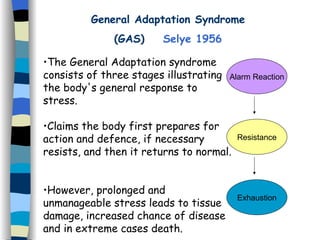
The General Adaptation syndrome consists of three stages illustrating the body's general response to stress. Claims the body first prepares for action and defence, if necessary resists, and then it returns to normal.  However, prolonged and unmanageable stress leads to tissue damage, increased chance of disease and in extreme cases death. General Adaptation Syndrome (GAS)  Selye 1956 Alarm Reaction Exhaustion Resistance
Activity: Split into groups of four or five Each person in the group has a card with a  different area of the GAS to research and make  notes on. Everyone  with the same task must group  together,  discuss it and make detailed  notes, before returning to their original group. It is your job to make sure everyone in the group  has detailed notes on your stage.
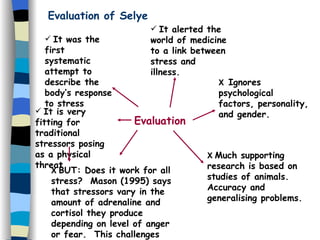
It was the first systematic attempt to describe the body’s response to stress It alerted the world of medicine to a link between stress and illness. It is very fitting for traditional stressors posing as a physical threat  X  BUT: Does it work for all stress?  Mason (1995) says that stressors vary in the amount of adrenaline and cortisol they produce depending on level of anger or fear.  This challenges Selye. X  Ignores psychological factors, personality, and gender. X  Much supporting research is based on studies of animals.  Accuracy and generalising problems. Evaluation of Selye Evaluation
Recap Activity: To practice exam style questions… Put all your notes away and answer the following question: Outline Selye’s General Adaptation Syndrome and give two criticisms of this explanation. (6 marks + 2 marks + 2 marks)
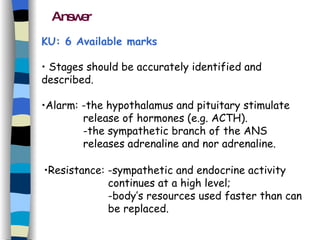
Answer Stages should be accurately identified and described. Alarm: -the hypothalamus and pituitary stimulate      release of hormones (e.g. ACTH). -the sympathetic branch of the ANS  releases adrenaline and nor adrenaline. Resistance: -sympathetic and endocrine activity  continues at a high level;  -body’s resources used faster than can be replaced. KU: 6 Available marks
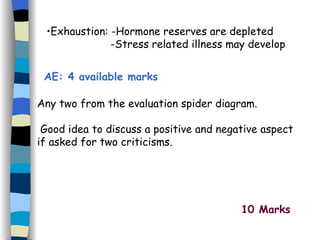
Exhaustion: -Hormone reserves are depleted -Stress related illness may develop AE: 4 available marks  Any two from the evaluation spider diagram. Good idea to discuss a positive and negative aspect if asked for two criticisms. 10 Marks

3. General Adaptation Syndrome

  • 1.
    General Adaptation Syndrome(GAS) Selye’s model to explain the short term effects of exposure to stressors. Also accounts for the long term implications of prolonged exposure to stress.
  • 2.
    The General Adaptationsyndrome consists of three stages illustrating the body's general response to stress. Claims the body first prepares for action and defence, if necessary resists, and then it returns to normal. However, prolonged and unmanageable stress leads to tissue damage, increased chance of disease and in extreme cases death. General Adaptation Syndrome (GAS) Selye 1956 Alarm Reaction Exhaustion Resistance
  • 3.
    Activity: Split intogroups of four or five Each person in the group has a card with a different area of the GAS to research and make notes on. Everyone with the same task must group together, discuss it and make detailed notes, before returning to their original group. It is your job to make sure everyone in the group has detailed notes on your stage.
  • 4.
    It was thefirst systematic attempt to describe the body’s response to stress It alerted the world of medicine to a link between stress and illness. It is very fitting for traditional stressors posing as a physical threat X BUT: Does it work for all stress? Mason (1995) says that stressors vary in the amount of adrenaline and cortisol they produce depending on level of anger or fear. This challenges Selye. X Ignores psychological factors, personality, and gender. X Much supporting research is based on studies of animals. Accuracy and generalising problems. Evaluation of Selye Evaluation
  • 5.
    Recap Activity: Topractice exam style questions… Put all your notes away and answer the following question: Outline Selye’s General Adaptation Syndrome and give two criticisms of this explanation. (6 marks + 2 marks + 2 marks)
  • 6.
    Answer Stages shouldbe accurately identified and described. Alarm: -the hypothalamus and pituitary stimulate release of hormones (e.g. ACTH). -the sympathetic branch of the ANS releases adrenaline and nor adrenaline. Resistance: -sympathetic and endocrine activity continues at a high level; -body’s resources used faster than can be replaced. KU: 6 Available marks
  • 7.
    Exhaustion: -Hormone reservesare depleted -Stress related illness may develop AE: 4 available marks Any two from the evaluation spider diagram. Good idea to discuss a positive and negative aspect if asked for two criticisms. 10 Marks