
Concept of Stress
• Stress results from a change in the environment that is
perceived as a challenge, a threat, or a danger and can
have both positive and negative effects.
•Stress is the body’s physiological reaction to any
stimulus that evokes a change.
• Any situation, event, or agent that threatens a
person’s security is a stressor.
• A stressor is a stimulus that evokes the need to adapt
and can be internal or external. For example, a
headache is an internal stressor, whereas a difficult
assignment is an external stressor.
• A stressor can be physical (such as a laceration),
physiological (e.g., hypertension), or psychosocial
(e.g., graduation from school).
•Adaptation
• is an ongoing process by which individuals adjust to
stressors in order to achieve homeostasis (equilibrium
between physiological, psychological, socio-cultural,
intellectual, and spiritual needs).
• Adaptation is a holistic response that involves all
dimensions of an individual.
Definition
• According to hans selye, stress is non-specific response of the
body to any demand made upon it, whether is caused by the
results of pleasant and unpleasant situation.
• Stress is any physiological and psychological tension that
threatens a person’s total equilibrium. In medical terms, stress
is the disruption of homeostasis through physical or
psychological stimuli.
Classification of Stress
1. Eustress:
• The prefix derives from the Greek ‘eu’ meaning
either “well” or “good”. When attached to the word
“stress”, it literally means “good stress”.
• A positive force that adds excitement and challenges
to life and provides a sense of wellbeing, certain
amount of stress to the person in is beneficial to do
more and better work.
• Examples:
- Meeting a challenge
- Coming in first or winning
- Getting a promotion
- Marriage
- The holidays
- Buying a new home
- Receiving a promotion or raise at work
- Starting a new job
2. Distress:
A negative force caused by unresolved
threatens.
Distress is a kind of suffering.
In medicine, distress is stress caused by
adverse events.
Sources of stress
Dr. Hans Selye defines stressor as: “that which produces
stress.”
There are many sources of stress. They a boardly classified
as internal or external stressors, or developmental or
situational stressors.
1. Internal stressors
2. External stressors
3. Developmental stressors
4. Situational stressors
Other stressors: spiritual stressor, financial stressor, social
stressors, physical stressors
Contd….
1. Internal stressors: originates within a person. For
e.g. infection, feeling of depression, pregnancy,
menopause, etc.
2. External stressors: originates outside the individual,
for e.g. a move to another city, a death in the family,
or pressure from peers, etc.
3. Developmental stressors: occur at predictable
times throughout an individual’s life. Within each
stage, certain tasks must be achieved to resolve the
crisis and reduce the stress. E.g.
Contd….
• Child stage- beginning school, establishing peer
relationships, peer competition
• Adolescent- changing physique, relationships,
exploring independence, choosing career
• Young adult- marriage, leaving home, managing
home, occupation, education, children
• Middle adult- physical changes of aging, maintaining
social status, standard of living
• Older adult- decreasing physical abilities and health,
changes in residence, retirement and reduced
income, death of spouse and friends, etc.
Contd….
4. Situational stressors: unpredictable and may occur
at any time during life. It may be either positive or
negative; includes the following:
• Illness or accident
• Marriage or divorce
• Loss (belongings, relationships, family members)
• New job
Response to stress
• Physiologic response to stress
• Behavioural (psychologic) response to the stress:
Physiologic response to stress
• It is a fight or flight response in which the body prepares itself for survival.
• Three major organs play a vital role to maintain homeostatic mechanisms:
medulla oblongata, reticular formation and pitutary gland.
• Medulla oblongata helps to control function of vital organs like heart rate,
blood pressure, respiration etc.
• Reticular formation helps in control of vital function as well as monitors the
physiological status of the body through connection with sensory and motor
factors.
• Pituitary gland influences the work of all glands. Some of the hormones it
releases will stimulate certain glands to produce more hormones and other
produce less hormones.
Behavioural (psychologic) response to the
stress
• A healthy individual develops psychological adaptive behaviour to
cope with sressors.
Task oriented behaviour
• Attack behaviours: an action taken to remove or overcome stresses or
to satisfy a need
• Withdrawl behaviour: removes himself or herself physically or
emotionally from the stressors
Response to Stress(level of
adaptation: physiologic,
psychologic)
Adaptation
• Adaptation is the evolutionary process whereby an organism becomes better able
to live in its habitat. Adaptation is the state of being adapted; the degree to which
an organism is able to live and reproduce in a given set of habitat. It can be related
to advice or mechanism that is changed so as to become suitable to a new or
special application or situation. Change in behavior of a person or group in
response to new or modified surroundings.
Types of adaptation to stress
• Local adaptation syndrome
• General adaptation syndrome
• Local adaptation syndrome (LAS)- localized response of the body tissue, an organ, or
part of the body to any kind of stressor or the stress of trauma, illness, or other
physiological change is known as local adaptation syndrome. It occurs as A reaction
to stress. For examples – reflex pain response: localized response of CNS to stimulus
of pain (remove hand from hot surface) – inflammatory response.
The main characteristics of this syndrome are:
• Localized in nature
• Adaptive response,
• Short term response and
• Restorative response-homeostasis
• If the Local Adaption Syndrome is failure, the body responds
through General Adaptation Syndrome to protect itself and
ensures survival in the best way.
General adaptation syndrome (GAS)
• Scientist Hans Selye (1907-1982) introduced the General Adaptation
Syndrome model in 1936 showing in three phases what the alleged
effects of stress has on the body
• The general body response augments bodily functions that protect
the organism from injury, psychological and physical harm and
suppress those functions nonessential to life is known as GAS.
• It is physiological response of the whole body to stress and involves several body
systems, primarily the autonomic nervous system and endocrine system.
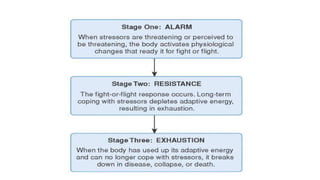
It has three stages:
• Alarm Reaction (AR)
• Resistance stage (RS)
• Exhaustion stage (ES)
1. Alarm reaction (1st stage):
• When the threat or stressor is identified or realized, the
body’s stress response is a state of alarm.
• Activation of the Hypothalamic Pituitary adrenal Axis (HPA),
the nervous system and the adrenal glands take place.
• During this phase the main stress hormones cortisol,
adrenaline, and noradrenaline, is released to provide instant
energy
• Prepare for fight or flight response
Contd….
• Adrenaline and noradrenaline are the hormones
which causes quicker heart rate, high BP, more
frequent breathing.
• Cortisol and cortisone suppress the immune system.
• Stimulation of sympathetic nervous system
• Once the cause of the stress is removed, the body will
go back to normal.
Contd….
2. Resistance or Adaptation (2nd stage):
• If cause for stress is not removed , GAS goes to
second stage.
• This is the body’s response to long term protection.
• Parasympathetic nervous system returns many
physiological functions to normal levels while body
focuses resources against the stressor
• It secrets the further hormones that increases
blood sugar levels to sustain energy and raise BP
Contd…..
3. Exhaustion (3rd stage):
• It occurs when the person is unable to continue to adapt to internal and external
environment demands.
• The initial autonomic nervous system symptoms may reappear (sweating, raised heart
rate etc.) And mental, physical and emotional resources suffer heavily.
• The body experiences "adrenal exhaustion". The blood sugar levels decrease as the
adrenals become depleted, leading to ulcers, depression, decreased stress tolerance,
progressive mental and physical exhaustion, illness and collapse.
• If stress continues, death may result.
Effects of stress on health
1. Physiological effects :
a. GI system:- stomachache, nausea, dry mouth, diarrhea, hungry, altered appetite.
Peristalsis of the intestines decreases, resulting in possible constipation and
flatus. Gastrointestinal disorders: colitis, chronic constipation, ulcers, gastritis
b. Cardio vascular/circulatory system:- palpitation, flushing, high pulses, high
BP, feeling cold, dizziness. Heart rate and cardiac output increase to transport
nutrients and by-products of metabolism more efficiently. Sodium and water
retention increase due to release of mineralocorticoids, which increases blood
volume. Cardiovascular disorders: hypertension, cardiac arrhythmias’ migraine
headaches
• Respiratory :- breathlessness, restlessness, holding breath. Rate and
depth of respirations increases because of dilation of the bronchioles
promoting hyperventilation.
Respiratory disorders: Emphysema, Chronic bronchitis, Asthma
• Reproductive:- decreased sexual drive.
• Sexual and reproductive disorder: Low libido, Impotence (erectile
dysfunction, or ED), menstrual irregularities
• Urinary:- frequency of micturation, Urinary output deceases.
Genitourinary disorders: Enuresis, Urinary frequency.
• Neurologic effect: Dizziness, Headaches and Pupils dilate to increase
visual perception when serious threats to the body arise. For serious
threats, mental alertness improves.
• Musculoskeletal effect: tension and twitching. Muscle tension
increases to prepare for rapid motor activity or defense.
Musculoskeletal disorders: Chronic back pain, Arthritis
• Integumentary: Sweat production (diaphoresis) increase to control
elevated body heat due to increased metabolism. Skin is pallid
because of constriction of peripheral blood vessels, an effect of
norepinephrine.
Integumentary disorders: Eczema, Psoriasis
• Endocrine effect: increased level of blood glucose and cortisol.
Blood sugar increases because of release of glucocorticoids and
gluconeogenesis.
Endocrine disorders: Thyroid problems, Amenorrhea, anovulation,
Diabetes, Excessive weight gain or weight loss
2. Effects on emotion:
• Anxiety, fear, depression, anger, crying, helplessness, upset,
frustrated, withdrawal, hopelessness, guilt, feeling rejected, etc.
3. . Effects on behavior:
Silent, outburst, nonverbal aggression, hyperactive,
insensitivity to others, slow reactions to others, loss of
interest in thinking, talk excessively, withdrawal, rejecting
people, smoking, alcohol or drug abuse, overeating, under
eating, insomnia, rapid speech.
4. Cognitive:
• impaired memory
• Confusion
• Impaired judgment
• Poor decision making
• Delayed response time
• Altered perceptions
• Inability to concentrate
5. SPIRITUAL
• ALIENATION (A WITHDRAWING OR
SEPARATION OF A PERSON OR A
PERSON'S AFFECTIONS FROM AN
OBJECT OR POSITION OF FORMER
ATTACHMENT)
• SOCIAL ISOLATION
• FEELING OF EMPTIES
Coping Strategies
(Defense Mechanism)
Coping strategies refer to the specific efforts, both
behavioral and psychological, that people employ to
master, tolerate, reduce, or minimize stressful events.
The effectiveness of the coping effort depends on the
type of stress, the individual, and the circumstances.
Coping responses are partly controlled
by personality (habitual traits), but also partly by
the social environment, particularly the nature of the
stressful environment
1. Compensation:
• The process of trying to overcome real or imagined
weakness, failure or deficiency in one area by
achieving recognition in another in order to maintain
self-esteem. The person overcomes an inability by
becoming proficient in another area. This may occur
at the conscious or unconscious level.
Contd…..
• Covering up weaknesses by emphasizing a more
desirable trait or by over achievement in a more
comfortable area.
• For example –A student who has difficulty with
academic may excel in sports.
• Purpose: Allows a person to overcome weakness and
achieve success.
2. Denial:
• An attempt to screen or ignore unacceptable
realities by refusing to acknowledge them.
• The client refuses to admit to anger, even though the
situation warrants it and the client’s voice indicates
anger.
Contd…..
• For example –
a. Despite finding a lump in her breast, a woman does
not seek medical treatment.
b. You are arrested for drunk driving several times but
don't believe you have a problem with alcohol.
• Purpose- Temporarily isolates a person from the full
impact of a traumatic situation.
3. Displacement:
• the transferring or discharging of emotional reactions
from one object or person to another object or
person.
• transfer of feelings or reactions evoked be one topic
or event to another that is less threatening.
Contd….
• For example –
a. A husband and wife are fighting, and the husband
becomes so angry he hits a door instead of his wife.
b. A client is angry at his physician. Does not express
it, but becomes verbally abusive with the nurse
• Purpose – allows for feeling to be expressed through
or to less dangerous objects or people.
4. Identification:
• An attempt to manage anxiety by imitating the
behavior of someone feared or respected.
• For example –
Contd….
A teenager who required lengthy rehab after an
accident decides to become a physical therapist as a
result of his experiences.
• Purpose – helps a person avoid self-devaluation.
5. Intellectualization:
• A mechanism by which an emotional response that
normally would accompany an uncomfortable or
painful incident is evaded by the use of rational
explanations that remove from the incident any
personal significance and feelings.
Contd….
• For example – the pain over a parent’s sudden death
is reduced by saying, “he wouldn’t have wanted to
live with a disability.”
• Purpose – protects a person from pain and traumatic
events.
6. Introjections:
• A form of identification that allows for the
acceptance of others’ norms and values into
oneself, even when contrary to one’s previous
assumptions.
Contd….
• For example:
a. The adolescent who takes on all the values and
styles of an admired teacher.
• Purpose – helps a person avoid social retaliation and
punishment; particularly important for the child’s
development of superego.
7. Minimization:
• Not acknowledging the significance of one’s behavior.
• This allows you to decrease the intensity of a
situation.
Contd….
• For example –
a. A person says, “Don’t believe everything my wife
tells you. I wasn’t so drunk I couldn’t drive.”
b. If parent divorce, most children feel responsible for
their parents’ breakup, so they may minimize it by
saying, “My parents don’t fight, they just argue a
lot.”
• Purpose – Allows a person to decrease responsibility
for own behavior.
8. Projection:
• A process in which blame is attached to others or the
environment for unacceptable desires, thoughts,
shortcomings, and mistakes.
Contd….
• for example –
a. a mother is told her child must repeat a grade in
school, and she blames this on the teacher’s poor
instruction.
b. a husband forgets to pay a bill and blames his wife
for not giving it to him earlier.
• purpose – allows a person to deny the existence of
shortcomings and mistakes; protects self-image.
9. Rationalization:
• Justification of certain behaviors by faulty logic and
ascribing motives that are socially acceptable but did
not in fact inspire the behavior.
• “The test had too many trick questions; i really know
all the material; our instructor was out to get me.”
• -
Contd….
• For example-
a. I always study hard for tests and I know a lot of
people who cheat so it's not a big deal I cheated
this time.
• Purpose- helps a person cope with inability to meet
goals or certain standards.
10. Repression:
• A person voluntarily excludes an anxiety- producing
event from conscious awareness.
• Unconscious blocking from awareness material that is
threatening and painful.
• For e.G.: A teenager, seeing his best friend killed in a
car accident, becomes amnesic about the
circumstances surrounding the accident.
• Purpose- protects a person from a traumatic
experience until he or she has the resources to cope.
Measures to reduce stress
General guidelines for helping the clients who are
stressed and feeling anxious are as below
1. Listen attentively; try to understand the client’s
perspective on the situation.
2. Provide an atmosphere of warmth and trust; convey
a sense of caring and empathy.
Contd….
3. Determine if it is appropriate to encourage clients’
participation in the plan of care; give them choices
about some aspects of care but do not overwhelm
them with choices.
4. Stay with clients as needed to promote safety and
feelings of security and to reduce fear.
Contd….
5. Control the environment to minimize additional
stressors such as reducing noise, limiting the
number of persons in the room, and providing care
by the same nurse as much as possible.
6. Implement suicide precautions if indicated.
7. Communicate in short, clear sentence.
Contd……
8. Help clients to:
• Determine situations that precipitate anxiety and
identify signs of anxiety.
• Verbalize feelings, perceptions, and fears as
appropriate. Some cultures discourage the expression
of feelings.
• Identify personal strengths.
Contd……
• Recognize usual coping patterns and differentiate
positive from negative coping mechanisms.
• Identify new strategies for managing stress (e.G.
Exercise, massage, progressive relaxation).
• Identify available support systems
Contd…..
9. Teach clients about:
• The importance of adequate exercise, a balanced diet,
and rest and sleep to energize the body and enhance
coping abilities.
• Educational programs available such as time
management, assertiveness training, and meditation
groups.
Thank You

Stress

  • 2.
    Concept of Stress •Stress results from a change in the environment that is perceived as a challenge, a threat, or a danger and can have both positive and negative effects.
  • 3.
    •Stress is thebody’s physiological reaction to any stimulus that evokes a change. • Any situation, event, or agent that threatens a person’s security is a stressor. • A stressor is a stimulus that evokes the need to adapt and can be internal or external. For example, a headache is an internal stressor, whereas a difficult assignment is an external stressor. • A stressor can be physical (such as a laceration), physiological (e.g., hypertension), or psychosocial (e.g., graduation from school).
  • 4.
    •Adaptation • is anongoing process by which individuals adjust to stressors in order to achieve homeostasis (equilibrium between physiological, psychological, socio-cultural, intellectual, and spiritual needs). • Adaptation is a holistic response that involves all dimensions of an individual.
  • 5.
    Definition • According tohans selye, stress is non-specific response of the body to any demand made upon it, whether is caused by the results of pleasant and unpleasant situation. • Stress is any physiological and psychological tension that threatens a person’s total equilibrium. In medical terms, stress is the disruption of homeostasis through physical or psychological stimuli.
  • 6.
    Classification of Stress 1.Eustress: • The prefix derives from the Greek ‘eu’ meaning either “well” or “good”. When attached to the word “stress”, it literally means “good stress”. • A positive force that adds excitement and challenges to life and provides a sense of wellbeing, certain amount of stress to the person in is beneficial to do more and better work.
  • 7.
    • Examples: - Meetinga challenge - Coming in first or winning - Getting a promotion - Marriage - The holidays - Buying a new home - Receiving a promotion or raise at work - Starting a new job
  • 8.
    2. Distress: A negativeforce caused by unresolved threatens. Distress is a kind of suffering. In medicine, distress is stress caused by adverse events.
  • 9.
    Sources of stress Dr.Hans Selye defines stressor as: “that which produces stress.” There are many sources of stress. They a boardly classified as internal or external stressors, or developmental or situational stressors. 1. Internal stressors 2. External stressors 3. Developmental stressors 4. Situational stressors Other stressors: spiritual stressor, financial stressor, social stressors, physical stressors
  • 10.
    Contd…. 1. Internal stressors:originates within a person. For e.g. infection, feeling of depression, pregnancy, menopause, etc. 2. External stressors: originates outside the individual, for e.g. a move to another city, a death in the family, or pressure from peers, etc. 3. Developmental stressors: occur at predictable times throughout an individual’s life. Within each stage, certain tasks must be achieved to resolve the crisis and reduce the stress. E.g.
  • 11.
    Contd…. • Child stage-beginning school, establishing peer relationships, peer competition • Adolescent- changing physique, relationships, exploring independence, choosing career • Young adult- marriage, leaving home, managing home, occupation, education, children • Middle adult- physical changes of aging, maintaining social status, standard of living • Older adult- decreasing physical abilities and health, changes in residence, retirement and reduced income, death of spouse and friends, etc.
  • 12.
    Contd…. 4. Situational stressors:unpredictable and may occur at any time during life. It may be either positive or negative; includes the following: • Illness or accident • Marriage or divorce • Loss (belongings, relationships, family members) • New job
  • 13.
    Response to stress •Physiologic response to stress • Behavioural (psychologic) response to the stress:
  • 14.
    Physiologic response tostress • It is a fight or flight response in which the body prepares itself for survival. • Three major organs play a vital role to maintain homeostatic mechanisms: medulla oblongata, reticular formation and pitutary gland. • Medulla oblongata helps to control function of vital organs like heart rate, blood pressure, respiration etc. • Reticular formation helps in control of vital function as well as monitors the physiological status of the body through connection with sensory and motor factors. • Pituitary gland influences the work of all glands. Some of the hormones it releases will stimulate certain glands to produce more hormones and other produce less hormones.
  • 15.
    Behavioural (psychologic) responseto the stress • A healthy individual develops psychological adaptive behaviour to cope with sressors. Task oriented behaviour • Attack behaviours: an action taken to remove or overcome stresses or to satisfy a need • Withdrawl behaviour: removes himself or herself physically or emotionally from the stressors
  • 16.
    Response to Stress(levelof adaptation: physiologic, psychologic)
  • 17.
    Adaptation • Adaptation isthe evolutionary process whereby an organism becomes better able to live in its habitat. Adaptation is the state of being adapted; the degree to which an organism is able to live and reproduce in a given set of habitat. It can be related to advice or mechanism that is changed so as to become suitable to a new or special application or situation. Change in behavior of a person or group in response to new or modified surroundings.
  • 18.
    Types of adaptationto stress • Local adaptation syndrome • General adaptation syndrome
  • 19.
    • Local adaptationsyndrome (LAS)- localized response of the body tissue, an organ, or part of the body to any kind of stressor or the stress of trauma, illness, or other physiological change is known as local adaptation syndrome. It occurs as A reaction to stress. For examples – reflex pain response: localized response of CNS to stimulus of pain (remove hand from hot surface) – inflammatory response. The main characteristics of this syndrome are: • Localized in nature • Adaptive response, • Short term response and • Restorative response-homeostasis
  • 20.
    • If theLocal Adaption Syndrome is failure, the body responds through General Adaptation Syndrome to protect itself and ensures survival in the best way.
  • 21.
    General adaptation syndrome(GAS) • Scientist Hans Selye (1907-1982) introduced the General Adaptation Syndrome model in 1936 showing in three phases what the alleged effects of stress has on the body • The general body response augments bodily functions that protect the organism from injury, psychological and physical harm and suppress those functions nonessential to life is known as GAS.
  • 22.
    • It isphysiological response of the whole body to stress and involves several body systems, primarily the autonomic nervous system and endocrine system. It has three stages: • Alarm Reaction (AR) • Resistance stage (RS) • Exhaustion stage (ES)
  • 24.
    1. Alarm reaction(1st stage): • When the threat or stressor is identified or realized, the body’s stress response is a state of alarm. • Activation of the Hypothalamic Pituitary adrenal Axis (HPA), the nervous system and the adrenal glands take place. • During this phase the main stress hormones cortisol, adrenaline, and noradrenaline, is released to provide instant energy • Prepare for fight or flight response
  • 25.
    Contd…. • Adrenaline andnoradrenaline are the hormones which causes quicker heart rate, high BP, more frequent breathing. • Cortisol and cortisone suppress the immune system. • Stimulation of sympathetic nervous system • Once the cause of the stress is removed, the body will go back to normal.
  • 26.
    Contd…. 2. Resistance orAdaptation (2nd stage): • If cause for stress is not removed , GAS goes to second stage. • This is the body’s response to long term protection. • Parasympathetic nervous system returns many physiological functions to normal levels while body focuses resources against the stressor • It secrets the further hormones that increases blood sugar levels to sustain energy and raise BP
  • 27.
    Contd….. 3. Exhaustion (3rdstage): • It occurs when the person is unable to continue to adapt to internal and external environment demands. • The initial autonomic nervous system symptoms may reappear (sweating, raised heart rate etc.) And mental, physical and emotional resources suffer heavily. • The body experiences "adrenal exhaustion". The blood sugar levels decrease as the adrenals become depleted, leading to ulcers, depression, decreased stress tolerance, progressive mental and physical exhaustion, illness and collapse. • If stress continues, death may result.
  • 29.
    Effects of stresson health 1. Physiological effects : a. GI system:- stomachache, nausea, dry mouth, diarrhea, hungry, altered appetite. Peristalsis of the intestines decreases, resulting in possible constipation and flatus. Gastrointestinal disorders: colitis, chronic constipation, ulcers, gastritis b. Cardio vascular/circulatory system:- palpitation, flushing, high pulses, high BP, feeling cold, dizziness. Heart rate and cardiac output increase to transport nutrients and by-products of metabolism more efficiently. Sodium and water retention increase due to release of mineralocorticoids, which increases blood volume. Cardiovascular disorders: hypertension, cardiac arrhythmias’ migraine headaches
  • 30.
    • Respiratory :-breathlessness, restlessness, holding breath. Rate and depth of respirations increases because of dilation of the bronchioles promoting hyperventilation. Respiratory disorders: Emphysema, Chronic bronchitis, Asthma • Reproductive:- decreased sexual drive. • Sexual and reproductive disorder: Low libido, Impotence (erectile dysfunction, or ED), menstrual irregularities • Urinary:- frequency of micturation, Urinary output deceases. Genitourinary disorders: Enuresis, Urinary frequency. • Neurologic effect: Dizziness, Headaches and Pupils dilate to increase visual perception when serious threats to the body arise. For serious threats, mental alertness improves.
  • 31.
    • Musculoskeletal effect:tension and twitching. Muscle tension increases to prepare for rapid motor activity or defense. Musculoskeletal disorders: Chronic back pain, Arthritis • Integumentary: Sweat production (diaphoresis) increase to control elevated body heat due to increased metabolism. Skin is pallid because of constriction of peripheral blood vessels, an effect of norepinephrine. Integumentary disorders: Eczema, Psoriasis • Endocrine effect: increased level of blood glucose and cortisol. Blood sugar increases because of release of glucocorticoids and gluconeogenesis. Endocrine disorders: Thyroid problems, Amenorrhea, anovulation, Diabetes, Excessive weight gain or weight loss
  • 32.
    2. Effects onemotion: • Anxiety, fear, depression, anger, crying, helplessness, upset, frustrated, withdrawal, hopelessness, guilt, feeling rejected, etc.
  • 33.
    3. . Effectson behavior: Silent, outburst, nonverbal aggression, hyperactive, insensitivity to others, slow reactions to others, loss of interest in thinking, talk excessively, withdrawal, rejecting people, smoking, alcohol or drug abuse, overeating, under eating, insomnia, rapid speech.
  • 34.
    4. Cognitive: • impairedmemory • Confusion • Impaired judgment • Poor decision making • Delayed response time • Altered perceptions • Inability to concentrate 5. SPIRITUAL • ALIENATION (A WITHDRAWING OR SEPARATION OF A PERSON OR A PERSON'S AFFECTIONS FROM AN OBJECT OR POSITION OF FORMER ATTACHMENT) • SOCIAL ISOLATION • FEELING OF EMPTIES
  • 36.
    Coping Strategies (Defense Mechanism) Copingstrategies refer to the specific efforts, both behavioral and psychological, that people employ to master, tolerate, reduce, or minimize stressful events. The effectiveness of the coping effort depends on the type of stress, the individual, and the circumstances. Coping responses are partly controlled by personality (habitual traits), but also partly by the social environment, particularly the nature of the stressful environment
  • 37.
    1. Compensation: • Theprocess of trying to overcome real or imagined weakness, failure or deficiency in one area by achieving recognition in another in order to maintain self-esteem. The person overcomes an inability by becoming proficient in another area. This may occur at the conscious or unconscious level.
  • 38.
    Contd….. • Covering upweaknesses by emphasizing a more desirable trait or by over achievement in a more comfortable area. • For example –A student who has difficulty with academic may excel in sports. • Purpose: Allows a person to overcome weakness and achieve success.
  • 39.
    2. Denial: • Anattempt to screen or ignore unacceptable realities by refusing to acknowledge them. • The client refuses to admit to anger, even though the situation warrants it and the client’s voice indicates anger.
  • 40.
    Contd….. • For example– a. Despite finding a lump in her breast, a woman does not seek medical treatment. b. You are arrested for drunk driving several times but don't believe you have a problem with alcohol. • Purpose- Temporarily isolates a person from the full impact of a traumatic situation.
  • 41.
    3. Displacement: • thetransferring or discharging of emotional reactions from one object or person to another object or person. • transfer of feelings or reactions evoked be one topic or event to another that is less threatening.
  • 42.
    Contd…. • For example– a. A husband and wife are fighting, and the husband becomes so angry he hits a door instead of his wife. b. A client is angry at his physician. Does not express it, but becomes verbally abusive with the nurse • Purpose – allows for feeling to be expressed through or to less dangerous objects or people.
  • 43.
    4. Identification: • Anattempt to manage anxiety by imitating the behavior of someone feared or respected. • For example –
  • 44.
    Contd…. A teenager whorequired lengthy rehab after an accident decides to become a physical therapist as a result of his experiences. • Purpose – helps a person avoid self-devaluation.
  • 45.
    5. Intellectualization: • Amechanism by which an emotional response that normally would accompany an uncomfortable or painful incident is evaded by the use of rational explanations that remove from the incident any personal significance and feelings.
  • 46.
    Contd…. • For example– the pain over a parent’s sudden death is reduced by saying, “he wouldn’t have wanted to live with a disability.” • Purpose – protects a person from pain and traumatic events.
  • 47.
    6. Introjections: • Aform of identification that allows for the acceptance of others’ norms and values into oneself, even when contrary to one’s previous assumptions.
  • 48.
    Contd…. • For example: a.The adolescent who takes on all the values and styles of an admired teacher. • Purpose – helps a person avoid social retaliation and punishment; particularly important for the child’s development of superego.
  • 49.
    7. Minimization: • Notacknowledging the significance of one’s behavior. • This allows you to decrease the intensity of a situation.
  • 50.
    Contd…. • For example– a. A person says, “Don’t believe everything my wife tells you. I wasn’t so drunk I couldn’t drive.” b. If parent divorce, most children feel responsible for their parents’ breakup, so they may minimize it by saying, “My parents don’t fight, they just argue a lot.” • Purpose – Allows a person to decrease responsibility for own behavior.
  • 51.
    8. Projection: • Aprocess in which blame is attached to others or the environment for unacceptable desires, thoughts, shortcomings, and mistakes.
  • 52.
    Contd…. • for example– a. a mother is told her child must repeat a grade in school, and she blames this on the teacher’s poor instruction. b. a husband forgets to pay a bill and blames his wife for not giving it to him earlier. • purpose – allows a person to deny the existence of shortcomings and mistakes; protects self-image.
  • 53.
    9. Rationalization: • Justificationof certain behaviors by faulty logic and ascribing motives that are socially acceptable but did not in fact inspire the behavior. • “The test had too many trick questions; i really know all the material; our instructor was out to get me.” • -
  • 54.
    Contd…. • For example- a.I always study hard for tests and I know a lot of people who cheat so it's not a big deal I cheated this time. • Purpose- helps a person cope with inability to meet goals or certain standards.
  • 55.
    10. Repression: • Aperson voluntarily excludes an anxiety- producing event from conscious awareness. • Unconscious blocking from awareness material that is threatening and painful. • For e.G.: A teenager, seeing his best friend killed in a car accident, becomes amnesic about the circumstances surrounding the accident. • Purpose- protects a person from a traumatic experience until he or she has the resources to cope.
  • 56.
    Measures to reducestress General guidelines for helping the clients who are stressed and feeling anxious are as below 1. Listen attentively; try to understand the client’s perspective on the situation. 2. Provide an atmosphere of warmth and trust; convey a sense of caring and empathy.
  • 57.
    Contd…. 3. Determine ifit is appropriate to encourage clients’ participation in the plan of care; give them choices about some aspects of care but do not overwhelm them with choices. 4. Stay with clients as needed to promote safety and feelings of security and to reduce fear.
  • 58.
    Contd…. 5. Control theenvironment to minimize additional stressors such as reducing noise, limiting the number of persons in the room, and providing care by the same nurse as much as possible. 6. Implement suicide precautions if indicated. 7. Communicate in short, clear sentence.
  • 59.
    Contd…… 8. Help clientsto: • Determine situations that precipitate anxiety and identify signs of anxiety. • Verbalize feelings, perceptions, and fears as appropriate. Some cultures discourage the expression of feelings. • Identify personal strengths.
  • 60.
    Contd…… • Recognize usualcoping patterns and differentiate positive from negative coping mechanisms. • Identify new strategies for managing stress (e.G. Exercise, massage, progressive relaxation). • Identify available support systems
  • 61.
    Contd….. 9. Teach clientsabout: • The importance of adequate exercise, a balanced diet, and rest and sleep to energize the body and enhance coping abilities. • Educational programs available such as time management, assertiveness training, and meditation groups.
  • 62.

Editor's Notes

  • #22 Alleged: asserted to be true