3D HOLOGRAPHIC
PROJECTION
Introduction and Applications
HOLOGRAM
• To understand how a holographic projector works we
need to know what a hologram is.
• Holography is a photographic technique that records
the light scattered from an object, and then presents
it in a way that appears three-dimensional.
• The word holography comes from the Greek words
ὅλος (holos; "whole") and γραφή (graphē; "writing" or
"drawing").
HOLOGRAM - HISTORY
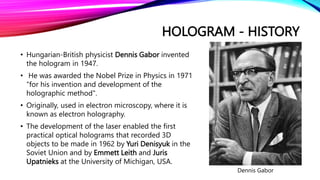
• Hungarian-British physicist Dennis Gabor invented
the hologram in 1947.
• He was awarded the Nobel Prize in Physics in 1971
"for his invention and development of the
holographic method".
• Originally, used in electron microscopy, where it is
known as electron holography.
• The development of the laser enabled the first
practical optical holograms that recorded 3D
objects to be made in 1962 by Yuri Denisyuk in the
Soviet Union and by Emmett Leith and Juris
Upatnieks at the University of Michigan, USA.
Dennis Gabor
THREE-DIMENSIONAL HOLOGRAPHIC
PROJECTION TECHNOLOGY
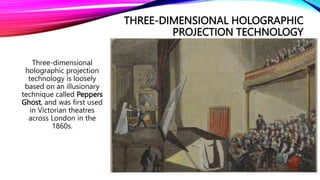
Three-dimensional
holographic projection
technology is loosely
based on an illusionary
technique called Peppers
Ghost, and was first used
in Victorian theatres
across London in the
1860s.
CATEGORIES OF HOLOGRAPHY
Category Interference fringe Recording of interference fringes Reconstruction
Holography optical
interference
DCG or PDLC Interference has been
recorded as
the photosensitive
material
hologram.
Digital Holography optical
interference
CCD or CMOS Spatial Light Modulator
Computer Generated
Holography
phase
calculation
with
computer
Lithography or etching Diffractive optical
element after
lithography or etching
Spatial Light Modulator
In recent years, the development of holography gradually toward to
digital holography and computer generated holography.
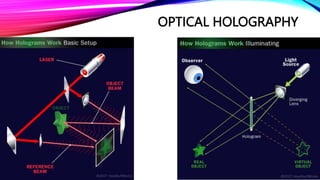
OPTICAL HOLOGRAPHY
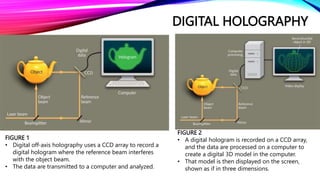
DIGITAL HOLOGRAPHY
FIGURE 1
• Digital off-axis holography uses a CCD array to record a
digital hologram where the reference beam interferes
with the object beam.
• The data are transmitted to a computer and analyzed.
FIGURE 2
• A digital hologram is recorded on a CCD array,
and the data are processed on a computer to
create a digital 3D model in the computer.
• That model is then displayed on the screen,
shown as if in three dimensions.
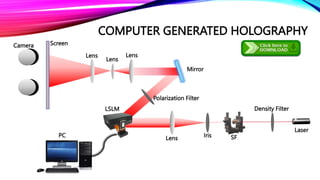
COMPUTER GENERATED HOLOGRAPHY
Camera
LSLM
SF
Laser
Density Filter
Polarization Filter
Iris
Lens
PC
Lens
Lens
Lens
Mirror
Screen
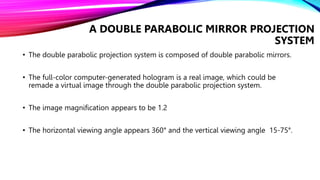
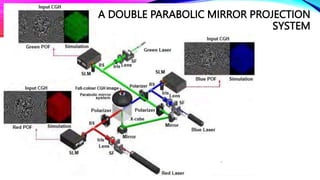
• The double parabolic projection system is composed of double parabolic mirrors.
• The full-color computer-generated hologram is a real image, which could be
remade a virtual image through the double parabolic projection system.
• The image magnification appears to be 1.2
• The horizontal viewing angle appears 360° and the vertical viewing angle 15-75°.
A DOUBLE PARABOLIC MIRROR PROJECTION
SYSTEM
A DOUBLE PARABOLIC MIRROR PROJECTION
SYSTEM
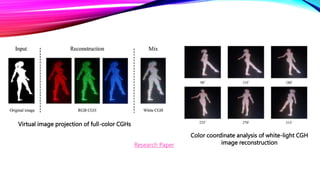
Virtual image projection of full-color CGHs
Color coordinate analysis of white-light CGH
image reconstruction
Research Paper
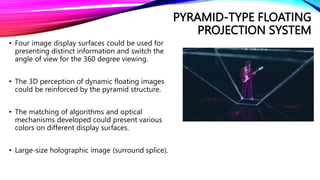
PYRAMID-TYPE FLOATING
PROJECTION SYSTEM
• Four image display surfaces could be used for
presenting distinct information and switch the
angle of view for the 360 degree viewing.
• The 3D perception of dynamic floating images
could be reinforced by the pyramid structure.
• The matching of algorithms and optical
mechanisms developed could present various
colors on different display surfaces.
• Large-size holographic image (surround splice).
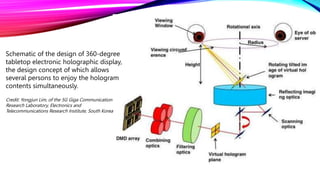
Schematic of the design of 360-degree
tabletop electronic holographic display,
the design concept of which allows
several persons to enjoy the hologram
contents simultaneously.
Credit: Yongjun Lim, of the 5G Giga Communication
Research Laboratory, Electronics and
Telecommunications Research Institute, South Korea
APPLICATIONS OF 3D
HOLOGRAPHIC PROJECTION
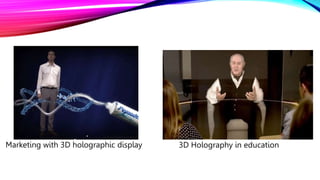
Marketing with 3D holographic display 3D Holography in education
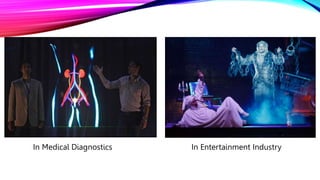
In Medical Diagnostics In Entertainment Industry
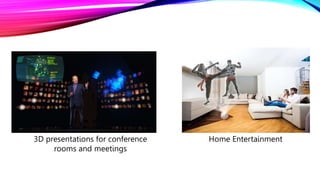
3D presentations for conference
rooms and meetings
Home Entertainment
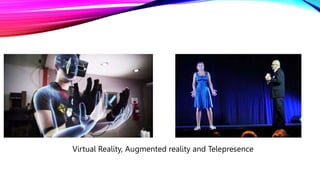
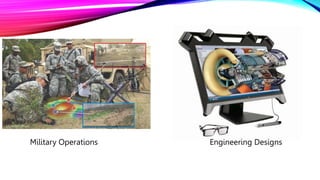
Virtual Reality, Augmented reality and Telepresence
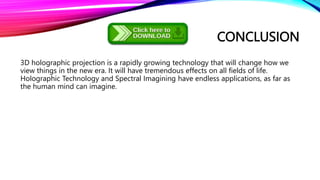
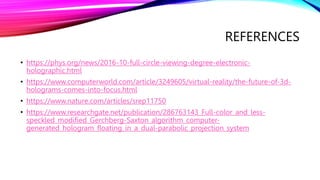
Military Operations Engineering Designs
CONCLUSION
3D holographic projection is a rapidly growing technology that will change how we
view things in the new era. It will have tremendous effects on all fields of life.
Holographic Technology and Spectral Imagining have endless applications, as far as
the human mind can imagine.
REFERENCES
• https://phys.org/news/2016-10-full-circle-viewing-degree-electronic-
holographic.html
• https://www.computerworld.com/article/3249605/virtual-reality/the-future-of-3d-
holograms-comes-into-focus.html
• https://www.nature.com/articles/srep11750
• https://www.researchgate.net/publication/286763143_Full-color_and_less-
speckled_modified_Gerchberg-Saxton_algorithm_computer-
generated_hologram_floating_in_a_dual-parabolic_projection_system

3D Holographic Projection Technology.pptx

  • 1.
  • 2.
    HOLOGRAM • To understandhow a holographic projector works we need to know what a hologram is. • Holography is a photographic technique that records the light scattered from an object, and then presents it in a way that appears three-dimensional. • The word holography comes from the Greek words ὅλος (holos; "whole") and γραφή (graphē; "writing" or "drawing").
  • 3.
    HOLOGRAM - HISTORY •Hungarian-British physicist Dennis Gabor invented the hologram in 1947. • He was awarded the Nobel Prize in Physics in 1971 "for his invention and development of the holographic method". • Originally, used in electron microscopy, where it is known as electron holography. • The development of the laser enabled the first practical optical holograms that recorded 3D objects to be made in 1962 by Yuri Denisyuk in the Soviet Union and by Emmett Leith and Juris Upatnieks at the University of Michigan, USA. Dennis Gabor
  • 4.
    THREE-DIMENSIONAL HOLOGRAPHIC PROJECTION TECHNOLOGY Three-dimensional holographicprojection technology is loosely based on an illusionary technique called Peppers Ghost, and was first used in Victorian theatres across London in the 1860s.
  • 5.
    CATEGORIES OF HOLOGRAPHY CategoryInterference fringe Recording of interference fringes Reconstruction Holography optical interference DCG or PDLC Interference has been recorded as the photosensitive material hologram. Digital Holography optical interference CCD or CMOS Spatial Light Modulator Computer Generated Holography phase calculation with computer Lithography or etching Diffractive optical element after lithography or etching Spatial Light Modulator In recent years, the development of holography gradually toward to digital holography and computer generated holography.
  • 6.
  • 7.
    DIGITAL HOLOGRAPHY FIGURE 1 •Digital off-axis holography uses a CCD array to record a digital hologram where the reference beam interferes with the object beam. • The data are transmitted to a computer and analyzed. FIGURE 2 • A digital hologram is recorded on a CCD array, and the data are processed on a computer to create a digital 3D model in the computer. • That model is then displayed on the screen, shown as if in three dimensions.
  • 8.
    COMPUTER GENERATED HOLOGRAPHY Camera LSLM SF Laser DensityFilter Polarization Filter Iris Lens PC Lens Lens Lens Mirror Screen
  • 9.
    • The doubleparabolic projection system is composed of double parabolic mirrors. • The full-color computer-generated hologram is a real image, which could be remade a virtual image through the double parabolic projection system. • The image magnification appears to be 1.2 • The horizontal viewing angle appears 360° and the vertical viewing angle 15-75°. A DOUBLE PARABOLIC MIRROR PROJECTION SYSTEM
  • 10.
    A DOUBLE PARABOLICMIRROR PROJECTION SYSTEM
  • 11.
    Virtual image projectionof full-color CGHs Color coordinate analysis of white-light CGH image reconstruction Research Paper
  • 12.
    PYRAMID-TYPE FLOATING PROJECTION SYSTEM •Four image display surfaces could be used for presenting distinct information and switch the angle of view for the 360 degree viewing. • The 3D perception of dynamic floating images could be reinforced by the pyramid structure. • The matching of algorithms and optical mechanisms developed could present various colors on different display surfaces. • Large-size holographic image (surround splice).
  • 13.
    Schematic of thedesign of 360-degree tabletop electronic holographic display, the design concept of which allows several persons to enjoy the hologram contents simultaneously. Credit: Yongjun Lim, of the 5G Giga Communication Research Laboratory, Electronics and Telecommunications Research Institute, South Korea
  • 14.
  • 15.
    Marketing with 3Dholographic display 3D Holography in education
  • 16.
    In Medical DiagnosticsIn Entertainment Industry
  • 17.
    3D presentations forconference rooms and meetings Home Entertainment
  • 18.
    Virtual Reality, Augmentedreality and Telepresence
  • 19.
  • 20.
    CONCLUSION 3D holographic projectionis a rapidly growing technology that will change how we view things in the new era. It will have tremendous effects on all fields of life. Holographic Technology and Spectral Imagining have endless applications, as far as the human mind can imagine.
  • 21.
    REFERENCES • https://phys.org/news/2016-10-full-circle-viewing-degree-electronic- holographic.html • https://www.computerworld.com/article/3249605/virtual-reality/the-future-of-3d- holograms-comes-into-focus.html •https://www.nature.com/articles/srep11750 • https://www.researchgate.net/publication/286763143_Full-color_and_less- speckled_modified_Gerchberg-Saxton_algorithm_computer- generated_hologram_floating_in_a_dual-parabolic_projection_system