PAPER PRESENTATION
3D-Holographic-Projection-Technology
RAMACHANDRA COLLEGE OF ENGINEERING
ELURU
ELECTRONICS AND COMMUNICATION DEPARTMENT
Presented by
D.Satyanarayanarao AbdulRaheem
satyanarayana1456@gmail.com raheem.smiley@gmail.com
Abstract:
This is a new HD Projection
Technologyin which a
person is captured in 3D
aspects with a special HD
Camera On a speciallybuilt
Stage and Projected “As Is
“at variousDistant
Locations“At –A –Time”.
Viewers at the other end
will feel the presence of
REAL Person in front of
them and also interact with
the projected ‘Virtual”
Person, without wearing
any kind of 3D glasses, as
they interact with ‘Actual
Person’.
>Holography is a technique that
allows the light scattered froman
object to be recorded and later
reconstructed.
>The technique to optically store,
retrieve, and process information.
>Preservethe 3-D information of a
holographed subject
Types in holograms:
(A)Reflex hologram
>Illuminatedbya spotof white incandescent
lightsource,fromfront-above
>The image consistsof lightreflectedbythe
hologram
>Produces multicolorholograms,makes
imagesopticallyindistinguishable fromthe
original objects
The reflection hologram, in which a truly
three-dimensional image is seen near its
surface, is the most common type shown
in galleries. The hologram is
Illuminated by a “spot” of white
incandescent light
, held at a specific angle and distance
and located on the viewer’s side of the
hologram. Thus, the image consists of
light
Reflected by the hologram. Recently, these
holograms have been made and displayed
in color
—
Their images optically indistinguishable
from the original objects. If a mirrors the
object, the holographic image of the mirror
reflects white light
(B) Transmissionhologram
>Viewed with laser light, usually of
the sametype used to make the
recording.
>Need light sourcebehind them.
>Virtual image can be very sharp
and deep.
The typical transmission hologram is
viewed with laser light, usually of
the same type used to make the
recording. This light is directed from
behind the hologram
And the image is transmitted to the
observer’s side. The virtual image
Can be very sharpened deep.
Furthermore, if an undiverged laser
beam is directed backward (relative
to the direction of the reference
beam) through the hologram, a real
image can be projected onto a screen
located at the original position of the
object.
(C)Computer-generatedholograms
>No need for a real object
>Interference pattern is calculated
digitally, using algorithms
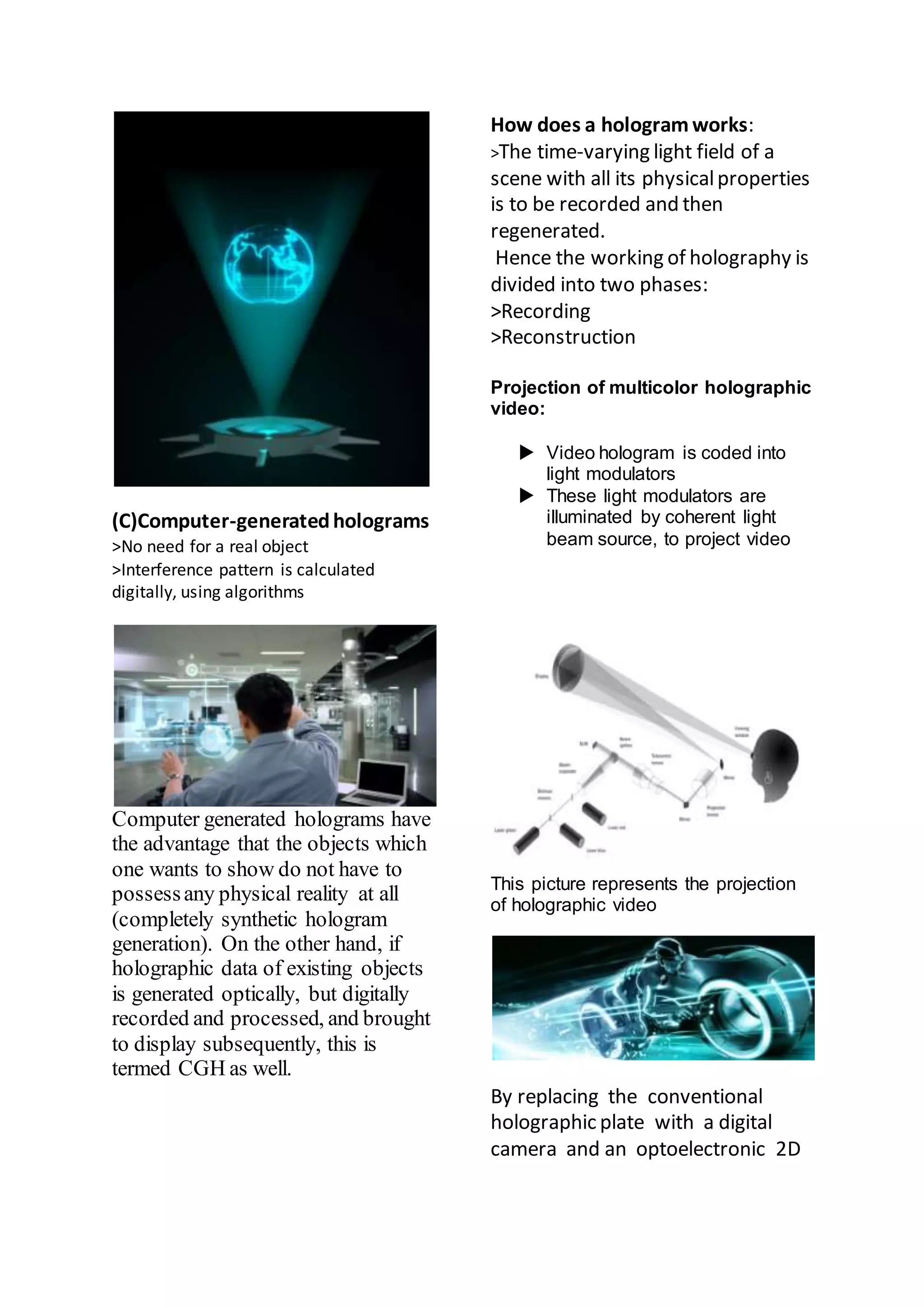
Computer generated holograms have
the advantage that the objects which
one wants to show do not have to
possessany physical reality at all
(completely synthetic hologram
generation). On the other hand, if
holographic data of existing objects
is generated optically, but digitally
recorded and processed, and brought
to display subsequently, this is
termed CGH as well.
How does a hologramworks:
>The time-varying light field of a
scene with all its physicalproperties
is to be recorded and then
regenerated.
Hence the working of holography is
divided into two phases:
>Recording
>Reconstruction
Projection of multicolor holographic
video:
 Video hologram is coded into
light modulators
 These light modulators are
illuminated by coherent light
beam source, to project video
This picture represents the projection
of holographic video
By replacing the conventional
holographic plate with a digital
camera and an optoelectronic 2D
screen, we can capture and
display holographic video.
By using the abovetechnique the
videos are made I movie like torn
This is shown in the abovefigure
Constructionof hologram:
Reconstructionof hologram:
Basic toolsrequiredtomake ahologram
includesaredlasers,lenses,beam splitter,
mirrorsand holographicfilm
Hologramsare recordedindarker
environment
Advances intechnology:
 Touchable holograms
 Tactile holographicdisplaywithhaptic
feedback
 Horizontal 360º viewof a image on
table top
 User interfacingintegrateddisplays
Tactile display with haptic feedback
“Airborne Ultrasound Tactile Display
[Iwamoto et al. 2008]” is a
tactile
display which provides tactile sensation onto
the user’s hand.
It utilizes the nonlinear phenomenon of
ultrasound; acoustic radiation pressure. When
an object interrupts the propagation of ultra-
sound, a pressure field is exerted on the
surface of the object.
Userinterfacingintegrateddisplays
While camera-based and marker-less hand
tracking systems are demonstrated these days,
we use Wiimote (Nintendo) which has an
infrared (IR) camera for simplicity. A retro
reflective marker is attached on the
tip of user’s middle finger.
IR LEDs illuminate the marker and two
Wilmot’s sense the 3D position of the finger.
Owing to this hand-tracking system, the users
can handle the floating virtual image with their
hands.
APPLICATIONS OF HOLOGRAMS
&IT’S FUTURE SCOPE:
 Educational applications
 Marketing with 3D
holographic display
 3D simulation displays for
scientific visualization
 Improved virtualReality and
augmented reality
 Telepresence and video
conferencing
 Entertainment displays
 Military and Space
Applications
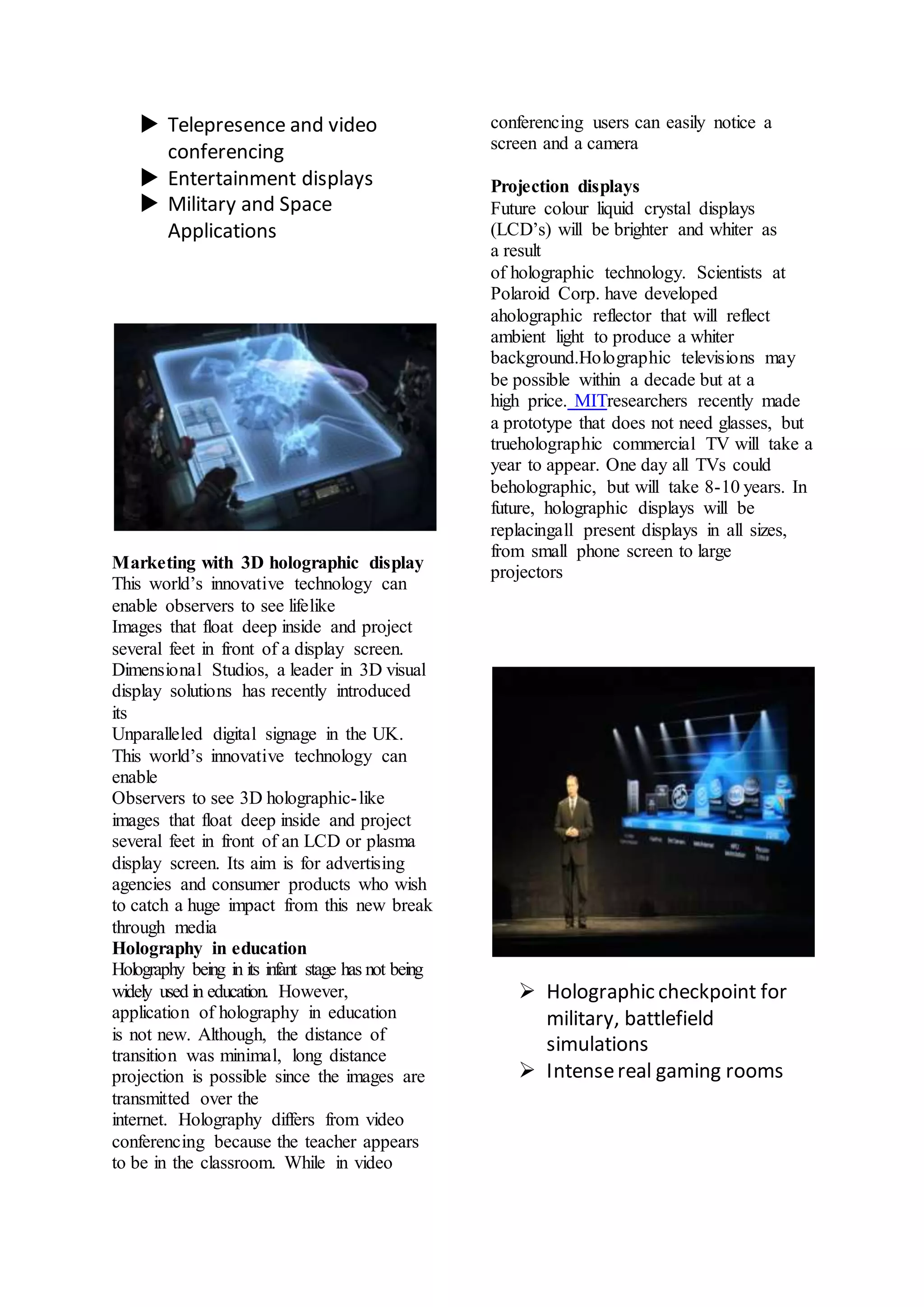
Marketing with 3D holographic display
This world’s innovative technology can
enable observers to see lifelike
Images that float deep inside and project
several feet in front of a display screen.
Dimensional Studios, a leader in 3D visual
display solutions has recently introduced
its
Unparalleled digital signage in the UK.
This world’s innovative technology can
enable
Observers to see 3D holographic-like
images that float deep inside and project
several feet in front of an LCD or plasma
display screen. Its aim is for advertising
agencies and consumer products who wish
to catch a huge impact from this new break
through media
Holography in education
Holography being in its infant stage has not being
widely used in education. However,
application of holography in education
is not new. Although, the distance of
transition was minimal, long distance
projection is possible since the images are
transmitted over the
internet. Holography differs from video
conferencing because the teacher appears
to be in the classroom. While in video
conferencing users can easily notice a
screen and a camera
Projection displays
Future colour liquid crystal displays
(LCD’s) will be brighter and whiter as
a result
of holographic technology. Scientists at
Polaroid Corp. have developed
aholographic reflector that will reflect
ambient light to produce a whiter
background.Holographic televisions may
be possible within a decade but at a
high price. MITresearchers recently made
a prototype that does not need glasses, but
trueholographic commercial TV will take a
year to appear. One day all TVs could
beholographic, but will take 8-10 years. In
future, holographic displays will be
replacingall present displays in all sizes,
from small phone screen to large
projectors
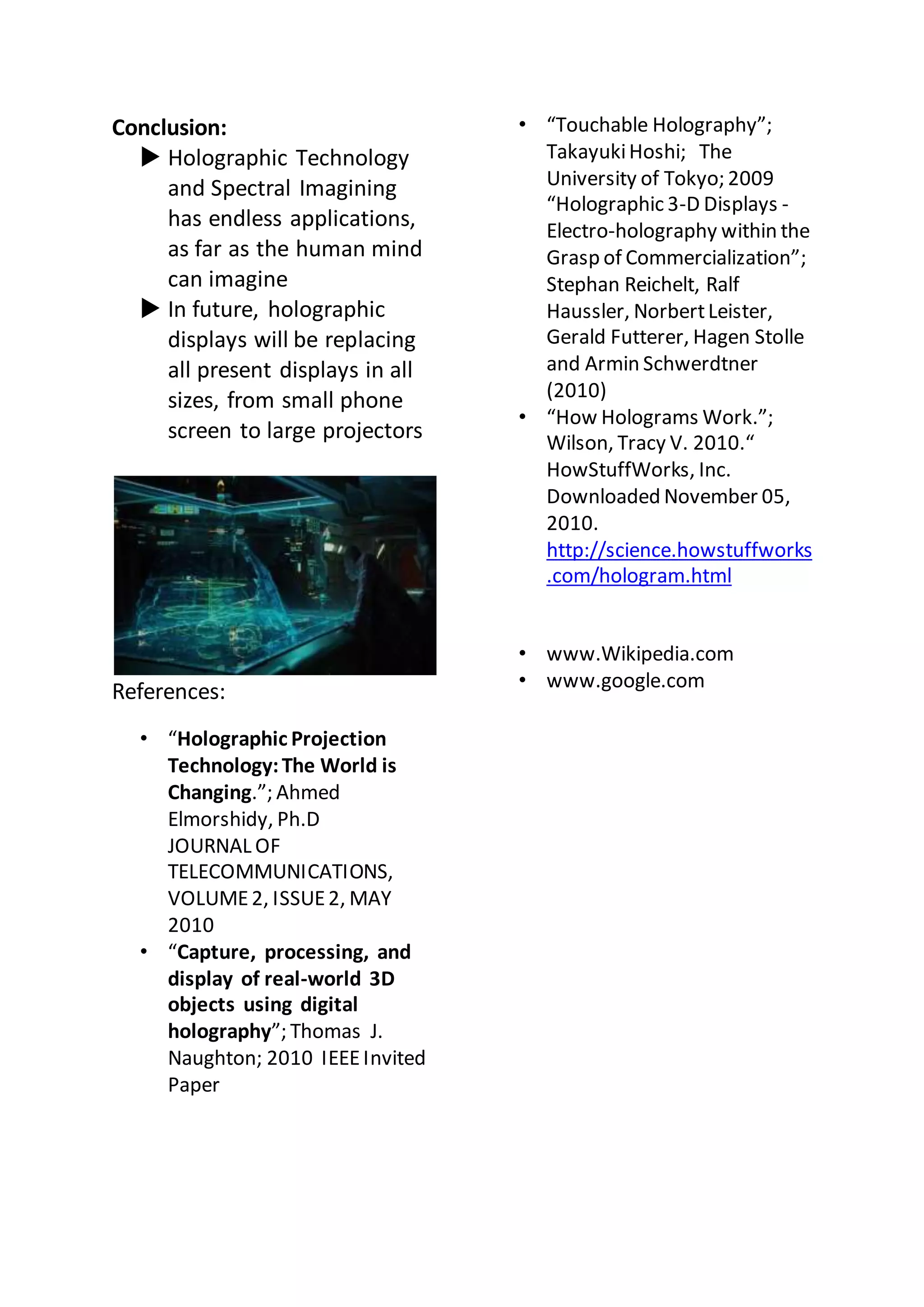
 Holographic checkpoint for
military, battlefield
simulations
 Intensereal gaming rooms
Conclusion:
 Holographic Technology
and Spectral Imagining
has endless applications,
as far as the human mind
can imagine
 In future, holographic
displays will be replacing
all present displays in all
sizes, from small phone
screen to large projectors
References:
• “Holographic Projection
Technology:The World is
Changing.”; Ahmed
Elmorshidy, Ph.D
JOURNAL OF
TELECOMMUNICATIONS,
VOLUME2, ISSUE2, MAY
2010
• “Capture, processing, and
display of real-world 3D
objects using digital
holography”; Thomas J.
Naughton; 2010 IEEEInvited
Paper
• “Touchable Holography”;
TakayukiHoshi; The
University of Tokyo; 2009
“Holographic 3-D Displays -
Electro-holography within the
Grasp of Commercialization”;
Stephan Reichelt, Ralf
Haussler, NorbertLeister,
Gerald Futterer, Hagen Stolle
and Armin Schwerdtner
(2010)
• “How Holograms Work.”;
Wilson, Tracy V. 2010.“
HowStuffWorks, Inc.
Downloaded November 05,
2010.
http://science.howstuffworks
.com/hologram.html
• www.Wikipedia.com
• www.google.com

3d holographic design

  • 1.
    PAPER PRESENTATION 3D-Holographic-Projection-Technology RAMACHANDRA COLLEGEOF ENGINEERING ELURU ELECTRONICS AND COMMUNICATION DEPARTMENT Presented by D.Satyanarayanarao AbdulRaheem satyanarayana1456@gmail.com raheem.smiley@gmail.com Abstract: This is a new HD Projection Technologyin which a person is captured in 3D aspects with a special HD Camera On a speciallybuilt Stage and Projected “As Is “at variousDistant Locations“At –A –Time”. Viewers at the other end will feel the presence of REAL Person in front of them and also interact with the projected ‘Virtual” Person, without wearing any kind of 3D glasses, as they interact with ‘Actual Person’.
  • 2.
    >Holography is atechnique that allows the light scattered froman object to be recorded and later reconstructed. >The technique to optically store, retrieve, and process information. >Preservethe 3-D information of a holographed subject Types in holograms: (A)Reflex hologram >Illuminatedbya spotof white incandescent lightsource,fromfront-above >The image consistsof lightreflectedbythe hologram >Produces multicolorholograms,makes imagesopticallyindistinguishable fromthe original objects The reflection hologram, in which a truly three-dimensional image is seen near its surface, is the most common type shown in galleries. The hologram is Illuminated by a “spot” of white incandescent light , held at a specific angle and distance and located on the viewer’s side of the hologram. Thus, the image consists of light Reflected by the hologram. Recently, these holograms have been made and displayed in color — Their images optically indistinguishable from the original objects. If a mirrors the object, the holographic image of the mirror reflects white light (B) Transmissionhologram >Viewed with laser light, usually of the sametype used to make the recording. >Need light sourcebehind them. >Virtual image can be very sharp and deep. The typical transmission hologram is viewed with laser light, usually of the same type used to make the recording. This light is directed from behind the hologram And the image is transmitted to the observer’s side. The virtual image Can be very sharpened deep. Furthermore, if an undiverged laser beam is directed backward (relative to the direction of the reference beam) through the hologram, a real image can be projected onto a screen located at the original position of the object.
  • 3.
    (C)Computer-generatedholograms >No need fora real object >Interference pattern is calculated digitally, using algorithms Computer generated holograms have the advantage that the objects which one wants to show do not have to possessany physical reality at all (completely synthetic hologram generation). On the other hand, if holographic data of existing objects is generated optically, but digitally recorded and processed, and brought to display subsequently, this is termed CGH as well. How does a hologramworks: >The time-varying light field of a scene with all its physicalproperties is to be recorded and then regenerated. Hence the working of holography is divided into two phases: >Recording >Reconstruction Projection of multicolor holographic video:  Video hologram is coded into light modulators  These light modulators are illuminated by coherent light beam source, to project video This picture represents the projection of holographic video By replacing the conventional holographic plate with a digital camera and an optoelectronic 2D
  • 4.
    screen, we cancapture and display holographic video. By using the abovetechnique the videos are made I movie like torn This is shown in the abovefigure Constructionof hologram: Reconstructionof hologram: Basic toolsrequiredtomake ahologram includesaredlasers,lenses,beam splitter, mirrorsand holographicfilm Hologramsare recordedindarker environment Advances intechnology:  Touchable holograms  Tactile holographicdisplaywithhaptic feedback  Horizontal 360º viewof a image on table top  User interfacingintegrateddisplays Tactile display with haptic feedback “Airborne Ultrasound Tactile Display [Iwamoto et al. 2008]” is a tactile display which provides tactile sensation onto the user’s hand. It utilizes the nonlinear phenomenon of ultrasound; acoustic radiation pressure. When an object interrupts the propagation of ultra- sound, a pressure field is exerted on the surface of the object. Userinterfacingintegrateddisplays While camera-based and marker-less hand tracking systems are demonstrated these days, we use Wiimote (Nintendo) which has an infrared (IR) camera for simplicity. A retro reflective marker is attached on the tip of user’s middle finger. IR LEDs illuminate the marker and two Wilmot’s sense the 3D position of the finger. Owing to this hand-tracking system, the users can handle the floating virtual image with their hands. APPLICATIONS OF HOLOGRAMS &IT’S FUTURE SCOPE:  Educational applications  Marketing with 3D holographic display  3D simulation displays for scientific visualization  Improved virtualReality and augmented reality
  • 5.
     Telepresence andvideo conferencing  Entertainment displays  Military and Space Applications Marketing with 3D holographic display This world’s innovative technology can enable observers to see lifelike Images that float deep inside and project several feet in front of a display screen. Dimensional Studios, a leader in 3D visual display solutions has recently introduced its Unparalleled digital signage in the UK. This world’s innovative technology can enable Observers to see 3D holographic-like images that float deep inside and project several feet in front of an LCD or plasma display screen. Its aim is for advertising agencies and consumer products who wish to catch a huge impact from this new break through media Holography in education Holography being in its infant stage has not being widely used in education. However, application of holography in education is not new. Although, the distance of transition was minimal, long distance projection is possible since the images are transmitted over the internet. Holography differs from video conferencing because the teacher appears to be in the classroom. While in video conferencing users can easily notice a screen and a camera Projection displays Future colour liquid crystal displays (LCD’s) will be brighter and whiter as a result of holographic technology. Scientists at Polaroid Corp. have developed aholographic reflector that will reflect ambient light to produce a whiter background.Holographic televisions may be possible within a decade but at a high price. MITresearchers recently made a prototype that does not need glasses, but trueholographic commercial TV will take a year to appear. One day all TVs could beholographic, but will take 8-10 years. In future, holographic displays will be replacingall present displays in all sizes, from small phone screen to large projectors  Holographic checkpoint for military, battlefield simulations  Intensereal gaming rooms
  • 6.
    Conclusion:  Holographic Technology andSpectral Imagining has endless applications, as far as the human mind can imagine  In future, holographic displays will be replacing all present displays in all sizes, from small phone screen to large projectors References: • “Holographic Projection Technology:The World is Changing.”; Ahmed Elmorshidy, Ph.D JOURNAL OF TELECOMMUNICATIONS, VOLUME2, ISSUE2, MAY 2010 • “Capture, processing, and display of real-world 3D objects using digital holography”; Thomas J. Naughton; 2010 IEEEInvited Paper • “Touchable Holography”; TakayukiHoshi; The University of Tokyo; 2009 “Holographic 3-D Displays - Electro-holography within the Grasp of Commercialization”; Stephan Reichelt, Ralf Haussler, NorbertLeister, Gerald Futterer, Hagen Stolle and Armin Schwerdtner (2010) • “How Holograms Work.”; Wilson, Tracy V. 2010.“ HowStuffWorks, Inc. Downloaded November 05, 2010. http://science.howstuffworks .com/hologram.html • www.Wikipedia.com • www.google.com