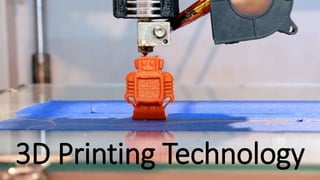
3D Printing Technology
Introduction
• 3D Printing is a form of additive manufacturing
technology where a three dimensional object is created by
laying down successive layers of material.
• It is also known as Additive Manufacturing.
• 3D printing is achieved using an additive process, where
successive layers of material are laid down in different
shapes.
History
• The technology of 3d printing using digital data was developed by
Charles Hull in 1984.
• He named his technology as stereo lithography and obtained a
patent for the technique in 1986.
• By the end of 1980s, other similar technologies such as Fused
Deposition Modelling (FDM) and Selective Laser Sintering (SLS)
were introduced.
• In 1993,Massachusetts Institute of Technology (MIT) patented
another technology, named “3 Dimensional Printing Techniques”,
which is similar to the inkjet Technology used in 2D Printers.
• In 2005, Z Corp. launched a breakthrough product, named
Spectrum Z510, which was the first high definition color 3D
Printer in the market.
3D Printable Models
• 3D printable models may be created with a computer aided design
package or via 3D scanner.
• The manual modeling process of preparing geometric data for 3D
computer graphics is similar to plastic arts such as sculpting.
• 3D scanning is a process of analyzing and collecting data of real
object; it shape and appearance and builds digital, three
dimensional models.
Terminology
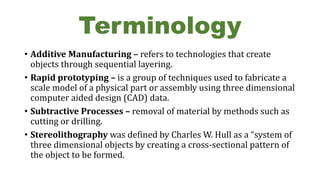
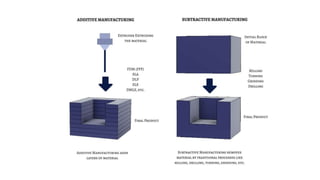
• Additive Manufacturing – refers to technologies that create
objects through sequential layering.
• Rapid prototyping – is a group of techniques used to fabricate a
scale model of a physical part or assembly using three dimensional
computer aided design (CAD) data.
• Subtractive Processes – removal of material by methods such as
cutting or drilling.
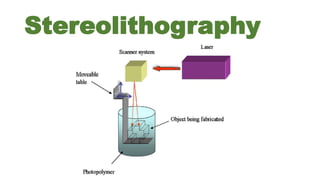
• Stereolithography was defined by Charles W. Hull as a “system of
three dimensional objects by creating a cross-sectional pattern of
the object to be formed.
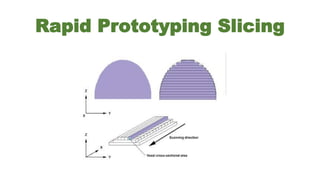
Rapid Prototyping Slicing
Stereolithography
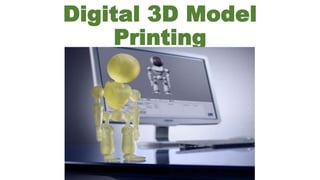
Digital 3D Model
Printing
Printing
• To perform a print, the machine reads the design from 3D
printable file(STL file).
• STL file – StereoLithography.
• It lays down successive layers of liquid, powder to build the model
from a series of cross sections.
• Printer resolution describes layers and thickness of the dpi or
micrometers.
• The practices are around 510 to 250DPI in diameter.
PRINT FINISHING
• Though the printer-produced resolution is sufficient for many
applications, printing a slightly oversize version of desired object in
standard resolution and the removing material with a higher-
resolution subtractive process can achieve greater precision.
THANKYOU

3D printing technology

  • 1.
  • 2.
    Introduction • 3D Printingis a form of additive manufacturing technology where a three dimensional object is created by laying down successive layers of material. • It is also known as Additive Manufacturing. • 3D printing is achieved using an additive process, where successive layers of material are laid down in different shapes.
  • 3.
    History • The technologyof 3d printing using digital data was developed by Charles Hull in 1984. • He named his technology as stereo lithography and obtained a patent for the technique in 1986. • By the end of 1980s, other similar technologies such as Fused Deposition Modelling (FDM) and Selective Laser Sintering (SLS) were introduced. • In 1993,Massachusetts Institute of Technology (MIT) patented another technology, named “3 Dimensional Printing Techniques”, which is similar to the inkjet Technology used in 2D Printers. • In 2005, Z Corp. launched a breakthrough product, named Spectrum Z510, which was the first high definition color 3D Printer in the market.
  • 4.
    3D Printable Models •3D printable models may be created with a computer aided design package or via 3D scanner. • The manual modeling process of preparing geometric data for 3D computer graphics is similar to plastic arts such as sculpting. • 3D scanning is a process of analyzing and collecting data of real object; it shape and appearance and builds digital, three dimensional models.
  • 5.
    Terminology • Additive Manufacturing– refers to technologies that create objects through sequential layering. • Rapid prototyping – is a group of techniques used to fabricate a scale model of a physical part or assembly using three dimensional computer aided design (CAD) data. • Subtractive Processes – removal of material by methods such as cutting or drilling. • Stereolithography was defined by Charles W. Hull as a “system of three dimensional objects by creating a cross-sectional pattern of the object to be formed.
  • 7.
  • 8.
  • 9.
  • 10.
    Printing • To performa print, the machine reads the design from 3D printable file(STL file). • STL file – StereoLithography. • It lays down successive layers of liquid, powder to build the model from a series of cross sections. • Printer resolution describes layers and thickness of the dpi or micrometers. • The practices are around 510 to 250DPI in diameter.
  • 11.
    PRINT FINISHING • Thoughthe printer-produced resolution is sufficient for many applications, printing a slightly oversize version of desired object in standard resolution and the removing material with a higher- resolution subtractive process can achieve greater precision.
  • 12.