ATTITUDE
IN
ORGANIZATION BEHAVIOR
Dr. J N Singh, Associate Professor
University of Engineering and Management
Jaipur
ATTITUDE – A BRIEF INTRODUCTION
 Attitudes are evaluative or judgments
statements – either favorable or unfavorable
– about objects, people, or events.
 Reflect how we feel about something.
 Ex: “I like my job” – Vikas says
[ you are expressing your attitude about your
work ]
COMPONENTS OF ATTITUDE
 Cognitive component
 Affective Component
 Behavioral component
Cognitive
Component
Affective
Component
Behavioral
Component
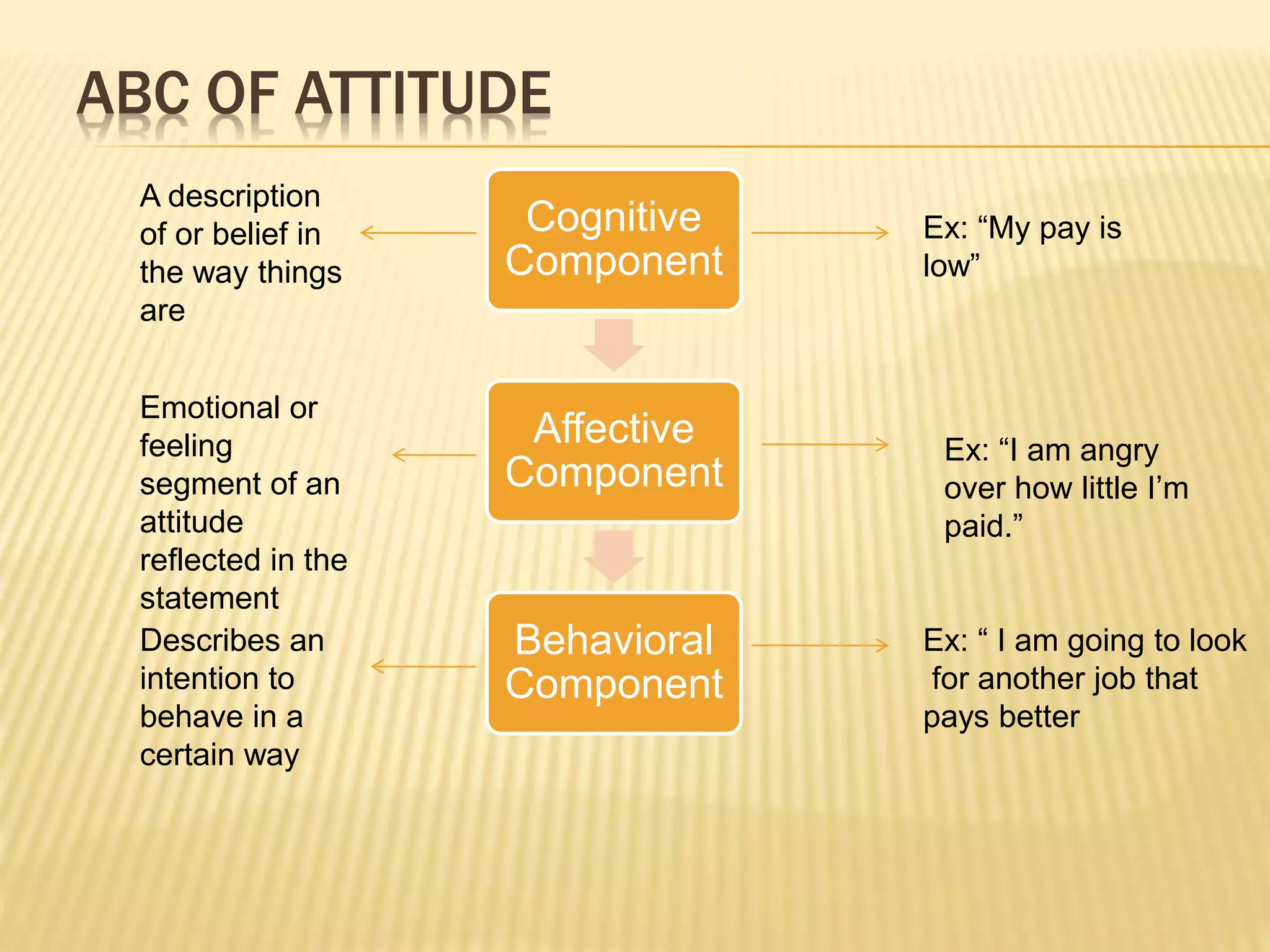
Ex: “My pay is
low”
A description
of or belief in
the way things
are
Emotional or
feeling
segment of an
attitude
reflected in the
statement
Ex: “I am angry
over how little I’m
paid.”
Describes an
intention to
behave in a
certain way
Ex: “ I am going to look
for another job that
pays better
ABC OF ATTITUDE
EXHIBIT – COMPONENTS OF AN ATTITUDE
Affective = Feeling
• I dislike my supervisor
Behavioral = Action
• I’m looking for other work; I’ve complained
about my supervisor to anyone who would
listen
Cognitive = Evaluation
• My supervisor gave promotion to a coworker
who deserved it less than I did. My supervisor
is unfair
Negative
attitude
toward
superviso
r
Affect,
behavior,
and
cognition
are
closely
related
COGNITIVE DISSONANCE
 American Psychologist “Leon Festinger” –
1957 [ book: A theory of Cognitive
Dissonance]
 “Any incompatibility between two or more
attitudes or between behavior and attitudes.”
 Occurs when a person holds two related but
contradictory cognitions.
 Two ideas – Consonance and Dissonance.
COGNITIVE DISSONANCE – CONT…
 Consonance: these ideas flow logically from
one another [ Ex: During Covid-19, I believe,
the pandemic is real and I must wear mask in
public and protect people from getting
infected]
 Dissonance: here, ideas oppose one another
[ Ex: I refuse to wear mask. My values and
beliefs contradict each other]
COGNITIVE DISSONANCE – CONT…
 People seek a stable consistency among
their attitudes and between their attitudes
and behavior
 Inconsistency is uncomfortable – individuals
try to reduce it or minimize it.
 No individual can avoid dissonance
COGNITIVE DISSONANCE – CONT
 Desire to reduce dissonance depends on
three factors:
(1) Importance of the elements creating
dissonance.
(2) Degree of the influence we believe
we have over the elements
(3) Rewards of the dissonance
COGNITIVE DISSONANCE – CONT
 The most powerful moderators of the
attitude-behavior relationship are the
importance of the attitude, its
correspondence to behavior, its accessibility,
the presence of social pressures, and
whether a person has direct experience with
the attitude.
 It tends to show a strong relationship to our
behavior.
DEFENSE MECHANISM OF COGNITIVE DISSONANCE
Avoiding
• Avoiding/ignoring
the dissonance
• Avoiding people
or situation,
discourage
people from
talking about it
Delegitimizing
• Undermining
evidence of the
dissonance
• Discrediting the
person, group or
situation
Limiting impact
• Limiting the
discomfort by
belittling its
importance
EXAMPLES OF COGNITIVE DISSONANCE
 Smoking
 Eating meat
 Doing household chores [Male]
Exercise: Write Five examples of Cognitive dissonance in your
life
CAUSES OF COGNITIVE DISSONANCE
• A person may have to do things they disagree with
as part of a job, to avoid bullying or abuse, or to
follow the law.
Forced
Compliance
• When a person must make a decision among several
options they do not like or agree with, they only have
one viable option, they may experience cognitive
dissonance.
Decision
Making
• People are more likely to view difficult tasks
positively, even if they do not morally agree with
them. They tend to value things they work hard for
highly, even if those things contradict a person’s
values.
Effort
JOB ATTITUDES
Job Satisfaction: A positive feeling about one’s job resulting from an evaluation of its
characteristics.
Job Involvement: The degree to which people identify psychologically with their jobs and
consider their perceived performance levels important to their self worth.
Psychological empowerment: Employees’ beliefs in the degree to which they influence
/affect their work environment, their competencies, the meaningfulness of their jobs, and their
autonomy.
Organizational Commitment: The degree to which an employee identifies with a particular organization and its goals and wishes to maintain membership in the organization.
Perceived Organizational Support: The degree to which employees believe an organization values their contribution and cares about their well-being.
Employee Engagement: The degree of enthusiasm an employee feels for the job
JOB SATISFACTION
 Measurement takes place by asking
employees question on:
“All things considered, how satisfied are you
with your job?”
Or…..on facets like
“Type of work”, “Skills needed”,
“Supervision”, “Present Pay”, “Promotion”,
“Opportunities", "Culture”, “Relationships with
coworkers”….etc
CAUSES OF JOB SATISFACTION
 Job Conditions
 Personality [Core-Self Evaluation: Believing
in one’s inner worth and basic competence]
 Pay
 Corporate Social Responsibility[CSR: An
organization’s self regulated actions to
benefit society or the environment beyond
what is required by law]
JOB SATISFACTION: OUTCOMES
 Job performance
 Organizational Citizenship Behavior
 Customer Satisfaction
 Life Satisfaction
JOB DISSATISFACTION - IMPACT
Dimensions Constructive Destructive
Active VOICE EXIT
Passive LOYALTY NEGLECT
Exit-Voice-Loyalty-Neglect
Framework
• Directs behavior toward leaving the organization, including looking
for a new position or resigning.
Exit
• Includes actively and constructively attempting to improve
conditions, including suggesting improvements, discussing
problems with superiors, and undertaking union activity
Voice
• Means passively but optimistically waiting for conditions to
improve, including speaking up for the organization in the face of
external criticism and trusting the organization and its management
to “do the right things.“
Loyalty
Neglect Passively allows conditions to worsen and includes chronic
absenteeism or lateness, reduced effort, and an increased error rate.
ATTITUDE.pptx

ATTITUDE.pptx

  • 1.
    ATTITUDE IN ORGANIZATION BEHAVIOR Dr. JN Singh, Associate Professor University of Engineering and Management Jaipur
  • 3.
    ATTITUDE – ABRIEF INTRODUCTION  Attitudes are evaluative or judgments statements – either favorable or unfavorable – about objects, people, or events.  Reflect how we feel about something.  Ex: “I like my job” – Vikas says [ you are expressing your attitude about your work ]
  • 4.
    COMPONENTS OF ATTITUDE Cognitive component  Affective Component  Behavioral component
  • 5.
    Cognitive Component Affective Component Behavioral Component Ex: “My payis low” A description of or belief in the way things are Emotional or feeling segment of an attitude reflected in the statement Ex: “I am angry over how little I’m paid.” Describes an intention to behave in a certain way Ex: “ I am going to look for another job that pays better ABC OF ATTITUDE
  • 6.
    EXHIBIT – COMPONENTSOF AN ATTITUDE Affective = Feeling • I dislike my supervisor Behavioral = Action • I’m looking for other work; I’ve complained about my supervisor to anyone who would listen Cognitive = Evaluation • My supervisor gave promotion to a coworker who deserved it less than I did. My supervisor is unfair Negative attitude toward superviso r Affect, behavior, and cognition are closely related
  • 7.
    COGNITIVE DISSONANCE  AmericanPsychologist “Leon Festinger” – 1957 [ book: A theory of Cognitive Dissonance]  “Any incompatibility between two or more attitudes or between behavior and attitudes.”  Occurs when a person holds two related but contradictory cognitions.  Two ideas – Consonance and Dissonance.
  • 8.
    COGNITIVE DISSONANCE –CONT…  Consonance: these ideas flow logically from one another [ Ex: During Covid-19, I believe, the pandemic is real and I must wear mask in public and protect people from getting infected]  Dissonance: here, ideas oppose one another [ Ex: I refuse to wear mask. My values and beliefs contradict each other]
  • 9.
    COGNITIVE DISSONANCE –CONT…  People seek a stable consistency among their attitudes and between their attitudes and behavior  Inconsistency is uncomfortable – individuals try to reduce it or minimize it.  No individual can avoid dissonance
  • 13.
    COGNITIVE DISSONANCE –CONT  Desire to reduce dissonance depends on three factors: (1) Importance of the elements creating dissonance. (2) Degree of the influence we believe we have over the elements (3) Rewards of the dissonance
  • 14.
    COGNITIVE DISSONANCE –CONT  The most powerful moderators of the attitude-behavior relationship are the importance of the attitude, its correspondence to behavior, its accessibility, the presence of social pressures, and whether a person has direct experience with the attitude.  It tends to show a strong relationship to our behavior.
  • 15.
    DEFENSE MECHANISM OFCOGNITIVE DISSONANCE Avoiding • Avoiding/ignoring the dissonance • Avoiding people or situation, discourage people from talking about it Delegitimizing • Undermining evidence of the dissonance • Discrediting the person, group or situation Limiting impact • Limiting the discomfort by belittling its importance
  • 16.
    EXAMPLES OF COGNITIVEDISSONANCE  Smoking  Eating meat  Doing household chores [Male] Exercise: Write Five examples of Cognitive dissonance in your life
  • 17.
    CAUSES OF COGNITIVEDISSONANCE • A person may have to do things they disagree with as part of a job, to avoid bullying or abuse, or to follow the law. Forced Compliance • When a person must make a decision among several options they do not like or agree with, they only have one viable option, they may experience cognitive dissonance. Decision Making • People are more likely to view difficult tasks positively, even if they do not morally agree with them. They tend to value things they work hard for highly, even if those things contradict a person’s values. Effort
  • 18.
    JOB ATTITUDES Job Satisfaction:A positive feeling about one’s job resulting from an evaluation of its characteristics. Job Involvement: The degree to which people identify psychologically with their jobs and consider their perceived performance levels important to their self worth. Psychological empowerment: Employees’ beliefs in the degree to which they influence /affect their work environment, their competencies, the meaningfulness of their jobs, and their autonomy. Organizational Commitment: The degree to which an employee identifies with a particular organization and its goals and wishes to maintain membership in the organization. Perceived Organizational Support: The degree to which employees believe an organization values their contribution and cares about their well-being. Employee Engagement: The degree of enthusiasm an employee feels for the job
  • 19.
    JOB SATISFACTION  Measurementtakes place by asking employees question on: “All things considered, how satisfied are you with your job?” Or…..on facets like “Type of work”, “Skills needed”, “Supervision”, “Present Pay”, “Promotion”, “Opportunities", "Culture”, “Relationships with coworkers”….etc
  • 20.
    CAUSES OF JOBSATISFACTION  Job Conditions  Personality [Core-Self Evaluation: Believing in one’s inner worth and basic competence]  Pay  Corporate Social Responsibility[CSR: An organization’s self regulated actions to benefit society or the environment beyond what is required by law]
  • 21.
    JOB SATISFACTION: OUTCOMES Job performance  Organizational Citizenship Behavior  Customer Satisfaction  Life Satisfaction
  • 22.
    JOB DISSATISFACTION -IMPACT Dimensions Constructive Destructive Active VOICE EXIT Passive LOYALTY NEGLECT Exit-Voice-Loyalty-Neglect Framework • Directs behavior toward leaving the organization, including looking for a new position or resigning. Exit • Includes actively and constructively attempting to improve conditions, including suggesting improvements, discussing problems with superiors, and undertaking union activity Voice • Means passively but optimistically waiting for conditions to improve, including speaking up for the organization in the face of external criticism and trusting the organization and its management to “do the right things.“ Loyalty Neglect Passively allows conditions to worsen and includes chronic absenteeism or lateness, reduced effort, and an increased error rate.