Anatomy & Embryology
OF
The Appendix
DEPARTMENT OF
SURGERY
ISTIKLAL HOSPITAL
Dr. Ma’moun Saleh
Supervised by: Dr. Haytham Hamdan
Outlines:
Definition.
Locations of the tip.
Microstructure.
Blood supply.
Lymph drainage and innervation.
Congenital abnormalities.
Embryology.
Definition :
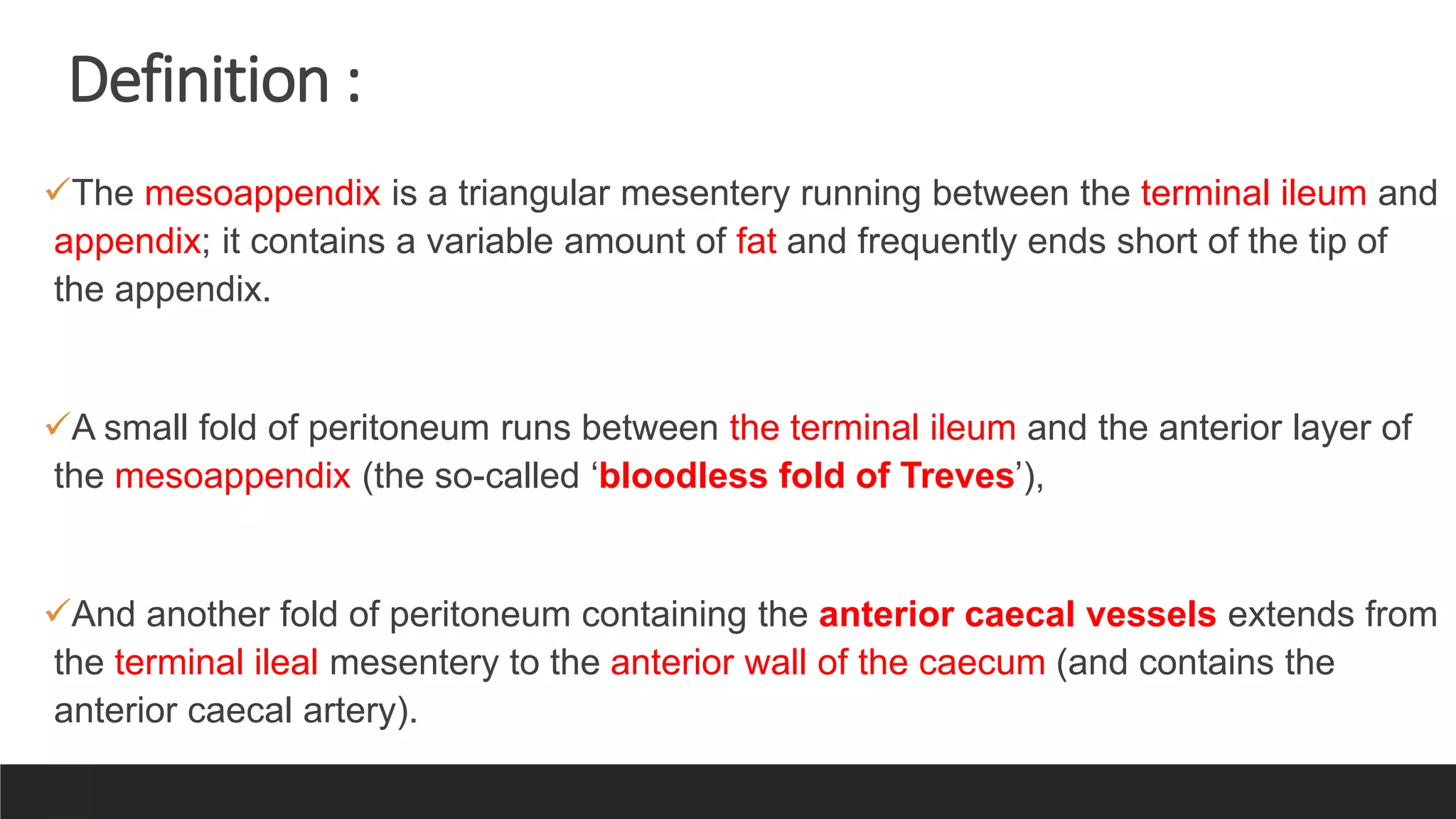
The vermiform (worm-like) appendix is a narrow, intraperitoneal, muscular blind-
ending tube,
Usually between 6 and 10 cm long in the adult.
It joins the posteromedial wall of the caecum below the ileocolic junction.
The appendix grows in length and diameter during early childhood, reaching almost
mature dimensions by about 3 years of age.
Definition :
The surface marking for the base of the appendix has traditionally been described by
McBurney’s point.
The appendix has a continuous outer layer of longitudinal muscle formed by the
coalescence of the three taeniae coli.
Its lumen is irregularly narrowed by submucosal lymphoid tissue.
Definition :
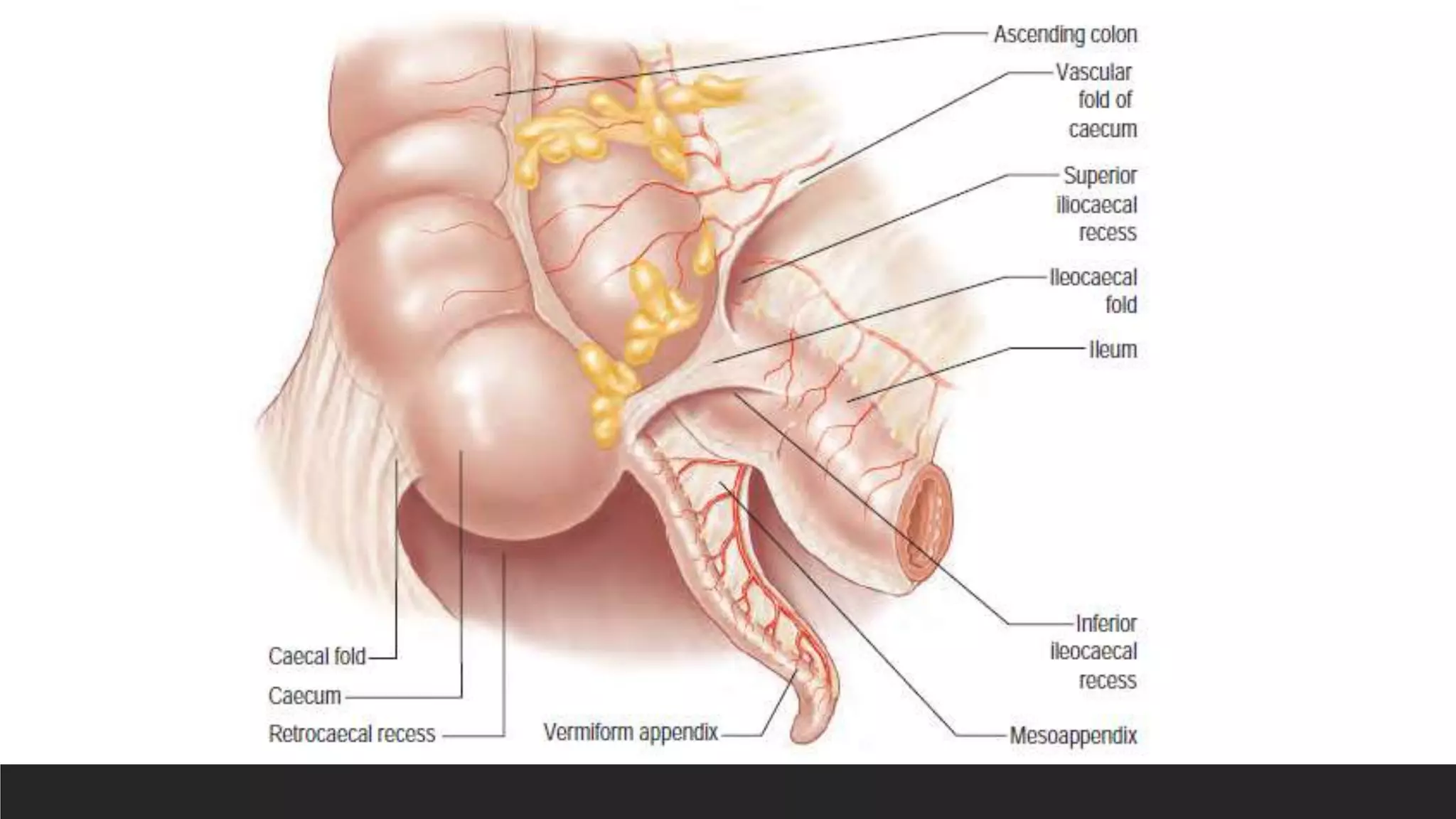
The mesoappendix is a triangular mesentery running between the terminal ileum and
appendix; it contains a variable amount of fat and frequently ends short of the tip of
the appendix.
A small fold of peritoneum runs between the terminal ileum and the anterior layer of
the mesoappendix (the so-called ‘bloodless fold of Treves’),
And another fold of peritoneum containing the anterior caecal vessels extends from
the terminal ileal mesentery to the anterior wall of the caecum (and contains the
anterior caecal artery).
Location of the tip:
The tip is most commonly retrocaecal or retrocolic (behind the caecum or lower
ascending colon, respectively, anterior to iliacus and psoas major),
Pelvic (when the appendix descends over the pelvic brim, in close relation to the
right uterine tube and ovary in females).
Other positions include subcaecal, and pre- or post-ileal (anterior or posterior to the
terminal ileum, respectively.
Microstructure
The appendix is now linked to the
development and preservation of gut-
associated lymphoid tissue (GALT)
And to the maintenance of intestinal
flora.
The layers of the wall of the appendix are similar to those of the large intestine in
general.
The serosa forms a complete covering, except along the mesenteric attachment.
The outer longitudinal muscle is a complete layer of uniform thickness
The submucosa typically contains large lymphoid aggregates that may extend
into the mucosa and disrupt the integrity of the muscularis mucosae (Fig. 66.20).
The mucosa is covered by a columnar epithelium, which contains M cells where it
overlies the mucosal lymphoid tissue.
Glands (crypts) are similar to those of the colon but are fewer in number and less
densely packed.
Blood Supply:
Appendicular artery is a branch of the posterior cecal artery
Veins :
The veins drain into the posterior cecal vein.
Lymph Drainage:
The lymph drains into nodes in the mesoappendix and eventually into the superior
mesenteric lymph nodes.
Nerve Supply:
The appendix is supplied by the sympathetic and vagus nerves from the superior
mesenteric plexus.
PAIN OF APPENDICITIS:
Visceral pain in the appendix is produced by distention of its lumen or spasm of its
muscle.
The afferent pain fibers enter the spinal cord at the level of the tenth thoracic
segment, and a vague referred pain is felt in the region of the umbilicus.
Later, the pain shifts to where the inflamed appendix irritates the parietal peritoneum,
and then the pain is precise, severe, and localized (somatic pain)
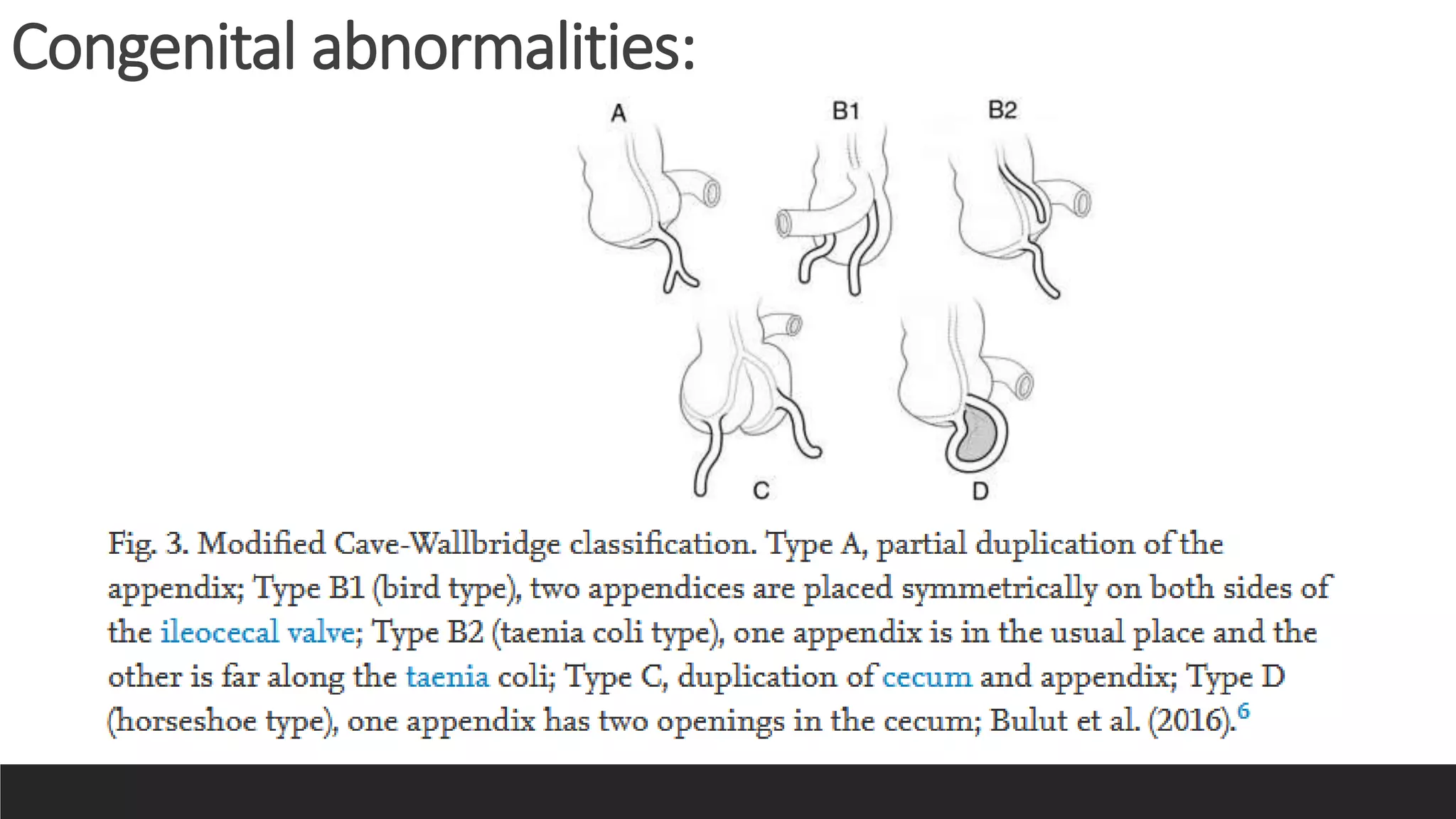
Congenital abnormalities:
Embryology :
The appendix, along with the ileum and the colon, develops from the midgut and first
appears at 8 weeks of gestation.
As the gut rotates medially, the cecum becomes fixed in the right lower quadrant,
thus determining the final position of the appendix.
Embryology:
The primordial gut is divided into three parts According to their blood supply:
Foregut: mostly by Celiac artery
Midgut: by Superior Mesenteric artery
Hindgut: by Inferior Mesenteric artery
References:
SABISTON TEXTBOOK of SURGERY 20th Edition.
Schwartz’s Principles of Surgery 11th Edition.
Grays Anatomy-The Anatomical Basis of Clinical Practice 41 Edition.
Snell's Clinical Anatomy An Illustrated Reviews with Questions & Explanations,
4Edition.

3. Appendix (Anatomy).pptx

  • 1.
    Anatomy & Embryology OF TheAppendix DEPARTMENT OF SURGERY ISTIKLAL HOSPITAL Dr. Ma’moun Saleh Supervised by: Dr. Haytham Hamdan
  • 2.
    Outlines: Definition. Locations of thetip. Microstructure. Blood supply. Lymph drainage and innervation. Congenital abnormalities. Embryology.
  • 3.
    Definition : The vermiform(worm-like) appendix is a narrow, intraperitoneal, muscular blind- ending tube, Usually between 6 and 10 cm long in the adult. It joins the posteromedial wall of the caecum below the ileocolic junction. The appendix grows in length and diameter during early childhood, reaching almost mature dimensions by about 3 years of age.
  • 4.
    Definition : The surfacemarking for the base of the appendix has traditionally been described by McBurney’s point. The appendix has a continuous outer layer of longitudinal muscle formed by the coalescence of the three taeniae coli. Its lumen is irregularly narrowed by submucosal lymphoid tissue.
  • 5.
    Definition : The mesoappendixis a triangular mesentery running between the terminal ileum and appendix; it contains a variable amount of fat and frequently ends short of the tip of the appendix. A small fold of peritoneum runs between the terminal ileum and the anterior layer of the mesoappendix (the so-called ‘bloodless fold of Treves’), And another fold of peritoneum containing the anterior caecal vessels extends from the terminal ileal mesentery to the anterior wall of the caecum (and contains the anterior caecal artery).
  • 8.
    Location of thetip: The tip is most commonly retrocaecal or retrocolic (behind the caecum or lower ascending colon, respectively, anterior to iliacus and psoas major), Pelvic (when the appendix descends over the pelvic brim, in close relation to the right uterine tube and ovary in females). Other positions include subcaecal, and pre- or post-ileal (anterior or posterior to the terminal ileum, respectively.
  • 10.
    Microstructure The appendix isnow linked to the development and preservation of gut- associated lymphoid tissue (GALT) And to the maintenance of intestinal flora.
  • 11.
    The layers ofthe wall of the appendix are similar to those of the large intestine in general. The serosa forms a complete covering, except along the mesenteric attachment. The outer longitudinal muscle is a complete layer of uniform thickness The submucosa typically contains large lymphoid aggregates that may extend into the mucosa and disrupt the integrity of the muscularis mucosae (Fig. 66.20). The mucosa is covered by a columnar epithelium, which contains M cells where it overlies the mucosal lymphoid tissue. Glands (crypts) are similar to those of the colon but are fewer in number and less densely packed.
  • 12.
    Blood Supply: Appendicular arteryis a branch of the posterior cecal artery Veins : The veins drain into the posterior cecal vein. Lymph Drainage: The lymph drains into nodes in the mesoappendix and eventually into the superior mesenteric lymph nodes. Nerve Supply: The appendix is supplied by the sympathetic and vagus nerves from the superior mesenteric plexus.
  • 13.
    PAIN OF APPENDICITIS: Visceralpain in the appendix is produced by distention of its lumen or spasm of its muscle. The afferent pain fibers enter the spinal cord at the level of the tenth thoracic segment, and a vague referred pain is felt in the region of the umbilicus. Later, the pain shifts to where the inflamed appendix irritates the parietal peritoneum, and then the pain is precise, severe, and localized (somatic pain)
  • 14.
  • 15.
    Embryology : The appendix,along with the ileum and the colon, develops from the midgut and first appears at 8 weeks of gestation. As the gut rotates medially, the cecum becomes fixed in the right lower quadrant, thus determining the final position of the appendix.
  • 16.
    Embryology: The primordial gutis divided into three parts According to their blood supply: Foregut: mostly by Celiac artery Midgut: by Superior Mesenteric artery Hindgut: by Inferior Mesenteric artery
  • 17.
    References: SABISTON TEXTBOOK ofSURGERY 20th Edition. Schwartz’s Principles of Surgery 11th Edition. Grays Anatomy-The Anatomical Basis of Clinical Practice 41 Edition. Snell's Clinical Anatomy An Illustrated Reviews with Questions & Explanations, 4Edition.