APPENDICITIS
Moderator: Dr M Talukdar
Associate Professor
Presenter: Dr Monitosh Paul
2nd year PGT
Objective
 History
 Embryology & Anomaly
 Anatomy
 Acute Appendicitis (Aetiology, Pathology, Clinical
Diagnosis)
 Special Feature (acc. to position, age)
 D/D of AcuteAppendicitis
 Appendicular Lump
History
 In 1492, Leonardo da Vinci first depicted the appendix in anatomic
drawings
 In 1554, Fernel first recoded case of disease in appendix
 In 1521, Jacopo B da Capri, identified the appendix as an anatomic
structure.
 In 1710, Phillipe Verheyen coined the term 'appendixvermiformis'.
 The first recorded successful appendicectomywas done in 1735 by
Claudius Amyand
.
In 1880, Lawson Tait performed first transabdominal appendicectomy
 Kurt Semm, ( German gynecologist) did first laparoscopic
appendectomy in 1980.
 Reginal Fitz of Harvard Medical School coined the term
‘Appendicitis’
Embryology
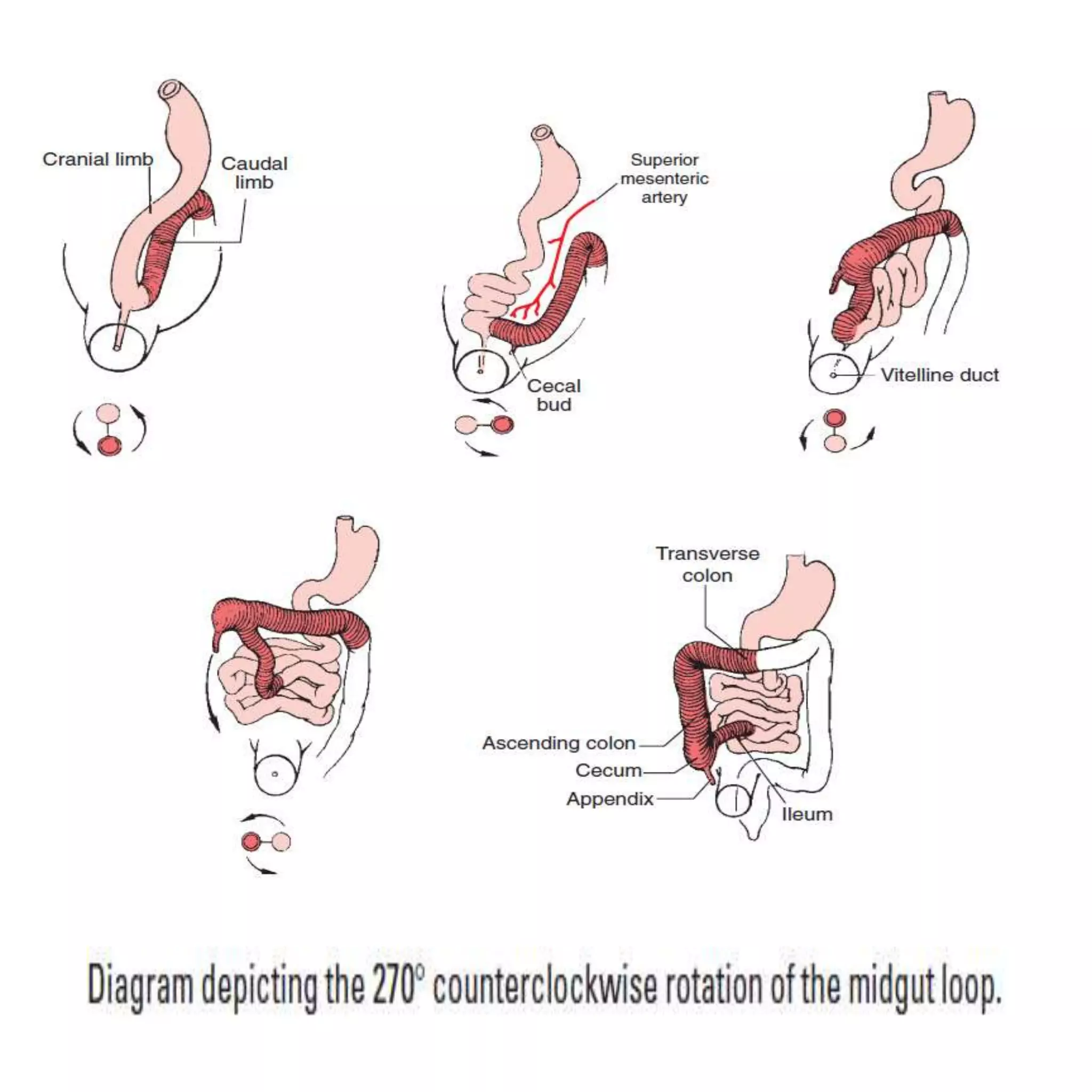
• The appendix and caecum develops as outpouching of the
caudal limb of the midgut loop in 6th wks of development &
appendix is visible by 8wks
• 270-degree counterclockwise rotation of midgut loop occurs to
lie in right side of abdomen
• By 5th month, appendix elongates into vermiform shape
• At birth, it is located at the tip of caecum due to differential
growth of the lateral wall of the caecum.
• And by 2yrs of age appendix originates from the posteromedial
wall of the caecum caudal to ileocaecal valve
Congenital Anomalies
1. Absence of the Appendix: An absent appendix may have failed
to form in the eighth week. Or may have formed but lacking
demarcation from rest of the cecum due to same rate of
development as that of caecum. (4 cases found in 71000
specimen examined)
2. Ectopic Appendix: Different locations include- in the thorax,
(in association with malrotation and diaphragmatic defect),
lumbar area, posterior ceacal wall
3. Left-Sided Appendix: Conditions that can result in a left-sided
appendix in order of frequency are: (1) situs inversus viscerum,
(2) nonrotation of the intestines, (3) "wandering“ cecum with a
long mesentery, and (4) an excessively long appendix crossing
the midline.
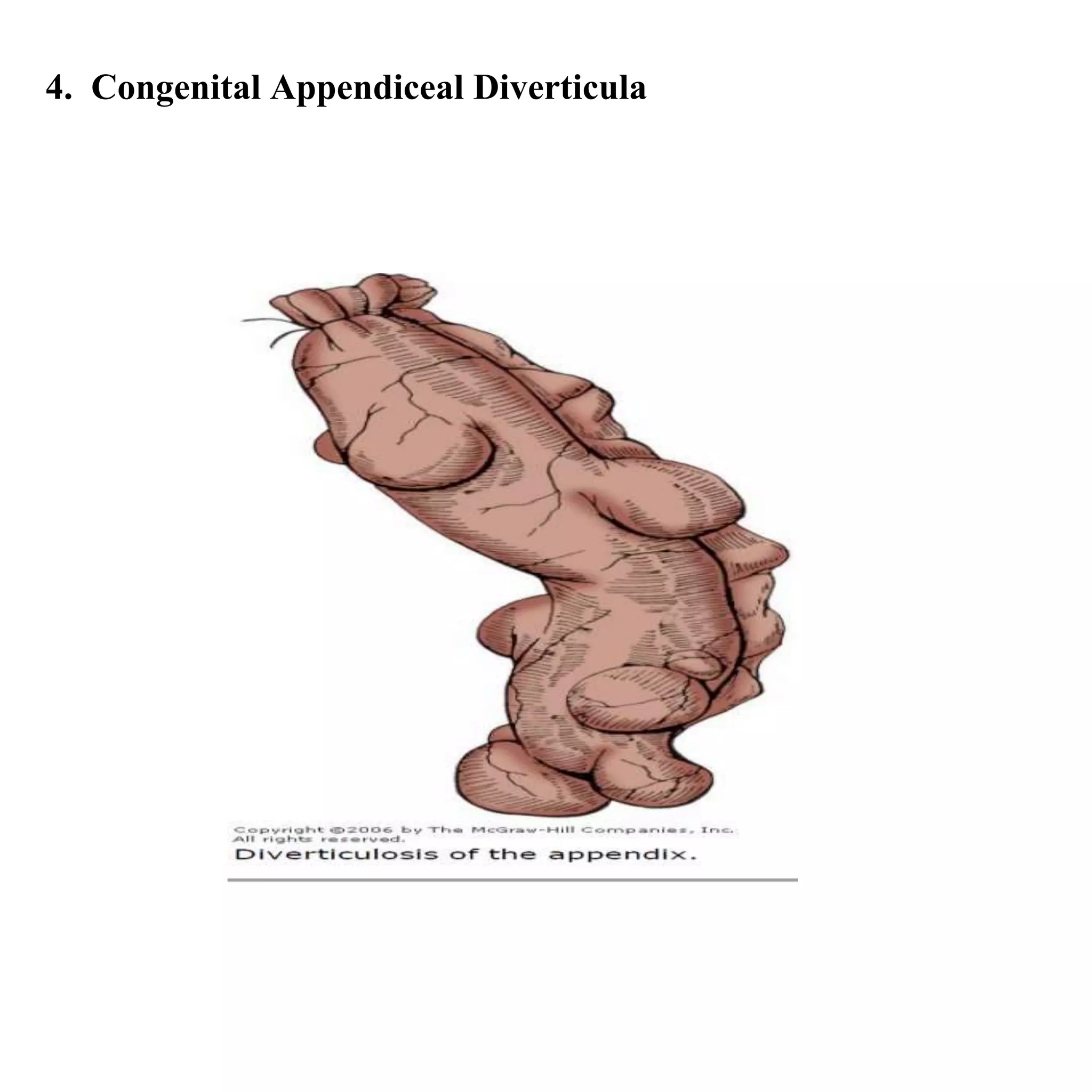
4. Congenital Appendiceal Diverticula
5. Duplication of the Appendix:
Waugh Classification:
a) Double-barreled appendix, with a common muscularis and
often a distal communication between the lumina
b) "Bird-type" paired appendix. Symmetrically placed on either
side of ileocecal valve
c) Taenia coli-type duplication. Here an additional small appendix
forms on a taenia along with a normal appendix at the usual site.
Wallbridge Anomaly
1. Type A anomaly. Single cecum and a partial duplication of
the appendix with a single base.
2. Type B1 anomaly. Two completelyseparate appendices
arise from a single cecum.
3. Type B2 anomaly. The second appendix is usually found arising
from the taenia coli of the wall of the cecum.
4. Type C anomaly. Double cecum, each with its own appendix,
Wallbridge Anomaly: A,B1,B2,C
B1
B2
Anatomy
Size of the Appendix
 Length Range : 5- 35 cm
Average: 9 cm
 Diameter: 3 - 8 mm
lumen: 1- 3 mm
 Origin – Postero-medial wall of the caecum ( 2cm below
the ileocecalorifice)
 Appendicular orifice: Guarded by an indistinct semilunar
fold of mucous membrane k/as Valve of Gerlach.
 Mesoappendix: peritoneum – lower surface ofthe mesentery
of the terminalileum.
 It is a true diverticulum containing all layers of colonic wall
Microscopic anatomy
Microscopic anatomy
• Layers:
- Mucosa
- Submucosa
- Muscularis
- Serosa
Layers:
- Mucosa
- Submucosa
- Muscularis
- Serosa
Position of the Appendix
Position of Appendix
Position Incidence
Retrocecal 74% Commonest postion
Pelvic 21% 2nd Commonest position
Pre-ileal 1%
Post- ileal 0.5%
Paracaecal 2%
Promontoric( Subileal /subcaecal)
1.5%
In pregnancy the position of appendix changes with period of
gestation
Blood Supply
Arterial
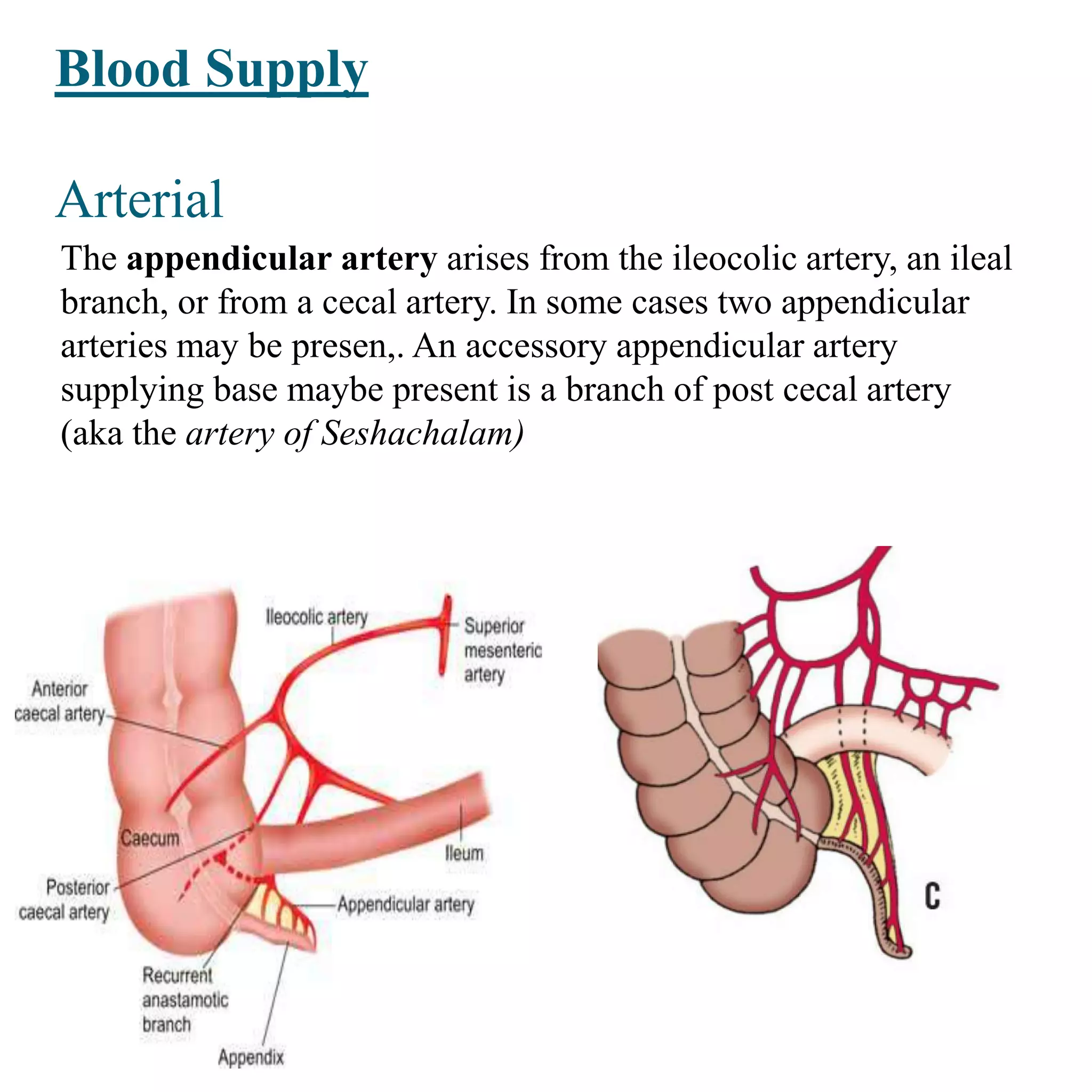
The appendicular artery arises from the ileocolic artery, an ileal
branch, or from a cecal artery. In some cases two appendicular
arteries may be presen,. An accessory appendicular artery
supplying base maybe present is a branch of post cecal artery
(aka the artery of Seshachalam)
End Artery
Thrombosis of Appendicular artery leads to
Gangrenous appendicitis
Venous Drainage:
PortalVein
Appendicular Vein
Ileocolic vein
Superior Mesenteric vein
Nerve Supply:
 Autonomic innervation: Superior mesenteric plexus
 Afferent fibre by Sympathetic Nerve fibre enter to spinal cord at
T10
 Para Sympathetic Nerves- Vagus
Lymphatic & KULTSCHITZSKY Cells
 The submucosa contains numerouslymphatic
aggregations or follicles ( aka abdominal tonsil)
 8-15 lymphatic vessels - mesoappendix
 Ileocolic Node ( Sup & Inf group)
 Ileocolic Nodes SMN Celiac nodes &
Cysterna chyli
 In the base of the crypts lie argentaffin cells
(Kultschitzsky cells) which may give rise to carcinoid
tumors .
Function of Appendix:
The physiologic action of this vestigial organ in human beings is
not known. Due to the presence of numerous lymphatic follicles
however, it is generally accepted that the appendix performs
immune functions and also has role in maintaining gut
microbiota
Appendicectomy has protective role in Ulcerative collitis
Acute Appendicitis
Epidemiology:
• The incidence of acute appendicitis ranges from 8.6 to 11
cases per 10,000 person-years.
• In a lifetime, 8.6% of males and 6.7% of females can be
expected to develop acute appendicitis
• Overall, perforation occurs in 19% of cases of acute
appendicitis.
• Perforated appendicitis has a bimodal distribution, with a
predilection for patients at extremes of age i.e. higher
among patients younger than 5 and older than 65 years
Etiology:
 Faecolith & fecal stasis
 Lymphoid hyperplasia
 Bacterial proliferation : mixed growth commonestis
streptococci & E.Coli.
 Intestinal parasites – Oxyuris Vermicularis (pinworm)
 Tumour( Ca of the Caecum) in elderly & middle age.
 Fibrotic stricture of theappendix
Composition of Faecolith:
 Bacteria
 Calcium phosphate
 Epithelial Debris
 Inspissated fecal material
 Foreign bodies ( Rarely)
Pathology: Obstructive & Non obstructive
Obstructive- Primarily
 Acuteappendicitis
 Gangrenousappendicitis
 Phlegmonous mass/paracaecal
abscess
 Mucocele of theappendix
 Rupture of appendix
Pathology Non- obstructive
Obstruction is not the sole cause as some patients with fecolith is
found have histologically normal appendix and the majority of
patients with appendicitis show no evidence for a fecalith.
Furthermore there is no signs of obstruction or elevated luminal
pressure in many appendicitis cases
Pathology
Luminal obstruction
Swelling of the mucosal and submucosal lymphoid
tissue at the base of the appendix
Increased intra-luminal pressure(mucus secretion &
gas production by bacteria)
Edema, mucosal ulceration
Impaired venous drainage
Mucosal ischaemia &
Bacterial translocation to submucosa
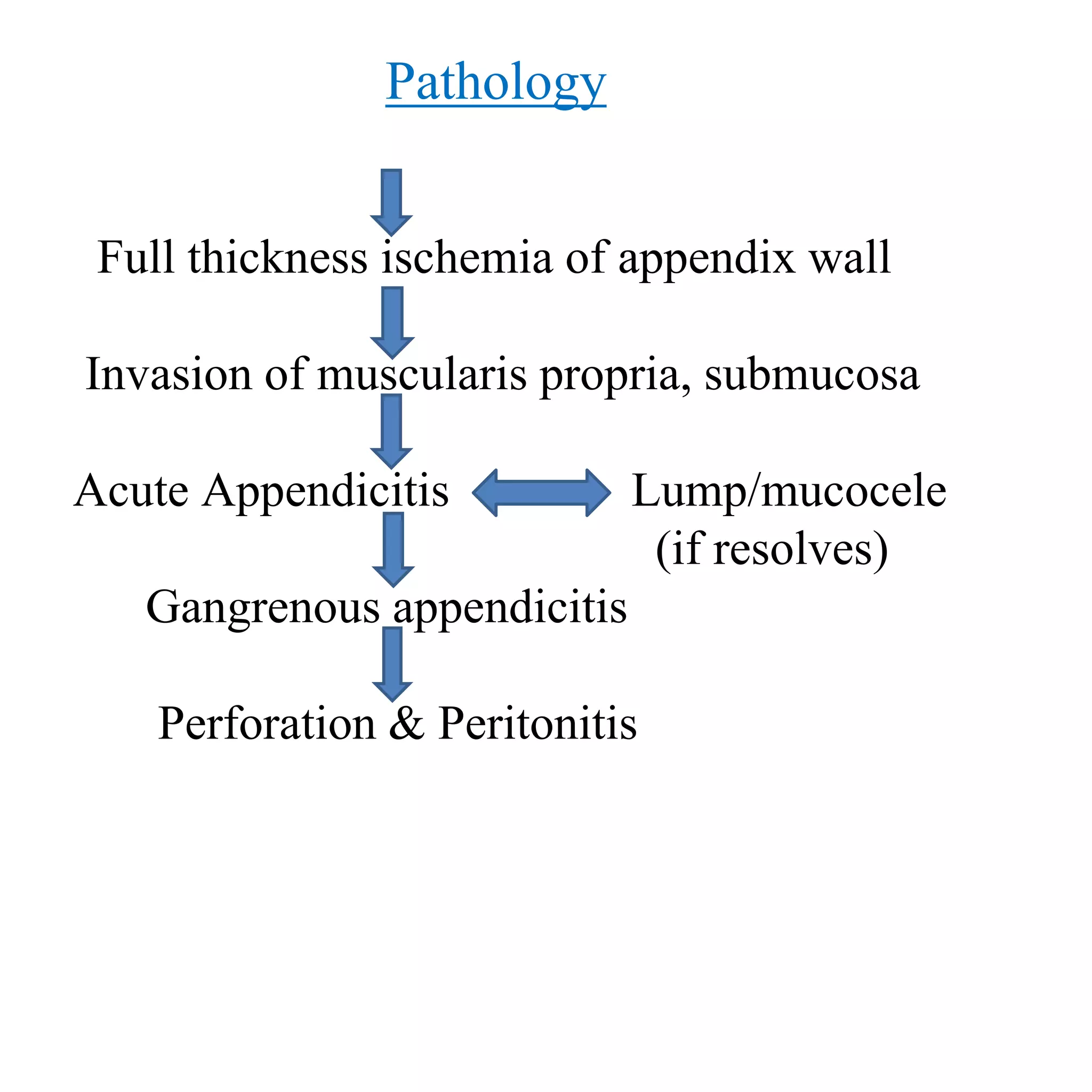
Pathology
Full thickness ischemia of appendix wall
Invasion of muscularis propria, submucosa
Acute Appendicitis Lump/mucocele
(if resolves)
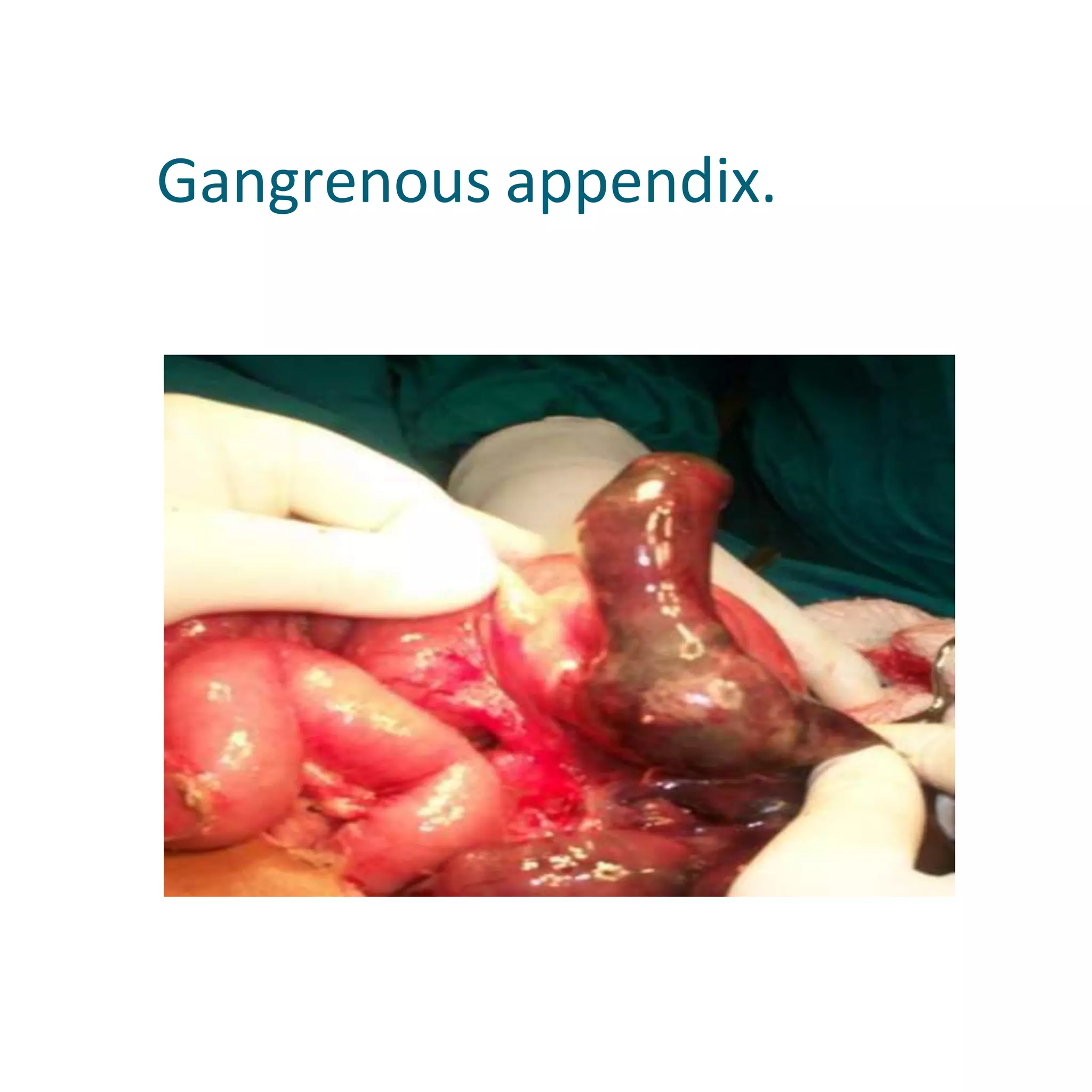
Gangrenous appendicitis
Perforation & Peritonitis
Gangrenous appendix.
Phlegmonous Mass/Paracaecal
abscess
Greater omentum & loops of small bowelbecome
adherent tothe inflamed appendix
Walling off the spread of peritoneal contamination
Phlegmonous Mass / Paracaecal abscess
Phlegmonous appendicitis
Appendicular inflammation- resolves-
distended mucus filled organ- Mucocele of
appendix
Factors predisposing perforation
 Extreme of Age
 Immunosuppression
 Diabetes Mellitus
 Faecolith obstruction
 Pelvic appendix
 Previous Abdominal surgery
Bacteriology of perforated appendix
Clinical Features of Acute Appendicitis
Symptoms
 PAIN: Initially Periumbilical region ( visceral ) in
response to inflammation &obstruction.
:Pain shift to right iliac fossa : Parietal
peritoneum irritated and inflamed.
 ANOREXIA (useful and constant feature in children)
 NAUSEA with/without VOMITTING
 Diarrhoea /Constipation
Clinical Sign
• Fever : Low grade after 6hours
• Tachycardia: more pronounced in Perforation,
Gangrene & Peritonitis
• Mild Dehydration
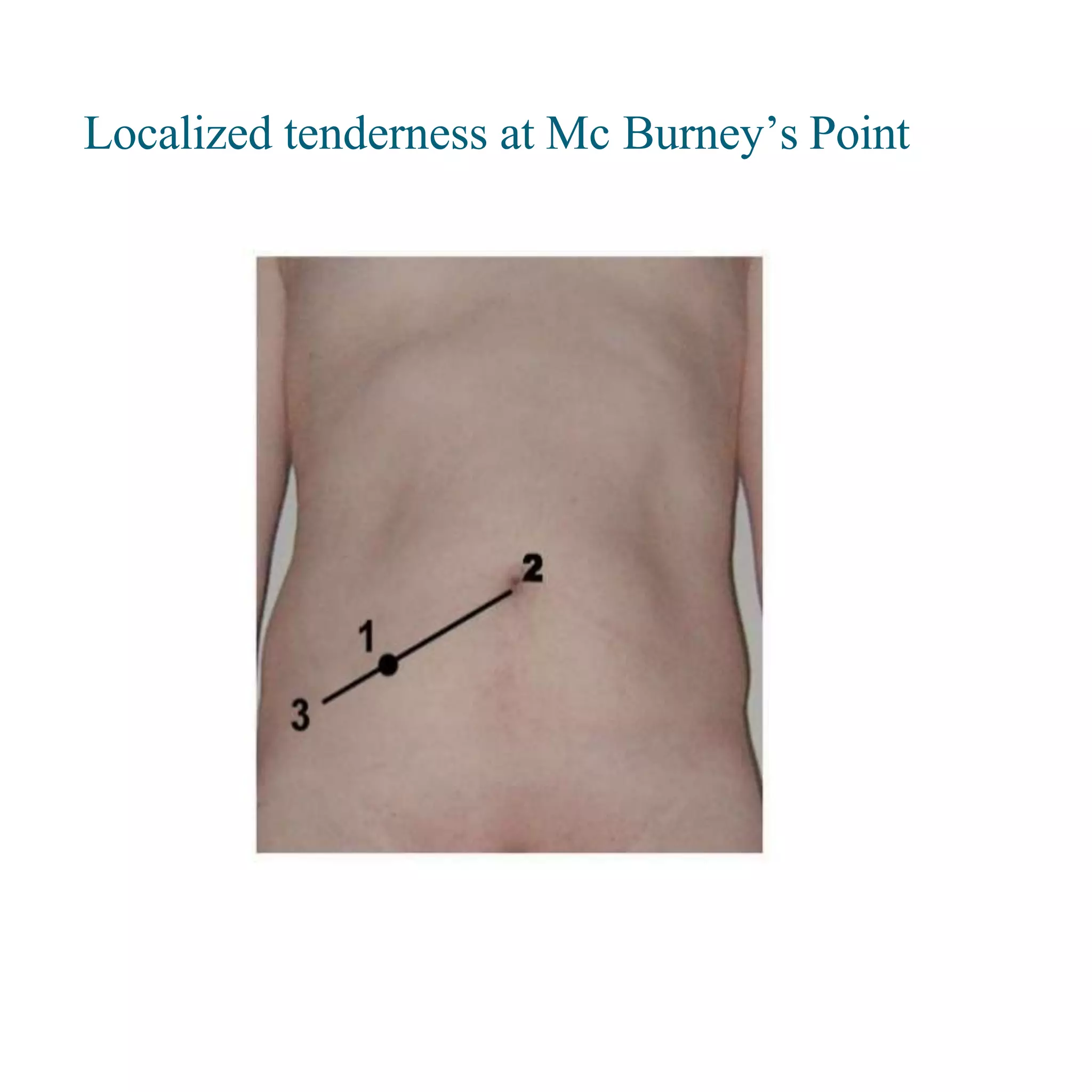
• Tenderness (localized) in the RIF
• Muscle Guarding
• Rebound Tenderness / BLUMBERG’S Sign
• Murphy’s triad : abdominal pain, vomiting,
fever
Sign to elicit in Appendicitis
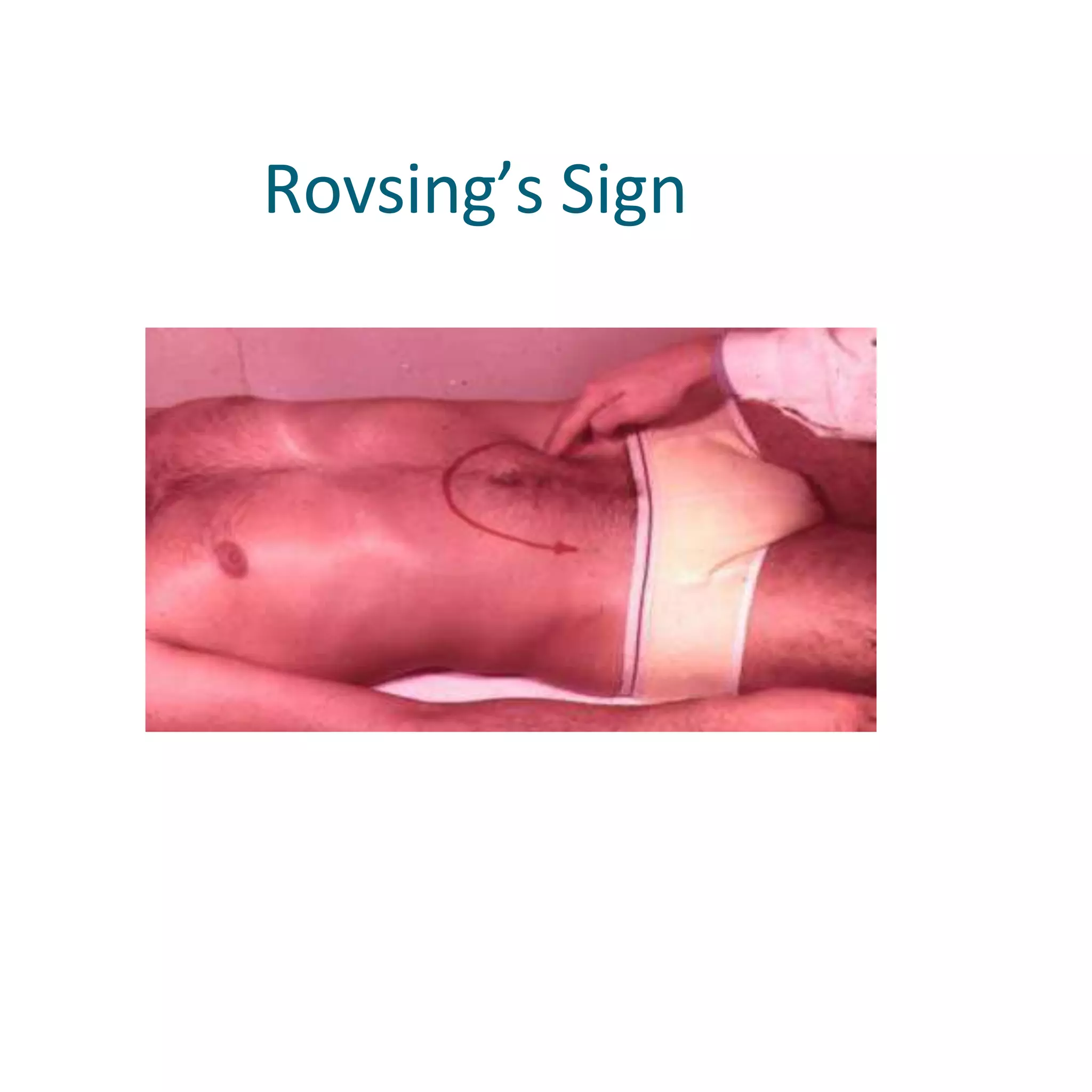
Rovsing’s Sign
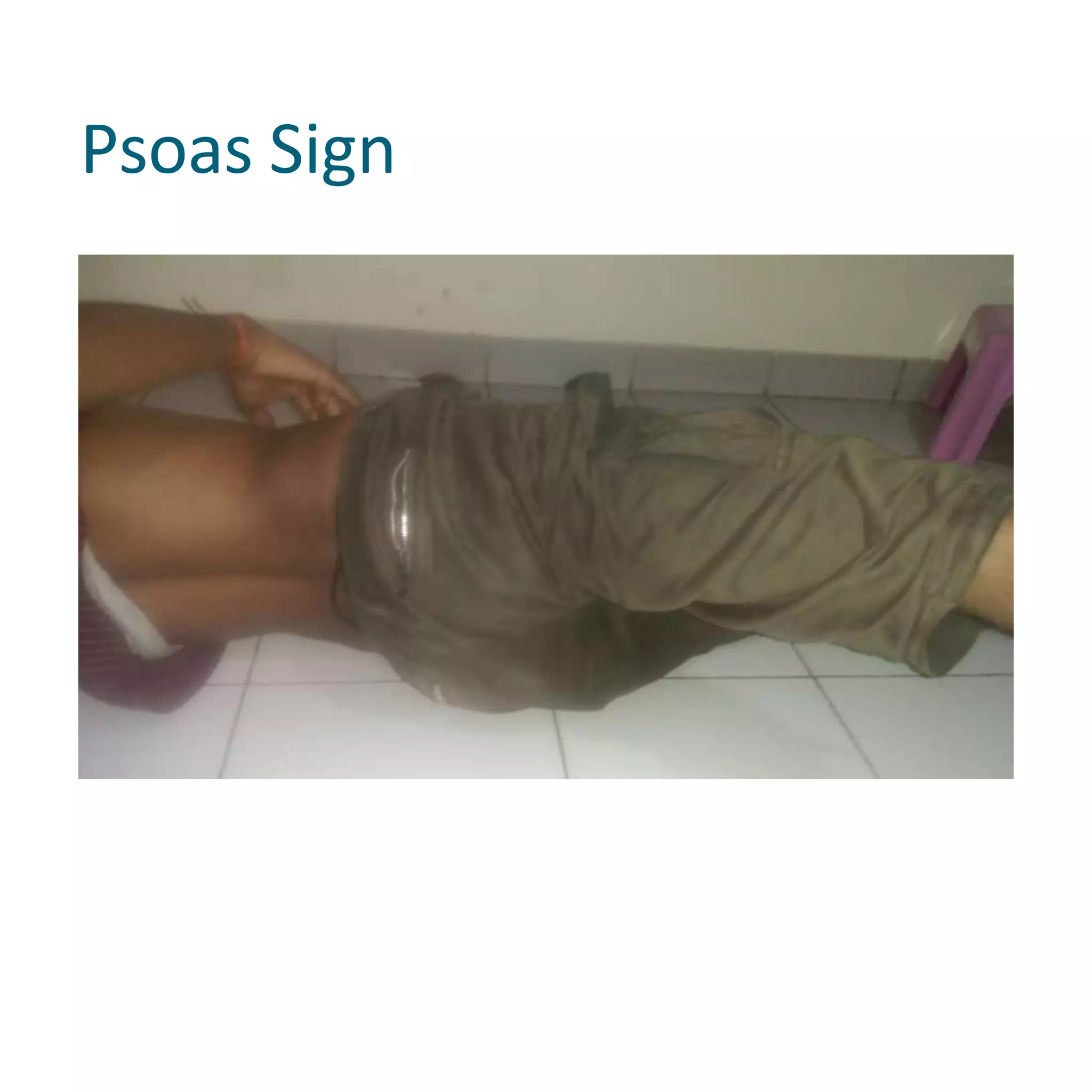
Psoas Sign
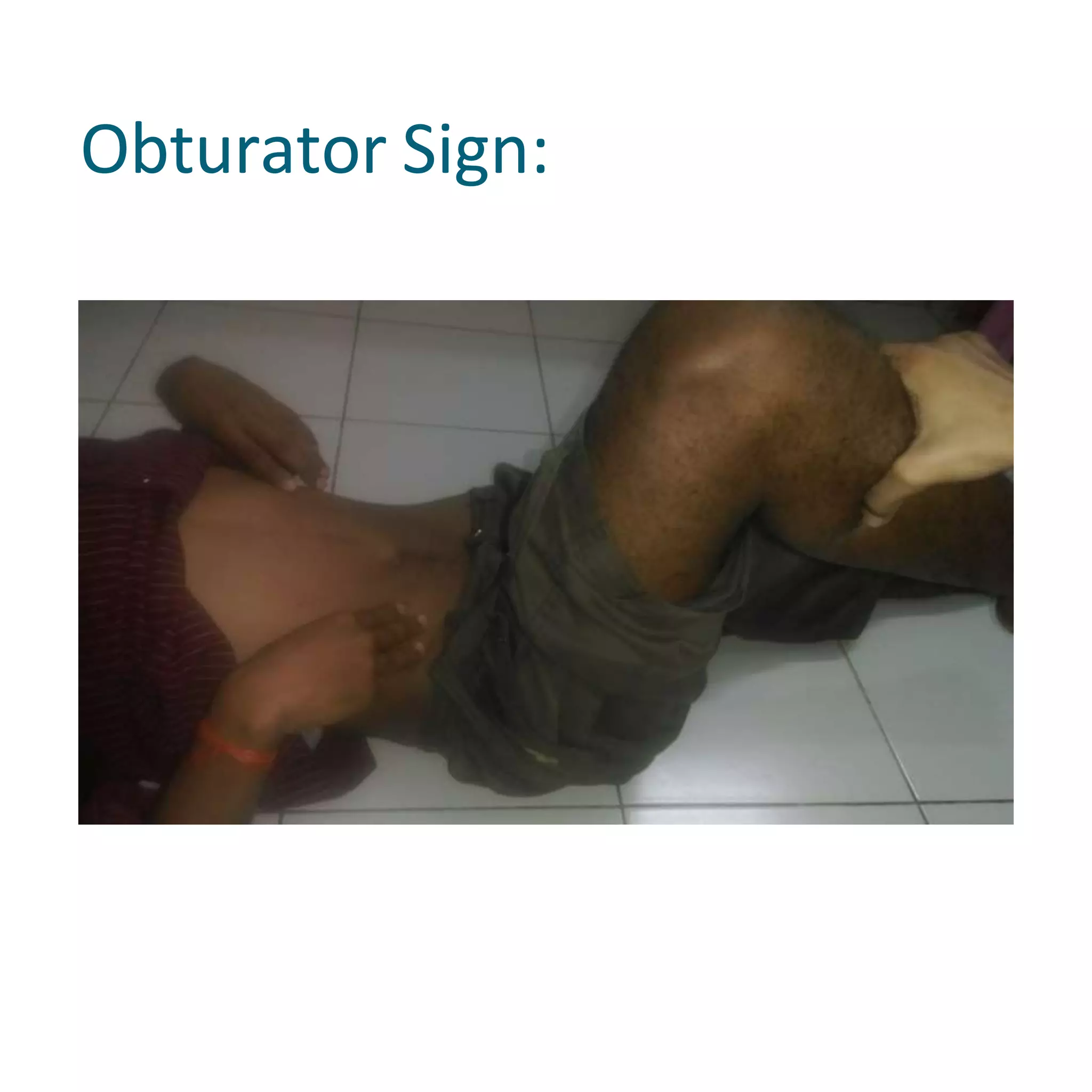
Obturator Sign:
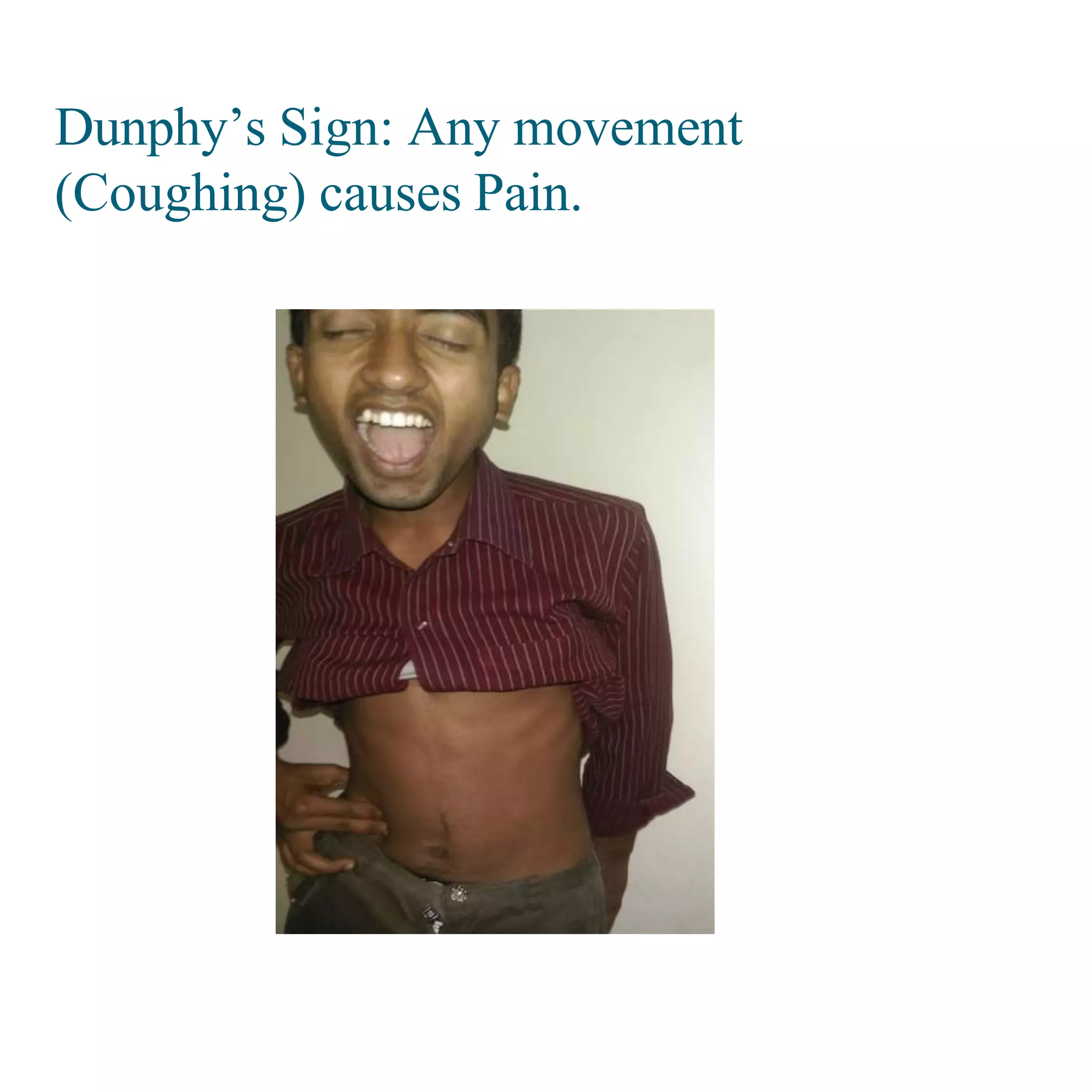
Dunphy’s Sign: Any movement
(Coughing) causes Pain.
Hyperesthesia in Sherren’s
Localized tenderness at Mc Burney’s Point
ALVARADO SCORING SYSTEM
(MANTRELS)
SYMPTOMS SCORE
Migratory RIF Pain 1
Anorexia 1
Nausea/Vomiting 1
SIGN
Tenderness in RIF 2
Rebound tenderness in RIF 1
Elevated Temperature 1
Laboratory Findings
Leucocytosis 2
Shift to the left of neutrophils 1
Total 10
Interpretation of ALVARADO Score.
Aggregates
score
7-10 Strongly
predictive of
Appendicitis
Aggregates
score
5-6 Equivocal CT & USG
helpful in
making Dx.
Aggregates
score
1-4 Appendicitis
can be ruled
out
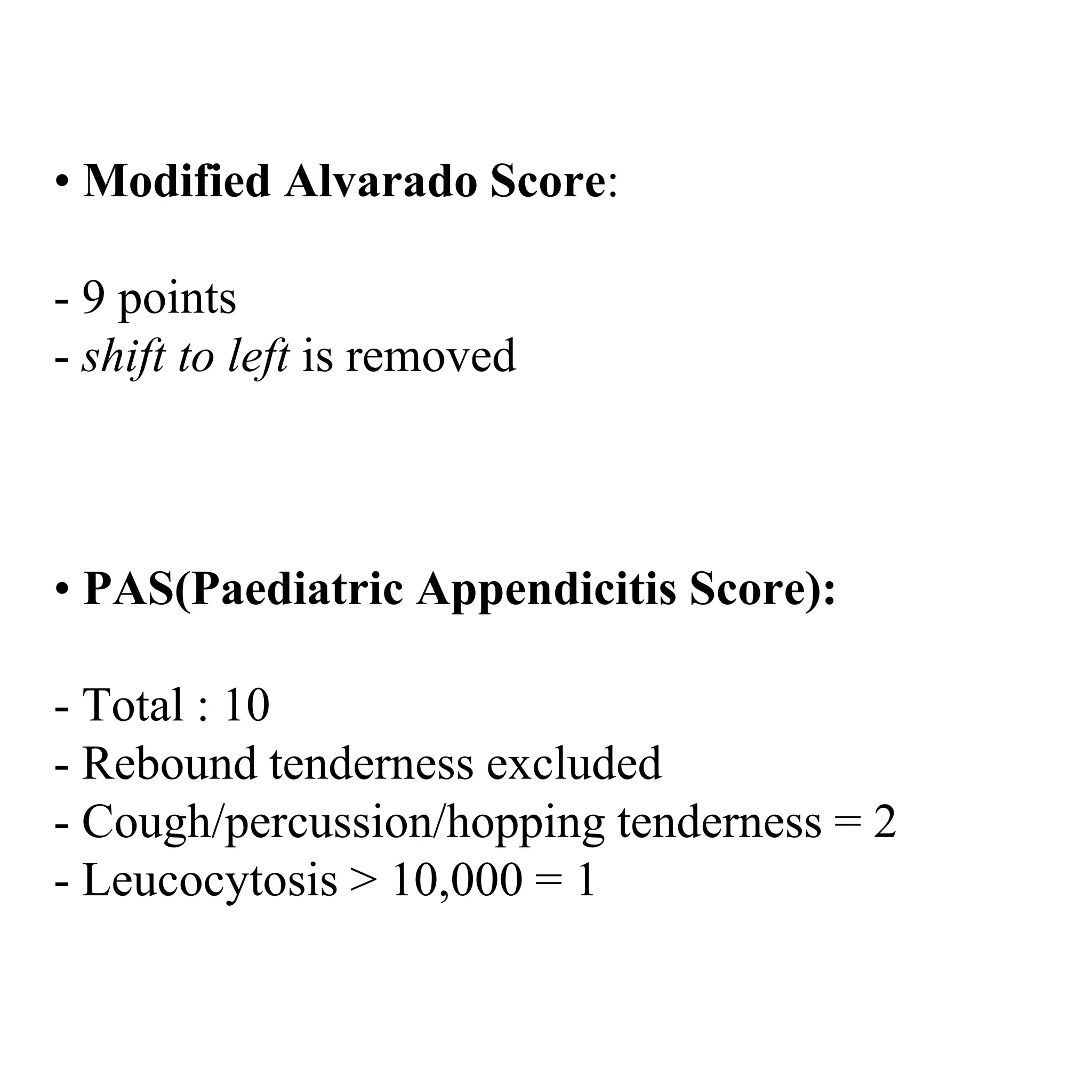
• Modified Alvarado Score:
- 9 points
- shift to left is removed
• PAS(Paediatric Appendicitis Score):
- Total : 10
- Rebound tenderness excluded
- Cough/percussion/hopping tenderness = 2
- Leucocytosis > 10,000 = 1
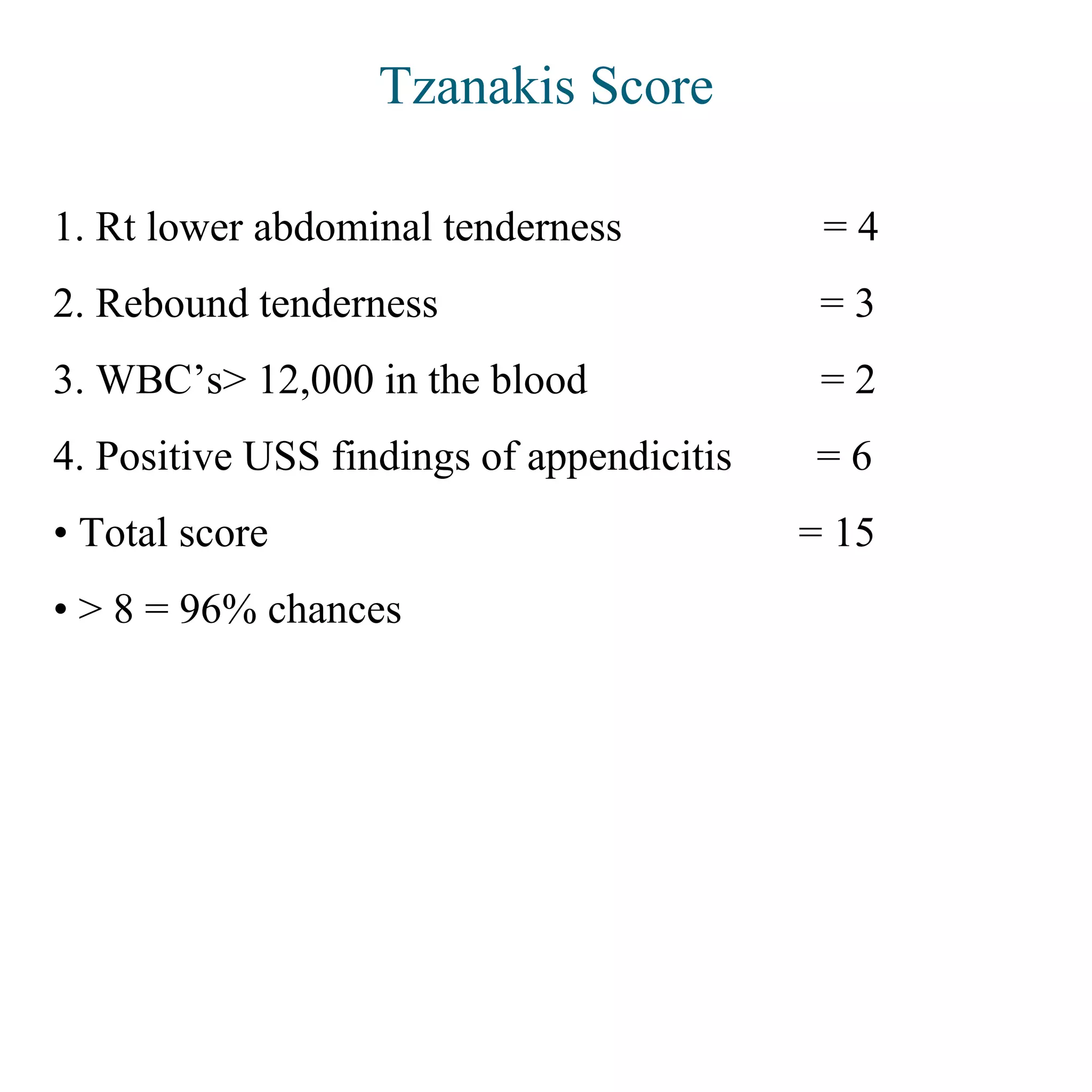
Tzanakis Score
1. Rt lower abdominal tenderness = 4
2. Rebound tenderness = 3
3. WBC’s> 12,000 in the blood = 2
4. Positive USS findings of appendicitis = 6
• Total score = 15
• > 8 = 96% chances
Special clinical scenarios
• According to position:
1. Retro-caecal
- Silent appendix
- Quadratus lumborum rigidity
- Psoas sign
- Loin tenderness
2. Pelvic
- Early diarrhoea
- Increased urinary frequency
- Deep tenderness over symphysis pubis
- DRE: Rectovesical pouch/POD tenderness
- Obturator/Psoas sign +ve
Special clinical scenarios
3. Post-ileal
- Diarrhoea
- Marked retching
- Ill defined tenderness to rt of umbilicus
Special clinical scenarios
• As per age:
1. Infants
- Uncommon <36 mths
- Difficult to diagnose
- Diffuse peritonitis common
- High incidence of perforation
2. Children
- Vomiting
- Marked anorexia
Special clinical scenarios
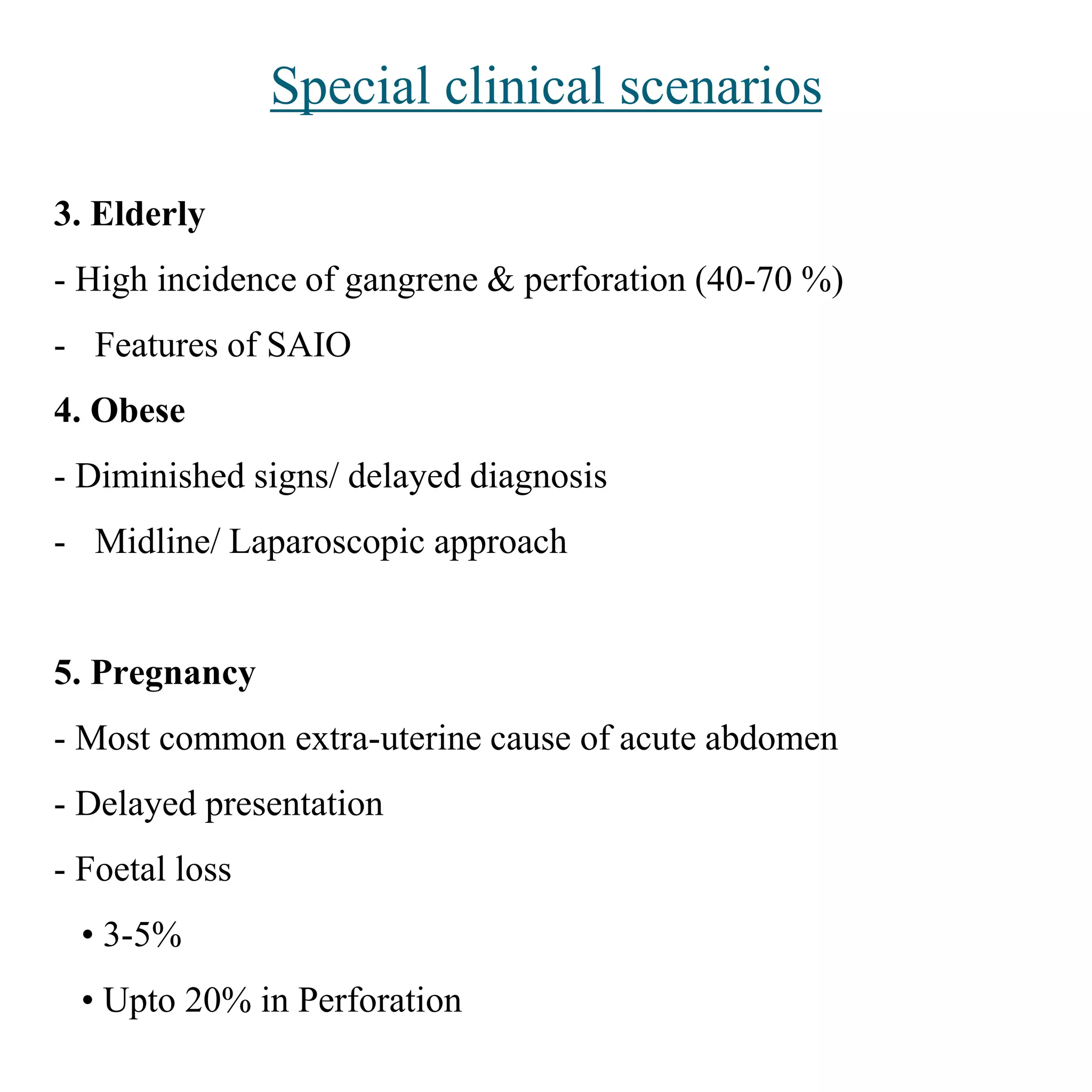
3. Elderly
- High incidence of gangrene & perforation (40-70 %)
- Features of SAIO
4. Obese
- Diminished signs/ delayed diagnosis
- Midline/ Laparoscopic approach
5. Pregnancy
- Most common extra-uterine cause of acute abdomen
- Delayed presentation
- Foetal loss
• 3-5%
• Upto 20% in Perforation
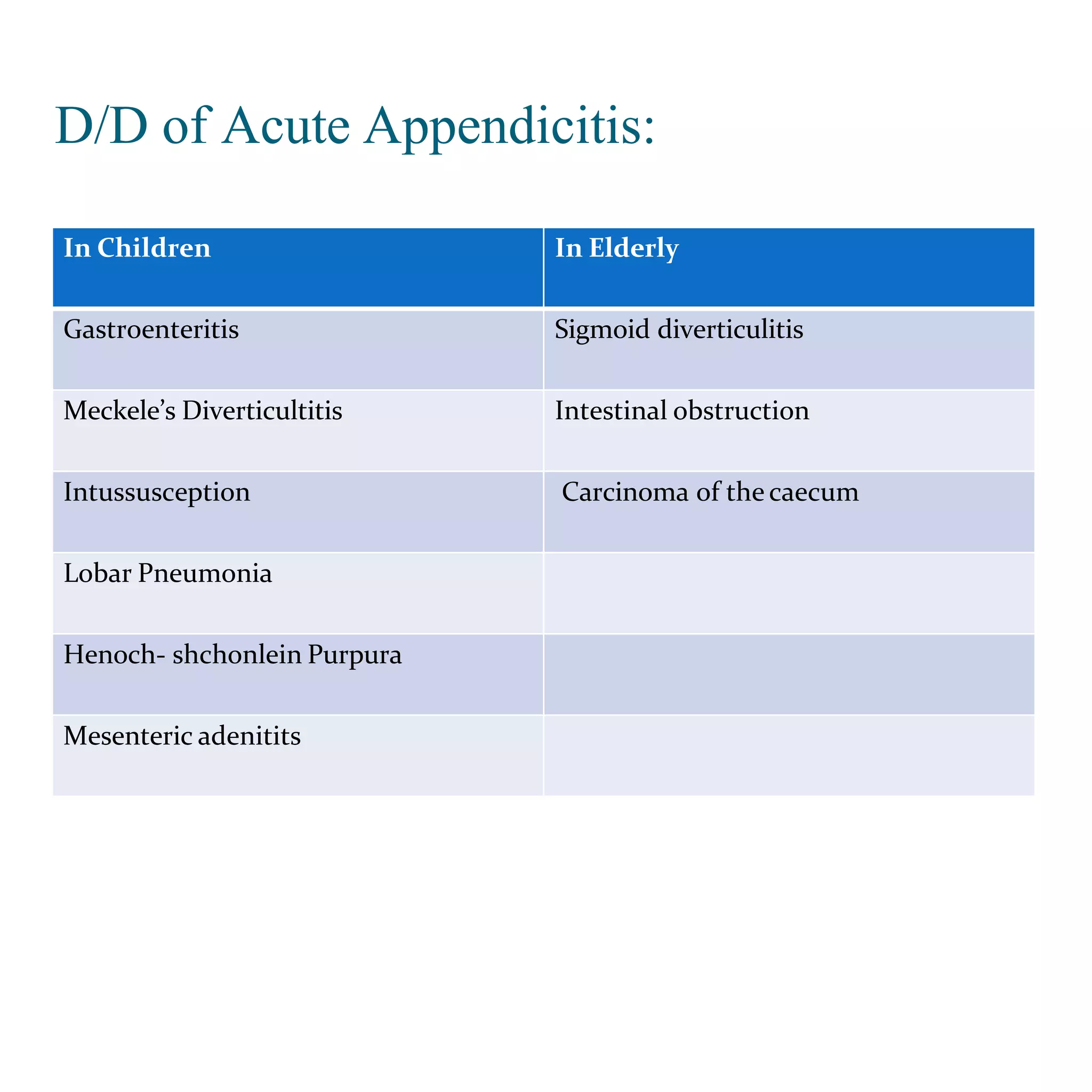
D/D of Acute Appendicitis:
In Children In Elderly
Gastroenteritis Sigmoid diverticulitis
Meckele’s Diverticultitis Intestinal obstruction
Intussusception Carcinoma of the caecum
Lobar Pneumonia
Henoch- shchonlein Purpura
Mesenteric adenitits
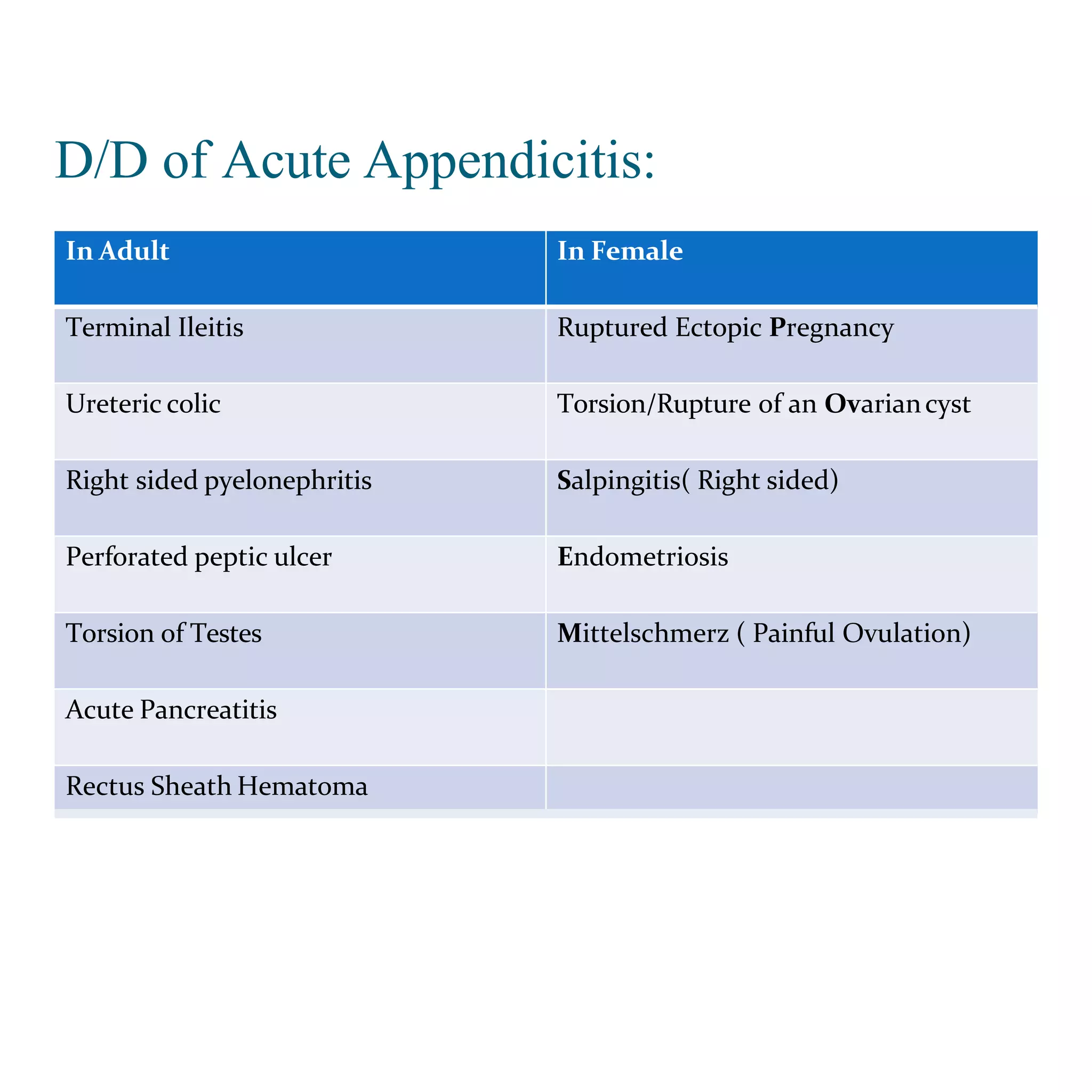
D/D of Acute Appendicitis:
In Adult In Female
Terminal Ileitis Ruptured Ectopic Pregnancy
Ureteric colic Torsion/Rupture of an Ovariancyst
Right sided pyelonephritis Salpingitis( Right sided)
Perforated peptic ulcer Endometriosis
Torsion of Testes Mittelschmerz ( Painful Ovulation)
Acute Pancreatitis
Rectus Sheath Hematoma
Appendicular Lump
Appendicular Lump- on 3rd day.
Appendix
Edematous Caecum
Terminal Ileum
Omentum ( Greater Omentum)
Loop of Intestine
Ascending Colon
Adjacent Peritoneum
Presentation of Appendicular Lump
 Usually on 3rd day of attack ofappendicitis.
 Lump in RIF
 Rigidity over thelump
 Tenderness
 Fever/ Increase pulse.
Appendicular Lump- Don’t Operate
 Severeadhesion/ Difficult toseparate the part.
 Highly vascular and dangerous tooperate
 Chance of Fecal fistula
 Max chance of iatrogenicinjury
D/D of Appendicular Lump
Hypertrophic Ileo- caecal Tuberculosis
Carcinoma of the Caecum
Crohn’s Disease
Actinomycosis
Twisted ovarian cyst in female
Right sided iliac lymphadenitis
Parametritis
Recurrent Acute Appendicitis
Inflammation of appendix may present as a chronic condition
characterized by recurrent lower abdominal pain
It arises as a consequence of incomplete self-limiting obstruction of
appendix lumen
Incidence:
Overall Risk: 20.5% (all in 3yrs and 80% in 6mnth duration)
High morbidity with complication rate 3.4% upto 18%
Recurrent Acute Appendicitis
Appendix is thickened and shows fibrosis indicating
previous inflammation
Fig: Excised appendix showing the point of luminal obstruction
with distal fibrosis.
Appendicitis

Appendicitis

  • 1.
    APPENDICITIS Moderator: Dr MTalukdar Associate Professor Presenter: Dr Monitosh Paul 2nd year PGT
  • 2.
    Objective  History  Embryology& Anomaly  Anatomy  Acute Appendicitis (Aetiology, Pathology, Clinical Diagnosis)  Special Feature (acc. to position, age)  D/D of AcuteAppendicitis  Appendicular Lump
  • 3.
    History  In 1492,Leonardo da Vinci first depicted the appendix in anatomic drawings  In 1554, Fernel first recoded case of disease in appendix  In 1521, Jacopo B da Capri, identified the appendix as an anatomic structure.  In 1710, Phillipe Verheyen coined the term 'appendixvermiformis'.  The first recorded successful appendicectomywas done in 1735 by Claudius Amyand . In 1880, Lawson Tait performed first transabdominal appendicectomy  Kurt Semm, ( German gynecologist) did first laparoscopic appendectomy in 1980.  Reginal Fitz of Harvard Medical School coined the term ‘Appendicitis’
  • 4.
    Embryology • The appendixand caecum develops as outpouching of the caudal limb of the midgut loop in 6th wks of development & appendix is visible by 8wks • 270-degree counterclockwise rotation of midgut loop occurs to lie in right side of abdomen • By 5th month, appendix elongates into vermiform shape • At birth, it is located at the tip of caecum due to differential growth of the lateral wall of the caecum. • And by 2yrs of age appendix originates from the posteromedial wall of the caecum caudal to ileocaecal valve
  • 6.
    Congenital Anomalies 1. Absenceof the Appendix: An absent appendix may have failed to form in the eighth week. Or may have formed but lacking demarcation from rest of the cecum due to same rate of development as that of caecum. (4 cases found in 71000 specimen examined) 2. Ectopic Appendix: Different locations include- in the thorax, (in association with malrotation and diaphragmatic defect), lumbar area, posterior ceacal wall 3. Left-Sided Appendix: Conditions that can result in a left-sided appendix in order of frequency are: (1) situs inversus viscerum, (2) nonrotation of the intestines, (3) "wandering“ cecum with a long mesentery, and (4) an excessively long appendix crossing the midline.
  • 7.
  • 8.
    5. Duplication ofthe Appendix: Waugh Classification: a) Double-barreled appendix, with a common muscularis and often a distal communication between the lumina b) "Bird-type" paired appendix. Symmetrically placed on either side of ileocecal valve c) Taenia coli-type duplication. Here an additional small appendix forms on a taenia along with a normal appendix at the usual site.
  • 9.
    Wallbridge Anomaly 1. TypeA anomaly. Single cecum and a partial duplication of the appendix with a single base. 2. Type B1 anomaly. Two completelyseparate appendices arise from a single cecum. 3. Type B2 anomaly. The second appendix is usually found arising from the taenia coli of the wall of the cecum. 4. Type C anomaly. Double cecum, each with its own appendix,
  • 10.
  • 11.
  • 12.
    Size of theAppendix  Length Range : 5- 35 cm Average: 9 cm  Diameter: 3 - 8 mm lumen: 1- 3 mm
  • 13.
     Origin –Postero-medial wall of the caecum ( 2cm below the ileocecalorifice)  Appendicular orifice: Guarded by an indistinct semilunar fold of mucous membrane k/as Valve of Gerlach.  Mesoappendix: peritoneum – lower surface ofthe mesentery of the terminalileum.  It is a true diverticulum containing all layers of colonic wall
  • 14.
    Microscopic anatomy Microscopic anatomy •Layers: - Mucosa - Submucosa - Muscularis - Serosa Layers: - Mucosa - Submucosa - Muscularis - Serosa
  • 15.
  • 16.
    Position of Appendix PositionIncidence Retrocecal 74% Commonest postion Pelvic 21% 2nd Commonest position Pre-ileal 1% Post- ileal 0.5% Paracaecal 2% Promontoric( Subileal /subcaecal) 1.5%
  • 17.
    In pregnancy theposition of appendix changes with period of gestation
  • 18.
    Blood Supply Arterial The appendicularartery arises from the ileocolic artery, an ileal branch, or from a cecal artery. In some cases two appendicular arteries may be presen,. An accessory appendicular artery supplying base maybe present is a branch of post cecal artery (aka the artery of Seshachalam)
  • 19.
    End Artery Thrombosis ofAppendicular artery leads to Gangrenous appendicitis
  • 20.
  • 21.
    Nerve Supply:  Autonomicinnervation: Superior mesenteric plexus  Afferent fibre by Sympathetic Nerve fibre enter to spinal cord at T10  Para Sympathetic Nerves- Vagus
  • 22.
    Lymphatic & KULTSCHITZSKYCells  The submucosa contains numerouslymphatic aggregations or follicles ( aka abdominal tonsil)  8-15 lymphatic vessels - mesoappendix  Ileocolic Node ( Sup & Inf group)  Ileocolic Nodes SMN Celiac nodes & Cysterna chyli  In the base of the crypts lie argentaffin cells (Kultschitzsky cells) which may give rise to carcinoid tumors .
  • 23.
    Function of Appendix: Thephysiologic action of this vestigial organ in human beings is not known. Due to the presence of numerous lymphatic follicles however, it is generally accepted that the appendix performs immune functions and also has role in maintaining gut microbiota Appendicectomy has protective role in Ulcerative collitis
  • 24.
    Acute Appendicitis Epidemiology: • Theincidence of acute appendicitis ranges from 8.6 to 11 cases per 10,000 person-years. • In a lifetime, 8.6% of males and 6.7% of females can be expected to develop acute appendicitis • Overall, perforation occurs in 19% of cases of acute appendicitis. • Perforated appendicitis has a bimodal distribution, with a predilection for patients at extremes of age i.e. higher among patients younger than 5 and older than 65 years
  • 25.
    Etiology:  Faecolith &fecal stasis  Lymphoid hyperplasia  Bacterial proliferation : mixed growth commonestis streptococci & E.Coli.  Intestinal parasites – Oxyuris Vermicularis (pinworm)  Tumour( Ca of the Caecum) in elderly & middle age.  Fibrotic stricture of theappendix
  • 26.
    Composition of Faecolith: Bacteria  Calcium phosphate  Epithelial Debris  Inspissated fecal material  Foreign bodies ( Rarely)
  • 27.
    Pathology: Obstructive &Non obstructive Obstructive- Primarily  Acuteappendicitis  Gangrenousappendicitis  Phlegmonous mass/paracaecal abscess  Mucocele of theappendix  Rupture of appendix
  • 28.
    Pathology Non- obstructive Obstructionis not the sole cause as some patients with fecolith is found have histologically normal appendix and the majority of patients with appendicitis show no evidence for a fecalith. Furthermore there is no signs of obstruction or elevated luminal pressure in many appendicitis cases
  • 29.
    Pathology Luminal obstruction Swelling ofthe mucosal and submucosal lymphoid tissue at the base of the appendix Increased intra-luminal pressure(mucus secretion & gas production by bacteria) Edema, mucosal ulceration Impaired venous drainage Mucosal ischaemia & Bacterial translocation to submucosa
  • 30.
    Pathology Full thickness ischemiaof appendix wall Invasion of muscularis propria, submucosa Acute Appendicitis Lump/mucocele (if resolves) Gangrenous appendicitis Perforation & Peritonitis
  • 31.
  • 32.
    Phlegmonous Mass/Paracaecal abscess Greater omentum& loops of small bowelbecome adherent tothe inflamed appendix Walling off the spread of peritoneal contamination Phlegmonous Mass / Paracaecal abscess
  • 33.
  • 34.
    Appendicular inflammation- resolves- distendedmucus filled organ- Mucocele of appendix
  • 35.
    Factors predisposing perforation Extreme of Age  Immunosuppression  Diabetes Mellitus  Faecolith obstruction  Pelvic appendix  Previous Abdominal surgery
  • 36.
  • 37.
    Clinical Features ofAcute Appendicitis Symptoms  PAIN: Initially Periumbilical region ( visceral ) in response to inflammation &obstruction. :Pain shift to right iliac fossa : Parietal peritoneum irritated and inflamed.  ANOREXIA (useful and constant feature in children)  NAUSEA with/without VOMITTING  Diarrhoea /Constipation
  • 38.
    Clinical Sign • Fever: Low grade after 6hours • Tachycardia: more pronounced in Perforation, Gangrene & Peritonitis • Mild Dehydration • Tenderness (localized) in the RIF • Muscle Guarding • Rebound Tenderness / BLUMBERG’S Sign • Murphy’s triad : abdominal pain, vomiting, fever
  • 39.
    Sign to elicitin Appendicitis
  • 40.
  • 41.
  • 42.
  • 43.
    Dunphy’s Sign: Anymovement (Coughing) causes Pain.
  • 44.
  • 45.
    Localized tenderness atMc Burney’s Point
  • 46.
    ALVARADO SCORING SYSTEM (MANTRELS) SYMPTOMSSCORE Migratory RIF Pain 1 Anorexia 1 Nausea/Vomiting 1 SIGN Tenderness in RIF 2 Rebound tenderness in RIF 1 Elevated Temperature 1 Laboratory Findings Leucocytosis 2 Shift to the left of neutrophils 1 Total 10
  • 47.
    Interpretation of ALVARADOScore. Aggregates score 7-10 Strongly predictive of Appendicitis Aggregates score 5-6 Equivocal CT & USG helpful in making Dx. Aggregates score 1-4 Appendicitis can be ruled out
  • 48.
    • Modified AlvaradoScore: - 9 points - shift to left is removed • PAS(Paediatric Appendicitis Score): - Total : 10 - Rebound tenderness excluded - Cough/percussion/hopping tenderness = 2 - Leucocytosis > 10,000 = 1
  • 49.
    Tzanakis Score 1. Rtlower abdominal tenderness = 4 2. Rebound tenderness = 3 3. WBC’s> 12,000 in the blood = 2 4. Positive USS findings of appendicitis = 6 • Total score = 15 • > 8 = 96% chances
  • 50.
    Special clinical scenarios •According to position: 1. Retro-caecal - Silent appendix - Quadratus lumborum rigidity - Psoas sign - Loin tenderness 2. Pelvic - Early diarrhoea - Increased urinary frequency - Deep tenderness over symphysis pubis - DRE: Rectovesical pouch/POD tenderness - Obturator/Psoas sign +ve
  • 51.
    Special clinical scenarios 3.Post-ileal - Diarrhoea - Marked retching - Ill defined tenderness to rt of umbilicus
  • 52.
    Special clinical scenarios •As per age: 1. Infants - Uncommon <36 mths - Difficult to diagnose - Diffuse peritonitis common - High incidence of perforation 2. Children - Vomiting - Marked anorexia
  • 53.
    Special clinical scenarios 3.Elderly - High incidence of gangrene & perforation (40-70 %) - Features of SAIO 4. Obese - Diminished signs/ delayed diagnosis - Midline/ Laparoscopic approach 5. Pregnancy - Most common extra-uterine cause of acute abdomen - Delayed presentation - Foetal loss • 3-5% • Upto 20% in Perforation
  • 54.
    D/D of AcuteAppendicitis: In Children In Elderly Gastroenteritis Sigmoid diverticulitis Meckele’s Diverticultitis Intestinal obstruction Intussusception Carcinoma of the caecum Lobar Pneumonia Henoch- shchonlein Purpura Mesenteric adenitits
  • 55.
    D/D of AcuteAppendicitis: In Adult In Female Terminal Ileitis Ruptured Ectopic Pregnancy Ureteric colic Torsion/Rupture of an Ovariancyst Right sided pyelonephritis Salpingitis( Right sided) Perforated peptic ulcer Endometriosis Torsion of Testes Mittelschmerz ( Painful Ovulation) Acute Pancreatitis Rectus Sheath Hematoma
  • 56.
  • 57.
    Appendicular Lump- on3rd day. Appendix Edematous Caecum Terminal Ileum Omentum ( Greater Omentum) Loop of Intestine Ascending Colon Adjacent Peritoneum
  • 58.
    Presentation of AppendicularLump  Usually on 3rd day of attack ofappendicitis.  Lump in RIF  Rigidity over thelump  Tenderness  Fever/ Increase pulse.
  • 59.
    Appendicular Lump- Don’tOperate  Severeadhesion/ Difficult toseparate the part.  Highly vascular and dangerous tooperate  Chance of Fecal fistula  Max chance of iatrogenicinjury
  • 60.
    D/D of AppendicularLump Hypertrophic Ileo- caecal Tuberculosis Carcinoma of the Caecum Crohn’s Disease Actinomycosis Twisted ovarian cyst in female Right sided iliac lymphadenitis Parametritis
  • 61.
    Recurrent Acute Appendicitis Inflammationof appendix may present as a chronic condition characterized by recurrent lower abdominal pain It arises as a consequence of incomplete self-limiting obstruction of appendix lumen Incidence: Overall Risk: 20.5% (all in 3yrs and 80% in 6mnth duration) High morbidity with complication rate 3.4% upto 18%
  • 62.
    Recurrent Acute Appendicitis Appendixis thickened and shows fibrosis indicating previous inflammation Fig: Excised appendix showing the point of luminal obstruction with distal fibrosis.