LEACHING
LEACHING
• Solid-Liquid Extraction process
• Mass transfer operation
• One or more constituents of solid mixture by
contact with a liquid solvent.
• Widely used in the biological and food
processing industries
• The separation of sugar from sugar beets with
hot water
Principle
• Solvent penetrate or diffuse into the solid
• Solute then diffuse through the solid solvent
mixture to surface of particle
• Until the equilibrium is established
• Rate of solvent transfer to surface of solids is
faster
• Rate of solvent transfer into solids is slower.
Types of leaching
• Unsteady state operation
• Steady state operation
Unsteady state operation
• In situ leaching
• Heap leaching
• Percolation tank
• Shank system
• Filter press leaching
• Agitated vessel
Mining industries
Steady state operation
• Agitated vessels
• Thickeners
• Continuous countercurrent decantation
• Hydrocyclone
• Filter leaching
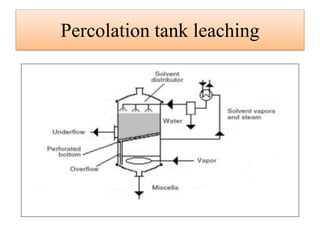
Percolation tank leaching
• Closed tanks are necessary to prevent
evaporation losses when the solvent is volatile.
• Examples: Sugar from sugar-beet slice
Percolation tank leaching
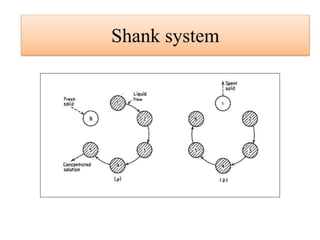
Shank system
• Used in Metallurgical industries.
• Recovery of tannins from tree barks and
woods
Shank system
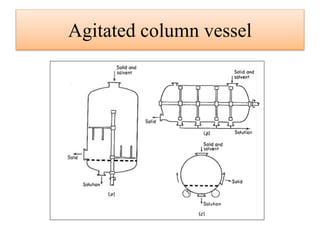
Agitated column vessel
• Used for coarse solids.
• Closed cylindrical vessels containing paddles
or stirrers on vertical shafts, as well as false
bottoms for leach solution removal.
• Finely divided solids can be suspended in
leaching solvents by agitation
Agitated column vessel
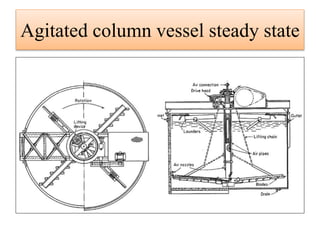
Agitated column vessel steady state
• There is a continuous flow of liquid and solid
into and out of the tank, so that no
accumulation of solid occurs.
• Turbine type agitator is used for effective
operations.
• Types: Pachuca tanks and Dorr agitators (air-
lift and mechanical principle).
• Central shaft acts as an air lift and revolves
slowly.
• Arms attached to the shaft bottom moves the
Agitated column vessel steady state
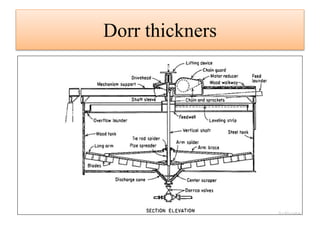
Thickeners
• It increases the ratio of solid to liquid in a
dilute suspension of finely sized particles by
settling and decanting, producing clear liquid
and thickened sludge.
• It reduces filtering costs, readily transportable
Dorr thickners
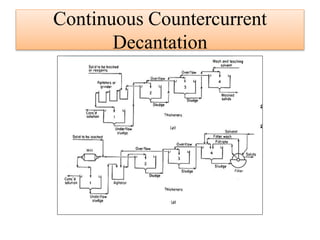
Continuous Countercurrent
Decantation
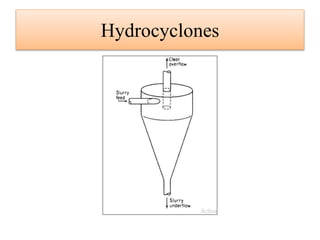
Hydrocyclones
• It is same as of size of classifications of solids.
• Used for solid-liquid separation in place of
thickeners in countercurrent washings of
solids.
Hydrocyclones
Bollman Extractor
• Contains a bucket elevator in a closed casing.
• The buckets are loaded with flaky solids such
as soybeans.
• The solids are sprayed with appropriate
amount of half miscella as they travel
downward.
• Half miscella is the intermediate solvent
containing some extracted oil and some small
solid particles.
• As solids and solvent flow concurrently down
Bollman Extractor
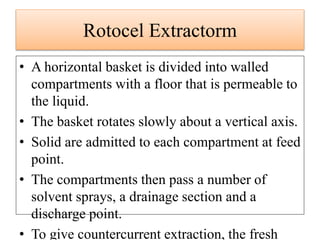
Rotocel Extractorm
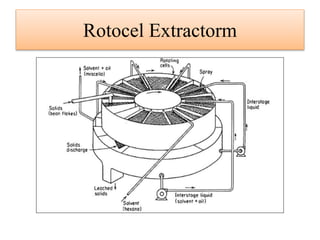
• A horizontal basket is divided into walled
compartments with a floor that is permeable to
the liquid.
• The basket rotates slowly about a vertical axis.
• Solid are admitted to each compartment at feed
point.
• The compartments then pass a number of
solvent sprays, a drainage section and a
discharge point.
• To give countercurrent extraction, the fresh
Rotocel Extractorm
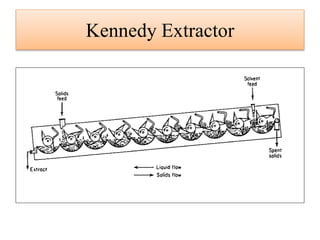
Kennedy Extractor
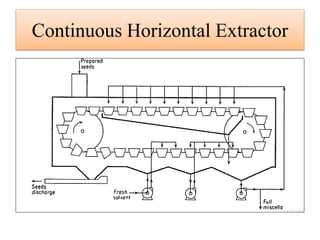
Continuous Horizontal Extractor
Leaching

Leaching

  • 1.
  • 2.
    LEACHING • Solid-Liquid Extractionprocess • Mass transfer operation • One or more constituents of solid mixture by contact with a liquid solvent. • Widely used in the biological and food processing industries • The separation of sugar from sugar beets with hot water
  • 3.
    Principle • Solvent penetrateor diffuse into the solid • Solute then diffuse through the solid solvent mixture to surface of particle • Until the equilibrium is established • Rate of solvent transfer to surface of solids is faster • Rate of solvent transfer into solids is slower.
  • 4.
    Types of leaching •Unsteady state operation • Steady state operation
  • 5.
    Unsteady state operation •In situ leaching • Heap leaching • Percolation tank • Shank system • Filter press leaching • Agitated vessel Mining industries
  • 6.
    Steady state operation •Agitated vessels • Thickeners • Continuous countercurrent decantation • Hydrocyclone • Filter leaching
  • 7.
  • 8.
    • Closed tanksare necessary to prevent evaporation losses when the solvent is volatile. • Examples: Sugar from sugar-beet slice Percolation tank leaching
  • 9.
  • 10.
    • Used inMetallurgical industries. • Recovery of tannins from tree barks and woods Shank system
  • 11.
  • 12.
    • Used forcoarse solids. • Closed cylindrical vessels containing paddles or stirrers on vertical shafts, as well as false bottoms for leach solution removal. • Finely divided solids can be suspended in leaching solvents by agitation Agitated column vessel
  • 13.
  • 14.
    • There isa continuous flow of liquid and solid into and out of the tank, so that no accumulation of solid occurs. • Turbine type agitator is used for effective operations. • Types: Pachuca tanks and Dorr agitators (air- lift and mechanical principle). • Central shaft acts as an air lift and revolves slowly. • Arms attached to the shaft bottom moves the Agitated column vessel steady state
  • 15.
    Thickeners • It increasesthe ratio of solid to liquid in a dilute suspension of finely sized particles by settling and decanting, producing clear liquid and thickened sludge. • It reduces filtering costs, readily transportable
  • 16.
  • 17.
  • 18.
    Hydrocyclones • It issame as of size of classifications of solids. • Used for solid-liquid separation in place of thickeners in countercurrent washings of solids.
  • 19.
  • 20.
  • 21.
    • Contains abucket elevator in a closed casing. • The buckets are loaded with flaky solids such as soybeans. • The solids are sprayed with appropriate amount of half miscella as they travel downward. • Half miscella is the intermediate solvent containing some extracted oil and some small solid particles. • As solids and solvent flow concurrently down Bollman Extractor
  • 22.
  • 23.
    • A horizontalbasket is divided into walled compartments with a floor that is permeable to the liquid. • The basket rotates slowly about a vertical axis. • Solid are admitted to each compartment at feed point. • The compartments then pass a number of solvent sprays, a drainage section and a discharge point. • To give countercurrent extraction, the fresh Rotocel Extractorm
  • 24.
  • 25.