Abstract
Á Wavelet-packet-based (WPB) algorithm for
 sparse response identification

Á Applicable to arbitrary frequency spectra

Á Discrete WP transform (DWPT) adaptively
 tailored to spectral energy distribution

Á Reduced complexity and number of active
 coefficients
                                              1
Introduction

 Challenge for adaptive filters: large number of
 coefficients µ high computational complexity and slow
 convergence;

 Strategy for sparse impulse responses: detect active
 coefficients before adaptation;

  µ A small number of coefficients must be adapted at
  each iteration;

                                                         2
Objectives in deriving the technique:


 1. To enable the identification of sparse responses with
    arbitrary spectral energy distribution;

 2. To obtain a number of adaptive coefficients very
    close to the number of nonzero samples of the
    actual response;

 3. To keep the computational complexity at levels
    compatible with the competing algorithms.


                                                       3
Adaptation Strategy
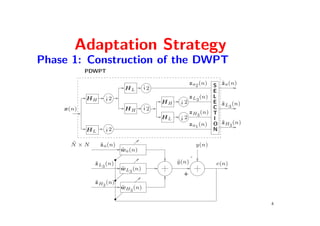
Phase 1: Construction of the DWPT
           PDWPT

                                                   z a2 (n)  ˜
                                                           S z a (n)
                           HL       2                      E
           HH      2                              z L3 (n) L
                                        HH      2          E z (n)
                                                             ˜
    x(n)                   HH       2                      C L3
                                                  z H3 (n) T
                                        HL      2          I
                                                             ˜
                                                  z a1 (n) O z H3 (n)
           HL      2                                       N

      ˜
      N ×N      ˜
                z a (n)                                  y(n)
                          ˜
                          wa (n)
                                                     -
             ˜
             z L3 (n)                        y (n)
                                             ˜                  e(n)
                          ˜
                          wL3 (n)
                                               +
             ˜
             z H3 (n)
                          ˜
                          wH3 (n)

                                                                        4
Adaptation Strategy
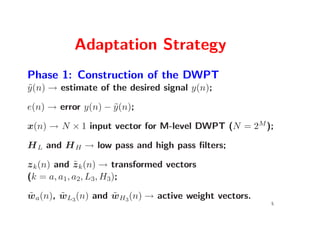
Phase 1: Construction of the DWPT
y (n) → estimate of the desired signal y(n);
˜

e(n) → error y(n) − y (n);
                    ˜

x(n) → N × 1 input vector for M-level DWPT (N = 2M );

H L and H H → low pass and high pass filters;

            ˜
z k (n) and z k (n) → transformed vectors
(k = a, a1, a2, L3, H3);

˜      ˜           ˜
wa(n), wL3 (n) and wH3 (n) → active weight vectors.
                                                      5
Adaptation Strategy
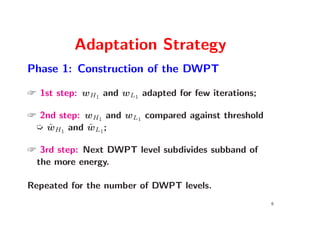
Phase 1: Construction of the DWPT

 1st step: wH1 and wL1 adapted for few iterations;

 2nd step: wH1 and wL1 compared against threshold
 µ wH1 and wL1 ;
    ˜        ˜

 3rd step: Next DWPT level subdivides subband of
 the more energy.

Repeated for the number of DWPT levels.
                                                      6
Adaptation Strategy
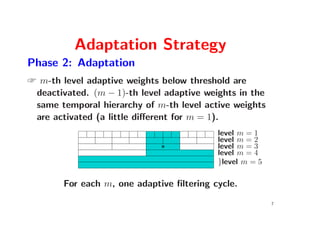
Phase 2: Adaptation
 m-th level adaptive weights below threshold are
 deactivated. (m − 1)-th level adaptive weights in the
 same temporal hierarchy of m-th level active weights
 are activated (a little different for m = 1).
                                           level m = 1
                                           level m = 2
                              *            level m = 3
                                           level m = 4
                                           }level m = 5

        For each m, one adaptive filtering cycle.
                                                          7
Adaptation Strategy

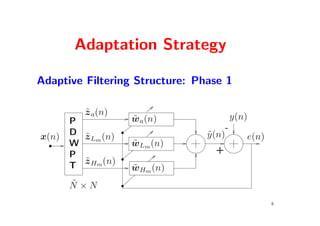
Adaptive Filtering Structure: Phase 1

          ˜
          z a(n)                         y(n)
       P            ˜
                    wa(n)
       D z (n)                       -
x(n)     ˜ Lm                   y (n)
                                ˜           e(n)
       W            ˜
                    wLm (n)
       P                          +
         ˜
       T z Hm (n)   ˜
                    wHm (n)
       ˜
       N ×N
                                                   8
Adaptive Filtering Structure: Phase 1

 Output Signal:
 y (n) = z T (n)w(n), where
 ˜       ˜       ˜
 z (n) = [˜ T (n), z T m (n), z T m (n)]T ,
 ˜        za       ˜L         ˜H
 w(n) = [wT (n), wT m (n), wT m (n)]T ;
  ˜        ˜a       ˜L          ˜H

 Error: e(n) = y(n) − y (n);
                       ˜

 Adaptive Weight Updating:
  ˜           ˜
 wa(n + 1) = wa(n) + 2˜Λ−2(n)e(n)˜ a(n)
                       µ a         z
 wLm (n + 1) = wLm (n) + 2˜λ−2 (n)e(n)˜ Lm (n)
  ˜             ˜         µ Lm        z
 wHm (n + 1) = wHm (n) + 2˜λ−2 (n)e(n)˜ Hm (n);
  ˜             ˜         µ Hm         z
                                                  9
Adaptation Strategy
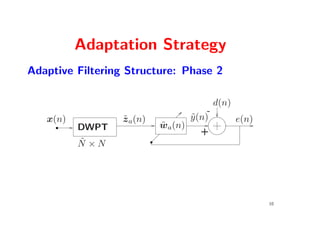
Adaptive Filtering Structure: Phase 2

                                            d(n)
                                        -
   x(n)           ˜
                  z a(n)           y (n)
                                   ˜               e(n)
          DWPT             ˜
                           wa(n)
                                      +
          ˜
          N ×N


                                                          10
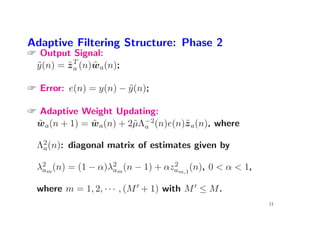
Adaptive Filtering Structure: Phase 2
 Output Signal:
 y (n) = z T (n)wa(n);
 ˜       ˜a     ˜

 Error: e(n) = y(n) − y (n);
                       ˜

 Adaptive Weight Updating:
  ˜          ˜
 wa(n + 1) = wa(n) + 2˜Λ−2(n)e(n)˜ a(n), where
                      µ a        z

  Λ2 (n): diagonal matrix of estimates given by
   a

  λ2 m (n) = (1 − α)λ2 m (n − 1) + αzam,1 (n), 0  α  1,
   a                 a
                                     2


  where m = 1, 2, · · · , (M ′ + 1) with M ′ ≤ M .
                                                            11
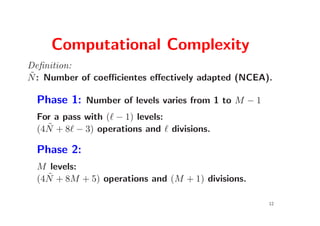
Computational Complexity
Definition:
˜
N : Number of coefficientes effectively adapted (NCEA).

  Phase 1: Number of levels varies from 1 to M − 1
  For a pass with (ℓ − 1) levels:
    ˜
  (4N + 8ℓ − 3) operations and ℓ divisions.

  Phase 2:
  M levels:
    ˜
  (4N + 8M + 5) operations and (M + 1) divisions.

                                                     12
Simulations
• Unknown responses: Sparse channel models from [6].

• Input signal: Generated using [5, Eq.(29)].

• Noise power: -40 dB

• Algorithms:
 WPB - Wavelet-Packet-Based
 HB - Haar-Basis [5]
 TD-NLMS - Wavelet transformed NLMS
 NLMS - Time-domain NLMS
                                                       13
• Detection thresholds:


               ˜˜
              µξ(k)
  T H = βf a
               ˜
              λ2(k)
                 δ
  ˜           ˜ ˜
  ξ(k) = (1 − µ)ξ(k − 1) + µe2(k)
                           ˜        (Estimate of E[e2(k)])
  βf a(phase 1 of WPB) = 3, 86
  βf a(phase 2 of WPB) = 0, 77
  βf a(HB) = 2.57,   Pf a = 0.01


                                                         14
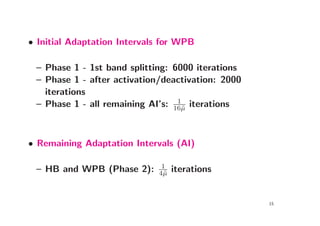
• Initial Adaptation Intervals for WPB

 – Phase 1 - 1st band splitting: 6000 iterations
 – Phase 1 - after activation/deactivation: 2000
   iterations
                                  1
 – Phase 1 - all remaining AI’s: 16˜ iterations
                                   µ


• Remaining Adaptation Intervals (AI)

                              1
 – HB and WPB (Phase 2):     4˜
                              µ   iterations


                                                   15
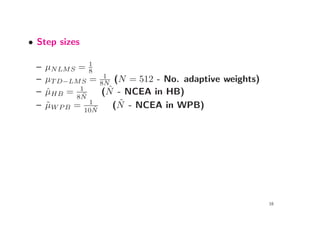
• Step sizes

               1
 –   µN LM S = 8
                   1
 –   µT D−LM S = 8N (N = 512 - No. adaptive weights)
 –   µHB = 81ˆ
     ˆ               ˆ
                   (N - NCEA in HB)
             N
 –             1
     µW P B = 10N
     ˜                 ˜
                      (N - NCEA in WPB)
                 ˜


                                                       16
Simulation Results
  Channel Response Model 1 [6]:
                 Number of Coefficients                                                     Normalized Mean-Square
                 Effectively Adapted                                                       Deviation
       600                                                                       1
                                                          HB                                                                 WPB
                                                          WPB                   −3                                           HB
       500                                                                                                                   TD-LMS
                                                                                −7
                                                                                                                             NLMS
       400                                                                      −11


                                                                    MSD in dB
NCEA


                                                                                −15

       300
                                                                                −19


       200                                                                      −23


                                                                                −27

       100
                                                                                −31


        0                                                                       −35
             0    40   80   120   160   200       240   280   320                     0    40   80   120   160   200       240   280   320
                                              3                                                                        3
                            iterations (×10 )                                                        iterations (×10 )

                                                                                                                            17
Simulation Results
   Channel Response Model 7 [6]:
                 Number of Coefficients                                                     Normalized Mean-Square
                 Effectively Adapted                                                       Deviation
       600                                                                      10
                                                          HB                                                                 WPB
                                                          WPB                                                                HB
       500                                                                                                                   TD-LMS
                                                                                 0
                                                                                                                             NLMS
       400


                                                                    MSD in dB
                                                                                −10
NCEA


       300

                                                                                −20

       200


                                                                                −30
       100


        0                                                                       −40
             0    40   80   120   160   200       240   280   320                     0    40   80   120   160   200       240        280   320
                                              3                                                                        3
                            iterations (×10 )                                                        iterations (×10 )

                                                                                                                                 18
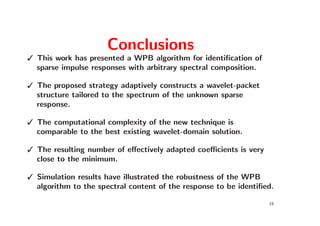
Conclusions
 This work has presented a WPB algorithm for identification of
  sparse impulse responses with arbitrary spectral composition.

 The proposed strategy adaptively constructs a wavelet-packet
  structure tailored to the spectrum of the unknown sparse
  response.

 The computational complexity of the new technique is
  comparable to the best existing wavelet-domain solution.

 The resulting number of effectively adapted coefficients is very
  close to the minimum.

 Simulation results have illustrated the robustness of the WPB
  algorithm to the spectral content of the response to be identified.

                                                                  19
Bibliography
[1] Nurgun Erdol and Filiz Basbug, ”Wavelet Transform Based Adaptive Filters: Analysis and New
    Results”, IEEE Transactions on Signal Processing, vol. 44, no. 9, pp. 2163 - 2171, Sept
    1996.
[2] M. R. Petraglia and J. C. B. Torres, ”Performance Analysis of Adaptive Filter Structure
    Employing Wavelet and Sparse Subfilters”, IEE Proceedings-Vision, Image and Signal
    Processing, vol. 149, no. 2, pp. 115 - 119, April 2002.
[3] M. I. Doroslovacki and Howard Fan, ”Wavelet-Based Linear System Modeling and Adaptive
    Filtering”, IEEE Trans. on Signal Proc., vol. 44, no. 5, pp. 1156 - 1167, May 1996.
[4] N. J. Bershad and A. Bist, ”Fast Coupled Adaptation for Sparse Impulse Responses Using a
    Partial Haar Transform”, IEEE Trans. on Signal Proc., vol. 53, no. 3, pp. 966 - 976,
    March 2005.
[5] K. C. Ho and S. D. Blunt, ”Rapid Identification of a Sparse Impulse Response Using an
    Adaptive Algorithm in the Haar Domain”, IEEE Trans. on Signal Proc., vol. 51, no. 3, pp.
    628-638, March 2003.
[6] Digital Network Echo Cancellers, ITU-T Recommendation G. 168, 2004.
[7] R. R. Coifman and Y. Meyer and M. V. Wickerhauser, Wavelet analysis and signal
    processing, Jones and Barlett, Boston, 1992.
[8] St´phane Mallat, A wavelet tour of signal processing, Academic Press, 1998.
       e


                                                                                            20

WAVELET-PACKET-BASED ADAPTIVE ALGORITHM FOR SPARSE IMPULSE RESPONSE IDENTIFICATION

  • 1.
    Abstract Á Wavelet-packet-based (WPB)algorithm for sparse response identification Á Applicable to arbitrary frequency spectra Á Discrete WP transform (DWPT) adaptively tailored to spectral energy distribution Á Reduced complexity and number of active coefficients 1
  • 2.
    Introduction Challenge foradaptive filters: large number of coefficients µ high computational complexity and slow convergence; Strategy for sparse impulse responses: detect active coefficients before adaptation; µ A small number of coefficients must be adapted at each iteration; 2
  • 3.
    Objectives in derivingthe technique: 1. To enable the identification of sparse responses with arbitrary spectral energy distribution; 2. To obtain a number of adaptive coefficients very close to the number of nonzero samples of the actual response; 3. To keep the computational complexity at levels compatible with the competing algorithms. 3
  • 4.
    Adaptation Strategy Phase 1:Construction of the DWPT PDWPT z a2 (n) ˜ S z a (n) HL 2 E HH 2 z L3 (n) L HH 2 E z (n) ˜ x(n) HH 2 C L3 z H3 (n) T HL 2 I ˜ z a1 (n) O z H3 (n) HL 2 N ˜ N ×N ˜ z a (n) y(n) ˜ wa (n) - ˜ z L3 (n) y (n) ˜ e(n) ˜ wL3 (n) + ˜ z H3 (n) ˜ wH3 (n) 4
  • 5.
    Adaptation Strategy Phase 1:Construction of the DWPT y (n) → estimate of the desired signal y(n); ˜ e(n) → error y(n) − y (n); ˜ x(n) → N × 1 input vector for M-level DWPT (N = 2M ); H L and H H → low pass and high pass filters; ˜ z k (n) and z k (n) → transformed vectors (k = a, a1, a2, L3, H3); ˜ ˜ ˜ wa(n), wL3 (n) and wH3 (n) → active weight vectors. 5
  • 6.
    Adaptation Strategy Phase 1:Construction of the DWPT 1st step: wH1 and wL1 adapted for few iterations; 2nd step: wH1 and wL1 compared against threshold µ wH1 and wL1 ; ˜ ˜ 3rd step: Next DWPT level subdivides subband of the more energy. Repeated for the number of DWPT levels. 6
  • 7.
    Adaptation Strategy Phase 2:Adaptation m-th level adaptive weights below threshold are deactivated. (m − 1)-th level adaptive weights in the same temporal hierarchy of m-th level active weights are activated (a little different for m = 1). level m = 1 level m = 2 * level m = 3 level m = 4 }level m = 5 For each m, one adaptive filtering cycle. 7
  • 8.
    Adaptation Strategy Adaptive FilteringStructure: Phase 1 ˜ z a(n) y(n) P ˜ wa(n) D z (n) - x(n) ˜ Lm y (n) ˜ e(n) W ˜ wLm (n) P + ˜ T z Hm (n) ˜ wHm (n) ˜ N ×N 8
  • 9.
    Adaptive Filtering Structure:Phase 1 Output Signal: y (n) = z T (n)w(n), where ˜ ˜ ˜ z (n) = [˜ T (n), z T m (n), z T m (n)]T , ˜ za ˜L ˜H w(n) = [wT (n), wT m (n), wT m (n)]T ; ˜ ˜a ˜L ˜H Error: e(n) = y(n) − y (n); ˜ Adaptive Weight Updating: ˜ ˜ wa(n + 1) = wa(n) + 2˜Λ−2(n)e(n)˜ a(n) µ a z wLm (n + 1) = wLm (n) + 2˜λ−2 (n)e(n)˜ Lm (n) ˜ ˜ µ Lm z wHm (n + 1) = wHm (n) + 2˜λ−2 (n)e(n)˜ Hm (n); ˜ ˜ µ Hm z 9
  • 10.
    Adaptation Strategy Adaptive FilteringStructure: Phase 2 d(n) - x(n) ˜ z a(n) y (n) ˜ e(n) DWPT ˜ wa(n) + ˜ N ×N 10
  • 11.
    Adaptive Filtering Structure:Phase 2 Output Signal: y (n) = z T (n)wa(n); ˜ ˜a ˜ Error: e(n) = y(n) − y (n); ˜ Adaptive Weight Updating: ˜ ˜ wa(n + 1) = wa(n) + 2˜Λ−2(n)e(n)˜ a(n), where µ a z Λ2 (n): diagonal matrix of estimates given by a λ2 m (n) = (1 − α)λ2 m (n − 1) + αzam,1 (n), 0 α 1, a a 2 where m = 1, 2, · · · , (M ′ + 1) with M ′ ≤ M . 11
  • 12.
    Computational Complexity Definition: ˜ N :Number of coefficientes effectively adapted (NCEA). Phase 1: Number of levels varies from 1 to M − 1 For a pass with (ℓ − 1) levels: ˜ (4N + 8ℓ − 3) operations and ℓ divisions. Phase 2: M levels: ˜ (4N + 8M + 5) operations and (M + 1) divisions. 12
  • 13.
    Simulations • Unknown responses:Sparse channel models from [6]. • Input signal: Generated using [5, Eq.(29)]. • Noise power: -40 dB • Algorithms: WPB - Wavelet-Packet-Based HB - Haar-Basis [5] TD-NLMS - Wavelet transformed NLMS NLMS - Time-domain NLMS 13
  • 14.
    • Detection thresholds: ˜˜ µξ(k) T H = βf a ˜ λ2(k) δ ˜ ˜ ˜ ξ(k) = (1 − µ)ξ(k − 1) + µe2(k) ˜ (Estimate of E[e2(k)]) βf a(phase 1 of WPB) = 3, 86 βf a(phase 2 of WPB) = 0, 77 βf a(HB) = 2.57, Pf a = 0.01 14
  • 15.
    • Initial AdaptationIntervals for WPB – Phase 1 - 1st band splitting: 6000 iterations – Phase 1 - after activation/deactivation: 2000 iterations 1 – Phase 1 - all remaining AI’s: 16˜ iterations µ • Remaining Adaptation Intervals (AI) 1 – HB and WPB (Phase 2): 4˜ µ iterations 15
  • 16.
    • Step sizes 1 – µN LM S = 8 1 – µT D−LM S = 8N (N = 512 - No. adaptive weights) – µHB = 81ˆ ˆ ˆ (N - NCEA in HB) N – 1 µW P B = 10N ˜ ˜ (N - NCEA in WPB) ˜ 16
  • 17.
    Simulation Results Channel Response Model 1 [6]: Number of Coefficients Normalized Mean-Square Effectively Adapted Deviation 600 1 HB WPB WPB −3 HB 500 TD-LMS −7 NLMS 400 −11 MSD in dB NCEA −15 300 −19 200 −23 −27 100 −31 0 −35 0 40 80 120 160 200 240 280 320 0 40 80 120 160 200 240 280 320 3 3 iterations (×10 ) iterations (×10 ) 17
  • 18.
    Simulation Results Channel Response Model 7 [6]: Number of Coefficients Normalized Mean-Square Effectively Adapted Deviation 600 10 HB WPB WPB HB 500 TD-LMS 0 NLMS 400 MSD in dB −10 NCEA 300 −20 200 −30 100 0 −40 0 40 80 120 160 200 240 280 320 0 40 80 120 160 200 240 280 320 3 3 iterations (×10 ) iterations (×10 ) 18
  • 19.
    Conclusions This workhas presented a WPB algorithm for identification of sparse impulse responses with arbitrary spectral composition. The proposed strategy adaptively constructs a wavelet-packet structure tailored to the spectrum of the unknown sparse response. The computational complexity of the new technique is comparable to the best existing wavelet-domain solution. The resulting number of effectively adapted coefficients is very close to the minimum. Simulation results have illustrated the robustness of the WPB algorithm to the spectral content of the response to be identified. 19
  • 20.
    Bibliography [1] Nurgun Erdoland Filiz Basbug, ”Wavelet Transform Based Adaptive Filters: Analysis and New Results”, IEEE Transactions on Signal Processing, vol. 44, no. 9, pp. 2163 - 2171, Sept 1996. [2] M. R. Petraglia and J. C. B. Torres, ”Performance Analysis of Adaptive Filter Structure Employing Wavelet and Sparse Subfilters”, IEE Proceedings-Vision, Image and Signal Processing, vol. 149, no. 2, pp. 115 - 119, April 2002. [3] M. I. Doroslovacki and Howard Fan, ”Wavelet-Based Linear System Modeling and Adaptive Filtering”, IEEE Trans. on Signal Proc., vol. 44, no. 5, pp. 1156 - 1167, May 1996. [4] N. J. Bershad and A. Bist, ”Fast Coupled Adaptation for Sparse Impulse Responses Using a Partial Haar Transform”, IEEE Trans. on Signal Proc., vol. 53, no. 3, pp. 966 - 976, March 2005. [5] K. C. Ho and S. D. Blunt, ”Rapid Identification of a Sparse Impulse Response Using an Adaptive Algorithm in the Haar Domain”, IEEE Trans. on Signal Proc., vol. 51, no. 3, pp. 628-638, March 2003. [6] Digital Network Echo Cancellers, ITU-T Recommendation G. 168, 2004. [7] R. R. Coifman and Y. Meyer and M. V. Wickerhauser, Wavelet analysis and signal processing, Jones and Barlett, Boston, 1992. [8] St´phane Mallat, A wavelet tour of signal processing, Academic Press, 1998. e 20