TIME SERIES ANALYSIS
A Report Submitted
in Partial Fulfilment of the Requirements
for the 8 Semester
MASTER OF SCIENCE
by
Kavita Meena
to the
School of Mathematical Sciences
National Institute of Science Education and Research
Bhubaneswar
Date 14/4/2014
INTRODUCTION
The purpose of this report is to study the spectrum of a stationary process via linear
filters and frequencies in order to do statistical analysis in frequency domain . In first
section of this report characterizations of autocovariance functions is introduce and
spectral density of an ARMA-process is determined . In section statistical analysis in
the frequency domain, testing for a white noise and estimating of spectral densities
are derived using the periodogram . In last section of this report , The box-jenkins
programme , partical application of box-jenkins method in real life is described and
various estimations for certain parameteress are found.
i
Contents
1 The Spectrum of a Stationary Process 1
1.1 Characterizatios of Autocovariance Functions . . . . . . . . . . . . . 1
1.2 Spectral distribution for linear filters . . . . . . . . . . . . . . . . . . 8
1.3 Spectral Density of an ARMA-Process . . . . . . . . . . . . . . . . . 10
2 Statistical Analysis in the Frequency Domain 13
2.1 Testing for a White Noise . . . . . . . . . . . . . . . . . . . . . . . . 13
2.2 Estimating Spectral Densities . . . . . . . . . . . . . . . . . . . . . . 15
3 The Box Jenkins Program 26
4 Conclusion 30
References 31
ii
Chapter 1
The Spectrum of a Stationary Pro-
cess
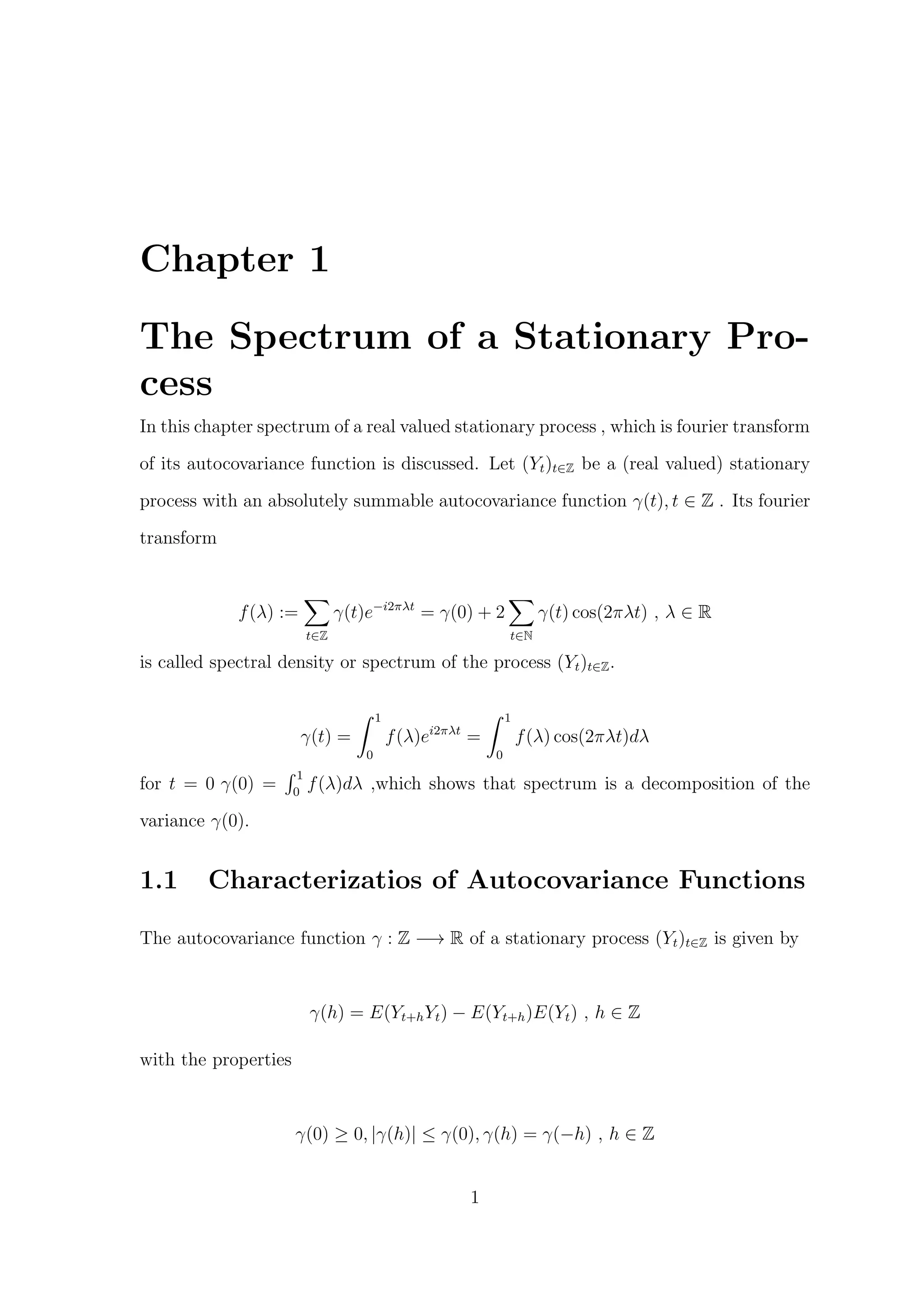
In this chapter spectrum of a real valued stationary process , which is fourier transform
of its autocovariance function is discussed. Let (Yt)t∈Z be a (real valued) stationary
process with an absolutely summable autocovariance function γ(t), t ∈ Z . Its fourier
transform
f(λ) :=
t∈Z
γ(t)e−i2πλt
= γ(0) + 2
t∈N
γ(t) cos(2πλt) , λ ∈ R
is called spectral density or spectrum of the process (Yt)t∈Z.
γ(t) =
1
0
f(λ)ei2πλt
=
1
0
f(λ) cos(2πλt)dλ
for t = 0 γ(0) =
1
0
f(λ)dλ ,which shows that spectrum is a decomposition of the
variance γ(0).
1.1 Characterizatios of Autocovariance Functions
The autocovariance function γ : Z −→ R of a stationary process (Yt)t∈Z is given by
γ(h) = E(Yt+hYt) − E(Yt+h)E(Yt) , h ∈ Z
with the properties
γ(0) ≥ 0, |γ(h)| ≤ γ(0), γ(h) = γ(−h) , h ∈ Z
1
1 The Spectrum of a Stationary Process
The following result characterizes an autocovariance function in terms of positive
semidefiniteness.
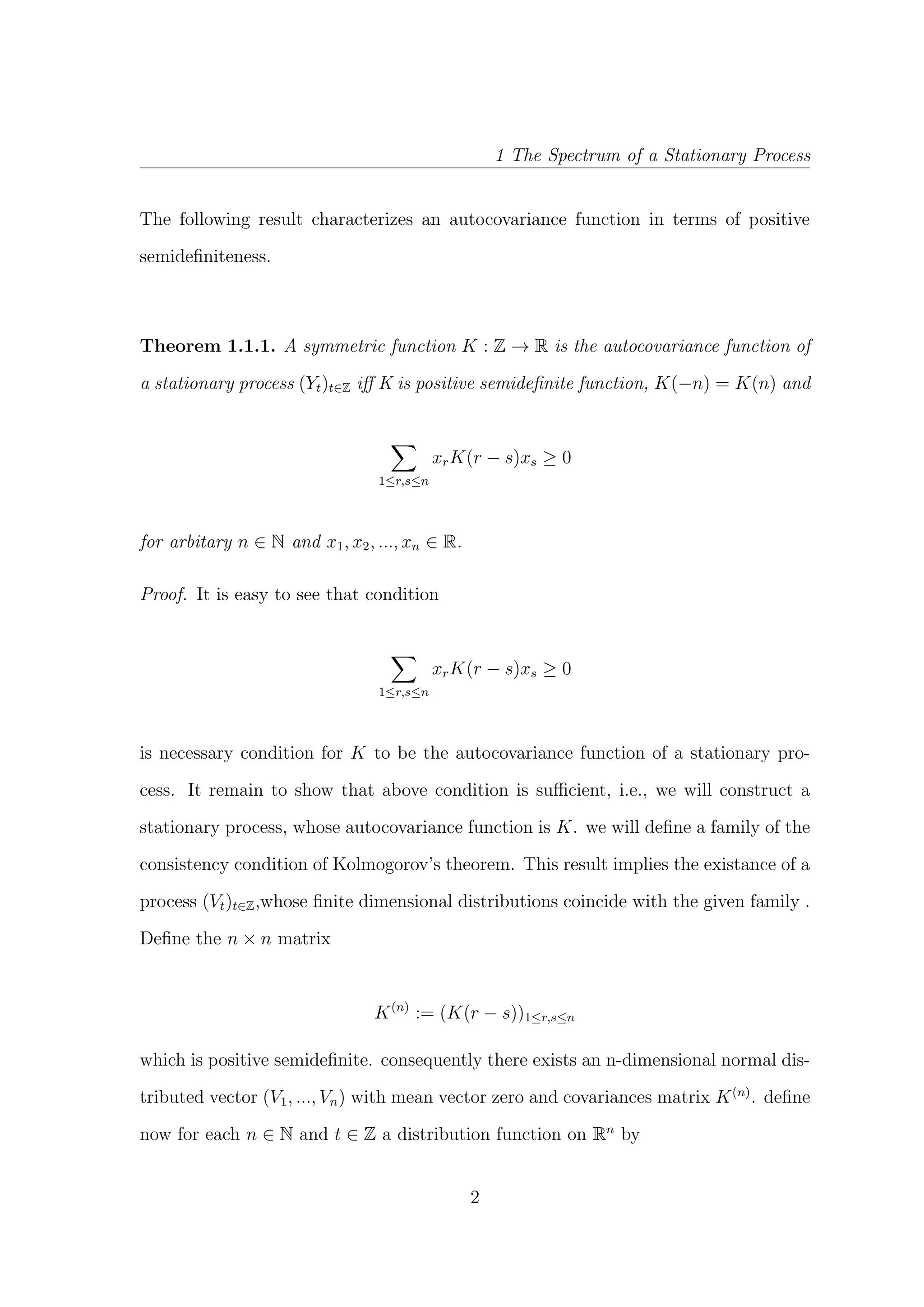
Theorem 1.1.1. A symmetric function K : Z → R is the autocovariance function of
a stationary process (Yt)t∈Z iff K is positive semidefinite function, K(−n) = K(n) and
1≤r,s≤n
xrK(r − s)xs ≥ 0
for arbitary n ∈ N and x1, x2, ..., xn ∈ R.
Proof. It is easy to see that condition
1≤r,s≤n
xrK(r − s)xs ≥ 0
is necessary condition for K to be the autocovariance function of a stationary pro-
cess. It remain to show that above condition is sufficient, i.e., we will construct a
stationary process, whose autocovariance function is K. we will define a family of the
consistency condition of Kolmogorov’s theorem. This result implies the existance of a
process (Vt)t∈Z,whose finite dimensional distributions coincide with the given family .
Define the n × n matrix
K(n)
:= (K(r − s))1≤r,s≤n
which is positive semidefinite. consequently there exists an n-dimensional normal dis-
tributed vector (V1, ..., Vn) with mean vector zero and covariances matrix K(n)
. define
now for each n ∈ N and t ∈ Z a distribution function on Rn
by
2
1 The Spectrum of a Stationary Process
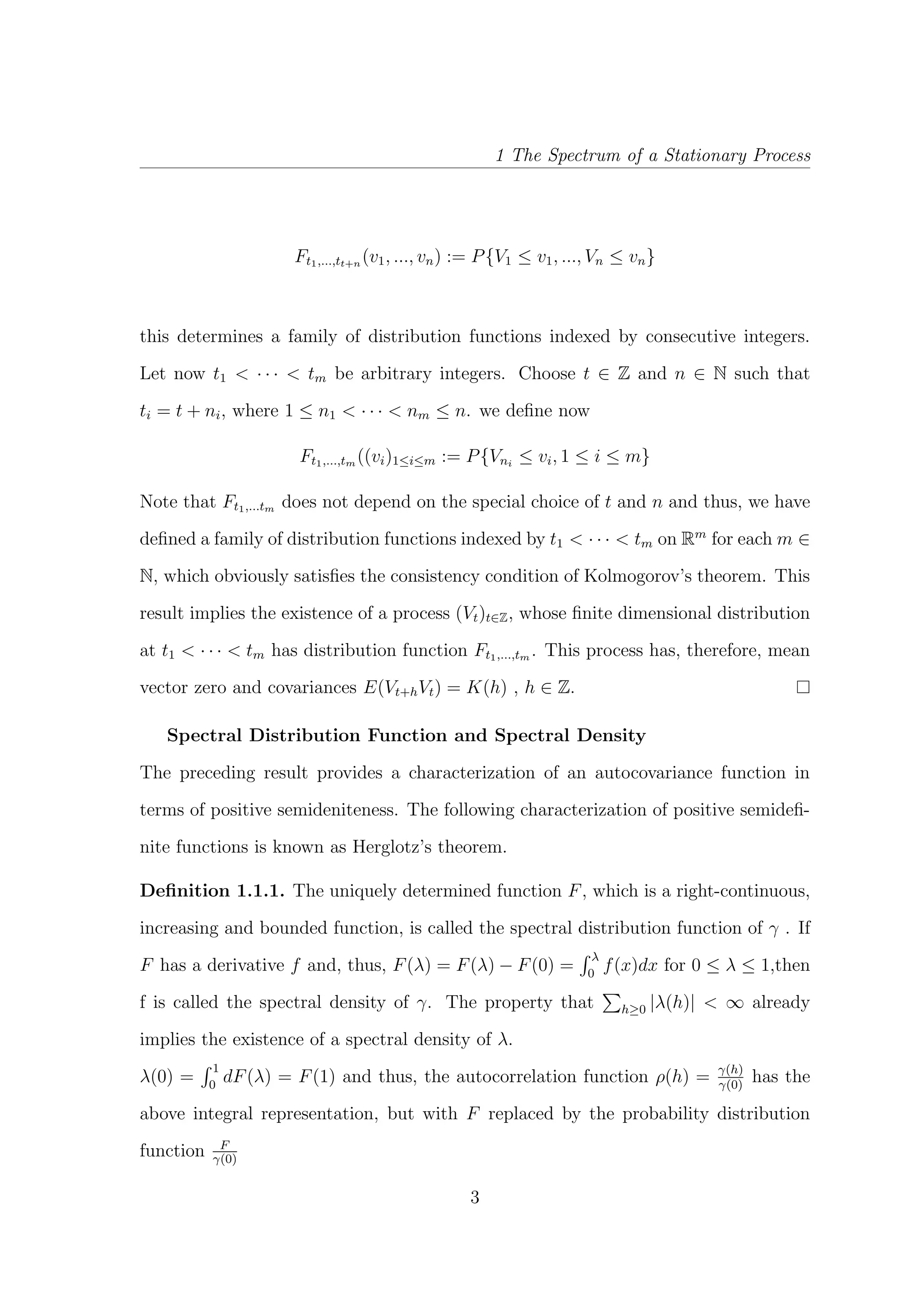
Ft1,...,tt+n (v1, ..., vn) := P{V1 ≤ v1, ..., Vn ≤ vn}
this determines a family of distribution functions indexed by consecutive integers.
Let now t1 < · · · < tm be arbitrary integers. Choose t ∈ Z and n ∈ N such that
ti = t + ni, where 1 ≤ n1 < · · · < nm ≤ n. we define now
Ft1,...,tm ((vi)1≤i≤m := P{Vni
≤ vi, 1 ≤ i ≤ m}
Note that Ft1,...tm does not depend on the special choice of t and n and thus, we have
defined a family of distribution functions indexed by t1 < · · · < tm on Rm
for each m ∈
N, which obviously satisfies the consistency condition of Kolmogorov’s theorem. This
result implies the existence of a process (Vt)t∈Z, whose finite dimensional distribution
at t1 < · · · < tm has distribution function Ft1,...,tm . This process has, therefore, mean
vector zero and covariances E(Vt+hVt) = K(h) , h ∈ Z.
Spectral Distribution Function and Spectral Density
The preceding result provides a characterization of an autocovariance function in
terms of positive semideniteness. The following characterization of positive semidefi-
nite functions is known as Herglotz’s theorem.
Definition 1.1.1. The uniquely determined function F, which is a right-continuous,
increasing and bounded function, is called the spectral distribution function of γ . If
F has a derivative f and, thus, F(λ) = F(λ) − F(0) =
λ
0
f(x)dx for 0 ≤ λ ≤ 1,then
f is called the spectral density of γ. The property that h≥0 |λ(h)| < ∞ already
implies the existence of a spectral density of λ.
λ(0) =
1
0
dF(λ) = F(1) and thus, the autocorrelation function ρ(h) = γ(h)
γ(0)
has the
above integral representation, but with F replaced by the probability distribution
function F
γ(0)
3
1 The Spectrum of a Stationary Process
Theorem 1.1.2. A symmetric function K : Z −→ R is positive semidefinite iff it
can be represented as an integral
γ(h) =
1
0
ei2πλh
dF(λ) =
1
0
cos(2πλh)dF(λ),
where F is a real valued measure generating function on [0, 1] with F(0) = 0. The
function F is uniquely determined.
Proof. We establish first the uniqueness of F. Let G be another measure generating
function with G(λ) = 0 for λ ≤ 0 and constant for λ ≥ 1 such that
γ(h) =
1
0
ei2πλh
dF(λ) =
1
0
ei2πλh
dG(λ) , h ∈ Z.
Let now ψ be a continuous function on [0, 1]. From calculus we know that we can find
for arbitrary ε > 0 a trigonometric polynomial pε(λ) = N
h=−N ahei2πλh
, 0 ≤ λ ≤ 1,
such that
sup
0≤λ≤1
|ψ(λ) − pε(λ)| ≤ ε.
As a consequence we obtain that
1
0
ψ(λ)dF(λ) =
1
0
pε(λ)dF(λ) + r1(ε)
=
1
0
pε(λ)dG(λ) + r1(ε)
=
1
0
ψ(λ)dG(λ) + r2(ε)
where ri(ε) → 0 as ε → 0, i = 1, 2, and, thus,
1
0
ψ(λ)dF(λ) =
1
0
ψ(λ)dG(λ).
Since ψ was an arbitrary continuous function, this in turn together with F(0) =
G(0) = 0 implies F = G. Suppose now that γ has the representation
γ(h) =
1
0
ei2πλh
dF(λ) =
1
0
cos(2πλh)dF(λ)
4
1 The Spectrum of a Stationary Process
We have for arbitrary xi ∈ R, i = 1, ..., n
1≤r,s≤n
xrγ(r − s)xs =
1
0 1≤r,s≤n
xrxsei2πλ(r−s)
dF(λ)
=
1
0
|
n
r=1
xrei2πλr
|2
dF(λ) ≥ 0,
i.e., γ is positive semidefinite. Suppose conversely that γ : Z −→ R is a positive
semidefinite function. This implies that for 0 ≤ λ ≤ 1 and N ∈ N
fN (λ) :=
1
N 1≤r,s≤N
e−i2πλr
γ(r − s)ei2πλs
=
1
N
|m|<N
(N − |m|)γ(m)e−i2πλm
≥ 0
Put now
FN (λ) :=
λ
0
fN (x)dx, 0 ≤ λ ≤ 1.
Then we have for each h ∈ Z
1
0
ei2πλh
=
|m|<N
1 −
|m|
N
γ(m)
1
0
ei2πλ(h−m)
dλ
=
1 − |m|
N
γ(m) if |h| < N
0, if |h| ≥ N
Since FN (1) = γ(0) < ∞ for any N ∈ N, we can apply Helly’s selection theorem to
deduce the existence of a measure generating function ˜F and a subsequence (FNk
)k
such that FNk
converges weakly to ˜F i.e.,
1
0
g(λ)dFNk
(λ)
k→∞
−−−→
1
0
g(λ)d ˜F(λ)
for every continuous and bounded function g : [0, 1] −→ R. Put now F(λ) :=
˜F(λ) − ˜F(0). Then F is a measure generating function with F(0) = 0 and
1
0
g(λ)d ˜F(λ) =
1
0
g(λ)dF(λ).
5
1 The Spectrum of a Stationary Process
If we replace N in
1
0
ei2πλh
=
|m|<N
1 −
|m|
N
γ(m)
1
0
ei2πλ(h−m)
dλ
=
1 − |m|
N
γ(m) if |h| < N
0, if |h| ≥ N
by Nk and let k tend to infinity, we now obtain representation desired.
Example 1.1.1. A white noise (εt)tinZ has the autocovariance function
γ(h) =
σ2
, if h = 0
0, if h ∈ Z  {0}
Since
1
0
σ2
ei2πλh
dλ =
σ2
, if h = 0
0, if h ∈ Z  {0}
the process (εt) has by Theorem 1.1.2 the constant spectral density f(λ) = σ2
, 0 ≤
λ ≤ 1. This is the name giving property of the white noise process: As the white
light is characteristically perceived to belong to objects that reflect nearly all incident
energy throughout the visible spectrum, a white noise process weighs all possible
frequencies equally.
Corollary 1.1.3. A symmetric function γ : Z −→ R is the autocovariance function
of a stationary process (Yt)t∈Z, iff it satisfies one of the following two (equivalent)
conditions:
(i) γ(h) =
1
0
ei2πλh
dF(λ), h ∈ Z, where F is a measure generating function on [0, 1]
with F(0) = 0.
(ii) 1≤r,s≤n xrγ(r − s)xs ≥ 0 for each n ∈ N and x1, ..., xn ∈ R.
Corollary 1.1.4. A symmetric function γ : Z −→ R with t∈Z |γ(t)| < ∞ is the
autocovariance function of a stationary process iff
f(λ) :=
t∈Z
γ(t)e−i2πλt
≥ 0 , λ ∈ [0, 1]
6
1 The Spectrum of a Stationary Process
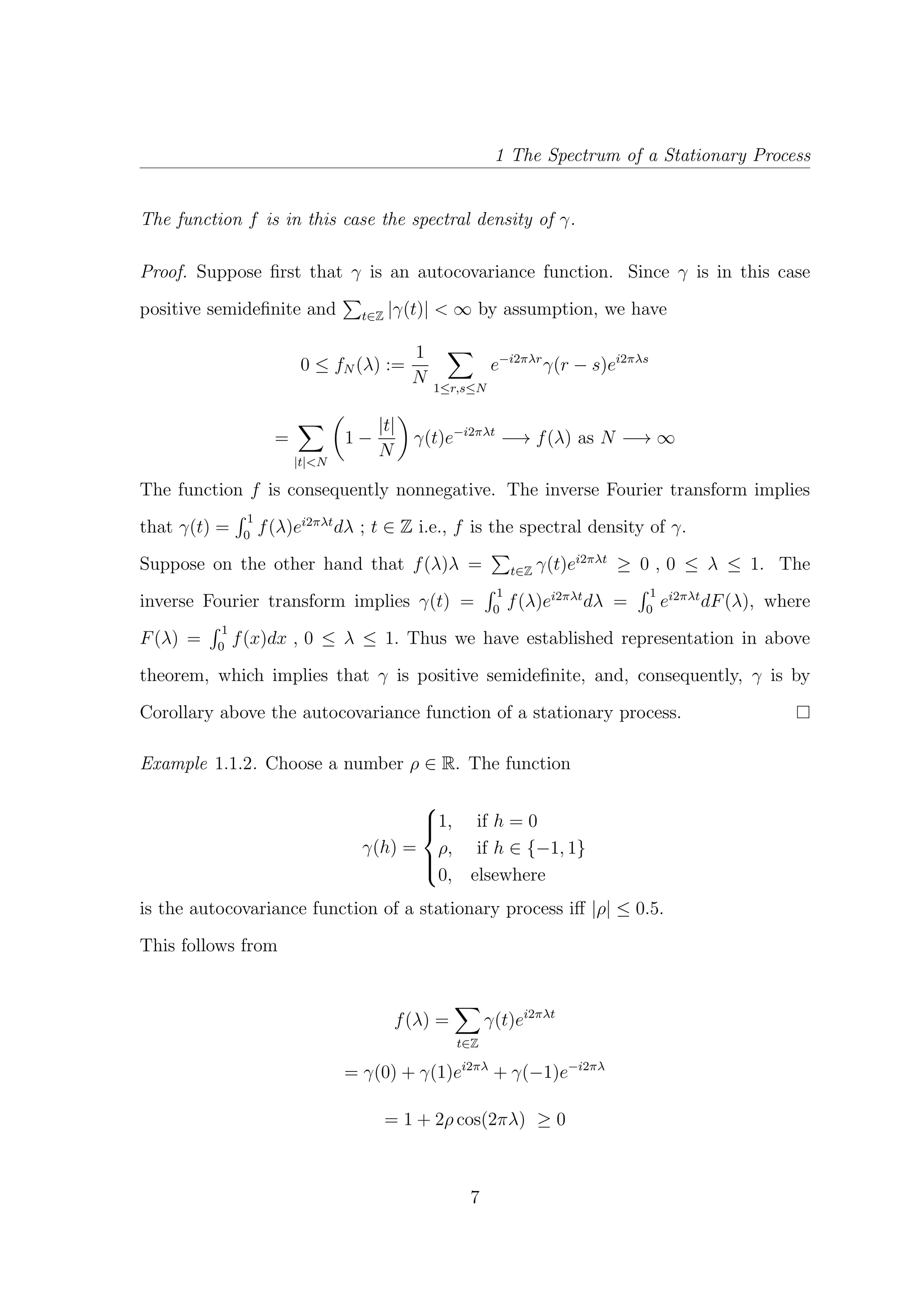
The function f is in this case the spectral density of γ.
Proof. Suppose first that γ is an autocovariance function. Since γ is in this case
positive semidefinite and t∈Z |γ(t)| < ∞ by assumption, we have
0 ≤ fN (λ) :=
1
N 1≤r,s≤N
e−i2πλr
γ(r − s)ei2πλs
=
|t|<N
1 −
|t|
N
γ(t)e−i2πλt
−→ f(λ) as N −→ ∞
The function f is consequently nonnegative. The inverse Fourier transform implies
that γ(t) =
1
0
f(λ)ei2πλt
dλ ; t ∈ Z i.e., f is the spectral density of γ.
Suppose on the other hand that f(λ)λ = t∈Z γ(t)ei2πλt
≥ 0 , 0 ≤ λ ≤ 1. The
inverse Fourier transform implies γ(t) =
1
0
f(λ)ei2πλt
dλ =
1
0
ei2πλt
dF(λ), where
F(λ) =
1
0
f(x)dx , 0 ≤ λ ≤ 1. Thus we have established representation in above
theorem, which implies that γ is positive semidefinite, and, consequently, γ is by
Corollary above the autocovariance function of a stationary process.
Example 1.1.2. Choose a number ρ ∈ R. The function
γ(h) =



1, if h = 0
ρ, if h ∈ {−1, 1}
0, elsewhere
is the autocovariance function of a stationary process iff |ρ| ≤ 0.5.
This follows from
f(λ) =
t∈Z
γ(t)ei2πλt
= γ(0) + γ(1)ei2πλ
+ γ(−1)e−i2πλ
= 1 + 2ρ cos(2πλ) ≥ 0
7
1 The Spectrum of a Stationary Process
for λ ∈ [0, 1] iff |ρ| ≤ 0.5. The function γ is the autocorrelation function of an
MA(1)-process. The spectral distribution function of a stationary process satisfies
F(0.5 + λ) − F(0.5−
) = F(0.5) − F((0.5 − λ)−
) , 0 ≤ λ < 0.5,
where F(x−
) := limε↓0F(x − ε) is the left-hand limit of F at x ∈ (0, 1] . If F has
a derivative f, we obtain from the above symmetry f(0.5 + λ) = f(0.5 − λ) or,
equivalently, f(1λ) = f(λ) and, hence,
γ(h) =
1
0
cos(2πλh)dF(λ) = 2
0.5
0
cos(2πλh)f(λ)df(λ)
The autocovariance function of a stationary process is, therefore, determined by the
values f(λ) , 0 ≤ λ ≤ 0.5, if the spectral density exists. Moreover, that the smallest
nonconstant period P0 visible through observations evaluated at time points t =
1, 2, ... is P0 = 2 i.e., the largest observable frequency is the Nyquist frequency λ0 =
1
P0
= 0.5, Hence, the spectral density f(λ) matters only for λ ∈ [0, 0.5].
Remark 1.1.1. The preceding Theorems shows that a function f : [0, 1] −→ R is the
spectral density of a stationary process iff f satisfies the following three conditions
(i)f(λ) ≥ 0,
(ii)f(λ) = f(1 − λ),
(iii)
1
0
f(λ)dλ < ∞
1.2 Spectral distribution for linear filters
Theorem 1.2.1. Let (Zt)t∈Z be a stationary process with spectral distribution function
FZ and let (at)t∈Z be an absolutely summable filter with Fourier transform fa. The
linear filtered process Yt := u∈Z auZt−u, t ∈ Z then has the spectral distribution
function
FY (λ) :=
1
0
|fa(x)|2
dFZ(x) , 0 ≤ λ ≤ 1.
8
1 The Spectrum of a Stationary Process
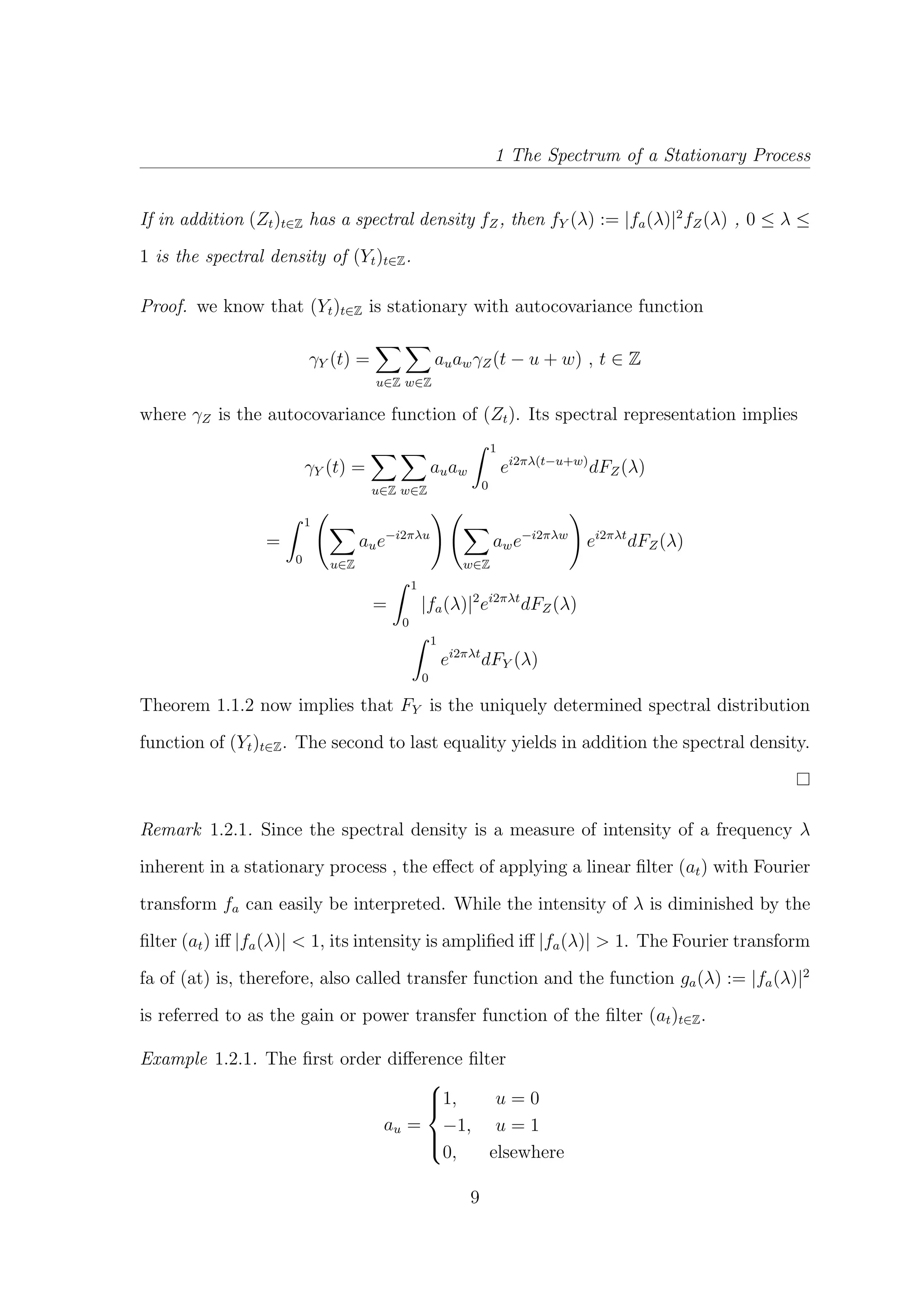
If in addition (Zt)t∈Z has a spectral density fZ, then fY (λ) := |fa(λ)|2
fZ(λ) , 0 ≤ λ ≤
1 is the spectral density of (Yt)t∈Z.
Proof. we know that (Yt)t∈Z is stationary with autocovariance function
γY (t) =
u∈Z w∈Z
auawγZ(t − u + w) , t ∈ Z
where γZ is the autocovariance function of (Zt). Its spectral representation implies
γY (t) =
u∈Z w∈Z
auaw
1
0
ei2πλ(t−u+w)
dFZ(λ)
=
1
0 u∈Z
aue−i2πλu
w∈Z
awe−i2πλw
ei2πλt
dFZ(λ)
=
1
0
|fa(λ)|2
ei2πλt
dFZ(λ)
1
0
ei2πλt
dFY (λ)
Theorem 1.1.2 now implies that FY is the uniquely determined spectral distribution
function of (Yt)t∈Z. The second to last equality yields in addition the spectral density.
Remark 1.2.1. Since the spectral density is a measure of intensity of a frequency λ
inherent in a stationary process , the effect of applying a linear filter (at) with Fourier
transform fa can easily be interpreted. While the intensity of λ is diminished by the
filter (at) iff |fa(λ)| < 1, its intensity is amplified iff |fa(λ)| > 1. The Fourier transform
fa of (at) is, therefore, also called transfer function and the function ga(λ) := |fa(λ)|2
is referred to as the gain or power transfer function of the filter (at)t∈Z.
Example 1.2.1. The first order difference filter
au =



1, u = 0
−1, u = 1
0, elsewhere
9
1 The Spectrum of a Stationary Process
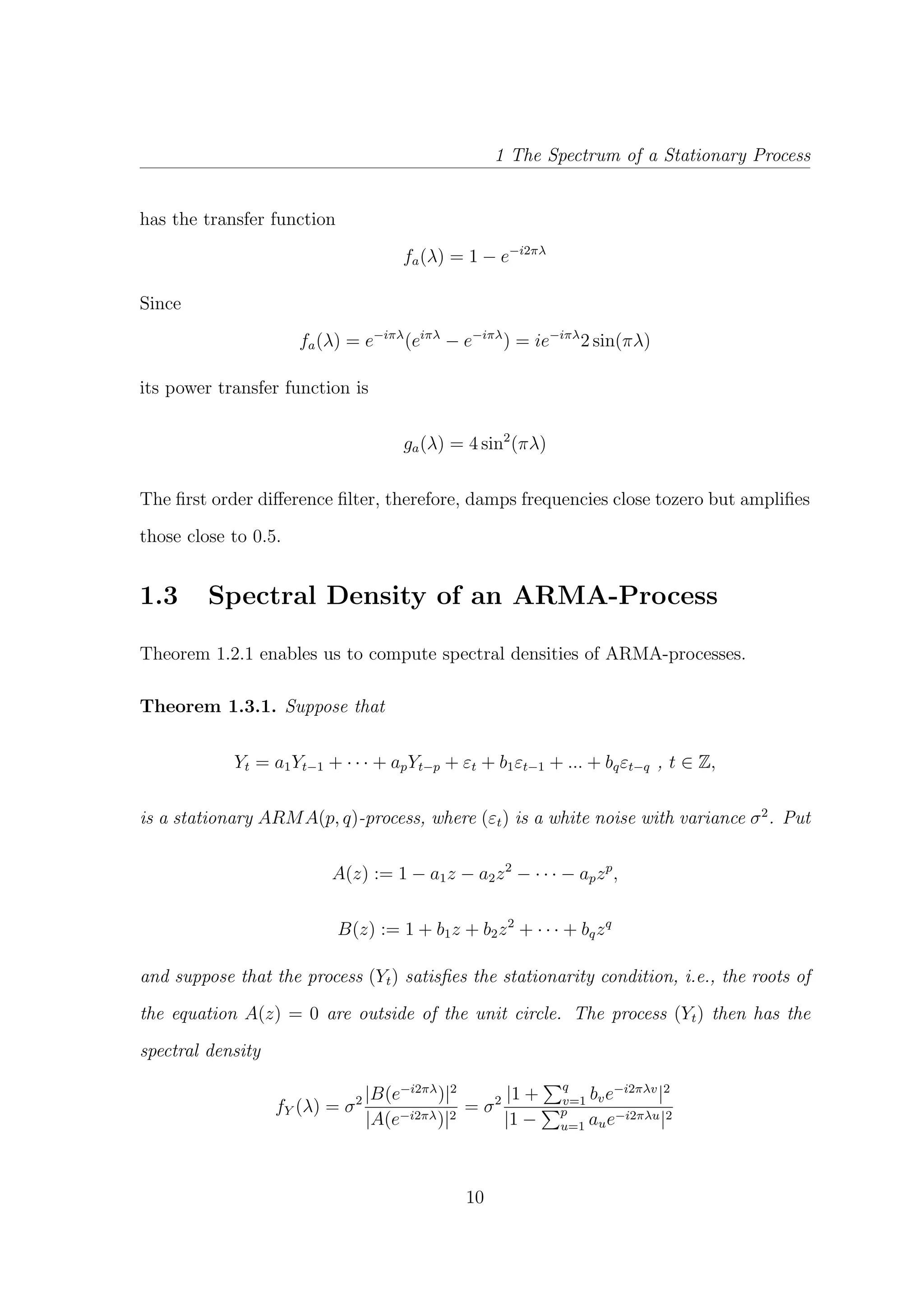
has the transfer function
fa(λ) = 1 − e−i2πλ
Since
fa(λ) = e−iπλ
(eiπλ
− e−iπλ
) = ie−iπλ
2 sin(πλ)
its power transfer function is
ga(λ) = 4 sin2
(πλ)
The first order difference filter, therefore, damps frequencies close tozero but amplifies
those close to 0.5.
1.3 Spectral Density of an ARMA-Process
Theorem 1.2.1 enables us to compute spectral densities of ARMA-processes.
Theorem 1.3.1. Suppose that
Yt = a1Yt−1 + · · · + apYt−p + εt + b1εt−1 + ... + bqεt−q , t ∈ Z,
is a stationary ARMA(p, q)-process, where (εt) is a white noise with variance σ2
. Put
A(z) := 1 − a1z − a2z2
− · · · − apzp
,
B(z) := 1 + b1z + b2z2
+ · · · + bqzq
and suppose that the process (Yt) satisfies the stationarity condition, i.e., the roots of
the equation A(z) = 0 are outside of the unit circle. The process (Yt) then has the
spectral density
fY (λ) = σ2 |B(e−i2πλ
)|2
|A(e−i2πλ)|2
= σ2 |1 + q
v=1 bve−i2πλv
|2
|1 − p
u=1 aue−i2πλu|2
10
1 The Spectrum of a Stationary Process
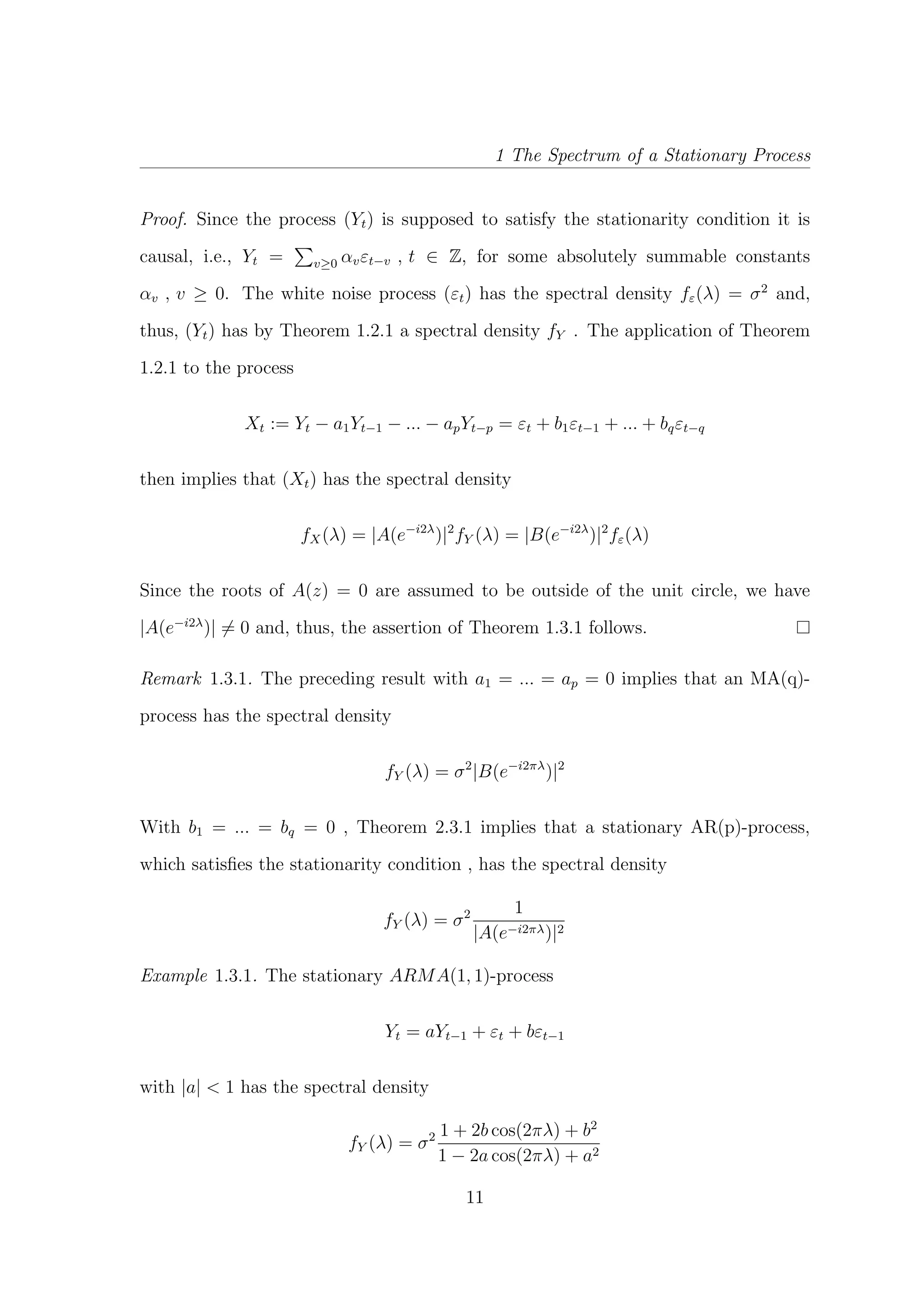
Proof. Since the process (Yt) is supposed to satisfy the stationarity condition it is
causal, i.e., Yt = v≥0 αvεt−v , t ∈ Z, for some absolutely summable constants
αv , v ≥ 0. The white noise process (εt) has the spectral density fε(λ) = σ2
and,
thus, (Yt) has by Theorem 1.2.1 a spectral density fY . The application of Theorem
1.2.1 to the process
Xt := Yt − a1Yt−1 − ... − apYt−p = εt + b1εt−1 + ... + bqεt−q
then implies that (Xt) has the spectral density
fX(λ) = |A(e−i2λ
)|2
fY (λ) = |B(e−i2λ
)|2
fε(λ)
Since the roots of A(z) = 0 are assumed to be outside of the unit circle, we have
|A(e−i2λ
)| = 0 and, thus, the assertion of Theorem 1.3.1 follows.
Remark 1.3.1. The preceding result with a1 = ... = ap = 0 implies that an MA(q)-
process has the spectral density
fY (λ) = σ2
|B(e−i2πλ
)|2
With b1 = ... = bq = 0 , Theorem 2.3.1 implies that a stationary AR(p)-process,
which satisfies the stationarity condition , has the spectral density
fY (λ) = σ2 1
|A(e−i2πλ)|2
Example 1.3.1. The stationary ARMA(1, 1)-process
Yt = aYt−1 + εt + bεt−1
with |a| < 1 has the spectral density
fY (λ) = σ2 1 + 2b cos(2πλ) + b2
1 − 2a cos(2πλ) + a2
11
1 The Spectrum of a Stationary Process
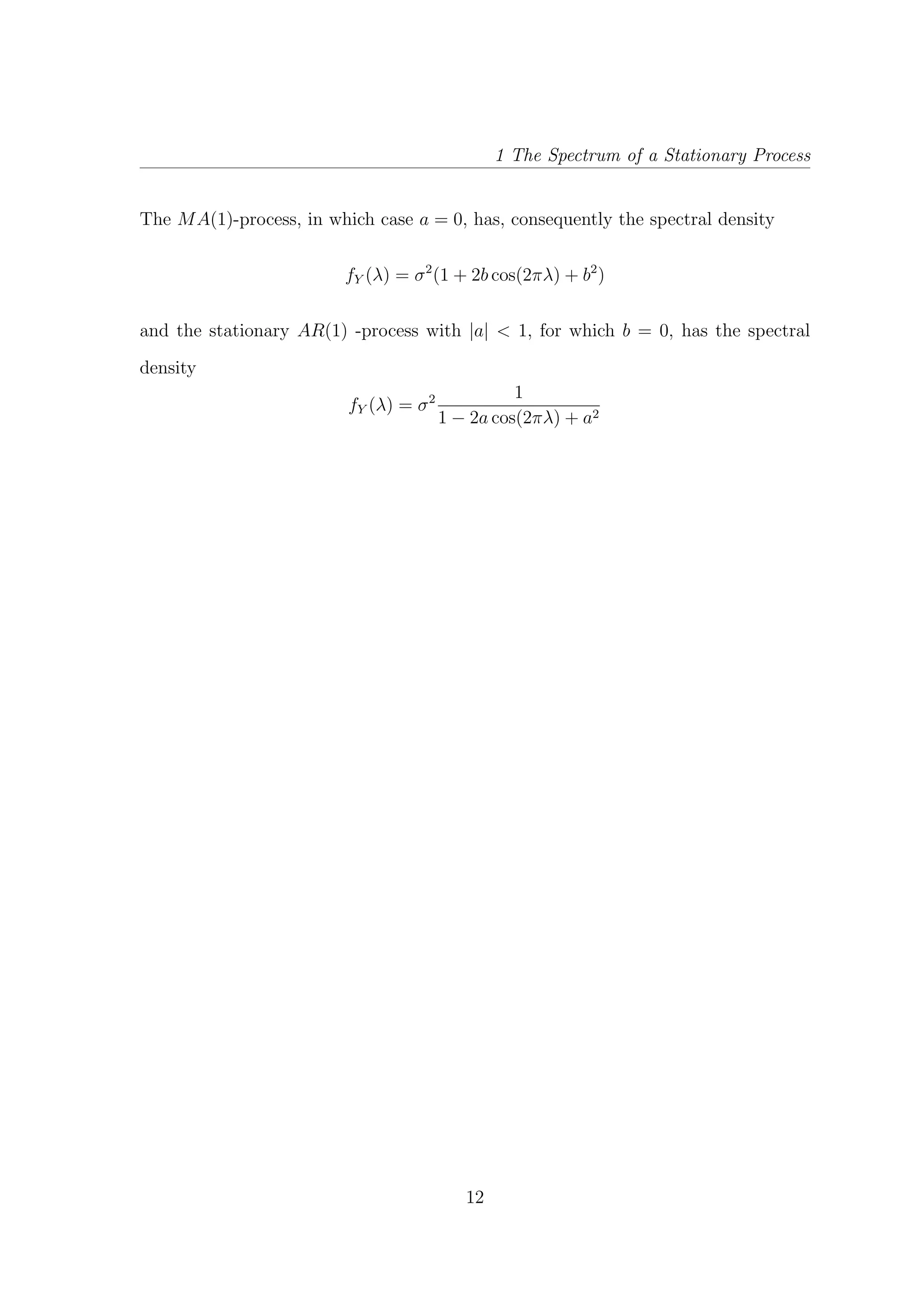
The MA(1)-process, in which case a = 0, has, consequently the spectral density
fY (λ) = σ2
(1 + 2b cos(2πλ) + b2
)
and the stationary AR(1) -process with |a| < 1, for which b = 0, has the spectral
density
fY (λ) = σ2 1
1 − 2a cos(2πλ) + a2
12
Chapter 2
Statistical Analysis in the Frequency
Domain
Here the problem of testing for a white noise and the estimation of the spectral density
are discussed . The empirical counterpart of the spectral density, the periodogram,
will be basic for both problems, though it will turn out that it is not a consistent
estimate. Consistency requires extra smoothing of the periodogram via a linear filter.
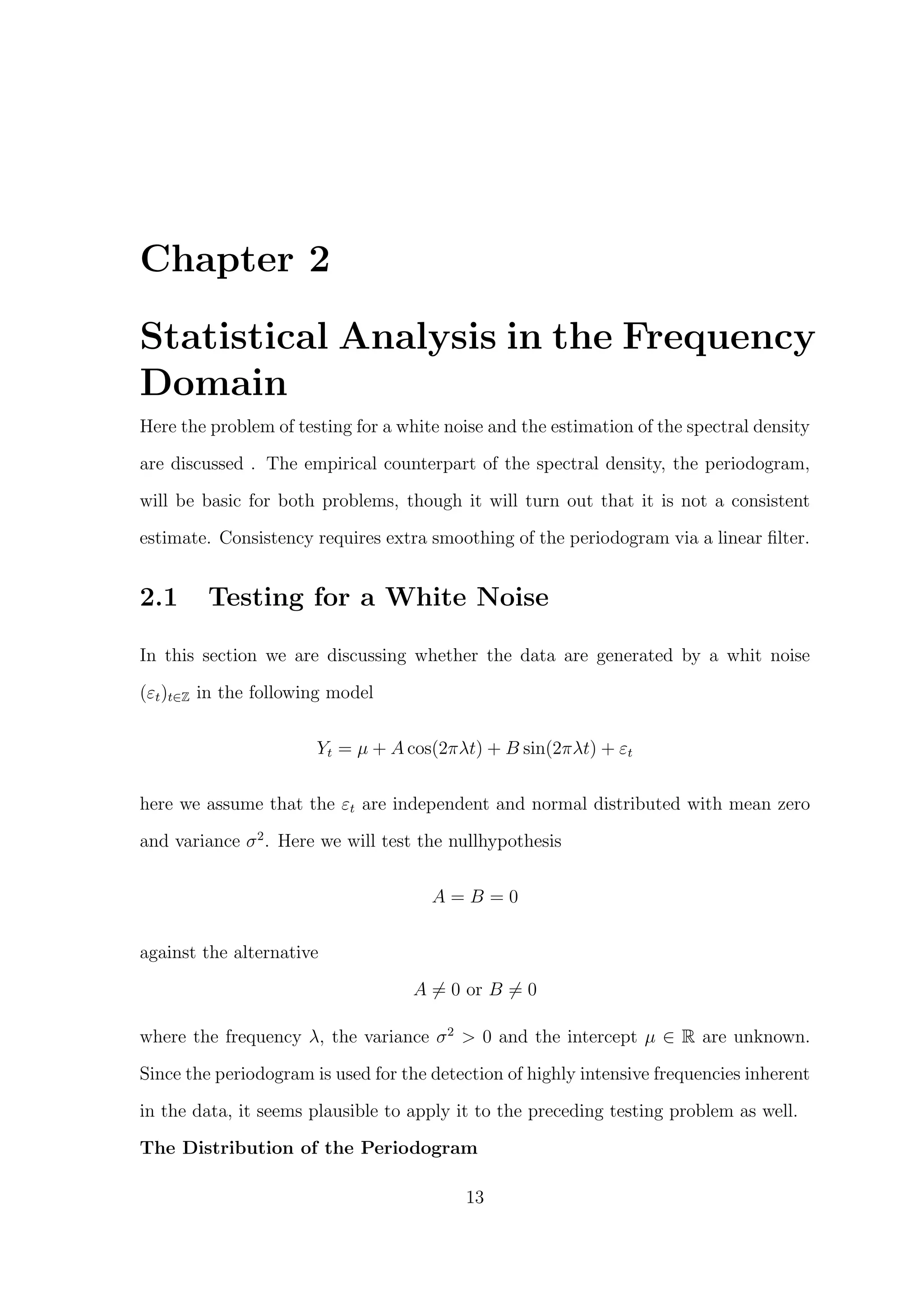
2.1 Testing for a White Noise
In this section we are discussing whether the data are generated by a whit noise
(εt)t∈Z in the following model
Yt = µ + A cos(2πλt) + B sin(2πλt) + εt
here we assume that the εt are independent and normal distributed with mean zero
and variance σ2
. Here we will test the nullhypothesis
A = B = 0
against the alternative
A = 0 or B = 0
where the frequency λ, the variance σ2
> 0 and the intercept µ ∈ R are unknown.
Since the periodogram is used for the detection of highly intensive frequencies inherent
in the data, it seems plausible to apply it to the preceding testing problem as well.
The Distribution of the Periodogram
13
2 Statistical Analysis in the Frequency Domain
Lemma 2.1.1. Let ε1, ..., εn be independent and identically normal distributed random
variables with mean µ ∈ R and variance σ2
> 0. Denote by ¯ε := 1
n
n
t=1 εt the sample
mean of ε1, ..., εn and by
Cε (k/n) =
1
n
n
t=1
(εt − ¯ε) cos 2
k
n
t
Sε (k/n) =
1
n
n
t=1
(εt − ¯ε) sin 2
k
n
t
the cross covariances with Fourier frequencies k/n , 1 ≤ k ≤ [(n − 1)/2]. Then the
2[(n − 1)/2] random variables
Cε (k/n) , Sε (k/n) , 1 ≤ k ≤ [(n − 1)/2]
are independent and identically N(0, σ2
/(2n))-distributed.
Corollary 2.1.2. Let ε1, ..., εn be as in the preceding lemma and let
Iε (k/n) = n C2
ε (k/n) + S2
ε (k/n)
be the pertaining periodogram, evaluated at the Fourier frequencies k/n , 1 ≤ k ≤
[(n−1)/2] , k ∈ N .The random variables Iε(k/n)/σ2
are independent and identically
standard exponential distributed i.e.,
P Iε(k/n)/σ2
≤ x =
1 − exp(−x) , x > 0
0 , x ≤ 0
Proof. Lemma mentioned above implies that
2n
σ2
Cε(k/n) ,
2n
σ2
Sε(k/n)
are independent standard normal random variables and, thus,
2Iε(k/n)
σ2
=
2n
σ2
Cε(k/n)
2
+
2n
σ2
Sε(k/n)
2
is χ2
-distributed with two degrees of freedom. Since this distribution has the distri-
bution function 1 − exp(−x/2) , x ≤ 0, the assertion follows.
14
2 Statistical Analysis in the Frequency Domain
For testing of White noise following test are used :
Fisher’s Test
κm :=
max1≤j≤m I(j/n)
(1/m) m
k=1 I(k/n)
= mMm
Where Mm :=
max1≤j≤m Iε(j/n)
m
k=1 Iε(k/n)
is significantly large, i.e., if one of the values I(j/n) is
significantly larger than the average over all. The hypothesis ( data is generated by
white noise ) is, therefore, rejected at error level α if
κm > cα with 1 − Gm
cα
m
= α
The BartlettKolmogorovSmirnov Test
The KolmogorovSmirnov statistic
∆m−1 := sup
x∈[0,1]
| ˆFm−1(x) − x|
In this test we fit our data points with graph of x and if value of ∆ is too high then
hypothesis is rejected.
2.2 Estimating Spectral Densities
We are assuming in the following that (Yt)t∈Z is a stationary real valued process with
mean µ and absolutely summable autocovariance function γ. From last chapter we
know that the process (Yt)t∈Z has the continous spectral density
f(λ) =
h∈Z
γ(h)e−i2πλh
In this section we will invetigate the limit behaviour of the periodogram for arbitrary
independent random variable (Yt)
Asymptotic Properties of the Periodogram
For Fourier frequencies k/n , 0 ≤ k ≤ [n/2] we put
In(k/n) =
1
n
|
n
t=1
Yte−i2π(k/n)t
|2
15
2 Statistical Analysis in the Frequency Domain
=
1
n



n
t=1
Yt cos(2π
k
n
t)
2
+
n
t=1
Yt sin(2π
k
n
t)
2



Up to k = 0, this coincide with the definition of the periodogram and it have repre-
sentation
In(k/n) ==
n¯Y 2
n , k = 0
|h|<n c(h)e−i2π(k/n)h
, k = 1, ..., [n/2]
with ¯Yn := 1
n
n
t=1 Yt and the sample autocovariance function
c(h) =
1
n
n−|h|
t=1
(Yt − ¯Yn)(Yt+|h| − ¯Yn)
By above representation , the results related to periodogarm done earlier and the
value In(k/n) does not change for k = 0 if we replace sample mean ¯Yn in c(h) by the
theoretical mean µ. This leads to the equivalent representation of the periodogram
for k = 0
In(k/n) =
|h|<n
1
n


n−|h|
t=1
(Yt − µ)(Yt+|h| − µ)

 e−i2π(k/n)h
=
1
n
n
t=1
(Yt − µ) + 2
n−1
h=1
1
n


n−|h|
t=1
(Yt − µ)(Yt+|h| − µ)

 cos(2π
k
n
h)
We define now the periodogram for λ ∈ [0, 0.5] as a piecewise constant function
In(λ) = In(k/n) if
k
n
−
1
2n
< λ ≤
k
n
+
1
2n
The following result shows that the periodogram In(λ) is for λ = 0 an asymptotically
unbiased estimator of the spectral density f(λ).
Theorem 2.2.1. Let (Yt)t∈Z be a stationary process with absolutely summable auto-
covariance function γ . Then we have with µ = E(Yt)
E(In(0)) − nµ2 n→∞
−−−→ f(0),
E(In(λ))
n→∞
−−−→ f(λ) , λ = 0
If λ = 0, then the convergence E(In(λ))
n→∞
−−−→ f(λ) holds uniformly on [0.0.5].
16
2 Statistical Analysis in the Frequency Domain
Proof. By representation written above the theorem and the Cesaro convergence re-
sult we have
E(In(0)) − nµ2
=
1
n
n
t=1
n
s=1
E(YtYs) − nµ2
=
1
n
n
t=1
n
s=1
Cov(Ys, Yt)
=
|h|<n
1 −
|h|
n
γ(h)
n→∞
−−−→
h∈Z
γ(h) = f(0)
Define now for λ ∈ [0, 0, 5] the auxiliary function
gn(λ) :=
k
n
, if
k
n
−
1
2n
< λ ≤
k
n
+
1
2n
Then we obviously have
In(λ) = In(gn(λ))
Choose now λ ∈ (0, 0.5]. Since gn(λ) −→ λasn −→ ∞, it follows that gn(λ) > 0 for
n large enough. now we obtain for such n
E(In(λ)) =
|h|<n
1
n
n−|h|
t=1
E (Yt − µ)(Yt+|h| − µ) e−i2πgn(λ)h
=
|h|<n
1 −
|h|
n
γ(h)e−i2πgn(λ)h
Since h∈Z |γ(h)| < ∞, the series |h|<n γ(h) exp(−i2πλh) converges to f(λ) uni-
formly for 0 ≤ λ ≤ 0.5. Kronecker’s implies moreover
|
|h|<n
|h|
n
γ(h)e−i2πλh
| ≤
|h|<n
|h|
n
|γ(h)|
n→∞
−−−→ 0
and, thus, the series
fn(λ) :=
|h|<n
1 −
|h|
n
γ(h)e−i2πλh
17
2 Statistical Analysis in the Frequency Domain
converges to f(λ) uniformly in λ as well. From gn(λ)
n→∞
−−−→ λ and the continuity of
f we obtain for λ ∈ (0, 0, 5]
|E(In(λ)) − f(λ)| = |fn(gn(λ)) − f(λ)|
≤ |fn(gn(λ)) − f(gn(λ))| + |f(gn(λ)) − f(λ)|
n→∞
−−−→ 0
Note that |gn(λ) − λ| ≤ 1/(2n). The uniform convergence in case of µ = 0 then
follows from the uniform convergence of gn(λ) to λ and the uniform continuity of f
on the compact interval [0, 0.5].
Theorem 2.2.2. Let Z1, ..., Zn be independent and identically distributed random
variables with mean E(Zt) = 0 and variance E(Z2
t ) = σ2
< ∞. Denote by In(λ) the
pertaining periodogram as defined earlier (In(λ) = In(gn(λ))).
(i) The random vector (In(λ1), ..., In(λr)) with 0 < λ1 < ... < λr < 0.5 converges in
distribution for n −→ ∞ to the distribution of r independent and identically expo-
nential distributed random variables with mean σ2
.
(ii) If E(Z4
t ) = ησ4
< ∞, then we have for k = 0, ..., [n/2] , k ∈ N
V ar(In(k/n)) =
2σ4
+ 1
n
(η − 3)σ4
, k = 0 or k = n/2
σ4
+ 1
n
(η − 3)σ4
elsewhere
and
Cov(In(j/n) , In(k/n)) =
1
n
(η − 3)σ4
, j = k
For N(0, σ2
)-distributed random variables Zt we have η = 3 and, thus, In(k/n) and
In(j/n) are for j = k uncorrelated. we established that they are independent in this
case.
18
2 Statistical Analysis in the Frequency Domain
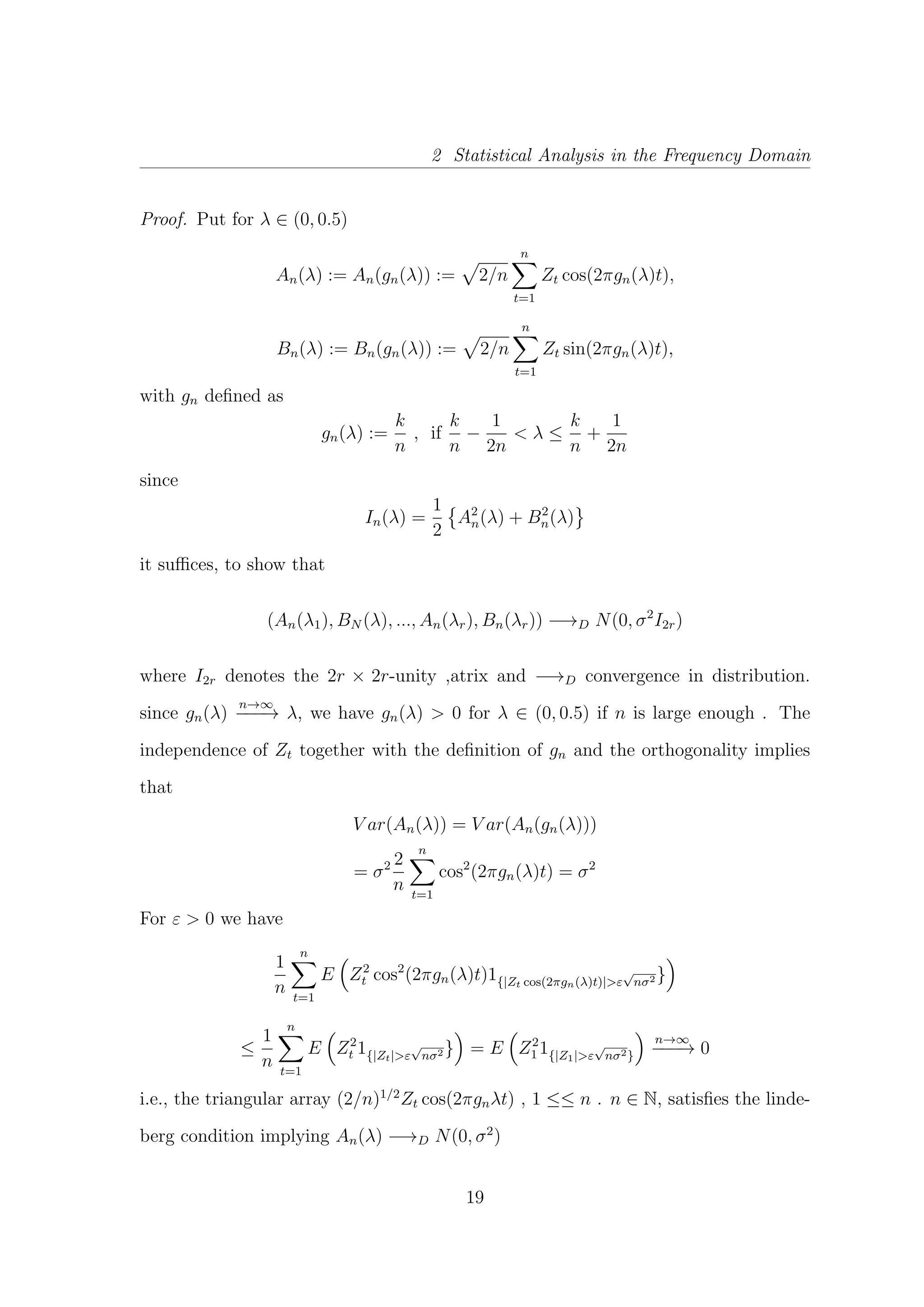
Proof. Put for λ ∈ (0, 0.5)
An(λ) := An(gn(λ)) := 2/n
n
t=1
Zt cos(2πgn(λ)t),
Bn(λ) := Bn(gn(λ)) := 2/n
n
t=1
Zt sin(2πgn(λ)t),
with gn defined as
gn(λ) :=
k
n
, if
k
n
−
1
2n
< λ ≤
k
n
+
1
2n
since
In(λ) =
1
2
A2
n(λ) + B2
n(λ)
it suffices, to show that
(An(λ1), BN (λ), ..., An(λr), Bn(λr)) −→D N(0, σ2
I2r)
where I2r denotes the 2r × 2r-unity ,atrix and −→D convergence in distribution.
since gn(λ)
n→∞
−−−→ λ, we have gn(λ) > 0 for λ ∈ (0, 0.5) if n is large enough . The
independence of Zt together with the definition of gn and the orthogonality implies
that
V ar(An(λ)) = V ar(An(gn(λ)))
= σ2 2
n
n
t=1
cos2
(2πgn(λ)t) = σ2
For ε > 0 we have
1
n
n
t=1
E Z2
t cos2
(2πgn(λ)t)1{|Zt cos(2πgn(λ)t)|>ε
√
nσ2 }
≤
1
n
n
t=1
E Z2
t 1{|Zt|>ε
√
nσ2 } = E Z2
1 1{|Z1|>ε
√
nσ2}
n→∞
−−−→ 0
i.e., the triangular array (2/n)1/2
Zt cos(2πgnλt) , 1 ≤≤ n . n ∈ N, satisfies the linde-
berg condition implying An(λ) −→D N(0, σ2
)
19
2 Statistical Analysis in the Frequency Domain
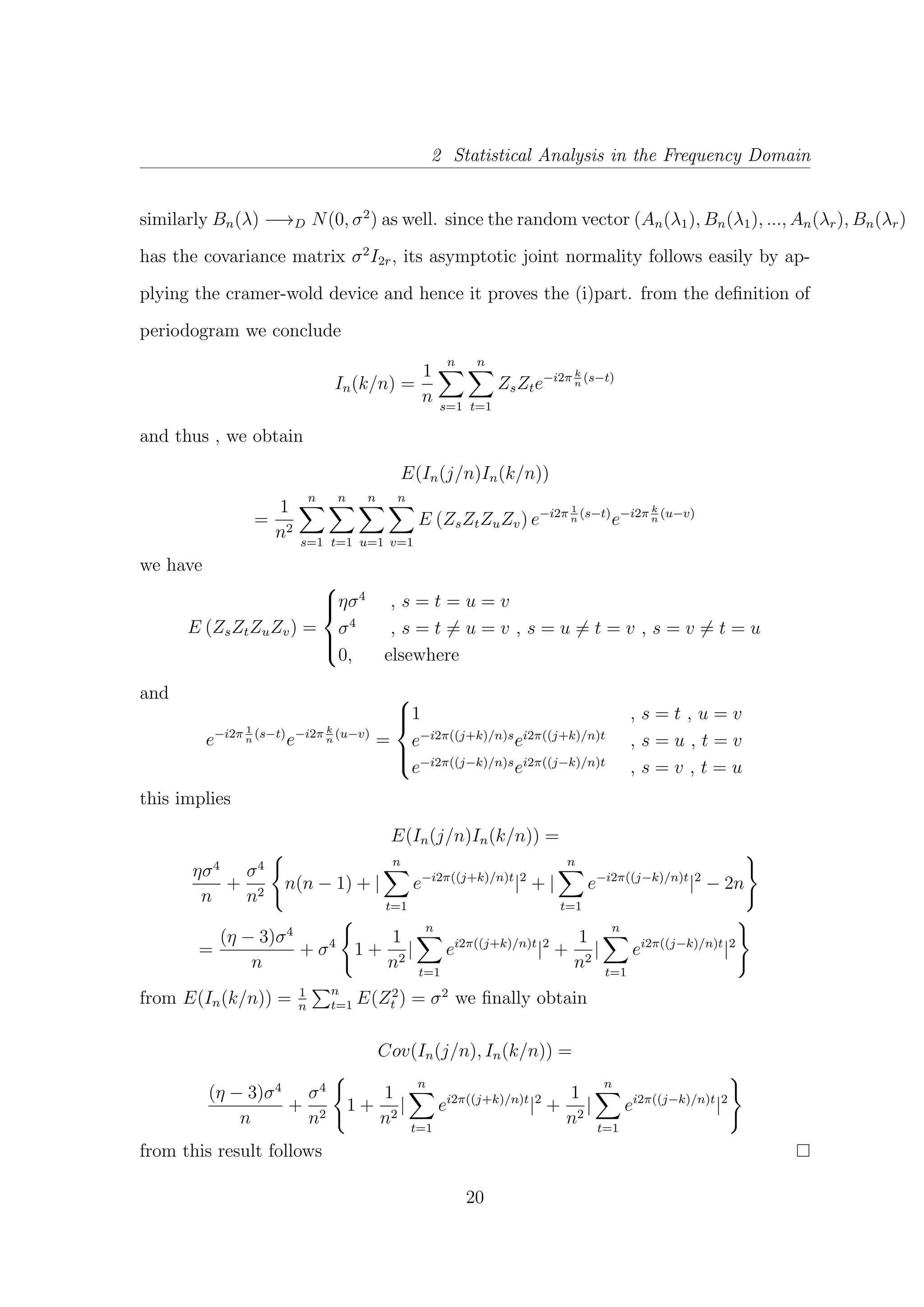
similarly Bn(λ) −→D N(0, σ2
) as well. since the random vector (An(λ1), Bn(λ1), ..., An(λr), Bn(λr)
has the covariance matrix σ2
I2r, its asymptotic joint normality follows easily by ap-
plying the cramer-wold device and hence it proves the (i)part. from the definition of
periodogram we conclude
In(k/n) =
1
n
n
s=1
n
t=1
ZsZte−i2π k
n
(s−t)
and thus , we obtain
E(In(j/n)In(k/n))
=
1
n2
n
s=1
n
t=1
n
u=1
n
v=1
E (ZsZtZuZv) e−i2π 1
n
(s−t)
e−i2π k
n
(u−v)
we have
E (ZsZtZuZv) =



ησ4
, s = t = u = v
σ4
, s = t = u = v , s = u = t = v , s = v = t = u
0, elsewhere
and
e−i2π 1
n
(s−t)
e−i2π k
n
(u−v)
=



1 , s = t , u = v
e−i2π((j+k)/n)s
ei2π((j+k)/n)t
, s = u , t = v
e−i2π((j−k)/n)s
ei2π((j−k)/n)t
, s = v , t = u
this implies
E(In(j/n)In(k/n)) =
ησ4
n
+
σ4
n2
n(n − 1) + |
n
t=1
e−i2π((j+k)/n)t
|2
+ |
n
t=1
e−i2π((j−k)/n)t
|2
− 2n
=
(η − 3)σ4
n
+ σ4
1 +
1
n2
|
n
t=1
ei2π((j+k)/n)t
|2
+
1
n2
|
n
t=1
ei2π((j−k)/n)t
|2
from E(In(k/n)) = 1
n
n
t=1 E(Z2
t ) = σ2
we finally obtain
Cov(In(j/n), In(k/n)) =
(η − 3)σ4
n
+
σ4
n2
1 +
1
n2
|
n
t=1
ei2π((j+k)/n)t
|2
+
1
n2
|
n
t=1
ei2π((j−k)/n)t
|2
from this result follows
20
2 Statistical Analysis in the Frequency Domain
Discrete Spectral Average Estimator
The preceding results show that the periodogram is not a consistent estimator of the
spectral density. The law of large numbers together with the above remark motivates,
however, that consistency can be achieved for a smoothed version of the periodogram
such as a simple moving average
|j|≤m
1
2m + 1
In
k + j
n
which puts equal weights 1/(2m + 1) on adjacent values. Dropping the condition of
equal weights, we define a general linear smoother by the linear filter
ˆfn
k
n
:=
|j|≤m
ajnIn
k + j
n
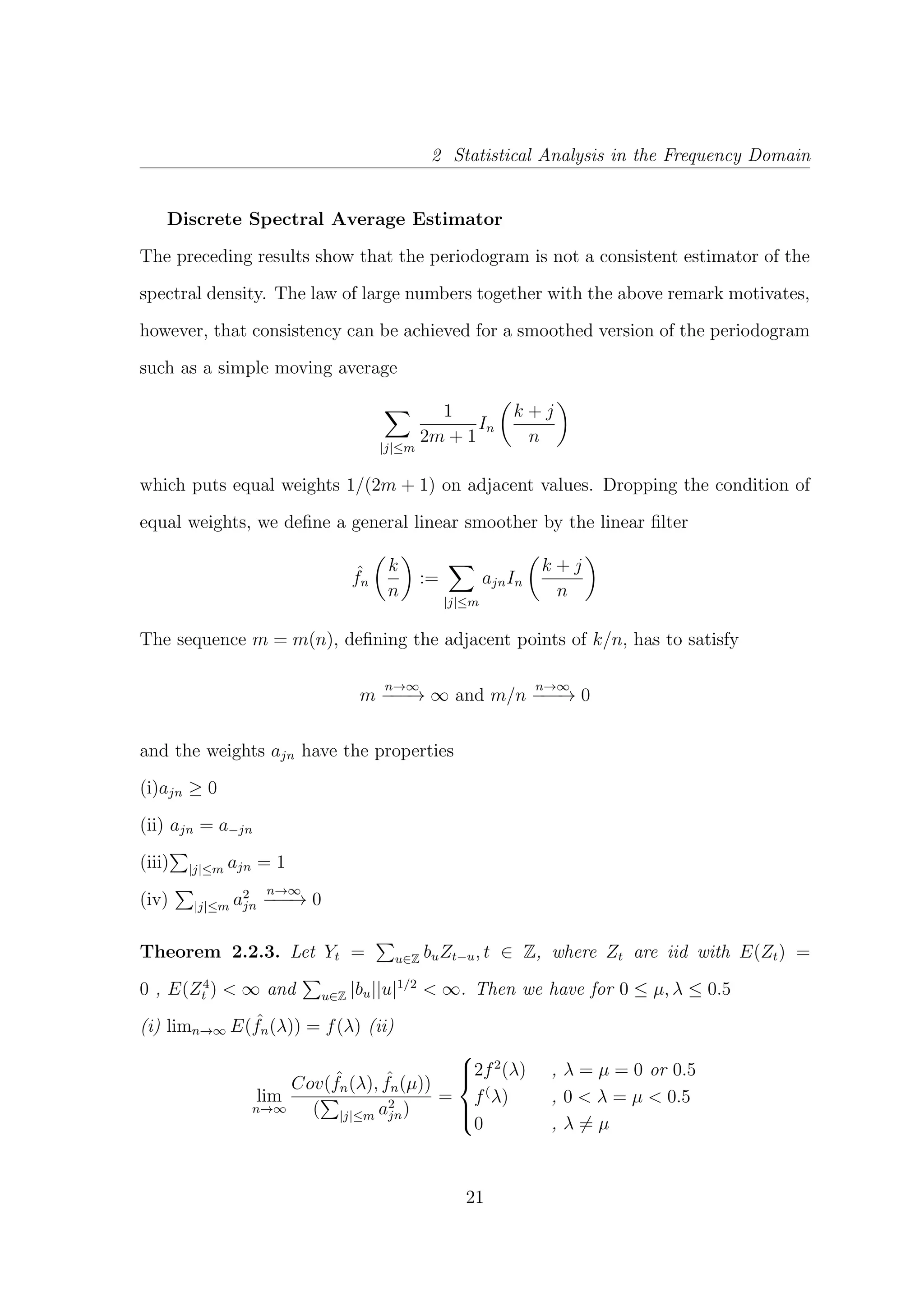
The sequence m = m(n), defining the adjacent points of k/n, has to satisfy
m
n→∞
−−−→ ∞ and m/n
n→∞
−−−→ 0
and the weights ajn have the properties
(i)ajn ≥ 0
(ii) ajn = a−jn
(iii) |j|≤m ajn = 1
(iv) |j|≤m a2
jn
n→∞
−−−→ 0
Theorem 2.2.3. Let Yt = u∈Z buZt−u, t ∈ Z, where Zt are iid with E(Zt) =
0 , E(Z4
t ) < ∞ and u∈Z |bu||u|1/2
< ∞. Then we have for 0 ≤ µ, λ ≤ 0.5
(i) limn→∞ E( ˆfn(λ)) = f(λ) (ii)
lim
n→∞
Cov( ˆfn(λ), ˆfn(µ))
( |j|≤m a2
jn)
=



2f2
(λ) , λ = µ = 0 or 0.5
f(
λ) , 0 < λ = µ < 0.5
0 , λ = µ
21
2 Statistical Analysis in the Frequency Domain
condition (iv) in properties of ajn on weights together with (ii) in the preceding result
entails that V ar( ˆfn(λ))
n→∞
−−−→ 0 for any λ ∈ [0, 0.5]. Together with (i) we, therefore,
obtain that the mean squared error of ˆfn(λ) vanishes asymptotically:
MSE( ˆfn(λ)) = E ( ˆfn(λ) − f(λ))2
= V ar( ˆfn(λ)) + BIAS2
( ˆfn(λ))
n→∞
−−−→ 0
Proof. By the definition of the spectral density estimator we have
|E( ˆfn(λ)) − f(λ)| = |
|j|≤m
ajn {E(In(gn(λ) + j/n)) − f(λ)} |
= |
|j|≤m
ajn {E(In(gn(λ) + j/n)) − f(gn(λ) + j/n) + f(gn(λ) + j/n) − f(λ)} |
where together with the uniform convergence of gn(λ) to λ implies
max
|j|≤m
|gn(λ) + j/n − λ|
n→∞
−−−→ 0
Choose ε > 0. The spectral density f of the process (Yt) is continous and hence we
have
max
|j|≤m
|E(In(gn(λ) + j/n)) − f(gn(λ) + j/n)| < ε/2
if n is large then property (iii) together with triangular inequality implies |E( ˆfn(λ))−
f(λ)| < ε for large n. This implies part from the definition of ˆfn we obtain
Cov( ˆfn(λ), ˆfn(µ))
=
|j|≤m |k|≤m
ajnaknCov (In(gn(λ) + j/n), In(gn(µ) + k/n))
If λ = µ and n sufficiently large we have gn(λ) + j/n = gn(µ) + k/n for arbitrary
|j|, |k| ≤ m. Now there exists a universal constant C1 > 0 such that
|Cov( ˆfn(λ), ˆfn(µ))| = |
|j|≤m |k|≤m
ajnaknO(n−1
)|
22
2 Statistical Analysis in the Frequency Domain
≤ C1n−1


|j|≤m
ajn


2
≤ C1
2m + 1
n
|j|≤m
a2
jn
where the final inequality is an application of the Cauchy - Schwartz inequality .
Since m/n
n→∞
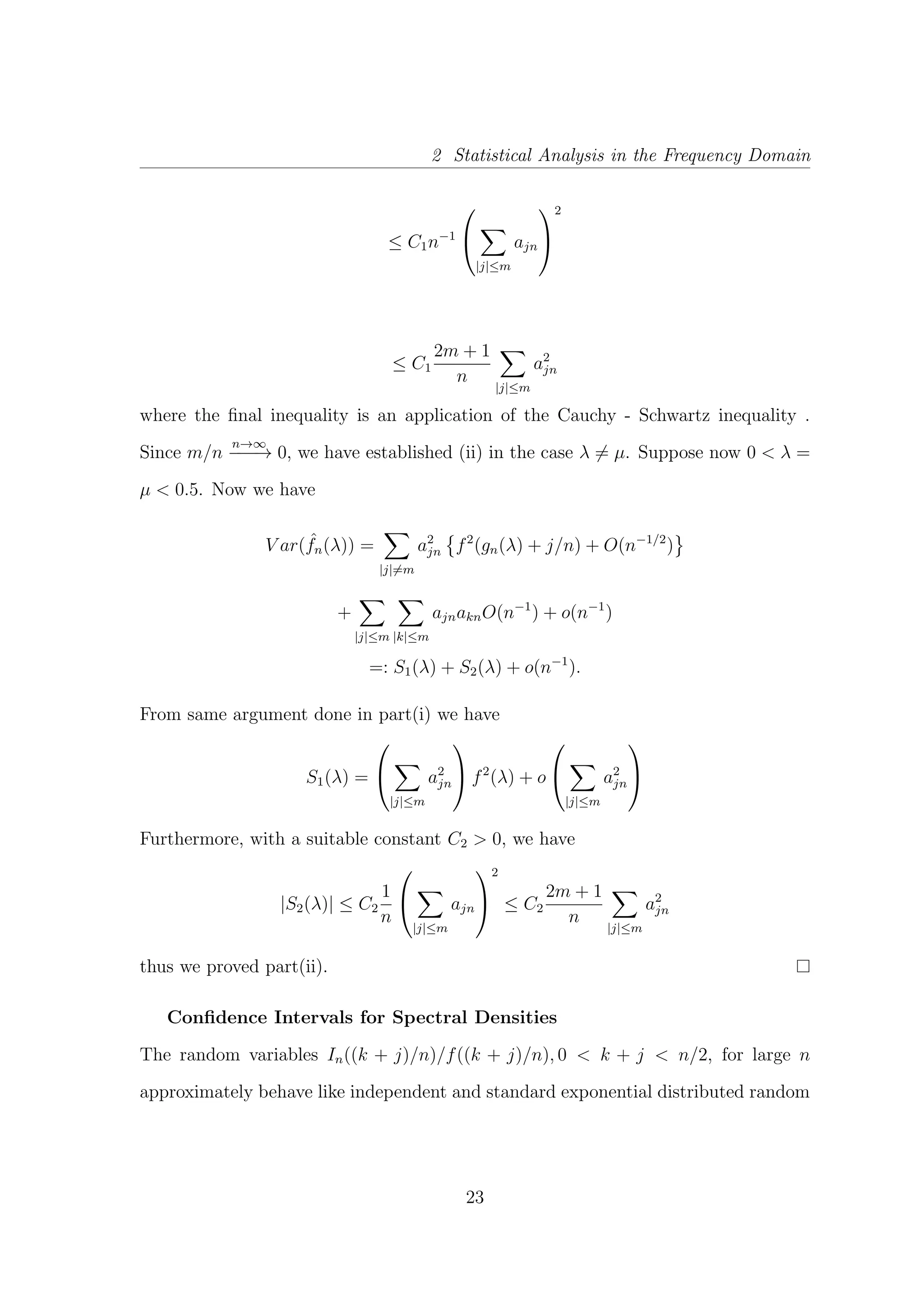
−−−→ 0, we have established (ii) in the case λ = µ. Suppose now 0 < λ =
µ < 0.5. Now we have
V ar( ˆfn(λ)) =
|j|=m
a2
jn f2
(gn(λ) + j/n) + O(n−1/2
)
+
|j|≤m |k|≤m
ajnaknO(n−1
) + o(n−1
)
=: S1(λ) + S2(λ) + o(n−1
).
From same argument done in part(i) we have
S1(λ) =


|j|≤m
a2
jn

 f2
(λ) + o


|j|≤m
a2
jn


Furthermore, with a suitable constant C2 > 0, we have
|S2(λ)| ≤ C2
1
n


|j|≤m
ajn


2
≤ C2
2m + 1
n
|j|≤m
a2
jn
thus we proved part(ii).
Confidence Intervals for Spectral Densities
The random variables In((k + j)/n)/f((k + j)/n), 0 < k + j < n/2, for large n
approximately behave like independent and standard exponential distributed random
23
2 Statistical Analysis in the Frequency Domain
variables χj. This suggests that the distribution of the discrete spectral average
estimator
ˆf(k/n) =
|j|≤m
ajnIn
kj
n
can be approximated by that of the weighted sum |j|≤m ajnXjf((k + j)/n) showed
that the distribution of this weighted sum can in turn be approximated by that of cY
with a suitably chosen c > 0, where Y follows a gamma distribution with parameters
p := ν/2 and b = 1/2 i.e.,
PY ≤ t =
bp
τ(p)
t
0
xp−1
exp(−bx)dx , t ≥ 0
where τ(p) :=
∞
0
xp−1
exp(−x)dx denotes the gamma function. The parameters ν
and c are determined by the method of moments as follows: ν and c are chosen such
that cY has mean f(k/n) and its variance equals the leading term of the variance
expansion of ˆf(k/n) in Theorem 3.2.4
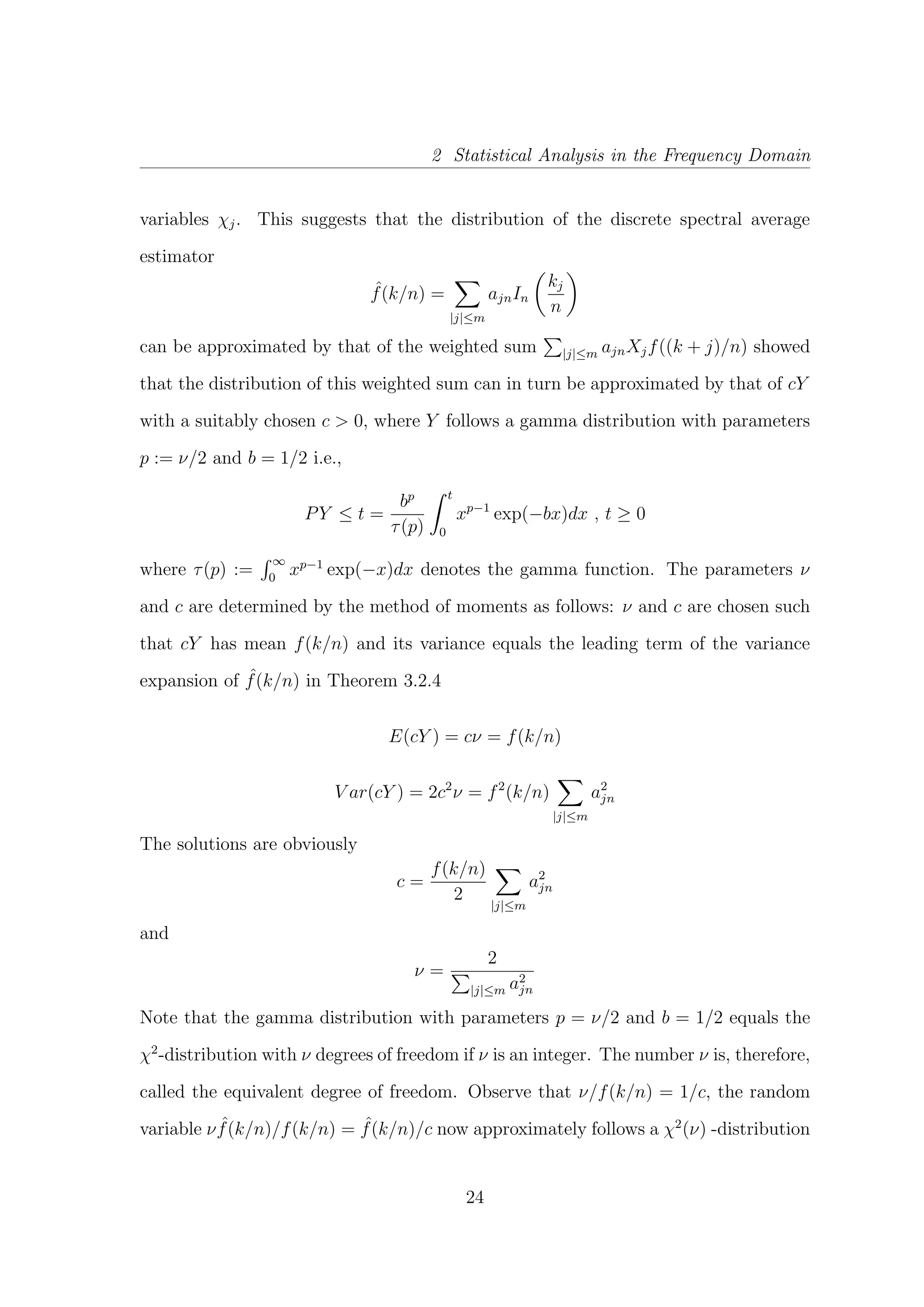
E(cY ) = cν = f(k/n)
V ar(cY ) = 2c2
ν = f2
(k/n)
|j|≤m
a2
jn
The solutions are obviously
c =
f(k/n)
2
|j|≤m
a2
jn
and
ν =
2
|j|≤m a2
jn
Note that the gamma distribution with parameters p = ν/2 and b = 1/2 equals the
χ2
-distribution with ν degrees of freedom if ν is an integer. The number ν is, therefore,
called the equivalent degree of freedom. Observe that ν/f(k/n) = 1/c, the random
variable ν ˆf(k/n)/f(k/n) = ˆf(k/n)/c now approximately follows a χ2
(ν) -distribution
24
2 Statistical Analysis in the Frequency Domain
with the convention that χ2
(ν) is the gamma distribution with parameters p = ν/2
and b = 1/2 if ν is not an integer. The interval
ν ˆf(k/n)
χ1−α/2(ν)
,
ν ˆf(k/n)
χ2
α/2
is a confidence interval for f(k/n) of approximate level 1−α , α ∈ (0, 1). By χ2
q(ν) we
denote the q-quantile of the χ2
(ν) -distribution i.e.,P{Y ≤ χ2
q(ν)} = q , 0 < q < 1.
we obtain the confidence interval for log(f(k/n))
Cν,α(k/n) := log( ˆf(k/n)) + log(ν) − log(χ2
1−α/2(ν)) , log( ˆf(k/n)) + log(ν) − log(χ2
α/2(ν))
This interval has constant length log(χ2
1−α/2(ν)/χ2
α/2(ν)). Note that Cν,α(k/n) is
a level (1 − α)-confidence interval only for log(f(λ)) at a fixed Fourier frequency
λ = k/n, with 0 < k < [n/2], but not simultaneously for λ ∈ (0, 0.5).
25
Chapter 3
The Box Jenkins Program
The aim of this chapter is to fit a time series model (Yt)t∈Z to a given set of data
y1, · · · , yn collected in time t. We suppose that the data y1, · · · , yn are (possibly)
variance-stabilized as well as trend or seasonally adjusted. We assume that they
were generated by clipping Y1, · · · , Yn from an ARMA(p, q)-process (Yt)t∈Z, which
we will fit to the data in the following. As seen earlier we could also fit the model
Yt = v≥0 αvεt−v to the data, where (εt) is a white noise. The BoxJenkins program
consists of four steps:
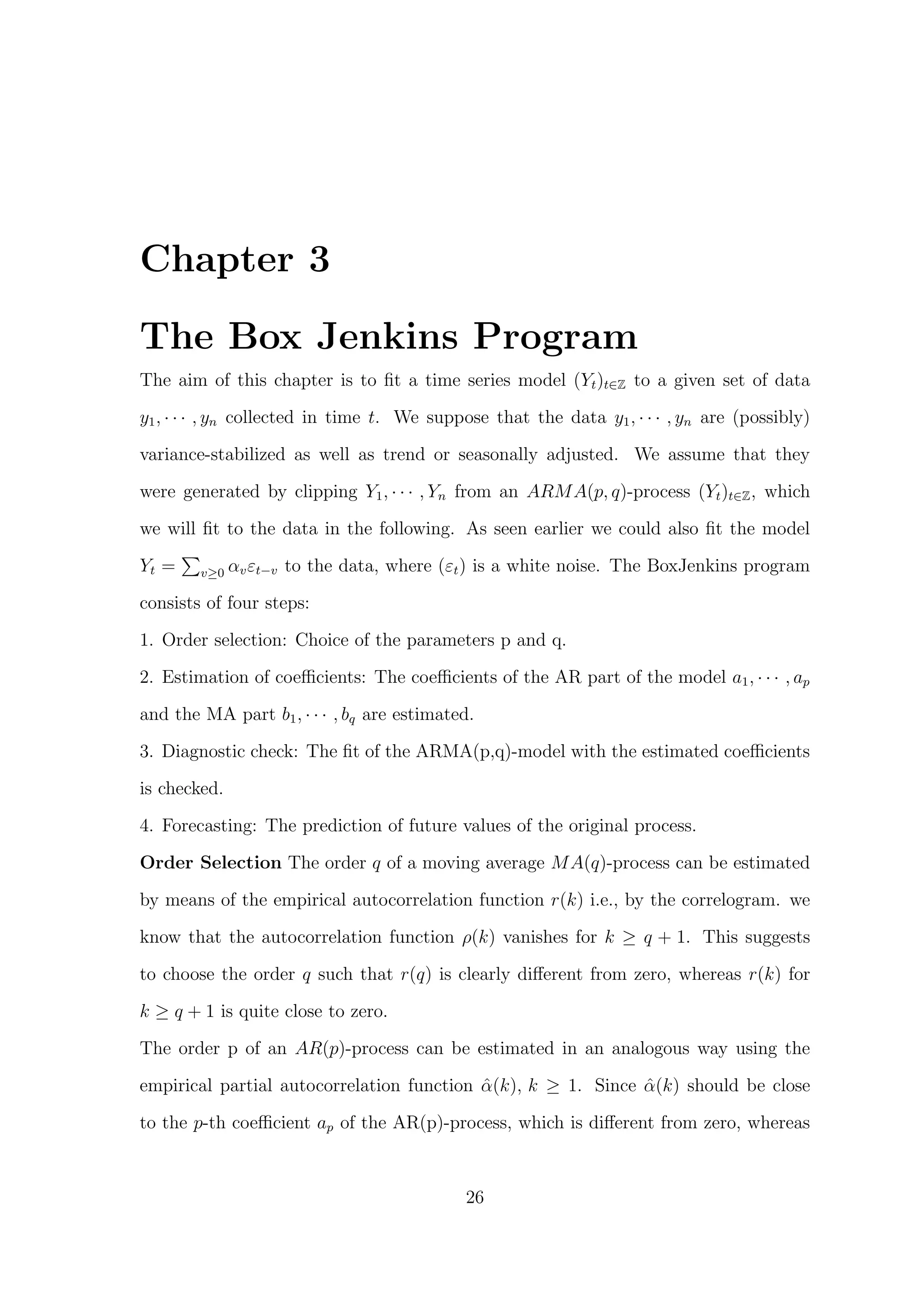
1. Order selection: Choice of the parameters p and q.
2. Estimation of coefficients: The coefficients of the AR part of the model a1, · · · , ap
and the MA part b1, · · · , bq are estimated.
3. Diagnostic check: The fit of the ARMA(p,q)-model with the estimated coefficients
is checked.
4. Forecasting: The prediction of future values of the original process.
Order Selection The order q of a moving average MA(q)-process can be estimated
by means of the empirical autocorrelation function r(k) i.e., by the correlogram. we
know that the autocorrelation function ρ(k) vanishes for k ≥ q + 1. This suggests
to choose the order q such that r(q) is clearly different from zero, whereas r(k) for
k ≥ q + 1 is quite close to zero.
The order p of an AR(p)-process can be estimated in an analogous way using the
empirical partial autocorrelation function ˆα(k), k ≥ 1. Since ˆα(k) should be close
to the p-th coefficient ap of the AR(p)-process, which is different from zero, whereas
26
3 The Box Jenkins Program
ˆα(k) ≈ 0 for k > p. The choice of the orders p and q of an ARMA(p, q)-process is
a bit more challenging. In this case one commonly takes the pair (p, q), minimizing
some information function, which is based on an estimate ˆσ2
p,q of the variance of ε0.
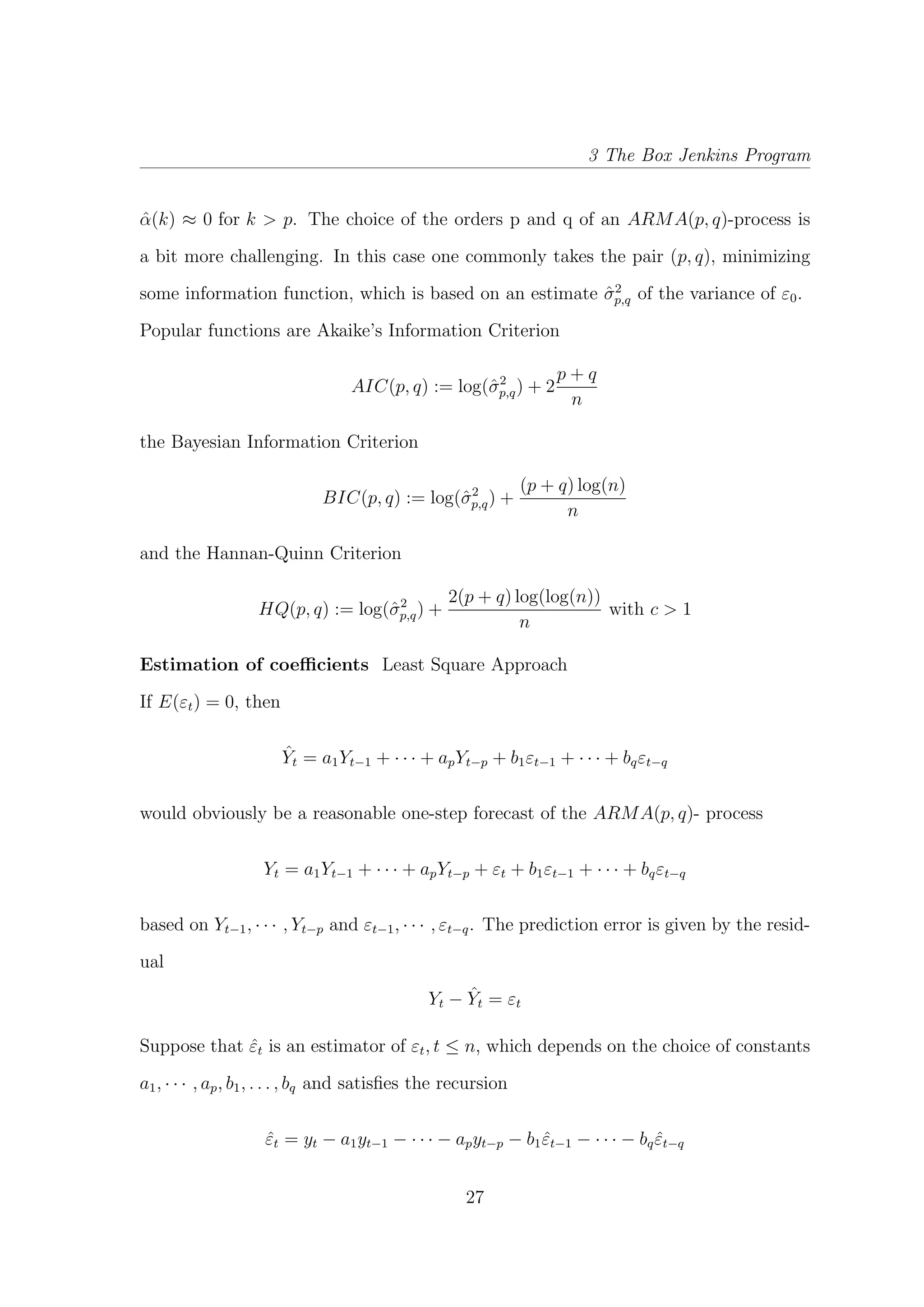
Popular functions are Akaike’s Information Criterion
AIC(p, q) := log(ˆσ2
p,q) + 2
p + q
n
the Bayesian Information Criterion
BIC(p, q) := log(ˆσ2
p,q) +
(p + q) log(n)
n
and the Hannan-Quinn Criterion
HQ(p, q) := log(ˆσ2
p,q) +
2(p + q) log(log(n))
n
with c > 1
Estimation of coefficients Least Square Approach
If E(εt) = 0, then
ˆYt = a1Yt−1 + · · · + apYt−p + b1εt−1 + · · · + bqεt−q
would obviously be a reasonable one-step forecast of the ARMA(p, q)- process
Yt = a1Yt−1 + · · · + apYt−p + εt + b1εt−1 + · · · + bqεt−q
based on Yt−1, · · · , Yt−p and εt−1, · · · , εt−q. The prediction error is given by the resid-
ual
Yt − ˆYt = εt
Suppose that ˆεt is an estimator of εt, t ≤ n, which depends on the choice of constants
a1, · · · , ap, b1, . . . , bq and satisfies the recursion
ˆεt = yt − a1yt−1 − · · · − apyt−p − b1 ˆεt−1 − · · · − bq ˆεt−q
27
3 The Box Jenkins Program
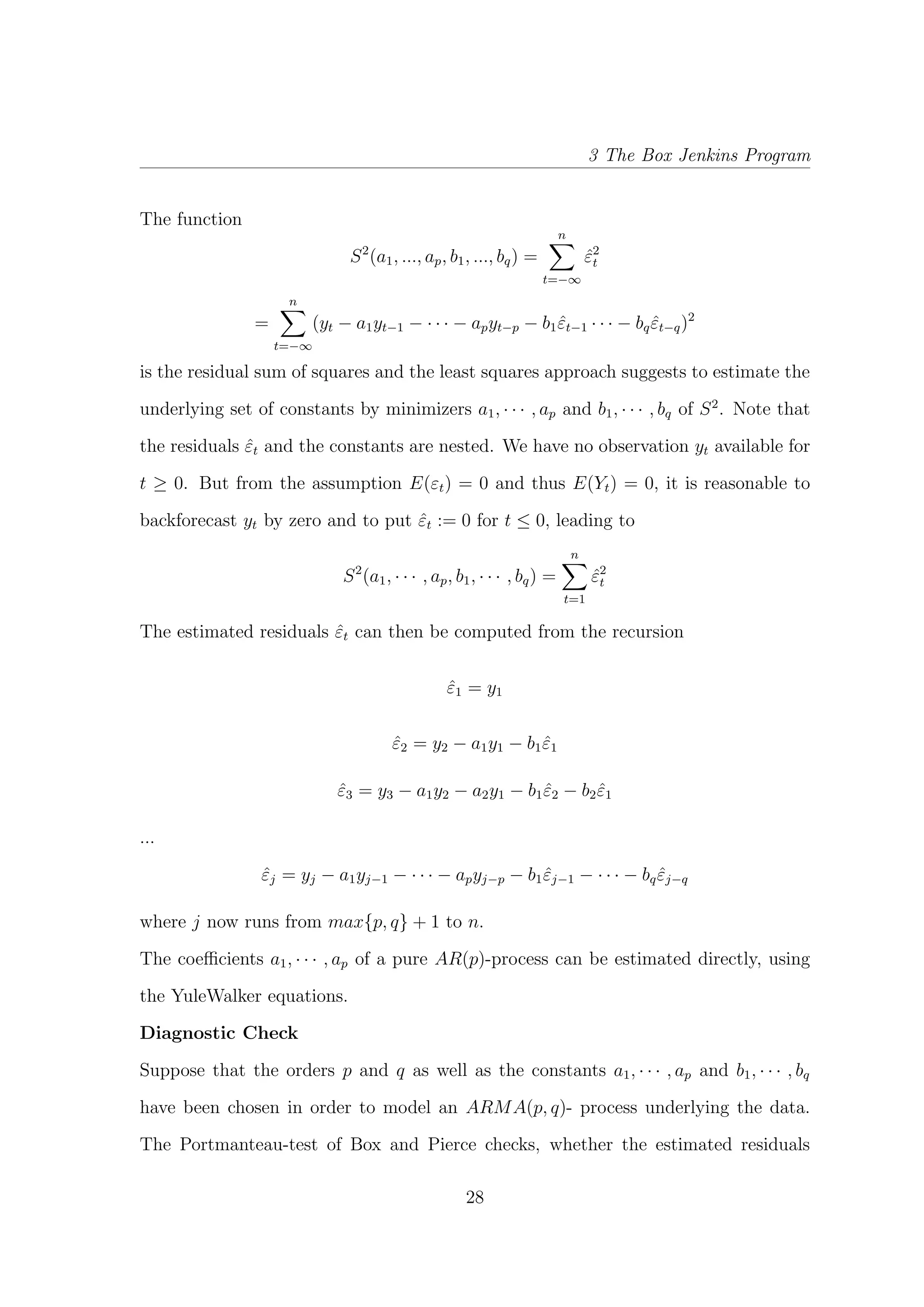
The function
S2
(a1, ..., ap, b1, ..., bq) =
n
t=−∞
ˆε2
t
=
n
t=−∞
(yt − a1yt−1 − · · · − apyt−p − b1 ˆεt−1 · · · − bq ˆεt−q)2
is the residual sum of squares and the least squares approach suggests to estimate the
underlying set of constants by minimizers a1, · · · , ap and b1, · · · , bq of S2
. Note that
the residuals ˆεt and the constants are nested. We have no observation yt available for
t ≥ 0. But from the assumption E(εt) = 0 and thus E(Yt) = 0, it is reasonable to
backforecast yt by zero and to put ˆεt := 0 for t ≤ 0, leading to
S2
(a1, · · · , ap, b1, · · · , bq) =
n
t=1
ˆε2
t
The estimated residuals ˆεt can then be computed from the recursion
ˆε1 = y1
ˆε2 = y2 − a1y1 − b1 ˆε1
ˆε3 = y3 − a1y2 − a2y1 − b1 ˆε2 − b2 ˆε1
...
ˆεj = yj − a1yj−1 − · · · − apyj−p − b1 ˆεj−1 − · · · − bq ˆεj−q
where j now runs from max{p, q} + 1 to n.
The coefficients a1, · · · , ap of a pure AR(p)-process can be estimated directly, using
the YuleWalker equations.
Diagnostic Check
Suppose that the orders p and q as well as the constants a1, · · · , ap and b1, · · · , bq
have been chosen in order to model an ARMA(p, q)- process underlying the data.
The Portmanteau-test of Box and Pierce checks, whether the estimated residuals
28
3 The Box Jenkins Program
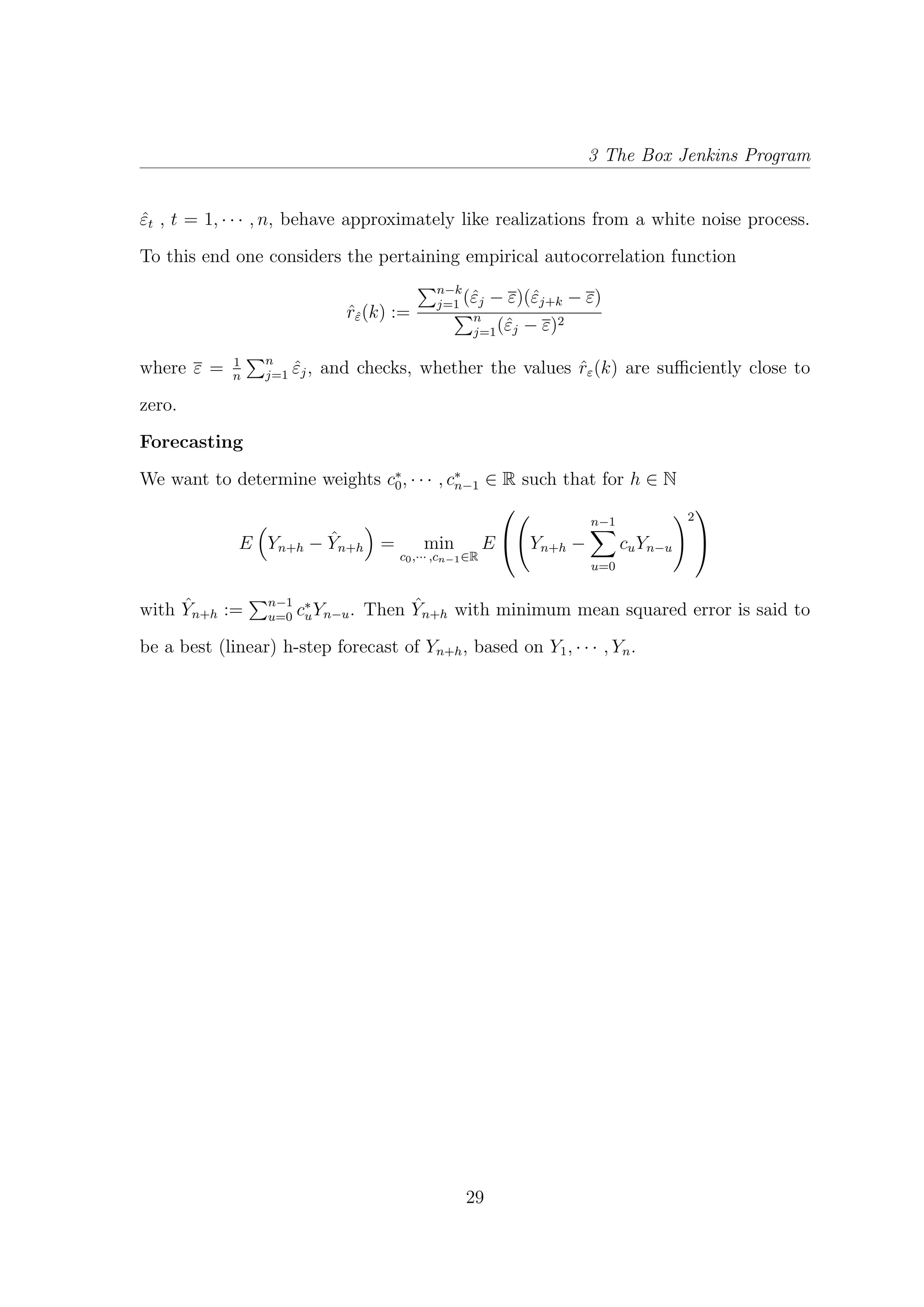
ˆεt , t = 1, · · · , n, behave approximately like realizations from a white noise process.
To this end one considers the pertaining empirical autocorrelation function
ˆrˆε(k) :=
n−k
j=1 (ˆεj − ε)(ˆεj+k − ε)
n
j=1(ˆεj − ε)2
where ε = 1
n
n
j=1 ˆεj, and checks, whether the values ˆrε(k) are sufficiently close to
zero.
Forecasting
We want to determine weights c∗
0, · · · , c∗
n−1 ∈ R such that for h ∈ N
E Yn+h − ˆYn+h = min
c0,··· ,cn−1∈R
E

 Yn+h −
n−1
u=0
cuYn−u
2


with ˆYn+h := n−1
u=0 c∗
uYn−u. Then ˆYn+h with minimum mean squared error is said to
be a best (linear) h-step forecast of Yn+h, based on Y1, · · · , Yn.
29
Chapter 4
Conclusion
The book ”A First on Time Series Analysis - Example with SAS ” was taken as
principal reference to conclude my semester project, various topics like spectral den-
sity, periodogram ,testing of whit noise etc. has been covered in this project. There
are several implications of the proposed topics in our real life scenario. Although
the theoretical aspects are more widely discussed in the initial chapters project, the
practical implications has also been elaborated in succeeding chapters.
30
References
Books
1. A First Course on Time Series Analysis Examples with SAS - Chair of Statistics,
University of Wurzburg, August 1, 2012
31

Time Series Analysis

  • 1.
    TIME SERIES ANALYSIS AReport Submitted in Partial Fulfilment of the Requirements for the 8 Semester MASTER OF SCIENCE by Kavita Meena to the School of Mathematical Sciences National Institute of Science Education and Research Bhubaneswar Date 14/4/2014
  • 2.
    INTRODUCTION The purpose ofthis report is to study the spectrum of a stationary process via linear filters and frequencies in order to do statistical analysis in frequency domain . In first section of this report characterizations of autocovariance functions is introduce and spectral density of an ARMA-process is determined . In section statistical analysis in the frequency domain, testing for a white noise and estimating of spectral densities are derived using the periodogram . In last section of this report , The box-jenkins programme , partical application of box-jenkins method in real life is described and various estimations for certain parameteress are found. i
  • 3.
    Contents 1 The Spectrumof a Stationary Process 1 1.1 Characterizatios of Autocovariance Functions . . . . . . . . . . . . . 1 1.2 Spectral distribution for linear filters . . . . . . . . . . . . . . . . . . 8 1.3 Spectral Density of an ARMA-Process . . . . . . . . . . . . . . . . . 10 2 Statistical Analysis in the Frequency Domain 13 2.1 Testing for a White Noise . . . . . . . . . . . . . . . . . . . . . . . . 13 2.2 Estimating Spectral Densities . . . . . . . . . . . . . . . . . . . . . . 15 3 The Box Jenkins Program 26 4 Conclusion 30 References 31 ii
  • 4.
    Chapter 1 The Spectrumof a Stationary Pro- cess In this chapter spectrum of a real valued stationary process , which is fourier transform of its autocovariance function is discussed. Let (Yt)t∈Z be a (real valued) stationary process with an absolutely summable autocovariance function γ(t), t ∈ Z . Its fourier transform f(λ) := t∈Z γ(t)e−i2πλt = γ(0) + 2 t∈N γ(t) cos(2πλt) , λ ∈ R is called spectral density or spectrum of the process (Yt)t∈Z. γ(t) = 1 0 f(λ)ei2πλt = 1 0 f(λ) cos(2πλt)dλ for t = 0 γ(0) = 1 0 f(λ)dλ ,which shows that spectrum is a decomposition of the variance γ(0). 1.1 Characterizatios of Autocovariance Functions The autocovariance function γ : Z −→ R of a stationary process (Yt)t∈Z is given by γ(h) = E(Yt+hYt) − E(Yt+h)E(Yt) , h ∈ Z with the properties γ(0) ≥ 0, |γ(h)| ≤ γ(0), γ(h) = γ(−h) , h ∈ Z 1
  • 5.
    1 The Spectrumof a Stationary Process The following result characterizes an autocovariance function in terms of positive semidefiniteness. Theorem 1.1.1. A symmetric function K : Z → R is the autocovariance function of a stationary process (Yt)t∈Z iff K is positive semidefinite function, K(−n) = K(n) and 1≤r,s≤n xrK(r − s)xs ≥ 0 for arbitary n ∈ N and x1, x2, ..., xn ∈ R. Proof. It is easy to see that condition 1≤r,s≤n xrK(r − s)xs ≥ 0 is necessary condition for K to be the autocovariance function of a stationary pro- cess. It remain to show that above condition is sufficient, i.e., we will construct a stationary process, whose autocovariance function is K. we will define a family of the consistency condition of Kolmogorov’s theorem. This result implies the existance of a process (Vt)t∈Z,whose finite dimensional distributions coincide with the given family . Define the n × n matrix K(n) := (K(r − s))1≤r,s≤n which is positive semidefinite. consequently there exists an n-dimensional normal dis- tributed vector (V1, ..., Vn) with mean vector zero and covariances matrix K(n) . define now for each n ∈ N and t ∈ Z a distribution function on Rn by 2
  • 6.
    1 The Spectrumof a Stationary Process Ft1,...,tt+n (v1, ..., vn) := P{V1 ≤ v1, ..., Vn ≤ vn} this determines a family of distribution functions indexed by consecutive integers. Let now t1 < · · · < tm be arbitrary integers. Choose t ∈ Z and n ∈ N such that ti = t + ni, where 1 ≤ n1 < · · · < nm ≤ n. we define now Ft1,...,tm ((vi)1≤i≤m := P{Vni ≤ vi, 1 ≤ i ≤ m} Note that Ft1,...tm does not depend on the special choice of t and n and thus, we have defined a family of distribution functions indexed by t1 < · · · < tm on Rm for each m ∈ N, which obviously satisfies the consistency condition of Kolmogorov’s theorem. This result implies the existence of a process (Vt)t∈Z, whose finite dimensional distribution at t1 < · · · < tm has distribution function Ft1,...,tm . This process has, therefore, mean vector zero and covariances E(Vt+hVt) = K(h) , h ∈ Z. Spectral Distribution Function and Spectral Density The preceding result provides a characterization of an autocovariance function in terms of positive semideniteness. The following characterization of positive semidefi- nite functions is known as Herglotz’s theorem. Definition 1.1.1. The uniquely determined function F, which is a right-continuous, increasing and bounded function, is called the spectral distribution function of γ . If F has a derivative f and, thus, F(λ) = F(λ) − F(0) = λ 0 f(x)dx for 0 ≤ λ ≤ 1,then f is called the spectral density of γ. The property that h≥0 |λ(h)| < ∞ already implies the existence of a spectral density of λ. λ(0) = 1 0 dF(λ) = F(1) and thus, the autocorrelation function ρ(h) = γ(h) γ(0) has the above integral representation, but with F replaced by the probability distribution function F γ(0) 3
  • 7.
    1 The Spectrumof a Stationary Process Theorem 1.1.2. A symmetric function K : Z −→ R is positive semidefinite iff it can be represented as an integral γ(h) = 1 0 ei2πλh dF(λ) = 1 0 cos(2πλh)dF(λ), where F is a real valued measure generating function on [0, 1] with F(0) = 0. The function F is uniquely determined. Proof. We establish first the uniqueness of F. Let G be another measure generating function with G(λ) = 0 for λ ≤ 0 and constant for λ ≥ 1 such that γ(h) = 1 0 ei2πλh dF(λ) = 1 0 ei2πλh dG(λ) , h ∈ Z. Let now ψ be a continuous function on [0, 1]. From calculus we know that we can find for arbitrary ε > 0 a trigonometric polynomial pε(λ) = N h=−N ahei2πλh , 0 ≤ λ ≤ 1, such that sup 0≤λ≤1 |ψ(λ) − pε(λ)| ≤ ε. As a consequence we obtain that 1 0 ψ(λ)dF(λ) = 1 0 pε(λ)dF(λ) + r1(ε) = 1 0 pε(λ)dG(λ) + r1(ε) = 1 0 ψ(λ)dG(λ) + r2(ε) where ri(ε) → 0 as ε → 0, i = 1, 2, and, thus, 1 0 ψ(λ)dF(λ) = 1 0 ψ(λ)dG(λ). Since ψ was an arbitrary continuous function, this in turn together with F(0) = G(0) = 0 implies F = G. Suppose now that γ has the representation γ(h) = 1 0 ei2πλh dF(λ) = 1 0 cos(2πλh)dF(λ) 4
  • 8.
    1 The Spectrumof a Stationary Process We have for arbitrary xi ∈ R, i = 1, ..., n 1≤r,s≤n xrγ(r − s)xs = 1 0 1≤r,s≤n xrxsei2πλ(r−s) dF(λ) = 1 0 | n r=1 xrei2πλr |2 dF(λ) ≥ 0, i.e., γ is positive semidefinite. Suppose conversely that γ : Z −→ R is a positive semidefinite function. This implies that for 0 ≤ λ ≤ 1 and N ∈ N fN (λ) := 1 N 1≤r,s≤N e−i2πλr γ(r − s)ei2πλs = 1 N |m|<N (N − |m|)γ(m)e−i2πλm ≥ 0 Put now FN (λ) := λ 0 fN (x)dx, 0 ≤ λ ≤ 1. Then we have for each h ∈ Z 1 0 ei2πλh = |m|<N 1 − |m| N γ(m) 1 0 ei2πλ(h−m) dλ = 1 − |m| N γ(m) if |h| < N 0, if |h| ≥ N Since FN (1) = γ(0) < ∞ for any N ∈ N, we can apply Helly’s selection theorem to deduce the existence of a measure generating function ˜F and a subsequence (FNk )k such that FNk converges weakly to ˜F i.e., 1 0 g(λ)dFNk (λ) k→∞ −−−→ 1 0 g(λ)d ˜F(λ) for every continuous and bounded function g : [0, 1] −→ R. Put now F(λ) := ˜F(λ) − ˜F(0). Then F is a measure generating function with F(0) = 0 and 1 0 g(λ)d ˜F(λ) = 1 0 g(λ)dF(λ). 5
  • 9.
    1 The Spectrumof a Stationary Process If we replace N in 1 0 ei2πλh = |m|<N 1 − |m| N γ(m) 1 0 ei2πλ(h−m) dλ = 1 − |m| N γ(m) if |h| < N 0, if |h| ≥ N by Nk and let k tend to infinity, we now obtain representation desired. Example 1.1.1. A white noise (εt)tinZ has the autocovariance function γ(h) = σ2 , if h = 0 0, if h ∈ Z {0} Since 1 0 σ2 ei2πλh dλ = σ2 , if h = 0 0, if h ∈ Z {0} the process (εt) has by Theorem 1.1.2 the constant spectral density f(λ) = σ2 , 0 ≤ λ ≤ 1. This is the name giving property of the white noise process: As the white light is characteristically perceived to belong to objects that reflect nearly all incident energy throughout the visible spectrum, a white noise process weighs all possible frequencies equally. Corollary 1.1.3. A symmetric function γ : Z −→ R is the autocovariance function of a stationary process (Yt)t∈Z, iff it satisfies one of the following two (equivalent) conditions: (i) γ(h) = 1 0 ei2πλh dF(λ), h ∈ Z, where F is a measure generating function on [0, 1] with F(0) = 0. (ii) 1≤r,s≤n xrγ(r − s)xs ≥ 0 for each n ∈ N and x1, ..., xn ∈ R. Corollary 1.1.4. A symmetric function γ : Z −→ R with t∈Z |γ(t)| < ∞ is the autocovariance function of a stationary process iff f(λ) := t∈Z γ(t)e−i2πλt ≥ 0 , λ ∈ [0, 1] 6
  • 10.
    1 The Spectrumof a Stationary Process The function f is in this case the spectral density of γ. Proof. Suppose first that γ is an autocovariance function. Since γ is in this case positive semidefinite and t∈Z |γ(t)| < ∞ by assumption, we have 0 ≤ fN (λ) := 1 N 1≤r,s≤N e−i2πλr γ(r − s)ei2πλs = |t|<N 1 − |t| N γ(t)e−i2πλt −→ f(λ) as N −→ ∞ The function f is consequently nonnegative. The inverse Fourier transform implies that γ(t) = 1 0 f(λ)ei2πλt dλ ; t ∈ Z i.e., f is the spectral density of γ. Suppose on the other hand that f(λ)λ = t∈Z γ(t)ei2πλt ≥ 0 , 0 ≤ λ ≤ 1. The inverse Fourier transform implies γ(t) = 1 0 f(λ)ei2πλt dλ = 1 0 ei2πλt dF(λ), where F(λ) = 1 0 f(x)dx , 0 ≤ λ ≤ 1. Thus we have established representation in above theorem, which implies that γ is positive semidefinite, and, consequently, γ is by Corollary above the autocovariance function of a stationary process. Example 1.1.2. Choose a number ρ ∈ R. The function γ(h) =    1, if h = 0 ρ, if h ∈ {−1, 1} 0, elsewhere is the autocovariance function of a stationary process iff |ρ| ≤ 0.5. This follows from f(λ) = t∈Z γ(t)ei2πλt = γ(0) + γ(1)ei2πλ + γ(−1)e−i2πλ = 1 + 2ρ cos(2πλ) ≥ 0 7
  • 11.
    1 The Spectrumof a Stationary Process for λ ∈ [0, 1] iff |ρ| ≤ 0.5. The function γ is the autocorrelation function of an MA(1)-process. The spectral distribution function of a stationary process satisfies F(0.5 + λ) − F(0.5− ) = F(0.5) − F((0.5 − λ)− ) , 0 ≤ λ < 0.5, where F(x− ) := limε↓0F(x − ε) is the left-hand limit of F at x ∈ (0, 1] . If F has a derivative f, we obtain from the above symmetry f(0.5 + λ) = f(0.5 − λ) or, equivalently, f(1λ) = f(λ) and, hence, γ(h) = 1 0 cos(2πλh)dF(λ) = 2 0.5 0 cos(2πλh)f(λ)df(λ) The autocovariance function of a stationary process is, therefore, determined by the values f(λ) , 0 ≤ λ ≤ 0.5, if the spectral density exists. Moreover, that the smallest nonconstant period P0 visible through observations evaluated at time points t = 1, 2, ... is P0 = 2 i.e., the largest observable frequency is the Nyquist frequency λ0 = 1 P0 = 0.5, Hence, the spectral density f(λ) matters only for λ ∈ [0, 0.5]. Remark 1.1.1. The preceding Theorems shows that a function f : [0, 1] −→ R is the spectral density of a stationary process iff f satisfies the following three conditions (i)f(λ) ≥ 0, (ii)f(λ) = f(1 − λ), (iii) 1 0 f(λ)dλ < ∞ 1.2 Spectral distribution for linear filters Theorem 1.2.1. Let (Zt)t∈Z be a stationary process with spectral distribution function FZ and let (at)t∈Z be an absolutely summable filter with Fourier transform fa. The linear filtered process Yt := u∈Z auZt−u, t ∈ Z then has the spectral distribution function FY (λ) := 1 0 |fa(x)|2 dFZ(x) , 0 ≤ λ ≤ 1. 8
  • 12.
    1 The Spectrumof a Stationary Process If in addition (Zt)t∈Z has a spectral density fZ, then fY (λ) := |fa(λ)|2 fZ(λ) , 0 ≤ λ ≤ 1 is the spectral density of (Yt)t∈Z. Proof. we know that (Yt)t∈Z is stationary with autocovariance function γY (t) = u∈Z w∈Z auawγZ(t − u + w) , t ∈ Z where γZ is the autocovariance function of (Zt). Its spectral representation implies γY (t) = u∈Z w∈Z auaw 1 0 ei2πλ(t−u+w) dFZ(λ) = 1 0 u∈Z aue−i2πλu w∈Z awe−i2πλw ei2πλt dFZ(λ) = 1 0 |fa(λ)|2 ei2πλt dFZ(λ) 1 0 ei2πλt dFY (λ) Theorem 1.1.2 now implies that FY is the uniquely determined spectral distribution function of (Yt)t∈Z. The second to last equality yields in addition the spectral density. Remark 1.2.1. Since the spectral density is a measure of intensity of a frequency λ inherent in a stationary process , the effect of applying a linear filter (at) with Fourier transform fa can easily be interpreted. While the intensity of λ is diminished by the filter (at) iff |fa(λ)| < 1, its intensity is amplified iff |fa(λ)| > 1. The Fourier transform fa of (at) is, therefore, also called transfer function and the function ga(λ) := |fa(λ)|2 is referred to as the gain or power transfer function of the filter (at)t∈Z. Example 1.2.1. The first order difference filter au =    1, u = 0 −1, u = 1 0, elsewhere 9
  • 13.
    1 The Spectrumof a Stationary Process has the transfer function fa(λ) = 1 − e−i2πλ Since fa(λ) = e−iπλ (eiπλ − e−iπλ ) = ie−iπλ 2 sin(πλ) its power transfer function is ga(λ) = 4 sin2 (πλ) The first order difference filter, therefore, damps frequencies close tozero but amplifies those close to 0.5. 1.3 Spectral Density of an ARMA-Process Theorem 1.2.1 enables us to compute spectral densities of ARMA-processes. Theorem 1.3.1. Suppose that Yt = a1Yt−1 + · · · + apYt−p + εt + b1εt−1 + ... + bqεt−q , t ∈ Z, is a stationary ARMA(p, q)-process, where (εt) is a white noise with variance σ2 . Put A(z) := 1 − a1z − a2z2 − · · · − apzp , B(z) := 1 + b1z + b2z2 + · · · + bqzq and suppose that the process (Yt) satisfies the stationarity condition, i.e., the roots of the equation A(z) = 0 are outside of the unit circle. The process (Yt) then has the spectral density fY (λ) = σ2 |B(e−i2πλ )|2 |A(e−i2πλ)|2 = σ2 |1 + q v=1 bve−i2πλv |2 |1 − p u=1 aue−i2πλu|2 10
  • 14.
    1 The Spectrumof a Stationary Process Proof. Since the process (Yt) is supposed to satisfy the stationarity condition it is causal, i.e., Yt = v≥0 αvεt−v , t ∈ Z, for some absolutely summable constants αv , v ≥ 0. The white noise process (εt) has the spectral density fε(λ) = σ2 and, thus, (Yt) has by Theorem 1.2.1 a spectral density fY . The application of Theorem 1.2.1 to the process Xt := Yt − a1Yt−1 − ... − apYt−p = εt + b1εt−1 + ... + bqεt−q then implies that (Xt) has the spectral density fX(λ) = |A(e−i2λ )|2 fY (λ) = |B(e−i2λ )|2 fε(λ) Since the roots of A(z) = 0 are assumed to be outside of the unit circle, we have |A(e−i2λ )| = 0 and, thus, the assertion of Theorem 1.3.1 follows. Remark 1.3.1. The preceding result with a1 = ... = ap = 0 implies that an MA(q)- process has the spectral density fY (λ) = σ2 |B(e−i2πλ )|2 With b1 = ... = bq = 0 , Theorem 2.3.1 implies that a stationary AR(p)-process, which satisfies the stationarity condition , has the spectral density fY (λ) = σ2 1 |A(e−i2πλ)|2 Example 1.3.1. The stationary ARMA(1, 1)-process Yt = aYt−1 + εt + bεt−1 with |a| < 1 has the spectral density fY (λ) = σ2 1 + 2b cos(2πλ) + b2 1 − 2a cos(2πλ) + a2 11
  • 15.
    1 The Spectrumof a Stationary Process The MA(1)-process, in which case a = 0, has, consequently the spectral density fY (λ) = σ2 (1 + 2b cos(2πλ) + b2 ) and the stationary AR(1) -process with |a| < 1, for which b = 0, has the spectral density fY (λ) = σ2 1 1 − 2a cos(2πλ) + a2 12
  • 16.
    Chapter 2 Statistical Analysisin the Frequency Domain Here the problem of testing for a white noise and the estimation of the spectral density are discussed . The empirical counterpart of the spectral density, the periodogram, will be basic for both problems, though it will turn out that it is not a consistent estimate. Consistency requires extra smoothing of the periodogram via a linear filter. 2.1 Testing for a White Noise In this section we are discussing whether the data are generated by a whit noise (εt)t∈Z in the following model Yt = µ + A cos(2πλt) + B sin(2πλt) + εt here we assume that the εt are independent and normal distributed with mean zero and variance σ2 . Here we will test the nullhypothesis A = B = 0 against the alternative A = 0 or B = 0 where the frequency λ, the variance σ2 > 0 and the intercept µ ∈ R are unknown. Since the periodogram is used for the detection of highly intensive frequencies inherent in the data, it seems plausible to apply it to the preceding testing problem as well. The Distribution of the Periodogram 13
  • 17.
    2 Statistical Analysisin the Frequency Domain Lemma 2.1.1. Let ε1, ..., εn be independent and identically normal distributed random variables with mean µ ∈ R and variance σ2 > 0. Denote by ¯ε := 1 n n t=1 εt the sample mean of ε1, ..., εn and by Cε (k/n) = 1 n n t=1 (εt − ¯ε) cos 2 k n t Sε (k/n) = 1 n n t=1 (εt − ¯ε) sin 2 k n t the cross covariances with Fourier frequencies k/n , 1 ≤ k ≤ [(n − 1)/2]. Then the 2[(n − 1)/2] random variables Cε (k/n) , Sε (k/n) , 1 ≤ k ≤ [(n − 1)/2] are independent and identically N(0, σ2 /(2n))-distributed. Corollary 2.1.2. Let ε1, ..., εn be as in the preceding lemma and let Iε (k/n) = n C2 ε (k/n) + S2 ε (k/n) be the pertaining periodogram, evaluated at the Fourier frequencies k/n , 1 ≤ k ≤ [(n−1)/2] , k ∈ N .The random variables Iε(k/n)/σ2 are independent and identically standard exponential distributed i.e., P Iε(k/n)/σ2 ≤ x = 1 − exp(−x) , x > 0 0 , x ≤ 0 Proof. Lemma mentioned above implies that 2n σ2 Cε(k/n) , 2n σ2 Sε(k/n) are independent standard normal random variables and, thus, 2Iε(k/n) σ2 = 2n σ2 Cε(k/n) 2 + 2n σ2 Sε(k/n) 2 is χ2 -distributed with two degrees of freedom. Since this distribution has the distri- bution function 1 − exp(−x/2) , x ≤ 0, the assertion follows. 14
  • 18.
    2 Statistical Analysisin the Frequency Domain For testing of White noise following test are used : Fisher’s Test κm := max1≤j≤m I(j/n) (1/m) m k=1 I(k/n) = mMm Where Mm := max1≤j≤m Iε(j/n) m k=1 Iε(k/n) is significantly large, i.e., if one of the values I(j/n) is significantly larger than the average over all. The hypothesis ( data is generated by white noise ) is, therefore, rejected at error level α if κm > cα with 1 − Gm cα m = α The BartlettKolmogorovSmirnov Test The KolmogorovSmirnov statistic ∆m−1 := sup x∈[0,1] | ˆFm−1(x) − x| In this test we fit our data points with graph of x and if value of ∆ is too high then hypothesis is rejected. 2.2 Estimating Spectral Densities We are assuming in the following that (Yt)t∈Z is a stationary real valued process with mean µ and absolutely summable autocovariance function γ. From last chapter we know that the process (Yt)t∈Z has the continous spectral density f(λ) = h∈Z γ(h)e−i2πλh In this section we will invetigate the limit behaviour of the periodogram for arbitrary independent random variable (Yt) Asymptotic Properties of the Periodogram For Fourier frequencies k/n , 0 ≤ k ≤ [n/2] we put In(k/n) = 1 n | n t=1 Yte−i2π(k/n)t |2 15
  • 19.
    2 Statistical Analysisin the Frequency Domain = 1 n    n t=1 Yt cos(2π k n t) 2 + n t=1 Yt sin(2π k n t) 2    Up to k = 0, this coincide with the definition of the periodogram and it have repre- sentation In(k/n) == n¯Y 2 n , k = 0 |h|<n c(h)e−i2π(k/n)h , k = 1, ..., [n/2] with ¯Yn := 1 n n t=1 Yt and the sample autocovariance function c(h) = 1 n n−|h| t=1 (Yt − ¯Yn)(Yt+|h| − ¯Yn) By above representation , the results related to periodogarm done earlier and the value In(k/n) does not change for k = 0 if we replace sample mean ¯Yn in c(h) by the theoretical mean µ. This leads to the equivalent representation of the periodogram for k = 0 In(k/n) = |h|<n 1 n   n−|h| t=1 (Yt − µ)(Yt+|h| − µ)   e−i2π(k/n)h = 1 n n t=1 (Yt − µ) + 2 n−1 h=1 1 n   n−|h| t=1 (Yt − µ)(Yt+|h| − µ)   cos(2π k n h) We define now the periodogram for λ ∈ [0, 0.5] as a piecewise constant function In(λ) = In(k/n) if k n − 1 2n < λ ≤ k n + 1 2n The following result shows that the periodogram In(λ) is for λ = 0 an asymptotically unbiased estimator of the spectral density f(λ). Theorem 2.2.1. Let (Yt)t∈Z be a stationary process with absolutely summable auto- covariance function γ . Then we have with µ = E(Yt) E(In(0)) − nµ2 n→∞ −−−→ f(0), E(In(λ)) n→∞ −−−→ f(λ) , λ = 0 If λ = 0, then the convergence E(In(λ)) n→∞ −−−→ f(λ) holds uniformly on [0.0.5]. 16
  • 20.
    2 Statistical Analysisin the Frequency Domain Proof. By representation written above the theorem and the Cesaro convergence re- sult we have E(In(0)) − nµ2 = 1 n n t=1 n s=1 E(YtYs) − nµ2 = 1 n n t=1 n s=1 Cov(Ys, Yt) = |h|<n 1 − |h| n γ(h) n→∞ −−−→ h∈Z γ(h) = f(0) Define now for λ ∈ [0, 0, 5] the auxiliary function gn(λ) := k n , if k n − 1 2n < λ ≤ k n + 1 2n Then we obviously have In(λ) = In(gn(λ)) Choose now λ ∈ (0, 0.5]. Since gn(λ) −→ λasn −→ ∞, it follows that gn(λ) > 0 for n large enough. now we obtain for such n E(In(λ)) = |h|<n 1 n n−|h| t=1 E (Yt − µ)(Yt+|h| − µ) e−i2πgn(λ)h = |h|<n 1 − |h| n γ(h)e−i2πgn(λ)h Since h∈Z |γ(h)| < ∞, the series |h|<n γ(h) exp(−i2πλh) converges to f(λ) uni- formly for 0 ≤ λ ≤ 0.5. Kronecker’s implies moreover | |h|<n |h| n γ(h)e−i2πλh | ≤ |h|<n |h| n |γ(h)| n→∞ −−−→ 0 and, thus, the series fn(λ) := |h|<n 1 − |h| n γ(h)e−i2πλh 17
  • 21.
    2 Statistical Analysisin the Frequency Domain converges to f(λ) uniformly in λ as well. From gn(λ) n→∞ −−−→ λ and the continuity of f we obtain for λ ∈ (0, 0, 5] |E(In(λ)) − f(λ)| = |fn(gn(λ)) − f(λ)| ≤ |fn(gn(λ)) − f(gn(λ))| + |f(gn(λ)) − f(λ)| n→∞ −−−→ 0 Note that |gn(λ) − λ| ≤ 1/(2n). The uniform convergence in case of µ = 0 then follows from the uniform convergence of gn(λ) to λ and the uniform continuity of f on the compact interval [0, 0.5]. Theorem 2.2.2. Let Z1, ..., Zn be independent and identically distributed random variables with mean E(Zt) = 0 and variance E(Z2 t ) = σ2 < ∞. Denote by In(λ) the pertaining periodogram as defined earlier (In(λ) = In(gn(λ))). (i) The random vector (In(λ1), ..., In(λr)) with 0 < λ1 < ... < λr < 0.5 converges in distribution for n −→ ∞ to the distribution of r independent and identically expo- nential distributed random variables with mean σ2 . (ii) If E(Z4 t ) = ησ4 < ∞, then we have for k = 0, ..., [n/2] , k ∈ N V ar(In(k/n)) = 2σ4 + 1 n (η − 3)σ4 , k = 0 or k = n/2 σ4 + 1 n (η − 3)σ4 elsewhere and Cov(In(j/n) , In(k/n)) = 1 n (η − 3)σ4 , j = k For N(0, σ2 )-distributed random variables Zt we have η = 3 and, thus, In(k/n) and In(j/n) are for j = k uncorrelated. we established that they are independent in this case. 18
  • 22.
    2 Statistical Analysisin the Frequency Domain Proof. Put for λ ∈ (0, 0.5) An(λ) := An(gn(λ)) := 2/n n t=1 Zt cos(2πgn(λ)t), Bn(λ) := Bn(gn(λ)) := 2/n n t=1 Zt sin(2πgn(λ)t), with gn defined as gn(λ) := k n , if k n − 1 2n < λ ≤ k n + 1 2n since In(λ) = 1 2 A2 n(λ) + B2 n(λ) it suffices, to show that (An(λ1), BN (λ), ..., An(λr), Bn(λr)) −→D N(0, σ2 I2r) where I2r denotes the 2r × 2r-unity ,atrix and −→D convergence in distribution. since gn(λ) n→∞ −−−→ λ, we have gn(λ) > 0 for λ ∈ (0, 0.5) if n is large enough . The independence of Zt together with the definition of gn and the orthogonality implies that V ar(An(λ)) = V ar(An(gn(λ))) = σ2 2 n n t=1 cos2 (2πgn(λ)t) = σ2 For ε > 0 we have 1 n n t=1 E Z2 t cos2 (2πgn(λ)t)1{|Zt cos(2πgn(λ)t)|>ε √ nσ2 } ≤ 1 n n t=1 E Z2 t 1{|Zt|>ε √ nσ2 } = E Z2 1 1{|Z1|>ε √ nσ2} n→∞ −−−→ 0 i.e., the triangular array (2/n)1/2 Zt cos(2πgnλt) , 1 ≤≤ n . n ∈ N, satisfies the linde- berg condition implying An(λ) −→D N(0, σ2 ) 19
  • 23.
    2 Statistical Analysisin the Frequency Domain similarly Bn(λ) −→D N(0, σ2 ) as well. since the random vector (An(λ1), Bn(λ1), ..., An(λr), Bn(λr) has the covariance matrix σ2 I2r, its asymptotic joint normality follows easily by ap- plying the cramer-wold device and hence it proves the (i)part. from the definition of periodogram we conclude In(k/n) = 1 n n s=1 n t=1 ZsZte−i2π k n (s−t) and thus , we obtain E(In(j/n)In(k/n)) = 1 n2 n s=1 n t=1 n u=1 n v=1 E (ZsZtZuZv) e−i2π 1 n (s−t) e−i2π k n (u−v) we have E (ZsZtZuZv) =    ησ4 , s = t = u = v σ4 , s = t = u = v , s = u = t = v , s = v = t = u 0, elsewhere and e−i2π 1 n (s−t) e−i2π k n (u−v) =    1 , s = t , u = v e−i2π((j+k)/n)s ei2π((j+k)/n)t , s = u , t = v e−i2π((j−k)/n)s ei2π((j−k)/n)t , s = v , t = u this implies E(In(j/n)In(k/n)) = ησ4 n + σ4 n2 n(n − 1) + | n t=1 e−i2π((j+k)/n)t |2 + | n t=1 e−i2π((j−k)/n)t |2 − 2n = (η − 3)σ4 n + σ4 1 + 1 n2 | n t=1 ei2π((j+k)/n)t |2 + 1 n2 | n t=1 ei2π((j−k)/n)t |2 from E(In(k/n)) = 1 n n t=1 E(Z2 t ) = σ2 we finally obtain Cov(In(j/n), In(k/n)) = (η − 3)σ4 n + σ4 n2 1 + 1 n2 | n t=1 ei2π((j+k)/n)t |2 + 1 n2 | n t=1 ei2π((j−k)/n)t |2 from this result follows 20
  • 24.
    2 Statistical Analysisin the Frequency Domain Discrete Spectral Average Estimator The preceding results show that the periodogram is not a consistent estimator of the spectral density. The law of large numbers together with the above remark motivates, however, that consistency can be achieved for a smoothed version of the periodogram such as a simple moving average |j|≤m 1 2m + 1 In k + j n which puts equal weights 1/(2m + 1) on adjacent values. Dropping the condition of equal weights, we define a general linear smoother by the linear filter ˆfn k n := |j|≤m ajnIn k + j n The sequence m = m(n), defining the adjacent points of k/n, has to satisfy m n→∞ −−−→ ∞ and m/n n→∞ −−−→ 0 and the weights ajn have the properties (i)ajn ≥ 0 (ii) ajn = a−jn (iii) |j|≤m ajn = 1 (iv) |j|≤m a2 jn n→∞ −−−→ 0 Theorem 2.2.3. Let Yt = u∈Z buZt−u, t ∈ Z, where Zt are iid with E(Zt) = 0 , E(Z4 t ) < ∞ and u∈Z |bu||u|1/2 < ∞. Then we have for 0 ≤ µ, λ ≤ 0.5 (i) limn→∞ E( ˆfn(λ)) = f(λ) (ii) lim n→∞ Cov( ˆfn(λ), ˆfn(µ)) ( |j|≤m a2 jn) =    2f2 (λ) , λ = µ = 0 or 0.5 f( λ) , 0 < λ = µ < 0.5 0 , λ = µ 21
  • 25.
    2 Statistical Analysisin the Frequency Domain condition (iv) in properties of ajn on weights together with (ii) in the preceding result entails that V ar( ˆfn(λ)) n→∞ −−−→ 0 for any λ ∈ [0, 0.5]. Together with (i) we, therefore, obtain that the mean squared error of ˆfn(λ) vanishes asymptotically: MSE( ˆfn(λ)) = E ( ˆfn(λ) − f(λ))2 = V ar( ˆfn(λ)) + BIAS2 ( ˆfn(λ)) n→∞ −−−→ 0 Proof. By the definition of the spectral density estimator we have |E( ˆfn(λ)) − f(λ)| = | |j|≤m ajn {E(In(gn(λ) + j/n)) − f(λ)} | = | |j|≤m ajn {E(In(gn(λ) + j/n)) − f(gn(λ) + j/n) + f(gn(λ) + j/n) − f(λ)} | where together with the uniform convergence of gn(λ) to λ implies max |j|≤m |gn(λ) + j/n − λ| n→∞ −−−→ 0 Choose ε > 0. The spectral density f of the process (Yt) is continous and hence we have max |j|≤m |E(In(gn(λ) + j/n)) − f(gn(λ) + j/n)| < ε/2 if n is large then property (iii) together with triangular inequality implies |E( ˆfn(λ))− f(λ)| < ε for large n. This implies part from the definition of ˆfn we obtain Cov( ˆfn(λ), ˆfn(µ)) = |j|≤m |k|≤m ajnaknCov (In(gn(λ) + j/n), In(gn(µ) + k/n)) If λ = µ and n sufficiently large we have gn(λ) + j/n = gn(µ) + k/n for arbitrary |j|, |k| ≤ m. Now there exists a universal constant C1 > 0 such that |Cov( ˆfn(λ), ˆfn(µ))| = | |j|≤m |k|≤m ajnaknO(n−1 )| 22
  • 26.
    2 Statistical Analysisin the Frequency Domain ≤ C1n−1   |j|≤m ajn   2 ≤ C1 2m + 1 n |j|≤m a2 jn where the final inequality is an application of the Cauchy - Schwartz inequality . Since m/n n→∞ −−−→ 0, we have established (ii) in the case λ = µ. Suppose now 0 < λ = µ < 0.5. Now we have V ar( ˆfn(λ)) = |j|=m a2 jn f2 (gn(λ) + j/n) + O(n−1/2 ) + |j|≤m |k|≤m ajnaknO(n−1 ) + o(n−1 ) =: S1(λ) + S2(λ) + o(n−1 ). From same argument done in part(i) we have S1(λ) =   |j|≤m a2 jn   f2 (λ) + o   |j|≤m a2 jn   Furthermore, with a suitable constant C2 > 0, we have |S2(λ)| ≤ C2 1 n   |j|≤m ajn   2 ≤ C2 2m + 1 n |j|≤m a2 jn thus we proved part(ii). Confidence Intervals for Spectral Densities The random variables In((k + j)/n)/f((k + j)/n), 0 < k + j < n/2, for large n approximately behave like independent and standard exponential distributed random 23
  • 27.
    2 Statistical Analysisin the Frequency Domain variables χj. This suggests that the distribution of the discrete spectral average estimator ˆf(k/n) = |j|≤m ajnIn kj n can be approximated by that of the weighted sum |j|≤m ajnXjf((k + j)/n) showed that the distribution of this weighted sum can in turn be approximated by that of cY with a suitably chosen c > 0, where Y follows a gamma distribution with parameters p := ν/2 and b = 1/2 i.e., PY ≤ t = bp τ(p) t 0 xp−1 exp(−bx)dx , t ≥ 0 where τ(p) := ∞ 0 xp−1 exp(−x)dx denotes the gamma function. The parameters ν and c are determined by the method of moments as follows: ν and c are chosen such that cY has mean f(k/n) and its variance equals the leading term of the variance expansion of ˆf(k/n) in Theorem 3.2.4 E(cY ) = cν = f(k/n) V ar(cY ) = 2c2 ν = f2 (k/n) |j|≤m a2 jn The solutions are obviously c = f(k/n) 2 |j|≤m a2 jn and ν = 2 |j|≤m a2 jn Note that the gamma distribution with parameters p = ν/2 and b = 1/2 equals the χ2 -distribution with ν degrees of freedom if ν is an integer. The number ν is, therefore, called the equivalent degree of freedom. Observe that ν/f(k/n) = 1/c, the random variable ν ˆf(k/n)/f(k/n) = ˆf(k/n)/c now approximately follows a χ2 (ν) -distribution 24
  • 28.
    2 Statistical Analysisin the Frequency Domain with the convention that χ2 (ν) is the gamma distribution with parameters p = ν/2 and b = 1/2 if ν is not an integer. The interval ν ˆf(k/n) χ1−α/2(ν) , ν ˆf(k/n) χ2 α/2 is a confidence interval for f(k/n) of approximate level 1−α , α ∈ (0, 1). By χ2 q(ν) we denote the q-quantile of the χ2 (ν) -distribution i.e.,P{Y ≤ χ2 q(ν)} = q , 0 < q < 1. we obtain the confidence interval for log(f(k/n)) Cν,α(k/n) := log( ˆf(k/n)) + log(ν) − log(χ2 1−α/2(ν)) , log( ˆf(k/n)) + log(ν) − log(χ2 α/2(ν)) This interval has constant length log(χ2 1−α/2(ν)/χ2 α/2(ν)). Note that Cν,α(k/n) is a level (1 − α)-confidence interval only for log(f(λ)) at a fixed Fourier frequency λ = k/n, with 0 < k < [n/2], but not simultaneously for λ ∈ (0, 0.5). 25
  • 29.
    Chapter 3 The BoxJenkins Program The aim of this chapter is to fit a time series model (Yt)t∈Z to a given set of data y1, · · · , yn collected in time t. We suppose that the data y1, · · · , yn are (possibly) variance-stabilized as well as trend or seasonally adjusted. We assume that they were generated by clipping Y1, · · · , Yn from an ARMA(p, q)-process (Yt)t∈Z, which we will fit to the data in the following. As seen earlier we could also fit the model Yt = v≥0 αvεt−v to the data, where (εt) is a white noise. The BoxJenkins program consists of four steps: 1. Order selection: Choice of the parameters p and q. 2. Estimation of coefficients: The coefficients of the AR part of the model a1, · · · , ap and the MA part b1, · · · , bq are estimated. 3. Diagnostic check: The fit of the ARMA(p,q)-model with the estimated coefficients is checked. 4. Forecasting: The prediction of future values of the original process. Order Selection The order q of a moving average MA(q)-process can be estimated by means of the empirical autocorrelation function r(k) i.e., by the correlogram. we know that the autocorrelation function ρ(k) vanishes for k ≥ q + 1. This suggests to choose the order q such that r(q) is clearly different from zero, whereas r(k) for k ≥ q + 1 is quite close to zero. The order p of an AR(p)-process can be estimated in an analogous way using the empirical partial autocorrelation function ˆα(k), k ≥ 1. Since ˆα(k) should be close to the p-th coefficient ap of the AR(p)-process, which is different from zero, whereas 26
  • 30.
    3 The BoxJenkins Program ˆα(k) ≈ 0 for k > p. The choice of the orders p and q of an ARMA(p, q)-process is a bit more challenging. In this case one commonly takes the pair (p, q), minimizing some information function, which is based on an estimate ˆσ2 p,q of the variance of ε0. Popular functions are Akaike’s Information Criterion AIC(p, q) := log(ˆσ2 p,q) + 2 p + q n the Bayesian Information Criterion BIC(p, q) := log(ˆσ2 p,q) + (p + q) log(n) n and the Hannan-Quinn Criterion HQ(p, q) := log(ˆσ2 p,q) + 2(p + q) log(log(n)) n with c > 1 Estimation of coefficients Least Square Approach If E(εt) = 0, then ˆYt = a1Yt−1 + · · · + apYt−p + b1εt−1 + · · · + bqεt−q would obviously be a reasonable one-step forecast of the ARMA(p, q)- process Yt = a1Yt−1 + · · · + apYt−p + εt + b1εt−1 + · · · + bqεt−q based on Yt−1, · · · , Yt−p and εt−1, · · · , εt−q. The prediction error is given by the resid- ual Yt − ˆYt = εt Suppose that ˆεt is an estimator of εt, t ≤ n, which depends on the choice of constants a1, · · · , ap, b1, . . . , bq and satisfies the recursion ˆεt = yt − a1yt−1 − · · · − apyt−p − b1 ˆεt−1 − · · · − bq ˆεt−q 27
  • 31.
    3 The BoxJenkins Program The function S2 (a1, ..., ap, b1, ..., bq) = n t=−∞ ˆε2 t = n t=−∞ (yt − a1yt−1 − · · · − apyt−p − b1 ˆεt−1 · · · − bq ˆεt−q)2 is the residual sum of squares and the least squares approach suggests to estimate the underlying set of constants by minimizers a1, · · · , ap and b1, · · · , bq of S2 . Note that the residuals ˆεt and the constants are nested. We have no observation yt available for t ≥ 0. But from the assumption E(εt) = 0 and thus E(Yt) = 0, it is reasonable to backforecast yt by zero and to put ˆεt := 0 for t ≤ 0, leading to S2 (a1, · · · , ap, b1, · · · , bq) = n t=1 ˆε2 t The estimated residuals ˆεt can then be computed from the recursion ˆε1 = y1 ˆε2 = y2 − a1y1 − b1 ˆε1 ˆε3 = y3 − a1y2 − a2y1 − b1 ˆε2 − b2 ˆε1 ... ˆεj = yj − a1yj−1 − · · · − apyj−p − b1 ˆεj−1 − · · · − bq ˆεj−q where j now runs from max{p, q} + 1 to n. The coefficients a1, · · · , ap of a pure AR(p)-process can be estimated directly, using the YuleWalker equations. Diagnostic Check Suppose that the orders p and q as well as the constants a1, · · · , ap and b1, · · · , bq have been chosen in order to model an ARMA(p, q)- process underlying the data. The Portmanteau-test of Box and Pierce checks, whether the estimated residuals 28
  • 32.
    3 The BoxJenkins Program ˆεt , t = 1, · · · , n, behave approximately like realizations from a white noise process. To this end one considers the pertaining empirical autocorrelation function ˆrˆε(k) := n−k j=1 (ˆεj − ε)(ˆεj+k − ε) n j=1(ˆεj − ε)2 where ε = 1 n n j=1 ˆεj, and checks, whether the values ˆrε(k) are sufficiently close to zero. Forecasting We want to determine weights c∗ 0, · · · , c∗ n−1 ∈ R such that for h ∈ N E Yn+h − ˆYn+h = min c0,··· ,cn−1∈R E   Yn+h − n−1 u=0 cuYn−u 2   with ˆYn+h := n−1 u=0 c∗ uYn−u. Then ˆYn+h with minimum mean squared error is said to be a best (linear) h-step forecast of Yn+h, based on Y1, · · · , Yn. 29
  • 33.
    Chapter 4 Conclusion The book”A First on Time Series Analysis - Example with SAS ” was taken as principal reference to conclude my semester project, various topics like spectral den- sity, periodogram ,testing of whit noise etc. has been covered in this project. There are several implications of the proposed topics in our real life scenario. Although the theoretical aspects are more widely discussed in the initial chapters project, the practical implications has also been elaborated in succeeding chapters. 30
  • 34.
    References Books 1. A FirstCourse on Time Series Analysis Examples with SAS - Chair of Statistics, University of Wurzburg, August 1, 2012 31