
Chapter 2Chapter 2
Cecibel Villca RochaCecibel Villca Rocha
Jenny Lara CanelasJenny Lara Canelas
Contents
• Auxiliary verbs: be, do and have.
• Simple present, present continuous,
present perfect continuous and
present perfect.
PART 1
A. Statements, Yes/No Questions,
and Short Responses
With Do
Examples
Affirmative statements
We study a lot.
Maria has a lot to do.
Negative statements
They don’t study a lot.
He doesn’t have a lot to do.
Yes/No
questions
Do you study a lot?
Does she have a lot to do?
Possible
responses
Yes, I do. No, I don’t.
Yes, she does.
No, she doesn’t
With Be, Have and Modal Auxiliaries
Examples
Affirmative statements
We are studying.
Maria can help.
Tomas has left.
Negative statements
They aren’t studying now.
Ming can’t help.
Ali hasn’t left.
Yes/No
questions
Are you studying now?
Can Leah help?
Has Alfred left?
Possible responses
Yes, I am. No, I’m not.
Yes, she can. No, she can’t.
Yes, he has. No, he hasn’t
B. Information Questions
Question
word
Auxiliary verb
+ negative
Subject
When do
did
you have class?
you have class last semester?
Where will
are
have
had
you take classes?
you going to take classes?
you taken classes?
you taken classes before enrolling
here?
Why are
weren’t
you late?
you on time yesterday?
Common Question Words
• how
• how… like
• how + adjective or adverb
• what
• what… be (look) like
• what + noun
• when
• where
• which + noun
• who(m)
• whose
• why
• why not
• asks about manner
• asks for an opinion
• asks about things
• asks for a description
• asks for specific details
• asks about time (specific or general)
• asks about place
• asks about a specific person, place....
• asks about people
• asks about ownership or possession
• asks about reasons
• gives suggestions
C. Information Questions about Subjects:
Who, Whose, Which and What
Examples
Question
Response
Who teaches that class?
Dr. Johnson
Question
Response
Who teaches that class?
Dr. Johnson and two teaching assistants.
Question
Response
Whose class has a lot of reading?
Dr. Johnson’s class.
Question
Response
Which art class has the most work?
Which (one) has the most work?
Art 210.
Question
Response
What makes the class so difficult?
The amount of homework.
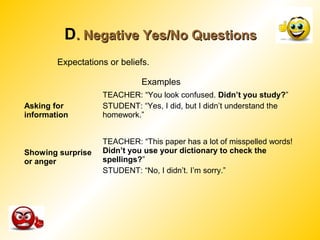
D. Negative Yes/No Questions. Negative Yes/No Questions
Examples
Asking for
information
TEACHER: “You look confused. Didn’t you study?”
STUDENT: “Yes, I did, but I didn’t understand the
homework.”
Showing surprise
or anger
TEACHER: “This paper has a lot of misspelled words!
Didn’t you use your dictionary to check the
spellings?”
STUDENT: “No, I didn’t. I’m sorry.”
Expectations or beliefs.
PART 2
A. The Simple Present TenseA. The Simple Present Tense
USESUSES EXAMPLESEXAMPLES
FactsFacts Alan and LuAlan and Lu areare professors at theprofessors at the
university.university.
AlanAlan workworkss in the physics departmentin the physics department
LuLu teachteacheses music.music.
RoutinesRoutines LuLu hashas classes every day.classes every day.
AlanAlan doesn’t havedoesn’t have classes on Tuesdays orclasses on Tuesdays or
ThursdaysThursdays
OpinionsOpinions
Do theyDo they enjoyenjoy their work?their work?
Lu eLu enjoynjoyss her classes very much.her classes very much.
Alan doesn’t like to teach.Alan doesn’t like to teach.
Reference of the futureReference of the future Next year, AlanNext year, Alan hashas a sabbatical.a sabbatical.
HeHe doesn’t teachdoesn’t teach next year.next year.
Adverbs Of Frequency And Other TimeAdverbs Of Frequency And Other Time
ExpressionsExpressions
Adverbs of FrequencyAdverbs of Frequency Other TimeOther Time
ExpressionsExpressions
AlwaysAlways
Almost alwaysAlmost always
Usually, normally, typically,Usually, normally, typically,
commonly, generallycommonly, generally
Often, frequentlyOften, frequently
SometimesSometimes
OccasionallyOccasionally
SeldomSeldom
RarelyRarely
Hardly everHardly ever
Almost neverAlmost never
nevernever
……100 percent..100 percent..
……0 percent …0 percent …
Without failWithout fail
As a ruleAs a rule
On a regular basisOn a regular basis
By and largeBy and large
In generalIn general
At time, from time toAt time, from time to
timetime
On occasionOn occasion
(every) now and then(every) now and then
(every) now and again(every) now and again
Once in a (great) whileOnce in a (great) while
Placement of Adverbs of FrequencyPlacement of Adverbs of Frequency
ExamplesExamples
In Statements with One VerbIn Statements with One Verb WeWe usuallyusually go to the university ongo to the university on
Mondays.Mondays.
My roommateMy roommate almost alwaysalmost always finishesfinishes
earlyearly
II seldomseldom finish my work before 6:00finish my work before 6:00
In Statements with AuxiliaryIn Statements with Auxiliary
Verbs and BE as the MainVerbs and BE as the Main
VerbVerb
Our classes areOur classes are generallygenerally interestinginteresting
I don’tI don’t alwaysalways enjoys them, however.enjoys them, however.
We haveWe have occasionallyoccasionally skipped classesskipped classes
In QuestionsIn Questions Are youAre you everever late for class?late for class?
Do youDo you usuallyusually get to class on time?get to class on time?
Longer Expressions withLonger Expressions with
Verbs in All TenseVerbs in All Tense
As a ruleAs a rule, we get to the university early., we get to the university early.
I’m lateI’m late every now and themevery now and them
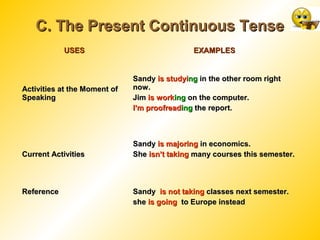
C. The Present Continuous TenseC. The Present Continuous Tense
USESUSES EXAMPLESEXAMPLES
Activities at the Moment ofActivities at the Moment of
SpeakingSpeaking
SandySandy is studyiis studyingng in the other room rightin the other room right
now.now.
JimJim is workis workinging on the computer.on the computer.
I’m proofreadI’m proofreadinging the report.the report.
Current ActivitiesCurrent Activities
SandySandy is majoringis majoring in economics.in economics.
SheShe isn’t takingisn’t taking many courses this semester.many courses this semester.
ReferenceReference SandySandy is not takingis not taking classes next semester.classes next semester.
sheshe isis goinggoing to Europe insteadto Europe instead
D. Verbs Not Normally Used in theD. Verbs Not Normally Used in the
Continuous TenseContinuous Tense
Verbs of feeling or thoughtVerbs of feeling or thought ExamplesExamples
Appreciate BeAppreciate Be
BelieveBelieve ConsiderConsider
Dislike HateDislike Hate
Know LikeKnow Like
LoveLove MeanMean
Mind MissMind Miss
Need PreferNeed Prefer
RecognizeRecognize WantWant
RememberRemember
ThinkThink
UnderstandUnderstand
HeHe doesn’t understanddoesn’t understand the problemthe problem
WeWe needneed to talk about it.to talk about it.
II thinkthink that is a good ideathat is a good idea
WeWe preferprefer to talk later.to talk later.
Compare:Compare:
WeWe have been consideringhave been considering anotheranother
possibilitypossibility
II am Thinkingam Thinking about several otherabout several other
possibilities now.possibilities now.
Verbs of PerceptionVerbs of Perception ExamplesExamples
ApperApper
HearHear
LookLook
SeeSee
SeemSeem
SmellSmell
SoundSound
tastetaste
This apple lThis apple looksooks good.good.
ItIt tastestastes deliciousdelicious
Compare:Compare:
II am lookingam looking at the apple now.at the apple now.
II am tastingam tasting the apple nowthe apple now
PART 3
A. The Present Perfect Continuous TenseThe Present Perfect Continuous Tense
This tense stresses the duration of an activity.
Examples Notes
How long have you been studying
English?
I have been studying English for six
years.
My brother has also been taking English
since he was in high school.
Lately, he has been complaining about
his classes.
for + a period of time
since + beggining time
all morning (day, week)
lately, so far, to date, up to
now
How long…?
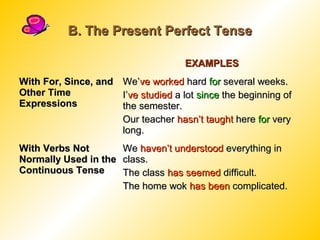
B. The Present Perfect TenseB. The Present Perfect Tense
EXAMPLESEXAMPLES
With For, Since, andWith For, Since, and
Other TimeOther Time
ExpressionsExpressions
We’We’veve workedworked hardhard forfor several weeks.several weeks.
I’I’veve studiedstudied a lota lot sincesince the beginning ofthe beginning of
the semester.the semester.
Our teacherOur teacher hasn’t taughthasn’t taught herehere forfor veryvery
long.long.
With Verbs NotWith Verbs Not
Normally Used in theNormally Used in the
Continuous TenseContinuous Tense
WeWe haven’t understoodhaven’t understood everything ineverything in
class.class.
The classThe class has seemedhas seemed difficult.difficult.
The home wokThe home wok has beenhas been complicated.complicated.
PRACTICEPRACTICE
1. Complete the following with present perfect
continuous forms of the verbs in
parentheses. Use contractions when
possible. Mark all cases where both forms
are possible and try to explain any
differences in meaning between the two
tenses. The first one is done as an example.
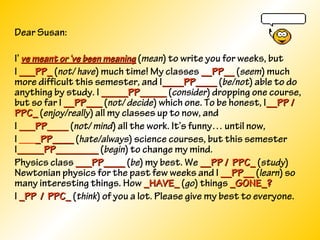
Dear Susan:
I’ ve meant or ‘ve been meaningve meant or ‘ve been meaning (mean) to write you for weeks, but
I ______ (not/ have) much time! My classes _______ (seem) much
more difficult this semester, and I__________ (be/not) able to do
anything but study. I ____________ (consider) dropping one course,
but so far I ___________________ (not/ decide) which one. To be honest,
I______________________ (enjoy/really) all my classes up to now, and
I __________________ (not/ mind) all the work. It’s funny… until now,
I _________________ (hate/always) science courses, but this semester
I__________________________ (begin) to change my mind.
Physics class _________ (be) my best. We ____________ (study)
Newtonian physics for the past few weeks and I ________ (learn) so
many interesting things. How _______(go) things __________?
I __________ (think) of you a lot. Please give my best to everyone.
Dear Susan:
I’ ve meant or ‘ve been meaningve meant or ‘ve been meaning (mean) to write you for weeks, but
I ___PP____PP_ (not/ have) much time! My classes __PP____PP__ (seem) much
more difficult this semester, and I____PP________PP____ (be/not) able to do
anything by study. I _____PP__________PP_____ (consider) dropping one course,
but so far I __PP_____PP___ (not/ decide) which one. To be honest, I__PP /__PP /
PPC_PPC_ (enjoy/really) all my classes up to now, and
I ___PP_______PP____ (not/ mind) all the work. It’s funny… until now,
I ____PP_____PP____ (hate/always) science courses, but this semester
I_____PP_____________PP________ (begin) to change my mind.
Physics class ___PP_______PP____ (be) my best. We __PP / PPC___PP / PPC_ (study)
Newtonian physics for the past few weeks and I __PP____PP__ (learn) so
many interesting things. How _HAVE__HAVE_ (go) things _GONE_?_GONE_?
I _PP / PPC__PP / PPC_ (think) of you a lot. Please give my best to everyone.

2.auxiliary verbs simple_present_present_perfect

  • 1.
    Chapter 2Chapter 2 CecibelVillca RochaCecibel Villca Rocha Jenny Lara CanelasJenny Lara Canelas
  • 2.
    Contents • Auxiliary verbs:be, do and have. • Simple present, present continuous, present perfect continuous and present perfect.
  • 3.
  • 4.
    A. Statements, Yes/NoQuestions, and Short Responses With Do Examples Affirmative statements We study a lot. Maria has a lot to do. Negative statements They don’t study a lot. He doesn’t have a lot to do. Yes/No questions Do you study a lot? Does she have a lot to do? Possible responses Yes, I do. No, I don’t. Yes, she does. No, she doesn’t
  • 5.
    With Be, Haveand Modal Auxiliaries Examples Affirmative statements We are studying. Maria can help. Tomas has left. Negative statements They aren’t studying now. Ming can’t help. Ali hasn’t left. Yes/No questions Are you studying now? Can Leah help? Has Alfred left? Possible responses Yes, I am. No, I’m not. Yes, she can. No, she can’t. Yes, he has. No, he hasn’t
  • 6.
    B. Information Questions Question word Auxiliaryverb + negative Subject When do did you have class? you have class last semester? Where will are have had you take classes? you going to take classes? you taken classes? you taken classes before enrolling here? Why are weren’t you late? you on time yesterday?
  • 7.
    Common Question Words •how • how… like • how + adjective or adverb • what • what… be (look) like • what + noun • when • where • which + noun • who(m) • whose • why • why not • asks about manner • asks for an opinion • asks about things • asks for a description • asks for specific details • asks about time (specific or general) • asks about place • asks about a specific person, place.... • asks about people • asks about ownership or possession • asks about reasons • gives suggestions
  • 8.
    C. Information Questionsabout Subjects: Who, Whose, Which and What Examples Question Response Who teaches that class? Dr. Johnson Question Response Who teaches that class? Dr. Johnson and two teaching assistants. Question Response Whose class has a lot of reading? Dr. Johnson’s class. Question Response Which art class has the most work? Which (one) has the most work? Art 210. Question Response What makes the class so difficult? The amount of homework.
  • 9.
    D. Negative Yes/NoQuestions. Negative Yes/No Questions Examples Asking for information TEACHER: “You look confused. Didn’t you study?” STUDENT: “Yes, I did, but I didn’t understand the homework.” Showing surprise or anger TEACHER: “This paper has a lot of misspelled words! Didn’t you use your dictionary to check the spellings?” STUDENT: “No, I didn’t. I’m sorry.” Expectations or beliefs.
  • 10.
  • 11.
    A. The SimplePresent TenseA. The Simple Present Tense USESUSES EXAMPLESEXAMPLES FactsFacts Alan and LuAlan and Lu areare professors at theprofessors at the university.university. AlanAlan workworkss in the physics departmentin the physics department LuLu teachteacheses music.music. RoutinesRoutines LuLu hashas classes every day.classes every day. AlanAlan doesn’t havedoesn’t have classes on Tuesdays orclasses on Tuesdays or ThursdaysThursdays OpinionsOpinions Do theyDo they enjoyenjoy their work?their work? Lu eLu enjoynjoyss her classes very much.her classes very much. Alan doesn’t like to teach.Alan doesn’t like to teach. Reference of the futureReference of the future Next year, AlanNext year, Alan hashas a sabbatical.a sabbatical. HeHe doesn’t teachdoesn’t teach next year.next year.
  • 12.
    Adverbs Of FrequencyAnd Other TimeAdverbs Of Frequency And Other Time ExpressionsExpressions Adverbs of FrequencyAdverbs of Frequency Other TimeOther Time ExpressionsExpressions AlwaysAlways Almost alwaysAlmost always Usually, normally, typically,Usually, normally, typically, commonly, generallycommonly, generally Often, frequentlyOften, frequently SometimesSometimes OccasionallyOccasionally SeldomSeldom RarelyRarely Hardly everHardly ever Almost neverAlmost never nevernever ……100 percent..100 percent.. ……0 percent …0 percent … Without failWithout fail As a ruleAs a rule On a regular basisOn a regular basis By and largeBy and large In generalIn general At time, from time toAt time, from time to timetime On occasionOn occasion (every) now and then(every) now and then (every) now and again(every) now and again Once in a (great) whileOnce in a (great) while
  • 13.
    Placement of Adverbsof FrequencyPlacement of Adverbs of Frequency ExamplesExamples In Statements with One VerbIn Statements with One Verb WeWe usuallyusually go to the university ongo to the university on Mondays.Mondays. My roommateMy roommate almost alwaysalmost always finishesfinishes earlyearly II seldomseldom finish my work before 6:00finish my work before 6:00 In Statements with AuxiliaryIn Statements with Auxiliary Verbs and BE as the MainVerbs and BE as the Main VerbVerb Our classes areOur classes are generallygenerally interestinginteresting I don’tI don’t alwaysalways enjoys them, however.enjoys them, however. We haveWe have occasionallyoccasionally skipped classesskipped classes In QuestionsIn Questions Are youAre you everever late for class?late for class? Do youDo you usuallyusually get to class on time?get to class on time? Longer Expressions withLonger Expressions with Verbs in All TenseVerbs in All Tense As a ruleAs a rule, we get to the university early., we get to the university early. I’m lateI’m late every now and themevery now and them
  • 14.
    C. The PresentContinuous TenseC. The Present Continuous Tense USESUSES EXAMPLESEXAMPLES Activities at the Moment ofActivities at the Moment of SpeakingSpeaking SandySandy is studyiis studyingng in the other room rightin the other room right now.now. JimJim is workis workinging on the computer.on the computer. I’m proofreadI’m proofreadinging the report.the report. Current ActivitiesCurrent Activities SandySandy is majoringis majoring in economics.in economics. SheShe isn’t takingisn’t taking many courses this semester.many courses this semester. ReferenceReference SandySandy is not takingis not taking classes next semester.classes next semester. sheshe isis goinggoing to Europe insteadto Europe instead
  • 15.
    D. Verbs NotNormally Used in theD. Verbs Not Normally Used in the Continuous TenseContinuous Tense Verbs of feeling or thoughtVerbs of feeling or thought ExamplesExamples Appreciate BeAppreciate Be BelieveBelieve ConsiderConsider Dislike HateDislike Hate Know LikeKnow Like LoveLove MeanMean Mind MissMind Miss Need PreferNeed Prefer RecognizeRecognize WantWant RememberRemember ThinkThink UnderstandUnderstand HeHe doesn’t understanddoesn’t understand the problemthe problem WeWe needneed to talk about it.to talk about it. II thinkthink that is a good ideathat is a good idea WeWe preferprefer to talk later.to talk later. Compare:Compare: WeWe have been consideringhave been considering anotheranother possibilitypossibility II am Thinkingam Thinking about several otherabout several other possibilities now.possibilities now.
  • 16.
    Verbs of PerceptionVerbsof Perception ExamplesExamples ApperApper HearHear LookLook SeeSee SeemSeem SmellSmell SoundSound tastetaste This apple lThis apple looksooks good.good. ItIt tastestastes deliciousdelicious Compare:Compare: II am lookingam looking at the apple now.at the apple now. II am tastingam tasting the apple nowthe apple now
  • 17.
  • 18.
    A. The PresentPerfect Continuous TenseThe Present Perfect Continuous Tense This tense stresses the duration of an activity. Examples Notes How long have you been studying English? I have been studying English for six years. My brother has also been taking English since he was in high school. Lately, he has been complaining about his classes. for + a period of time since + beggining time all morning (day, week) lately, so far, to date, up to now How long…?
  • 19.
    B. The PresentPerfect TenseB. The Present Perfect Tense EXAMPLESEXAMPLES With For, Since, andWith For, Since, and Other TimeOther Time ExpressionsExpressions We’We’veve workedworked hardhard forfor several weeks.several weeks. I’I’veve studiedstudied a lota lot sincesince the beginning ofthe beginning of the semester.the semester. Our teacherOur teacher hasn’t taughthasn’t taught herehere forfor veryvery long.long. With Verbs NotWith Verbs Not Normally Used in theNormally Used in the Continuous TenseContinuous Tense WeWe haven’t understoodhaven’t understood everything ineverything in class.class. The classThe class has seemedhas seemed difficult.difficult. The home wokThe home wok has beenhas been complicated.complicated.
  • 20.
    PRACTICEPRACTICE 1. Complete thefollowing with present perfect continuous forms of the verbs in parentheses. Use contractions when possible. Mark all cases where both forms are possible and try to explain any differences in meaning between the two tenses. The first one is done as an example.
  • 21.
    Dear Susan: I’ vemeant or ‘ve been meaningve meant or ‘ve been meaning (mean) to write you for weeks, but I ______ (not/ have) much time! My classes _______ (seem) much more difficult this semester, and I__________ (be/not) able to do anything but study. I ____________ (consider) dropping one course, but so far I ___________________ (not/ decide) which one. To be honest, I______________________ (enjoy/really) all my classes up to now, and I __________________ (not/ mind) all the work. It’s funny… until now, I _________________ (hate/always) science courses, but this semester I__________________________ (begin) to change my mind. Physics class _________ (be) my best. We ____________ (study) Newtonian physics for the past few weeks and I ________ (learn) so many interesting things. How _______(go) things __________? I __________ (think) of you a lot. Please give my best to everyone.
  • 22.
    Dear Susan: I’ vemeant or ‘ve been meaningve meant or ‘ve been meaning (mean) to write you for weeks, but I ___PP____PP_ (not/ have) much time! My classes __PP____PP__ (seem) much more difficult this semester, and I____PP________PP____ (be/not) able to do anything by study. I _____PP__________PP_____ (consider) dropping one course, but so far I __PP_____PP___ (not/ decide) which one. To be honest, I__PP /__PP / PPC_PPC_ (enjoy/really) all my classes up to now, and I ___PP_______PP____ (not/ mind) all the work. It’s funny… until now, I ____PP_____PP____ (hate/always) science courses, but this semester I_____PP_____________PP________ (begin) to change my mind. Physics class ___PP_______PP____ (be) my best. We __PP / PPC___PP / PPC_ (study) Newtonian physics for the past few weeks and I __PP____PP__ (learn) so many interesting things. How _HAVE__HAVE_ (go) things _GONE_?_GONE_? I _PP / PPC__PP / PPC_ (think) of you a lot. Please give my best to everyone.

Editor's Notes

  • #5 Simple present and past use forms of do in questions, negatives, short responses and tag questions.
  • #6 Sentences with continuous and present perfect tenses, modal auxiliaries and BE as a main verb, all follow the same pattern for formation of Q, N…
  • #9 WHO people, takes a singular verb. WHICH one o more people, places, things, familiar to the speaker. WHAT unfamiliar.
  • #10 1. the speaker hopes for a yes answer, but realices a no answer is also possible. 2. Is sure of a no answer.
  • #13 MANY OF THESE EXPRESSIONS ALSO APPEAR WITH VERBS IN THE PRESENT AND PAST PERFECT TENSE
  • #15 THIS tense is used for activities that are temporary that rather permanent time expression FOR EXAMPLE frequently include: now, TODAY OR THIS MORNING THIS WEEK THIS YEAR.
  • #16 the following verbs are seldom used in the continuous tense, EXCEPT in certain IDIOMATIC uses or in description of a definitive action
  • #17 THESE VERBS SOMETIMES APPEAR IN A CONTINUOUS TENSE IN THE DESCRIPTION OF A SPECIFIC ACTION IT IS IMPORTAN TO USE TIME EXPRESSION
  • #19 Time expressions: for+a period of time, since+beggining time, all morning(day, week…) lately, so far, to date, up to now, until now. How long?
  • #20 TIME EXPRESSION THAT GIVE THIS MEANING OF THE PPT INCLUDE:, SO FAR, TILL NOW, TO DATE UP TO NOW NOT USED WITH THIS TIME ONLY AND IDIOMATIC EXPRESIONS