Downloaded 78 times
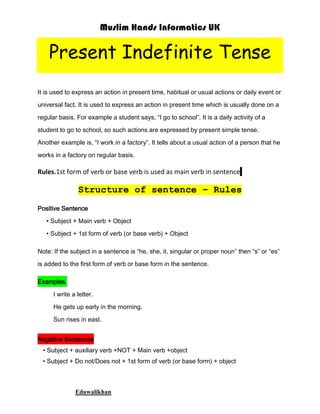
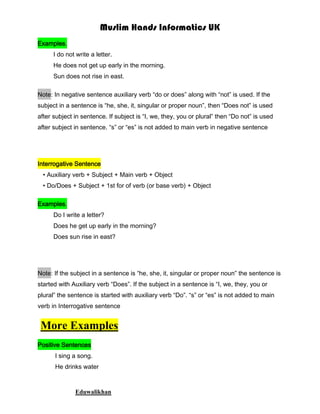
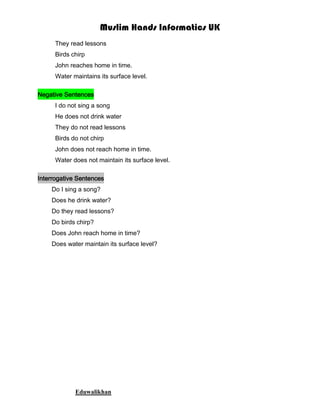

This document provides examples and rules for using the present indefinite tense in English. The present indefinite tense is used to express habitual or daily actions in the present time. It explains that the first form or base form of the verb is used in positive sentences. Auxiliary verbs like "do" or "does" are used in negative and interrogative sentences, along with the base verb form without adding "s" or "es". Several examples are given for positive, negative and interrogative sentences to illustrate the rules for using the present indefinite tense.


