HAVE
Main verb or auxiliary verb?
Let’s revise!
■ Have, as one of the most used verbs
in English, has got many uses. Let’s
remember them…
1. Possession: We have a large
extended family.
2. ….
Uses of have
1. Possession: We have a large extended family.
2. For actions and experiences: have lunch, have a great time,
have a chat, have a drink, etc.
3. Obligation: You have to keep quiet in the library.
4. To talk about services you pay someone for doing (have +
object + past participle): I had my hair cut this morning.
5. Possession, with have got (informal): I’ve got tons of work to do.
6. In negative sentences as a fixed expression: haven’t. I haven’t a
clue.
7. For specific obligation  have got. I’ve got to go now, but I’ll
see you later.
8. To form perfect tenses (present and past perfect, future perfect,
etc.): I’d never tried sushi before.
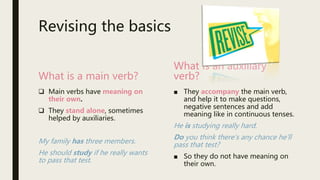
Revising the basics
What is a main verb?
 Main verbs have meaning on
their own.
 They stand alone, sometimes
helped by auxiliaries.
My family has three members.
He should study if he really wants
to pass that test.
What is an auxiliary
verb?
■ They accompany the main verb,
and help it to make questions,
negative sentences and add
meaning like in continuous tenses.
He is studying really hard.
Do you think there’s any chance he’ll
pass that test?
■ So they do not have meaning on
their own.
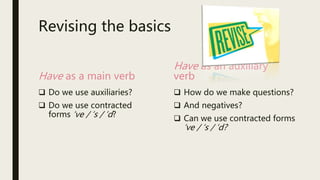
Revising the basics
Have as a main verb
 Do we use auxiliaries?
 Do we use contracted
forms ‘ve / ‘s / ‘d?
Have as an auxiliary
verb
 How do we make questions?
 And negatives?
 Can we use contracted forms
‘ve / ‘s / ‘d?
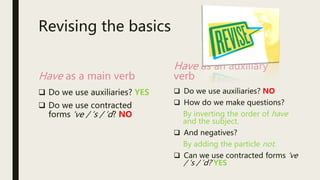
Revising the basics
Have as a main verb
 Do we use auxiliaries? YES
 Do we use contracted
forms ‘ve / ‘s / ‘d? NO
Have as an auxiliary
verb
 Do we use auxiliaries? NO
 How do we make questions?
By inverting the order of have
and the subject.
 And negatives?
By adding the particle not.
 Can we use contracted forms ‘ve
/ ‘s / ‘d? YES
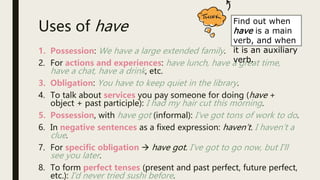
Uses of have
1. Possession: We have a large extended family.
2. For actions and experiences: have lunch, have a great time,
have a chat, have a drink, etc.
3. Obligation: You have to keep quiet in the library.
4. To talk about services you pay someone for doing (have +
object + past participle): I had my hair cut this morning.
5. Possession, with have got (informal): I’ve got tons of work to do.
6. In negative sentences as a fixed expression: haven’t. I haven’t a
clue.
7. For specific obligation  have got. I’ve got to go now, but I’ll
see you later.
8. To form perfect tenses (present and past perfect, future perfect,
etc.): I’d never tried sushi before.
Find out when
have is a main
verb, and when
it is an auxiliary
verb.
Have as a main verb
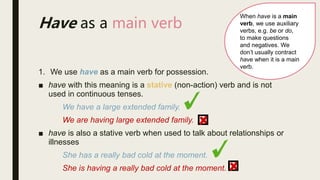
1. We use have as a main verb for possession.
■ have with this meaning is a stative (non-action) verb and is not
used in continuous tenses.
We have a large extended family.
We are having large extended family.
■ have is also a stative verb when used to talk about relationships or
illnesses
She has a really bad cold at the moment.
She is having a really bad cold at the moment.
When have is a main
verb, we use auxiliary
verbs, e.g. be or do,
to make questions
and negatives. We
don’t usually contract
have when it is a main
verb.
Have as a main verb
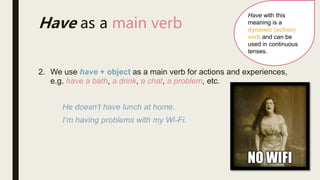
2. We use have + object as a main verb for actions and experiences,
e.g. have a bath, a drink, a chat, a problem, etc.
He doesn’t have lunch at home.
I’m having problems with my Wi-Fi.
Have with this
meaning is a
dynamic (action)
verb and can be
used in continuous
tenses.
Right or wrong?
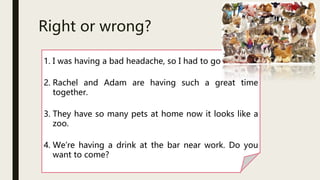
1. I was having a bad headache, so I had to go home.
2. Rachel and Adam are having such a great time
together.
3. They have so many pets at home now it looks like a
zoo.
4. We’re having a drink at the bar near work. Do you
want to come?
Right or wrong?
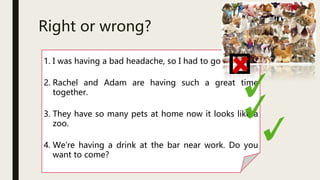
1. I was having a bad headache, so I had to go home.
2. Rachel and Adam are having such a great time
together.
3. They have so many pets at home now it looks like a
zoo.
4. We’re having a drink at the bar near work. Do you
want to come?
■ We use have to as a main verb to express obligation,
especially obligation imposed by others, and rules and
regulations.
Do we really have to spend Christmas with your parents
again?
You have to switch your phones before you come in for the
exam.
Have as a main verb
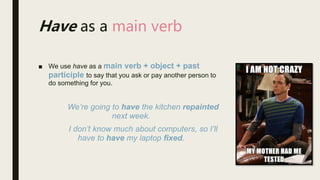
■ We use have as a main verb + object + past
participle to say that you ask or pay another person to
do something for you.
We’re going to have the kitchen repainted
next week.
I don’t know much about computers, so I’ll
have to have my laptop fixed.
Have as a main verb
When have is an
auxiliary verb, we make
questions by inverting
have and the subject,
and negatives with
haven’t / hasn’t. have as
an auxiliary verb is often
contracted to ’ve / ’s;
had is contracted to ’d.
Have as an auxiliary verb
1. We often use have got for possession. The meaning
is exactly the same as have.
How many children have you got? I’ve got three,
two boys and a girl.
They haven’t got much money.
■ have here is an auxiliary verb.
■ have got has a present meaning. We normally use
had for the past, not had got.
■ have got is very common in informal English.
Have as an auxiliary verb
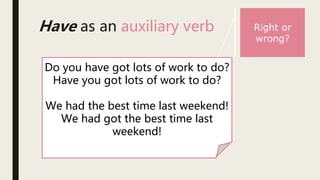
Do you have got lots of work to do?
Have you got lots of work to do?
We had the best time last weekend!
We had got the best time last
weekend!
Right or
wrong?
Have as an auxiliary verb
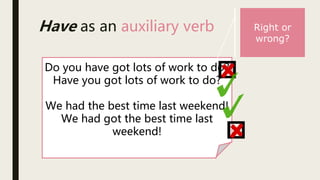
Do you have got lots of work to do?
Have you got lots of work to do?
We had the best time last weekend!
We had got the best time last
weekend!
Right or
wrong?
When have is an
auxiliary verb, we make
questions by inverting
have and the subject,
and negatives with
haven’t / hasn’t. have as
an auxiliary verb is often
contracted to ’ve / ’s;
had is contracted to ’d.
Have as an auxiliary verb
2. In negative sentences, we occasionally leave
out got, especially in fixed expressions like
I haven’t time.
I haven’t a clue.
I haven’t the time to go to the bank.
Have as an auxiliary verb
3. We use have got to to express obligation, especially in informal
English. Have got to is normally used for a specific obligation
rather than a general or repeated obligation. Compare:
I’ve got to make a quick phone call. (= specific)
I have to wear a suit to work. (= general)
Have as an auxiliary verb
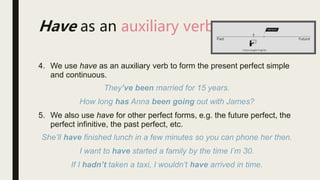
4. We use have as an auxiliary verb to form the present perfect simple
and continuous.
They’ve been married for 15 years.
How long has Anna been going out with James?
5. We also use have for other perfect forms, e.g. the future perfect, the
perfect infinitive, the past perfect, etc.
She’ll have finished lunch in a few minutes so you can phone her then.
I want to have started a family by the time I’m 30.
If I hadn’t taken a taxi, I wouldn’t have arrived in time.

Have: main verb or auxiliary verb

  • 1.
    HAVE Main verb orauxiliary verb?
  • 2.
    Let’s revise! ■ Have,as one of the most used verbs in English, has got many uses. Let’s remember them… 1. Possession: We have a large extended family. 2. ….
  • 3.
    Uses of have 1.Possession: We have a large extended family. 2. For actions and experiences: have lunch, have a great time, have a chat, have a drink, etc. 3. Obligation: You have to keep quiet in the library. 4. To talk about services you pay someone for doing (have + object + past participle): I had my hair cut this morning. 5. Possession, with have got (informal): I’ve got tons of work to do. 6. In negative sentences as a fixed expression: haven’t. I haven’t a clue. 7. For specific obligation  have got. I’ve got to go now, but I’ll see you later. 8. To form perfect tenses (present and past perfect, future perfect, etc.): I’d never tried sushi before.
  • 4.
    Revising the basics Whatis a main verb?  Main verbs have meaning on their own.  They stand alone, sometimes helped by auxiliaries. My family has three members. He should study if he really wants to pass that test. What is an auxiliary verb? ■ They accompany the main verb, and help it to make questions, negative sentences and add meaning like in continuous tenses. He is studying really hard. Do you think there’s any chance he’ll pass that test? ■ So they do not have meaning on their own.
  • 5.
    Revising the basics Haveas a main verb  Do we use auxiliaries?  Do we use contracted forms ‘ve / ‘s / ‘d? Have as an auxiliary verb  How do we make questions?  And negatives?  Can we use contracted forms ‘ve / ‘s / ‘d?
  • 6.
    Revising the basics Haveas a main verb  Do we use auxiliaries? YES  Do we use contracted forms ‘ve / ‘s / ‘d? NO Have as an auxiliary verb  Do we use auxiliaries? NO  How do we make questions? By inverting the order of have and the subject.  And negatives? By adding the particle not.  Can we use contracted forms ‘ve / ‘s / ‘d? YES
  • 7.
    Uses of have 1.Possession: We have a large extended family. 2. For actions and experiences: have lunch, have a great time, have a chat, have a drink, etc. 3. Obligation: You have to keep quiet in the library. 4. To talk about services you pay someone for doing (have + object + past participle): I had my hair cut this morning. 5. Possession, with have got (informal): I’ve got tons of work to do. 6. In negative sentences as a fixed expression: haven’t. I haven’t a clue. 7. For specific obligation  have got. I’ve got to go now, but I’ll see you later. 8. To form perfect tenses (present and past perfect, future perfect, etc.): I’d never tried sushi before. Find out when have is a main verb, and when it is an auxiliary verb.
  • 8.
    Have as amain verb 1. We use have as a main verb for possession. ■ have with this meaning is a stative (non-action) verb and is not used in continuous tenses. We have a large extended family. We are having large extended family. ■ have is also a stative verb when used to talk about relationships or illnesses She has a really bad cold at the moment. She is having a really bad cold at the moment. When have is a main verb, we use auxiliary verbs, e.g. be or do, to make questions and negatives. We don’t usually contract have when it is a main verb.
  • 9.
    Have as amain verb 2. We use have + object as a main verb for actions and experiences, e.g. have a bath, a drink, a chat, a problem, etc. He doesn’t have lunch at home. I’m having problems with my Wi-Fi. Have with this meaning is a dynamic (action) verb and can be used in continuous tenses.
  • 10.
    Right or wrong? 1.I was having a bad headache, so I had to go home. 2. Rachel and Adam are having such a great time together. 3. They have so many pets at home now it looks like a zoo. 4. We’re having a drink at the bar near work. Do you want to come?
  • 11.
    Right or wrong? 1.I was having a bad headache, so I had to go home. 2. Rachel and Adam are having such a great time together. 3. They have so many pets at home now it looks like a zoo. 4. We’re having a drink at the bar near work. Do you want to come?
  • 12.
    ■ We usehave to as a main verb to express obligation, especially obligation imposed by others, and rules and regulations. Do we really have to spend Christmas with your parents again? You have to switch your phones before you come in for the exam. Have as a main verb
  • 13.
    ■ We usehave as a main verb + object + past participle to say that you ask or pay another person to do something for you. We’re going to have the kitchen repainted next week. I don’t know much about computers, so I’ll have to have my laptop fixed. Have as a main verb
  • 14.
    When have isan auxiliary verb, we make questions by inverting have and the subject, and negatives with haven’t / hasn’t. have as an auxiliary verb is often contracted to ’ve / ’s; had is contracted to ’d. Have as an auxiliary verb 1. We often use have got for possession. The meaning is exactly the same as have. How many children have you got? I’ve got three, two boys and a girl. They haven’t got much money. ■ have here is an auxiliary verb. ■ have got has a present meaning. We normally use had for the past, not had got. ■ have got is very common in informal English.
  • 15.
    Have as anauxiliary verb Do you have got lots of work to do? Have you got lots of work to do? We had the best time last weekend! We had got the best time last weekend! Right or wrong?
  • 16.
    Have as anauxiliary verb Do you have got lots of work to do? Have you got lots of work to do? We had the best time last weekend! We had got the best time last weekend! Right or wrong?
  • 17.
    When have isan auxiliary verb, we make questions by inverting have and the subject, and negatives with haven’t / hasn’t. have as an auxiliary verb is often contracted to ’ve / ’s; had is contracted to ’d. Have as an auxiliary verb 2. In negative sentences, we occasionally leave out got, especially in fixed expressions like I haven’t time. I haven’t a clue. I haven’t the time to go to the bank.
  • 18.
    Have as anauxiliary verb 3. We use have got to to express obligation, especially in informal English. Have got to is normally used for a specific obligation rather than a general or repeated obligation. Compare: I’ve got to make a quick phone call. (= specific) I have to wear a suit to work. (= general)
  • 19.
    Have as anauxiliary verb 4. We use have as an auxiliary verb to form the present perfect simple and continuous. They’ve been married for 15 years. How long has Anna been going out with James? 5. We also use have for other perfect forms, e.g. the future perfect, the perfect infinitive, the past perfect, etc. She’ll have finished lunch in a few minutes so you can phone her then. I want to have started a family by the time I’m 30. If I hadn’t taken a taxi, I wouldn’t have arrived in time.