Present simple and continuous (Adapted from Fernando Braña Asensio)
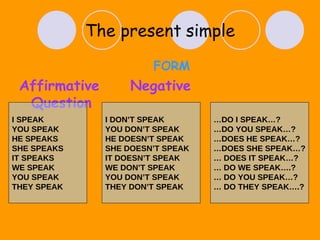
The present   simple FORM Affirmative  Negative  Question  I SPEAK YOU SPEAK HE SPEAKS SHE SPEAKS IT SPEAKS WE SPEAK YOU SPEAK THEY SPEAK I DON’T SPEAK YOU DON’T SPEAK HE DOESN’T SPEAK SHE DOESN’T SPEAK IT DOESN’T SPEAK WE DON’T SPEAK YOU DON’T SPEAK THEY DON’T SPEAK … DO I SPEAK…? … DO YOU SPEAK…? … DOES HE SPEAK…? … DOES SHE SPEAK…? …  DOES IT SPEAK…? …  DO WE SPEAK….? …  DO YOU SPEAK…? …  DO THEY SPEAK….?
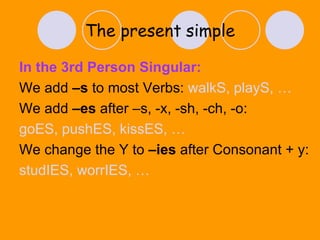
The present   simple In the 3rd Person Singular: We add  –s  to most Verbs:  walkS, playS, … We add  –es  after –s, -x, -sh, -ch, -o: goES, pushES, kissES, … We change the Y to  –ies  after Consonant + y: studIES, worrIES, …
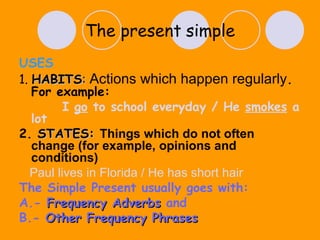
The present   simple USES 1.  HABITS :   Actions which happen regularly . For example: I  go  to school everyday / He  smokes  a lot 2.   STATES:   Things which do not often change (for example, opinions and conditions) Paul lives in Florida / He has short hair  The Simple Present usually goes with:  A.-  Frequency Adverbs  and B.-  Other Frequency Phrases
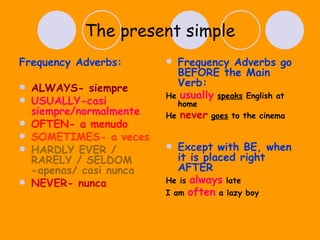
The present simple Frequency Adverbs: ALWAYS- siempre USUALLY-casi siempre/normalmente OFTEN- a menudo SOMETIMES- a veces HARDLY EVER / RARELY / SELDOM -apenas/ casi nunca NEVER- nunca Frequency Adverbs go BEFORE the Main Verb: He  usually   speaks  English at home He  never   goes  to the cinema  Except with BE, when it is placed right AFTER He is  always  late I am  often  a lazy boy
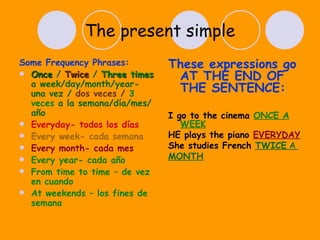
The present simple Some Frequency Phrases: Once  /  Twice  /  Three times   a week/day/month/year- una vez /  dos veces /  3 veces  a la semana/día/mes/año Everyday- todos los días Every week- cada semana Every month- cada mes Every year- cada año From time to time – de vez en cuando At weekends – los fines de semana These expressions go AT THE END OF THE SENTENCE: I go to the cinema  ONCE A WEEK HE plays the piano  EVERYDAY She studies French  TWICE  A  MONTH
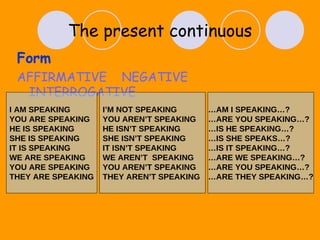
The present continuous Form AFFIRMATIVE   NEGATIVE  INTERROGATIVE I AM SPEAKING YOU ARE SPEAKING HE IS SPEAKING SHE IS SPEAKING IT IS SPEAKING WE ARE SPEAKING YOU ARE SPEAKING THEY ARE SPEAKING I’M NOT SPEAKING YOU AREN’T SPEAKING  HE ISN’T SPEAKING SHE ISN’T SPEAKING IT ISN’T SPEAKING WE AREN’T  SPEAKING YOU AREN’T SPEAKING THEY AREN’T SPEAKING … AM I SPEAKING…? … ARE YOU SPEAKING…? … IS HE SPEAKING…? … IS SHE SPEAKS…? … IS IT SPEAKING…? … ARE WE SPEAKING…? … ARE YOU SPEAKING…? … ARE THEY SPEAKING…?
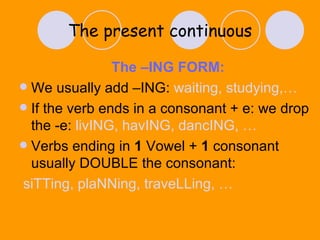
The present continuous The –ING FORM: We usually add –ING:  waiting, studying,… If the verb ends in a consonant + e: we drop the -e:  livING, havING, dancING, … Verbs ending in  1  Vowel +  1  consonant usually DOUBLE the consonant:  siTTing, plaNNing, traveLLing, …
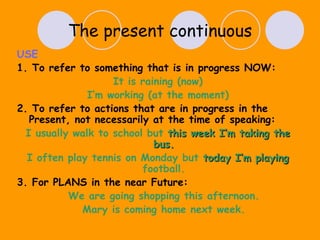
The present continuous USE 1. To refer to something that is in progress NOW: It is raining (now) I’m working (at the moment) 2. To refer to actions that are in progress in the Present, not necessarily at the time of speaking: I usually walk to school but  this week I’m taking the bus. I often play tennis on Monday but  today I’m playing  football. 3. For PLANS in the near Future: We are going shopping this afternoon. Mary is coming home next week.
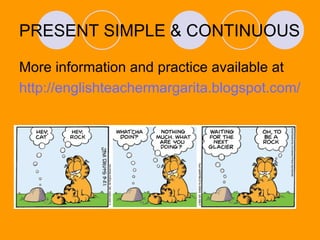
PRESENT SIMPLE & CONTINUOUS More information and practice available at http://englishteachermargarita.blogspot.com/

Present simple and continuous adapted from Fernando Braña Asensio

  • 1.
    Present simple andcontinuous (Adapted from Fernando Braña Asensio)
  • 2.
    The present simple FORM Affirmative Negative Question I SPEAK YOU SPEAK HE SPEAKS SHE SPEAKS IT SPEAKS WE SPEAK YOU SPEAK THEY SPEAK I DON’T SPEAK YOU DON’T SPEAK HE DOESN’T SPEAK SHE DOESN’T SPEAK IT DOESN’T SPEAK WE DON’T SPEAK YOU DON’T SPEAK THEY DON’T SPEAK … DO I SPEAK…? … DO YOU SPEAK…? … DOES HE SPEAK…? … DOES SHE SPEAK…? … DOES IT SPEAK…? … DO WE SPEAK….? … DO YOU SPEAK…? … DO THEY SPEAK….?
  • 3.
    The present simple In the 3rd Person Singular: We add –s to most Verbs: walkS, playS, … We add –es after –s, -x, -sh, -ch, -o: goES, pushES, kissES, … We change the Y to –ies after Consonant + y: studIES, worrIES, …
  • 4.
    The present simple USES 1. HABITS : Actions which happen regularly . For example: I go to school everyday / He smokes a lot 2. STATES: Things which do not often change (for example, opinions and conditions) Paul lives in Florida / He has short hair The Simple Present usually goes with: A.- Frequency Adverbs and B.- Other Frequency Phrases
  • 5.
    The present simpleFrequency Adverbs: ALWAYS- siempre USUALLY-casi siempre/normalmente OFTEN- a menudo SOMETIMES- a veces HARDLY EVER / RARELY / SELDOM -apenas/ casi nunca NEVER- nunca Frequency Adverbs go BEFORE the Main Verb: He usually speaks English at home He never goes to the cinema Except with BE, when it is placed right AFTER He is always late I am often a lazy boy
  • 6.
    The present simpleSome Frequency Phrases: Once / Twice / Three times a week/day/month/year- una vez / dos veces / 3 veces a la semana/día/mes/año Everyday- todos los días Every week- cada semana Every month- cada mes Every year- cada año From time to time – de vez en cuando At weekends – los fines de semana These expressions go AT THE END OF THE SENTENCE: I go to the cinema ONCE A WEEK HE plays the piano EVERYDAY She studies French TWICE A MONTH
  • 7.
    The present continuousForm AFFIRMATIVE NEGATIVE INTERROGATIVE I AM SPEAKING YOU ARE SPEAKING HE IS SPEAKING SHE IS SPEAKING IT IS SPEAKING WE ARE SPEAKING YOU ARE SPEAKING THEY ARE SPEAKING I’M NOT SPEAKING YOU AREN’T SPEAKING HE ISN’T SPEAKING SHE ISN’T SPEAKING IT ISN’T SPEAKING WE AREN’T SPEAKING YOU AREN’T SPEAKING THEY AREN’T SPEAKING … AM I SPEAKING…? … ARE YOU SPEAKING…? … IS HE SPEAKING…? … IS SHE SPEAKS…? … IS IT SPEAKING…? … ARE WE SPEAKING…? … ARE YOU SPEAKING…? … ARE THEY SPEAKING…?
  • 8.
    The present continuousThe –ING FORM: We usually add –ING: waiting, studying,… If the verb ends in a consonant + e: we drop the -e: livING, havING, dancING, … Verbs ending in 1 Vowel + 1 consonant usually DOUBLE the consonant: siTTing, plaNNing, traveLLing, …
  • 9.
    The present continuousUSE 1. To refer to something that is in progress NOW: It is raining (now) I’m working (at the moment) 2. To refer to actions that are in progress in the Present, not necessarily at the time of speaking: I usually walk to school but this week I’m taking the bus. I often play tennis on Monday but today I’m playing football. 3. For PLANS in the near Future: We are going shopping this afternoon. Mary is coming home next week.
  • 10.
    PRESENT SIMPLE &CONTINUOUS More information and practice available at http://englishteachermargarita.blogspot.com/