10-24
objects persisting in time three dimensionalism coincidence four dimensionalism coincidence essentialist non-coincidence non-essential non-coincidence (mereological) nihilism
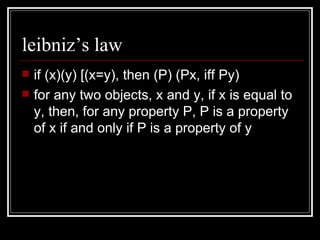
leibniz’s law if (x)(y) [(x=y), then (P) (Px, iff Py) for any two objects, x and y, if x is equal to y, then, for any property P, P is a property of x if and only if P is a property of y
3Dism 3D states that (1) an ordinary object occupies multiple spacetime regions; (2) these spacetime regions are temporally unextended, or instantaneous, and non-simultaneous claims that objects endure in time an ordinary object x exists at time t iff it is wholly present at t
4Dism (1) an ordinary object occupies a unique spacetime region; (2) this spacetime region is temporally extended claims that objects perdure an object exists at time t iff it has a temporal part at t
coincidence lump of clay/statue puzzle there exists at t 1  a lump of clay the lump of clay is molded into a statue, such that the statue exists at t 2 the lump of clay is, according to leibniz’s law, distinct from the statue as it has a property that the statue does not have, namely it existed at t 1 it looks like there are two objects coinciding in the same spacetime region, and this looks like a puzzle because it is generally understood that objects cannot do any such thing
solution to coincidence 3Dism says that there is a total overlap, and objects completely overlap 4Dism says that the objects’ temporal parts overlap, that the statue is merely a subsegment of the “temporal worm”; this is no more surprising than two roads overlapping the essentialist move is to say that there is only one thing, and we make a mistake to suggest that there is any overlap at all.  once we have a statue, the lump no longer exists the non-essentialist says the object in question has no essential properties, and we merely used different sortals to talk about the same thing the nihilist claims there is no object; there is only simples and relations between simples
personal identity biological view psychological view memory nihilist (eliminativist)
biological view identity is related to the organism; we just are our body brain is not necessarily any more important than any other body part as long as organism is biologically alive, identity survives allows us to say things like “i was once a fetus.”
psychological continuity personal identity is in the psychology of the person allows us to make sense of “brownson” case this seems to be what most people rely on when pressed
memory a particular version of the psychological view a person’s memory is responsible for continued identity as the same person this is the view espoused by locke
nihilism there is no such thing as personal identity; it is merely a fiction we never experience the “i” we only have the experiences of particular impressions, and we have no reason to suppose there is some ultimate subject to whom those impressions all belong
alternate ideas notion of identity is vague we simply never decided what was meant in these particular instances there are multiple candidates for identity this is a linguistic move mistaken use of word problems arise because we do not recognize that when we begin to talk about person having psychological identity we are applying a different concept than we normally use person normally simply refers to object
various problems can i say that i was ever a fetus? do i have some responsibility to “brownson”? how does brain fission change things? can psychology be instantiated by a computer program? am i the same person if i am made up of different material put together in exactly the same way?

10-24

  • 1.
  • 2.
    objects persisting intime three dimensionalism coincidence four dimensionalism coincidence essentialist non-coincidence non-essential non-coincidence (mereological) nihilism
  • 3.
    leibniz’s law if(x)(y) [(x=y), then (P) (Px, iff Py) for any two objects, x and y, if x is equal to y, then, for any property P, P is a property of x if and only if P is a property of y
  • 4.
    3Dism 3D statesthat (1) an ordinary object occupies multiple spacetime regions; (2) these spacetime regions are temporally unextended, or instantaneous, and non-simultaneous claims that objects endure in time an ordinary object x exists at time t iff it is wholly present at t
  • 5.
    4Dism (1) anordinary object occupies a unique spacetime region; (2) this spacetime region is temporally extended claims that objects perdure an object exists at time t iff it has a temporal part at t
  • 6.
    coincidence lump ofclay/statue puzzle there exists at t 1 a lump of clay the lump of clay is molded into a statue, such that the statue exists at t 2 the lump of clay is, according to leibniz’s law, distinct from the statue as it has a property that the statue does not have, namely it existed at t 1 it looks like there are two objects coinciding in the same spacetime region, and this looks like a puzzle because it is generally understood that objects cannot do any such thing
  • 7.
    solution to coincidence3Dism says that there is a total overlap, and objects completely overlap 4Dism says that the objects’ temporal parts overlap, that the statue is merely a subsegment of the “temporal worm”; this is no more surprising than two roads overlapping the essentialist move is to say that there is only one thing, and we make a mistake to suggest that there is any overlap at all. once we have a statue, the lump no longer exists the non-essentialist says the object in question has no essential properties, and we merely used different sortals to talk about the same thing the nihilist claims there is no object; there is only simples and relations between simples
  • 8.
    personal identity biologicalview psychological view memory nihilist (eliminativist)
  • 9.
    biological view identityis related to the organism; we just are our body brain is not necessarily any more important than any other body part as long as organism is biologically alive, identity survives allows us to say things like “i was once a fetus.”
  • 10.
    psychological continuity personalidentity is in the psychology of the person allows us to make sense of “brownson” case this seems to be what most people rely on when pressed
  • 11.
    memory a particularversion of the psychological view a person’s memory is responsible for continued identity as the same person this is the view espoused by locke
  • 12.
    nihilism there isno such thing as personal identity; it is merely a fiction we never experience the “i” we only have the experiences of particular impressions, and we have no reason to suppose there is some ultimate subject to whom those impressions all belong
  • 13.
    alternate ideas notionof identity is vague we simply never decided what was meant in these particular instances there are multiple candidates for identity this is a linguistic move mistaken use of word problems arise because we do not recognize that when we begin to talk about person having psychological identity we are applying a different concept than we normally use person normally simply refers to object
  • 14.
    various problems cani say that i was ever a fetus? do i have some responsibility to “brownson”? how does brain fission change things? can psychology be instantiated by a computer program? am i the same person if i am made up of different material put together in exactly the same way?