CASE STUDIES IN MACHINE LEARNING IN
POWER SYSTEMS>>STATE OF CHARGE ESTIMATION
ENERGY MANAGEMENT >>FRAUD DETECTION
RELIABILITY IMPROVEMENT>>AI IN CONDITION
MONITORING
HIMADRI BANERJI
MD ECO URJA
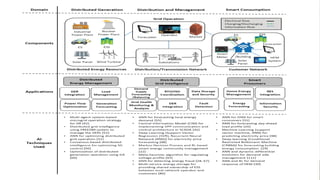
State-of-the-art artificial intelligence techniques are now being developed to support
various applications in a distributed smart grid.
In particular, artificial techniques has been applied to support the integration of
renewable energy resources, the integration of energy storage systems, demand
response, management of the grid and home energy, and security.
As the smart grid involves various actors, such as energy produces, markets, and
consumers, we also discuss how artificial intelligence and market liberalization can
potentially help to increase the overall social welfare delivery of the grid.
Howeve there exist challenges for large-scale integration and orchestration of
automated distributed devices to realize a truly smart grid.
AI APPLICATION AND CASE STUDY IN POWER SYSTEMS
With machine learning applications, it became easier to handle the power system complex
challenges.
The traditional techniques are not computationally promising solutions since they have limited
capacity to manage the massive amount of data (including chunks of heterogeneous datasets)
coming from measurement units such as smart meters and phasor measurement units.
The several advanced, efficient and intelligent learning algorithms are widely developed to improve
solutions accuracy to many real-world problems in diverse domains such as voltage and slope
stability, power flow management, the estate of charge estimation, and rotor system diagnosis
AI APPLICATION AND CASE STUDY IN POWER SYSTEMS
State Of Charge (SOC) estimation of energy storage devices is the significantly important topic
of many studies in smart power systems.
The prediction machine learning algorithms are built considering the effective parameters of
SOC estimations which are battery current, battery module temperature, power out of the
battery (available and requested), battery power loss and heat removed from the battery.
In a case study one sees improving the accuracy and performance of Lithium-Ion battery state
estimation in electric vehicles by using a genetic algorithm-based fuzzy C-means clustering
method compared to those models formed by conventional fuzzy techniques
AI APPLICATION AND CASE STUDY IN POWER SYSTEMS
The learning mechanism handled terminal power, moving average voltage and
current parameters dataset to perform the off-line training phase.
After this phase, however, this model forecast the battery state of charge in the real-
time requests.
The genetic-fuzzy clustering technique is used in the first step to learning the model
topology and antecedent parameters.
Next, the model applied a backpropagation learning algorithm to optimize the
acquired parameters of the first step.
AI APPLICATION AND CASE STUDY IN POWER SYSTEMS
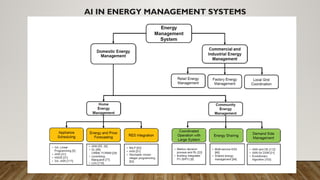
AI IN ENERGY MANAGEMENT SYSTEMS
AI FOR FRAUD DETECTION IN ENERGY MANAGEMENT SYSTEMS
The electric utilities have to handle problems with the non-technical losses caused by frauds and
thefts committed by some of their consumers. In order to minimize this, some methodologies
have been created to perform the detection of consumers that might be fraudsters.
In this context, the use of classification techniques can improve the hit rate of the fraud
detection and increase the financial income.
A novel energy management technique has been piloted in a Brazilian Utility with use of the
knowledge-discovery in databases process based on artificial neural networks applied to the
classifying process of consumers to be inspected.
The experiment performed in a Brazilian electric power distribution company indicated an
improvement of over 50% of the proposed approach compared to the previous methods used by
that company.
KNOWLEDGE DISCOVERY IN DATABASE PROCESS
AI FOR FRAUD DETECTION IN ENERGY MANAGEMENT SYSTEMS
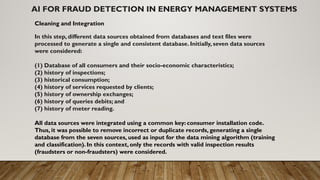
In this step, different data sources obtained from databases and text files were
processed to generate a single and consistent database. Initially, seven data sources
were considered:
(1) Database of all consumers and their socio-economic characteristics;
(2) history of inspections;
(3) historical consumption;
(4) history of services requested by clients;
(5) history of ownership exchanges;
(6) history of queries debits; and
(7) history of meter reading.
All data sources were integrated using a common key: consumer installation code.
Thus, it was possible to remove incorrect or duplicate records, generating a single
database from the seven sources, used as input for the data mining algorithm (training
and classification). In this context, only the records with valid inspection results
(fraudsters or non-fraudsters) were considered.
AI FOR FRAUD DETECTION IN ENERGY MANAGEMENT SYSTEMS
Cleaning and Integration
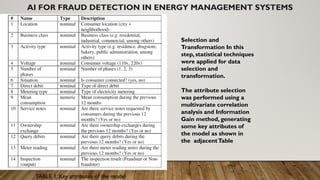
TABLE 1: Key attributes of the model
Selection and
Transformation In this
step, statistical techniques
were applied for data
selection and
transformation.
The attribute selection
was performed using a
multivariate correlation
analysis and Information
Gain method, generating
some key attributes of
the model as shown in
the adjacentTable
AI FOR FRAUD DETECTION IN ENERGY MANAGEMENT SYSTEMS
The data transformation was
performed by normalization
methods.
The Min-Max method was
used to transform the single
numerical attribute Mean
Consumption, wherein each
value is converted to a range
between 0 and 1.
For the nominal attributes,
two distinct methods were
applied: if the number of
distinct values was less than
five, the Binary method was
applied; otherwise the One-
of-N method was used
Data MiningThe problem addressed here is
a supervised classification one because there
are real inspections’ records to be used for
the training step.
An artificial neural network/multilayer
perceptron (ANNMLP) was used for the
dataset training and classification.
The MLPs using the Backpropagation
algorithm have been successfully applied to
solve many similar complex problems, such
as pattern recognition, classification, data
preprocessing, etc.
The ANN-MLP’s architecture used three
layers: input, hidden and output layers.
AI FOR FRAUD DETECTION IN ENERGY MANAGEMENT SYSTEMS
After defining the architecture, the data mining algorithm was coded using the
training/test/validation schema and the stratified k-Fold CrossValidation method.
In this case, k is equal to 10, i.e., at the each iteration the dataset is randomly
partitioned into 10 equal size subsets. Of the 10 subsets, 9 are used as training data
and a single is used for testing the model.
This process is then repeated k times, and the average error is calculated.
This implementation requires parameter settings to perform the experiments
successfully.
AI FOR FRAUD DETECTION IN ENERGY MANAGEMENT SYSTEMS
RESULTS AND DISCUSSION
The evaluation of the results was performed using a confusion matrix that compares real
inspections to classified inspections by the ANN-MLP, indicating four result types: (1)TP is
a fraudster consumer correctly classified as fraudster; (2) FN is a fraudster consumer
incorrectly classified as non-fraudster; (3) FP is a consumer non-fraudster incorrectly
classified as fraudster; (4)TN is a consumer non-fraudster correctly classified as non-
fraudster.
Some measures are used to check the classifier efficiency: hit rate is the percentage of
records correctly classified; recall:TP / (TP+FN); precision =TP / (TP+FP);True Positive
rate =TP / (TP+FN); and False Positive rate = FP / (FP+TN)
AI FOR FRAUD DETECTION IN ENERGY MANAGEMENT SYSTEMS
AI IN IMPROVING POWER GENERATION
FLEXIBILITY
Operational flexibility in thermal power plants is normally
assessed by three criteria: mimimun compliant load, start-up time
and maximum load gradient .
The minimum compliant load of a natural gas combined cycle
depends mainly on the gas turbine, as stable combustion and
acceptable emissions Nox limits must be guaranteed.
Modern heavy duty gas turbines may offer a minimum load of
40–50% of the full load, but this level is expected to decrease to
30%
AI IN IMPROVING POWER
GENERATION FLEXIBILITY
In this context a Power Generating Company with 2×1 CCGT generation plant, developed a
plan to adapt the operational flexibility and performance that enable them to stay longer in
the market or to return earlier thus increasing plant revenue.
The 786 MW plant consists of two GE MS9001 FA DLN 2.0+ gas turbines and an ALSTOM
DKYZZ3-2N41 steam turbine.
The power plant has been operating in AGC mode, cycling more than 30% of load an
average of 150 times per day.
In this demanding operating context, the unstable steam temperatures represented a
constrain to steepen the plant ramp rate, to decrease the minimum load, and to reduce the
thermal stresses.
AI IN IMPROVING POWER
GENERATION FLEXIBILITY
Due to the improvement of the control performance, the plant has taken a
step further.ADEX as implemented an optimization setpoint control that
increases the steam temperature 2.1°C, reducing the rate an additional
0.05%.
Keeping the temperature in a narrow band leads to a reduction of the
induced thermal stress on superheater headers and steam turbines, which
increases the equipment life expectancy and the plant availability.
AI IN IMPROVING POWER GENERATION
FLEXIBILITY
AI IN IMPROVING EQUIPMENT RELIABILITY
Genetic algorithms (GAs) are software programs that provide evolutionary systems
solutions through modelling or by imitating the biological evolution processes through a
three-stage process of Selection, Genetic Operation and Replacement.
GA is used in artificial intelligence to classify faults and monitor the conditions of
various applications.
To classify and monitor a selected set of optimal features by GA in roller bearing health
and the result shows that the application of ANNs with GA is a powerful technique.
In a related study, acoustic emission technique was used to diagnose faults and monitor
bearing conditions.
Continuous wavelet transform and wavelet-based waveform parameter selection were
used to measure and optimize genetic algorithm selection.
What is Fuzzy Logic?
Zadeh, in 1965, proposed a multivalued logic which enabled the definition of intermediate values between traditional
evaluations such as yes/no, true/false, which he termed as Fuzzy Logic .
AI IN IMPROVING EQUIPMENT RELIABILITY

Case Studies IN Machine Learning

  • 1.
    CASE STUDIES INMACHINE LEARNING IN POWER SYSTEMS>>STATE OF CHARGE ESTIMATION ENERGY MANAGEMENT >>FRAUD DETECTION RELIABILITY IMPROVEMENT>>AI IN CONDITION MONITORING HIMADRI BANERJI MD ECO URJA
  • 2.
    State-of-the-art artificial intelligencetechniques are now being developed to support various applications in a distributed smart grid. In particular, artificial techniques has been applied to support the integration of renewable energy resources, the integration of energy storage systems, demand response, management of the grid and home energy, and security. As the smart grid involves various actors, such as energy produces, markets, and consumers, we also discuss how artificial intelligence and market liberalization can potentially help to increase the overall social welfare delivery of the grid. Howeve there exist challenges for large-scale integration and orchestration of automated distributed devices to realize a truly smart grid. AI APPLICATION AND CASE STUDY IN POWER SYSTEMS
  • 4.
    With machine learningapplications, it became easier to handle the power system complex challenges. The traditional techniques are not computationally promising solutions since they have limited capacity to manage the massive amount of data (including chunks of heterogeneous datasets) coming from measurement units such as smart meters and phasor measurement units. The several advanced, efficient and intelligent learning algorithms are widely developed to improve solutions accuracy to many real-world problems in diverse domains such as voltage and slope stability, power flow management, the estate of charge estimation, and rotor system diagnosis AI APPLICATION AND CASE STUDY IN POWER SYSTEMS
  • 5.
    State Of Charge(SOC) estimation of energy storage devices is the significantly important topic of many studies in smart power systems. The prediction machine learning algorithms are built considering the effective parameters of SOC estimations which are battery current, battery module temperature, power out of the battery (available and requested), battery power loss and heat removed from the battery. In a case study one sees improving the accuracy and performance of Lithium-Ion battery state estimation in electric vehicles by using a genetic algorithm-based fuzzy C-means clustering method compared to those models formed by conventional fuzzy techniques AI APPLICATION AND CASE STUDY IN POWER SYSTEMS
  • 6.
    The learning mechanismhandled terminal power, moving average voltage and current parameters dataset to perform the off-line training phase. After this phase, however, this model forecast the battery state of charge in the real- time requests. The genetic-fuzzy clustering technique is used in the first step to learning the model topology and antecedent parameters. Next, the model applied a backpropagation learning algorithm to optimize the acquired parameters of the first step. AI APPLICATION AND CASE STUDY IN POWER SYSTEMS
  • 7.
    AI IN ENERGYMANAGEMENT SYSTEMS
  • 8.
    AI FOR FRAUDDETECTION IN ENERGY MANAGEMENT SYSTEMS The electric utilities have to handle problems with the non-technical losses caused by frauds and thefts committed by some of their consumers. In order to minimize this, some methodologies have been created to perform the detection of consumers that might be fraudsters. In this context, the use of classification techniques can improve the hit rate of the fraud detection and increase the financial income. A novel energy management technique has been piloted in a Brazilian Utility with use of the knowledge-discovery in databases process based on artificial neural networks applied to the classifying process of consumers to be inspected. The experiment performed in a Brazilian electric power distribution company indicated an improvement of over 50% of the proposed approach compared to the previous methods used by that company.
  • 9.
    KNOWLEDGE DISCOVERY INDATABASE PROCESS AI FOR FRAUD DETECTION IN ENERGY MANAGEMENT SYSTEMS
  • 10.
    In this step,different data sources obtained from databases and text files were processed to generate a single and consistent database. Initially, seven data sources were considered: (1) Database of all consumers and their socio-economic characteristics; (2) history of inspections; (3) historical consumption; (4) history of services requested by clients; (5) history of ownership exchanges; (6) history of queries debits; and (7) history of meter reading. All data sources were integrated using a common key: consumer installation code. Thus, it was possible to remove incorrect or duplicate records, generating a single database from the seven sources, used as input for the data mining algorithm (training and classification). In this context, only the records with valid inspection results (fraudsters or non-fraudsters) were considered. AI FOR FRAUD DETECTION IN ENERGY MANAGEMENT SYSTEMS Cleaning and Integration
  • 11.
    TABLE 1: Keyattributes of the model Selection and Transformation In this step, statistical techniques were applied for data selection and transformation. The attribute selection was performed using a multivariate correlation analysis and Information Gain method, generating some key attributes of the model as shown in the adjacentTable AI FOR FRAUD DETECTION IN ENERGY MANAGEMENT SYSTEMS
  • 12.
    The data transformationwas performed by normalization methods. The Min-Max method was used to transform the single numerical attribute Mean Consumption, wherein each value is converted to a range between 0 and 1. For the nominal attributes, two distinct methods were applied: if the number of distinct values was less than five, the Binary method was applied; otherwise the One- of-N method was used Data MiningThe problem addressed here is a supervised classification one because there are real inspections’ records to be used for the training step. An artificial neural network/multilayer perceptron (ANNMLP) was used for the dataset training and classification. The MLPs using the Backpropagation algorithm have been successfully applied to solve many similar complex problems, such as pattern recognition, classification, data preprocessing, etc. The ANN-MLP’s architecture used three layers: input, hidden and output layers. AI FOR FRAUD DETECTION IN ENERGY MANAGEMENT SYSTEMS
  • 13.
    After defining thearchitecture, the data mining algorithm was coded using the training/test/validation schema and the stratified k-Fold CrossValidation method. In this case, k is equal to 10, i.e., at the each iteration the dataset is randomly partitioned into 10 equal size subsets. Of the 10 subsets, 9 are used as training data and a single is used for testing the model. This process is then repeated k times, and the average error is calculated. This implementation requires parameter settings to perform the experiments successfully. AI FOR FRAUD DETECTION IN ENERGY MANAGEMENT SYSTEMS
  • 14.
    RESULTS AND DISCUSSION Theevaluation of the results was performed using a confusion matrix that compares real inspections to classified inspections by the ANN-MLP, indicating four result types: (1)TP is a fraudster consumer correctly classified as fraudster; (2) FN is a fraudster consumer incorrectly classified as non-fraudster; (3) FP is a consumer non-fraudster incorrectly classified as fraudster; (4)TN is a consumer non-fraudster correctly classified as non- fraudster. Some measures are used to check the classifier efficiency: hit rate is the percentage of records correctly classified; recall:TP / (TP+FN); precision =TP / (TP+FP);True Positive rate =TP / (TP+FN); and False Positive rate = FP / (FP+TN) AI FOR FRAUD DETECTION IN ENERGY MANAGEMENT SYSTEMS
  • 15.
    AI IN IMPROVINGPOWER GENERATION FLEXIBILITY
  • 16.
    Operational flexibility inthermal power plants is normally assessed by three criteria: mimimun compliant load, start-up time and maximum load gradient . The minimum compliant load of a natural gas combined cycle depends mainly on the gas turbine, as stable combustion and acceptable emissions Nox limits must be guaranteed. Modern heavy duty gas turbines may offer a minimum load of 40–50% of the full load, but this level is expected to decrease to 30% AI IN IMPROVING POWER GENERATION FLEXIBILITY
  • 17.
    In this contexta Power Generating Company with 2×1 CCGT generation plant, developed a plan to adapt the operational flexibility and performance that enable them to stay longer in the market or to return earlier thus increasing plant revenue. The 786 MW plant consists of two GE MS9001 FA DLN 2.0+ gas turbines and an ALSTOM DKYZZ3-2N41 steam turbine. The power plant has been operating in AGC mode, cycling more than 30% of load an average of 150 times per day. In this demanding operating context, the unstable steam temperatures represented a constrain to steepen the plant ramp rate, to decrease the minimum load, and to reduce the thermal stresses. AI IN IMPROVING POWER GENERATION FLEXIBILITY
  • 18.
    Due to theimprovement of the control performance, the plant has taken a step further.ADEX as implemented an optimization setpoint control that increases the steam temperature 2.1°C, reducing the rate an additional 0.05%. Keeping the temperature in a narrow band leads to a reduction of the induced thermal stress on superheater headers and steam turbines, which increases the equipment life expectancy and the plant availability. AI IN IMPROVING POWER GENERATION FLEXIBILITY
  • 19.
    AI IN IMPROVINGEQUIPMENT RELIABILITY
  • 20.
    AI IN IMPROVINGEQUIPMENT RELIABILITY
  • 21.
    Genetic algorithms (GAs)are software programs that provide evolutionary systems solutions through modelling or by imitating the biological evolution processes through a three-stage process of Selection, Genetic Operation and Replacement. GA is used in artificial intelligence to classify faults and monitor the conditions of various applications. To classify and monitor a selected set of optimal features by GA in roller bearing health and the result shows that the application of ANNs with GA is a powerful technique. In a related study, acoustic emission technique was used to diagnose faults and monitor bearing conditions. Continuous wavelet transform and wavelet-based waveform parameter selection were used to measure and optimize genetic algorithm selection. What is Fuzzy Logic? Zadeh, in 1965, proposed a multivalued logic which enabled the definition of intermediate values between traditional evaluations such as yes/no, true/false, which he termed as Fuzzy Logic . AI IN IMPROVING EQUIPMENT RELIABILITY