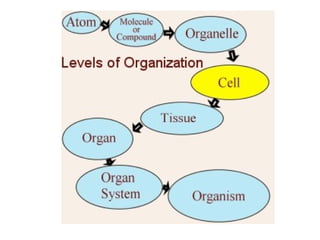
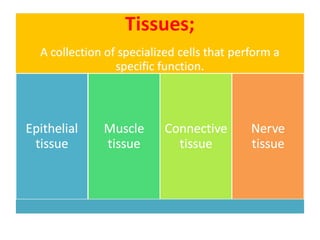

2.2 Cell Organisation Multicellular organisms
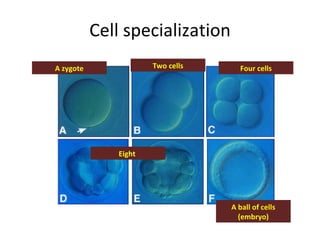
Cell specialization A zygote A ball of cells (embryo) Eight  Two cells Four cells
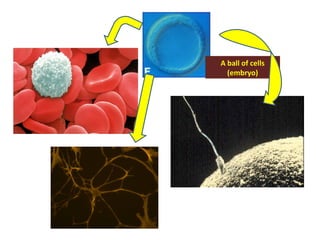
A ball of cells (embryo)
 
 
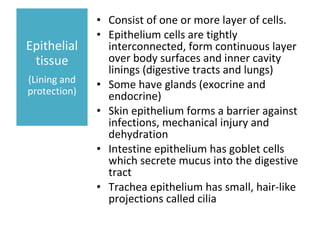
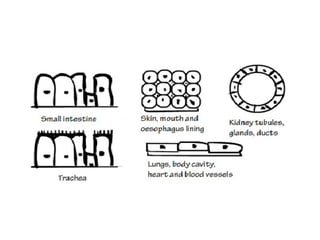
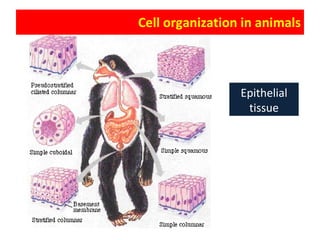
Consist of one or more layer of cells. Epithelium cells are tightly interconnected, form continuous layer over body surfaces and inner cavity linings (digestive tracts and lungs)  Some have glands (exocrine and endocrine)  Skin epithelium forms a barrier against infections, mechanical injury and dehydration  Intestine epithelium has goblet cells which secrete mucus into the digestive tract  Trachea epithelium has small, hair‐like projections called cilia  Epithelial tissue (Lining and protection)
 
Cell organization in animals Epithelial tissue
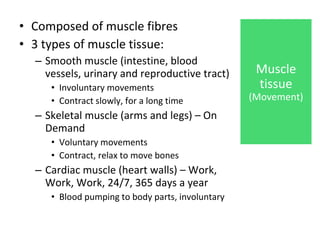
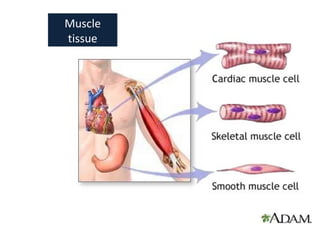
Composed of muscle fibres  3 types of muscle tissue:  Smooth muscle (intestine, blood vessels, urinary and reproductive tract)  Involuntary movements  Contract slowly, for a long time  Skeletal muscle (arms and legs) – On Demand  Voluntary movements  Contract, relax to move bones  Cardiac muscle (heart walls) – Work, Work, Work, 24/7, 365 days a year  Blood pumping to body parts, involuntary  Muscle tissue  (Movement)
Muscle tissue
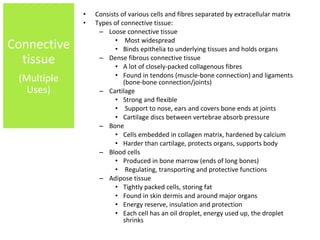
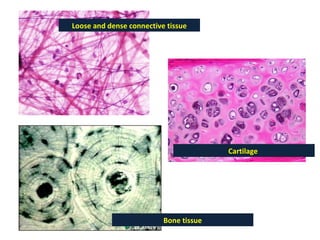
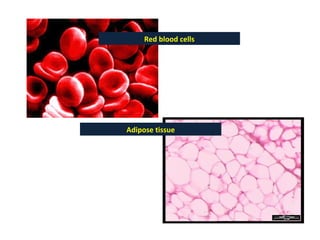
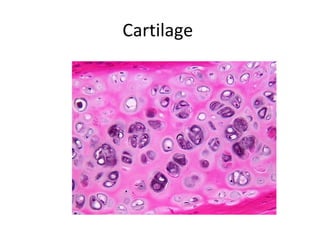
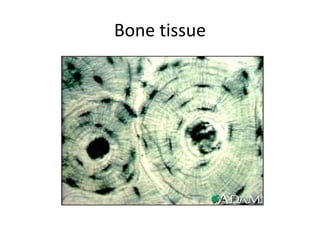
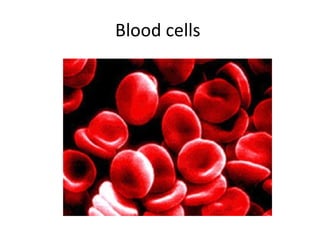
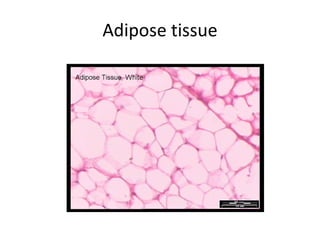
Consists of various cells and fibres separated by extracellular matrix   Types of connective tissue:  Loose connective tissue  Most widespread  Binds epithelia to underlying tissues and holds organs  Dense fibrous connective tissue  A lot of closely‐packed collagenous fibres Found in tendons (muscle‐bone connection) and ligaments (bone‐bone connection/joints) Cartilage  Strong and flexible  Support to nose, ears and covers bone ends at joints  Cartilage discs between vertebrae absorb pressure  Bone  Cells embedded in collagen matrix, hardened by calcium  Harder than cartilage, protects organs, supports body  Blood cells  Produced in bone marrow (ends of long bones)  Regulating, transporting and protective functions  Adipose tissue  Tightly packed cells, storing fat  Found in skin dermis and around major organs  Energy reserve, insulation and protection  Each cell has an oil droplet, energy used up, the droplet shrinks  Connective tissue (Multiple Uses)
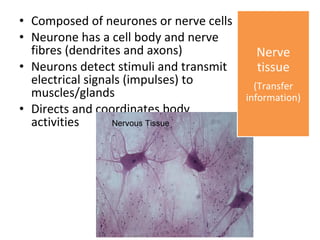
Composed of neurones or nerve cells  Neurone has a cell body and nerve fibres (dendrites and axons)  Neurons detect stimuli and transmit electrical signals (impulses) to muscles/glands  Directs and coordinates body activities  Nerve tissue (Transfer information)
Loose and dense connective tissue Bone tissue Cartilage
Red blood cells Adipose tissue
Cartilage
Bone tissue
Blood cells
Adipose tissue
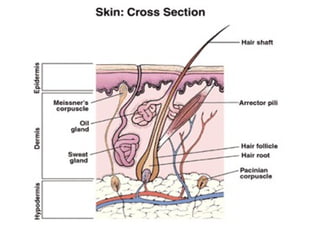
Organs  Tissues work together to perform a specific function. These are called organs. Examples are lungs, heart,  kidneys, brain etc. Example: The skin:  Consists of various tissues joined together  2 main layers, the epidermis and the dermis  Epidermis is made of epithelial tissue, which constantly divides  Dermis is made of connective, nerve, epithelial and muscle tissue  Blood is supplied through blood capillary network  Nerve endings are scattered throughout the skin, transmit impulses to nervous system  Epithelial cells produce hair follicles, sweat glands and oil glands
Organs
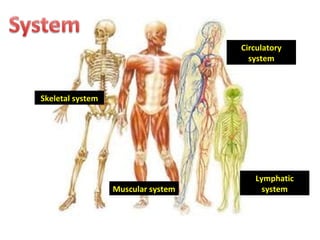
Skeletal system Muscular system Circulatory system Lymphatic system
 
 
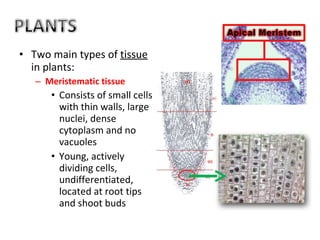
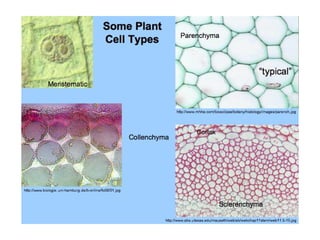
Two main types of  tissue  in plants:  Meristematic tissue  Consists of small cells with thin walls, large nuclei, dense cytoplasm and no vacuoles  Young, actively dividing cells, undifferentiated, located at root tips and shoot buds
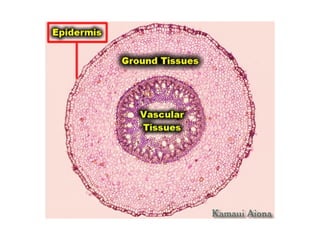
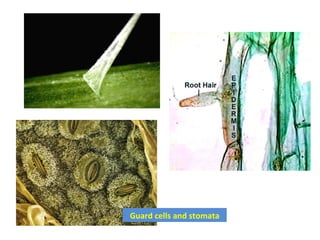
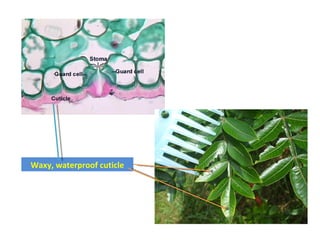
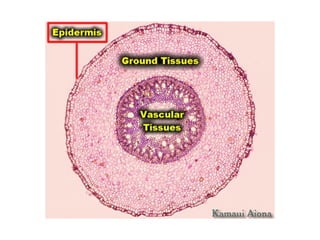
Permanent tissue  Differentiated/partly differentiated mature tissues  Three types of permanent tissue:  Epidermal tissue  Outermost layer, covering stems, leaves and roots of young plants  Flat, with large vacuoles  Walls that are exposed to air covered with waxy waterproof cuticle  Cuticle reduces water loss, mechanical injury and infection  Root cells have root hairs to increase water absorption  Guard cells, containing chloroplasts, open and close stomata
 
Guard cells and stomata
Waxy, waterproof cuticle


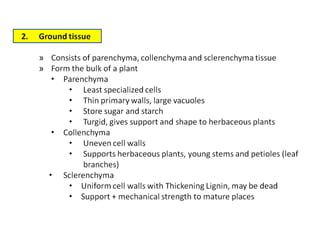
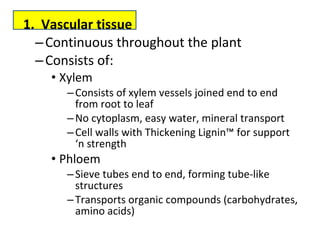
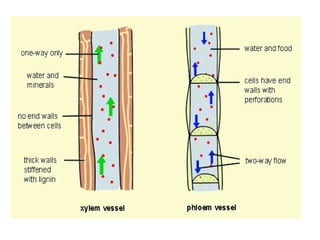
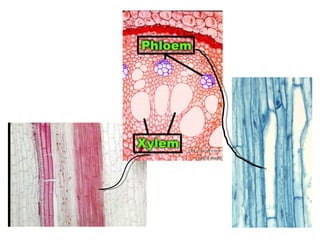
Vascular tissue  Continuous throughout the plant  Consists of:  Xylem  Consists of xylem vessels joined end to end from root to leaf  No cytoplasm, easy water, mineral transport  Cell walls with Thickening Lignin™ for support ‘n strength  Phloem  Sieve tubes end to end, forming tube‐like structures  Transports organic compounds (carbohydrates, amino acids)
 
 
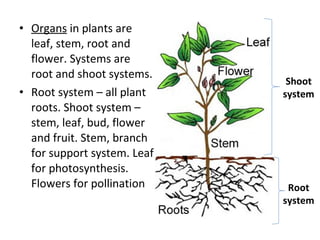
Organs  in plants are leaf, stem, root and flower. Systems are root and shoot systems. Root system – all plant roots. Shoot system – stem, leaf, bud, flower and fruit. Stem, branch for support system. Leaf for photosynthesis. Flowers for pollination Shoot system Root system
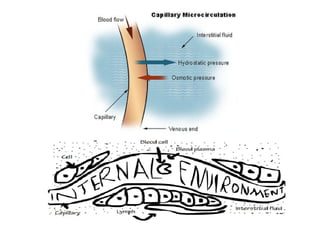
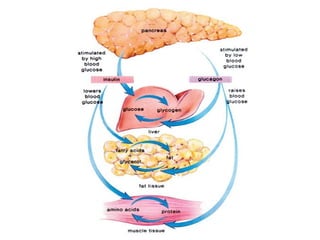
INTERNAL ENVIRONMENT Internal environment consists of blood plasma,  interstitial fluid (ISF)  and  lymph . Interstitial fluid (ISF)  fills spaces between cells and bathes the cells. It exchanges substances with the blood plasma and the lymph. Physical factors and chemical factors of internal environment must be maintained. Physical factors include temperature, blood pressure and osmotic pressure . Chemical factors include pH, salt and sugar content.
 
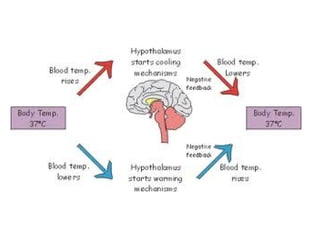
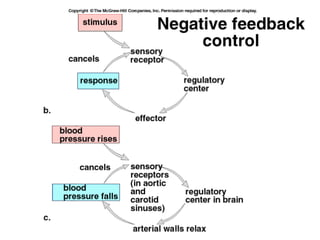
Homeostasis  is maintenance of constant internal environment for optimal cell performance. Any changes in the internal environment will cause homeostasis to kick in and work to cancel the change.  This is governed by the negative feedback mechanism.  Body temp. is regulated by integumentary system (skin+glands), nervous, circulatory, muscular and endocrine system.  Skin receptors detect rises in body temp, nerve cells transmit the info to the hypothalamus, the brain’s temp control. It activates blood vessels’ dilation to allow more blood flow to skin for heat loss and sweat glands to produce sweat to increase heat loss.
 
Oxygen and carbon dioxide levels are regulated by the respiratory, circulatory and nervous system.  Circulatory system transports oxygen to cells and carbon dioxide to lungs. Level changes are detected by nervous system like an increase in CO2 and decrease in oxygen. Heartbeat and breathing increase to get normal oxygen and CO2 levels.   
 
Blood osmotic pressure is regulated by nervous, endocrine, excretory and circulatory systems.  Chemical contents are regulated by excretory, circulatory, nervous and endocrine systems. Urea is transported to the kidneys by bloodstream to be excreted.  pH is regulated by respiratory, circulatory and excretory systems by controlling H+(hydrogen ion), OH– (hydroxyl ion) and HCO3– (hydrogen carbonate ion) levels in blood plasma and interstitial fluid
 
Test yourself! What is the function of contractile vacuoles in  Amoeba  sp.? Draw and label the process of phagocytosis in  Amoeba  sp. Explain the process. There are two main types of tissues in plants which are meristematic and permanent tissue. State the differences among the three types of permanent tissue. Name the systems that are involved in regulating the blood sugar level.
Download your notes from www.cikgurumaizah.blogspot.com

2.2

  • 1.
    2.2 Cell OrganisationMulticellular organisms
  • 2.
    Cell specialization Azygote A ball of cells (embryo) Eight Two cells Four cells
  • 3.
    A ball ofcells (embryo)
  • 4.
  • 5.
  • 6.
    Consist of oneor more layer of cells. Epithelium cells are tightly interconnected, form continuous layer over body surfaces and inner cavity linings (digestive tracts and lungs) Some have glands (exocrine and endocrine) Skin epithelium forms a barrier against infections, mechanical injury and dehydration Intestine epithelium has goblet cells which secrete mucus into the digestive tract Trachea epithelium has small, hair‐like projections called cilia Epithelial tissue (Lining and protection)
  • 7.
  • 8.
    Cell organization inanimals Epithelial tissue
  • 9.
    Composed of musclefibres 3 types of muscle tissue: Smooth muscle (intestine, blood vessels, urinary and reproductive tract) Involuntary movements Contract slowly, for a long time Skeletal muscle (arms and legs) – On Demand Voluntary movements Contract, relax to move bones Cardiac muscle (heart walls) – Work, Work, Work, 24/7, 365 days a year Blood pumping to body parts, involuntary Muscle tissue (Movement)
  • 10.
  • 11.
    Consists of variouscells and fibres separated by extracellular matrix   Types of connective tissue: Loose connective tissue Most widespread Binds epithelia to underlying tissues and holds organs Dense fibrous connective tissue A lot of closely‐packed collagenous fibres Found in tendons (muscle‐bone connection) and ligaments (bone‐bone connection/joints) Cartilage Strong and flexible Support to nose, ears and covers bone ends at joints Cartilage discs between vertebrae absorb pressure Bone Cells embedded in collagen matrix, hardened by calcium Harder than cartilage, protects organs, supports body Blood cells Produced in bone marrow (ends of long bones) Regulating, transporting and protective functions Adipose tissue Tightly packed cells, storing fat Found in skin dermis and around major organs Energy reserve, insulation and protection Each cell has an oil droplet, energy used up, the droplet shrinks Connective tissue (Multiple Uses)
  • 12.
    Composed of neuronesor nerve cells Neurone has a cell body and nerve fibres (dendrites and axons) Neurons detect stimuli and transmit electrical signals (impulses) to muscles/glands Directs and coordinates body activities Nerve tissue (Transfer information)
  • 13.
    Loose and denseconnective tissue Bone tissue Cartilage
  • 14.
    Red blood cellsAdipose tissue
  • 15.
  • 16.
  • 17.
  • 18.
  • 19.
    Organs Tissueswork together to perform a specific function. These are called organs. Examples are lungs, heart, kidneys, brain etc. Example: The skin: Consists of various tissues joined together 2 main layers, the epidermis and the dermis Epidermis is made of epithelial tissue, which constantly divides Dermis is made of connective, nerve, epithelial and muscle tissue Blood is supplied through blood capillary network Nerve endings are scattered throughout the skin, transmit impulses to nervous system Epithelial cells produce hair follicles, sweat glands and oil glands
  • 20.
  • 21.
    Skeletal system Muscularsystem Circulatory system Lymphatic system
  • 22.
  • 23.
  • 24.
    Two main typesof tissue in plants: Meristematic tissue Consists of small cells with thin walls, large nuclei, dense cytoplasm and no vacuoles Young, actively dividing cells, undifferentiated, located at root tips and shoot buds
  • 25.
    Permanent tissue Differentiated/partly differentiated mature tissues Three types of permanent tissue: Epidermal tissue Outermost layer, covering stems, leaves and roots of young plants Flat, with large vacuoles Walls that are exposed to air covered with waxy waterproof cuticle Cuticle reduces water loss, mechanical injury and infection Root cells have root hairs to increase water absorption Guard cells, containing chloroplasts, open and close stomata
  • 26.
  • 27.
  • 28.
  • 29.
  • 30.
  • 31.
  • 32.
    Vascular tissue Continuous throughout the plant Consists of: Xylem Consists of xylem vessels joined end to end from root to leaf No cytoplasm, easy water, mineral transport Cell walls with Thickening Lignin™ for support ‘n strength Phloem Sieve tubes end to end, forming tube‐like structures Transports organic compounds (carbohydrates, amino acids)
  • 33.
  • 34.
  • 35.
    Organs inplants are leaf, stem, root and flower. Systems are root and shoot systems. Root system – all plant roots. Shoot system – stem, leaf, bud, flower and fruit. Stem, branch for support system. Leaf for photosynthesis. Flowers for pollination Shoot system Root system
  • 36.
    INTERNAL ENVIRONMENT Internalenvironment consists of blood plasma, interstitial fluid (ISF) and lymph . Interstitial fluid (ISF) fills spaces between cells and bathes the cells. It exchanges substances with the blood plasma and the lymph. Physical factors and chemical factors of internal environment must be maintained. Physical factors include temperature, blood pressure and osmotic pressure . Chemical factors include pH, salt and sugar content.
  • 37.
  • 38.
    Homeostasis ismaintenance of constant internal environment for optimal cell performance. Any changes in the internal environment will cause homeostasis to kick in and work to cancel the change. This is governed by the negative feedback mechanism. Body temp. is regulated by integumentary system (skin+glands), nervous, circulatory, muscular and endocrine system. Skin receptors detect rises in body temp, nerve cells transmit the info to the hypothalamus, the brain’s temp control. It activates blood vessels’ dilation to allow more blood flow to skin for heat loss and sweat glands to produce sweat to increase heat loss.
  • 39.
  • 40.
    Oxygen and carbondioxide levels are regulated by the respiratory, circulatory and nervous system. Circulatory system transports oxygen to cells and carbon dioxide to lungs. Level changes are detected by nervous system like an increase in CO2 and decrease in oxygen. Heartbeat and breathing increase to get normal oxygen and CO2 levels.  
  • 41.
  • 42.
    Blood osmotic pressureis regulated by nervous, endocrine, excretory and circulatory systems. Chemical contents are regulated by excretory, circulatory, nervous and endocrine systems. Urea is transported to the kidneys by bloodstream to be excreted. pH is regulated by respiratory, circulatory and excretory systems by controlling H+(hydrogen ion), OH– (hydroxyl ion) and HCO3– (hydrogen carbonate ion) levels in blood plasma and interstitial fluid
  • 43.
  • 44.
    Test yourself! Whatis the function of contractile vacuoles in Amoeba sp.? Draw and label the process of phagocytosis in Amoeba sp. Explain the process. There are two main types of tissues in plants which are meristematic and permanent tissue. State the differences among the three types of permanent tissue. Name the systems that are involved in regulating the blood sugar level.
  • 45.
    Download your notesfrom www.cikgurumaizah.blogspot.com