Animal Form
and Function
• The study of animal form and function is integrated by
the common set of problems that all animals must solve.
• These include how to extract oxygen from the
environment, how to nourish themselves, how to
excrete waste products, and how to move.
• The comparative study of animals reveals that form
and function are closely correlated
Introduction
• Animals provide vivid examples of biology’s
overarching theme of evolution.
• For example, the long, tonguelike proboscis of a
hawkmoth is a structural adaptation for feeding.
Animal form and function reflects biology’s
major themes
• While natural selection provides a mechanism for
long-term adaptation, organisms also have the
capacity to adjust to environmental change over the
short term by physiological responses.
• For example, while most insects are inactive when cold, the
hawkmoth, Manduca sexta, can forage for nectar when air
temperatures are as low as 5o
C.
• The moth uses a shivering-like mechanism for preflight
warm up of its flight muscles.
• Searching for food, generating body heat and
regulating internal temperature, sensing and
responding to environmental stimuli, and all other
animal activities require fuel in the form of chemical
energy. (ATP) remember????
• Anatomy is the study of the structure of an
organism.
• Physiology is the study of the functions an
organism performs.
• The form-function principle is just another extension of
biology’s central theme of evolution.
Animals are multicellular organisms with their specialized
cells grouped into tissues.
• tissues make up functional units called organs, and
groups of organs that work together form organ
systems, and these functioning together form
organisms
• Tissues are groups of cell with a common structure and
function..
• Tissues are classified into four main categories:
epithelial tissue, connective tissue, nervous tissue, and
muscle tissue
Animal form and function are correlated at all
levels of organization
• Occurring in sheets of tightly packed cells,
epithelial tissue covers the outside of the body and
lines organs and cavities within the body.
• riveted together by tight junctions.
• The epithelium functions include: Protection, secretion,
absorption, filtration ect
• The free surface of the epithelium is exposed to air or
fluid, and the cells at the base of the barrier are attached
to a basement membrane, a dense mat of extracellular
matrix.
• Epithelia are classified by the number of cell layers
and the shape of the cells on the free surface.
• A simple epithelium has
a single layer of cells, and
a stratified epithelium
has multiple tiers of cells.
• The shapes of cells may
be cuboidal (like dice),
columnar (like bricks on
end), or squamous (flat
like floor tiles).
• Connective tissue functions mainly to bind and
support other tissues.
• Connective tissues have a sparse population of cells
scattered through an extracellular matrix.
• The matrix generally consists of a web of fibers
embedding in a uniform foundation that may be liquid,
jellylike, or solid.
• In most cases, the connective tissue cells secrete the
matrix.
• There are three kinds of connective tissue fibers,
which are all proteins: collagenous fibers, elastic
fibers, and reticular fibers.
• Collagenous fibers are made of collagen.
• Collagenous fibers are nonelastic and do not tear easily
when pulled lengthwise.
• Elastic fibers are long threads of elastin.
• Elastin fiber provide a rubbery quality.
• Reticular fibers are very thin and branched.
• Composed of collagen and continuous with collagenous
fibers, they form a tightly woven fabric that joins
connective tissue to adjacent tissues.
• The major types of connective tissues in
vertebrates are loose connective tissue, adipose
tissue, fibrous connective tissue, cartilage, bone,
and blood.
• Loose connective tissue binds epithelia to
underlying tissues and functions as packing
materials, holding organs in place.
• Two cell types predominated in the fibrous mesh
of loose connective tissue.
• Fibroblasts secrete the protein ingredients of the
extracellular fibers.
• Macrophages are amoeboid cells that roam the maze of
fibers, engulfing bacteria and the debris of dead cells by
phagocytosis.
• Adipose tissue is a specialized form of loose
connective tissues that store fat in adipose cells
distributed throughout the matrix.
• Adipose tissue pads and insulates the body and stores fuel as
fat molecules.
• Each adipose cell contains a large fat droplet that swells when
fat is stored and shrinks when the body uses fat as fuel.
• Fibrous connective tissue is dense, due to its large
number of collagenous fibers.
• The fibers are organized into parallel bundles, an arrangement
that maximizes nonelastic strength.
• This type of connective tissue forms tendons, attaching
muscles to bones, and ligaments, joining bones to bones at
joints.
• Cartilage has an abundance of collagenous fibers
embedded in a rubbery matrix made of a substance
called chondroitin sulfate, a protein-carbohydrate
complex.
• Chondrocytes secrete collagen and chondroitin sulfate.
• The composite of collagenous fibers and chondroitin
sulfate makes cartilage a strong yet somewhat flexible
support material.
• The skeleton of a shark is made of cartilage and the
embryonic skeletons of many vertebrates are
cartilaginous.
• We retain cartilage as flexible supports in certain
locations, such as the nose, ears, and vertebral disks.
• The skeleton supporting most vertebrates is made
of bone, a mineralized connective tissue.
• Osteoblasts deposit a matrix of collagen.
• Then, calcium, magnesium, and phosphate ions
combine and harden within the matrix into the mineral
hydroxyapatite.
• The combination of hard mineral and flexible collagen
makes bone harder than cartilage without being brittle.
• The microscopic structure of hard mammalian bones
consists of repeating units called osteons.
• Each osteon has concentric layers of mineralized
matrix deposited around a central canal containing
blood vessels and nerves that service the bone.
• Blood functions differently from other connective
tissues, but it does have an extensive extracellular
matrix.
• The matrix is a liquid called plasma, consisting of
water, salts, and a variety of dissolved proteins.
• Suspended in the plasma are erythrocytes (red blood
cells), leukocytes (white blood cells) and cell fragments
called platelets.
• Red cells carry oxygen.
• White cells function in defense against viruses,
bacteria, and other invaders.
• Platelets aid in blood clotting.
• Nervous tissue senses stimuli and transmits signals
from one part of the animal to another.
• The functional unit of nervous tissue is the neuron, or
nerve cell.
• It consists of a cell body and two or more extensions,
called dendrites and axons.
• Dendrites transmit nerve impulses from their tips toward
the rest of the neuron.
• Axons transmit impulses toward
another neuron or toward an
effector, such as a muscle cell.
• Muscle tissue is composed of long cells called
muscle fibers that are capable of contracting when
stimulated by nerve impulses.
• Arranged in parallel within the cytoplasm of muscle
fibers are large numbers of myofibrils made of the
contractile proteins actin and myosin.
• Muscle is the most abundant tissue in most animals, and
muscle contraction accounts for most of the energy-
consuming cellular work in active animals.
• There are three types of muscle tissue in the vertebrate
body: skeletal muscle, cardiac muscle, and smooth
muscle.
• Attached to bones by tendons, skeletal muscle is responsible for
voluntary movements.
• Skeletal muscle is also called striated muscle because the overlapping
filaments give the cells a striped (striated) appearance under the
microscope.
• Cardiac muscle forms the contractile wall of the heart.
• It is striated like cardiac muscle, but cardiac cells are branched.The ends
of the cells are joined by intercalated disks, which relay signals from
cell to cell during a heartbeat.
• Smooth muscle, which lacks striations, is found in the walls of
the digestive tract, urinary bladder, arteries, and other internal
organs.
• They contract more slowly than skeletal muscles but can remain
contracted longer.
• Controlled by different kinds of nerves than those controlling skeletal
muscles, smooth muscles are responsible for involuntary body activities.
• In all but the simplest animals (sponges and some
cnidarians) different tissues are organized into
organs.
• Many vertebrate organs are suspended by sheets of
connective tissues called mesenteries in body cavities
moistened or filled with fluid.
• Mammals have a thoracic cavity housing the lungs and
heart that is separated from the lower abdominal cavity
by a sheet of muscle called the diaphragm.
The organ systems of animals are
interdependent
• In some organs
the tissues are
arranged in
layers.
• For example,
the vertebrate
stomach has
four major
tissues layers.
Mucosa: an epithelial
layer that lines the
lumen
Submucosa: a matrix of
connective tissue that
contains blood vessels
and nerves
Muscularis: consists
mainly of smooth muscle
tissue
Serosa: a thin layer of
connective and epithelial
tissue external to the
muscularis
• Organ systems carry out the major body functions of most
animals.
• Each organ system consists of several organs and has specific
functions. The efforts of all systems must be coordinated for the
animal to survive.
• Physical requirements constrain what natural
selection can “invent,” including the size of single
cells.
• This prevents an amoeba the size of a pro wrestler
engulfing your legs when wading into a murky lake.
• An amoeba the size of a human could never move
materials across its membrane fast enough to satisfy such
a large blob of cytoplasm.
• In this example, a physical law - the math of surface-to-
volume relations - limits the evolution of an organism’s
form.
Physical laws constrain animal form
• Similarly, the laws of hydrodynamics constrain the
shapes that are possible for aquatic organisms that
swim very fast.
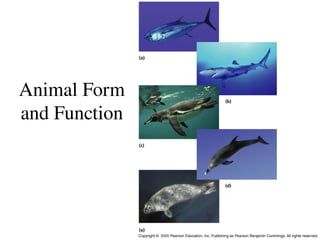
• Tunas, sharks, penguins, dolphins, seal, and whales are all
fast swimmers and all have the same basic shape, called a
fusiform shape.
• This shape
minimizes drag
in water, which is
about a thousand
times denser
than air.
• The similar forms of speedy fishes, birds, and
marine mammals are a consequence of
convergent evolution in the face of the universal
laws of hydrodynamics.
• Convergence occurs because natural selection shapes
similar adaptations when diverse organisms face the
same environmental challenge, such as the resistance of
water to fast travel.
• An animal’s size and shape have a direct effect on
how the animal exchanges energy and materials with
its surroundings.
• As a requirement for maintaining the fluid integrity of the
plasma membrane of its cells, an animal’s body must be
arranged so that all of its living cells are bathed in an
aqueous medium.
• Exchange with the environment occurs as dissolved
substances diffuse and are transported across the plasma
membranes between the cells and their aqueous
surroundings.
Body size and shape affect interactions with
the environment
• For example, a single-celled protist living in water
has a sufficient surface area of plasma membrane
to service its entire volume because it is so small.
• A large cell has less surface area
relative to its volume than a
smaller cell of the same shape.
• These considerations place a
physical constraint on cell size.
• Multicellular animals are composed of microscopic
cells, each with its own plasma membrane that acts
as a loading and unloading platform for a volume
of cytoplasm
• This only works if all the cells of the animal have
access to a suitable aqueous environment.
• For example, a hydra, built on
the sac plan, has a body wall
only two cell layers thick.
• Because its gastrovascular
cavity opens to the exterior,
both outer and inner layers
of cells are bathed in water.
• Most animals are more complex and made up of
compact masses of cells, producing outer surfaces
that are relatively small compared to their volume.
• Most organisms have
extensively folded or
branched internal surfaces
specialized for exchange
with the environment.
• The circulatory system
shuttles material among
all the exchange surfaces
within the animal.
• Although exchange with the environment is a
problem for animals whose cells are mostly
internal, complex forms have distinct benefits.
• Because the animal’s external surface need not be
bathed in water, it is possible for the animal to live on
land.
• Also, because the immediate environment for the cells
is the internal body fluid, the animal’s organ systems
can control the composition of the solution bathing its
cells.
Homeostasis is a dynamic state, an interplay between outside
forces that tend to change the internal environment and internal
control mechanisms that oppose such changes.
homeostasis, means “steady state,” or internal balance
• The internal environment of vertebrates is called the
interstitial fluid.
• This fluid exchanges nutrients and wastes with blood contained in
microscopic vessels called capillaries.
• While a pond-dwelling hydra is powerless to affect the temperature of
the fluid that bathes its cells, the human body can maintain its “internal
pond” at a more-or-less constant temperature of about 370
C.
Mechanisms of homeostasis moderate
changes in the internal environment
• Any homeostatic control system has three
functional components: a receptor, a control
center, and an effectors.
• The receptor detects a change in some variable in the
animal’s internal environment, such as a change in
temperature.
• The control center processes the information it receives
from the receptor and directs an appropriate response by
the effector.
Homeostasis depends on feedback circuits
• One type of control circuit, a negative-feedback system,
where buildup of the end product shuts the system off .
(Enzymes Feedback inhibition)
• Most homeostatic mechanisms in animals operate on this
principle of negative feedback
• In contrast to negative feedback, positive feedback
involves a change in some variable that trigger mechanisms
that amplify rather than reverse the change.
• For example, during childbirth, the pressure of the
baby’s head against sensors near the opening of the
uterus stimulates uterine contractions.
• These cause greater pressure against the uterine opening,
heightening the contractions, which cause still greater
pressure.
• While some aspects of the internal environment are
maintained at a set point, regulated change is
essential to normal body functions.
• In some cases, the changes are cyclical, such as the
changes in hormone levels responsible for the menstrual
cycle in women.
• In other cases, a regulated change is a reaction to a
challenge to the body.
• For example, the human body reacts to certain
infections by raising the set point for temperature to a
slightly higher level, and the resulting fevers helps
fight infection.
• All organisms require chemical energy for growth,
physiological processes, maintenance and repair,
regulation, and reproduction.
• Plants use light energy to build energy-rich organic
molecules from water and CO2, and then use those organic
molecules for fuel.
• In contrast, animals are heterotrophs and must obtain
their chemical energy in food, which contains organic
molecules synthesized by other organisms.
Animals are heterotrophs that harvest
chemical energy from the food they eat
• Food is digested by enzymatic hydrolysis, and
energy-containing food molecules are absorbed by
body cells.
• Most fuel molecules are used to generate ATP by
the catabolic processes of cellular respiration and
fermentation.
• The chemical energy of ATP powers cellular work,
enabling cells, organs, and organ systems to perform the
many functions that keep an animal alive.
• Since the production and use of ATP generates heat, an
animal must continuously loose heat to its surroundings.
• After energetic needs are met, any remaining food
molecules can be used
in biosynthesis.
• This includes body growth
and repair, synthesis of
storage material such as fat,
and production of
reproductive structures,
including gametes.
• Biosynthesis requires both
carbon skeletons for new
structures and ATP to
power their assembly.
• The flow of energy through an animal - an animal’s
bioenergetics - ultimately set the limits on the
animal’s behavior, growth, and reproduction and
determines how much food it needs.
• The amount of energy an animal uses in a unit of
time is called its metabolic rate - the sum of all the
energy-requiring biochemical reactions occurring
over a given time interval
Metabolic rate provides clues to an
animal’s bioenergetic “strategy”
Energy is measured in calories (cal) or kilocalories
(kcal).
• A kilocalorie is 1,000 calories.
• The term Calorie, with a capital C, as used by many
nutritionists, is actually a kilocalorie.
• Metabolic rate can be determined several ways.
• Because nearly all the chemical energy used in
cellular respiration eventually appears as heat,
metabolic rate can be measured by monitoring an
animal’s heat loss.
• There are two basic bioenergetic “strategies” used by
animals.
• Birds and mammals are mainly endothermic, maintaining
their body temperature at a certain level with heat generated
by metabolism.
• Most fishes, amphibians, reptiles, and invertebrates are
ectothermic, meaning they do not produce enough metabolic
heat to have much effect on body temperature.
• The ectothermic strategy requires much less energy than is
needed by endotherms, because of the energy cost of
heating (or cooling) an endothermic body.
• are generally incapable of intense activity over long
periods.
• One of animal biology’s most intriguing, but largely
unanswered questions has to do with the relationship
between body size and metabolic rate.
• Physiologists have shown that the amount of energy it
takes to maintain each gram of body weight is inversely
related to body size.
• For example, each gram of a mouse consumes about 20
times more calories than a gram of an elephant.
Metabolic rate per gram is inversely related
to body size among similar animals
• The higher metabolic rate of a smaller animal
demands a proportionately greater delivery rate of
oxygen.
• A smaller animal also has a higher breathing rate, blood
volume (relative to size), and heart rate (pulse) and
must eat much more food per unit of body mass.
• Researchers continue to search for causes
underlying this inverse relationship
• Every animal has a range of metabolic rates.
• Minimal rates power the basic functions that support life,
such as cell maintenance, breathing, and heartbeat.
• The metabolic rate of a nongrowing endotherm at
rest, with an empty stomach, and experiencing no
stress is called the basal metabolic rate (BMR).
• The BMR for humans averages abut 1,600 to 1,800 kcal
per day for adult males and about 1,300 to 1,500 kcal per
day for adult females.
Animals adjust their metabolic rates as
conditions change
• Between the extremes of BMR or SMR and
maximal metabolic rate, many factors influence
energy requirements.
• These include age, sex, size, body and environmental
temperatures, the quality and quantity of food, activity
level, oxygen availability, hormonal balance, and time of
day.
• Diurnal organisms, such as birds, humans, and many
insects, are usually active and have their highest
metabolic rates during daylight hours.
• Nocturnal organisms, such as bats, mice, and many
other mammals are usually active at night or near dawn
and dusk, and have their highest metabolic rates then.
• Metabolic rates measured when animals are
performing a variety of activities give a better idea
of the energy costs of everyday life.
• For most terrestrial animals, the average daily rate of
energy consumption is 2-4 times BMR or SMR.
• Humans in most developed countries have an
unusually low average daily metabolic rate of about
1.5 times BMR - an indication of relatively
sedentary lifestyles.
• For example, the typical annual energy budget of four
vertebrates reinforces two important concepts in
bioenergetics.
• First, a small animal has a much greater energy demand
per kg than does a large animal of the same class.
• Second, an ectotherm requires much less energy per kg
than does an endotherm of equivalent size.
• Further, size and energy strategy have a great
influence on how the total annual energy
expenditure is distributed among energetic needs.
Animal_Form_and_Function .ppt

  • 1.
  • 2.
    • The studyof animal form and function is integrated by the common set of problems that all animals must solve. • These include how to extract oxygen from the environment, how to nourish themselves, how to excrete waste products, and how to move. • The comparative study of animals reveals that form and function are closely correlated Introduction
  • 3.
    • Animals providevivid examples of biology’s overarching theme of evolution. • For example, the long, tonguelike proboscis of a hawkmoth is a structural adaptation for feeding. Animal form and function reflects biology’s major themes
  • 4.
    • While naturalselection provides a mechanism for long-term adaptation, organisms also have the capacity to adjust to environmental change over the short term by physiological responses. • For example, while most insects are inactive when cold, the hawkmoth, Manduca sexta, can forage for nectar when air temperatures are as low as 5o C. • The moth uses a shivering-like mechanism for preflight warm up of its flight muscles. • Searching for food, generating body heat and regulating internal temperature, sensing and responding to environmental stimuli, and all other animal activities require fuel in the form of chemical energy. (ATP) remember????
  • 5.
    • Anatomy isthe study of the structure of an organism. • Physiology is the study of the functions an organism performs. • The form-function principle is just another extension of biology’s central theme of evolution.
  • 6.
    Animals are multicellularorganisms with their specialized cells grouped into tissues. • tissues make up functional units called organs, and groups of organs that work together form organ systems, and these functioning together form organisms • Tissues are groups of cell with a common structure and function.. • Tissues are classified into four main categories: epithelial tissue, connective tissue, nervous tissue, and muscle tissue Animal form and function are correlated at all levels of organization
  • 7.
    • Occurring insheets of tightly packed cells, epithelial tissue covers the outside of the body and lines organs and cavities within the body. • riveted together by tight junctions. • The epithelium functions include: Protection, secretion, absorption, filtration ect • The free surface of the epithelium is exposed to air or fluid, and the cells at the base of the barrier are attached to a basement membrane, a dense mat of extracellular matrix.
  • 8.
    • Epithelia areclassified by the number of cell layers and the shape of the cells on the free surface. • A simple epithelium has a single layer of cells, and a stratified epithelium has multiple tiers of cells. • The shapes of cells may be cuboidal (like dice), columnar (like bricks on end), or squamous (flat like floor tiles).
  • 9.
    • Connective tissuefunctions mainly to bind and support other tissues. • Connective tissues have a sparse population of cells scattered through an extracellular matrix. • The matrix generally consists of a web of fibers embedding in a uniform foundation that may be liquid, jellylike, or solid. • In most cases, the connective tissue cells secrete the matrix. • There are three kinds of connective tissue fibers, which are all proteins: collagenous fibers, elastic fibers, and reticular fibers.
  • 10.
    • Collagenous fibersare made of collagen. • Collagenous fibers are nonelastic and do not tear easily when pulled lengthwise. • Elastic fibers are long threads of elastin. • Elastin fiber provide a rubbery quality. • Reticular fibers are very thin and branched. • Composed of collagen and continuous with collagenous fibers, they form a tightly woven fabric that joins connective tissue to adjacent tissues.
  • 11.
    • The majortypes of connective tissues in vertebrates are loose connective tissue, adipose tissue, fibrous connective tissue, cartilage, bone, and blood.
  • 12.
    • Loose connectivetissue binds epithelia to underlying tissues and functions as packing materials, holding organs in place. • Two cell types predominated in the fibrous mesh of loose connective tissue. • Fibroblasts secrete the protein ingredients of the extracellular fibers. • Macrophages are amoeboid cells that roam the maze of fibers, engulfing bacteria and the debris of dead cells by phagocytosis.
  • 13.
    • Adipose tissueis a specialized form of loose connective tissues that store fat in adipose cells distributed throughout the matrix. • Adipose tissue pads and insulates the body and stores fuel as fat molecules. • Each adipose cell contains a large fat droplet that swells when fat is stored and shrinks when the body uses fat as fuel. • Fibrous connective tissue is dense, due to its large number of collagenous fibers. • The fibers are organized into parallel bundles, an arrangement that maximizes nonelastic strength. • This type of connective tissue forms tendons, attaching muscles to bones, and ligaments, joining bones to bones at joints.
  • 14.
    • Cartilage hasan abundance of collagenous fibers embedded in a rubbery matrix made of a substance called chondroitin sulfate, a protein-carbohydrate complex. • Chondrocytes secrete collagen and chondroitin sulfate. • The composite of collagenous fibers and chondroitin sulfate makes cartilage a strong yet somewhat flexible support material. • The skeleton of a shark is made of cartilage and the embryonic skeletons of many vertebrates are cartilaginous. • We retain cartilage as flexible supports in certain locations, such as the nose, ears, and vertebral disks.
  • 15.
    • The skeletonsupporting most vertebrates is made of bone, a mineralized connective tissue. • Osteoblasts deposit a matrix of collagen. • Then, calcium, magnesium, and phosphate ions combine and harden within the matrix into the mineral hydroxyapatite. • The combination of hard mineral and flexible collagen makes bone harder than cartilage without being brittle. • The microscopic structure of hard mammalian bones consists of repeating units called osteons. • Each osteon has concentric layers of mineralized matrix deposited around a central canal containing blood vessels and nerves that service the bone.
  • 17.
    • Blood functionsdifferently from other connective tissues, but it does have an extensive extracellular matrix. • The matrix is a liquid called plasma, consisting of water, salts, and a variety of dissolved proteins. • Suspended in the plasma are erythrocytes (red blood cells), leukocytes (white blood cells) and cell fragments called platelets. • Red cells carry oxygen. • White cells function in defense against viruses, bacteria, and other invaders. • Platelets aid in blood clotting.
  • 18.
    • Nervous tissuesenses stimuli and transmits signals from one part of the animal to another. • The functional unit of nervous tissue is the neuron, or nerve cell. • It consists of a cell body and two or more extensions, called dendrites and axons. • Dendrites transmit nerve impulses from their tips toward the rest of the neuron. • Axons transmit impulses toward another neuron or toward an effector, such as a muscle cell.
  • 19.
    • Muscle tissueis composed of long cells called muscle fibers that are capable of contracting when stimulated by nerve impulses. • Arranged in parallel within the cytoplasm of muscle fibers are large numbers of myofibrils made of the contractile proteins actin and myosin. • Muscle is the most abundant tissue in most animals, and muscle contraction accounts for most of the energy- consuming cellular work in active animals.
  • 20.
    • There arethree types of muscle tissue in the vertebrate body: skeletal muscle, cardiac muscle, and smooth muscle.
  • 21.
    • Attached tobones by tendons, skeletal muscle is responsible for voluntary movements. • Skeletal muscle is also called striated muscle because the overlapping filaments give the cells a striped (striated) appearance under the microscope. • Cardiac muscle forms the contractile wall of the heart. • It is striated like cardiac muscle, but cardiac cells are branched.The ends of the cells are joined by intercalated disks, which relay signals from cell to cell during a heartbeat. • Smooth muscle, which lacks striations, is found in the walls of the digestive tract, urinary bladder, arteries, and other internal organs. • They contract more slowly than skeletal muscles but can remain contracted longer. • Controlled by different kinds of nerves than those controlling skeletal muscles, smooth muscles are responsible for involuntary body activities.
  • 22.
    • In allbut the simplest animals (sponges and some cnidarians) different tissues are organized into organs. • Many vertebrate organs are suspended by sheets of connective tissues called mesenteries in body cavities moistened or filled with fluid. • Mammals have a thoracic cavity housing the lungs and heart that is separated from the lower abdominal cavity by a sheet of muscle called the diaphragm. The organ systems of animals are interdependent
  • 23.
    • In someorgans the tissues are arranged in layers. • For example, the vertebrate stomach has four major tissues layers. Mucosa: an epithelial layer that lines the lumen Submucosa: a matrix of connective tissue that contains blood vessels and nerves Muscularis: consists mainly of smooth muscle tissue Serosa: a thin layer of connective and epithelial tissue external to the muscularis
  • 24.
    • Organ systemscarry out the major body functions of most animals. • Each organ system consists of several organs and has specific functions. The efforts of all systems must be coordinated for the animal to survive.
  • 25.
    • Physical requirementsconstrain what natural selection can “invent,” including the size of single cells. • This prevents an amoeba the size of a pro wrestler engulfing your legs when wading into a murky lake. • An amoeba the size of a human could never move materials across its membrane fast enough to satisfy such a large blob of cytoplasm. • In this example, a physical law - the math of surface-to- volume relations - limits the evolution of an organism’s form. Physical laws constrain animal form
  • 26.
    • Similarly, thelaws of hydrodynamics constrain the shapes that are possible for aquatic organisms that swim very fast. • Tunas, sharks, penguins, dolphins, seal, and whales are all fast swimmers and all have the same basic shape, called a fusiform shape. • This shape minimizes drag in water, which is about a thousand times denser than air.
  • 27.
    • The similarforms of speedy fishes, birds, and marine mammals are a consequence of convergent evolution in the face of the universal laws of hydrodynamics. • Convergence occurs because natural selection shapes similar adaptations when diverse organisms face the same environmental challenge, such as the resistance of water to fast travel.
  • 28.
    • An animal’ssize and shape have a direct effect on how the animal exchanges energy and materials with its surroundings. • As a requirement for maintaining the fluid integrity of the plasma membrane of its cells, an animal’s body must be arranged so that all of its living cells are bathed in an aqueous medium. • Exchange with the environment occurs as dissolved substances diffuse and are transported across the plasma membranes between the cells and their aqueous surroundings. Body size and shape affect interactions with the environment
  • 29.
    • For example,a single-celled protist living in water has a sufficient surface area of plasma membrane to service its entire volume because it is so small. • A large cell has less surface area relative to its volume than a smaller cell of the same shape. • These considerations place a physical constraint on cell size.
  • 30.
    • Multicellular animalsare composed of microscopic cells, each with its own plasma membrane that acts as a loading and unloading platform for a volume of cytoplasm • This only works if all the cells of the animal have access to a suitable aqueous environment. • For example, a hydra, built on the sac plan, has a body wall only two cell layers thick. • Because its gastrovascular cavity opens to the exterior, both outer and inner layers of cells are bathed in water.
  • 31.
    • Most animalsare more complex and made up of compact masses of cells, producing outer surfaces that are relatively small compared to their volume. • Most organisms have extensively folded or branched internal surfaces specialized for exchange with the environment. • The circulatory system shuttles material among all the exchange surfaces within the animal.
  • 32.
    • Although exchangewith the environment is a problem for animals whose cells are mostly internal, complex forms have distinct benefits. • Because the animal’s external surface need not be bathed in water, it is possible for the animal to live on land. • Also, because the immediate environment for the cells is the internal body fluid, the animal’s organ systems can control the composition of the solution bathing its cells.
  • 33.
    Homeostasis is adynamic state, an interplay between outside forces that tend to change the internal environment and internal control mechanisms that oppose such changes. homeostasis, means “steady state,” or internal balance • The internal environment of vertebrates is called the interstitial fluid. • This fluid exchanges nutrients and wastes with blood contained in microscopic vessels called capillaries. • While a pond-dwelling hydra is powerless to affect the temperature of the fluid that bathes its cells, the human body can maintain its “internal pond” at a more-or-less constant temperature of about 370 C. Mechanisms of homeostasis moderate changes in the internal environment
  • 34.
    • Any homeostaticcontrol system has three functional components: a receptor, a control center, and an effectors. • The receptor detects a change in some variable in the animal’s internal environment, such as a change in temperature. • The control center processes the information it receives from the receptor and directs an appropriate response by the effector. Homeostasis depends on feedback circuits
  • 35.
    • One typeof control circuit, a negative-feedback system, where buildup of the end product shuts the system off . (Enzymes Feedback inhibition) • Most homeostatic mechanisms in animals operate on this principle of negative feedback • In contrast to negative feedback, positive feedback involves a change in some variable that trigger mechanisms that amplify rather than reverse the change. • For example, during childbirth, the pressure of the baby’s head against sensors near the opening of the uterus stimulates uterine contractions. • These cause greater pressure against the uterine opening, heightening the contractions, which cause still greater pressure.
  • 36.
    • While someaspects of the internal environment are maintained at a set point, regulated change is essential to normal body functions. • In some cases, the changes are cyclical, such as the changes in hormone levels responsible for the menstrual cycle in women. • In other cases, a regulated change is a reaction to a challenge to the body. • For example, the human body reacts to certain infections by raising the set point for temperature to a slightly higher level, and the resulting fevers helps fight infection.
  • 37.
    • All organismsrequire chemical energy for growth, physiological processes, maintenance and repair, regulation, and reproduction. • Plants use light energy to build energy-rich organic molecules from water and CO2, and then use those organic molecules for fuel. • In contrast, animals are heterotrophs and must obtain their chemical energy in food, which contains organic molecules synthesized by other organisms. Animals are heterotrophs that harvest chemical energy from the food they eat
  • 38.
    • Food isdigested by enzymatic hydrolysis, and energy-containing food molecules are absorbed by body cells. • Most fuel molecules are used to generate ATP by the catabolic processes of cellular respiration and fermentation. • The chemical energy of ATP powers cellular work, enabling cells, organs, and organ systems to perform the many functions that keep an animal alive. • Since the production and use of ATP generates heat, an animal must continuously loose heat to its surroundings.
  • 39.
    • After energeticneeds are met, any remaining food molecules can be used in biosynthesis. • This includes body growth and repair, synthesis of storage material such as fat, and production of reproductive structures, including gametes. • Biosynthesis requires both carbon skeletons for new structures and ATP to power their assembly.
  • 40.
    • The flowof energy through an animal - an animal’s bioenergetics - ultimately set the limits on the animal’s behavior, growth, and reproduction and determines how much food it needs. • The amount of energy an animal uses in a unit of time is called its metabolic rate - the sum of all the energy-requiring biochemical reactions occurring over a given time interval Metabolic rate provides clues to an animal’s bioenergetic “strategy”
  • 41.
    Energy is measuredin calories (cal) or kilocalories (kcal). • A kilocalorie is 1,000 calories. • The term Calorie, with a capital C, as used by many nutritionists, is actually a kilocalorie. • Metabolic rate can be determined several ways. • Because nearly all the chemical energy used in cellular respiration eventually appears as heat, metabolic rate can be measured by monitoring an animal’s heat loss.
  • 42.
    • There aretwo basic bioenergetic “strategies” used by animals. • Birds and mammals are mainly endothermic, maintaining their body temperature at a certain level with heat generated by metabolism. • Most fishes, amphibians, reptiles, and invertebrates are ectothermic, meaning they do not produce enough metabolic heat to have much effect on body temperature. • The ectothermic strategy requires much less energy than is needed by endotherms, because of the energy cost of heating (or cooling) an endothermic body. • are generally incapable of intense activity over long periods.
  • 43.
    • One ofanimal biology’s most intriguing, but largely unanswered questions has to do with the relationship between body size and metabolic rate. • Physiologists have shown that the amount of energy it takes to maintain each gram of body weight is inversely related to body size. • For example, each gram of a mouse consumes about 20 times more calories than a gram of an elephant. Metabolic rate per gram is inversely related to body size among similar animals
  • 44.
    • The highermetabolic rate of a smaller animal demands a proportionately greater delivery rate of oxygen. • A smaller animal also has a higher breathing rate, blood volume (relative to size), and heart rate (pulse) and must eat much more food per unit of body mass. • Researchers continue to search for causes underlying this inverse relationship
  • 45.
    • Every animalhas a range of metabolic rates. • Minimal rates power the basic functions that support life, such as cell maintenance, breathing, and heartbeat. • The metabolic rate of a nongrowing endotherm at rest, with an empty stomach, and experiencing no stress is called the basal metabolic rate (BMR). • The BMR for humans averages abut 1,600 to 1,800 kcal per day for adult males and about 1,300 to 1,500 kcal per day for adult females. Animals adjust their metabolic rates as conditions change
  • 46.
    • Between theextremes of BMR or SMR and maximal metabolic rate, many factors influence energy requirements. • These include age, sex, size, body and environmental temperatures, the quality and quantity of food, activity level, oxygen availability, hormonal balance, and time of day. • Diurnal organisms, such as birds, humans, and many insects, are usually active and have their highest metabolic rates during daylight hours. • Nocturnal organisms, such as bats, mice, and many other mammals are usually active at night or near dawn and dusk, and have their highest metabolic rates then.
  • 47.
    • Metabolic ratesmeasured when animals are performing a variety of activities give a better idea of the energy costs of everyday life. • For most terrestrial animals, the average daily rate of energy consumption is 2-4 times BMR or SMR. • Humans in most developed countries have an unusually low average daily metabolic rate of about 1.5 times BMR - an indication of relatively sedentary lifestyles.
  • 48.
    • For example,the typical annual energy budget of four vertebrates reinforces two important concepts in bioenergetics. • First, a small animal has a much greater energy demand per kg than does a large animal of the same class. • Second, an ectotherm requires much less energy per kg than does an endotherm of equivalent size.
  • 49.
    • Further, sizeand energy strategy have a great influence on how the total annual energy expenditure is distributed among energetic needs.