5.2 MEIOSIS7th May 2010
What is meiosis?The process of nuclear division that reduces the number of chromosomes in new cells to half the number of chromosomes in parent cell.	2n (diploid) [parent cell]	n (diploid) [new cell]
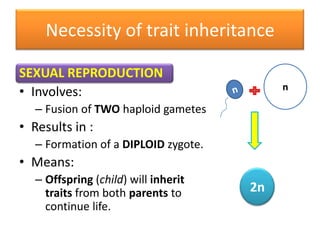
Necessity of trait inheritanceSEXUAL REPRODUCTIONInvolves:Fusion of TWO haploid gametesResults in :Formation of a DIPLOID zygote.Means:Offspring (child) will inherit traits from both parents to continue life.nn2n
The Significance of MEIOSISSexual reproduction leads to genetic variation among the offspring.Meiosis makes genetic variations possible in three ways:Cross-overReduction and fusion of gametesIndependent (random) assortment
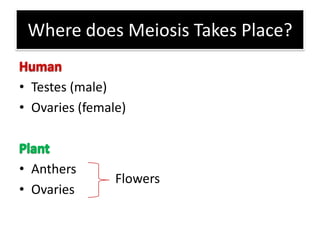
Where does Meiosis Takes Place?HumanTestes (male)Ovaries (female)PlantAnthers              Ovaries Flowers
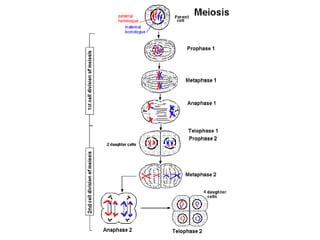
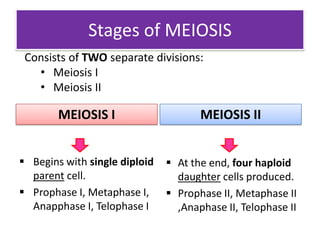
Stages of MEIOSISConsists of TWO separate divisions:   Meiosis I
   Meiosis II
Begins with single diploid parent cell.
Prophase I, Metaphase I, Anapphase I, Telophase I
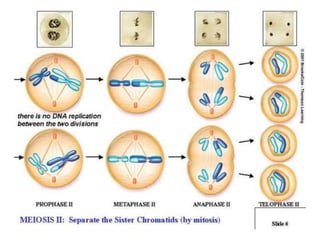
At the end, four haploid daughter cells produced.
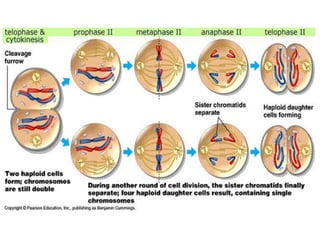
Prophase II, Metaphase II ,Anaphase II, Telophase IIMEIOSIS IMEIOSIS II
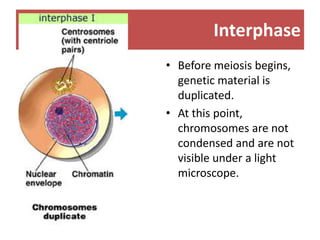
InterphaseBefore meiosis begins, genetic material is duplicated.At this point, chromosomes are not condensed and are not visible under a light microscope.
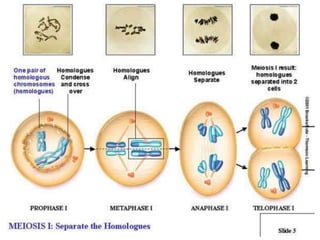
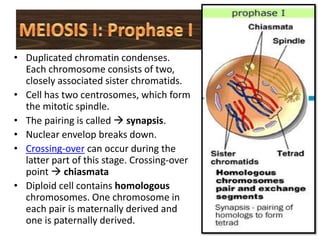
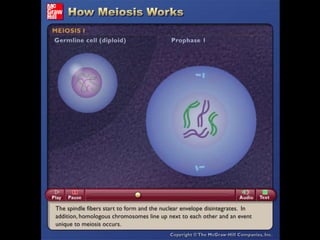
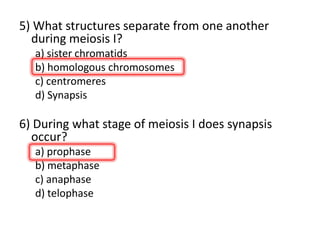
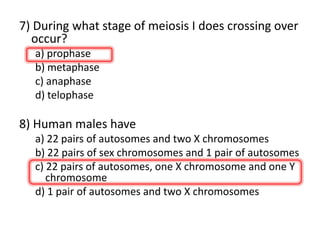
MEIOSIS I: Prophase I Duplicated chromatin condenses. Each chromosome consists of two, closely associated sister chromatids. Cell has two centrosomes, which form the mitotic spindle.The pairing is called  synapsis.Nuclear envelop breaks down.Crossing-over can occur during the latter part of this stage. Crossing-over point  chiasmataDiploid cell contains homologous chromosomes. One chromosome in each pair is maternally derived and one is paternally derived.
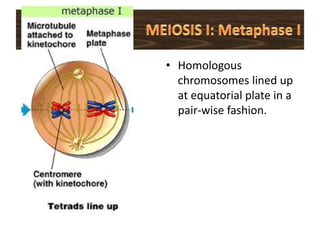
Homologous chromosomes lined up at equatorial plate in a pair-wise fashion.MEIOSIS I: Metaphase I
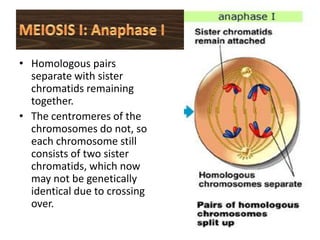
Homologous pairs separate with sister chromatids remaining together. The centromeres of the chromosomes do not, so each chromosome still consists of two sister chromatids, which now may not be genetically identical due to crossing over.MEIOSIS I: Anaphase I
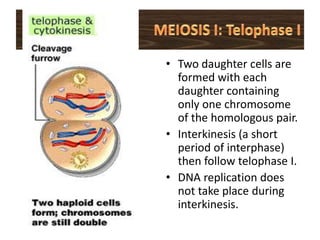
Two daughter cells are formed with each daughter containing only one chromosome of the homologous pair.Interkinesis (a short period of interphase) then follow telophase I.DNA replication does not take place during interkinesis. MEIOSIS I: Telophase I
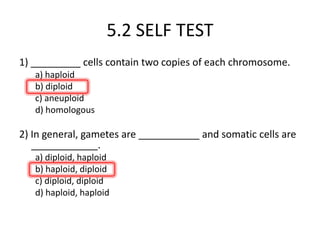
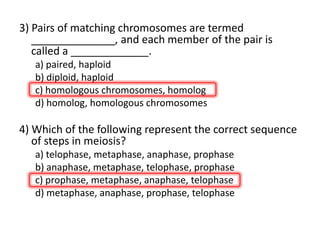
5.2 SELF TEST1) _________ cells contain two copies of each chromosome.a) haploidb) diploid c) aneuploidd) homologous 2) In general, gametes are ___________ and somatic cells are ____________. a) diploid, haploidb) haploid, diploidc) diploid, diploid d) haploid, haploid

5.2

  • 4.
  • 5.
    What is meiosis?Theprocess of nuclear division that reduces the number of chromosomes in new cells to half the number of chromosomes in parent cell. 2n (diploid) [parent cell] n (diploid) [new cell]
  • 6.
    Necessity of traitinheritanceSEXUAL REPRODUCTIONInvolves:Fusion of TWO haploid gametesResults in :Formation of a DIPLOID zygote.Means:Offspring (child) will inherit traits from both parents to continue life.nn2n
  • 7.
    The Significance ofMEIOSISSexual reproduction leads to genetic variation among the offspring.Meiosis makes genetic variations possible in three ways:Cross-overReduction and fusion of gametesIndependent (random) assortment
  • 8.
    Where does MeiosisTakes Place?HumanTestes (male)Ovaries (female)PlantAnthers Ovaries Flowers
  • 10.
    Stages of MEIOSISConsistsof TWO separate divisions: Meiosis I
  • 11.
    Meiosis II
  • 12.
    Begins with singlediploid parent cell.
  • 13.
    Prophase I, MetaphaseI, Anapphase I, Telophase I
  • 14.
    At the end,four haploid daughter cells produced.
  • 15.
    Prophase II, MetaphaseII ,Anaphase II, Telophase IIMEIOSIS IMEIOSIS II
  • 18.
    InterphaseBefore meiosis begins,genetic material is duplicated.At this point, chromosomes are not condensed and are not visible under a light microscope.
  • 19.
    MEIOSIS I: ProphaseI Duplicated chromatin condenses. Each chromosome consists of two, closely associated sister chromatids. Cell has two centrosomes, which form the mitotic spindle.The pairing is called  synapsis.Nuclear envelop breaks down.Crossing-over can occur during the latter part of this stage. Crossing-over point  chiasmataDiploid cell contains homologous chromosomes. One chromosome in each pair is maternally derived and one is paternally derived.
  • 20.
    Homologous chromosomes linedup at equatorial plate in a pair-wise fashion.MEIOSIS I: Metaphase I
  • 21.
    Homologous pairs separatewith sister chromatids remaining together. The centromeres of the chromosomes do not, so each chromosome still consists of two sister chromatids, which now may not be genetically identical due to crossing over.MEIOSIS I: Anaphase I
  • 22.
    Two daughter cellsare formed with each daughter containing only one chromosome of the homologous pair.Interkinesis (a short period of interphase) then follow telophase I.DNA replication does not take place during interkinesis. MEIOSIS I: Telophase I
  • 25.
    5.2 SELF TEST1)_________ cells contain two copies of each chromosome.a) haploidb) diploid c) aneuploidd) homologous 2) In general, gametes are ___________ and somatic cells are ____________. a) diploid, haploidb) haploid, diploidc) diploid, diploid d) haploid, haploid