SKELETAL
SYSTEM
01
A Spectrum of Support
03
A Framework for Movement
02
Table of contents
Types of Skeletons
The Axial and Appendicular
Skeleton
The Endoskeleton
04
05
Table of contents
Functions of the Skeletal
System
Adaptations and
Evolution
INTRODUCTION
The skeletal system serves as the
fundamental framework for all vertebrates,
providing support, structure, and protection
for the body. This presentation will delve into
the diverse ways animal skeletons are
designed to meet the unique needs of different
species. The skeletal system is the 'framework'
upon which the body is built – it provides
support, protection and enables the animal to
move. The joints are considered to be an
integral part of the skeleton. The skeletal
system is made of the specialized connective
tissues, bone and cartilage
What is the origin of
bones in animals?
Bones in animals originate from mesoderm-derived
mesenchymal cells and undergo a process involving three
stages: membranous period, cartilaginous period, and bony
period. The skeletal system, consisting of bones and cartilage,
plays a crucial role in providing structure, protecting organs,
allowing movement, storing minerals, producing blood cells,
and storing fats. The evolution of the skeletal system provides
insights into the classification and characteristics of different
animal groups. Before the establishment of the concept of
evolution, two types of bones were recognized in vertebrates
based on their embryonic development. Evolutionary processes,
as evidenced by the fossil record, show the transition from early
bony fish to modern ray-finned and lobe-finned fish, which
eventually led to species capable of moving out of the water.
Understanding the evolutionary developmental biology of
vertebrate skeletal tissues is essential for comprehending the
interconnectedness of somite and vertebral patterning and the
A Spectrum of Support
Types of Skeletons
Why is it
important?
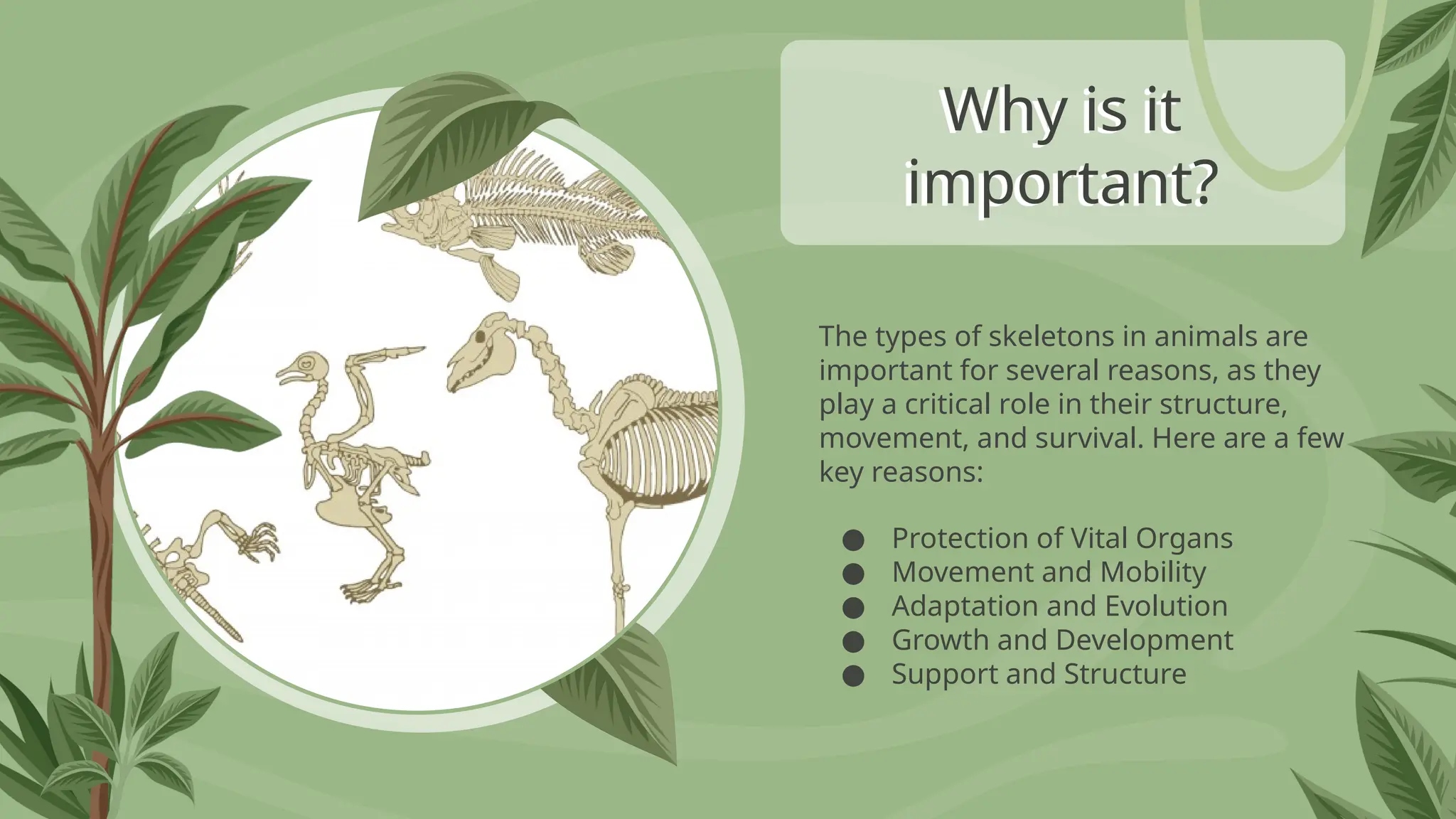
The types of skeletons in animals are
important for several reasons, as they
play a critical role in their structure,
movement, and survival. Here are a few
key reasons:
● Protection of Vital Organs
● Movement and Mobility
● Adaptation and Evolution
● Growth and Development
● Support and Structure
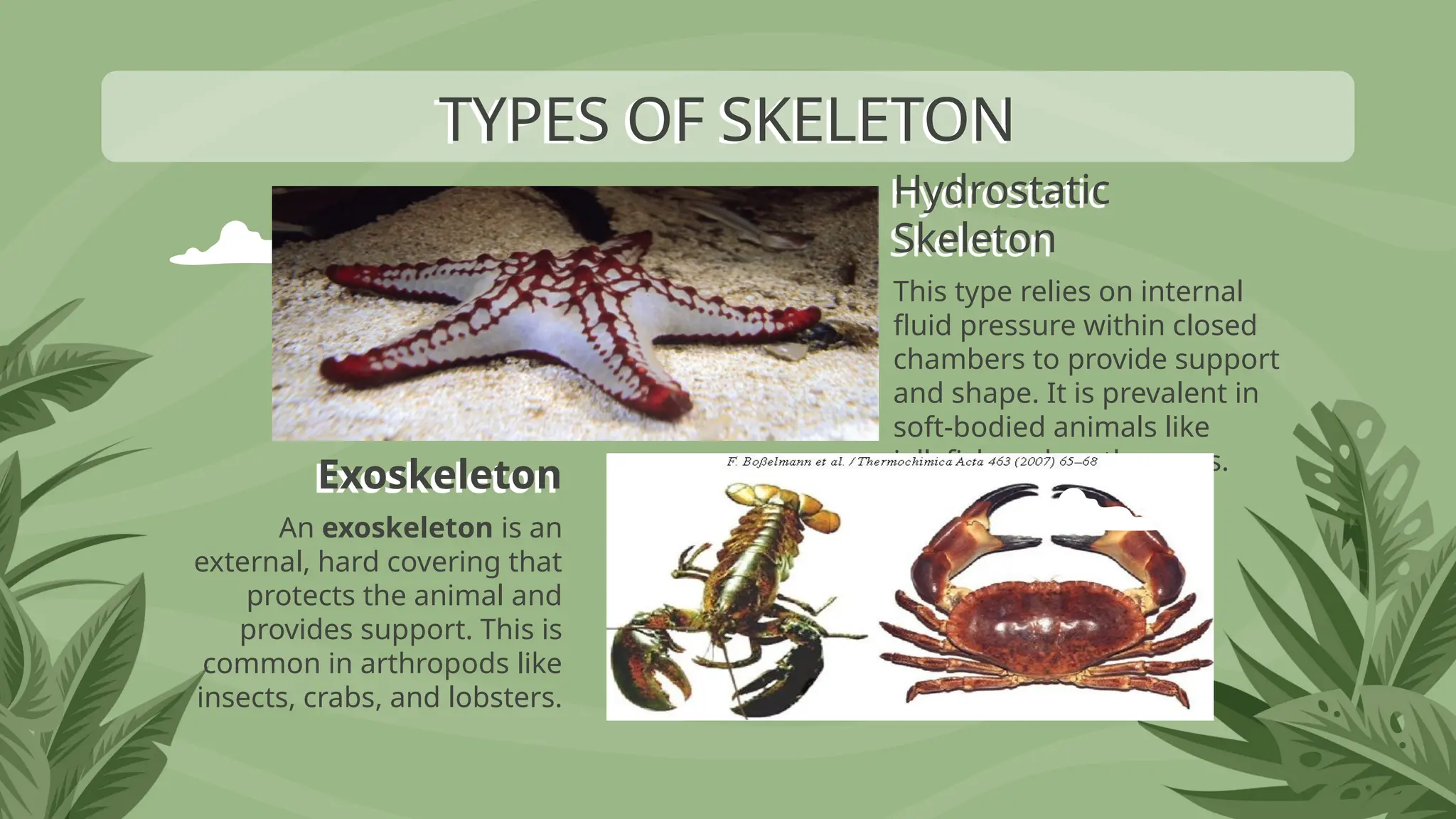
Exoskeleton
Hydrostatic
Skeleton
An exoskeleton is an
external, hard covering that
protects the animal and
provides support. This is
common in arthropods like
insects, crabs, and lobsters.
This type relies on internal
fluid pressure within closed
chambers to provide support
and shape. It is prevalent in
soft-bodied animals like
jellyfish and earthworms.
TYPES OF SKELETON
Endoskeleton
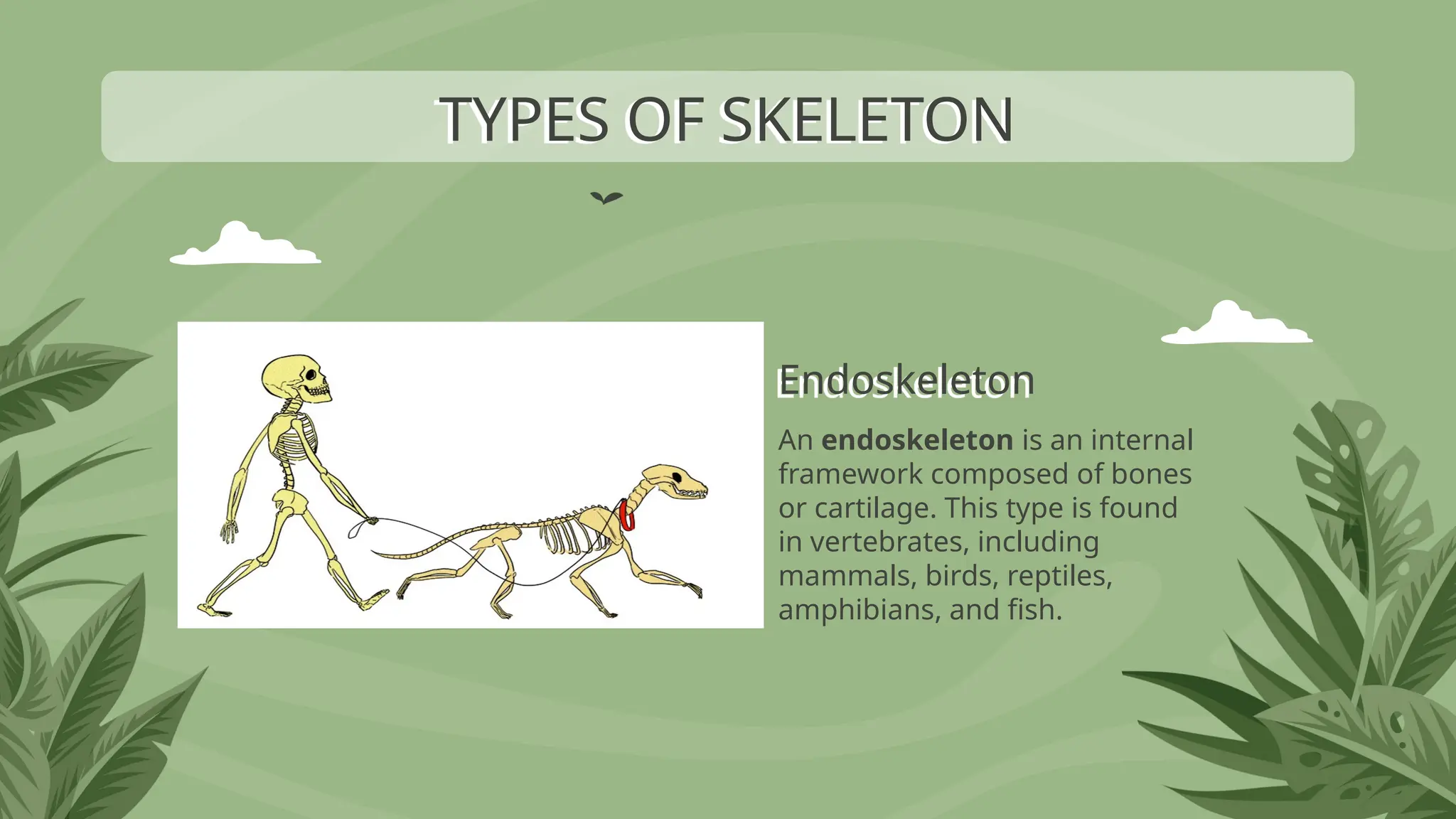
An endoskeleton is an internal
framework composed of bones
or cartilage. This type is found
in vertebrates, including
mammals, birds, reptiles,
amphibians, and fish.
TYPES OF SKELETON
BONES
These rigid structures
provide strength and
support, protecting vital
organs and serving as
attachment points for
muscles
A flexible connective
tissue found in joints,
ears, and nose, cartilage
provides cushioning and
reduces friction.
These strong, fibrous
tissues connect bones to
bones, stabilizing joints
and limiting their range
of motion.
These tough, fibrous
cords connect muscles
to bones, transmitting
force and enabling
movement.
ENDOSKELETON
LIGAMENTS
CARTILAGE
TENDONS
Appendicular
Skeleton
Axial Skeleton
This section comprises the
limbs (arms and legs) and
their connecting structures,
such as the shoulder and
pelvic girdles. It allows for
movement, locomotion, and
manipulation of the
environment..
This central core includes the
skull, vertebral column, ribs,
and sternum. It protects vital
organs and provides support
for the body.
The Axial and Appendicular Skeleton
Functions of the Skeletal System
The skeleton provides a
rigid framework that
supports the body and
protects vital organs.
Bones act as levers, and
muscles attached to
them generate force to
produce movement.
The process of blood cell
formation takes place in
the bone marrow,
producing red blood
cells, white blood cells,
and platelets.
Bones serve as a
reservoir for essential
minerals like calcium and
phosphorus, which can
be released into the
bloodstream as needed.
Support and
Protection Movement Hematopoiesis
Mineral Storage
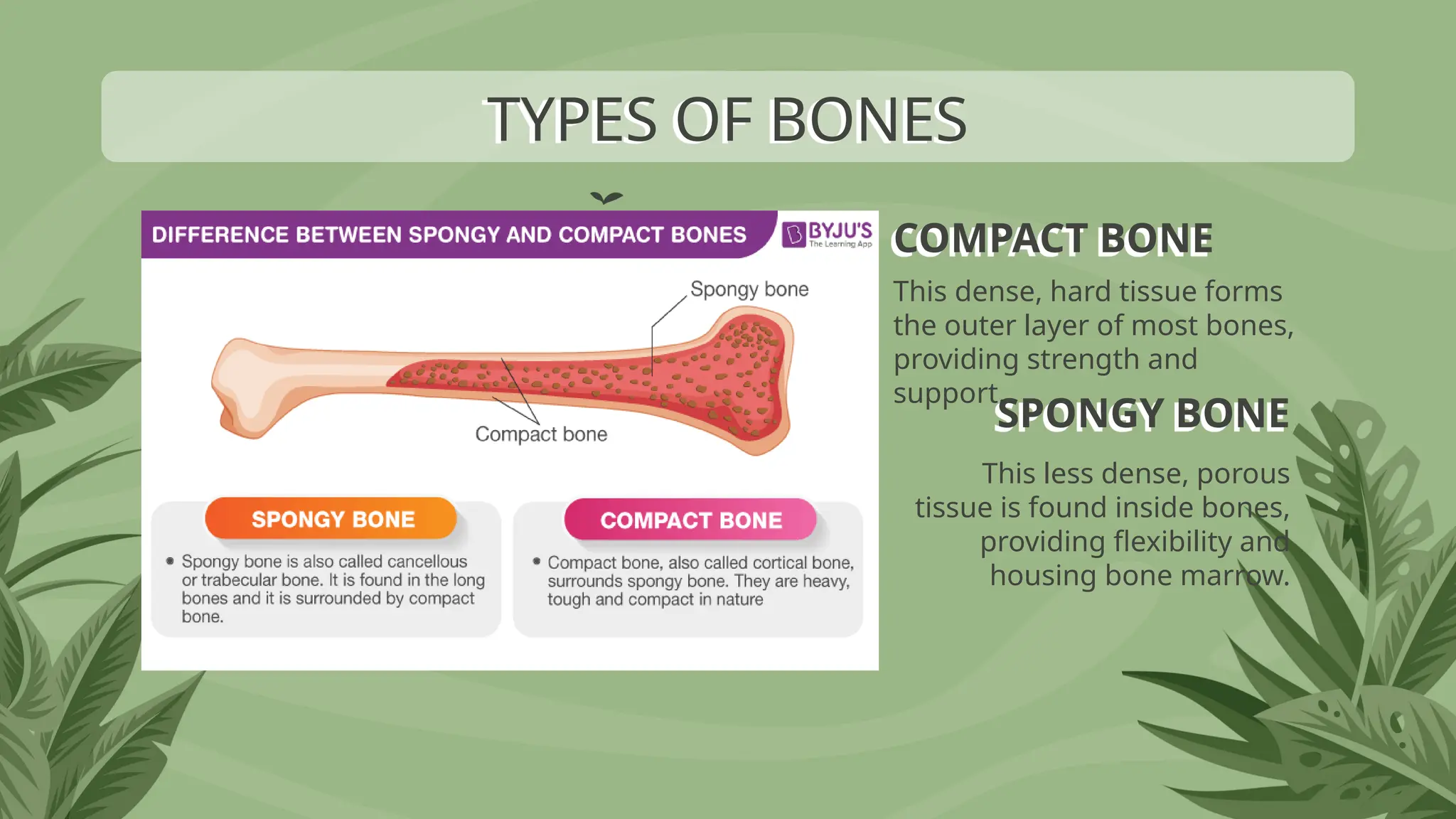
SPONGY BONE
COMPACT BONE
This dense, hard tissue forms
the outer layer of most bones,
providing strength and
support.
TYPES OF BONES
This less dense, porous
tissue is found inside bones,
providing flexibility and
housing bone marrow.
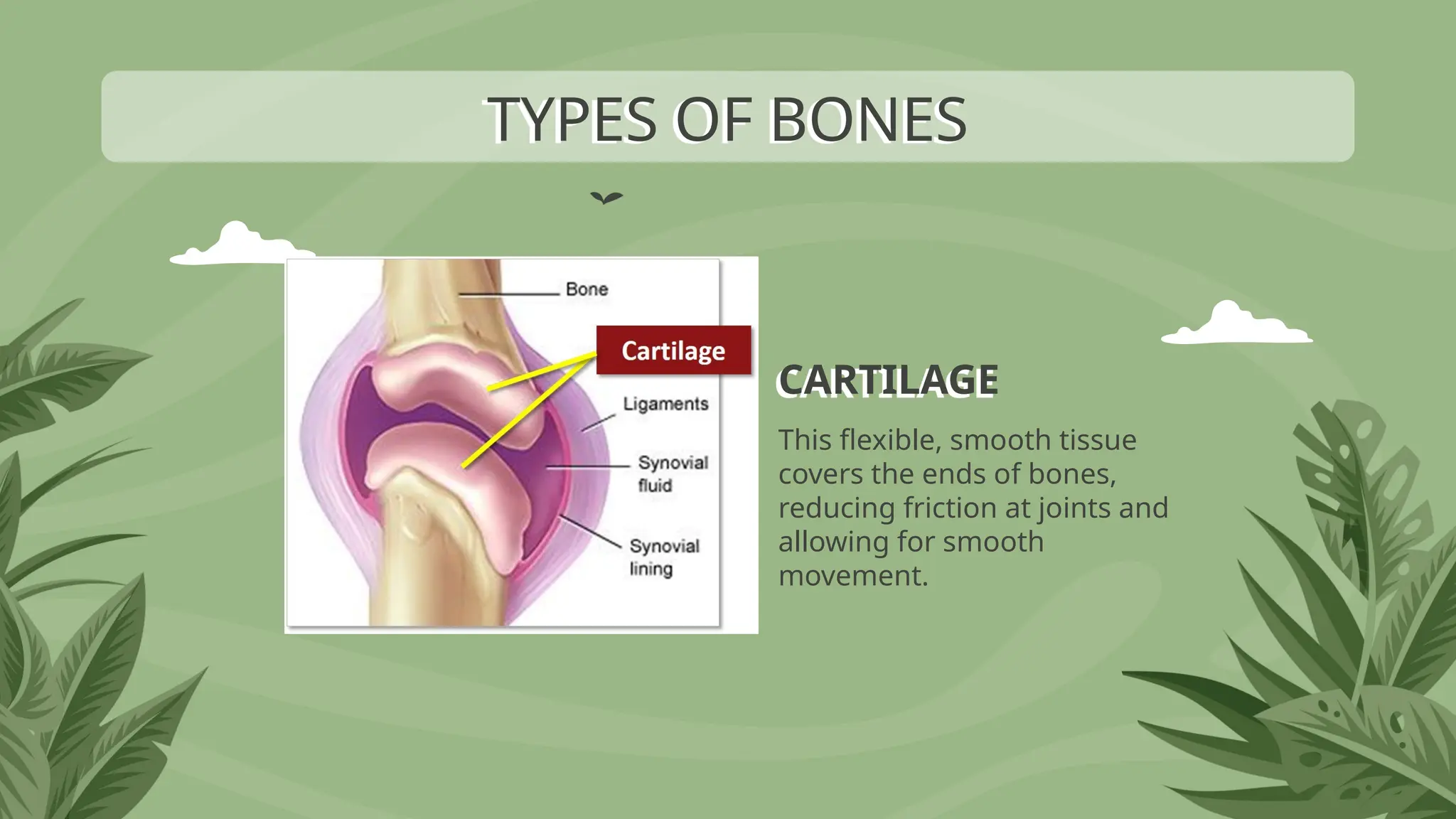
CARTILAGE
This flexible, smooth tissue
covers the ends of bones,
reducing friction at joints and
allowing for smooth
movement.
TYPES OF BONES
Cartilaginous
joints
Fibrous joints
These joints have limited
movement, with cartilage
connecting the bones. The hip
bone is an example.
These joints are immovable,
held together by strong
connective tissue. The skull
is an example of a fibrous
joint.
JOINTS
Synovial joints
These joints allow for free
movement, with a fluid-filled
cavity that reduces friction.
Synovial joints are further
categorized into five types.
JOINTS
• Ball-and-socket joints: These
joints allow for movement in
multiple planes, such as the
shoulder joint.
• Hinge joints: These joints allow
for movement in one plane, like
the knee or elbow.
• Gliding joints: These joints allow
for limited sliding movement, like
the wrist.
• Pivot joints: These joints allow for
rotation around a central axis, like
the head turning side to side.
• Compound joints: These joints
involve multiple bones and joints,
allowing for a variety of
movements, like nodding the
Adaptation
s and
Evolution
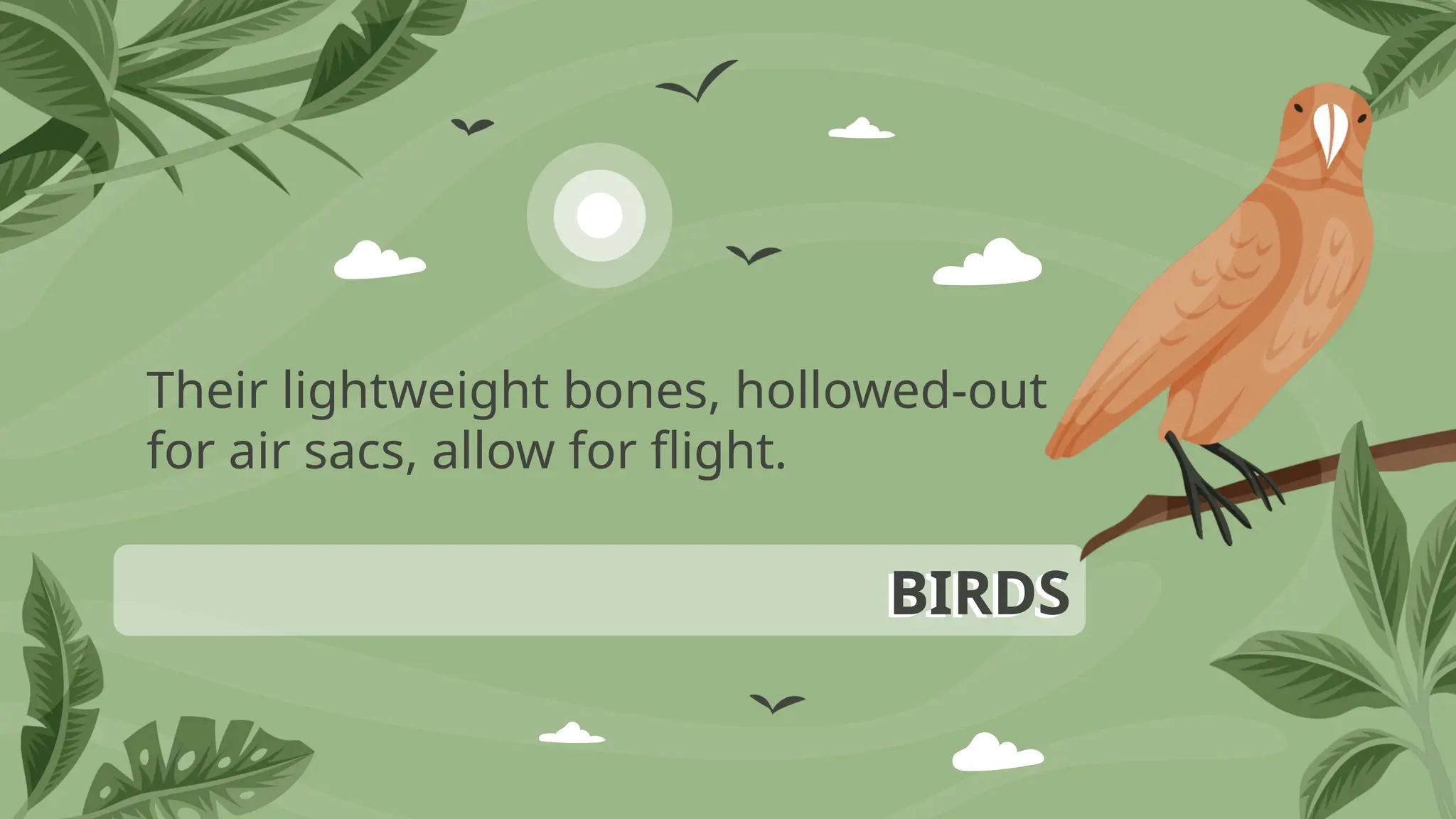
BIRDS
Their lightweight bones, hollowed-out
for air sacs, allow for flight.
Their streamlined skeletons,
often with flexible cartilage,
enable efficient swimming.
FISH
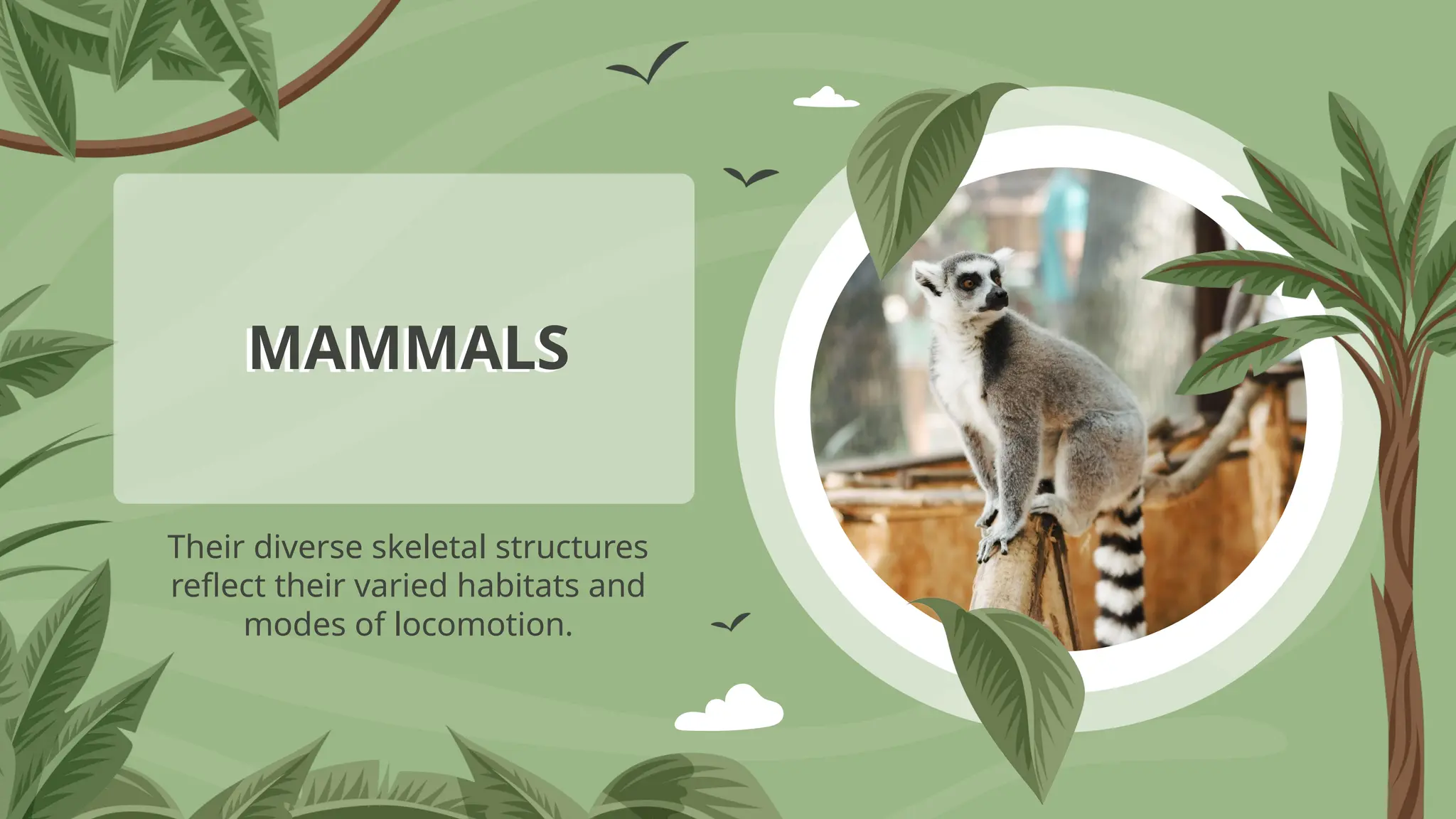
Their diverse skeletal structures
reflect their varied habitats and
modes of locomotion.
MAMMALS
WHY DO WE HAVE SKELETONS?
A skeleton protects our organs, such as our brain, heart
and lungs.
A skeleton keeps us upright.
A skeleton helps us to move.
Fun facts about
Skeletons
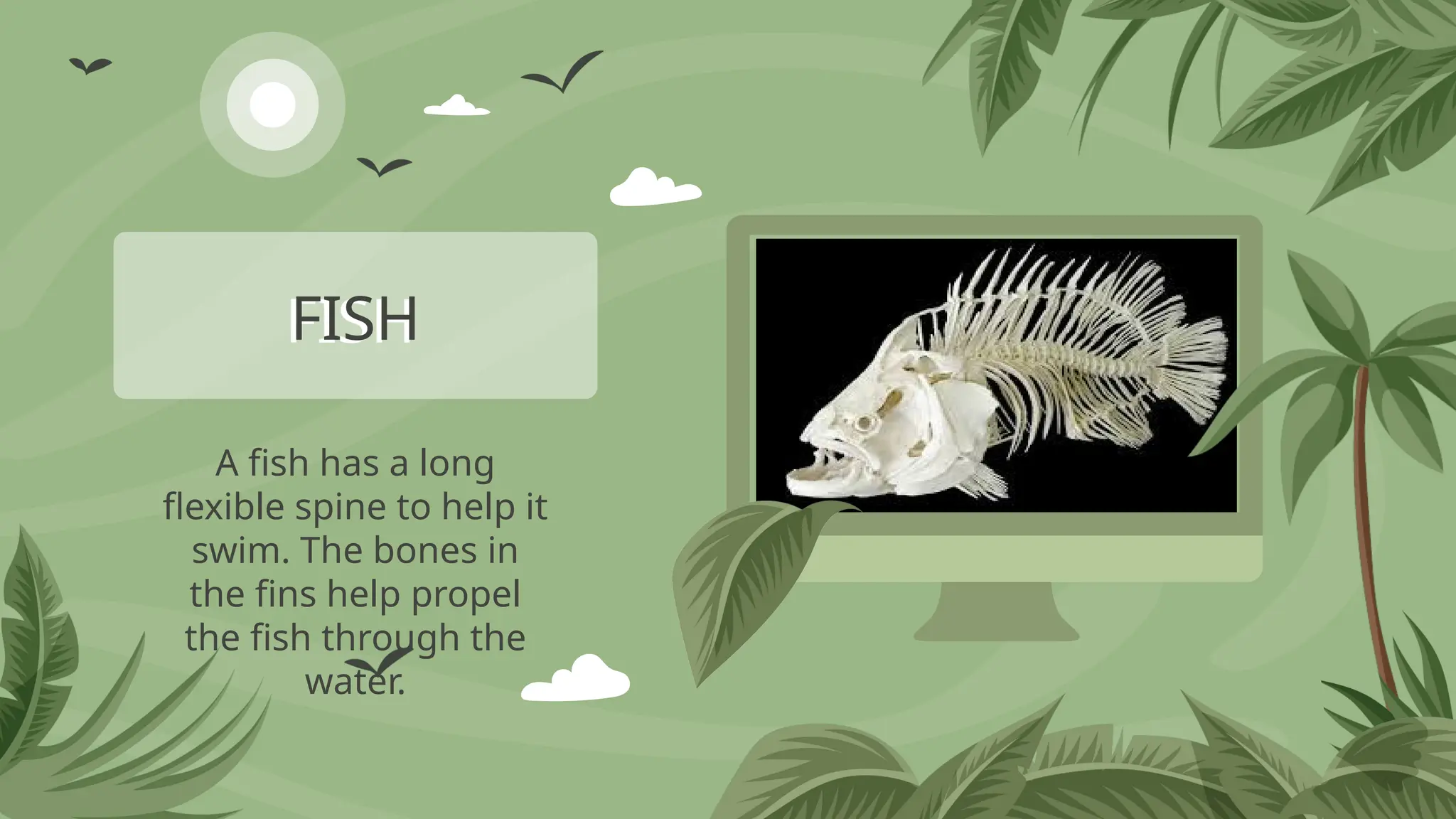
A fish has a long
flexible spine to help it
swim. The bones in
the fins help propel
the fish through the
water.
FISH
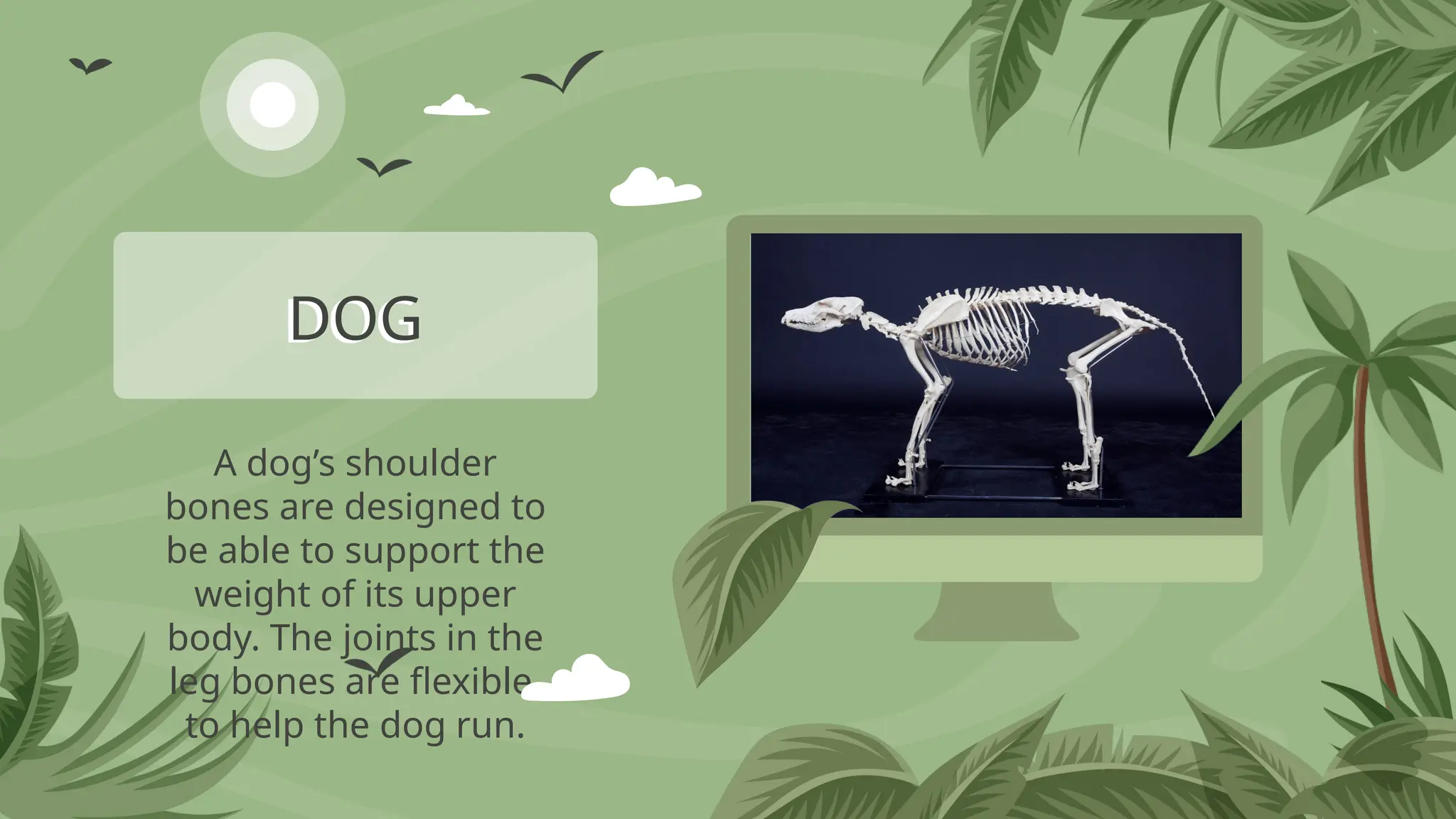
A dog’s shoulder
bones are designed to
be able to support the
weight of its upper
body. The joints in the
leg bones are flexible
to help the dog run.
DOG
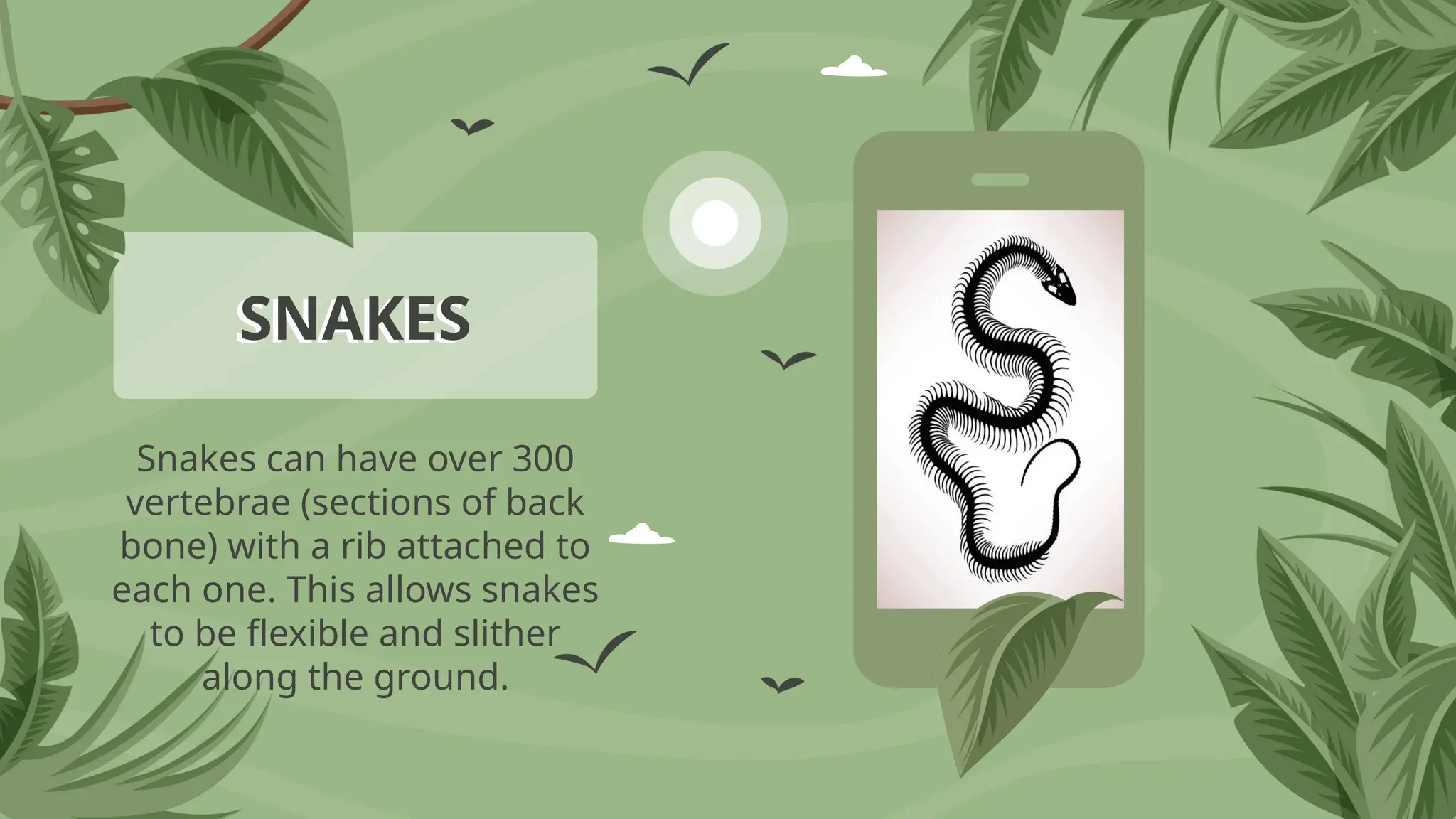
Snakes can have over 300
vertebrae (sections of back
bone) with a rib attached to
each one. This allows snakes
to be flexible and slither
along the ground.
SNAKES
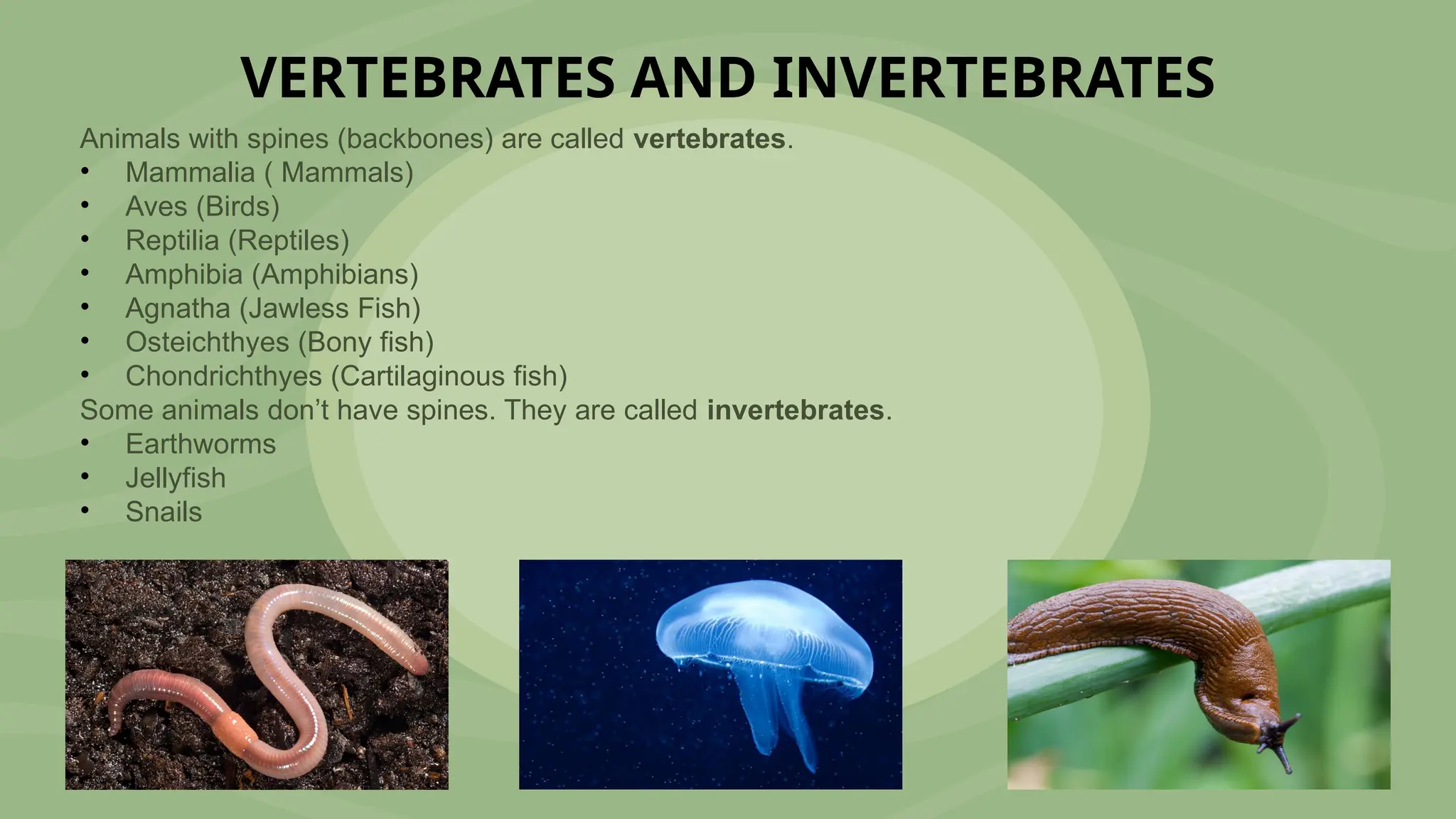
VERTEBRATES AND INVERTEBRATES
Animals with spines (backbones) are called vertebrates.
• Mammalia ( Mammals)
• Aves (Birds)
• Reptilia (Reptiles)
• Amphibia (Amphibians)
• Agnatha (Jawless Fish)
• Osteichthyes (Bony fish)
• Chondrichthyes (Cartilaginous fish)
Some animals don’t have spines. They are called invertebrates.
• Earthworms
• Jellyfish
• Snails
THANK YOU!

Skeletal-System-Group 3 yahay kaaayo haa

  • 1.
  • 2.
    01 A Spectrum ofSupport 03 A Framework for Movement 02 Table of contents Types of Skeletons The Axial and Appendicular Skeleton The Endoskeleton
  • 3.
    04 05 Table of contents Functionsof the Skeletal System Adaptations and Evolution
  • 4.
    INTRODUCTION The skeletal systemserves as the fundamental framework for all vertebrates, providing support, structure, and protection for the body. This presentation will delve into the diverse ways animal skeletons are designed to meet the unique needs of different species. The skeletal system is the 'framework' upon which the body is built – it provides support, protection and enables the animal to move. The joints are considered to be an integral part of the skeleton. The skeletal system is made of the specialized connective tissues, bone and cartilage
  • 5.
    What is theorigin of bones in animals? Bones in animals originate from mesoderm-derived mesenchymal cells and undergo a process involving three stages: membranous period, cartilaginous period, and bony period. The skeletal system, consisting of bones and cartilage, plays a crucial role in providing structure, protecting organs, allowing movement, storing minerals, producing blood cells, and storing fats. The evolution of the skeletal system provides insights into the classification and characteristics of different animal groups. Before the establishment of the concept of evolution, two types of bones were recognized in vertebrates based on their embryonic development. Evolutionary processes, as evidenced by the fossil record, show the transition from early bony fish to modern ray-finned and lobe-finned fish, which eventually led to species capable of moving out of the water. Understanding the evolutionary developmental biology of vertebrate skeletal tissues is essential for comprehending the interconnectedness of somite and vertebral patterning and the
  • 6.
    A Spectrum ofSupport Types of Skeletons
  • 7.
    Why is it important? Thetypes of skeletons in animals are important for several reasons, as they play a critical role in their structure, movement, and survival. Here are a few key reasons: ● Protection of Vital Organs ● Movement and Mobility ● Adaptation and Evolution ● Growth and Development ● Support and Structure
  • 8.
    Exoskeleton Hydrostatic Skeleton An exoskeleton isan external, hard covering that protects the animal and provides support. This is common in arthropods like insects, crabs, and lobsters. This type relies on internal fluid pressure within closed chambers to provide support and shape. It is prevalent in soft-bodied animals like jellyfish and earthworms. TYPES OF SKELETON
  • 9.
    Endoskeleton An endoskeleton isan internal framework composed of bones or cartilage. This type is found in vertebrates, including mammals, birds, reptiles, amphibians, and fish. TYPES OF SKELETON
  • 10.
    BONES These rigid structures providestrength and support, protecting vital organs and serving as attachment points for muscles A flexible connective tissue found in joints, ears, and nose, cartilage provides cushioning and reduces friction. These strong, fibrous tissues connect bones to bones, stabilizing joints and limiting their range of motion. These tough, fibrous cords connect muscles to bones, transmitting force and enabling movement. ENDOSKELETON LIGAMENTS CARTILAGE TENDONS
  • 11.
    Appendicular Skeleton Axial Skeleton This sectioncomprises the limbs (arms and legs) and their connecting structures, such as the shoulder and pelvic girdles. It allows for movement, locomotion, and manipulation of the environment.. This central core includes the skull, vertebral column, ribs, and sternum. It protects vital organs and provides support for the body. The Axial and Appendicular Skeleton
  • 12.
    Functions of theSkeletal System The skeleton provides a rigid framework that supports the body and protects vital organs. Bones act as levers, and muscles attached to them generate force to produce movement. The process of blood cell formation takes place in the bone marrow, producing red blood cells, white blood cells, and platelets. Bones serve as a reservoir for essential minerals like calcium and phosphorus, which can be released into the bloodstream as needed. Support and Protection Movement Hematopoiesis Mineral Storage
  • 13.
    SPONGY BONE COMPACT BONE Thisdense, hard tissue forms the outer layer of most bones, providing strength and support. TYPES OF BONES This less dense, porous tissue is found inside bones, providing flexibility and housing bone marrow.
  • 14.
    CARTILAGE This flexible, smoothtissue covers the ends of bones, reducing friction at joints and allowing for smooth movement. TYPES OF BONES
  • 15.
    Cartilaginous joints Fibrous joints These jointshave limited movement, with cartilage connecting the bones. The hip bone is an example. These joints are immovable, held together by strong connective tissue. The skull is an example of a fibrous joint. JOINTS
  • 16.
    Synovial joints These jointsallow for free movement, with a fluid-filled cavity that reduces friction. Synovial joints are further categorized into five types. JOINTS • Ball-and-socket joints: These joints allow for movement in multiple planes, such as the shoulder joint. • Hinge joints: These joints allow for movement in one plane, like the knee or elbow. • Gliding joints: These joints allow for limited sliding movement, like the wrist. • Pivot joints: These joints allow for rotation around a central axis, like the head turning side to side. • Compound joints: These joints involve multiple bones and joints, allowing for a variety of movements, like nodding the
  • 17.
  • 18.
    BIRDS Their lightweight bones,hollowed-out for air sacs, allow for flight.
  • 19.
    Their streamlined skeletons, oftenwith flexible cartilage, enable efficient swimming. FISH
  • 20.
    Their diverse skeletalstructures reflect their varied habitats and modes of locomotion. MAMMALS
  • 21.
    WHY DO WEHAVE SKELETONS? A skeleton protects our organs, such as our brain, heart and lungs. A skeleton keeps us upright. A skeleton helps us to move.
  • 22.
  • 23.
    A fish hasa long flexible spine to help it swim. The bones in the fins help propel the fish through the water. FISH
  • 24.
    A dog’s shoulder bonesare designed to be able to support the weight of its upper body. The joints in the leg bones are flexible to help the dog run. DOG
  • 25.
    Snakes can haveover 300 vertebrae (sections of back bone) with a rib attached to each one. This allows snakes to be flexible and slither along the ground. SNAKES
  • 26.
    VERTEBRATES AND INVERTEBRATES Animalswith spines (backbones) are called vertebrates. • Mammalia ( Mammals) • Aves (Birds) • Reptilia (Reptiles) • Amphibia (Amphibians) • Agnatha (Jawless Fish) • Osteichthyes (Bony fish) • Chondrichthyes (Cartilaginous fish) Some animals don’t have spines. They are called invertebrates. • Earthworms • Jellyfish • Snails
  • 27.