Dr. Andrés Gómez
Andres.gomez.tato@cesga.es
Jan. 2020
Quantum Computing
Lecture 2
 QPU
 Topologies of QPU
 Programming
 Simulators.
 Introduction to ProjectQ
 My first program with ProjectQ .
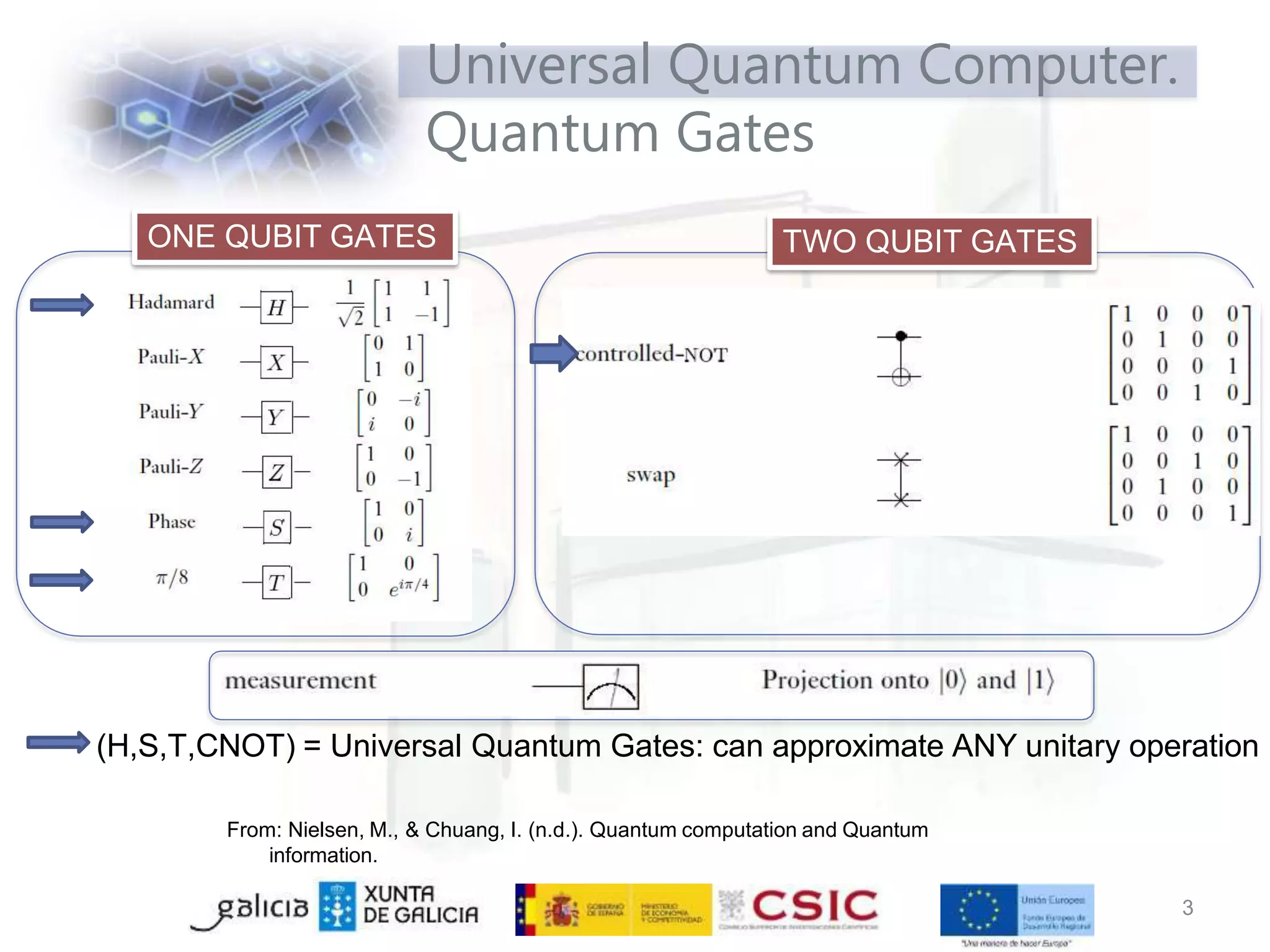
Universal Quantum Computer.
Quantum Gates
From: Nielsen, M., & Chuang, I. (n.d.). Quantum computation and Quantum
information.
ONE QUBIT GATES TWO QUBIT GATES
(H,S,T,CNOT) = Universal Quantum Gates: can approximate ANY unitary operation
3
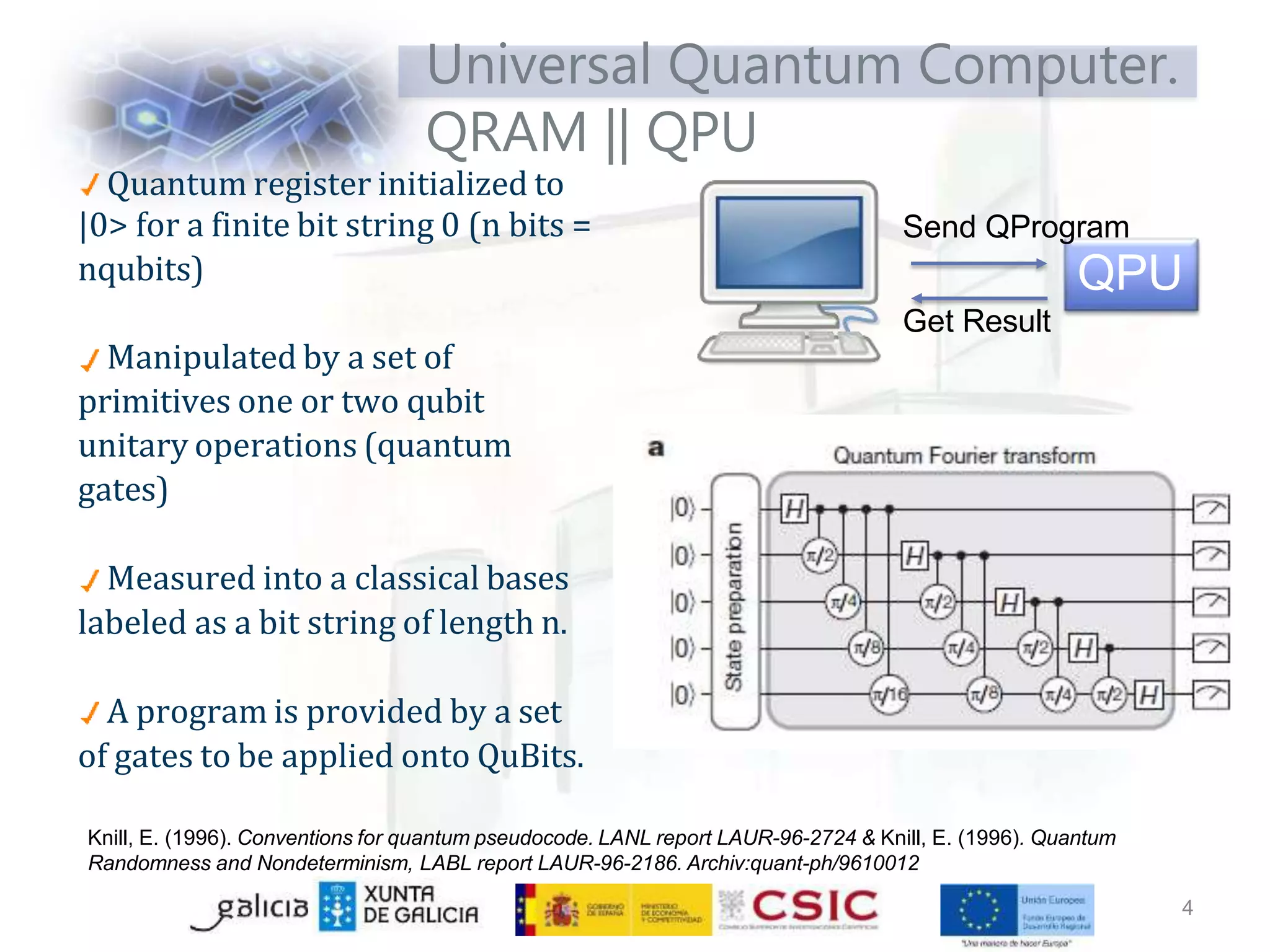
Quantum register initialized to
|0> for a finite bit string 0 (n bits =
nqubits)
Manipulated by a set of
primitives one or two qubit
unitary operations (quantum
gates)
Measured into a classical bases
labeled as a bit string of length n.
A program is provided by a set
of gates to be applied onto QuBits.
Universal Quantum Computer.
QRAM || QPU
Send QProgram
QPU
Get Result
Knill, E. (1996). Conventions for quantum pseudocode. LANL report LAUR-96-2724 & Knill, E. (1996). Quantum
Randomness and Nondeterminism, LABL report LAUR-96-2186. Archiv:quant-ph/9610012
4
Ion Trap (I)
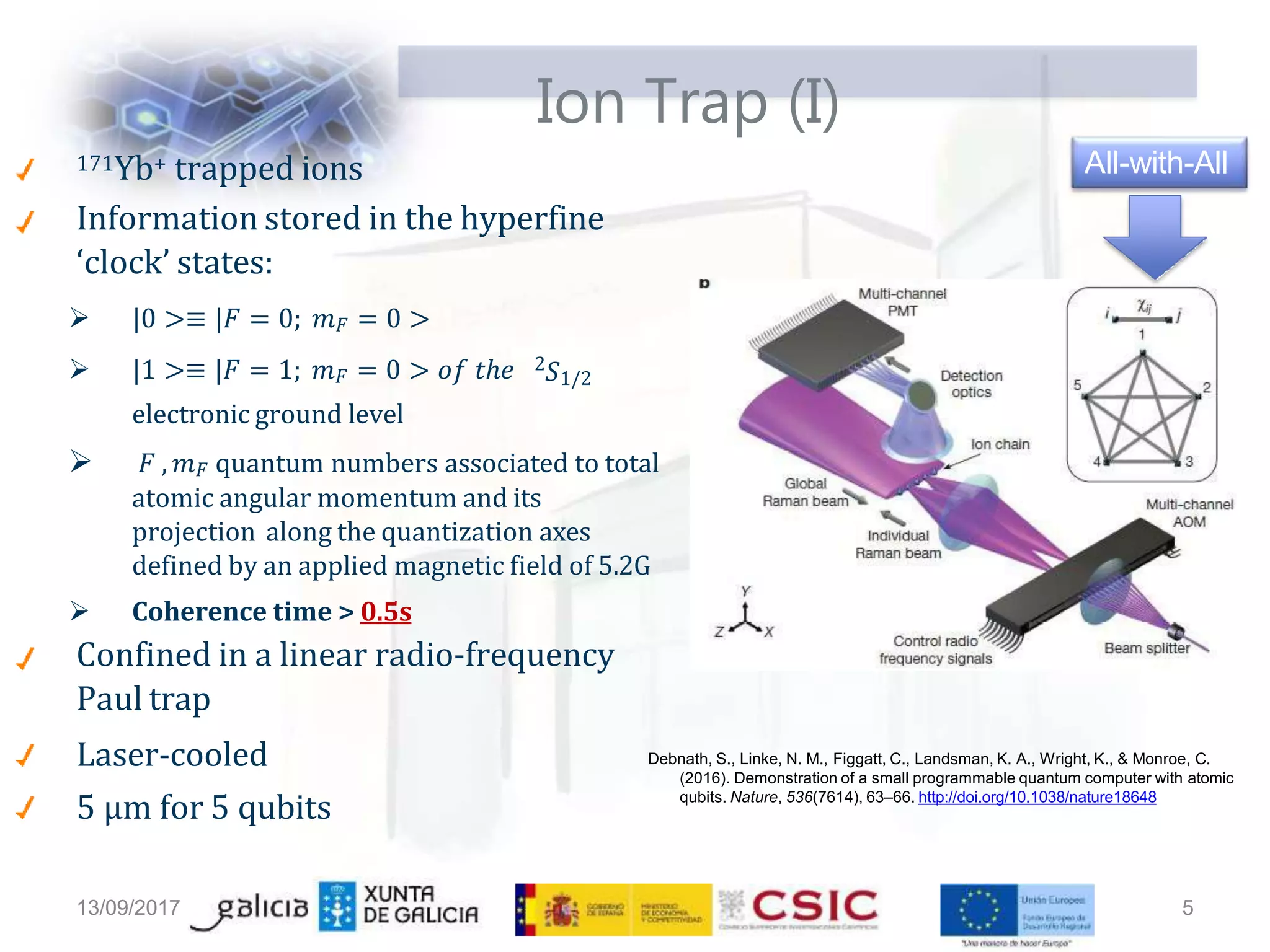
171Yb+ trapped ions
Information stored in the hyperfine
‘clock’ states:
2
𝑆1/2
 |0 >≡ |𝐹 = 0; 𝑚𝐹 = 0 >
 |1 >≡ |𝐹 = 1; 𝑚𝐹 = 0 > 𝑜𝑓 𝑡ℎ𝑒
electronic ground level
 𝐹 , 𝑚𝐹 quantum numbers associated to total
atomic angular momentum and its
projection along the quantization axes
defined by an applied magnetic field of 5.2G
 Coherence time > 0.5s
Confined in a linear radio-frequency
Paul trap
Laser-cooled
5 µm for 5 qubits
Debnath, S., Linke, N. M., Figgatt, C., Landsman, K. A., Wright, K., & Monroe, C.
(2016). Demonstration of a small programmable quantum computer with atomic
qubits. Nature, 536(7614), 63–66. http://doi.org/10.1038/nature18648
13/09/2017 5
All-with-All
Ion Trap (II): Universal Gates
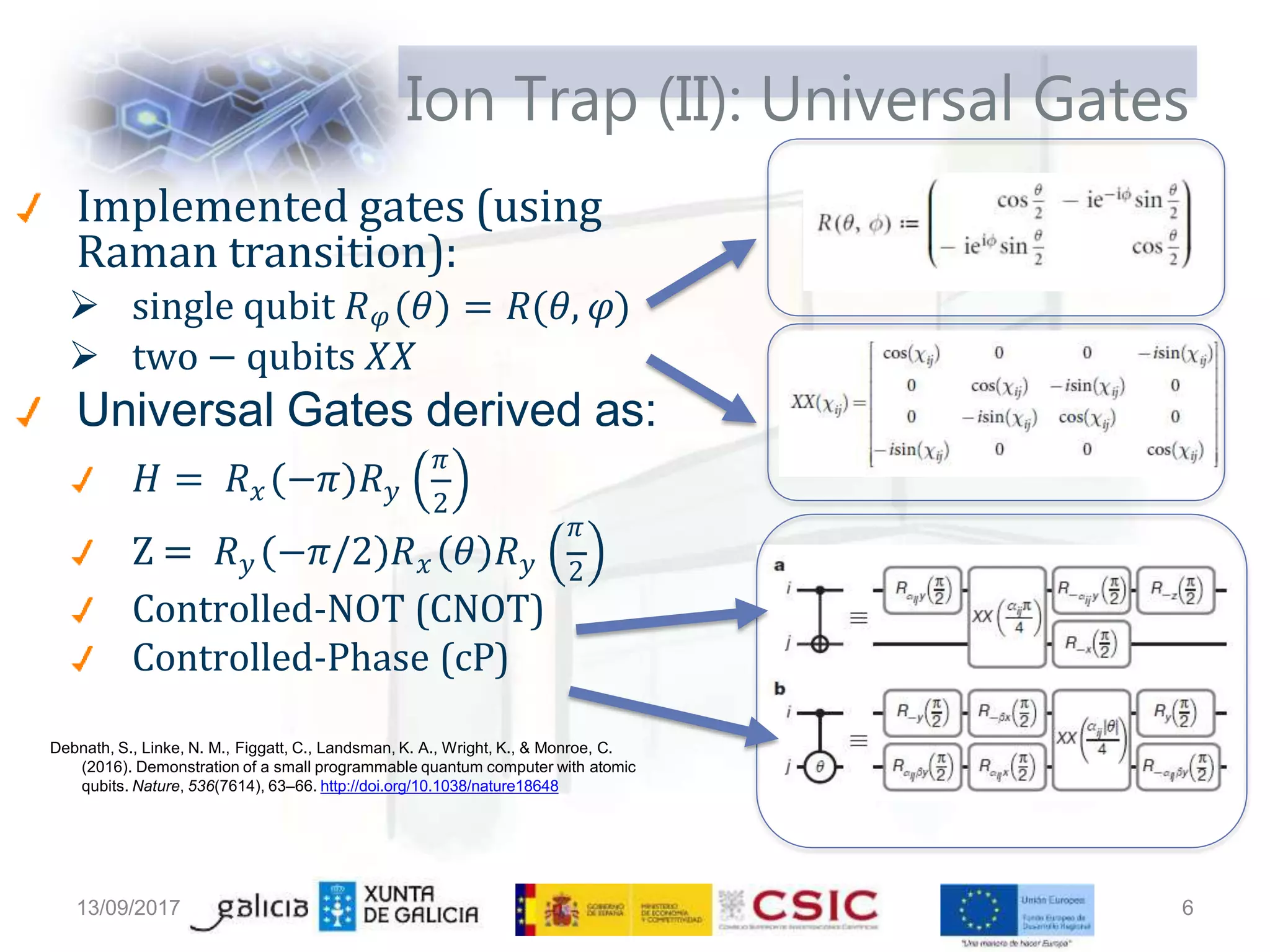
Implemented gates (using
Raman transition):
 single qubit 𝑅𝜑 𝜃 = 𝑅(𝜃, 𝜑)
 two − qubits 𝑋𝑋
𝐻 = 𝑅 −𝜋 𝑅
𝑥 𝑦
Universal Gates derived as:
𝜋
2
Z = 𝑅 −𝜋/2 𝑅 𝜃 𝑅
𝑦 𝑥 𝑦
𝜋
2
Controlled-NOT (CNOT)
Controlled-Phase (cP)
Debnath, S., Linke, N. M., Figgatt, C., Landsman, K. A., Wright, K., & Monroe, C.
(2016). Demonstration of a small programmable quantum computer with atomic
qubits. Nature, 536(7614), 63–66. http://doi.org/10.1038/nature18648
13/09/2017 6
Ion Trap (III): QFT(5)
State preparation (single qubits rotations)
Total gates[1]:
 5 H = 10 R
 10 CP = 10 (6R + 1 X)
 Total = 80 gates
Optimised Version [2]:
 22 single-qubit gates
 10 two-qubits gates
 Total: 32 gates
 Time: 2669 µs
1 Debnath, S., Linke, N. M., Figgatt, C., Landsman, K. A., Wright, K., & Monroe, C.
(2016). Demonstration of a small programmable quantum computer with atomic
qubits. Nature, 536(7614), 63–66. http://doi.org/10.1038/nature18648
2 Maslov, D. (2017). Basic circuit compilation techniques for an ion-trap quantum
machine. New Journal of Physics, 19(2), 23035. http://doi.org/10.1088/1367-
2630/aa5e47
QFT Ideal Gates: 15
13/09/2017 7
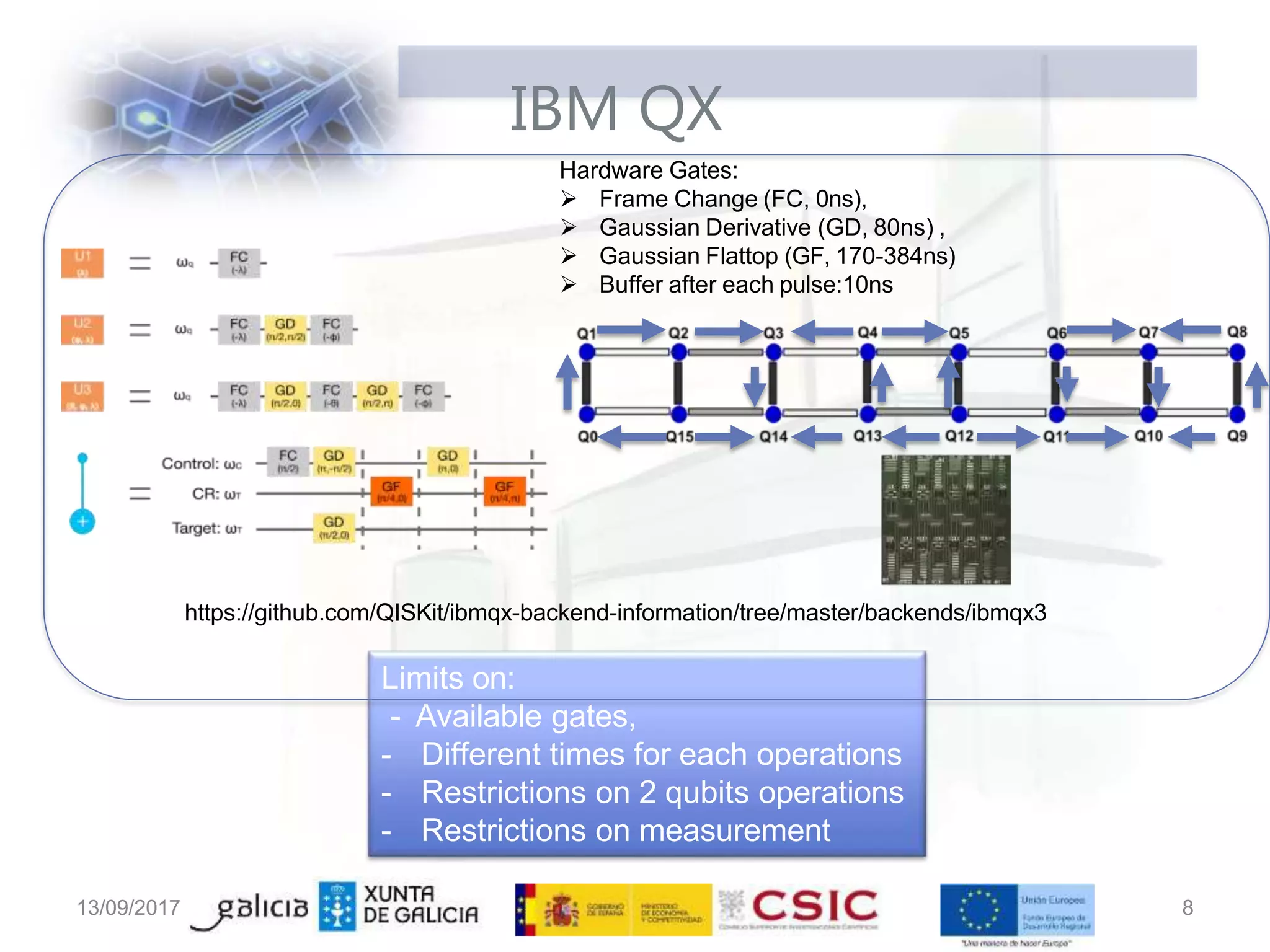
IBM QX
Hardware Gates:
 Frame Change (FC, 0ns),
 Gaussian Derivative (GD, 80ns) ,
 Gaussian Flattop (GF, 170-384ns)
 Buffer after each pulse:10ns
https://github.com/QISKit/ibmqx-backend-information/tree/master/backends/ibmqx3
Limits on:
- Available gates,
- Different times for each operations
- Restrictions on 2 qubits operations
- Restrictions on measurement
13/09/2017 8
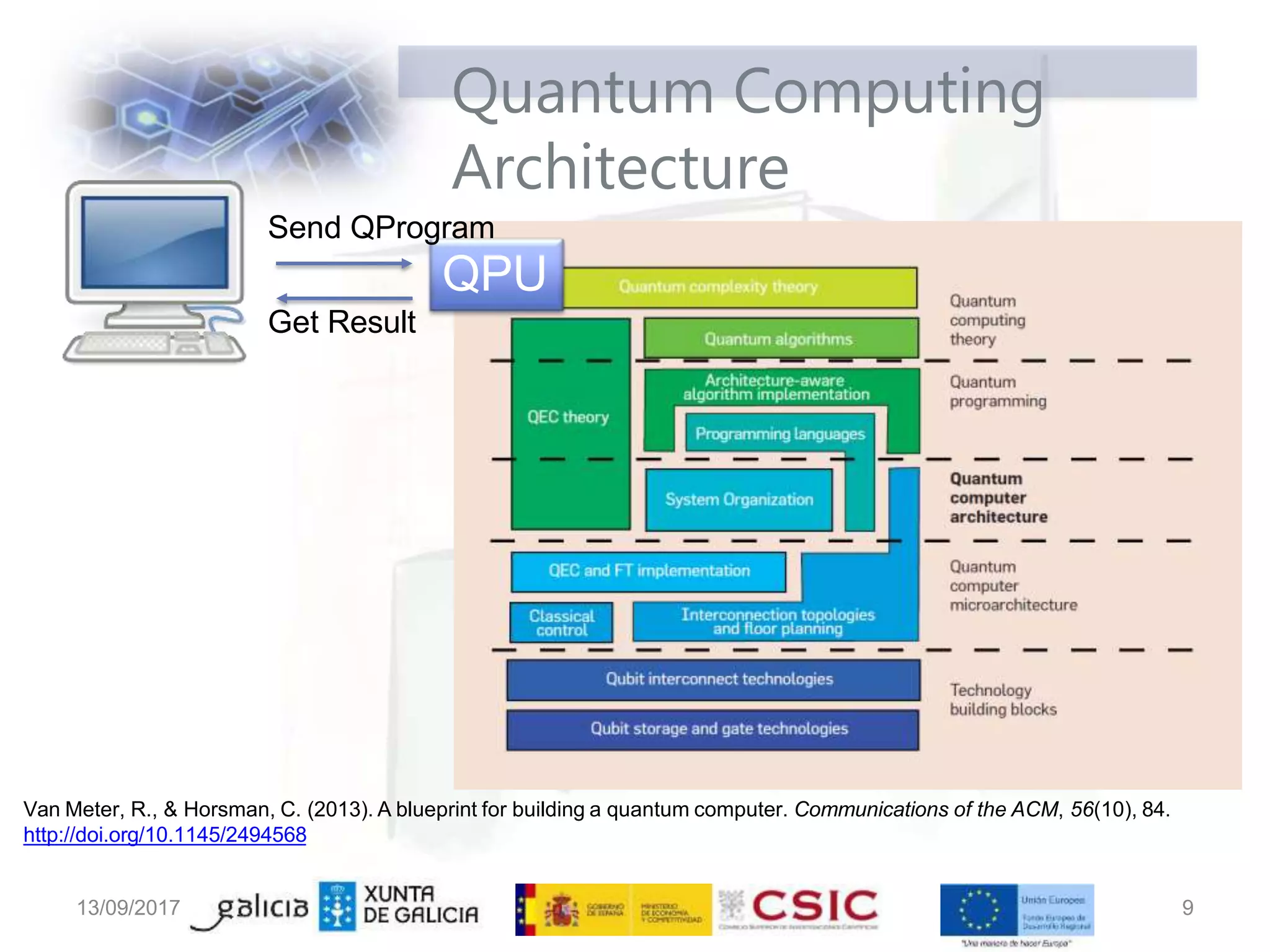
Quantum Computing
Architecture
Send QProgram
QPU
Get Result
13/09/2017 9
Van Meter, R., & Horsman, C. (2013). A blueprint for building a quantum computer. Communications of the ACM, 56(10), 84.
http://doi.org/10.1145/2494568
10
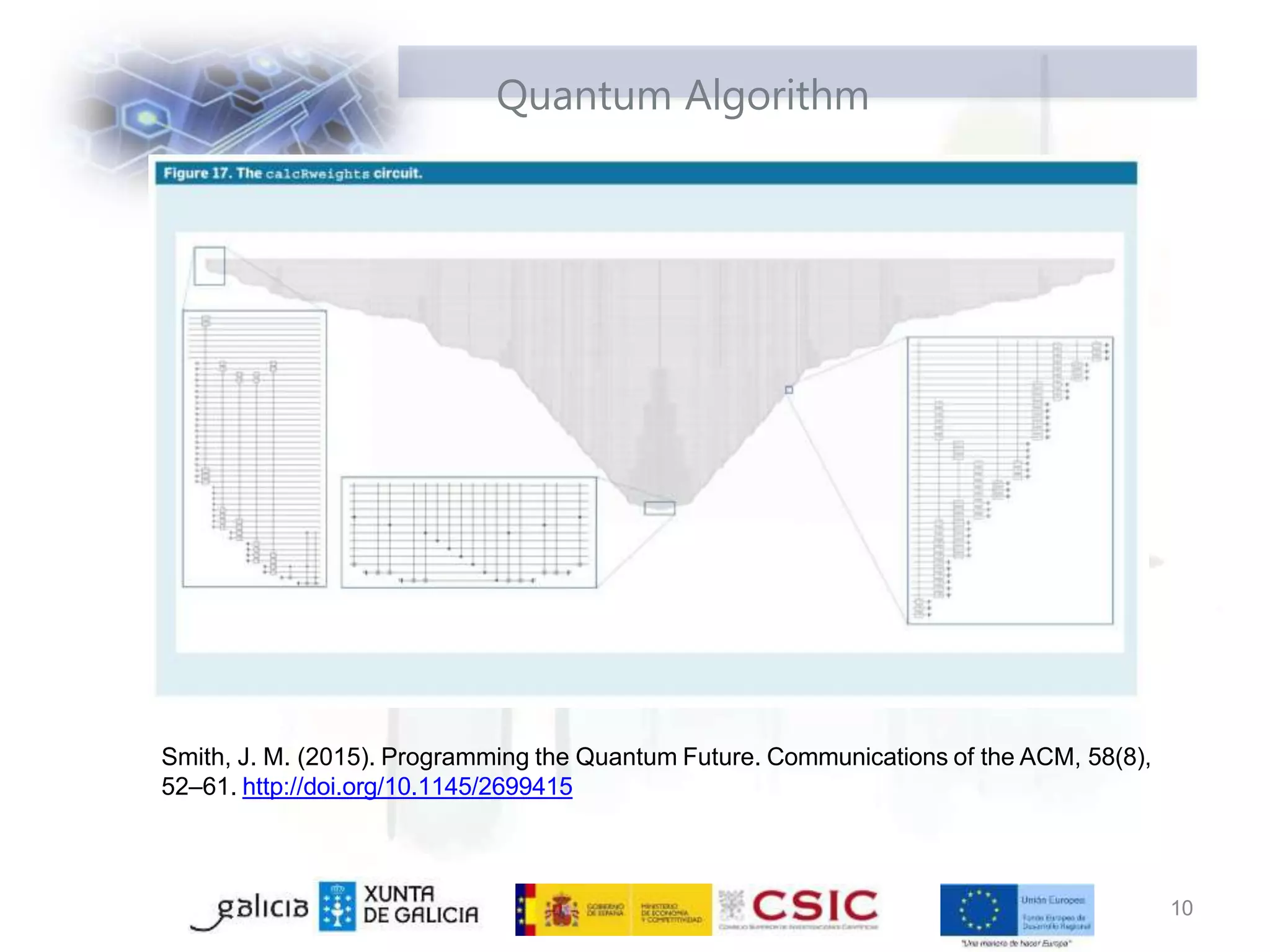
Smith, J. M. (2015). Programming the Quantum Future. Communications of the ACM, 58(8),
52–61. http://doi.org/10.1145/2699415
Quantum Algorithm
Quantum Algorithm
A sequence of gates applied on a set of
qubits
Some well-known techniques:
 Amplify amplitude (Grover’s)
 Estimate phase
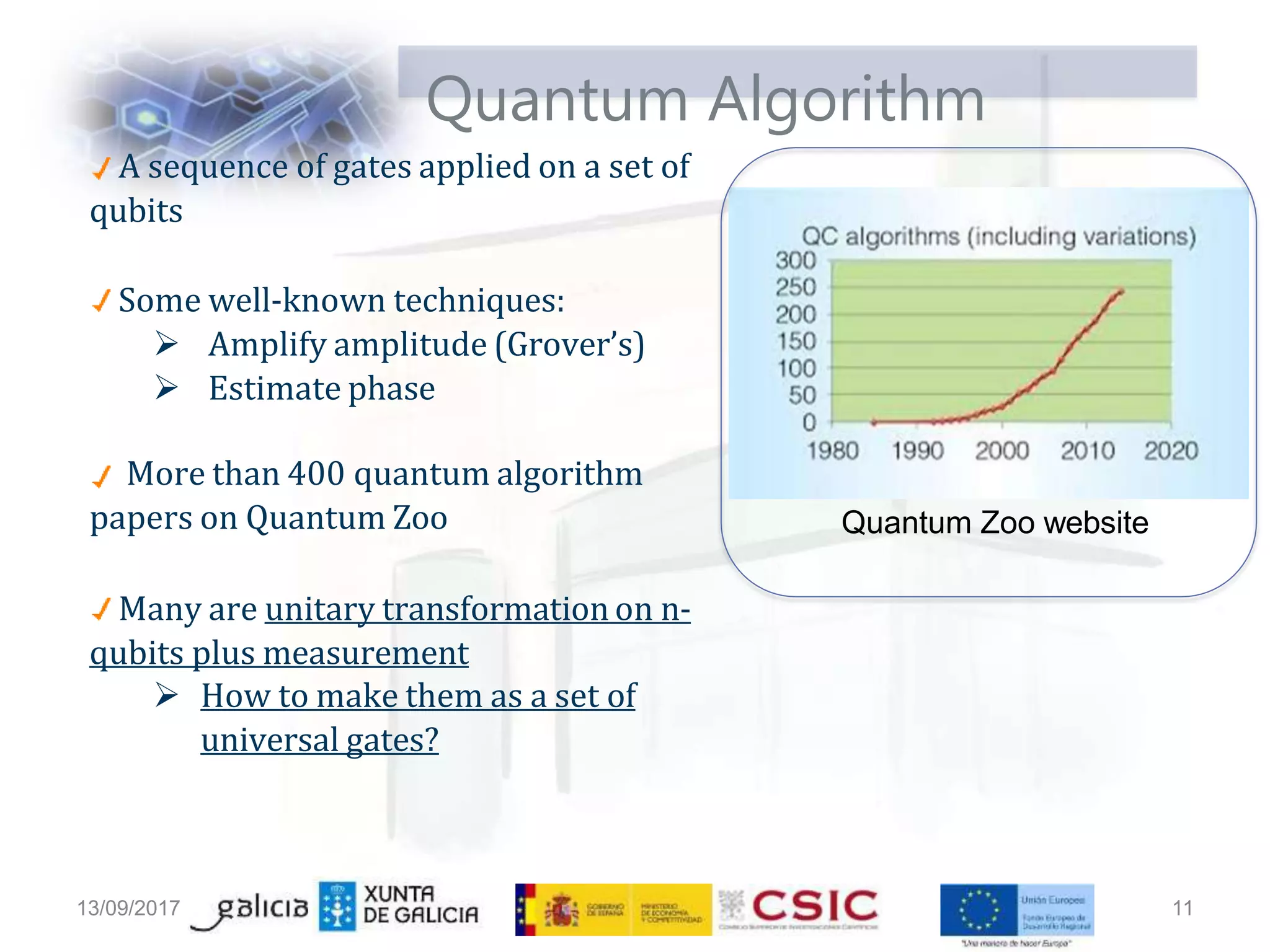
More than 400 quantum algorithm
papers on Quantum Zoo
Many are unitary transformation on n-
qubits plus measurement
 How to make them as a set of
universal gates?
Quantum Zoo website
13/09/2017 11
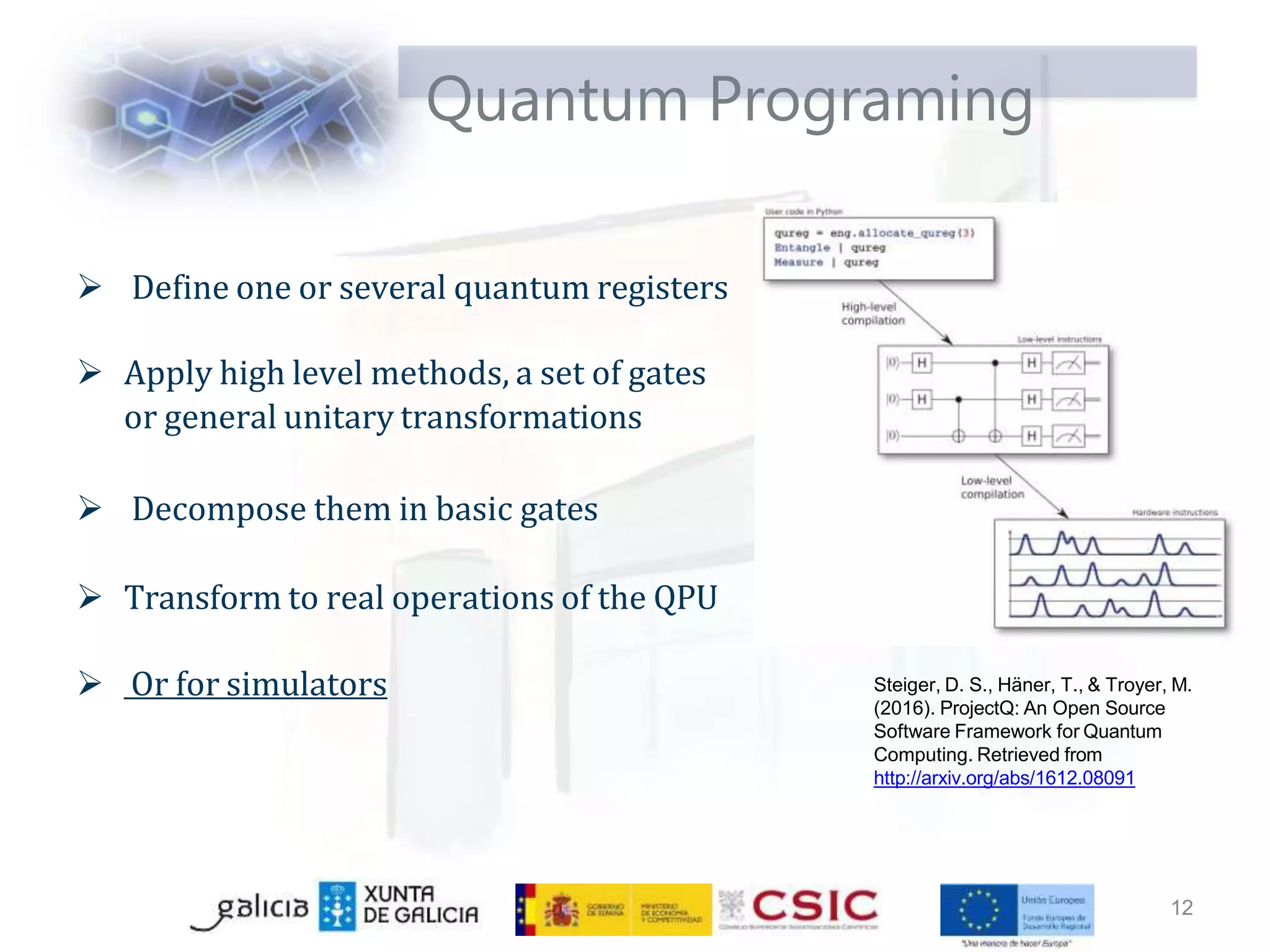
Quantum Programing
 Define one or several quantum registers
 Apply high level methods, a set of gates
or general unitary transformations
 Decompose them in basic gates
 Transform to real operations of the QPU
 Or for simulators Steiger, D. S., Häner, T., & Troyer, M.
(2016). ProjectQ: An Open Source
Software Framework for Quantum
Computing. Retrieved from
http://arxiv.org/abs/1612.08091
12
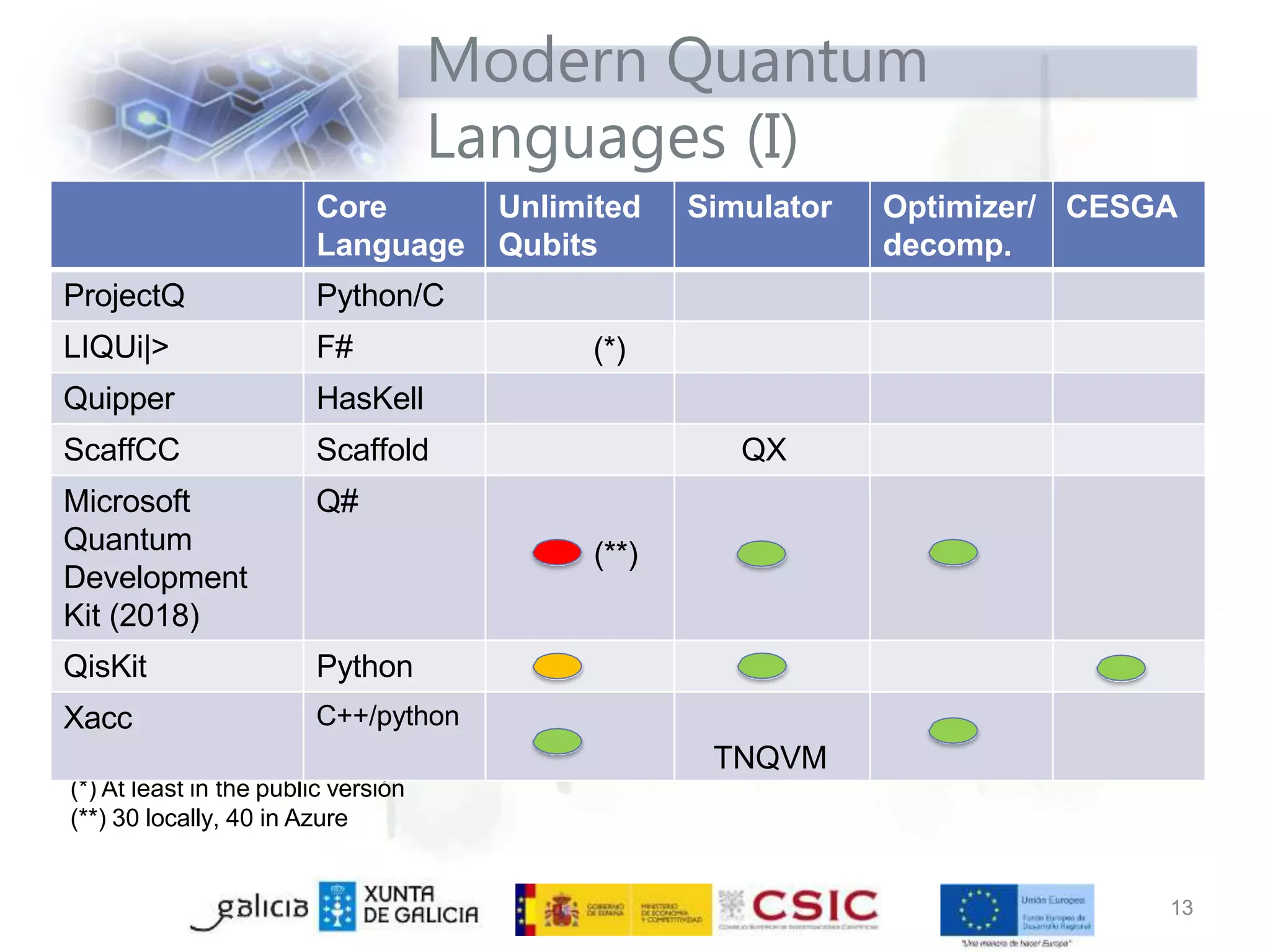
Modern Quantum
Languages (I)
(*) At least in the public versión
(**) 30 locally, 40 in Azure
Core
Language
Unlimited
Qubits
Simulator Optimizer/
decomp.
CESGA
ProjectQ Python/C
LIQUi|> F# (*)
Quipper HasKell
ScaffCC Scaffold QX
Microsoft
Quantum
Development
Kit (2018)
Q#
(**)
QisKit Python
Xacc C++/python
TNQVM
13
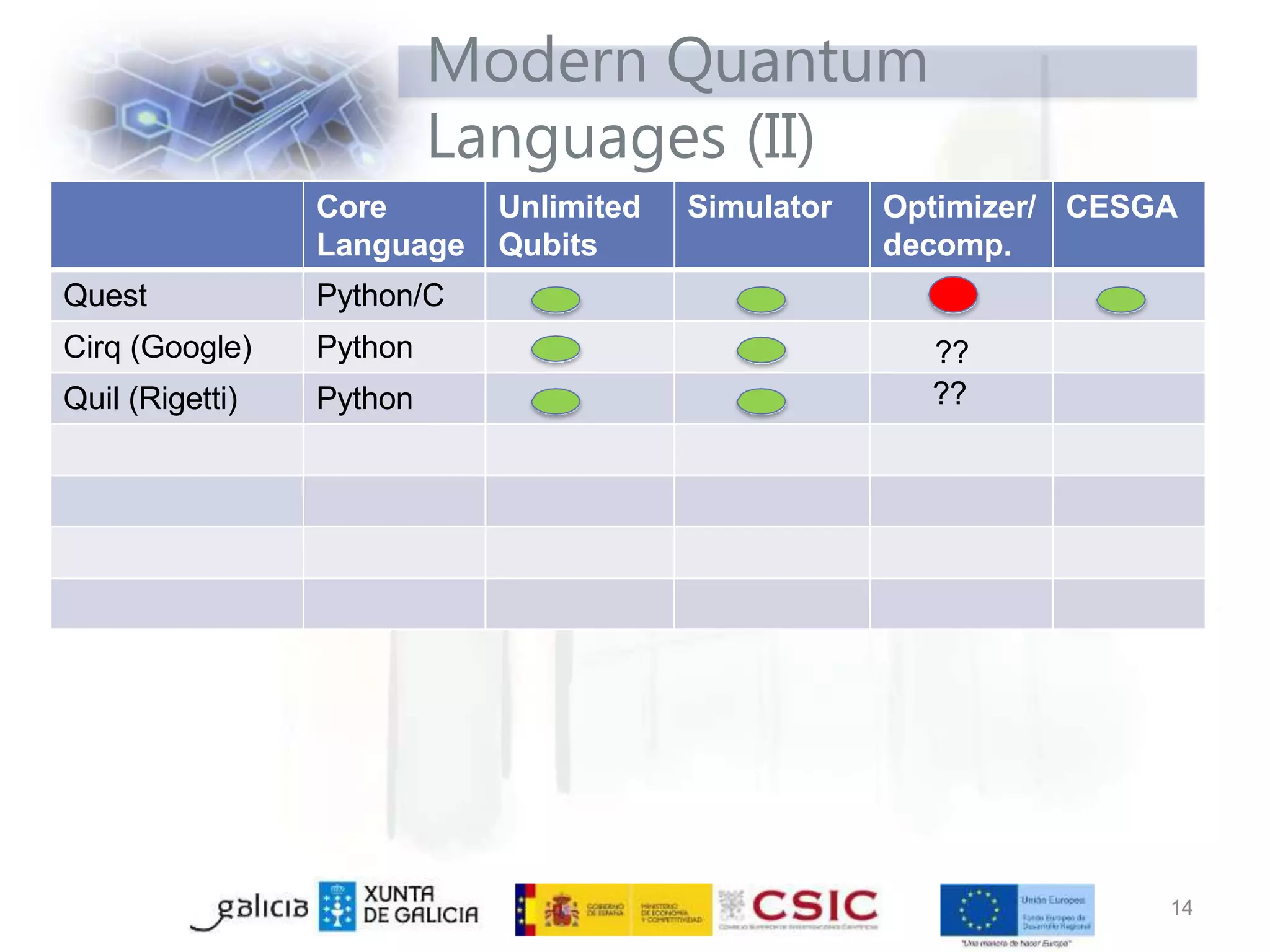
Modern Quantum
Languages (II)
Core
Language
Unlimited
Qubits
Simulator Optimizer/
decomp.
CESGA
Quest Python/C
Cirq (Google) Python ??
Quil (Rigetti) Python ??
14
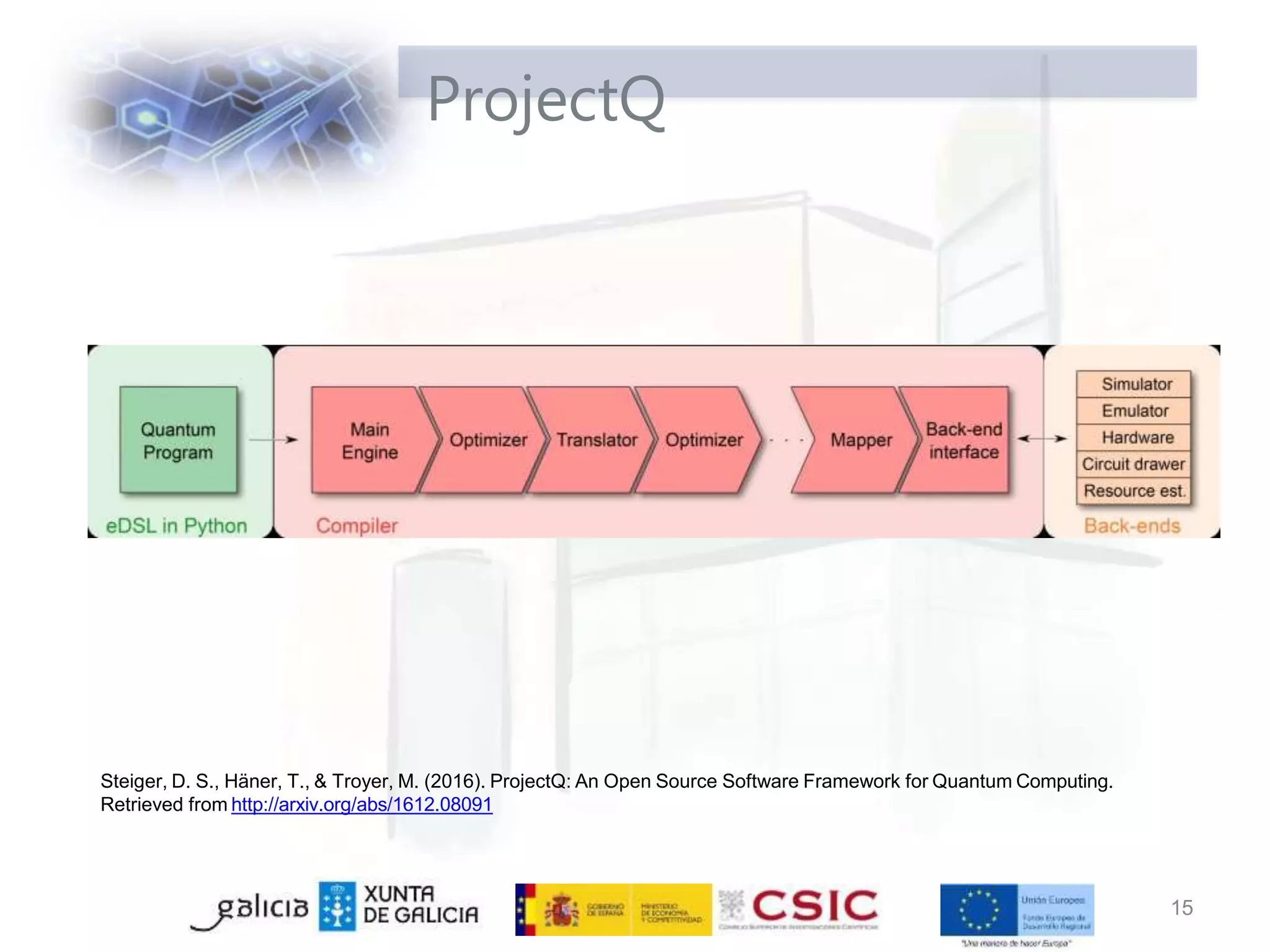
ProjectQ
Steiger, D. S., Häner, T., & Troyer, M. (2016). ProjectQ: An Open Source Software Framework for Quantum Computing.
Retrieved from http://arxiv.org/abs/1612.08091
15
ProjectQ. Compiler Engines
MainEngine The MainEngine class provides all functionality of the main compiler engine.
CommandModifier
CommandModifier is a compiler engine which applies a function to all incoming
commands, sending on the resulting command instead of the original one.
IBMCNOTMapper CNOT mapper for the IBM backend.
ManualMapper
Manual Mapper which adds QubitPlacementTags to Allocate gate commands
according to a user-specified mapping.
LocalOptimizer
LocalOptimizer is a compiler engine which optimizes locally (merging rotations,
cancelling gates with their inverse) in a local window of user-defined size.
AutoReplacer
The AutoReplacer is a compiler engine which uses engine.is_available in order to
determine which commands need to be replaced/decomposed/compiled further.
TagRemover TagRemover is a compiler engine which removes temporary command tags.
More at http://projectq.readthedocs.io/en/latest/projectq.cengines.html
eng = MainEngine(backend=Simulator(),
engine list =[AutoReplacer(rule_set), TagRemover(), LocalOptimizer(3) ])
Steiger, D. S., Häner, T., & Troyer, M. (2016). ProjectQ: An Open Source Software Framework for Quantum Computing.
Retrieved from http://arxiv.org/abs/1612.08091
16
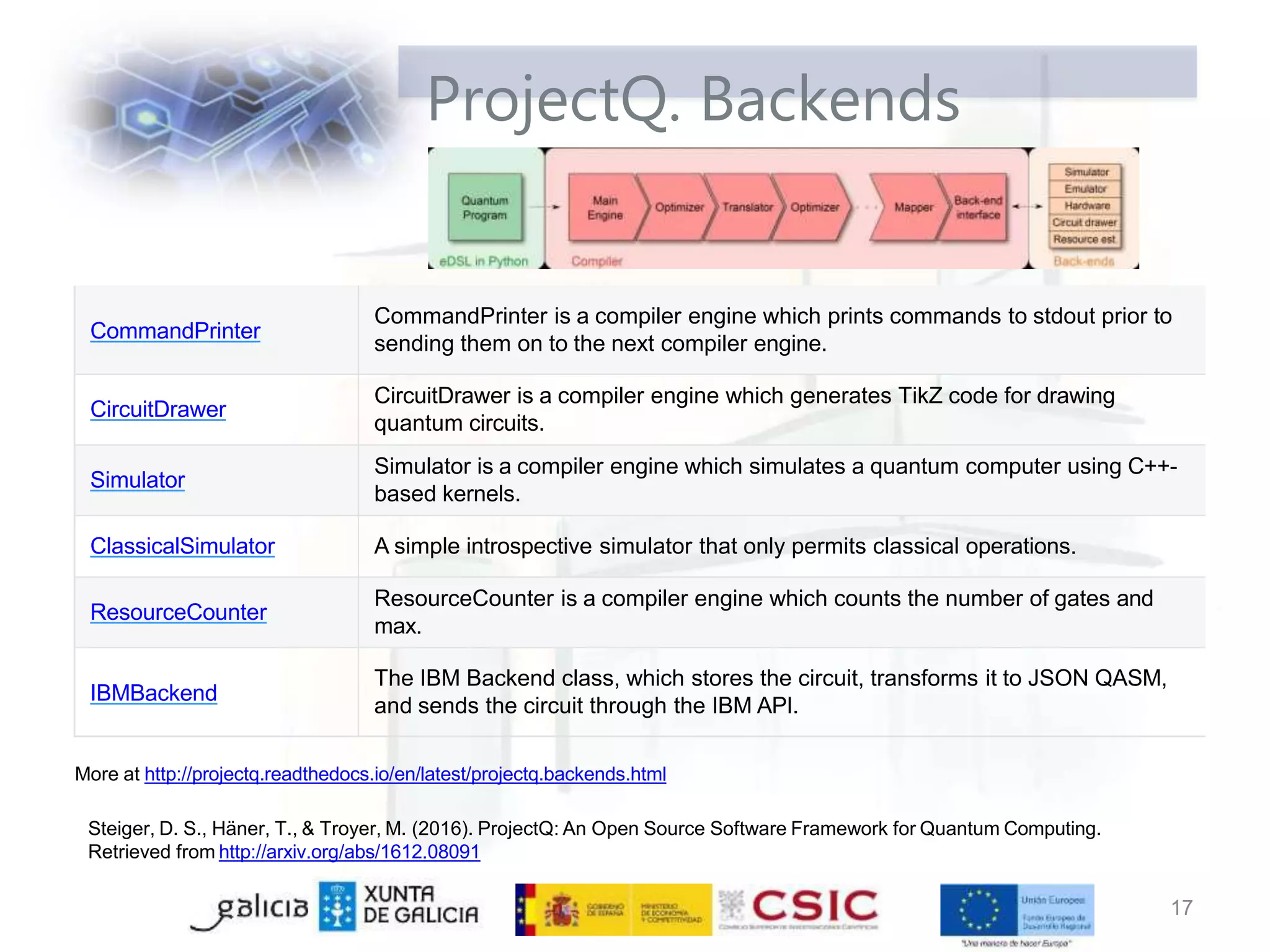
ProjectQ. Backends
More at http://projectq.readthedocs.io/en/latest/projectq.backends.html
Steiger, D. S., Häner, T., & Troyer, M. (2016). ProjectQ: An Open Source Software Framework for Quantum Computing.
Retrieved from http://arxiv.org/abs/1612.08091
17
CommandPrinter
CommandPrinter is a compiler engine which prints commands to stdout prior to
sending them on to the next compiler engine.
CircuitDrawer
CircuitDrawer is a compiler engine which generates TikZ code for drawing
quantum circuits.
Simulator
Simulator is a compiler engine which simulates a quantum computer using C++-
based kernels.
ClassicalSimulator A simple introspective simulator that only permits classical operations.
ResourceCounter
ResourceCounter is a compiler engine which counts the number of gates and
max.
IBMBackend
The IBM Backend class, which stores the circuit, transforms it to JSON QASM,
and sends the circuit through the IBM API.
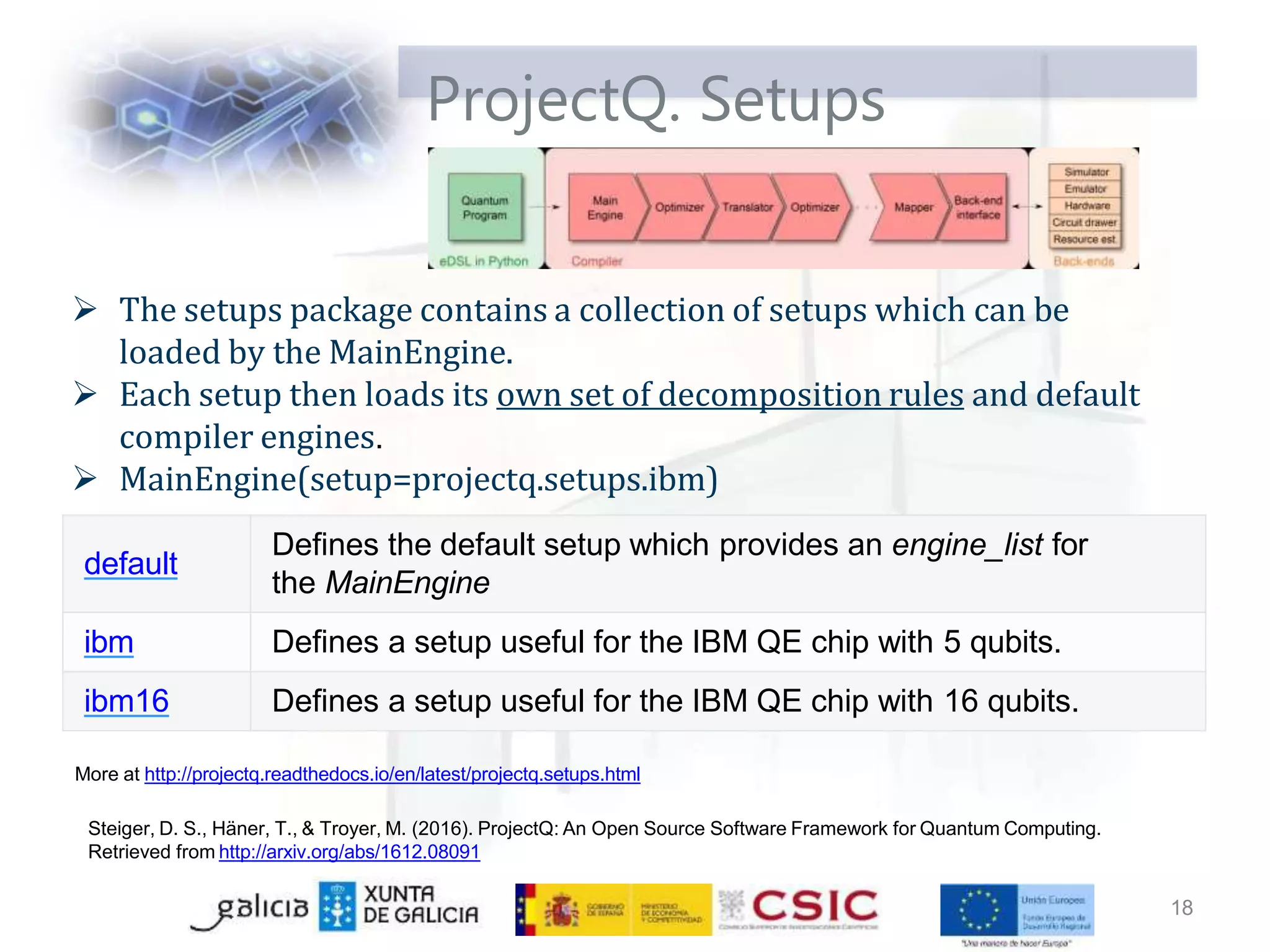
ProjectQ. Setups
 The setups package contains a collection of setups which can be
loaded by the MainEngine.
 Each setup then loads its own set of decomposition rules and default
compiler engines.
 MainEngine(setup=projectq.setups.ibm)
More at http://projectq.readthedocs.io/en/latest/projectq.setups.html
Steiger, D. S., Häner, T., & Troyer, M. (2016). ProjectQ: An Open Source Software Framework for Quantum Computing.
Retrieved from http://arxiv.org/abs/1612.08091
18
default
Defines the default setup which provides an engine_list for
the MainEngine
ibm Defines a setup useful for the IBM QE chip with 5 qubits.
ibm16 Defines a setup useful for the IBM QE chip with 16 qubits.
ProjectQ. eDSL. Operations
 All common gates: X, Y, Z, T, S, CNOT, SWAP, etc.
 Additional useful gates: Rx, Ry, Rz, R, Ph, Toffoli
(ControledControledNOT/ ControledControledX)
 Advanced operations:
 Quantum Fourier Transform, QFT
 Hamiltonian Time Evolution, TimeEvolution
 A set of gates to be applied on a set of qubits, QubitOperator
 Create an entangled state: Entangle
 Methods to create multi-qubit controlled gates, ControledGate
 Measurement: Measure
 Sintax: <Operation> | <qubits>.
 Example: H | qureg[0]
More at http://projectq.readthedocs.io/en/latest/projectq.ops.html
19
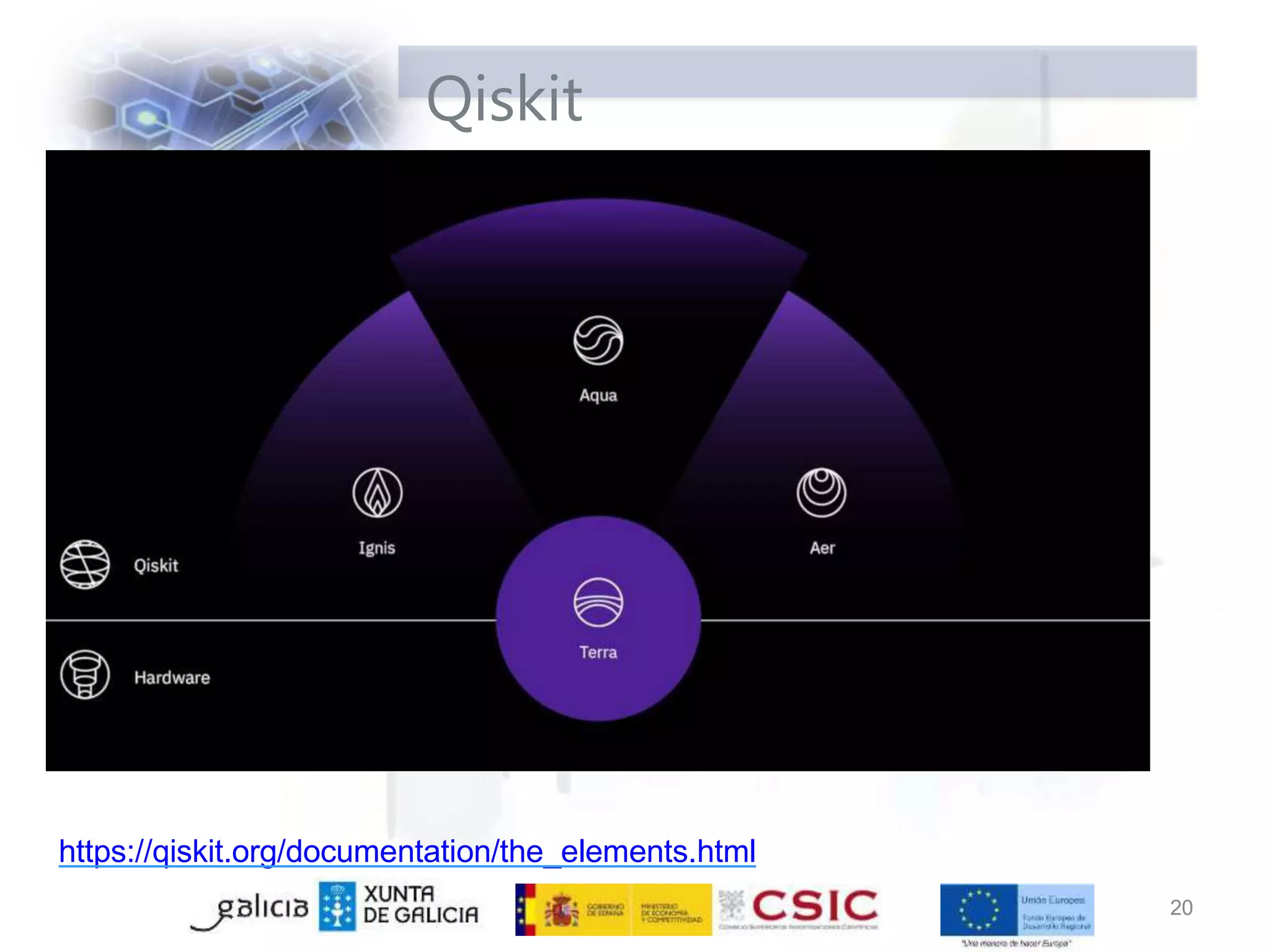
Qiskit
https://qiskit.org/documentation/the_elements.html
20
Qiskit
21
More at http://projectq.readthedocs.io/en/latest/projectq.ops.html
 All common gates: X, Y, Z, T, S, CNOT, SWAP, etc.
 Additional useful gates: Rx, Ry, Rz, R, Toffoli
 Specific gates for IBM hardware:u1,cu1,u2,cu2,u3,cu3
 Advanced operations:
 Quantum Fourier Transform, QFT
 Hamiltonian Time Evolution, TimeEvolution
 A set of gates to be applied on a set of qubits, Operator
 Methods to create multi-qubit controlled gates
 Measurement:Measure
 Sintax: gates are methods of the circuit class:
 Example: circuit.h(0) means add a H gate to qubit 0
Qiskit. Backends
22
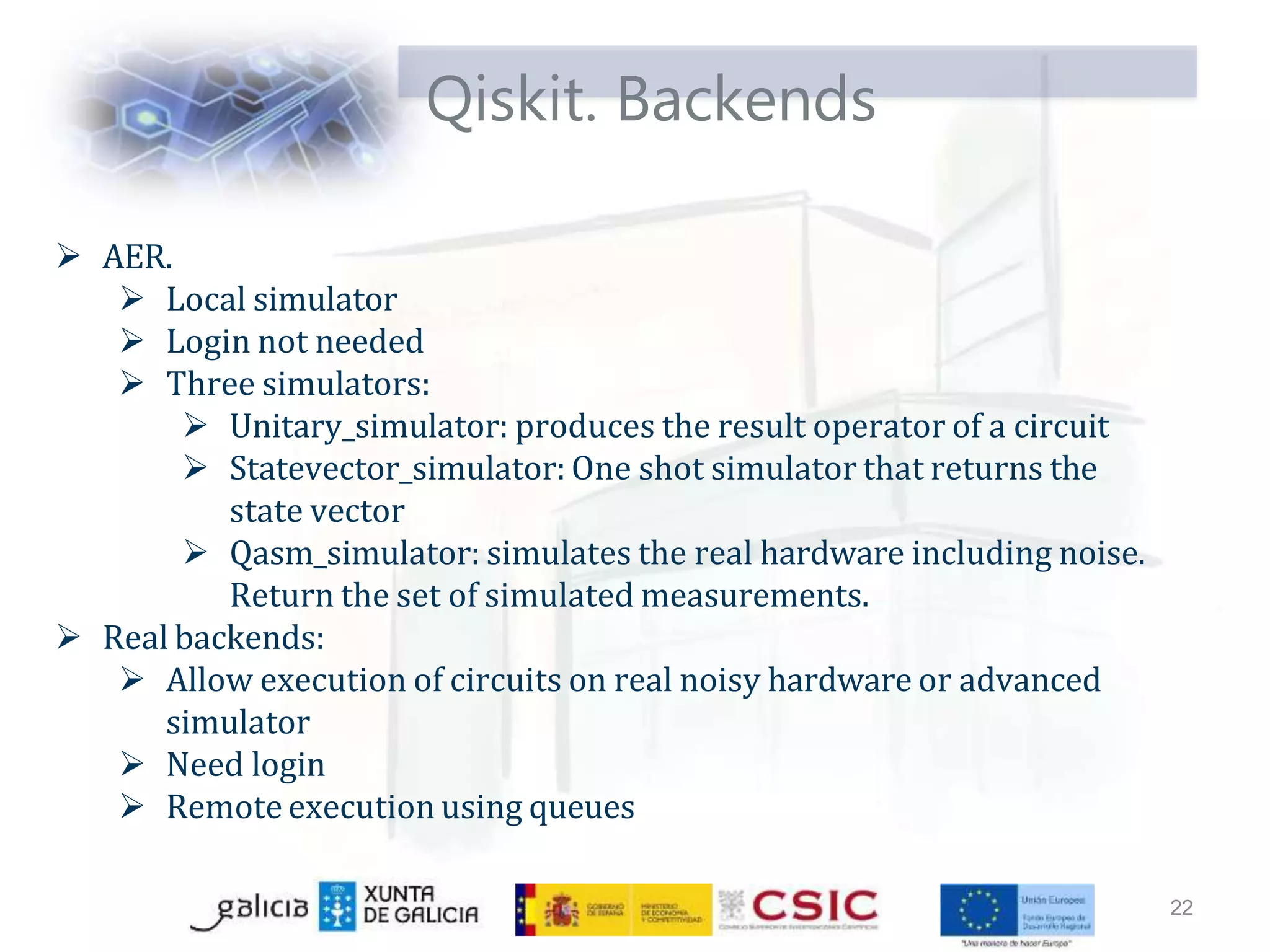
 AER.
 Local simulator
 Login not needed
 Three simulators:
 Unitary_simulator: produces the result operator of a circuit
 Statevector_simulator: One shot simulator that returns the
state vector
 Qasm_simulator: simulates the real hardware including noise.
Return the set of simulated measurements.
 Real backends:
 Allow execution of circuits on real noisy hardware or advanced
simulator
 Need login
 Remote execution using queues
OPEN PROJECTQ/ DENSE_CODING NOTEBOOK
Exercise: My First ProjectQ Program
OPEN QISKIT/ DENSE_CODING NOTEBOOK
Exercise: My First Qiskit Program
Some Basic Concepts with 2 qubits
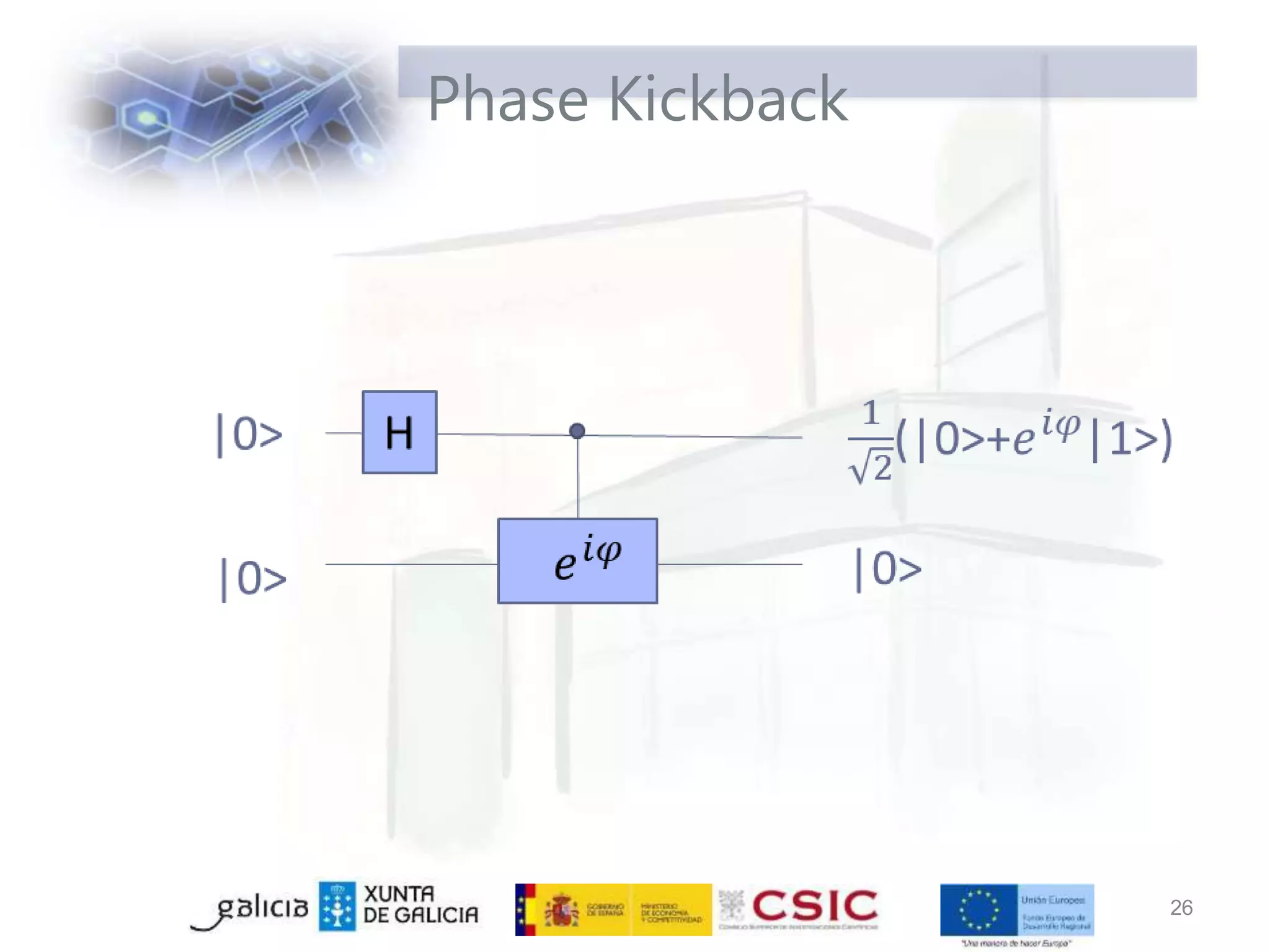
Phase Kickback
26
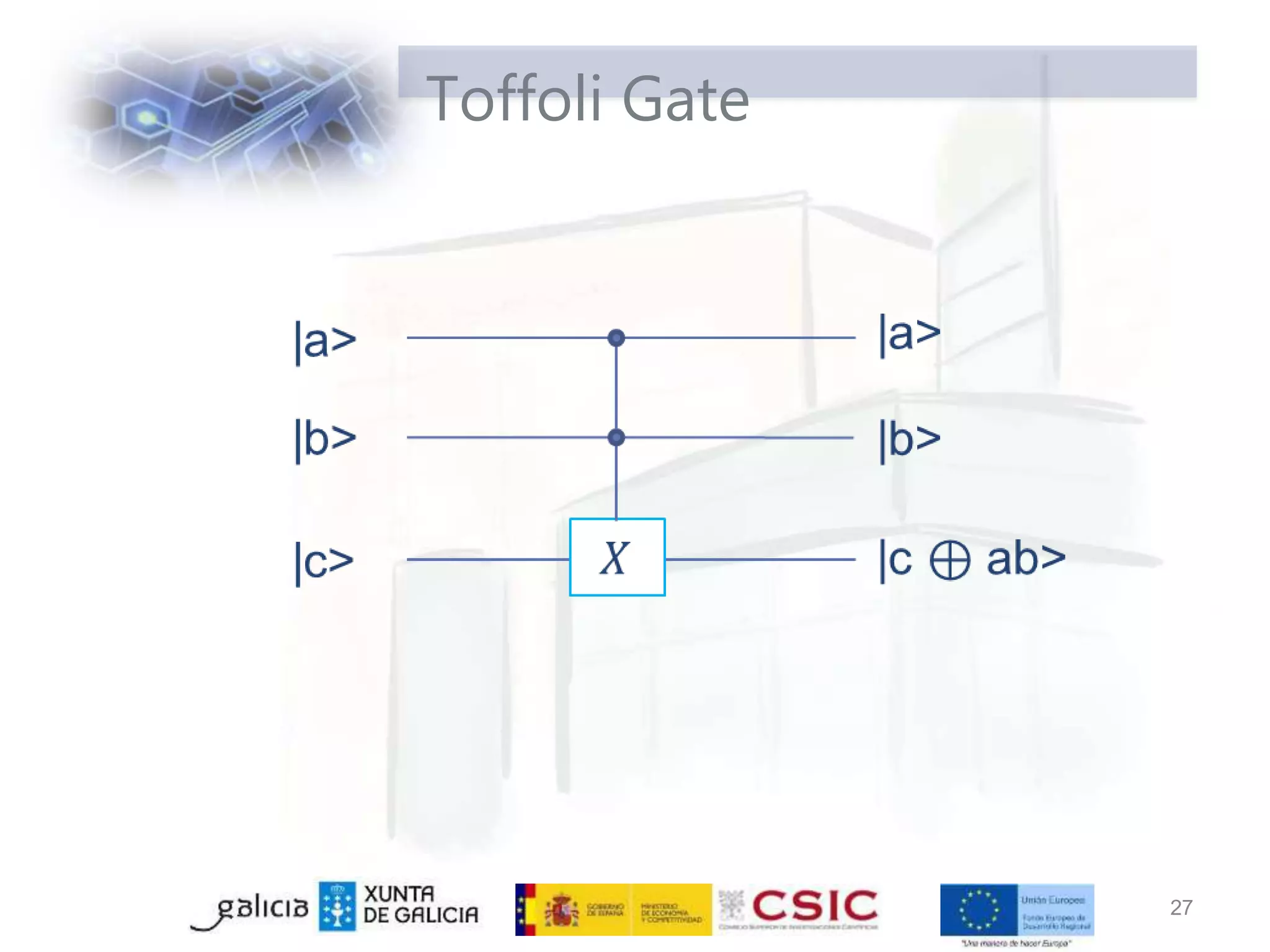
Toffoli Gate
27
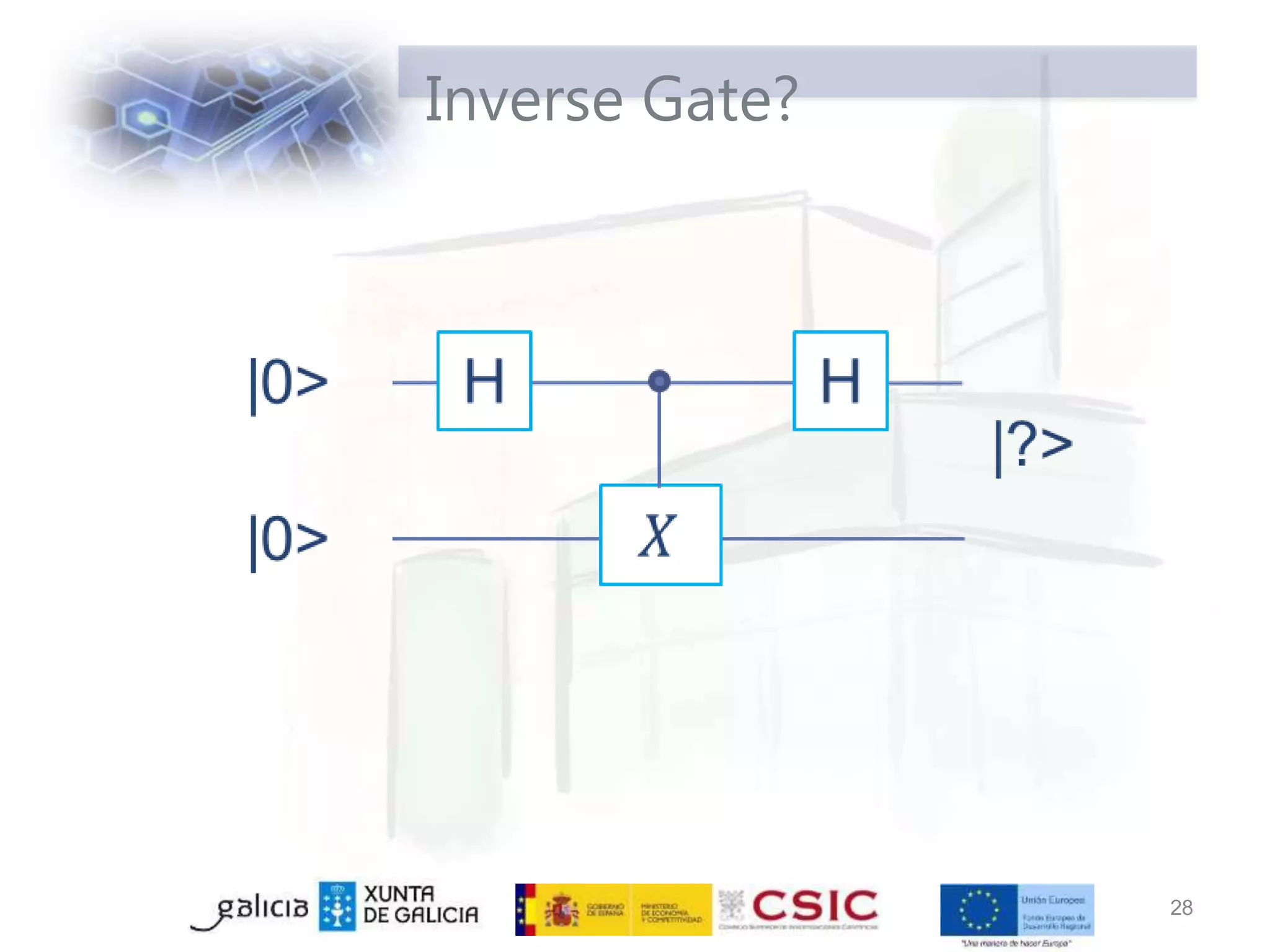
Inverse Gate?
28
OPEN PROJECTQ/ SOME_BASICS NOTEBOOK
Exercise: Some Basic Gates with ProjectQ
OPEN QISKIT/ SOME_BASICS NOTEBOOK
Exercise: Some Basic Gates with Qiskit
Lecture_2_v2_qc.pptx

Lecture_2_v2_qc.pptx

  • 1.
  • 2.
    Lecture 2  QPU Topologies of QPU  Programming  Simulators.  Introduction to ProjectQ  My first program with ProjectQ .
  • 3.
    Universal Quantum Computer. QuantumGates From: Nielsen, M., & Chuang, I. (n.d.). Quantum computation and Quantum information. ONE QUBIT GATES TWO QUBIT GATES (H,S,T,CNOT) = Universal Quantum Gates: can approximate ANY unitary operation 3
  • 4.
    Quantum register initializedto |0> for a finite bit string 0 (n bits = nqubits) Manipulated by a set of primitives one or two qubit unitary operations (quantum gates) Measured into a classical bases labeled as a bit string of length n. A program is provided by a set of gates to be applied onto QuBits. Universal Quantum Computer. QRAM || QPU Send QProgram QPU Get Result Knill, E. (1996). Conventions for quantum pseudocode. LANL report LAUR-96-2724 & Knill, E. (1996). Quantum Randomness and Nondeterminism, LABL report LAUR-96-2186. Archiv:quant-ph/9610012 4
  • 5.
    Ion Trap (I) 171Yb+trapped ions Information stored in the hyperfine ‘clock’ states: 2 𝑆1/2  |0 >≡ |𝐹 = 0; 𝑚𝐹 = 0 >  |1 >≡ |𝐹 = 1; 𝑚𝐹 = 0 > 𝑜𝑓 𝑡ℎ𝑒 electronic ground level  𝐹 , 𝑚𝐹 quantum numbers associated to total atomic angular momentum and its projection along the quantization axes defined by an applied magnetic field of 5.2G  Coherence time > 0.5s Confined in a linear radio-frequency Paul trap Laser-cooled 5 µm for 5 qubits Debnath, S., Linke, N. M., Figgatt, C., Landsman, K. A., Wright, K., & Monroe, C. (2016). Demonstration of a small programmable quantum computer with atomic qubits. Nature, 536(7614), 63–66. http://doi.org/10.1038/nature18648 13/09/2017 5 All-with-All
  • 6.
    Ion Trap (II):Universal Gates Implemented gates (using Raman transition):  single qubit 𝑅𝜑 𝜃 = 𝑅(𝜃, 𝜑)  two − qubits 𝑋𝑋 𝐻 = 𝑅 −𝜋 𝑅 𝑥 𝑦 Universal Gates derived as: 𝜋 2 Z = 𝑅 −𝜋/2 𝑅 𝜃 𝑅 𝑦 𝑥 𝑦 𝜋 2 Controlled-NOT (CNOT) Controlled-Phase (cP) Debnath, S., Linke, N. M., Figgatt, C., Landsman, K. A., Wright, K., & Monroe, C. (2016). Demonstration of a small programmable quantum computer with atomic qubits. Nature, 536(7614), 63–66. http://doi.org/10.1038/nature18648 13/09/2017 6
  • 7.
    Ion Trap (III):QFT(5) State preparation (single qubits rotations) Total gates[1]:  5 H = 10 R  10 CP = 10 (6R + 1 X)  Total = 80 gates Optimised Version [2]:  22 single-qubit gates  10 two-qubits gates  Total: 32 gates  Time: 2669 µs 1 Debnath, S., Linke, N. M., Figgatt, C., Landsman, K. A., Wright, K., & Monroe, C. (2016). Demonstration of a small programmable quantum computer with atomic qubits. Nature, 536(7614), 63–66. http://doi.org/10.1038/nature18648 2 Maslov, D. (2017). Basic circuit compilation techniques for an ion-trap quantum machine. New Journal of Physics, 19(2), 23035. http://doi.org/10.1088/1367- 2630/aa5e47 QFT Ideal Gates: 15 13/09/2017 7
  • 8.
    IBM QX Hardware Gates: Frame Change (FC, 0ns),  Gaussian Derivative (GD, 80ns) ,  Gaussian Flattop (GF, 170-384ns)  Buffer after each pulse:10ns https://github.com/QISKit/ibmqx-backend-information/tree/master/backends/ibmqx3 Limits on: - Available gates, - Different times for each operations - Restrictions on 2 qubits operations - Restrictions on measurement 13/09/2017 8
  • 9.
    Quantum Computing Architecture Send QProgram QPU GetResult 13/09/2017 9 Van Meter, R., & Horsman, C. (2013). A blueprint for building a quantum computer. Communications of the ACM, 56(10), 84. http://doi.org/10.1145/2494568
  • 10.
    10 Smith, J. M.(2015). Programming the Quantum Future. Communications of the ACM, 58(8), 52–61. http://doi.org/10.1145/2699415 Quantum Algorithm
  • 11.
    Quantum Algorithm A sequenceof gates applied on a set of qubits Some well-known techniques:  Amplify amplitude (Grover’s)  Estimate phase More than 400 quantum algorithm papers on Quantum Zoo Many are unitary transformation on n- qubits plus measurement  How to make them as a set of universal gates? Quantum Zoo website 13/09/2017 11
  • 12.
    Quantum Programing  Defineone or several quantum registers  Apply high level methods, a set of gates or general unitary transformations  Decompose them in basic gates  Transform to real operations of the QPU  Or for simulators Steiger, D. S., Häner, T., & Troyer, M. (2016). ProjectQ: An Open Source Software Framework for Quantum Computing. Retrieved from http://arxiv.org/abs/1612.08091 12
  • 13.
    Modern Quantum Languages (I) (*)At least in the public versión (**) 30 locally, 40 in Azure Core Language Unlimited Qubits Simulator Optimizer/ decomp. CESGA ProjectQ Python/C LIQUi|> F# (*) Quipper HasKell ScaffCC Scaffold QX Microsoft Quantum Development Kit (2018) Q# (**) QisKit Python Xacc C++/python TNQVM 13
  • 14.
    Modern Quantum Languages (II) Core Language Unlimited Qubits SimulatorOptimizer/ decomp. CESGA Quest Python/C Cirq (Google) Python ?? Quil (Rigetti) Python ?? 14
  • 15.
    ProjectQ Steiger, D. S.,Häner, T., & Troyer, M. (2016). ProjectQ: An Open Source Software Framework for Quantum Computing. Retrieved from http://arxiv.org/abs/1612.08091 15
  • 16.
    ProjectQ. Compiler Engines MainEngineThe MainEngine class provides all functionality of the main compiler engine. CommandModifier CommandModifier is a compiler engine which applies a function to all incoming commands, sending on the resulting command instead of the original one. IBMCNOTMapper CNOT mapper for the IBM backend. ManualMapper Manual Mapper which adds QubitPlacementTags to Allocate gate commands according to a user-specified mapping. LocalOptimizer LocalOptimizer is a compiler engine which optimizes locally (merging rotations, cancelling gates with their inverse) in a local window of user-defined size. AutoReplacer The AutoReplacer is a compiler engine which uses engine.is_available in order to determine which commands need to be replaced/decomposed/compiled further. TagRemover TagRemover is a compiler engine which removes temporary command tags. More at http://projectq.readthedocs.io/en/latest/projectq.cengines.html eng = MainEngine(backend=Simulator(), engine list =[AutoReplacer(rule_set), TagRemover(), LocalOptimizer(3) ]) Steiger, D. S., Häner, T., & Troyer, M. (2016). ProjectQ: An Open Source Software Framework for Quantum Computing. Retrieved from http://arxiv.org/abs/1612.08091 16
  • 17.
    ProjectQ. Backends More athttp://projectq.readthedocs.io/en/latest/projectq.backends.html Steiger, D. S., Häner, T., & Troyer, M. (2016). ProjectQ: An Open Source Software Framework for Quantum Computing. Retrieved from http://arxiv.org/abs/1612.08091 17 CommandPrinter CommandPrinter is a compiler engine which prints commands to stdout prior to sending them on to the next compiler engine. CircuitDrawer CircuitDrawer is a compiler engine which generates TikZ code for drawing quantum circuits. Simulator Simulator is a compiler engine which simulates a quantum computer using C++- based kernels. ClassicalSimulator A simple introspective simulator that only permits classical operations. ResourceCounter ResourceCounter is a compiler engine which counts the number of gates and max. IBMBackend The IBM Backend class, which stores the circuit, transforms it to JSON QASM, and sends the circuit through the IBM API.
  • 18.
    ProjectQ. Setups  Thesetups package contains a collection of setups which can be loaded by the MainEngine.  Each setup then loads its own set of decomposition rules and default compiler engines.  MainEngine(setup=projectq.setups.ibm) More at http://projectq.readthedocs.io/en/latest/projectq.setups.html Steiger, D. S., Häner, T., & Troyer, M. (2016). ProjectQ: An Open Source Software Framework for Quantum Computing. Retrieved from http://arxiv.org/abs/1612.08091 18 default Defines the default setup which provides an engine_list for the MainEngine ibm Defines a setup useful for the IBM QE chip with 5 qubits. ibm16 Defines a setup useful for the IBM QE chip with 16 qubits.
  • 19.
    ProjectQ. eDSL. Operations All common gates: X, Y, Z, T, S, CNOT, SWAP, etc.  Additional useful gates: Rx, Ry, Rz, R, Ph, Toffoli (ControledControledNOT/ ControledControledX)  Advanced operations:  Quantum Fourier Transform, QFT  Hamiltonian Time Evolution, TimeEvolution  A set of gates to be applied on a set of qubits, QubitOperator  Create an entangled state: Entangle  Methods to create multi-qubit controlled gates, ControledGate  Measurement: Measure  Sintax: <Operation> | <qubits>.  Example: H | qureg[0] More at http://projectq.readthedocs.io/en/latest/projectq.ops.html 19
  • 20.
  • 21.
    Qiskit 21 More at http://projectq.readthedocs.io/en/latest/projectq.ops.html All common gates: X, Y, Z, T, S, CNOT, SWAP, etc.  Additional useful gates: Rx, Ry, Rz, R, Toffoli  Specific gates for IBM hardware:u1,cu1,u2,cu2,u3,cu3  Advanced operations:  Quantum Fourier Transform, QFT  Hamiltonian Time Evolution, TimeEvolution  A set of gates to be applied on a set of qubits, Operator  Methods to create multi-qubit controlled gates  Measurement:Measure  Sintax: gates are methods of the circuit class:  Example: circuit.h(0) means add a H gate to qubit 0
  • 22.
    Qiskit. Backends 22  AER. Local simulator  Login not needed  Three simulators:  Unitary_simulator: produces the result operator of a circuit  Statevector_simulator: One shot simulator that returns the state vector  Qasm_simulator: simulates the real hardware including noise. Return the set of simulated measurements.  Real backends:  Allow execution of circuits on real noisy hardware or advanced simulator  Need login  Remote execution using queues
  • 23.
    OPEN PROJECTQ/ DENSE_CODINGNOTEBOOK Exercise: My First ProjectQ Program
  • 24.
    OPEN QISKIT/ DENSE_CODINGNOTEBOOK Exercise: My First Qiskit Program
  • 25.
    Some Basic Conceptswith 2 qubits
  • 26.
  • 27.
  • 28.
  • 29.
    OPEN PROJECTQ/ SOME_BASICSNOTEBOOK Exercise: Some Basic Gates with ProjectQ
  • 30.
    OPEN QISKIT/ SOME_BASICSNOTEBOOK Exercise: Some Basic Gates with Qiskit