CHICKEN POX
(VARICELLA)
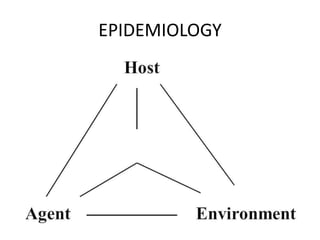
EPIDEMIOLOGY
AGENT FACTORS
• Agent: HHV-3
• Source of infection: a case of chicken pox
– Oropharyngeal secretions and lesions of skin and
mucosa.
– Rarely - a patient with Herpes Zoster.
• Infectivity:
– Period of Communicability:
• 1-2 days before rash
&
• 4-5 days thereafter
• Secondary attack rate:
90%
• Varicella-zoster virus (VZV) causes primary,
latent, and recurrent infections.
• The primary infection - manifested - Varicella
(chickenpox) and results in establishment of a
lifelong latent infection of sensory ganglion
neurons.
• Reactivation of latent infection - Herpes Zoster
(shingles).
HOST FACTOS
• Age: Children <10 yrs.
• Immunity:
– Durable
– Second attacks – rare
– Maternal antibody - first few months of life.
– CMI- Zoster
• Pregnancy: risk for foetus and neonate
Hemorrhagic Varicella in infant:
One attack -durable immunity.
ENVIRONMENTAL FACTORS
• Seasonal trend
• First six months of the year
• Overcrowding
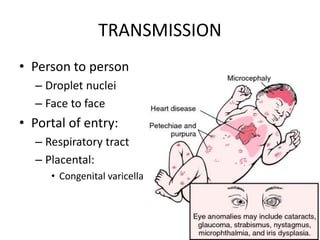
TRANSMISSION
• Person to person
– Droplet nuclei
– Face to face
• Portal of entry:
– Respiratory tract
– Placental:
• Congenital varicella
INCUBATION PERIOD
• 14 to 16 days
• 10 to 21 days
CLINICAL FEATURES
• The clinical course may be divided into two
stages:
(A)Pre-eruptive Stage.
(B) Eruptive Stage.
Pre-Eruptive Stage
1. Onset - sudden - mild or moderate fever,
pain in the back, shivering and malaise.
2. Very brief- about 24 hours.
3. Adults- usually more severe and may last
for 2-3 days before the rash comes out.
Eruptive Phase
1. In children - rash is often the first sign.
2. It comes on the day the fever starts.
ERUPTIVE PHASE – FEVER
• The fever does not run high but shows
exacerbations with each fresh crop of
eruption.
ERUPTIVE PHASE – RASH
1. Symmetrical.
2. It first appears - on the trunk
where it is abundant,
and
then comes on the face, arms
and legs where it is less
abundant.
3. Mucosal surfaces (buccal, &
pharyngeal)- generally
involved.
ERUPTIVE PHASE – RASH
4. Axillae - may be affected,
but
palms and soles- usually
not affected.
4. The density of the
eruption diminishes
centrifugally.
ERUPTIVE PHASE – EVOLUTION OF RASH
1. The rash advances quickly through the
stages of macule, papule, vesicle and scab.
2. First to attract attention - vesicles filled
with clear fluid and looking like "dew-
drops" on the skin.
3. They are superficial, with easily ruptured
walls & surrounded by an area of
inflammation.
Superficial vesicles
Unilocular Vesicles;
Dew-drop like.
Inflammation around vesicles
ERUPTIVE PHASE – EVOLUTION OF RASH
4. Usually they are not umbilicated.
5. The vesicles may form crusts without going
through the pustular stage.
6. Many of the lesions may abort.
7. Scabbing begins 4 to 7 days after the
appearance of rash.
Pleomorphic Rash
COMPLICATIONS
1. Secondary bacterial infection of lesions.
2. Cellulitis, Lymphadenitis, and Subcutaneous
abscess.
3. Varicella gangrenosa from S.pyogenes – a life-
threatening infection.
4. Bacteremia causing pneumonia, arthritis, and
osteomyelitis.
5. CNS manifestations – Encephalitis & Cerebellar
ataxia.
6. Varicella hepatitis.
GROUPS AT INCREASED RISK OF
COMPLICATIONS
1. Healthy adolescents & adults
2. Immunocompromised persons
3. Pregnant women
4. Newborns of mothers with rash onset
within 5 days before delivery to 48 hours
after delivery.
5. Children with malignancy if chemotherapy
was given during the I.P.
LABORATORY DIAGNOSIS
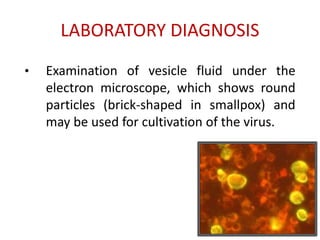
• Examination of vesicle fluid under the
electron microscope, which shows round
particles (brick-shaped in smallpox) and
may be used for cultivation of the virus.
2. Scrapings of floor of vesicles show
multinucleated giant cells coloured by
Giemsa stain (not in smallpox).
3. Serology is used mainly for epidemiological
surveys.
TREATMENT OF UNCOMPLICATED
VARICELLA
• Oral therapy with Acyclovir – 20 mg/kg/dose
maximum: 800 mg/dose
4 doses per day X 5 days should be used to
treat uncomplicated Varicella
TREATMENT IN HIGH-RISK PATIENTS
• Acyclovir guanine – 500 mg/m2 8 hourly
I.V. X 7 days.
• Given within 72 hrs. prevents progressive
Varicella and visceral dissemination in high-
risk patients.
• Drug therapy does not interfere with
induction of immunity.
TREATMENT OF HERPES ZOSTER
• Acyclovir also useful for treatment of Herpes
zoster in dose of 500 mg/m2 or 10 mg/kg 8
hourly.
PREVENTION
1. VZV transmission is difficult to prevent
because the infection is contagious for 24-48
hr before the rash appears.
2. Infection control practices, including caring
for infected patients in isolation rooms with
filtered air systems, are essential.
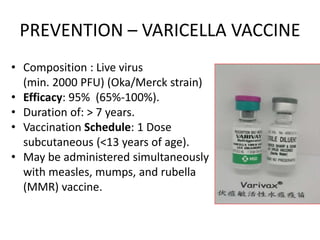
PREVENTION – VARICELLA VACCINE
• Composition : Live virus
(min. 2000 PFU) (Oka/Merck strain)
• Efficacy: 95% (65%-100%).
• Duration of: > 7 years.
• Vaccination Schedule: 1 Dose
subcutaneous (<13 years of age).
• May be administered simultaneously
with measles, mumps, and rubella
(MMR) vaccine.
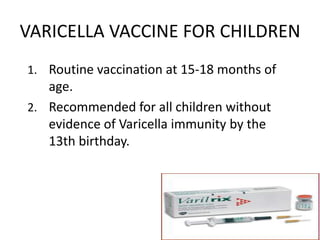
VARICELLA VACCINE FOR CHILDREN
1. Routine vaccination at 15-18 months of
age.
2. Recommended for all children without
evidence of Varicella immunity by the
13th birthday.
VARICELLA VACCINE FOR
ADOLESCENTS AND ADULTS
1. Recommended to all persons >13 years of
age without evidence of Varicella
immunity.
2. Two doses separated by 4-8 weeks.
VARICELLA VACCINE– ADVERSE REACTIONS
• Injection site complaints –
19% (children)
24% (adolescents and adults).
• Rash- 3 – 4% of vaccinees.
– Rash may be maculopapular rather
than vesicular.
– Average 5 lesions.
• Systemic reactions not common.
ZOSTER FOLLOWING VACCINATION
1. Most cases in children.
2. Risk from vaccine virus less than from wild
virus.
3. Usually a mild illness without complications.
VARICELLA VACCINE– CONTRAINDICATIONS
AND PRECAUTIONS
1. Severe allergic reaction to vaccine
component or following a prior dose.
2. Immunosuppression.
3. Pregnancy.
4. Moderate or severe acute illness.
5. Recent blood product transfusion.
Conclusions
1. Varicella or Chickenpox is a vaccine
preventable disease occuring commonly in
children.
2. It is characterized by fever & pleomorphic
rash in centripetal distribution.
3. It causes many complications if it occurs in
adults.
MCQs
1. “Pleomorphism” is the characterstic of rash
of :
1. Measles.
2. HHV – 3.
3. Smallpox.
4. Fifth disease.
Ans. – 2.
MCQs
2. A child presenting with fever and Varicella
rash on day 1 :
1. Has already transmitted the virus to other
children.
2. Is infectious to his siblings.
3. Will continue to infect others for 4 – 5 days.
4. All of the above.
5. Only 1 & 2 are correct.
Ans. – 4.
MCQs
3. Following are not false about “Congenital
Varicella Syndrome” except: (multiple choice)
1. Risk of transmission is maximum in the 2nd
trimester of pregnancy.
2. Extensive involvement of neurological system of
foetus.
3. Hyper-pigmentation of skin is pathognomic sign.
4. If fetus is born alive, may have problem in
defecation and micturition.
Ans. – 1,3.
MCQs
4. Complications of Varicella : (multiple choice)
1. Occur more commonly in children infected
within first 5 years of life.
2. Pnuemonia is more common in adults.
3. Can be prevented by early administration of
Acyclovir.
4. Varicella gangrenosa is a life-threatening
infection caused by superadded Clostridium
infection.
Ans. – 2,3.
MCQs
5. All are false about Varicella vaccine except :
(multiple choice)
1. It may be given along with MMR vaccine (live
vaccine).
2. AIDS patients, not having previous history of
Varicella, should receive this vaccine.
3. The child is 100% protected for his entire life.
4. A susceptible female should be immunized in
the first trimester of pregnancy itself
Ans. – 1.
Differences
Smallpox Chickenpox
• IP – About 12 days
(range 7-17 days)
• Prodromal symptoms -
Usually mild
• Distribution of rash –
• - palms and soles
frequently involved
• Axilla usually free
• Rash predominant on
extensor surfaces and
bony prominences
• About 15 days
(range 7-21 days)
• Usually mild
• - seldom affected
• Axilla affected
• Rash mostly on flexor
surfaces
Characteristics of the rash
• deep-seated
• Vesicles multilocular and
umbilicated
• Only one stage of rash
may be seen at one time
• No area of inflammation
is seen around the
vesicles
• superficial
• unilocular; dew-drop like
appearance
• pleomorphic-different
stages of the rash evident
at one given time,
because rash appears in
successive crops
• an area of inflammation is
seen around the vesicles
Evolution of rash
• evolution of rash is
slow, deliberate and
majestic, passing
through definite stages
of macule, papule,
vesicle and pustule
• - scabs begin to form
10-14 days after the
rash ap
• evolution of rash very
rapid
• - scabs begin to form 4-
7 days after the rash
appears
Fever
• Fever subsides with the
appearance of rash, but
may rise again in the
pustular stage
(secondary rise of fever)
• Temperature rises with
each fresh crop of rash
20180108 chicken pox

20180108 chicken pox

  • 1.
  • 2.
  • 3.
    AGENT FACTORS • Agent:HHV-3 • Source of infection: a case of chicken pox – Oropharyngeal secretions and lesions of skin and mucosa. – Rarely - a patient with Herpes Zoster. • Infectivity: – Period of Communicability: • 1-2 days before rash & • 4-5 days thereafter • Secondary attack rate: 90%
  • 4.
    • Varicella-zoster virus(VZV) causes primary, latent, and recurrent infections. • The primary infection - manifested - Varicella (chickenpox) and results in establishment of a lifelong latent infection of sensory ganglion neurons. • Reactivation of latent infection - Herpes Zoster (shingles).
  • 5.
    HOST FACTOS • Age:Children <10 yrs. • Immunity: – Durable – Second attacks – rare – Maternal antibody - first few months of life. – CMI- Zoster • Pregnancy: risk for foetus and neonate Hemorrhagic Varicella in infant: One attack -durable immunity.
  • 6.
    ENVIRONMENTAL FACTORS • Seasonaltrend • First six months of the year • Overcrowding
  • 7.
    TRANSMISSION • Person toperson – Droplet nuclei – Face to face • Portal of entry: – Respiratory tract – Placental: • Congenital varicella
  • 8.
    INCUBATION PERIOD • 14to 16 days • 10 to 21 days
  • 9.
    CLINICAL FEATURES • Theclinical course may be divided into two stages: (A)Pre-eruptive Stage. (B) Eruptive Stage.
  • 10.
    Pre-Eruptive Stage 1. Onset- sudden - mild or moderate fever, pain in the back, shivering and malaise. 2. Very brief- about 24 hours. 3. Adults- usually more severe and may last for 2-3 days before the rash comes out.
  • 11.
    Eruptive Phase 1. Inchildren - rash is often the first sign. 2. It comes on the day the fever starts.
  • 12.
    ERUPTIVE PHASE –FEVER • The fever does not run high but shows exacerbations with each fresh crop of eruption.
  • 13.
    ERUPTIVE PHASE –RASH 1. Symmetrical. 2. It first appears - on the trunk where it is abundant, and then comes on the face, arms and legs where it is less abundant. 3. Mucosal surfaces (buccal, & pharyngeal)- generally involved.
  • 14.
    ERUPTIVE PHASE –RASH 4. Axillae - may be affected, but palms and soles- usually not affected. 4. The density of the eruption diminishes centrifugally.
  • 15.
    ERUPTIVE PHASE –EVOLUTION OF RASH 1. The rash advances quickly through the stages of macule, papule, vesicle and scab. 2. First to attract attention - vesicles filled with clear fluid and looking like "dew- drops" on the skin. 3. They are superficial, with easily ruptured walls & surrounded by an area of inflammation. Superficial vesicles Unilocular Vesicles; Dew-drop like. Inflammation around vesicles
  • 16.
    ERUPTIVE PHASE –EVOLUTION OF RASH 4. Usually they are not umbilicated. 5. The vesicles may form crusts without going through the pustular stage. 6. Many of the lesions may abort. 7. Scabbing begins 4 to 7 days after the appearance of rash. Pleomorphic Rash
  • 17.
    COMPLICATIONS 1. Secondary bacterialinfection of lesions. 2. Cellulitis, Lymphadenitis, and Subcutaneous abscess. 3. Varicella gangrenosa from S.pyogenes – a life- threatening infection. 4. Bacteremia causing pneumonia, arthritis, and osteomyelitis. 5. CNS manifestations – Encephalitis & Cerebellar ataxia. 6. Varicella hepatitis.
  • 18.
    GROUPS AT INCREASEDRISK OF COMPLICATIONS 1. Healthy adolescents & adults 2. Immunocompromised persons 3. Pregnant women 4. Newborns of mothers with rash onset within 5 days before delivery to 48 hours after delivery. 5. Children with malignancy if chemotherapy was given during the I.P.
  • 19.
    LABORATORY DIAGNOSIS • Examinationof vesicle fluid under the electron microscope, which shows round particles (brick-shaped in smallpox) and may be used for cultivation of the virus.
  • 20.
    2. Scrapings offloor of vesicles show multinucleated giant cells coloured by Giemsa stain (not in smallpox). 3. Serology is used mainly for epidemiological surveys.
  • 21.
    TREATMENT OF UNCOMPLICATED VARICELLA •Oral therapy with Acyclovir – 20 mg/kg/dose maximum: 800 mg/dose 4 doses per day X 5 days should be used to treat uncomplicated Varicella
  • 22.
    TREATMENT IN HIGH-RISKPATIENTS • Acyclovir guanine – 500 mg/m2 8 hourly I.V. X 7 days. • Given within 72 hrs. prevents progressive Varicella and visceral dissemination in high- risk patients. • Drug therapy does not interfere with induction of immunity.
  • 23.
    TREATMENT OF HERPESZOSTER • Acyclovir also useful for treatment of Herpes zoster in dose of 500 mg/m2 or 10 mg/kg 8 hourly.
  • 24.
    PREVENTION 1. VZV transmissionis difficult to prevent because the infection is contagious for 24-48 hr before the rash appears. 2. Infection control practices, including caring for infected patients in isolation rooms with filtered air systems, are essential.
  • 25.
    PREVENTION – VARICELLAVACCINE • Composition : Live virus (min. 2000 PFU) (Oka/Merck strain) • Efficacy: 95% (65%-100%). • Duration of: > 7 years. • Vaccination Schedule: 1 Dose subcutaneous (<13 years of age). • May be administered simultaneously with measles, mumps, and rubella (MMR) vaccine.
  • 26.
    VARICELLA VACCINE FORCHILDREN 1. Routine vaccination at 15-18 months of age. 2. Recommended for all children without evidence of Varicella immunity by the 13th birthday.
  • 27.
    VARICELLA VACCINE FOR ADOLESCENTSAND ADULTS 1. Recommended to all persons >13 years of age without evidence of Varicella immunity. 2. Two doses separated by 4-8 weeks.
  • 28.
    VARICELLA VACCINE– ADVERSEREACTIONS • Injection site complaints – 19% (children) 24% (adolescents and adults). • Rash- 3 – 4% of vaccinees. – Rash may be maculopapular rather than vesicular. – Average 5 lesions. • Systemic reactions not common.
  • 29.
    ZOSTER FOLLOWING VACCINATION 1.Most cases in children. 2. Risk from vaccine virus less than from wild virus. 3. Usually a mild illness without complications.
  • 30.
    VARICELLA VACCINE– CONTRAINDICATIONS ANDPRECAUTIONS 1. Severe allergic reaction to vaccine component or following a prior dose. 2. Immunosuppression. 3. Pregnancy. 4. Moderate or severe acute illness. 5. Recent blood product transfusion.
  • 31.
    Conclusions 1. Varicella orChickenpox is a vaccine preventable disease occuring commonly in children. 2. It is characterized by fever & pleomorphic rash in centripetal distribution. 3. It causes many complications if it occurs in adults.
  • 32.
    MCQs 1. “Pleomorphism” isthe characterstic of rash of : 1. Measles. 2. HHV – 3. 3. Smallpox. 4. Fifth disease. Ans. – 2.
  • 33.
    MCQs 2. A childpresenting with fever and Varicella rash on day 1 : 1. Has already transmitted the virus to other children. 2. Is infectious to his siblings. 3. Will continue to infect others for 4 – 5 days. 4. All of the above. 5. Only 1 & 2 are correct. Ans. – 4.
  • 34.
    MCQs 3. Following arenot false about “Congenital Varicella Syndrome” except: (multiple choice) 1. Risk of transmission is maximum in the 2nd trimester of pregnancy. 2. Extensive involvement of neurological system of foetus. 3. Hyper-pigmentation of skin is pathognomic sign. 4. If fetus is born alive, may have problem in defecation and micturition. Ans. – 1,3.
  • 35.
    MCQs 4. Complications ofVaricella : (multiple choice) 1. Occur more commonly in children infected within first 5 years of life. 2. Pnuemonia is more common in adults. 3. Can be prevented by early administration of Acyclovir. 4. Varicella gangrenosa is a life-threatening infection caused by superadded Clostridium infection. Ans. – 2,3.
  • 36.
    MCQs 5. All arefalse about Varicella vaccine except : (multiple choice) 1. It may be given along with MMR vaccine (live vaccine). 2. AIDS patients, not having previous history of Varicella, should receive this vaccine. 3. The child is 100% protected for his entire life. 4. A susceptible female should be immunized in the first trimester of pregnancy itself Ans. – 1.
  • 37.
    Differences Smallpox Chickenpox • IP– About 12 days (range 7-17 days) • Prodromal symptoms - Usually mild • Distribution of rash – • - palms and soles frequently involved • Axilla usually free • Rash predominant on extensor surfaces and bony prominences • About 15 days (range 7-21 days) • Usually mild • - seldom affected • Axilla affected • Rash mostly on flexor surfaces
  • 38.
    Characteristics of therash • deep-seated • Vesicles multilocular and umbilicated • Only one stage of rash may be seen at one time • No area of inflammation is seen around the vesicles • superficial • unilocular; dew-drop like appearance • pleomorphic-different stages of the rash evident at one given time, because rash appears in successive crops • an area of inflammation is seen around the vesicles
  • 39.
    Evolution of rash •evolution of rash is slow, deliberate and majestic, passing through definite stages of macule, papule, vesicle and pustule • - scabs begin to form 10-14 days after the rash ap • evolution of rash very rapid • - scabs begin to form 4- 7 days after the rash appears
  • 40.
    Fever • Fever subsideswith the appearance of rash, but may rise again in the pustular stage (secondary rise of fever) • Temperature rises with each fresh crop of rash