MEASLES [RUBEOLA]
Dr. Sushrit A. Neelopant
Assistant Professor,
Department of Community Medicine
RIMS, Raichur
10/2/2020
• An acute highly infectious disease of childhood
caused by - A - myxovirus
• ‘Rubeola’ = red spots
• Endemic in all parts of the world
• Before availability of vaccine, it killed 7-8M children a
year, today it still kills about 1m people
10/2/2020
• Clinical:
– Fever, coryza, cough  Rash
• Developing countries
– morbidity & mortality high
• Types of Measles:
– Purpuric measles
– Haemorrhagic measles
– Atypical measles
– Modified measles
10/2/2020
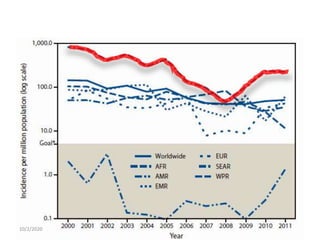
• > 30 million people are affected each year by
measles
• It is a leading killer among
– vaccine preventable diseases of childhood
10/2/2020
10/2/2020
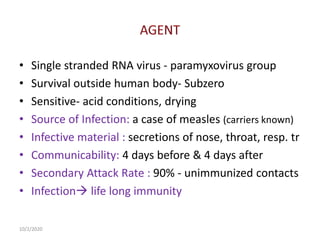
• Single stranded RNA virus - paramyxovirus group
• Survival outside human body- Subzero
• Sensitive- acid conditions, drying
• Source of Infection: a case of measles (carriers known)
• Infective material : secretions of nose, throat, resp. tr
• Communicability: 4 days before & 4 days after
• Secondary Attack Rate : 90% - unimmunized contacts
• Infection life long immunity
10/2/2020
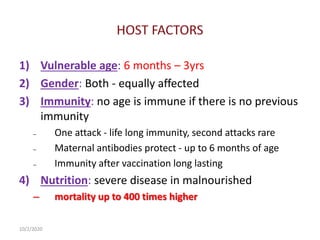
1) Vulnerable age: 6 months – 3yrs
2) Gender: Both - equally affected
3) Immunity: no age is immune if there is no previous
immunity
– One attack - life long immunity, second attacks rare
– Maternal antibodies protect - up to 6 months of age
– Immunity after vaccination long lasting
4) Nutrition: severe disease in malnourished
– mortality up to 400 times higher
10/2/2020
• Can spread in any season
• Increased transmission during winter
• Poor socio-economic conditions- favour attack
10/2/2020
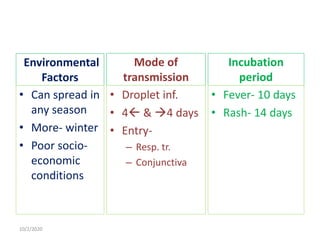
Environmental
Factors
• Can spread in
any season
• More- winter
• Poor socio-
economic
conditions
Mode of
transmission
• Droplet inf.
• 4 & 4 days
• Entry-
– Resp. tr.
– Conjunctiva
Incubation
period
• Fever- 10 days
• Rash- 14 days
10/2/2020
1. PRODROMAL STAGE
2. ERUPTIVE STAGE
3. POST-MEASLES STAGE
10/2/2020
• Begins 10 days after infection
– fever, sneezing, cough, coryza, conjunctivitis,
lacrimation, photophobia
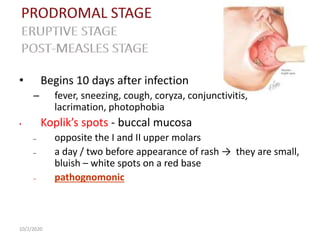
• Koplik’s spots - buccal mucosa
– opposite the I and II upper molars
– a day / two before appearance of rash → they are small,
bluish – white spots on a red base
– pathognomonic
10/2/2020
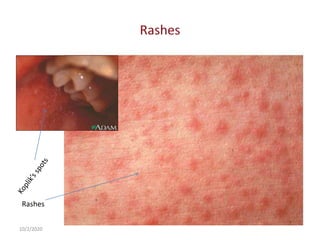
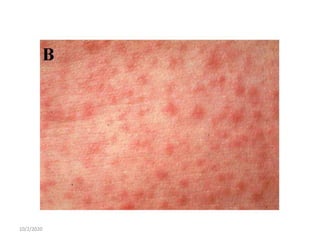
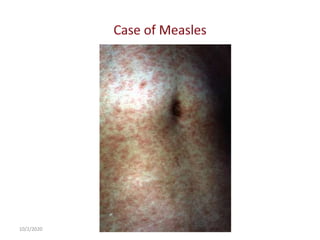
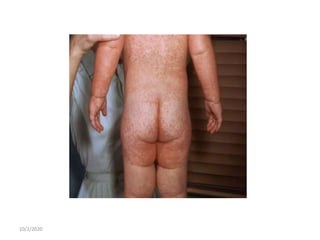
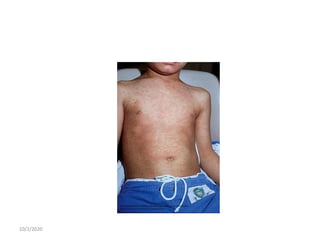
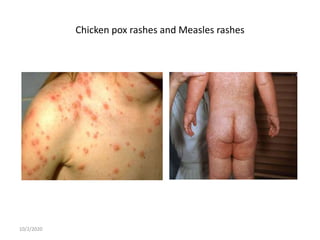
• Rash- dusky red, macular/ maculopapular → face
(at hair line/forehead) → neck → extends down the
body in 2–3 days → to lower extremities
• Disappears in 3 – 4 days → fades in the same order
of the appearance end of disease
10/2/2020
Rashes
10/2/2020
10/2/2020
10/2/2020
10/2/2020
10/2/2020
Chicken pox rashes and Measles rashes
10/2/2020
• child has lost weight remains weak
• failure to recover 
• gradual deterioration into chronic illness 
• susceptible to other bacterial and viral infection,
diarrhoea, pyogenic inf, reactivation of pulmonary
tuberculosis, growth retardation
10/2/2020
• The risk of complications and death- highest in
young children and adults
• The most common complications of measles are
otitis media, diarrhoea and pneumonia
• Less common complications-
– sinusitis, mastoiditis, myocarditis, keratoconjunctivitis,
mesenteric adenitis, hepatitis, and thrombocytopenic
purpura
10/2/2020
• Measles infection during pregnancy is
associated with spontaneous abortion
and with delivery of low birth weight
infants
10/2/2020
• In addition to the acute complications, measles virus
can cause a degenerative disorder of the central
nervous system known as Subacute Sclerosing
PanEncephalitis (SSPE)
• The reported risk of SSPE ranges from 1 case per
100,000 measles cases in persons infected after four
years of age to 18 cases per 100,000 measles cases in
persons infected in infancy
10/2/2020
Prevention
10/2/2020
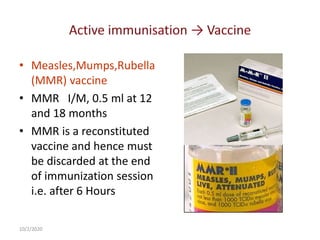
• Measles,Mumps,Rubella
(MMR) vaccine
• MMR I/M, 0.5 ml at 12
and 18 months
• MMR is a reconstituted
vaccine and hence must
be discarded at the end
of immunization session
i.e. after 6 Hours
10/2/2020
• Measles vaccine is contraindicated in persons with
immunodeficiency or immuno suppression
• However, it should be administered to persons with
asymptomatic human immunodeficiency virus (HIV)
infection since measles disease may be severe or
fatal in such persons
• Severely immunocompromised persons with HIV
infection should not be vaccinated
10/2/2020
• Passive immunity against measles disease can be
induced by the administration of commercially
prepared immune globulin (IG) (formerly called
immune serum globulin [ISG]), which typically has a
high measles antibody titer
• Administration of 0.25 mL of IG per kilogram
(maximum dose 15 mL) can modify or prevent the
development of measles in the exposed person
10/2/2020

20180122 measles

  • 1.
    MEASLES [RUBEOLA] Dr. SushritA. Neelopant Assistant Professor, Department of Community Medicine RIMS, Raichur 10/2/2020
  • 2.
    • An acutehighly infectious disease of childhood caused by - A - myxovirus • ‘Rubeola’ = red spots • Endemic in all parts of the world • Before availability of vaccine, it killed 7-8M children a year, today it still kills about 1m people 10/2/2020
  • 3.
    • Clinical: – Fever,coryza, cough  Rash • Developing countries – morbidity & mortality high • Types of Measles: – Purpuric measles – Haemorrhagic measles – Atypical measles – Modified measles 10/2/2020
  • 4.
    • > 30million people are affected each year by measles • It is a leading killer among – vaccine preventable diseases of childhood 10/2/2020
  • 5.
  • 6.
    • Single strandedRNA virus - paramyxovirus group • Survival outside human body- Subzero • Sensitive- acid conditions, drying • Source of Infection: a case of measles (carriers known) • Infective material : secretions of nose, throat, resp. tr • Communicability: 4 days before & 4 days after • Secondary Attack Rate : 90% - unimmunized contacts • Infection life long immunity 10/2/2020
  • 7.
    1) Vulnerable age:6 months – 3yrs 2) Gender: Both - equally affected 3) Immunity: no age is immune if there is no previous immunity – One attack - life long immunity, second attacks rare – Maternal antibodies protect - up to 6 months of age – Immunity after vaccination long lasting 4) Nutrition: severe disease in malnourished – mortality up to 400 times higher 10/2/2020
  • 8.
    • Can spreadin any season • Increased transmission during winter • Poor socio-economic conditions- favour attack 10/2/2020
  • 9.
    Environmental Factors • Can spreadin any season • More- winter • Poor socio- economic conditions Mode of transmission • Droplet inf. • 4 & 4 days • Entry- – Resp. tr. – Conjunctiva Incubation period • Fever- 10 days • Rash- 14 days 10/2/2020
  • 10.
    1. PRODROMAL STAGE 2.ERUPTIVE STAGE 3. POST-MEASLES STAGE 10/2/2020
  • 11.
    • Begins 10days after infection – fever, sneezing, cough, coryza, conjunctivitis, lacrimation, photophobia • Koplik’s spots - buccal mucosa – opposite the I and II upper molars – a day / two before appearance of rash → they are small, bluish – white spots on a red base – pathognomonic 10/2/2020
  • 12.
    • Rash- duskyred, macular/ maculopapular → face (at hair line/forehead) → neck → extends down the body in 2–3 days → to lower extremities • Disappears in 3 – 4 days → fades in the same order of the appearance end of disease 10/2/2020
  • 13.
  • 14.
  • 15.
  • 16.
  • 17.
  • 18.
    Chicken pox rashesand Measles rashes 10/2/2020
  • 19.
    • child haslost weight remains weak • failure to recover  • gradual deterioration into chronic illness  • susceptible to other bacterial and viral infection, diarrhoea, pyogenic inf, reactivation of pulmonary tuberculosis, growth retardation 10/2/2020
  • 20.
    • The riskof complications and death- highest in young children and adults • The most common complications of measles are otitis media, diarrhoea and pneumonia • Less common complications- – sinusitis, mastoiditis, myocarditis, keratoconjunctivitis, mesenteric adenitis, hepatitis, and thrombocytopenic purpura 10/2/2020
  • 21.
    • Measles infectionduring pregnancy is associated with spontaneous abortion and with delivery of low birth weight infants 10/2/2020
  • 22.
    • In additionto the acute complications, measles virus can cause a degenerative disorder of the central nervous system known as Subacute Sclerosing PanEncephalitis (SSPE) • The reported risk of SSPE ranges from 1 case per 100,000 measles cases in persons infected after four years of age to 18 cases per 100,000 measles cases in persons infected in infancy 10/2/2020
  • 23.
  • 24.
    • Measles,Mumps,Rubella (MMR) vaccine •MMR I/M, 0.5 ml at 12 and 18 months • MMR is a reconstituted vaccine and hence must be discarded at the end of immunization session i.e. after 6 Hours 10/2/2020
  • 25.
    • Measles vaccineis contraindicated in persons with immunodeficiency or immuno suppression • However, it should be administered to persons with asymptomatic human immunodeficiency virus (HIV) infection since measles disease may be severe or fatal in such persons • Severely immunocompromised persons with HIV infection should not be vaccinated 10/2/2020
  • 26.
    • Passive immunityagainst measles disease can be induced by the administration of commercially prepared immune globulin (IG) (formerly called immune serum globulin [ISG]), which typically has a high measles antibody titer • Administration of 0.25 mL of IG per kilogram (maximum dose 15 mL) can modify or prevent the development of measles in the exposed person 10/2/2020