TUBERCULOSIS
Dr. Sushrit A. Neelopant
Assistant Professor,
Department of Community Medicine
RIMS, Raichur
• Cause- M. Tuberculosis
• Organs-
– Lungs
– Intestine, meninges, bones, joints, LN, skin
– Humans, Cattle
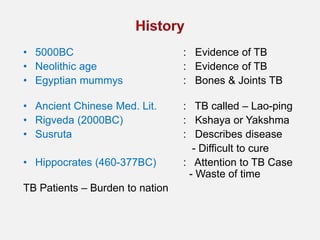
• 5000BC : Evidence of TB
• Neolithic age : Evidence of TB
• Egyptian mummys : Bones & Joints TB
• Ancient Chinese Med. Lit. : TB called – Lao-ping
• Rigveda (2000BC) : Kshaya or Yakshma
• Susruta : Describes disease
- Difficult to cure
• Hippocrates (460-377BC) : Attention to TB Case
- Waste of time
TB Patients – Burden to nation
• In England (11th to 12th centuries):
 TB known as – King’s Evil
 Trt. for TB : King Edward – Feet touching,
– Blessings
: Queen Anne
• Franciscus sylvius (1614–1672 AD):
 Word used – Tubercle
 Tubercles Seen – Lungs of patients
• Gaspard Laurent Bayle (1774 – 1816 AD):
Word first time used : Tuberculosis
• Robert Koch (1882 ) : Discovery of TB bacilli
• Roentgen (1895) : X-ray
• Calmette & Guerin (1924) : BCG Vaccine
• Jesus Christ
• Theodore Laennaec
• Ramanujan
• Kamala Nehru
• Kumar Gandharva
• Jinna
• Nelson Mandela etc.
• 1/3- affected
• 5-10% - will develop TB
• New cases % deaths- developing countries
• 2013- 9M- 6.1M reported to WHO
• Treatment success rate- 86%
• 2014-
– Incidence- 176/L
– Prevalence- 227/L
– Mortality- 21/L
• 39% of global burden- SEAR
• 24% - India
• 3.4M- India, Bangladesh, Indonesia, Myanmar, Thailand
• Ped. TB- 10%
• Highest TB burden
• 2015-
– Prev- 195/ L
– Incidence- 167/ L
– Mortality- 17/ L
• Incidence
• Prevalence
• Mortality from TB
• Case fatality rate
• Case notification rate
• Case detection rate
• Prevalence of DR cases
• Prevalence of infection
• Incidence of infection
• Bacteriologically confirmed TB
• Clinically diagnosed TB
• Anatomical site- Pulm., extra pulm.
• History of prev. Rx-
– New pt.,
– prev. Rx pt- Relapse, Ta Failure, Ta Loss to Follow up,
other prev. Rx, Pt.s with unknown prev. TB Rx
• Drug resistance
– Mono
– Poly – other than I, R
– Multi – both I, R
– Extensive – MDR + FQ + Inj- C, K, A
– Rif. Res.
• Cured –
• Treatment completed-
• Treatment failed –
• Died-
• Lost to follow-up-
• Not evaluated -
• Treatment success -
Natural history
1. Agent factors
• Agent: Mycobacterium tubercle bacilli
• Commonly known as- Koch’s Bacillus or tubercle bacillus
or acid fast bacillus.
• Discovered by Dr. Robert Koch on 24th March in 1882.
(World TB day)
• Wells in 1934 demonstrated a plausible mechanism of
airborne spread.
• Facultative intracellular parasite
• Gram positive, acid fast bacilli
• Straight or slightly curved, Thick cell wall
• Measures 0.5μm by 3μm
• Culture characteristics- grows slowly: 14 -15hrs
• Optimum pH required is 6.4 – 7.0
• Media for TB bacilli
• Among all strains, of importance to man are
• Human strain- man
• Bovine strain- cattle
Solid media Liquid media
L. J. medium Dubos medium
Dorset Middle brooks
Petragnini Sula’s
Loeffer Sautan’s
Tarshis Proskauer & Becks
Source of infection :
• Human source
• Most common is a human case with sputum-positive for
TB bacilli, & who has either received no treatment or has
not been treated fully.
Mode of spread:
• Through droplet nuclei- aerosolized by coughing,
sneezing & speaking.
• 3000 infectious nuclei per cough
• Tiny droplets dry rapidly
• The smallest (<5 to 10 μm in diameter) may remain
suspended in the air for several hours & gain direct
access to the terminal alveoli when inhaled.
• An estimated annual average of 10-15 persons contract the
infection from one case of infectious pulmonary TB.
• Bovine source: infected milk
Communicability:
• Patients are infective as long as they remain untreated.
Effective anti- TB treatment reduces infectivity by 90% within
48hours.
2. Host factors
• Age – affects all, mainly 15-54years productive age
group
• In India from an average 2% in 0-14yrs to almost 20% at
15-20 years of age.
• Sex – more common in males.
• Nutrition – malnutrition widely predisposes TB.
• Immunity – no inherited immunity against TB
• Acquired as a result of natural infection or BCG
vaccination.
• Low immunity makes person susceptible to TB as seen
in HIV infection.
3. Socio-economic factors
• Social disease with medical aspects.
• Barometer of social welfare.
• Social factors – overcrowding, poor quality of life, poor
housing, under nutrition, lack of education, large families,
lack of awareness of causes of illness, etc.
• Tobacco, smoking, alcoholism & corticosteroids therapy
also reduce resistance against infection.
-- Host – Parasite Relationship
-- Host - Immunity, DTH
-- Parasite – No., Virulence
Lung – commonest involvement
a) Constitutional Symptoms
Fever, Night sweats, Psychoneurosis,
Digestive disturbances, Weight loss
Anorexia, Malaise
b) Pulmonary Symptoms
Cough – 90%
Expectoration – 85%
Haemoptysis – 42%
Dyspnea – 35%
Chest Pain – 20%
c) Extra-pulmonary Symptoms
Lymphadenopathy
1. Curative component
1. Case finding
2. Treatment
2. Preventive component
1. BCG Vaccination
1. Sputum examination- microscopy
A. Collection
a. Day 1- sample 1- on the spot sample
b. Day 2- sample 2- early morning sample
OR
c. Pt. From far – 2 samples 1 hr apart
B. ZN
C. Slide reporting No. Of AFB Result
Nil/ 100 OIF 0
1-9/ 100 OIF Scanty
10-99/ 100 OIF +
1-10/ 1 OIF ++
> 10/ 1 OIF +++
2. Fluorescence microscopy
A. Industrialized countries
B. Auramine stain
C. Speed- 1-2 min
D. Field of view – 5-10 times
3. LED microscopy
A. Superior to conventional microscopy
B. Recommended- phased manner
• CXR
• Smear –Ve PTB & Children
• Pleural, pericardial effusion
• Miliary TB
• Exclude bronchiectasis, aspergiloma
Solid media Liquid media
L. J. medium Dubos medium
Dorset Middle brooks 7H10/ 7H11
Petragnini Kircher’s/ Middle brook 7H9
Loeffer Sula’s
Tarshis Sautan’s
Proskauer & Becks
• Micro colony detection on solid media
– Middle brook 7H11 incubate- Examine alternate day
– MTB- detection in <7 days
• Radiometric BACTEC 460 TB method
– C labelled palmitic acid in 7H12,
– Detection- metab.
– GI value
• MGIT 960
• MB/ BACT system
– Non-radiometric continuous monitoring system
– Colorimetric detection – CO2
• Genotypic
– PCR
– TMA and NAA
– Cartridge based NAAT
– GeneXpert MTB/ RIF
• Phenotypic
– FAST Plaque TB
• MycoDot
• Detect- TB (ELISA)
• Pathozyme Myco (ELISA)
• Antigen A60 (ELISA)
• Von Pirquet- 1907
• Estimate- prev.
• Tuberculin-
– PPD-S (5 TU, 0.1µg/ 0.1ml) &
– PPD-RT 23 with Tween 80 (1 TU)
• Montoux test-
– 1 TU, ID, forearm, pale wheal- 6-10mm
– Result- 48-96 hrs, ideal- 72hrs
• Erythma, Induration-
– >10mm- +ve, 6-9mm- doubtful, <5mm- more risk
• Bactericidal
– Rifampicin- 450mg
– INH- 600mg
– Streptomycin- 750mg
– Pyrazinamide- 1500mg
• Bacteriostatic
– Ethambutol- 1200mg
• Fluoroquinolones
• Ethionamide
• Capreomycin
• Kanamycin, Amikacin
• Cycloserine
• Thioacetazone
• Macrolides
• Category I- Red box-
– New sputum +ve
– New sputum smear –ve
– New extra-pulmonary
– New others
• Category II- Blue box
– Sputum smear +ve Relapse
– Sputum smear +ve Failure
– Sputum smear +ve treatment after default
• MDR-TB
– 6 (9)- Km Lvx Eto Cs Z E H
– 18- Lvx Eto Cs E H
– Reserve/ substitute- PAS, Mfx, Cm
• XDR-TB
– 6-12- Cm, PAS, Mfx, High dose- H, Cfz, Lzd, Amx/Clv
– 18- PAS, Mfx, High dose-H, Cfz, Lzd, Amx/Clv
– Reserve/ substitute- Clarithromycin, Thiacetazone
• Thioacetazone- Severe rash, agranulocytosis
• Streptomycin- Hearing loss / disturbed balance
• Ethambutol- Visual disturbance
• Rifampicin- Renal failure, shock, thrombocytopaenia
• Pyrazinamide- Hepatitis
• Danish 1331
• Dose
• Administration
• Age
• Phenomena after vaccination
• Complications- ulcer, supp. Lymphadenitis, dissem. TB
• Protective value

20180218 tuberculosis

  • 1.
    TUBERCULOSIS Dr. Sushrit A.Neelopant Assistant Professor, Department of Community Medicine RIMS, Raichur
  • 2.
    • Cause- M.Tuberculosis • Organs- – Lungs – Intestine, meninges, bones, joints, LN, skin – Humans, Cattle
  • 3.
    • 5000BC :Evidence of TB • Neolithic age : Evidence of TB • Egyptian mummys : Bones & Joints TB • Ancient Chinese Med. Lit. : TB called – Lao-ping • Rigveda (2000BC) : Kshaya or Yakshma • Susruta : Describes disease - Difficult to cure • Hippocrates (460-377BC) : Attention to TB Case - Waste of time TB Patients – Burden to nation
  • 4.
    • In England(11th to 12th centuries):  TB known as – King’s Evil  Trt. for TB : King Edward – Feet touching, – Blessings : Queen Anne • Franciscus sylvius (1614–1672 AD):  Word used – Tubercle  Tubercles Seen – Lungs of patients
  • 5.
    • Gaspard LaurentBayle (1774 – 1816 AD): Word first time used : Tuberculosis • Robert Koch (1882 ) : Discovery of TB bacilli • Roentgen (1895) : X-ray • Calmette & Guerin (1924) : BCG Vaccine
  • 6.
    • Jesus Christ •Theodore Laennaec • Ramanujan • Kamala Nehru • Kumar Gandharva • Jinna • Nelson Mandela etc.
  • 7.
    • 1/3- affected •5-10% - will develop TB • New cases % deaths- developing countries • 2013- 9M- 6.1M reported to WHO • Treatment success rate- 86% • 2014- – Incidence- 176/L – Prevalence- 227/L – Mortality- 21/L
  • 8.
    • 39% ofglobal burden- SEAR • 24% - India • 3.4M- India, Bangladesh, Indonesia, Myanmar, Thailand • Ped. TB- 10%
  • 9.
    • Highest TBburden • 2015- – Prev- 195/ L – Incidence- 167/ L – Mortality- 17/ L
  • 10.
    • Incidence • Prevalence •Mortality from TB • Case fatality rate • Case notification rate • Case detection rate • Prevalence of DR cases • Prevalence of infection • Incidence of infection
  • 11.
    • Bacteriologically confirmedTB • Clinically diagnosed TB
  • 12.
    • Anatomical site-Pulm., extra pulm. • History of prev. Rx- – New pt., – prev. Rx pt- Relapse, Ta Failure, Ta Loss to Follow up, other prev. Rx, Pt.s with unknown prev. TB Rx • Drug resistance – Mono – Poly – other than I, R – Multi – both I, R – Extensive – MDR + FQ + Inj- C, K, A – Rif. Res.
  • 13.
    • Cured – •Treatment completed- • Treatment failed – • Died- • Lost to follow-up- • Not evaluated - • Treatment success -
  • 14.
    Natural history 1. Agentfactors • Agent: Mycobacterium tubercle bacilli • Commonly known as- Koch’s Bacillus or tubercle bacillus or acid fast bacillus. • Discovered by Dr. Robert Koch on 24th March in 1882. (World TB day) • Wells in 1934 demonstrated a plausible mechanism of airborne spread.
  • 15.
    • Facultative intracellularparasite • Gram positive, acid fast bacilli • Straight or slightly curved, Thick cell wall • Measures 0.5μm by 3μm • Culture characteristics- grows slowly: 14 -15hrs • Optimum pH required is 6.4 – 7.0
  • 16.
    • Media forTB bacilli • Among all strains, of importance to man are • Human strain- man • Bovine strain- cattle Solid media Liquid media L. J. medium Dubos medium Dorset Middle brooks Petragnini Sula’s Loeffer Sautan’s Tarshis Proskauer & Becks
  • 17.
    Source of infection: • Human source • Most common is a human case with sputum-positive for TB bacilli, & who has either received no treatment or has not been treated fully.
  • 18.
    Mode of spread: •Through droplet nuclei- aerosolized by coughing, sneezing & speaking. • 3000 infectious nuclei per cough • Tiny droplets dry rapidly • The smallest (<5 to 10 μm in diameter) may remain suspended in the air for several hours & gain direct access to the terminal alveoli when inhaled.
  • 19.
    • An estimatedannual average of 10-15 persons contract the infection from one case of infectious pulmonary TB. • Bovine source: infected milk Communicability: • Patients are infective as long as they remain untreated. Effective anti- TB treatment reduces infectivity by 90% within 48hours.
  • 20.
    2. Host factors •Age – affects all, mainly 15-54years productive age group • In India from an average 2% in 0-14yrs to almost 20% at 15-20 years of age. • Sex – more common in males.
  • 21.
    • Nutrition –malnutrition widely predisposes TB. • Immunity – no inherited immunity against TB • Acquired as a result of natural infection or BCG vaccination. • Low immunity makes person susceptible to TB as seen in HIV infection.
  • 22.
    3. Socio-economic factors •Social disease with medical aspects. • Barometer of social welfare. • Social factors – overcrowding, poor quality of life, poor housing, under nutrition, lack of education, large families, lack of awareness of causes of illness, etc. • Tobacco, smoking, alcoholism & corticosteroids therapy also reduce resistance against infection.
  • 23.
    -- Host –Parasite Relationship -- Host - Immunity, DTH -- Parasite – No., Virulence Lung – commonest involvement a) Constitutional Symptoms Fever, Night sweats, Psychoneurosis, Digestive disturbances, Weight loss Anorexia, Malaise
  • 24.
    b) Pulmonary Symptoms Cough– 90% Expectoration – 85% Haemoptysis – 42% Dyspnea – 35% Chest Pain – 20% c) Extra-pulmonary Symptoms Lymphadenopathy
  • 25.
    1. Curative component 1.Case finding 2. Treatment 2. Preventive component 1. BCG Vaccination
  • 26.
    1. Sputum examination-microscopy A. Collection a. Day 1- sample 1- on the spot sample b. Day 2- sample 2- early morning sample OR c. Pt. From far – 2 samples 1 hr apart B. ZN C. Slide reporting No. Of AFB Result Nil/ 100 OIF 0 1-9/ 100 OIF Scanty 10-99/ 100 OIF + 1-10/ 1 OIF ++ > 10/ 1 OIF +++
  • 27.
    2. Fluorescence microscopy A.Industrialized countries B. Auramine stain C. Speed- 1-2 min D. Field of view – 5-10 times 3. LED microscopy A. Superior to conventional microscopy B. Recommended- phased manner
  • 28.
    • CXR • Smear–Ve PTB & Children • Pleural, pericardial effusion • Miliary TB • Exclude bronchiectasis, aspergiloma
  • 29.
    Solid media Liquidmedia L. J. medium Dubos medium Dorset Middle brooks 7H10/ 7H11 Petragnini Kircher’s/ Middle brook 7H9 Loeffer Sula’s Tarshis Sautan’s Proskauer & Becks
  • 30.
    • Micro colonydetection on solid media – Middle brook 7H11 incubate- Examine alternate day – MTB- detection in <7 days • Radiometric BACTEC 460 TB method – C labelled palmitic acid in 7H12, – Detection- metab. – GI value • MGIT 960 • MB/ BACT system – Non-radiometric continuous monitoring system – Colorimetric detection – CO2
  • 31.
    • Genotypic – PCR –TMA and NAA – Cartridge based NAAT – GeneXpert MTB/ RIF • Phenotypic – FAST Plaque TB
  • 32.
    • MycoDot • Detect-TB (ELISA) • Pathozyme Myco (ELISA) • Antigen A60 (ELISA)
  • 33.
    • Von Pirquet-1907 • Estimate- prev. • Tuberculin- – PPD-S (5 TU, 0.1µg/ 0.1ml) & – PPD-RT 23 with Tween 80 (1 TU) • Montoux test- – 1 TU, ID, forearm, pale wheal- 6-10mm – Result- 48-96 hrs, ideal- 72hrs • Erythma, Induration- – >10mm- +ve, 6-9mm- doubtful, <5mm- more risk
  • 36.
    • Bactericidal – Rifampicin-450mg – INH- 600mg – Streptomycin- 750mg – Pyrazinamide- 1500mg • Bacteriostatic – Ethambutol- 1200mg
  • 37.
    • Fluoroquinolones • Ethionamide •Capreomycin • Kanamycin, Amikacin • Cycloserine • Thioacetazone • Macrolides
  • 38.
    • Category I-Red box- – New sputum +ve – New sputum smear –ve – New extra-pulmonary – New others • Category II- Blue box – Sputum smear +ve Relapse – Sputum smear +ve Failure – Sputum smear +ve treatment after default
  • 39.
    • MDR-TB – 6(9)- Km Lvx Eto Cs Z E H – 18- Lvx Eto Cs E H – Reserve/ substitute- PAS, Mfx, Cm • XDR-TB – 6-12- Cm, PAS, Mfx, High dose- H, Cfz, Lzd, Amx/Clv – 18- PAS, Mfx, High dose-H, Cfz, Lzd, Amx/Clv – Reserve/ substitute- Clarithromycin, Thiacetazone
  • 40.
    • Thioacetazone- Severerash, agranulocytosis • Streptomycin- Hearing loss / disturbed balance • Ethambutol- Visual disturbance • Rifampicin- Renal failure, shock, thrombocytopaenia • Pyrazinamide- Hepatitis
  • 41.
    • Danish 1331 •Dose • Administration • Age • Phenomena after vaccination • Complications- ulcer, supp. Lymphadenitis, dissem. TB • Protective value