HIV/AIDS
1
DEFINITION
• AIDS - a fatal illness caused by a retrovirus
known as HIV which breaks down the body’s
immune system, leaving the victim vulnerable
to a host of life threatening opportunistic
infections, neurological disorders, or unusual
malignancies.
• “Slim disease”
• AIDS – last stage of HIV infection.
2
WHO/NACO definition of AIDS
Clinical AIDS in an adult
Positive test for HIV antibody – 2 separate tests using
2 different antigens and one of these criteria,
• Weight loss >10% ; Chronic diarrhoea >1 month.
• Disseminated, miliary or extra pulmonary TB.
• Neurological impairment.
• Candidiasis of the esophagus with diagnosable
Dysphagia along with oral Candidiasis.
• Kaposi’s sarcoma
3
WHO/NACO defn of AIDS
Clinical AIDS in children
2 major & 2 minor signs in absence of known cases of
immuno-suppression.
Major signs
• Weight loss or abnormal slow growth.
• Failure to thrive or recurrent/persistent diarrhoea
or recurrent infections or recurrent fever >1 month.
• Candidiasis or TB or Herpes zoster
4
Contd…
Minor signs
• Generalized lymphadenopathy.
• Oro-pharyngeal candidiasis.
• Repeated infections like otitis, pharyngitis.
• Persistent cough >1 month.
• Generalized dermatitis.
• Confirmed maternal HIV infection
5
INDIA – HIV/AIDS
HISTORY
• 1986-1st case of HIV in FSW of Chennai.
• 1987 – 1st case of AIDS in Mumbai.
6
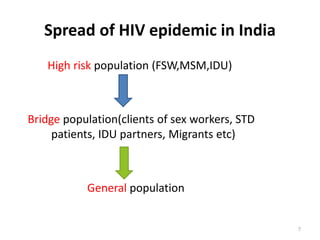
Spread of HIV epidemic in India
High risk population (FSW,MSM,IDU)
Bridge population(clients of sex workers, STD
patients, IDU partners, Migrants etc)
General population
7
Classification of states in India
a) High prevalent States
• Prevalence in antenatal women >1%
• Prevalence in high risk groups >5%.
• Maharashtra, TN, AP, Karnataka, Manipur, Nagaland.
8
b) Moderate prevalent States
• Prevalence in antenatal women <1%
• Prevalence in high risk groups >5%.
• Gujarat, Goa, Puducherry.
c) Low prevalent States
• Prevalence in antenatal women <1%
• Prevalence in high-risk groups <5%
• Rest of the states.
9
EPIDEMIOLOGICAL FACTORS
AGENT FACTORS
• Human Immuno-deficiency Virus.
• Cases and carriers – reservoir of infection.
• Blood, semen, CSF, tears, saliva, breast milk, urine,
cervical and vaginal secretions – sources of infection.
HOST FACTORS
• Sexually active persons (20-49 years).
• High risk groups
10
Strains
HIV1 HIV2
• HIV1 is more virulent than HIV2
• HIV1 – present world wide
• HIV2 – more in West Africa
• India – HIV1 & HIV2
11
Characteristics of HIV
• Fragile
• Alive in air : 7-8 seconds
• At room temp (20-250c) – in dried blood- survives for
7 days.
• Found in dead body -16th day
• Killed at 560c – 30 minutes
• Killed at 600c – 10 minutes
• Killed at 1000c – in seconds
12
High-risk groups
• Male homosexuals, bisexuals
• IV drug abusers
• Multiple sex partners
• Prostitutes, both male and female
• Clients of STD
• Migrants
• Newborn of infected mothers
• Transfusion recipients of blood and blood products
• Medical and para-medical staff
13
Modes of transmission
a) Sexual transmission
• Vaginal, anal or oral.
• More risk- presence of abrasions of skin or mucous
membrane in vagina, anus or oral cavity
b) Blood
• High risk – fresh frozen plasma, fibrinogen, anti-
haemophilic factor VIII & IX.
• Mod risk – gamma globulin, immunoglobulins of
rabies, hep B & anti-D .
• No risk – human albumin, hep vaccine, prothrombin
complex
14
c) Sharing needles and syringes
d) Mother to child transmission
• During pregnancy : 5-10 %
• During delivery : 10 %
• During breast feeding : 5-20 %
15
Risk of transmission of HIV through different
modes
Route Efficiency
• Trans. of blood/ products > 90%
• Mother to child transmission 25-35%
• Sharing needles/syringes 3-5%
• Sexual route 0.01 -1.0%
• Percutaneous exposure 0.4%
• Muco-cutaneous exposure 0.05%
16
Body Fluids
CAN TRANSMIT MAY NOT TRANSMIT
HIGH LOW NONE
Blood Saliva Tears
Rectal Secretions Vomit Sweat
Vaginal Secretions Urine Feces
Semen
Pre-cum
Breast Milk
Menstrual Blood
Brain/Spinal fluid
17
CLINICAL SPECTRUM OF HIV INFECTION
Primary
Infection
Asymptomatic
Period
Pre AIDS
syndrome AIDS
Fever, Rash,
Arthralgia, LNE
 2- 6 wks 
Generalized
Lymphadenopathy
Fever, Weight loss
Opportunistic
Infection
Malignant
diseases
Acquisition of virus
Incubation Period
DEATH
INFECTIOUS CLINICAL CONDITIONS
IN HIV / AIDS
>500
CD4
CELLS
ACUTE RETROVIRAL SYNDROME
CANDIDAL VAGINITIS
200 – 500
CD4 CELLS
PNEUMONIAS, PULMONARY TB,
HERPES ZOSTER, OROPHARYNGEAL CANDIDIASIS
ORAL HAIRY LEUKOPLAKIA, KAPOSI’S SARCOMA &
CRYPTOSPORIDIOSIS (SELF LIMITED)
<200 CD4 CELLS
PCP, MILIARY/ EXTRA PULM. TB, DISSEMINATED
HISTOPLASMOSIS & COCCIDIODOMYCOSIS &
PROGRESSIVE MULTIFOCAL
LEUKOENCEPHALOPATHY
<100 CD4 CELLS
DISSEMINATED HERPES SIMPLEX
TOXOPLASMOSIS,CRYPTOCOCCOSIS
CRYPTO / MICROSPORIDIOSIS
CANDIDAL OESOPHAGITIS
<50 CD4 CELLS
DISSEMINATED CMV
DISSEMINATED MAC
NON INFECTIOUS CLINICAL
CONDITIONS IN HIV / AIDS
>500
CD4 CELLS
PERSISTENT GENERALISED LYMPHADENOPATHY (PGL)
GULLAIN – BARRE’ SYNDROME
MYOPATHY & ASEPTIC MENINGITIS
200 – 500 CD4 CELLS
CERVICAL INTRAEPITHELIAL NEOPLASIA / CANCER
B-CELL & HODGKIN’S LYMPHOMA, ANAEMIA, PURPURA ,
MONONEURONAL MULTIPLEX
LYMPHOCYTIC INTERSTITIL PNEUMONIA (LIP)
<200 CD4 CELLS
WASTING, DEMENTIA, NON HODGKIN’S
LYMPHOMA
PERIPHERAL NEUROPATHY, VACUOLAR
MYOPATHY, PROGRESSIVE
POLYRADICULOPATHY,
CARDIOMYOPATHY
<100 CD4 CELLS
<50 CD4 CELLS CNS LYMPHOMA
Herpes zoster
Bacillary angiomatosis Sec syphillis
Molluscum contagiosum
Skin candidiasisCrusted scabies
Viral warts Herpes simplex
Pruritic papular dermatitis Tinea infection
CMV infection Pencillium marneffe
Kaposis sarcoma
Basal cell carcinoma lymphoma
Oral candidiasis
• Oral hairy leukoplakia
• Chronic gingivitis
Angular stomatitis Aphthous ulcer
CMV RETINITIS
LAB DIAGNOSIS
HIV Diagnostic Tests
• Tests that detect antibody
• Tests that detect antigen
• Tests that detect viral nucleic acid
• Tests that detect the whole virus
• Antibody Detection
 most widely used
 most effective way
• Tests divided into two broad groups
 Screening assays
 Supplemental assays
Screening Tests
• Screening tests (ELISA, Rapid, Simple)
– ELISA (2-3 hours)
– Rapid tests (minutes)
• Dot blot assays
• Particle agglutination
• HIV Spot tests
– Simple (½ hour )
• Based on ELISA principle
Lab diagnosis during window period
P24 antigen assay (<40%)
PCR
Viral Culture
Need of lab. Diagnosis in window period
Untested blood transfusion
Risky heterosexual / homosexual exposure
Needle stick injury (contaminated)
HAART
Highly active antiretroviral therapy refers to the use
of combinations of various antiretroviral drugs with
different mechanisms of action to treat HIV
Harder for HIV drug to become resistant
Ex: Atriplais
Control of AIDS
There are 4 basic approaches :
1.Prevention
2.ART
3.Specific prophylaxis
4.Primary health care
PREVENTION
a. Condom promotion
b.Prevention of STI
c.Pre and Post test counseling
d.Prevention of Blood born HIV transmission.
e.BCC(Behavioral change communication)
ANTIRETROVIRAL TREATMENT
(ART)
• ART
• Prevention of parent to child transmission (PPTCT)
• Occupational post exposure prophylaxis (PEP)
PPTCT
PREVENTION OF PARENT TO CHILD
TRANSMISSION
Mother-to-child transmission
Is the main cause of HIV infection in children
It can occur during:
• Pregnancy 5-10%
• Delivery 10 %
• Post natal period 5 – 20%
Categories of exposure
Mild exposure Mucus membrane and non-
intact skin with small
volume,eg.small bore needle
Moderate
exposure
Mucus membrane and non-
intact skin with large volume
Severe
exposure
Percutaneous with large
exposure
Exposure with >18 bore needle,
deep wound,
4.Primary health care
• Because of wide range health implications
AIDS touches all aspects of primary health
care
• So AIDS control programmes are not
developed in isolation
• Integration into country’s primary health
care system is essential
National AIDS Prevention And Control Policy
(NAPCP) 2002
National AIDS Control Programme phaseIV
• Aiming at accelerating reversal and integrating
response, the fourth National AIDS Control
Programme (NACP-IV) has now aimed at zero
infection, zero stigma and zero death.
• The focus now is on prevention of HIV, especially
among female sex workers, men having sex with
men, intravenous drug abusers, truck drivers and
migrants,”
Soil-transmitted helminthiases
• Soil-transmitted helminthiases (STH) refer to a group
of parasitic diseases caused by nematode worms
• Transmitted to humans by faecally contaminated soil.
• The soil-transmitted helminths of major concern to
humans are –
Ascaris lumbricoides
Trichuris trichiura
Necator americanus
Ancylostoma duodenale.
48
Burden of disease
• India and South Asia accounts for: Ascariasis 237
million cases (29 % of global burden — 0.4 — 3.0
million DALY)
• Trichuriasis 147 million cases (24 % of global burden
— 0.5 — 1.5 million DALY)
• Hookworm infection 130 million cases (23 % of
global burden — 0.6 - 5.6 million DALY).
49
Transmission
• Soil transmitted helminthes are transmitted by eggs
that are passed in the faeces of infected people.
• Adult worms live in the intestine where they produce
thousands of eggs each day.
• In areas that Lack adequate sanitation, these eggs
contaminate the soil.
• People become infected with A. Iambricoides and T
trichura by ingesting infective parasite eggs.
50
This can happen in several ways.
• Eggs that are attached to vegetables are ingested
when the vegetables are not carefully cooked,
washed or peeled.
• Eggs are ingested from contaminated water sources.
• Eggs are ingested by children who play in soil and
then put their hands in their mouths without
washing them.
51
• Hookworm eggs hatch in the soil, releasing larvae
that mature into a form that can actively penetrate
the skin.
• People become infected with hookworm primarily by
walking barefoot on the contaminated soil.
• There is no direct person-to-person transmission, or
infection from fresh faeces
• Eggs need three weeks to mature in the soil before
they become infective.
52
• These worms do not multiply in the human host.
• Reinfection occurs only as a result of contact with
infective stages in the environment.
53
Signs and symptoms
• Morbidity is related to the number of worms
harbored.
• People with light infections usually have no
symptoms.
• Heavier infections can cause a range of symptoms
including intestinal manifestations( diarrhea,
abdominal pain) general malaise and weakness
impaired cognitive and physical development.
• Hookworms cause chronic intestinal blood loss that
can result in anemia.
54
Nutritional effects
Soil-transmitted helminthes impair the nutritional
status of the people they infect in multiple ways.
• The worms feed on host tissues, including blood,
which leads to a loss of iron and protein
• The worms increase malabsorption of nutrients.
• In addition, roundworm may possibly compete for
vitamin A in the intestine.
55
• Some soil-transmitted helminths also cause loss of
appetite and therefore a reduction of nutritional
intake and physical fitness.
• In particular, T trichiura can cause diarrhoea and
dysentery.
56
Global strategy for controlling
STH and neglected tropical diseases:
• Relatively low mortality compared with the "big
three" (HIV/AIDS, malaria and tuberculosis.)
• Many of these diseases had been neglected in the
global public health agenda .
• In 2003, a historical paradigm shift occurred for a
number of chronically endemic tropical diseases,
now known collectively as neglected tropical
diseases (NTDs).
57
• In 2005 in Berlin, Germany, WHO convened a
meeting of partners and experts to secure strategic
and technical guidance and take this agenda forward.
• A NTD control strategy was defined by WHO in 2006.
58
Controlling morbidity:
• The strategy recommended by WHO to control
morbidity from STH
• Involves the periodic administration of anthelminthic
medicines
• Mainly single-dose albendazole (400 mg) and
mebendazole (500 mg):
59
Recommended strategy for STH control
• Integration within existing public-health activities -
reduces costs and increase effectiveness.
• Integrated preventive chemotherapy.
• A rational approach to control STH,lymphatic
filariasis onchocerciasis, schistosomiasis and blinding
trachoma.
60
Types of Interventions available for STH
control:
• Health care dependent
Drugs
Diagnostics Vaccines
Others (e.g. male circumcision, behavior change)
61
• Health care Independent
Environment
Water, Sanitation
Air pollution - Indoor & Outdoor
• Safety
• Vector Control
• Behavior Change
• Others?
62
• Providing sanitary latrine is an integral part of STH
control.
• Use of protective foot ware.
• Use of safe drinking water
• Washing of food articles, especially vegetables in
clean running water
• Clipping of nails.
63

20171007 hiv

  • 1.
  • 2.
    DEFINITION • AIDS -a fatal illness caused by a retrovirus known as HIV which breaks down the body’s immune system, leaving the victim vulnerable to a host of life threatening opportunistic infections, neurological disorders, or unusual malignancies. • “Slim disease” • AIDS – last stage of HIV infection. 2
  • 3.
    WHO/NACO definition ofAIDS Clinical AIDS in an adult Positive test for HIV antibody – 2 separate tests using 2 different antigens and one of these criteria, • Weight loss >10% ; Chronic diarrhoea >1 month. • Disseminated, miliary or extra pulmonary TB. • Neurological impairment. • Candidiasis of the esophagus with diagnosable Dysphagia along with oral Candidiasis. • Kaposi’s sarcoma 3
  • 4.
    WHO/NACO defn ofAIDS Clinical AIDS in children 2 major & 2 minor signs in absence of known cases of immuno-suppression. Major signs • Weight loss or abnormal slow growth. • Failure to thrive or recurrent/persistent diarrhoea or recurrent infections or recurrent fever >1 month. • Candidiasis or TB or Herpes zoster 4
  • 5.
    Contd… Minor signs • Generalizedlymphadenopathy. • Oro-pharyngeal candidiasis. • Repeated infections like otitis, pharyngitis. • Persistent cough >1 month. • Generalized dermatitis. • Confirmed maternal HIV infection 5
  • 6.
    INDIA – HIV/AIDS HISTORY •1986-1st case of HIV in FSW of Chennai. • 1987 – 1st case of AIDS in Mumbai. 6
  • 7.
    Spread of HIVepidemic in India High risk population (FSW,MSM,IDU) Bridge population(clients of sex workers, STD patients, IDU partners, Migrants etc) General population 7
  • 8.
    Classification of statesin India a) High prevalent States • Prevalence in antenatal women >1% • Prevalence in high risk groups >5%. • Maharashtra, TN, AP, Karnataka, Manipur, Nagaland. 8
  • 9.
    b) Moderate prevalentStates • Prevalence in antenatal women <1% • Prevalence in high risk groups >5%. • Gujarat, Goa, Puducherry. c) Low prevalent States • Prevalence in antenatal women <1% • Prevalence in high-risk groups <5% • Rest of the states. 9
  • 10.
    EPIDEMIOLOGICAL FACTORS AGENT FACTORS •Human Immuno-deficiency Virus. • Cases and carriers – reservoir of infection. • Blood, semen, CSF, tears, saliva, breast milk, urine, cervical and vaginal secretions – sources of infection. HOST FACTORS • Sexually active persons (20-49 years). • High risk groups 10
  • 11.
    Strains HIV1 HIV2 • HIV1is more virulent than HIV2 • HIV1 – present world wide • HIV2 – more in West Africa • India – HIV1 & HIV2 11
  • 12.
    Characteristics of HIV •Fragile • Alive in air : 7-8 seconds • At room temp (20-250c) – in dried blood- survives for 7 days. • Found in dead body -16th day • Killed at 560c – 30 minutes • Killed at 600c – 10 minutes • Killed at 1000c – in seconds 12
  • 13.
    High-risk groups • Malehomosexuals, bisexuals • IV drug abusers • Multiple sex partners • Prostitutes, both male and female • Clients of STD • Migrants • Newborn of infected mothers • Transfusion recipients of blood and blood products • Medical and para-medical staff 13
  • 14.
    Modes of transmission a)Sexual transmission • Vaginal, anal or oral. • More risk- presence of abrasions of skin or mucous membrane in vagina, anus or oral cavity b) Blood • High risk – fresh frozen plasma, fibrinogen, anti- haemophilic factor VIII & IX. • Mod risk – gamma globulin, immunoglobulins of rabies, hep B & anti-D . • No risk – human albumin, hep vaccine, prothrombin complex 14
  • 15.
    c) Sharing needlesand syringes d) Mother to child transmission • During pregnancy : 5-10 % • During delivery : 10 % • During breast feeding : 5-20 % 15
  • 16.
    Risk of transmissionof HIV through different modes Route Efficiency • Trans. of blood/ products > 90% • Mother to child transmission 25-35% • Sharing needles/syringes 3-5% • Sexual route 0.01 -1.0% • Percutaneous exposure 0.4% • Muco-cutaneous exposure 0.05% 16
  • 17.
    Body Fluids CAN TRANSMITMAY NOT TRANSMIT HIGH LOW NONE Blood Saliva Tears Rectal Secretions Vomit Sweat Vaginal Secretions Urine Feces Semen Pre-cum Breast Milk Menstrual Blood Brain/Spinal fluid 17
  • 18.
    CLINICAL SPECTRUM OFHIV INFECTION Primary Infection Asymptomatic Period Pre AIDS syndrome AIDS Fever, Rash, Arthralgia, LNE  2- 6 wks  Generalized Lymphadenopathy Fever, Weight loss Opportunistic Infection Malignant diseases Acquisition of virus Incubation Period DEATH
  • 19.
    INFECTIOUS CLINICAL CONDITIONS INHIV / AIDS >500 CD4 CELLS ACUTE RETROVIRAL SYNDROME CANDIDAL VAGINITIS 200 – 500 CD4 CELLS PNEUMONIAS, PULMONARY TB, HERPES ZOSTER, OROPHARYNGEAL CANDIDIASIS ORAL HAIRY LEUKOPLAKIA, KAPOSI’S SARCOMA & CRYPTOSPORIDIOSIS (SELF LIMITED) <200 CD4 CELLS PCP, MILIARY/ EXTRA PULM. TB, DISSEMINATED HISTOPLASMOSIS & COCCIDIODOMYCOSIS & PROGRESSIVE MULTIFOCAL LEUKOENCEPHALOPATHY <100 CD4 CELLS DISSEMINATED HERPES SIMPLEX TOXOPLASMOSIS,CRYPTOCOCCOSIS CRYPTO / MICROSPORIDIOSIS CANDIDAL OESOPHAGITIS <50 CD4 CELLS DISSEMINATED CMV DISSEMINATED MAC
  • 20.
    NON INFECTIOUS CLINICAL CONDITIONSIN HIV / AIDS >500 CD4 CELLS PERSISTENT GENERALISED LYMPHADENOPATHY (PGL) GULLAIN – BARRE’ SYNDROME MYOPATHY & ASEPTIC MENINGITIS 200 – 500 CD4 CELLS CERVICAL INTRAEPITHELIAL NEOPLASIA / CANCER B-CELL & HODGKIN’S LYMPHOMA, ANAEMIA, PURPURA , MONONEURONAL MULTIPLEX LYMPHOCYTIC INTERSTITIL PNEUMONIA (LIP) <200 CD4 CELLS WASTING, DEMENTIA, NON HODGKIN’S LYMPHOMA PERIPHERAL NEUROPATHY, VACUOLAR MYOPATHY, PROGRESSIVE POLYRADICULOPATHY, CARDIOMYOPATHY <100 CD4 CELLS <50 CD4 CELLS CNS LYMPHOMA
  • 21.
  • 22.
  • 23.
  • 24.
  • 25.
  • 26.
    Pruritic papular dermatitisTinea infection CMV infection Pencillium marneffe
  • 27.
  • 28.
  • 29.
  • 30.
    • Oral hairyleukoplakia • Chronic gingivitis
  • 31.
  • 32.
  • 33.
  • 34.
    HIV Diagnostic Tests •Tests that detect antibody • Tests that detect antigen • Tests that detect viral nucleic acid • Tests that detect the whole virus
  • 35.
    • Antibody Detection most widely used  most effective way • Tests divided into two broad groups  Screening assays  Supplemental assays
  • 36.
    Screening Tests • Screeningtests (ELISA, Rapid, Simple) – ELISA (2-3 hours) – Rapid tests (minutes) • Dot blot assays • Particle agglutination • HIV Spot tests – Simple (½ hour ) • Based on ELISA principle
  • 37.
    Lab diagnosis duringwindow period P24 antigen assay (<40%) PCR Viral Culture Need of lab. Diagnosis in window period Untested blood transfusion Risky heterosexual / homosexual exposure Needle stick injury (contaminated)
  • 38.
    HAART Highly active antiretroviraltherapy refers to the use of combinations of various antiretroviral drugs with different mechanisms of action to treat HIV Harder for HIV drug to become resistant Ex: Atriplais
  • 39.
    Control of AIDS Thereare 4 basic approaches : 1.Prevention 2.ART 3.Specific prophylaxis 4.Primary health care
  • 40.
    PREVENTION a. Condom promotion b.Preventionof STI c.Pre and Post test counseling d.Prevention of Blood born HIV transmission. e.BCC(Behavioral change communication)
  • 41.
    ANTIRETROVIRAL TREATMENT (ART) • ART •Prevention of parent to child transmission (PPTCT) • Occupational post exposure prophylaxis (PEP)
  • 42.
    PPTCT PREVENTION OF PARENTTO CHILD TRANSMISSION
  • 43.
    Mother-to-child transmission Is themain cause of HIV infection in children It can occur during: • Pregnancy 5-10% • Delivery 10 % • Post natal period 5 – 20%
  • 44.
    Categories of exposure Mildexposure Mucus membrane and non- intact skin with small volume,eg.small bore needle Moderate exposure Mucus membrane and non- intact skin with large volume Severe exposure Percutaneous with large exposure Exposure with >18 bore needle, deep wound,
  • 45.
    4.Primary health care •Because of wide range health implications AIDS touches all aspects of primary health care • So AIDS control programmes are not developed in isolation • Integration into country’s primary health care system is essential
  • 46.
    National AIDS PreventionAnd Control Policy (NAPCP) 2002
  • 47.
    National AIDS ControlProgramme phaseIV • Aiming at accelerating reversal and integrating response, the fourth National AIDS Control Programme (NACP-IV) has now aimed at zero infection, zero stigma and zero death. • The focus now is on prevention of HIV, especially among female sex workers, men having sex with men, intravenous drug abusers, truck drivers and migrants,”
  • 48.
    Soil-transmitted helminthiases • Soil-transmittedhelminthiases (STH) refer to a group of parasitic diseases caused by nematode worms • Transmitted to humans by faecally contaminated soil. • The soil-transmitted helminths of major concern to humans are – Ascaris lumbricoides Trichuris trichiura Necator americanus Ancylostoma duodenale. 48
  • 49.
    Burden of disease •India and South Asia accounts for: Ascariasis 237 million cases (29 % of global burden — 0.4 — 3.0 million DALY) • Trichuriasis 147 million cases (24 % of global burden — 0.5 — 1.5 million DALY) • Hookworm infection 130 million cases (23 % of global burden — 0.6 - 5.6 million DALY). 49
  • 50.
    Transmission • Soil transmittedhelminthes are transmitted by eggs that are passed in the faeces of infected people. • Adult worms live in the intestine where they produce thousands of eggs each day. • In areas that Lack adequate sanitation, these eggs contaminate the soil. • People become infected with A. Iambricoides and T trichura by ingesting infective parasite eggs. 50
  • 51.
    This can happenin several ways. • Eggs that are attached to vegetables are ingested when the vegetables are not carefully cooked, washed or peeled. • Eggs are ingested from contaminated water sources. • Eggs are ingested by children who play in soil and then put their hands in their mouths without washing them. 51
  • 52.
    • Hookworm eggshatch in the soil, releasing larvae that mature into a form that can actively penetrate the skin. • People become infected with hookworm primarily by walking barefoot on the contaminated soil. • There is no direct person-to-person transmission, or infection from fresh faeces • Eggs need three weeks to mature in the soil before they become infective. 52
  • 53.
    • These wormsdo not multiply in the human host. • Reinfection occurs only as a result of contact with infective stages in the environment. 53
  • 54.
    Signs and symptoms •Morbidity is related to the number of worms harbored. • People with light infections usually have no symptoms. • Heavier infections can cause a range of symptoms including intestinal manifestations( diarrhea, abdominal pain) general malaise and weakness impaired cognitive and physical development. • Hookworms cause chronic intestinal blood loss that can result in anemia. 54
  • 55.
    Nutritional effects Soil-transmitted helminthesimpair the nutritional status of the people they infect in multiple ways. • The worms feed on host tissues, including blood, which leads to a loss of iron and protein • The worms increase malabsorption of nutrients. • In addition, roundworm may possibly compete for vitamin A in the intestine. 55
  • 56.
    • Some soil-transmittedhelminths also cause loss of appetite and therefore a reduction of nutritional intake and physical fitness. • In particular, T trichiura can cause diarrhoea and dysentery. 56
  • 57.
    Global strategy forcontrolling STH and neglected tropical diseases: • Relatively low mortality compared with the "big three" (HIV/AIDS, malaria and tuberculosis.) • Many of these diseases had been neglected in the global public health agenda . • In 2003, a historical paradigm shift occurred for a number of chronically endemic tropical diseases, now known collectively as neglected tropical diseases (NTDs). 57
  • 58.
    • In 2005in Berlin, Germany, WHO convened a meeting of partners and experts to secure strategic and technical guidance and take this agenda forward. • A NTD control strategy was defined by WHO in 2006. 58
  • 59.
    Controlling morbidity: • Thestrategy recommended by WHO to control morbidity from STH • Involves the periodic administration of anthelminthic medicines • Mainly single-dose albendazole (400 mg) and mebendazole (500 mg): 59
  • 60.
    Recommended strategy forSTH control • Integration within existing public-health activities - reduces costs and increase effectiveness. • Integrated preventive chemotherapy. • A rational approach to control STH,lymphatic filariasis onchocerciasis, schistosomiasis and blinding trachoma. 60
  • 61.
    Types of Interventionsavailable for STH control: • Health care dependent Drugs Diagnostics Vaccines Others (e.g. male circumcision, behavior change) 61
  • 62.
    • Health careIndependent Environment Water, Sanitation Air pollution - Indoor & Outdoor • Safety • Vector Control • Behavior Change • Others? 62
  • 63.
    • Providing sanitarylatrine is an integral part of STH control. • Use of protective foot ware. • Use of safe drinking water • Washing of food articles, especially vegetables in clean running water • Clipping of nails. 63