Smallpox is a disease that can be easily diagnosed by the average
health worker. In this series of slides, typical cases of smallpox
are presented. Such cases account for 9 out of 10 patients who are
seen. Because smallpox is sometimes confused with chickenpox,
pictures of patients with chickenpox are included for comparison.
In the post-eradication era, the detection of a case of smallpox is a
public health emergency.
• Notify the health authority immediately.
• Isolate the patient.
• Vaccinate all contacts.
World Health Organization
Smallpox is a disfiguring disease.
3 out of 10 cases may die.
Variola virus.
Spread - secretions - patient's
mouth and nose, and by material
from pocks or scabs.
Transmitted directly from one
person to the next. Close contact
with patients, or their clothing or
bedding, is thus required for
infection.
A patient who has developed the
distinctive symptoms of smallpox
will have been exposed to the
virus about two weeks previously.
After a person has been infected through exposure to the smallpox
virus, a symptom-free period follows. This is called the incubation
period. It is normally 12 days in length but may be as short as 7
days or as long as 17 days.
The illness begins with fever. The patient feels sick and has
symptoms such as headache and severe backache.
A rash appears after 2 to 4 days and progresses through
characteristic stages of papules, vesicles, pustules and finally
scabs. The scabs fall off at the end of the 3rd or 4th week.
FEVER
RASH
Pre-eruption Papules-Vesicles Pustules Scabs
Onset of rash
Days – 4 – 3 – 2 – 1 1 2 3 4 5 6 7 8 9 10 11 12 13 14 21
The rash appears 2 to 4 days after
the patient first becomes ill with
fever.
Day 1- a few raised spots-papules.
They are usually seen first on the
face, and subsequently on the
body and extremities. On the right
side of this picture, a few small
papules may be seen. Unless it is
known that the patient has been
exposed to the virus or in contact
with a smallpox case two weeks
before, one may not suspect the
diagnosis at this time.
Day 2 of rash,
more papules appear.
Although they differ
somewhat in size, note that
they all have a very similar
appearance.
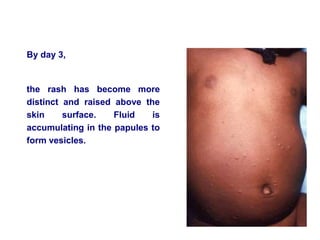
By day 3,
the rash has become more
distinct and raised above the
skin surface. Fluid is
accumulating in the papules to
form vesicles.
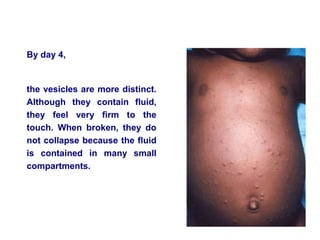
By day 4,
the vesicles are more distinct.
Although they contain fluid,
they feel very firm to the
touch. When broken, they do
not collapse because the fluid
is contained in many small
compartments.
By day 5,
the fluid in the vesicles has
become cloudy and looks like
pus. At this stage, the pocks
are called pustules.
At this time, the fever usually
rises and the patient feels
more ill than before.
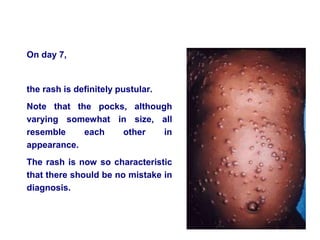
On day 7,
the rash is definitely pustular.
Note that the pocks, although
varying somewhat in size, all
resemble each other in
appearance.
The rash is now so characteristic
that there should be no mistake in
diagnosis.
During days 8 and 9,
the pustules increase
somewhat in size.
They are firm to the touch and
deeply embedded in the skin.
Gradually the pustules dry up and
dark scabs form.
The scabs begin to appear
between 10 and 14 days after the
rash first develops.
The scabs contain live smallpox
virus.
Until all scabs have fallen off, the
patient may infect others.
By day 20,
The scabs have come off and
light-coloured or depigmented
areas are observed.
Over a period of many weeks the
skin gradually returns to its
normal appearance.
However, scars which last for life
may remain on the face.
Such scars are an indication of
previous infection with smallpox.
In this slide, the development of the rash is followed through
consecutive stages. The numbers indicate the days after onset of
rash on which the pictures were taken.
Papules are seen on days 3 and 4; vesicles on day 5; pustules on
days 7 and 9; and, finally, scabs on day 13.
3 4 5
7 9 13
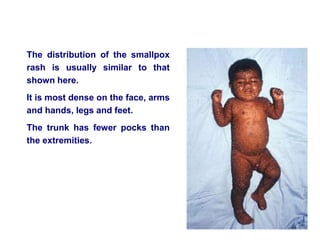
The distribution of the smallpox
rash is usually similar to that
shown here.
It is most dense on the face, arms
and hands, legs and feet.
The trunk has fewer pocks than
the extremities.
Note in this slide that the density of the rash is greater on the
face than on the body.
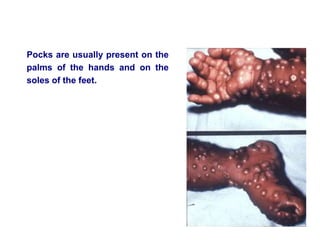
Pocks are usually present on the
palms of the hands and on the
soles of the feet.
This patient has chickenpox.
Chickenpox is the most
important disease likely to be
confused with smallpox.
It is caused by a different virus.
In smallpox, fever is present for 2 to 4 days before the rash
begins, while with chickenpox, fever and rash develop at the
same time.
All the pocks of the smallpox rash are in the same stage of
development on any given part of the body and develop slowly.
In chickenpox, the rash develops more rapidly, and vesicles,
pustules, and scabs may be seen at the same time.
SMALLPOX CHICKENPOX
At time of rash2 to 4 days before
the rash
FEVER
RASH
Pocks in several stagesPocks at same stageAppearance
RapidSlowDevelopment
During the first day or two of rash it
may be impossible, from the rash
alone, to differentiate smallpox from
chickenpox.
On day 3,
the rash associated with each
of the diseases continues to
look very similar.
By day 5- perfectly clear - patients
have different diseases.
The chickenpox pt. shows several
different stages of rash- papules,
vesicles and pustules present.
All of the smallpox lesions are at
the same stage of development.
Most of the chickenpox lesions -
small, 1 - 5 mm, smallpox lesions-
uniformly larger, 5 - 10 mm.
The lesions of chickenpox are
much more superficial.
The smallpox pustules - firm and
deeply embedded in the skin
By day 7, most of the chickenpox
lesions have already formed
scabs and some scabs, in fact,
have already separated. Scabs
over the smallpox lesions have
not yet formed.
On day 10 of the rash, most of the
chickenpox scabs have fallen off,
while the smallpox scabs are just
beginning to form.
In chickenpox, the scabs may
form as early as day 3 or 4 of rash
and normally fall off by day 14.
In this slide, pictures of the rash of chickenpox and smallpox
are seen on each of four different days: day 3, day 5, day 7,
and day 10. Note again that the chickenpox scabs have begun
to form on day 7 while, in smallpox, no scabs are observed
even on day 10.
The distribution of rash is also important in diagnosis.
In smallpox, more pocks usually occur on the arms and legs than
on the body. In chickenpox, more pocks occur on the body.
In smallpox, lesions are commonly found on the palms and soles.
In chickenpox, however, there are very few or no lesions on the
palms and soles.
SMALLPOX CHICKENPOX
RASH
More pocks on bodyMore pock on arms
and legs
Distribution
Usually absentUsually presentOn palms
and soles
The relative density of rash on different parts of the body
should be carefully observed. This diagram illustrates the
differences that are usually seen.
In this picture of a patient
with chickenpox, note that
the patient has many
pocks on his back but very
few on his arms or hands.
In smallpox, however, the pocks
are more dense on the arms and
legs than on the trunk.
In smallpox (shown in the lower
photograph), pocks are usually
present on the palms of the
hands.
In chickenpox there may be few
or no lesions on the palms of the
hands.
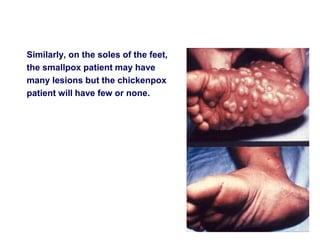
Similarly, on the soles of the feet,
the smallpox patient may have
many lesions but the chickenpox
patient will have few or none.
Note again the particular points that help to differentiate smallpox from chickenpox:
– in smallpox, the fever precedes the rash by 2 to 4 days,
– the pocks on any part of the body are at the same stage of development, and they
develop slowly,
– the pocks are more numerous on the arms and legs than on the body,
– the pocks are usually present on the palms and soles,
– death following smallpox is not uncommon, while in chickenpox death is very rare.
When death occurs in a patient in whom chickenpox has been diagnosed, smallpox
should always be suspected.
SMALLPOX CHICKENPOX
At time of rash2–4 days before the rashFEVER
RASH
Pocks in several stagesPocks at same stageAppearance
RapidSlowDevelopment
More pocks on bodyMore pocks on arms & legsDistribution
Usually absentUsually presentOn palms & soles
Very uncommonMore than 10%DEATH
After discussion, it is chickenpox.
Note:
(1) there are more pocks on the
trunk than on the extremities, a
distribution of rash that is
characteristic for chickenpox;
(2) different stages of the rash are
seen–papules, vesicles,
pustules and scabs;
(3) pustules and scabs are present
although it is only day 3 of rash;
(4) most of the lesions are very
small in size.
After discussion: At this time, it is
difficult to make a definite diagnosis
simply from observation of the rash.
What other information might provide
important clues to diagnosis?
After discussion:
(1) If the patient had experienced 2 to
4 days of fever before onset of rash,
this would suggest that she has
smallpox. If fever developed at the
time of rash, the diagnosis of
chickenpox would be more likely.
(continued next page)
(2) Information - whether the patient had experienced either
smallpox or chickenpox in the past - helpful since second
attacks of either disease are very rare.
(3) If mass vaccination of populations has been resumed and
the patient has a vaccination scar, the diagnosis of chickenpox
is more likely as few cases of smallpox are observed in
previously vaccinated persons, especially those vaccinated
within the preceding 5 to 10 days.
(4) A history of contact during the preceding 2 to 3 weeks with
either a case of chickenpox or smallpox would provide
valuable information. Note, however, that even with these clues
to diagnosis, one may not be able to decide definitely one way
or the other. The patient should be isolated and kept under
observation. If the disease progresses as described for
smallpox, samples should be collected for laboratory
diagnosis.
After discussion: It is now
perfectly apparent that the child
has smallpox.
Note that the pocks are all in the
same stage of development and
now, on day 5 of rash,
characteristic pustules are present.
The distribution of the rash is also
typical.
After discussion: It is chickenpox.
Note:
(1) different stages of the rash are
seen;
(2) scabs are already present
although it is only day 6 of rash;
(3) smallpox vaccination scars are
seen, thus making it less likely
that the patient has smallpox.
Multipuncture vaccination
by bifurcated needle
Recognition card (recto/verso)
Epidemiological factors which led to eradication of
smallpox :
1. no known animal reservoir.
2. no long-term carrier of the virus.
3. life-long immunity, after recovery from the disease.
4. the detection of cases - the rash was so characteristic.
5. sub clinical infection did not transmit the disease.
6. vaccine highly effective.
7. international co-operation.

20180108 smallpox

  • 1.
    Smallpox is adisease that can be easily diagnosed by the average health worker. In this series of slides, typical cases of smallpox are presented. Such cases account for 9 out of 10 patients who are seen. Because smallpox is sometimes confused with chickenpox, pictures of patients with chickenpox are included for comparison. In the post-eradication era, the detection of a case of smallpox is a public health emergency. • Notify the health authority immediately. • Isolate the patient. • Vaccinate all contacts. World Health Organization
  • 2.
    Smallpox is adisfiguring disease. 3 out of 10 cases may die. Variola virus. Spread - secretions - patient's mouth and nose, and by material from pocks or scabs. Transmitted directly from one person to the next. Close contact with patients, or their clothing or bedding, is thus required for infection. A patient who has developed the distinctive symptoms of smallpox will have been exposed to the virus about two weeks previously.
  • 3.
    After a personhas been infected through exposure to the smallpox virus, a symptom-free period follows. This is called the incubation period. It is normally 12 days in length but may be as short as 7 days or as long as 17 days. The illness begins with fever. The patient feels sick and has symptoms such as headache and severe backache. A rash appears after 2 to 4 days and progresses through characteristic stages of papules, vesicles, pustules and finally scabs. The scabs fall off at the end of the 3rd or 4th week. FEVER RASH Pre-eruption Papules-Vesicles Pustules Scabs Onset of rash Days – 4 – 3 – 2 – 1 1 2 3 4 5 6 7 8 9 10 11 12 13 14 21
  • 4.
    The rash appears2 to 4 days after the patient first becomes ill with fever. Day 1- a few raised spots-papules. They are usually seen first on the face, and subsequently on the body and extremities. On the right side of this picture, a few small papules may be seen. Unless it is known that the patient has been exposed to the virus or in contact with a smallpox case two weeks before, one may not suspect the diagnosis at this time.
  • 5.
    Day 2 ofrash, more papules appear. Although they differ somewhat in size, note that they all have a very similar appearance.
  • 6.
    By day 3, therash has become more distinct and raised above the skin surface. Fluid is accumulating in the papules to form vesicles.
  • 7.
    By day 4, thevesicles are more distinct. Although they contain fluid, they feel very firm to the touch. When broken, they do not collapse because the fluid is contained in many small compartments.
  • 8.
    By day 5, thefluid in the vesicles has become cloudy and looks like pus. At this stage, the pocks are called pustules. At this time, the fever usually rises and the patient feels more ill than before.
  • 9.
    On day 7, therash is definitely pustular. Note that the pocks, although varying somewhat in size, all resemble each other in appearance. The rash is now so characteristic that there should be no mistake in diagnosis.
  • 10.
    During days 8and 9, the pustules increase somewhat in size. They are firm to the touch and deeply embedded in the skin.
  • 11.
    Gradually the pustulesdry up and dark scabs form. The scabs begin to appear between 10 and 14 days after the rash first develops. The scabs contain live smallpox virus. Until all scabs have fallen off, the patient may infect others.
  • 12.
    By day 20, Thescabs have come off and light-coloured or depigmented areas are observed. Over a period of many weeks the skin gradually returns to its normal appearance. However, scars which last for life may remain on the face. Such scars are an indication of previous infection with smallpox.
  • 13.
    In this slide,the development of the rash is followed through consecutive stages. The numbers indicate the days after onset of rash on which the pictures were taken. Papules are seen on days 3 and 4; vesicles on day 5; pustules on days 7 and 9; and, finally, scabs on day 13. 3 4 5 7 9 13
  • 14.
    The distribution ofthe smallpox rash is usually similar to that shown here. It is most dense on the face, arms and hands, legs and feet. The trunk has fewer pocks than the extremities.
  • 15.
    Note in thisslide that the density of the rash is greater on the face than on the body.
  • 16.
    Pocks are usuallypresent on the palms of the hands and on the soles of the feet.
  • 17.
    This patient haschickenpox. Chickenpox is the most important disease likely to be confused with smallpox. It is caused by a different virus.
  • 18.
    In smallpox, feveris present for 2 to 4 days before the rash begins, while with chickenpox, fever and rash develop at the same time. All the pocks of the smallpox rash are in the same stage of development on any given part of the body and develop slowly. In chickenpox, the rash develops more rapidly, and vesicles, pustules, and scabs may be seen at the same time. SMALLPOX CHICKENPOX At time of rash2 to 4 days before the rash FEVER RASH Pocks in several stagesPocks at same stageAppearance RapidSlowDevelopment
  • 19.
    During the firstday or two of rash it may be impossible, from the rash alone, to differentiate smallpox from chickenpox.
  • 20.
    On day 3, therash associated with each of the diseases continues to look very similar.
  • 21.
    By day 5-perfectly clear - patients have different diseases. The chickenpox pt. shows several different stages of rash- papules, vesicles and pustules present. All of the smallpox lesions are at the same stage of development. Most of the chickenpox lesions - small, 1 - 5 mm, smallpox lesions- uniformly larger, 5 - 10 mm. The lesions of chickenpox are much more superficial. The smallpox pustules - firm and deeply embedded in the skin
  • 22.
    By day 7,most of the chickenpox lesions have already formed scabs and some scabs, in fact, have already separated. Scabs over the smallpox lesions have not yet formed.
  • 23.
    On day 10of the rash, most of the chickenpox scabs have fallen off, while the smallpox scabs are just beginning to form. In chickenpox, the scabs may form as early as day 3 or 4 of rash and normally fall off by day 14.
  • 24.
    In this slide,pictures of the rash of chickenpox and smallpox are seen on each of four different days: day 3, day 5, day 7, and day 10. Note again that the chickenpox scabs have begun to form on day 7 while, in smallpox, no scabs are observed even on day 10.
  • 25.
    The distribution ofrash is also important in diagnosis. In smallpox, more pocks usually occur on the arms and legs than on the body. In chickenpox, more pocks occur on the body. In smallpox, lesions are commonly found on the palms and soles. In chickenpox, however, there are very few or no lesions on the palms and soles. SMALLPOX CHICKENPOX RASH More pocks on bodyMore pock on arms and legs Distribution Usually absentUsually presentOn palms and soles
  • 26.
    The relative densityof rash on different parts of the body should be carefully observed. This diagram illustrates the differences that are usually seen.
  • 27.
    In this pictureof a patient with chickenpox, note that the patient has many pocks on his back but very few on his arms or hands.
  • 28.
    In smallpox, however,the pocks are more dense on the arms and legs than on the trunk.
  • 29.
    In smallpox (shownin the lower photograph), pocks are usually present on the palms of the hands. In chickenpox there may be few or no lesions on the palms of the hands.
  • 30.
    Similarly, on thesoles of the feet, the smallpox patient may have many lesions but the chickenpox patient will have few or none.
  • 31.
    Note again theparticular points that help to differentiate smallpox from chickenpox: – in smallpox, the fever precedes the rash by 2 to 4 days, – the pocks on any part of the body are at the same stage of development, and they develop slowly, – the pocks are more numerous on the arms and legs than on the body, – the pocks are usually present on the palms and soles, – death following smallpox is not uncommon, while in chickenpox death is very rare. When death occurs in a patient in whom chickenpox has been diagnosed, smallpox should always be suspected. SMALLPOX CHICKENPOX At time of rash2–4 days before the rashFEVER RASH Pocks in several stagesPocks at same stageAppearance RapidSlowDevelopment More pocks on bodyMore pocks on arms & legsDistribution Usually absentUsually presentOn palms & soles Very uncommonMore than 10%DEATH
  • 33.
    After discussion, itis chickenpox. Note: (1) there are more pocks on the trunk than on the extremities, a distribution of rash that is characteristic for chickenpox; (2) different stages of the rash are seen–papules, vesicles, pustules and scabs; (3) pustules and scabs are present although it is only day 3 of rash; (4) most of the lesions are very small in size.
  • 34.
    After discussion: Atthis time, it is difficult to make a definite diagnosis simply from observation of the rash. What other information might provide important clues to diagnosis? After discussion: (1) If the patient had experienced 2 to 4 days of fever before onset of rash, this would suggest that she has smallpox. If fever developed at the time of rash, the diagnosis of chickenpox would be more likely. (continued next page)
  • 35.
    (2) Information -whether the patient had experienced either smallpox or chickenpox in the past - helpful since second attacks of either disease are very rare. (3) If mass vaccination of populations has been resumed and the patient has a vaccination scar, the diagnosis of chickenpox is more likely as few cases of smallpox are observed in previously vaccinated persons, especially those vaccinated within the preceding 5 to 10 days. (4) A history of contact during the preceding 2 to 3 weeks with either a case of chickenpox or smallpox would provide valuable information. Note, however, that even with these clues to diagnosis, one may not be able to decide definitely one way or the other. The patient should be isolated and kept under observation. If the disease progresses as described for smallpox, samples should be collected for laboratory diagnosis.
  • 36.
    After discussion: Itis now perfectly apparent that the child has smallpox. Note that the pocks are all in the same stage of development and now, on day 5 of rash, characteristic pustules are present. The distribution of the rash is also typical.
  • 37.
    After discussion: Itis chickenpox. Note: (1) different stages of the rash are seen; (2) scabs are already present although it is only day 6 of rash; (3) smallpox vaccination scars are seen, thus making it less likely that the patient has smallpox.
  • 38.
  • 39.
  • 40.
    Epidemiological factors whichled to eradication of smallpox : 1. no known animal reservoir. 2. no long-term carrier of the virus. 3. life-long immunity, after recovery from the disease. 4. the detection of cases - the rash was so characteristic. 5. sub clinical infection did not transmit the disease. 6. vaccine highly effective. 7. international co-operation.