Current Stroke
Management Guideline
Dr Bhavin J Patel
SR neurology
GMC Kota.
Prehospital Stroke Management and System
of Care
 Pre hospital system:-
 Public education programs should be designed to reduce stroke onset to
emergency department arrival time and to increase timely use of thrombolysis
and thrombectormy. (COR 1 LOE C-EO)
 Regional Stroke center should be established which include facility of
thrombolysis and provide transport facility to nearest endovascular treatment
center. ( COR 1, LOE A)
Prehospital Stroke Management and System
of Care
 Every hospital should make stroke team with specified role to each team
member.
 Patient should be transported to nearest IV alteplase capable hospital and not
directly to the higher center which provide mechanical thrombectomy when
option exist. (COR 2B LOE B-NR)
 Organized protocol for emergency evaluation of suspected stroke patient is
recommended. (COR 1 LOE B-NR)
Prehospital Stroke Management and System
of Care
 Telemedicine/teleradiology evaluation of AIS patient can be effective for
correct and safely administration of IV alteplase. (COR 2a LOE B-R)
 Establishing and monitoring target time goals for ED door- to IV fibrinolysis
time can be beneficial to enhance system performance. (COR 1 LOE B-NR)
Emergency evaluation and treatment
 Stroke scale:-
 The use of stroke severity rating scale preferably NIHSS is recommended.
(COR 1 LOE B-NR)
 Imaging for IV alteplase:-
 NCCT head is sufficient to exclude ICH before IV alteplase.
 MRI is not required before IV alteplase to exclude CMBs. (COR 1)
 CTA with CTP or MR angio with DW-MRI with or without perfusion is
recommended in wake up stroke patient. ( COR 2A LOE B-R)
Emergency evaluation and treatment
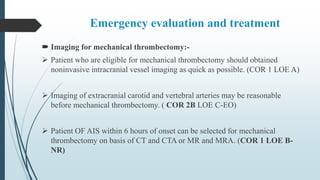
 Imaging for mechanical thrombectomy:-
 Patient who are eligible for mechanical thrombectomy should obtained
noninvasive intracranial vessel imaging as quick as possible. (COR 1 LOE A)
 Imaging of extracranial carotid and vertebral arteries may be reasonable
before mechanical thrombectomy. ( COR 2B LOE C-EO)
 Patient OF AIS within 6 hours of onset can be selected for mechanical
thrombectomy on basis of CT and CTA or MR and MRA. (COR 1 LOE B-
NR)
Emergency evaluation and treatment
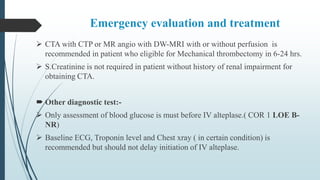
 CTA with CTP or MR angio with DW-MRI with or without perfusion is
recommended in patient who eligible for Mechanical thrombectomy in 6-24 hrs.
 S.Creatinine is not required in patient without history of renal impairment for
obtaining CTA.
 Other diagnostic test:-
 Only assessment of blood glucose is must before IV alteplase.( COR 1 LOE B-
NR)
 Baseline ECG, Troponin level and Chest xray ( in certain condition) is
recommended but should not delay initiation of IV alteplase.
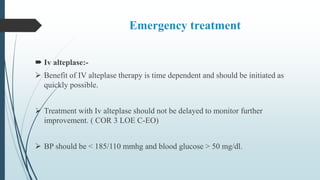
Emergency treatment
 Iv alteplase:-
 Benefit of IV alteplase therapy is time dependent and should be initiated as
quickly possible.
 Treatment with Iv alteplase should not be delayed to monitor further
improvement. ( COR 3 LOE C-EO)
 BP should be < 185/110 mmhg and blood glucose > 50 mg/dl.
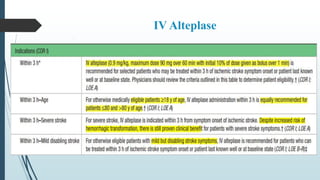
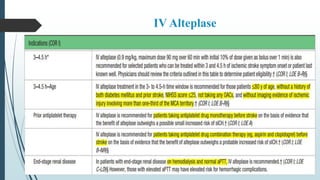
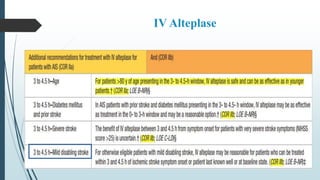
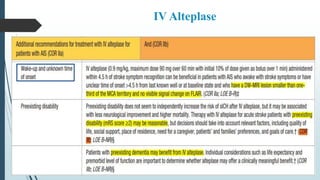
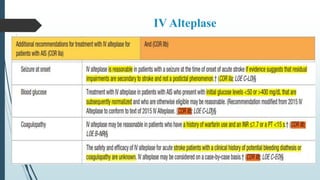
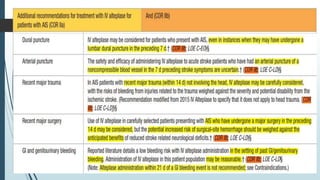
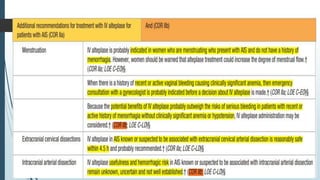
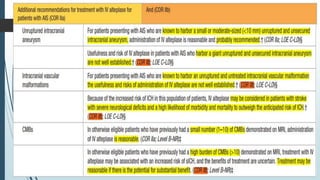
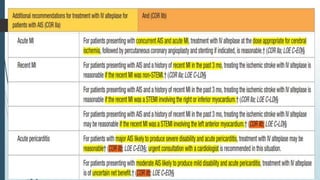
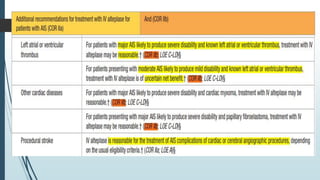
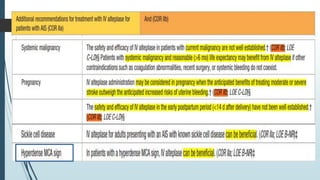
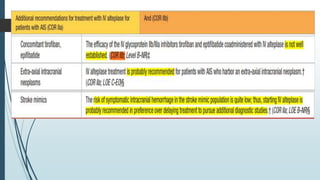
Indications of IV Alteplase
IV Alteplase
IV Alteplase
IV Alteplase
IV Alteplase
IV Alteplase
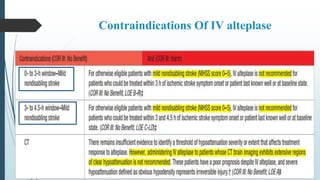
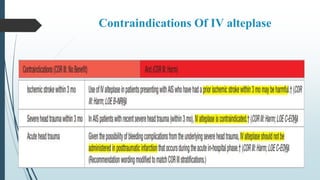
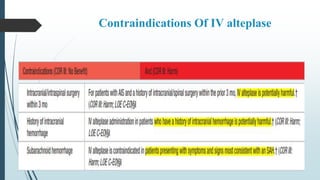
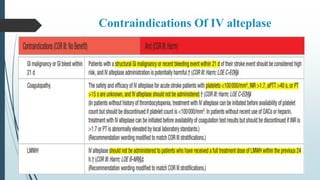
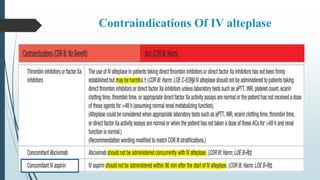
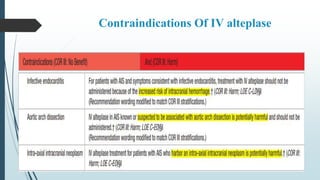
Contraindications Of IV alteplase
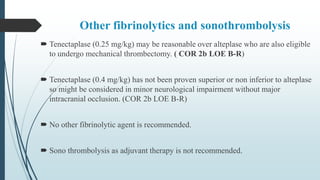
Other fibrinolytics and sonothrombolysis
 Tenectaplase (0.25 mg/kg) may be reasonable over alteplase who are also eligible
to undergo mechanical thrombectomy. ( COR 2b LOE B-R)
 Tenectaplase (0.4 mg/kg) has not been proven superior or non inferior to alteplase
so might be considered in minor neurological impairment without major
intracranial occlusion. (COR 2b LOE B-R)
 No other fibrinolytic agent is recommended.
 Sono thrombolysis as adjuvant therapy is not recommended.
Mechanical thrombectomy
 Concomitant with IV alteplase:-
 Patient eligible for IV alteplase should receive it even if mechanical
thrombectomy is being considered.
 Observation after IV alteplase to assess clinical response should ot be done in
mechanical thombectomy eligible patient.
Mechanical thrombectomy
 Criteria for mechanical thrombectomy with stent retriever (COR 1 LOE A)
 Prestroke MRS 0 to1
 Causative occlusion in ICA or M1 segment
 Age >= 18 years
 NIHSS and ASPECT score >= 6
 Treatment can be initiated within 6 hrs
 Aspiration thrombectomy is recommended with above criteria.(COR 1 LOE B-
R)
Mechanical thrombectomy
 Mechanical thrombectomy with stent retriever within 6 hrs may be
reasonable with uncertain benefit in following situations:-
 Causative occlusion in M2 or M3 segment ( COR 2b LOE B-R)
 Causative occlusion in ACA, vertebral arteries, basilar artery or PCA. (COR
2b LOE C-LD)
 Prestroke MRS>1 , NIHSS and ASPECTS < 6 in occlusion of ICA & M1 (
COR 2b LOE B-R)
Mechanical thrombectomy
 Mechanical thrombectomy beyond 6 hrs:-
 Recommended within 6 to 16 hrs in patients who have LVO in anterior circulation
and meet all DAWN and DEFUSE criteria. ( COR 1 LOE A)
 Recommended within 16 to 24 hrs in patients who have LVO in anterior
circulation and meet all DAWN criteria. ( COR 2A LOE B-R)
Mechanical thrombectomy
 Technique of Mechanical thrombectomy:-
 Stent retriever is preferred over other thrombectomy device. ( 1,A)
 Technical goal of thrombctomy procedure is to achieve mTICI 2b/3 angiographic
result. ( 1,A)
 Treatment of tandem (extracranial and intracranial) occlusion is reasonable. ( 2b,
B-R)
Mechanical thrombectomy
 The safety and efficacy of Glycoprotein 2b/3a inhibitors administered during
endovascular therapy is uncertain. (2b, C-LD)
 Use of salvage technique adjuvant like intraarterial fibrinolysis may be
reasonable to achieve mTICI 2b/3 angiographic result.
 Mechanical thrombectomy is recommended as first line therapy over intraarterial
thrombolysis. ( 1, C-EO)
Antiplatelet therapy
 Administration of Aspirin is recommended within 24 to 48 hrs of stroke onset.
Dose 160-300mg ( 1, A)
 Aspirin administration is delayed until 24 hrs in patients treated with thrombolysis
except in some concomitant condition in which holding of treatment result in
substantial risk. (1 ,A)
 In patient with minor noncardioembolic stroke and TIA ( ABCD2>= 4) treatment
with dual antiplatelet started within 24 hr and continued upto 21 days is effective in
reducing risk of recurrent stroke up to 90 days. (1,A)
Antiplatelet therapy
 Efficacy of tirofiban and eptifibatide is not well established. (2b, B-R)
 Abciximab is potentially harmful and should not be administered. (3,B-R)
 Ticagrelor is not recommended over aspirin for minor stroke. (3, B-R)
 Aspirin is not recommended as substitute for alteplase or thrombectomy.
Anticoagulant
 The usefulness of anticoagulant in severe ICA stenosis or nonocclusive extracranial
intraluminal thrombus is not established. (2b, B-R)
 Usefulness of thrombin inhibitors or oral Factor Xa inhibitors are not established. (
2b, B-R/C-LD)
 Urgent anticoagulation with the goal of preventing early recurrent stroke, halting
neurological worsening or improving outcome is not recommended in AIS.( 3, A)
Other emergency treatment
 Pharmacological or nonpharmacological treatments with putative neuropretective
actions are not recommended. ( 3,A)
 Hemodilution by volume expansion, administration of vasodilatory agents and
device to augment cerebral blood flow are not recommended. (3, A/A/B-R)
 The usefulness of urgent carotid end arterectomy or angioplasty in patients with
critical carotid stenosis or stroke in evolution is not recommended. ( 2b, B-NR)
General supportive care
 The benefit of flat head positioning early after hospitalization is uncertain (2b,
B-R)
 Supplemental oxygen is not recommended in non hypoxic patient. (3, B-R)
 Hyperbaric oxygen therapy is not recommended except when AIS caused by air
embolism. (3, B-NR)
 Benefit of treatment with induced hypothermia is uncertain.(2b,B-R)
General supportive care
 Dysphagia screening before patient start taking orally is effective to identify
patients at increased risk of aspiration. (1, C-LD)
 For patient with dysphagia it is reasonable to use nasogastric tube for early phase
of stroke( first 7 days).
 Percutaneous gastrectomy tube should be placed in patients with anticipated
persistent dysphagia. (>2-3 weeks) (2a. C-EO)
 Routine use of prophylactic antibiotics has not been shown beneficial. (3, A)
General supportive care
 In immobile AIS patients without contraindication Intermittent pneumatic
compression device is recommended to prevent DVT. (1, B-R)
 Benefit of prophylactic dose of heparin (UFH or LMWH) is not well established
to prevent DVT, (2b, A)
 Blood glucose level should be maintained in range of 140-180 mg/dl and close
monitoring to prevent hypo or hyperglycemia.( 2a, C-LD)
 Hypotension and hypovolemia should be corrected to maintain systemic
perfusion level. (1, C-EO)
BP management
 Early treatment of hypertension is indicated when required by comorbid conditions.
(1, C-EO)
 BP >=220/120 mmhg:- benefit of initiating or reinitiating treatment of hypertension
in first 48 to 72 hrs is uncertain. It might reasonable to lower it by 15% during first
2;- 4 hours.(2b, C-EO)
 BP< 220/120 mmhg:- benefit of initiating or reinitiating treatment of hypertension
in first 48 to 72 hrs is not effective to prevent death or dependency.(3, A)
 BP should be maintained <180/105 mmhg in patient whor received IV alteplase or
undergo mechanical thrombectomy for first 24 hours. ( 1, B-R/ 2a,B-NR)
Treatment of acute complications
 Brain swelling:-
 Use of osmotic therapy for patients with clinical deterioration is reasonable. (2a, C-
LD)
 Use of brief moderate hyperventilation ( pco2– 30-34 mm Hg) is reasonable as a
bridge to more definitive therapy in acute neurological decline. (2a, C-LD)
 Hypothermia or barbiturate coma is not recommended. (3, B-R)
 Corticosteroids should not be administered.(3, A)
Treatment of acute complications
 Surgical treatment supratentorial infarction:-
 Optimal trigger for decompressive craniectomy is unkown however decrease in
level of consciousness is reasonable to use as selection criteria. (2a, A)
 Patient with unilateral MCA infarction deteriorate neurologically within 48 hours
despite medical therapy should receive craniectomy with dural expansion.
• <= 60 years ( 2a, A)
• > 60 years ( 2b, B-R)
Treatment of acute complications
 Ventriculostomy is recommended for the treatment of obstructive hydrocephalus
in cerebellar infarction. (1,C-LD)
 Concomitant or subsequent sub occipital craniectomy depends on following
factors (1, B-NR)
• Size of infarction
• Neurological condition despite medical treatment
• Degree of brainstem compression
 It may be reasonable to inform relatives that the outcome after cerebellar infarct
can be good after surgery. (2b, C-LD)
Treatment of acute complications
 Seizures:-
 Recurrent seizures after stroke should be treated in similar manner as with other
neurological conditions. (1, C-LD)
 Antiseizures drug should be selected on basis of specific patient characteristics.
 Prophylactic use of AED is not recommended. (3, C-LD)
In hospital--- secondary stroke
prevention
 Brain imaging:-
 Use of MRI is reasonable in following patients:-
 Patient with carotid stenosis who are eligible for carotid revascularization in
whom NCCT or neurological examination dose not permit actual
localization.(2a, C-EO)
 Patients with PFO who are candidate for closure. (2a, B-R)
In hospital--- secondary stroke prevention
 Vascular imaging:-
 Nondisabling stroke in carotid territory:- vascular imaging including extracranial
vessel should be done in 24 hours. (1, B-NR)
 In patients with PFO for closure intracranial vessel imaging should be done. (2a,
B-NR)
In hospital--- secondary stroke prevention
 Cardiac monitoring should be performed for the at least 24 hours after AIS. (1,
B-NR)
 Usefulness of routine Echocardiography is uncertain and used in selected
patients. (2b, B-NR)
 It is reasonable to screen all patients for DM.(2a, C-EO)
 Routine screening for OSA in AIS patient is not recommended.(3, B-R)
 Routine screening for APLA and hyperhomocysteinemia is not recommended.
(3, C-LD/C-EO)
Antithrombotic agent
 For noncardioembolic AIS use of antiplatelet agent is recommended over
anticoagulants. ( 1, A)
 Patients who have AIS while taking aspirin, increasing dose of aspirin or
switching to alternative antiplatelet agent or warfarin for additional benefit is not
recommended.(2b,B-R/ 3, B-NR for warfarin)
 Starting of oral anticoagulation between 4 to 14 days after AIS with AF is
reasonable.(2a, B-NR)
Antithrombotic agent
 AIS with extracraniial arterial dissection :- antiplatelet or anticoagulant for 3-6
mths is reasonable.(2a, B-NR)
 AIS with hemorrhagic transformation :- intiation or continuation of antiplatelet
or anticoagulant may be considered. (2b, C-LD)
 For minor nondisabling stroke (MRS 0-2) carotid revascularization should be
performed between 2-7 days of index event.(2a, B-NR)
Hyperlipidemia
 Measurment of fasting or nonfasting plasma lipid profile is effective in estimating
atherosclerotic cardiovascular risk and documenting baseline LDL level. (1, B-
NR)
 Measurement of lipid profile should be done at 4 to 12 weeks after statin
initiation or dose adjustment and 3 to 12 months thereafter. (1, A)
 Patients with age <=75 years high intensity statin therapy should be initiated with
goal of 50% reduction in LDL level. (1,A)
Hyperlipidemia
 Patient who have contraindication or experience side effect with high intensity
statin therapy should be shifted to moderate intensity statin therapy with goal of
30 to 49% reduction in LDL. (1,A)
 Ezetimib should be added in patients who are on maximally tolerated statin dose
and still have LDL > 70 mg/dl. (2a, B-R)
 Patients who are on maximally tolerated LDL lowering therapy and still have LDL
> 70 mg/dl should consider for PCSK9 inhibitors.(2a, A)
Hyperlipidemia
 Statin therapy can be continued or initiated during acute period. (2a, B-R)
 Women in child bearing age on statin therapy should explain to stop it 1-2
months prior to pregnancy attempted. (1, C-LD)
 Patients with advance kidney disease on dialysis may be continued with statin
therapy but should not be initiated. (2b, C-LD/ 3, B-R)
Reference
 Powers et al 2019 Guidelines for Management of AIS Stroke.
2019;50:e344–e418
 2018 AHA/ACC guideline on management of blood cholesterol
 2017 AHA/ACC guideline on detection, evaluation and management of
high blood pressure
 2014 recommendations for management of cerebral and cerebellar
infarctions with brain swelling
Thank You

Current stroke management guideline

  • 1.
    Current Stroke Management Guideline DrBhavin J Patel SR neurology GMC Kota.
  • 5.
    Prehospital Stroke Managementand System of Care  Pre hospital system:-  Public education programs should be designed to reduce stroke onset to emergency department arrival time and to increase timely use of thrombolysis and thrombectormy. (COR 1 LOE C-EO)  Regional Stroke center should be established which include facility of thrombolysis and provide transport facility to nearest endovascular treatment center. ( COR 1, LOE A)
  • 6.
    Prehospital Stroke Managementand System of Care  Every hospital should make stroke team with specified role to each team member.  Patient should be transported to nearest IV alteplase capable hospital and not directly to the higher center which provide mechanical thrombectomy when option exist. (COR 2B LOE B-NR)  Organized protocol for emergency evaluation of suspected stroke patient is recommended. (COR 1 LOE B-NR)
  • 7.
    Prehospital Stroke Managementand System of Care  Telemedicine/teleradiology evaluation of AIS patient can be effective for correct and safely administration of IV alteplase. (COR 2a LOE B-R)  Establishing and monitoring target time goals for ED door- to IV fibrinolysis time can be beneficial to enhance system performance. (COR 1 LOE B-NR)
  • 8.
    Emergency evaluation andtreatment  Stroke scale:-  The use of stroke severity rating scale preferably NIHSS is recommended. (COR 1 LOE B-NR)  Imaging for IV alteplase:-  NCCT head is sufficient to exclude ICH before IV alteplase.  MRI is not required before IV alteplase to exclude CMBs. (COR 1)  CTA with CTP or MR angio with DW-MRI with or without perfusion is recommended in wake up stroke patient. ( COR 2A LOE B-R)
  • 9.
    Emergency evaluation andtreatment  Imaging for mechanical thrombectomy:-  Patient who are eligible for mechanical thrombectomy should obtained noninvasive intracranial vessel imaging as quick as possible. (COR 1 LOE A)  Imaging of extracranial carotid and vertebral arteries may be reasonable before mechanical thrombectomy. ( COR 2B LOE C-EO)  Patient OF AIS within 6 hours of onset can be selected for mechanical thrombectomy on basis of CT and CTA or MR and MRA. (COR 1 LOE B- NR)
  • 10.
    Emergency evaluation andtreatment  CTA with CTP or MR angio with DW-MRI with or without perfusion is recommended in patient who eligible for Mechanical thrombectomy in 6-24 hrs.  S.Creatinine is not required in patient without history of renal impairment for obtaining CTA.  Other diagnostic test:-  Only assessment of blood glucose is must before IV alteplase.( COR 1 LOE B- NR)  Baseline ECG, Troponin level and Chest xray ( in certain condition) is recommended but should not delay initiation of IV alteplase.
  • 11.
    Emergency treatment  Ivalteplase:-  Benefit of IV alteplase therapy is time dependent and should be initiated as quickly possible.  Treatment with Iv alteplase should not be delayed to monitor further improvement. ( COR 3 LOE C-EO)  BP should be < 185/110 mmhg and blood glucose > 50 mg/dl.
  • 12.
  • 13.
  • 14.
  • 15.
  • 16.
  • 17.
  • 25.
  • 26.
  • 27.
  • 28.
  • 29.
  • 30.
  • 31.
    Other fibrinolytics andsonothrombolysis  Tenectaplase (0.25 mg/kg) may be reasonable over alteplase who are also eligible to undergo mechanical thrombectomy. ( COR 2b LOE B-R)  Tenectaplase (0.4 mg/kg) has not been proven superior or non inferior to alteplase so might be considered in minor neurological impairment without major intracranial occlusion. (COR 2b LOE B-R)  No other fibrinolytic agent is recommended.  Sono thrombolysis as adjuvant therapy is not recommended.
  • 32.
    Mechanical thrombectomy  Concomitantwith IV alteplase:-  Patient eligible for IV alteplase should receive it even if mechanical thrombectomy is being considered.  Observation after IV alteplase to assess clinical response should ot be done in mechanical thombectomy eligible patient.
  • 33.
    Mechanical thrombectomy  Criteriafor mechanical thrombectomy with stent retriever (COR 1 LOE A)  Prestroke MRS 0 to1  Causative occlusion in ICA or M1 segment  Age >= 18 years  NIHSS and ASPECT score >= 6  Treatment can be initiated within 6 hrs  Aspiration thrombectomy is recommended with above criteria.(COR 1 LOE B- R)
  • 34.
    Mechanical thrombectomy  Mechanicalthrombectomy with stent retriever within 6 hrs may be reasonable with uncertain benefit in following situations:-  Causative occlusion in M2 or M3 segment ( COR 2b LOE B-R)  Causative occlusion in ACA, vertebral arteries, basilar artery or PCA. (COR 2b LOE C-LD)  Prestroke MRS>1 , NIHSS and ASPECTS < 6 in occlusion of ICA & M1 ( COR 2b LOE B-R)
  • 35.
    Mechanical thrombectomy  Mechanicalthrombectomy beyond 6 hrs:-  Recommended within 6 to 16 hrs in patients who have LVO in anterior circulation and meet all DAWN and DEFUSE criteria. ( COR 1 LOE A)  Recommended within 16 to 24 hrs in patients who have LVO in anterior circulation and meet all DAWN criteria. ( COR 2A LOE B-R)
  • 36.
    Mechanical thrombectomy  Techniqueof Mechanical thrombectomy:-  Stent retriever is preferred over other thrombectomy device. ( 1,A)  Technical goal of thrombctomy procedure is to achieve mTICI 2b/3 angiographic result. ( 1,A)  Treatment of tandem (extracranial and intracranial) occlusion is reasonable. ( 2b, B-R)
  • 37.
    Mechanical thrombectomy  Thesafety and efficacy of Glycoprotein 2b/3a inhibitors administered during endovascular therapy is uncertain. (2b, C-LD)  Use of salvage technique adjuvant like intraarterial fibrinolysis may be reasonable to achieve mTICI 2b/3 angiographic result.  Mechanical thrombectomy is recommended as first line therapy over intraarterial thrombolysis. ( 1, C-EO)
  • 38.
    Antiplatelet therapy  Administrationof Aspirin is recommended within 24 to 48 hrs of stroke onset. Dose 160-300mg ( 1, A)  Aspirin administration is delayed until 24 hrs in patients treated with thrombolysis except in some concomitant condition in which holding of treatment result in substantial risk. (1 ,A)  In patient with minor noncardioembolic stroke and TIA ( ABCD2>= 4) treatment with dual antiplatelet started within 24 hr and continued upto 21 days is effective in reducing risk of recurrent stroke up to 90 days. (1,A)
  • 39.
    Antiplatelet therapy  Efficacyof tirofiban and eptifibatide is not well established. (2b, B-R)  Abciximab is potentially harmful and should not be administered. (3,B-R)  Ticagrelor is not recommended over aspirin for minor stroke. (3, B-R)  Aspirin is not recommended as substitute for alteplase or thrombectomy.
  • 40.
    Anticoagulant  The usefulnessof anticoagulant in severe ICA stenosis or nonocclusive extracranial intraluminal thrombus is not established. (2b, B-R)  Usefulness of thrombin inhibitors or oral Factor Xa inhibitors are not established. ( 2b, B-R/C-LD)  Urgent anticoagulation with the goal of preventing early recurrent stroke, halting neurological worsening or improving outcome is not recommended in AIS.( 3, A)
  • 41.
    Other emergency treatment Pharmacological or nonpharmacological treatments with putative neuropretective actions are not recommended. ( 3,A)  Hemodilution by volume expansion, administration of vasodilatory agents and device to augment cerebral blood flow are not recommended. (3, A/A/B-R)  The usefulness of urgent carotid end arterectomy or angioplasty in patients with critical carotid stenosis or stroke in evolution is not recommended. ( 2b, B-NR)
  • 42.
    General supportive care The benefit of flat head positioning early after hospitalization is uncertain (2b, B-R)  Supplemental oxygen is not recommended in non hypoxic patient. (3, B-R)  Hyperbaric oxygen therapy is not recommended except when AIS caused by air embolism. (3, B-NR)  Benefit of treatment with induced hypothermia is uncertain.(2b,B-R)
  • 43.
    General supportive care Dysphagia screening before patient start taking orally is effective to identify patients at increased risk of aspiration. (1, C-LD)  For patient with dysphagia it is reasonable to use nasogastric tube for early phase of stroke( first 7 days).  Percutaneous gastrectomy tube should be placed in patients with anticipated persistent dysphagia. (>2-3 weeks) (2a. C-EO)  Routine use of prophylactic antibiotics has not been shown beneficial. (3, A)
  • 44.
    General supportive care In immobile AIS patients without contraindication Intermittent pneumatic compression device is recommended to prevent DVT. (1, B-R)  Benefit of prophylactic dose of heparin (UFH or LMWH) is not well established to prevent DVT, (2b, A)  Blood glucose level should be maintained in range of 140-180 mg/dl and close monitoring to prevent hypo or hyperglycemia.( 2a, C-LD)  Hypotension and hypovolemia should be corrected to maintain systemic perfusion level. (1, C-EO)
  • 45.
    BP management  Earlytreatment of hypertension is indicated when required by comorbid conditions. (1, C-EO)  BP >=220/120 mmhg:- benefit of initiating or reinitiating treatment of hypertension in first 48 to 72 hrs is uncertain. It might reasonable to lower it by 15% during first 2;- 4 hours.(2b, C-EO)  BP< 220/120 mmhg:- benefit of initiating or reinitiating treatment of hypertension in first 48 to 72 hrs is not effective to prevent death or dependency.(3, A)  BP should be maintained <180/105 mmhg in patient whor received IV alteplase or undergo mechanical thrombectomy for first 24 hours. ( 1, B-R/ 2a,B-NR)
  • 46.
    Treatment of acutecomplications  Brain swelling:-  Use of osmotic therapy for patients with clinical deterioration is reasonable. (2a, C- LD)  Use of brief moderate hyperventilation ( pco2– 30-34 mm Hg) is reasonable as a bridge to more definitive therapy in acute neurological decline. (2a, C-LD)  Hypothermia or barbiturate coma is not recommended. (3, B-R)  Corticosteroids should not be administered.(3, A)
  • 47.
    Treatment of acutecomplications  Surgical treatment supratentorial infarction:-  Optimal trigger for decompressive craniectomy is unkown however decrease in level of consciousness is reasonable to use as selection criteria. (2a, A)  Patient with unilateral MCA infarction deteriorate neurologically within 48 hours despite medical therapy should receive craniectomy with dural expansion. • <= 60 years ( 2a, A) • > 60 years ( 2b, B-R)
  • 48.
    Treatment of acutecomplications  Ventriculostomy is recommended for the treatment of obstructive hydrocephalus in cerebellar infarction. (1,C-LD)  Concomitant or subsequent sub occipital craniectomy depends on following factors (1, B-NR) • Size of infarction • Neurological condition despite medical treatment • Degree of brainstem compression  It may be reasonable to inform relatives that the outcome after cerebellar infarct can be good after surgery. (2b, C-LD)
  • 49.
    Treatment of acutecomplications  Seizures:-  Recurrent seizures after stroke should be treated in similar manner as with other neurological conditions. (1, C-LD)  Antiseizures drug should be selected on basis of specific patient characteristics.  Prophylactic use of AED is not recommended. (3, C-LD)
  • 50.
    In hospital--- secondarystroke prevention  Brain imaging:-  Use of MRI is reasonable in following patients:-  Patient with carotid stenosis who are eligible for carotid revascularization in whom NCCT or neurological examination dose not permit actual localization.(2a, C-EO)  Patients with PFO who are candidate for closure. (2a, B-R)
  • 51.
    In hospital--- secondarystroke prevention  Vascular imaging:-  Nondisabling stroke in carotid territory:- vascular imaging including extracranial vessel should be done in 24 hours. (1, B-NR)  In patients with PFO for closure intracranial vessel imaging should be done. (2a, B-NR)
  • 52.
    In hospital--- secondarystroke prevention  Cardiac monitoring should be performed for the at least 24 hours after AIS. (1, B-NR)  Usefulness of routine Echocardiography is uncertain and used in selected patients. (2b, B-NR)  It is reasonable to screen all patients for DM.(2a, C-EO)  Routine screening for OSA in AIS patient is not recommended.(3, B-R)  Routine screening for APLA and hyperhomocysteinemia is not recommended. (3, C-LD/C-EO)
  • 53.
    Antithrombotic agent  Fornoncardioembolic AIS use of antiplatelet agent is recommended over anticoagulants. ( 1, A)  Patients who have AIS while taking aspirin, increasing dose of aspirin or switching to alternative antiplatelet agent or warfarin for additional benefit is not recommended.(2b,B-R/ 3, B-NR for warfarin)  Starting of oral anticoagulation between 4 to 14 days after AIS with AF is reasonable.(2a, B-NR)
  • 54.
    Antithrombotic agent  AISwith extracraniial arterial dissection :- antiplatelet or anticoagulant for 3-6 mths is reasonable.(2a, B-NR)  AIS with hemorrhagic transformation :- intiation or continuation of antiplatelet or anticoagulant may be considered. (2b, C-LD)  For minor nondisabling stroke (MRS 0-2) carotid revascularization should be performed between 2-7 days of index event.(2a, B-NR)
  • 55.
    Hyperlipidemia  Measurment offasting or nonfasting plasma lipid profile is effective in estimating atherosclerotic cardiovascular risk and documenting baseline LDL level. (1, B- NR)  Measurement of lipid profile should be done at 4 to 12 weeks after statin initiation or dose adjustment and 3 to 12 months thereafter. (1, A)  Patients with age <=75 years high intensity statin therapy should be initiated with goal of 50% reduction in LDL level. (1,A)
  • 56.
    Hyperlipidemia  Patient whohave contraindication or experience side effect with high intensity statin therapy should be shifted to moderate intensity statin therapy with goal of 30 to 49% reduction in LDL. (1,A)  Ezetimib should be added in patients who are on maximally tolerated statin dose and still have LDL > 70 mg/dl. (2a, B-R)  Patients who are on maximally tolerated LDL lowering therapy and still have LDL > 70 mg/dl should consider for PCSK9 inhibitors.(2a, A)
  • 57.
    Hyperlipidemia  Statin therapycan be continued or initiated during acute period. (2a, B-R)  Women in child bearing age on statin therapy should explain to stop it 1-2 months prior to pregnancy attempted. (1, C-LD)  Patients with advance kidney disease on dialysis may be continued with statin therapy but should not be initiated. (2b, C-LD/ 3, B-R)
  • 58.
    Reference  Powers etal 2019 Guidelines for Management of AIS Stroke. 2019;50:e344–e418  2018 AHA/ACC guideline on management of blood cholesterol  2017 AHA/ACC guideline on detection, evaluation and management of high blood pressure  2014 recommendations for management of cerebral and cerebellar infarctions with brain swelling
  • 59.

Editor's Notes

  • #7 The mission: lifeline severity based stroke triage algorithm recommended. When pt is ineligible for thrombolysis and eligible for trombectomy should directly transport to advance center.
  • #8 STRokEDOC shows statistically signinificant more accurate IV alteplase eligibility assessment. AHA-GWTG hospitals DTN reduced by 10 mins after establishing goal.
  • #9 2a….NINDS and ECASS 3 trials:- risk of bleed is more with CMBs but benefit outweigh risk. Additional imaging should not delay IV alteplase administration Wake up stroke trial.
  • #10 2a. To provide useful information on endovascular procedure planning and eligibility. Aspect>= 6 No perfusion studies are required. THRACE and MR CLEAN trails required only NCCT to prove LVO and still demonstrate benefit of treatment.
  • #11 B-R….other investigation like plt count, pt apt may required in special circumstances.
  • #16 Meta analysis of 9 trials:- NINDS rtPA, IST 3 favors thrombolysis while ECASS 3 shows no benefit.
  • #17 Wake up trial:- MRS 0 to 1 in 60 % pt at 90 days
  • #24 NINDS rtPA and IST 3 no interection between hyperdense mca sign and outcome at 3 months.
  • #26 PRISMS RCT no benefit of treatment within 3 hrs also.
  • #30 ARTIS trial :- 300 mg iv aspirin within 90 mins. Shows increased sICH and no difference in outcome.
  • #32 Extend-IA TNK trial:- NOR-sass Clotbust-er
  • #38 Thrace and mr clean :- m.t f/b i.a.t
  • #39 IST and CAST + Cochrane rview:- aspirin dose and time Chance and point trial:- dual antiplatelet
  • #40 Socrates:- ticagrelor is not inferior to aspirn so can be given in pt who have c/I to aspirin.
  • #41 Cochrane review :-Significant difference in early neurological deterioration in 10 days, but same mrs score at 6 month
  • #42 For cerebral blood flow augment device COR reduce to 3 from 2b/
  • #43 HEADpost trial :- drawback minor stroke and recruitment time > 14 hrs. Airway support and ventilator assistance is recommended in altred sensorium or have bulbar symtoms. Induced hypothermia----increased risk of infection including pneumonia. Large phase 3 trial is going on.
  • #44 Evidence review committee and trial by joundi et la shows reduce risk of pneumonia by 13 % and more disability by 52%.
  • #45 European stroke organization guideline Who did not receive alteplase or M.T or comorbid conditions
  • #46 Concomitant acute coronary events, acute heart failure, aortic dissection, sICH, eclampsia. CHHIPS, access, CATIS:- BP trial
  • #47 Lack of evidence and increase risk of complication.
  • #50 Comorbid conditions, drug interection, type of seizure, side effects and cost effectivnes..
  • #51 Reduce, close, respect and closure 1 trials have taken MRI as inclusion criteria before closure of PFO.
  • #53 Various trial asso with sec. stroke prevention not required echo as selection criteria like ECST, Profess, NASCET, Socrates, point. Choice of test is depend on clinical judgement but Hbaic is most accurate. SAVE-RCT :- no reduction in cardiovascular event after treatment with CPAP.
  • #54 Actually there is no good trials available. Whatever trials has been done shows nonsignificant benefit. Multicenter trial prove it. < 4 days rsk of sICH
  • #55 Study shows no enlargement of HT or new HT development with treatment. However individual risk shold be assessed.
  • #56 High intensity :- atorvastatin 40-80 mg/ rosuvastatin 20-40 mg Moderate intensity:- atorva 20 mg rosuvas 10 mg
  • #57 Proprotein convertase subtilisin/kexin type 9:-alirocumab