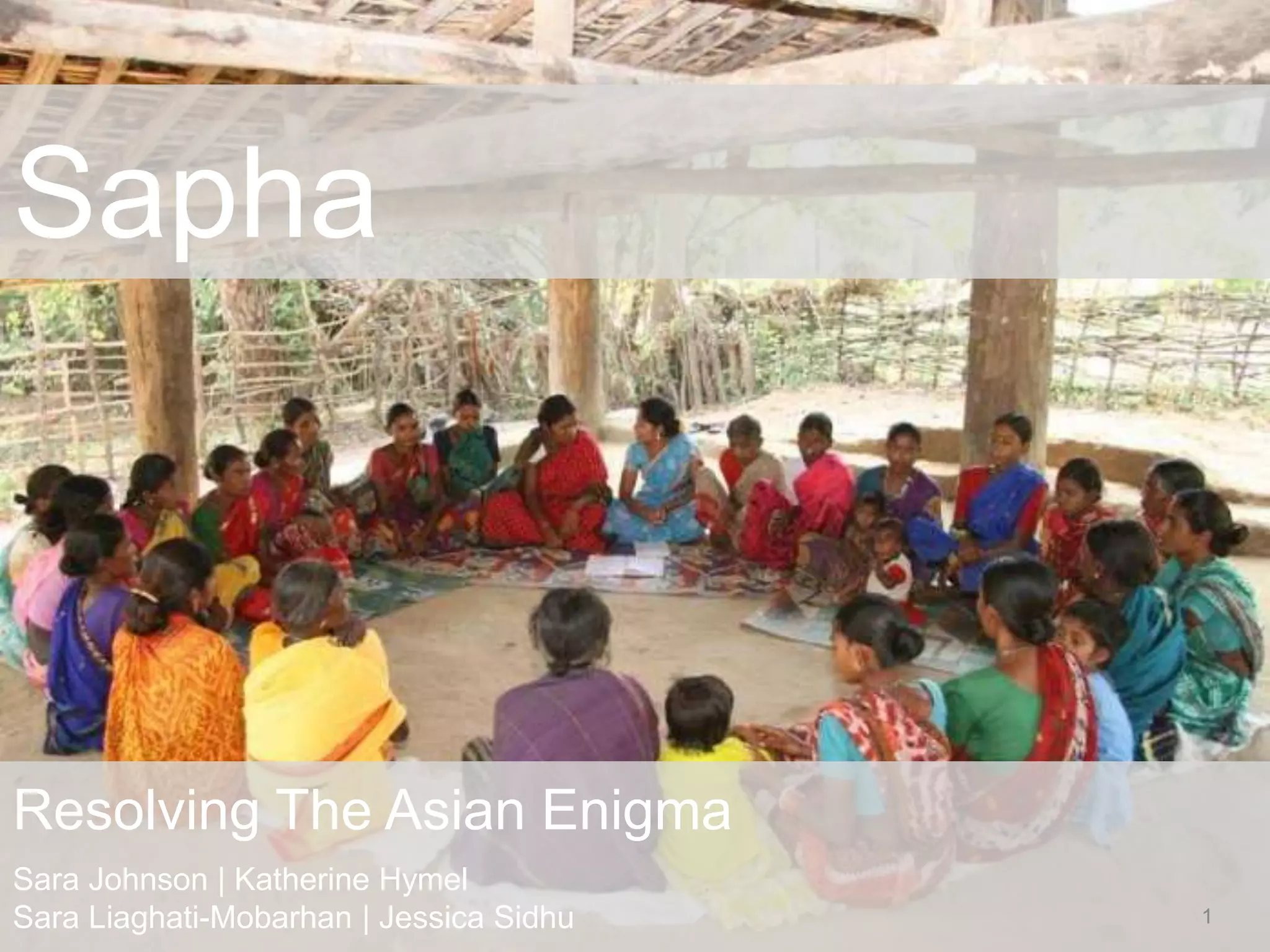
Resolving The Asian Enigma
Sapha
Sara Johnson | Katherine Hymel
Sara Liaghati-Mobarhan | Jessica Sidhu 1
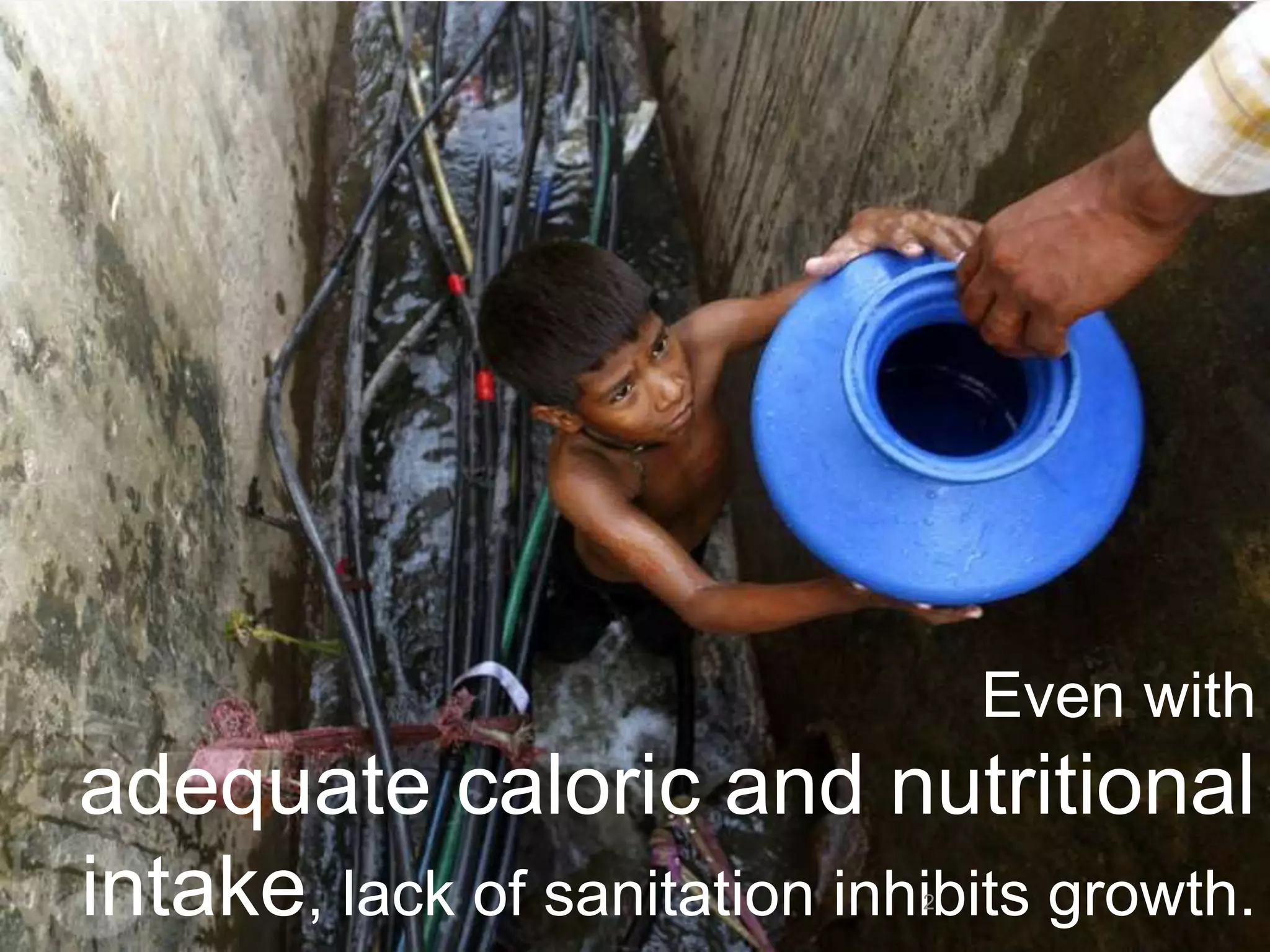
Even with
adequate caloric and nutritional
intake, lack of sanitation inhibits growth.2
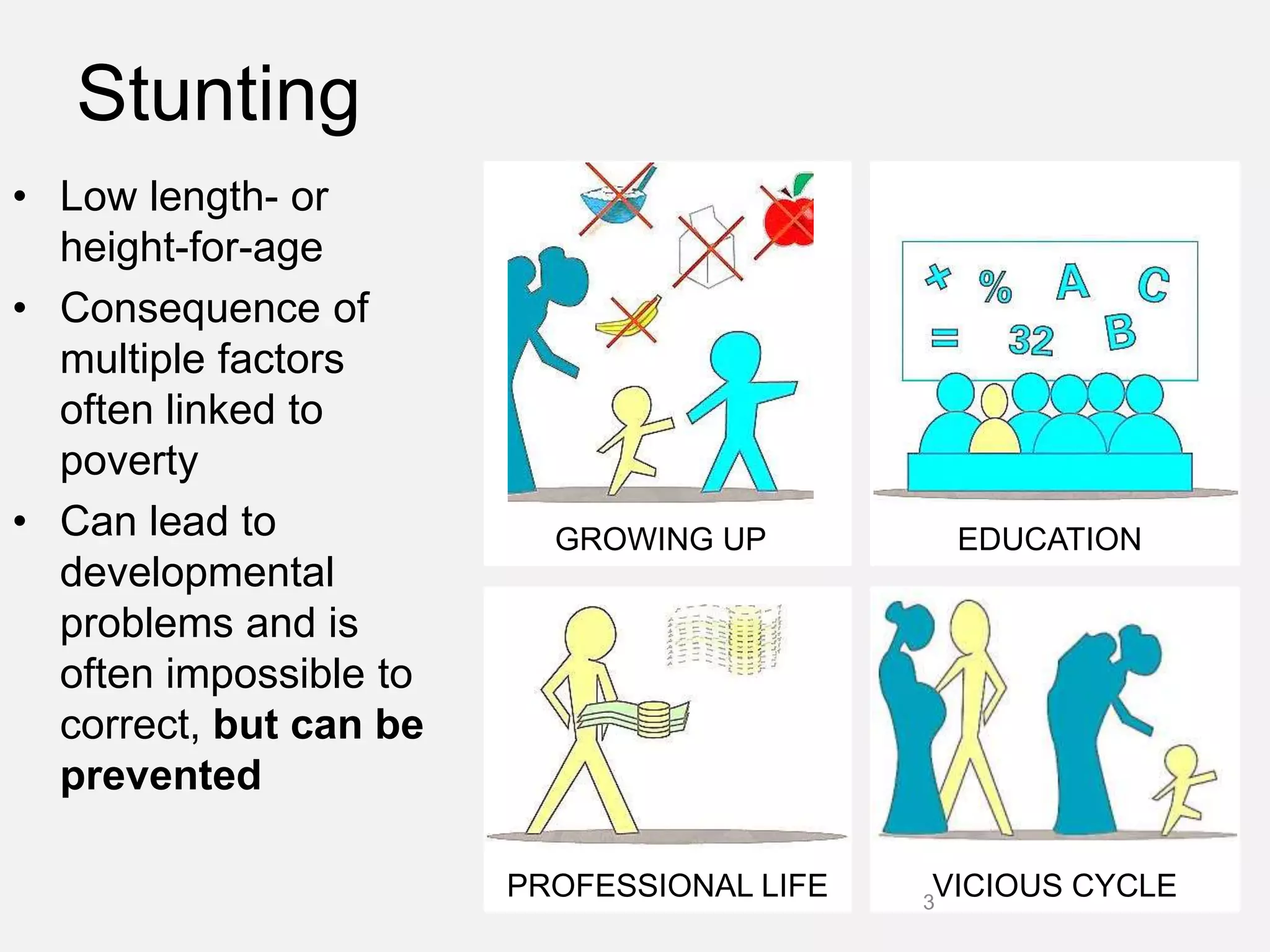
Stunting
• Low length- or
height-for-age
• Consequence of
multiple factors
often linked to
poverty
• Can lead to
developmental
problems and is
often impossible to
correct, but can be
prevented
GROWING UP EDUCATION
VICIOUS CYCLEPROFESSIONAL LIFE 3
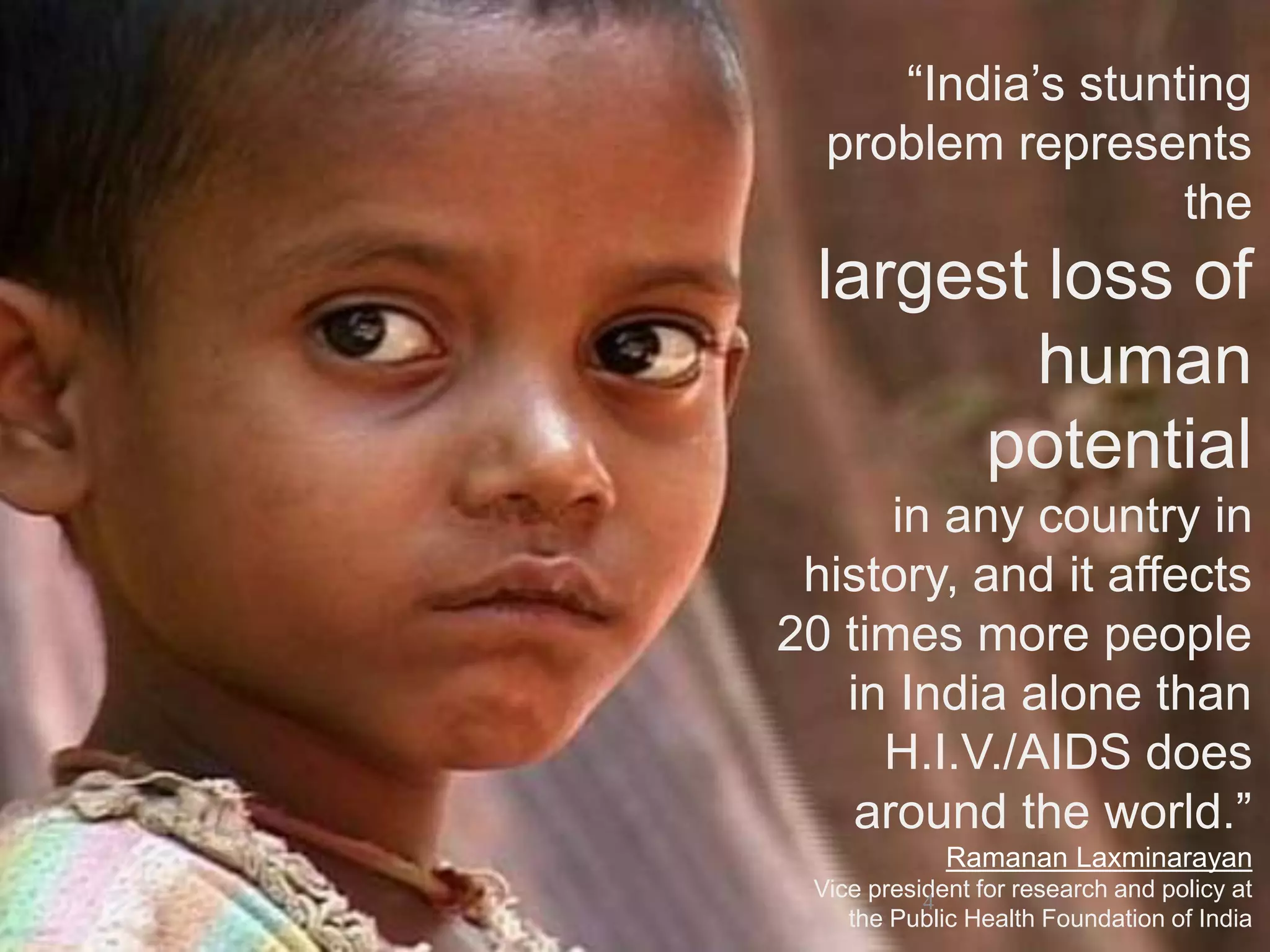
“India’s stunting
problem represents
the
largest loss of
human
potential
in any country in
history, and it affects
20 times more people
in India alone than
H.I.V./AIDS does
around the world.”
Ramanan Laxminarayan
Vice president for research and policy at
the Public Health Foundation of India
4
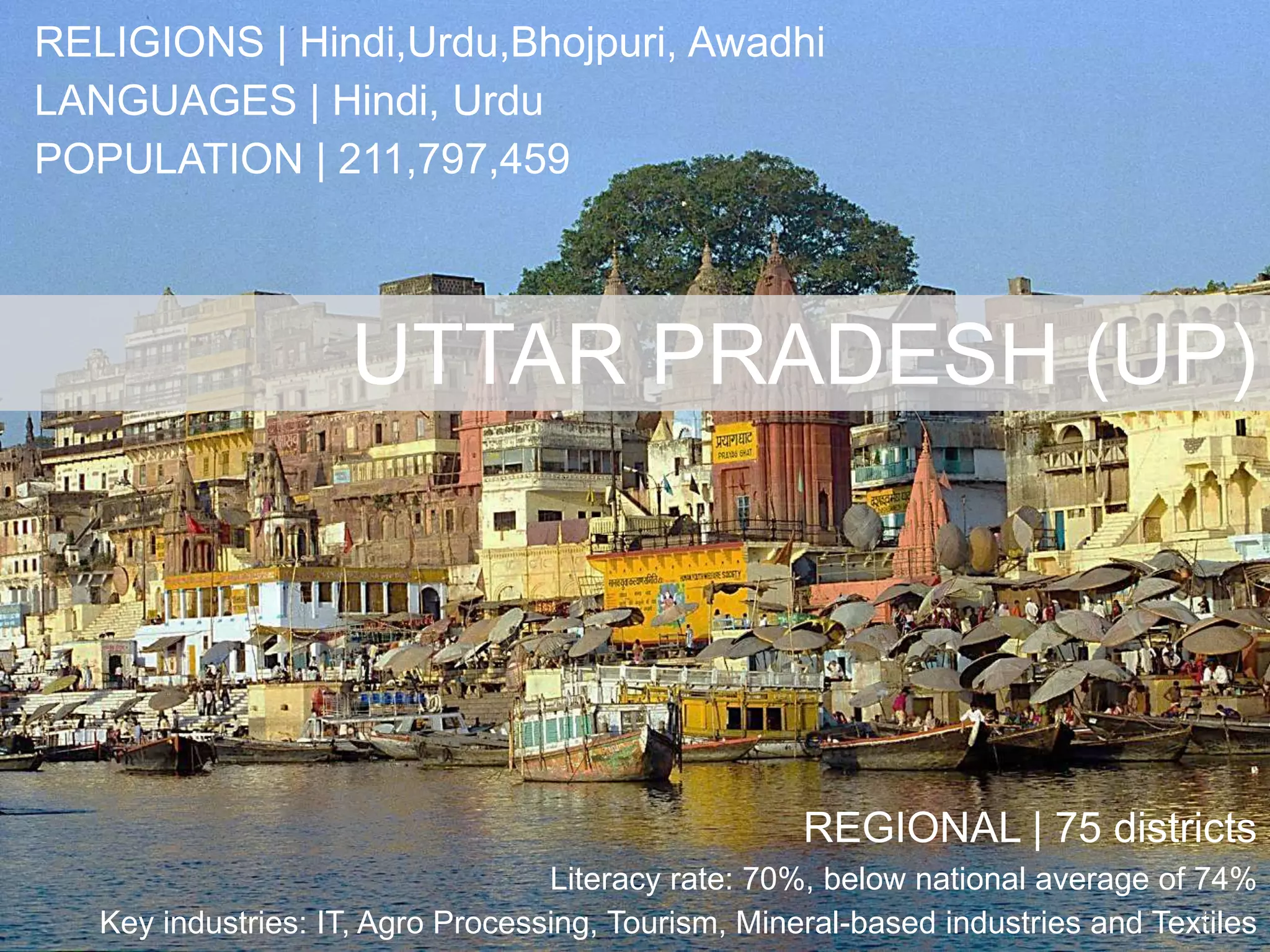
Uttar Pradesh
RELIGIONS | Hindi,Urdu,Bhojpuri, Awadhi
LANGUAGES | Hindi, Urdu
POPULATION | 211,797,459
REGIONAL | 75 districts
Literacy rate: 70%, below national average of 74%
Key industries: IT, Agro Processing, Tourism, Mineral-based industries and Textiles
UTTAR PRADESH (UP)
5
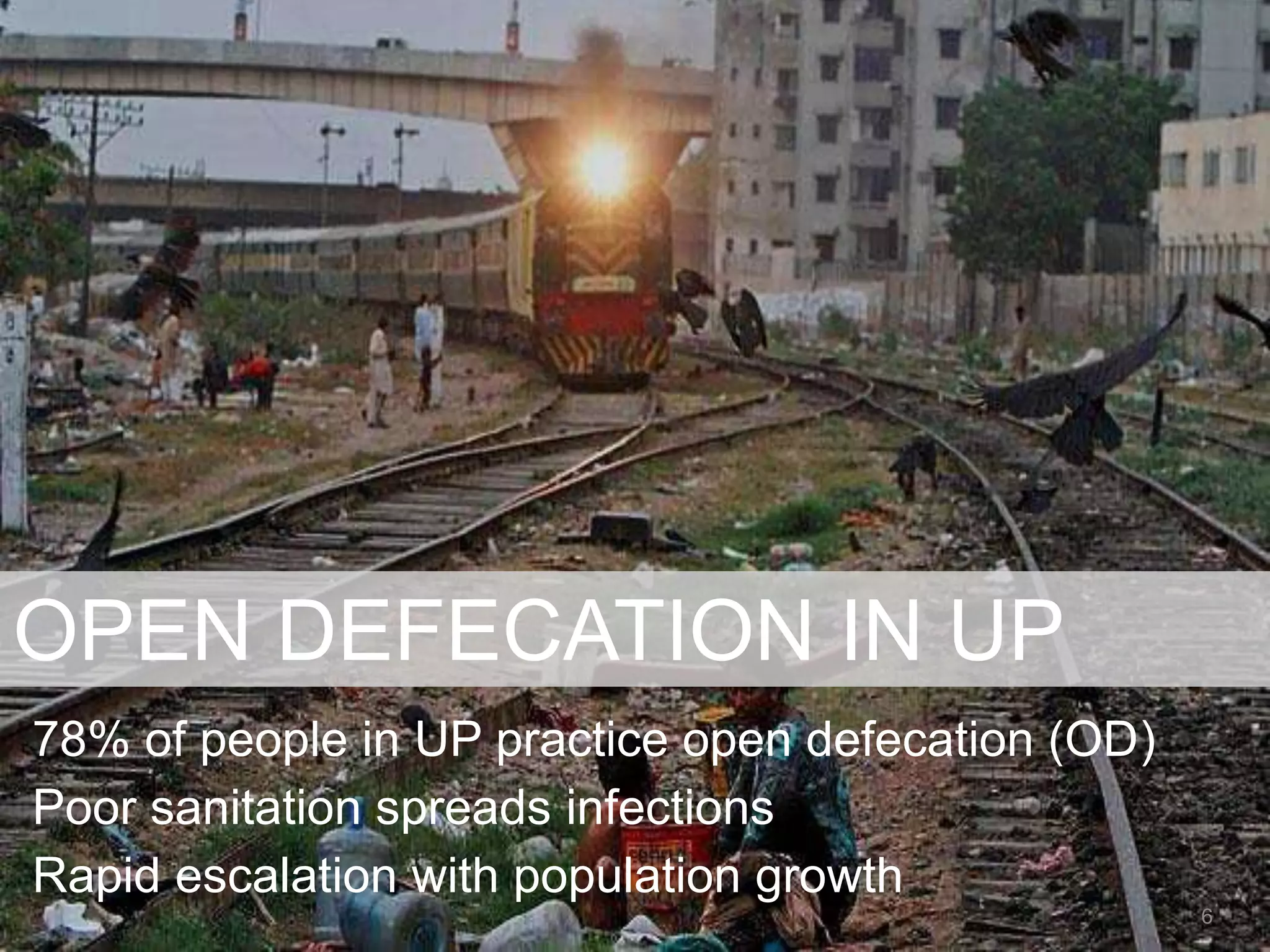
78% of people in UP practice open defecation (OD)
Poor sanitation spreads infections
Rapid escalation with population growth
OPEN DEFECATION IN UP
6
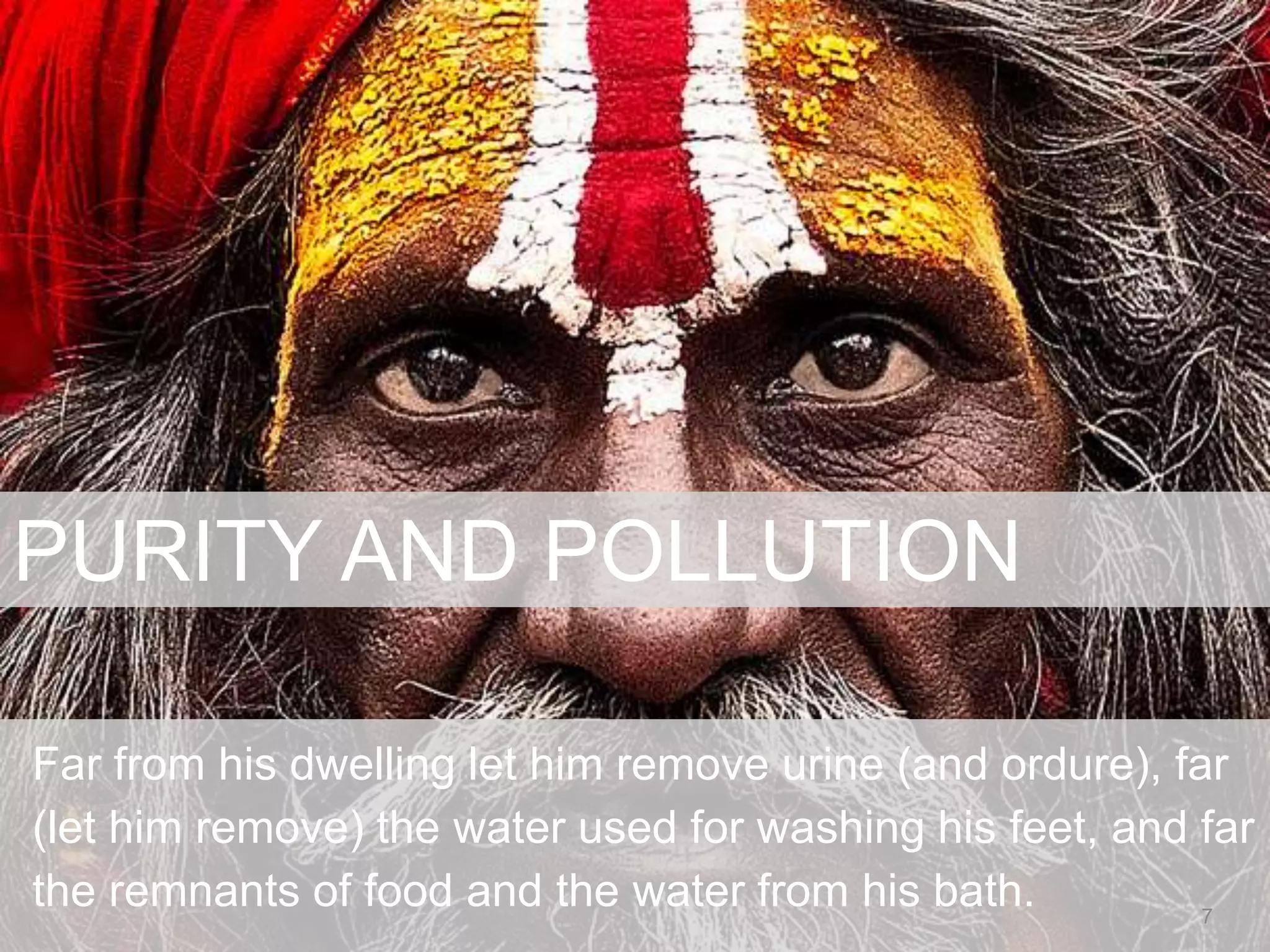
Far from his dwelling let him remove urine (and ordure), far
(let him remove) the water used for washing his feet, and far
the remnants of food and the water from his bath.
PURITY AND POLLUTION
7
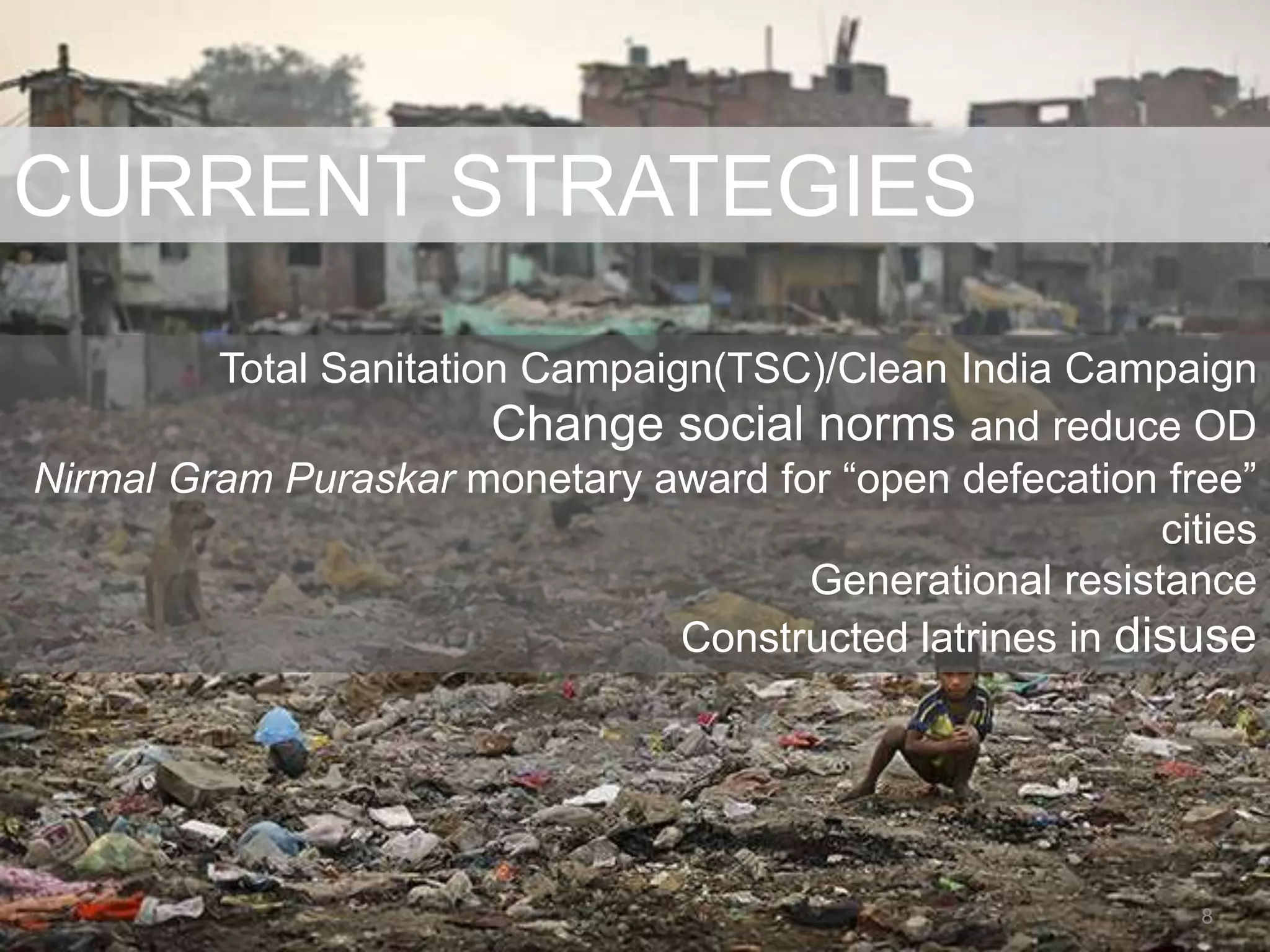
CURRENT STRATEGIES
Total Sanitation Campaign(TSC)/Clean India Campaign
Change social norms and reduce OD
Nirmal Gram Puraskar monetary award for “open defecation free”
cities
Generational resistance
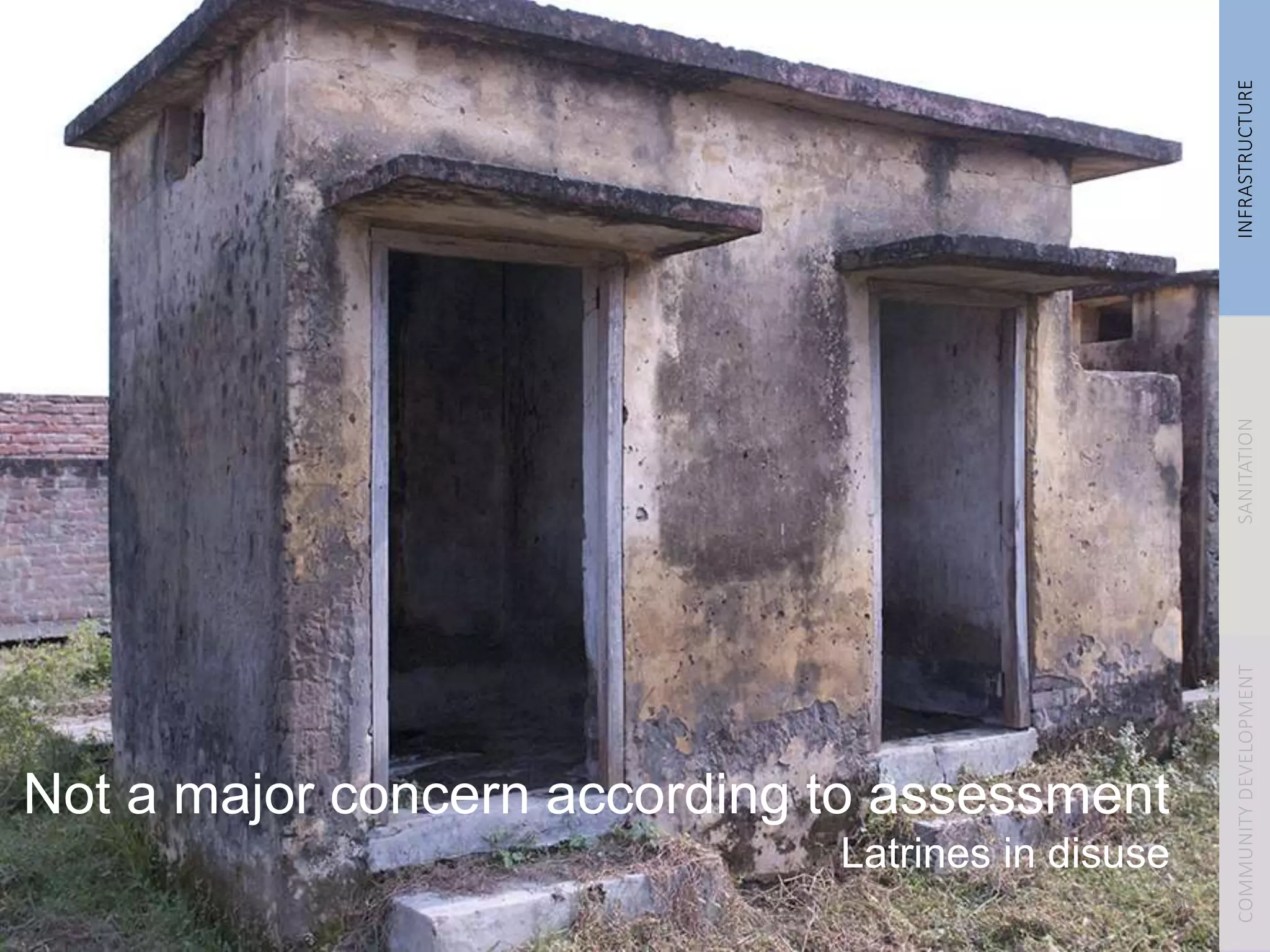
Constructed latrines in disuse
8
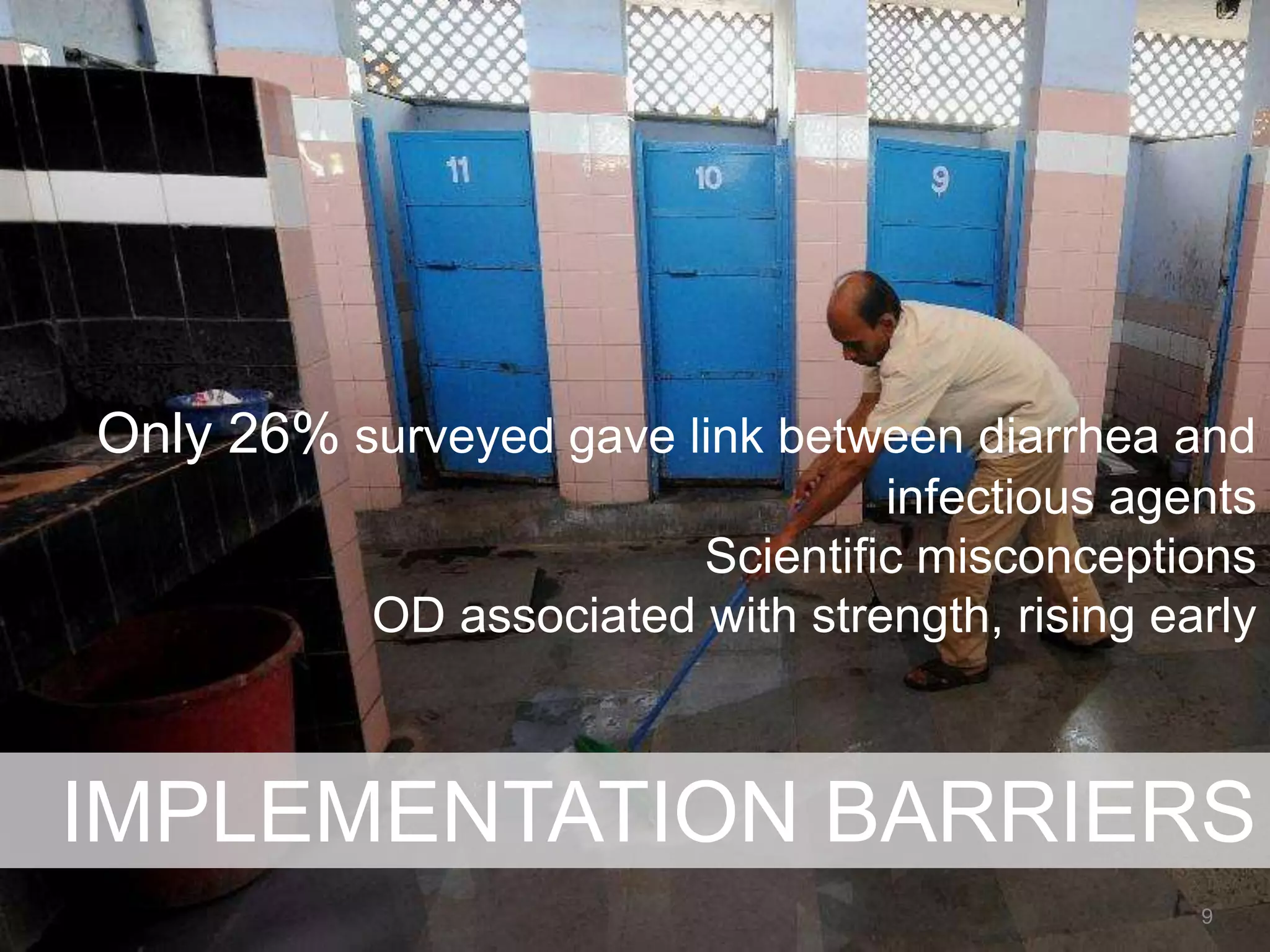
IMPLEMENTATION BARRIERS
Only 26% surveyed gave link between diarrhea and
infectious agents
Scientific misconceptions
OD associated with strength, rising early
9
Objective
Combat child stunting in rural regions of
northern India through assessment of each
village’s resources, mobilizing the
community through religious figures to
educate women and children on minimizing
exposure to growth-stunting microbia
10
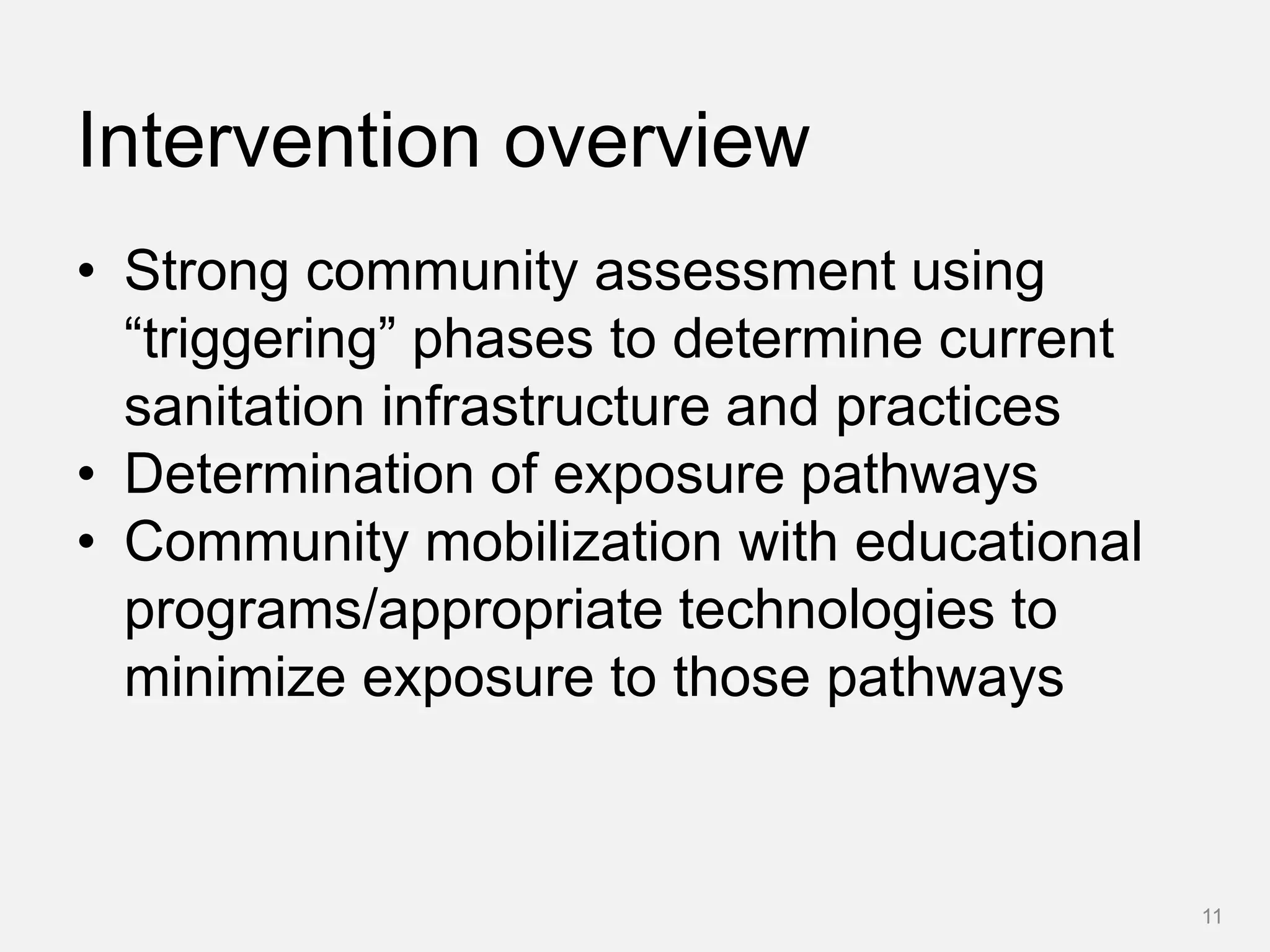
Intervention overview
• Strong community assessment using
“triggering” phases to determine current
sanitation infrastructure and practices
• Determination of exposure pathways
• Community mobilization with educational
programs/appropriate technologies to
minimize exposure to those pathways
11
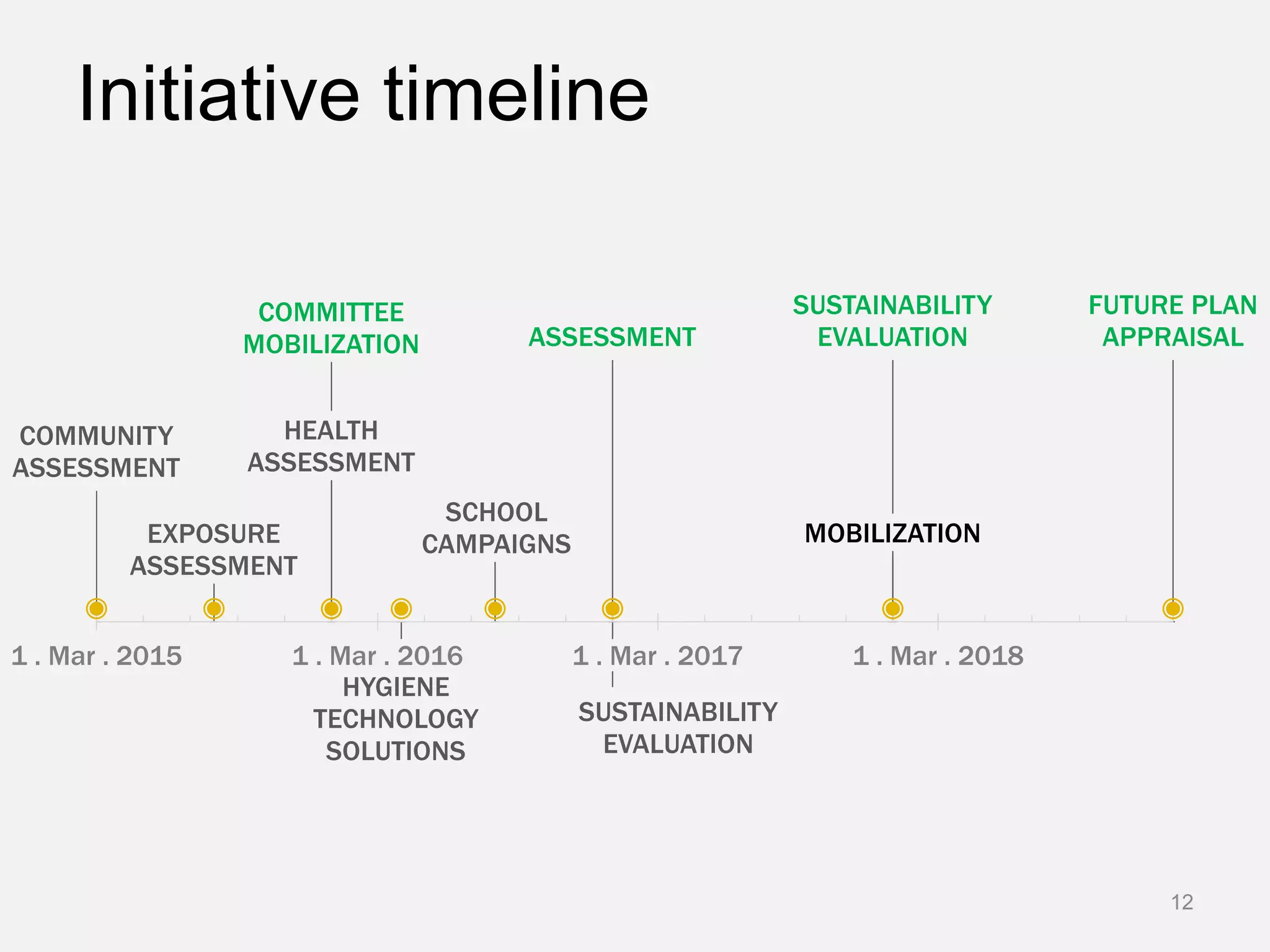
Initiative timeline
COMMUNITY
ASSESSMENT
EXPOSURE
ASSESSMENT
HEALTH
ASSESSMENT
COMMITTEE
MOBILIZATION
HYGIENE
TECHNOLOGY
SOLUTIONS
SCHOOL
CAMPAIGNS
SUSTAINABILITY
EVALUATION
ASSESSMENT
MOBILIZATION
SUSTAINABILITY
EVALUATION
FUTURE PLAN
APPRAISAL
1 . Mar . 2015 1 . Mar . 2016 1 . Mar . 2017 1 . Mar . 2018
12
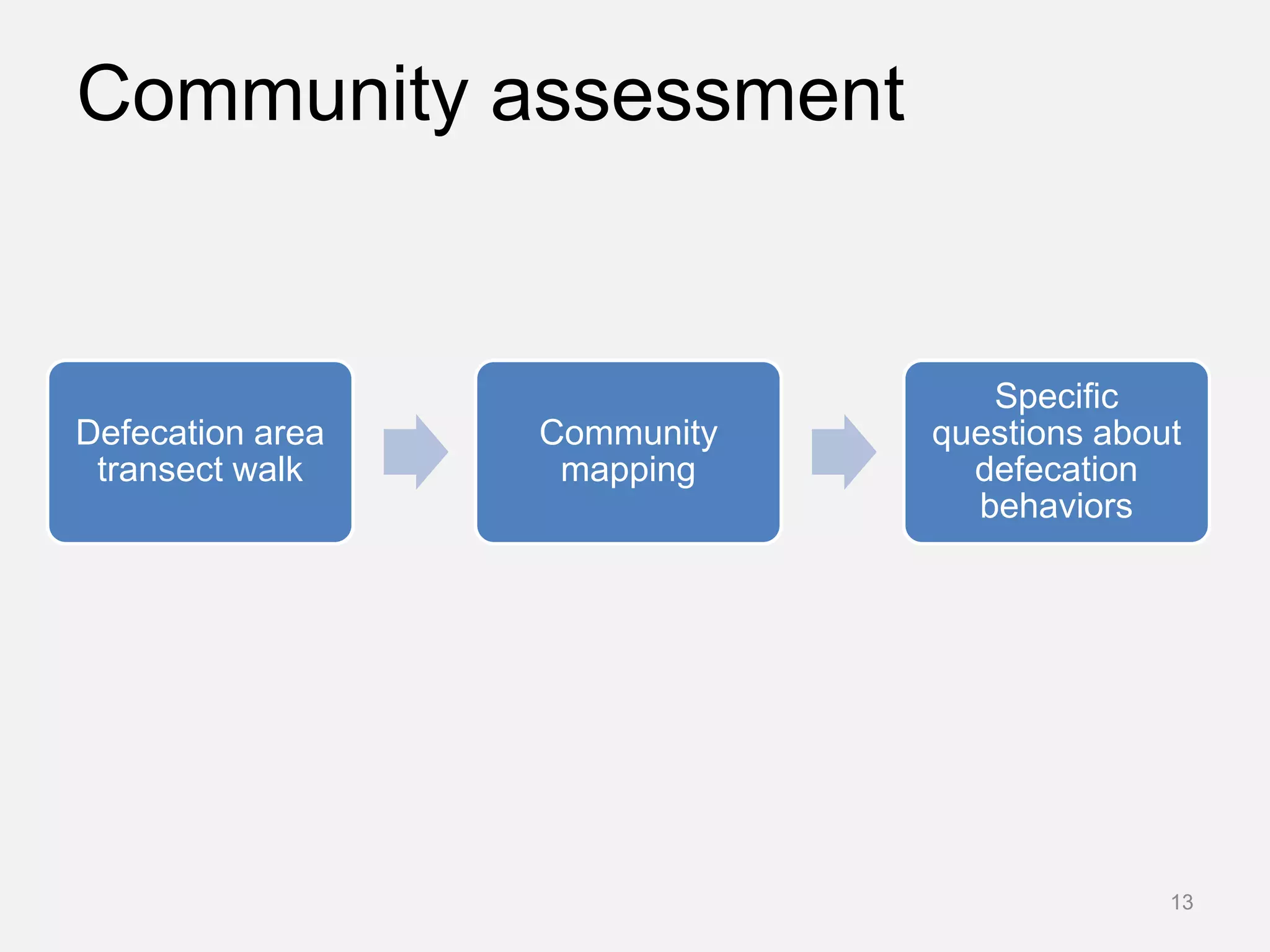
Defecation area
transect walk
Community
mapping
Specific
questions about
defecation
behaviors
Community assessment
13
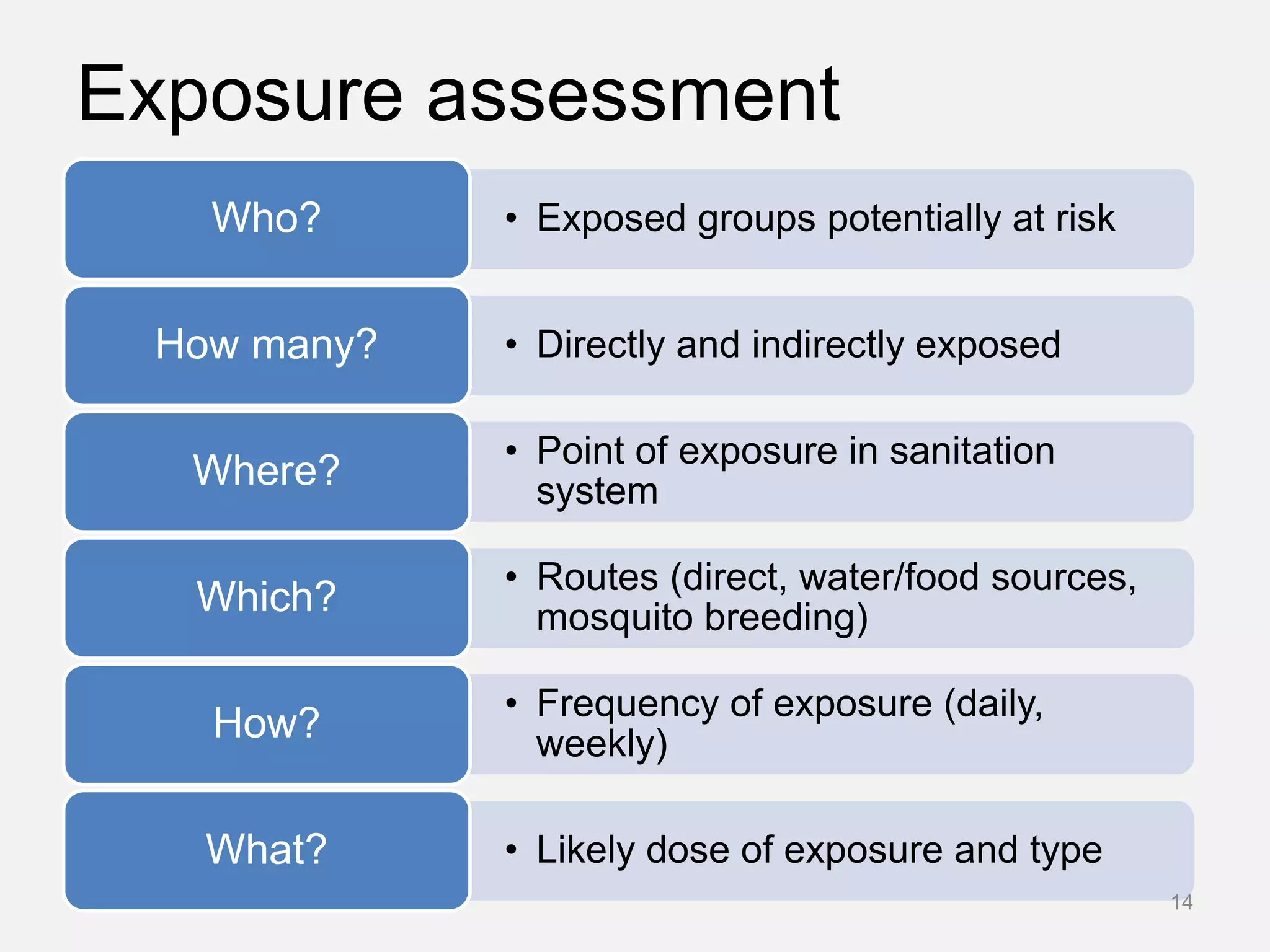
Exposure assessment
• Exposed groups potentially at riskWho?
• Directly and indirectly exposedHow many?
• Point of exposure in sanitation
systemWhere?
• Routes (direct, water/food sources,
mosquito breeding)Which?
• Frequency of exposure (daily,
weekly)How?
• Likely dose of exposure and typeWhat?
14
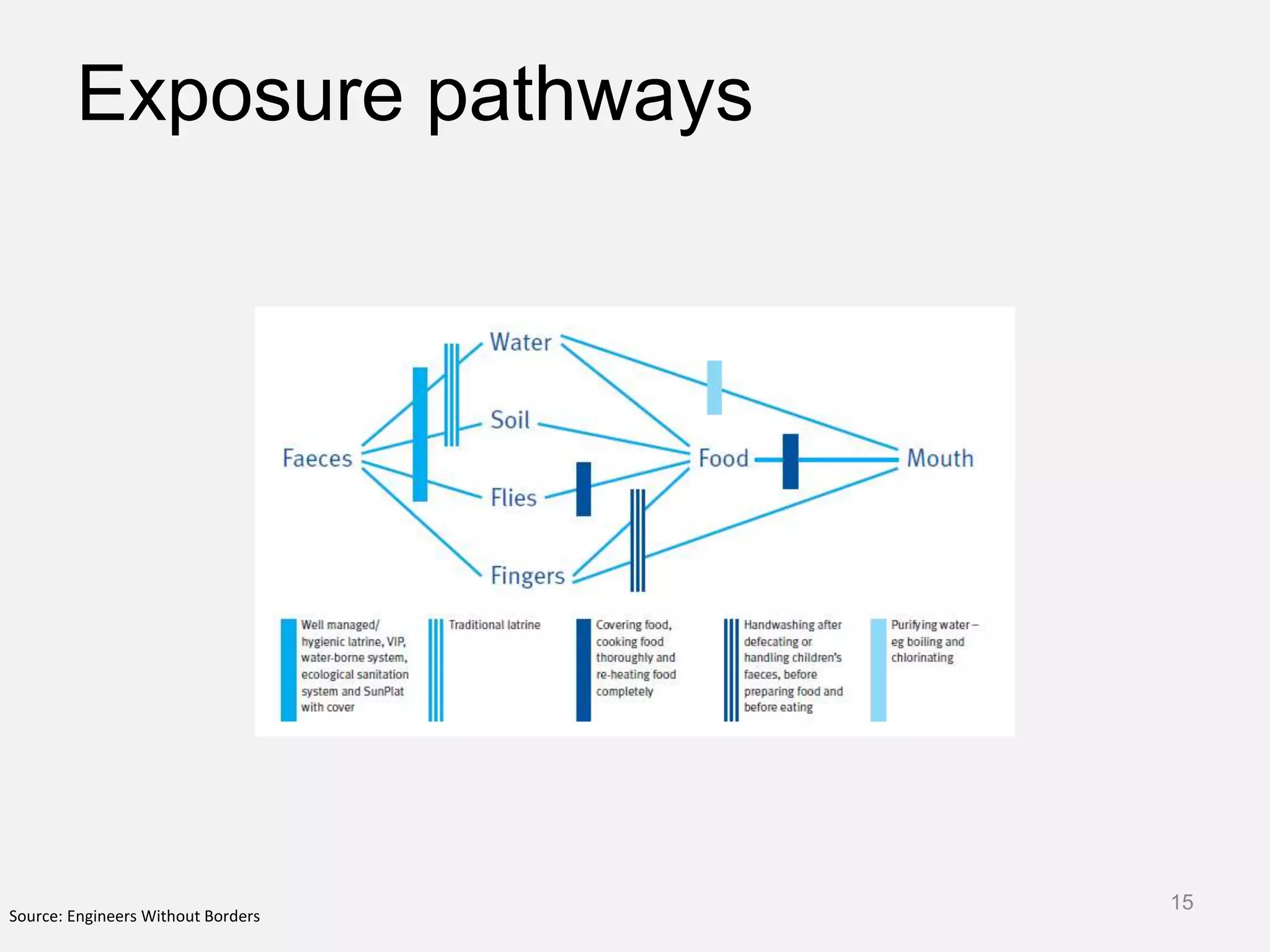
Exposure pathways
Source: Engineers Without Borders
15
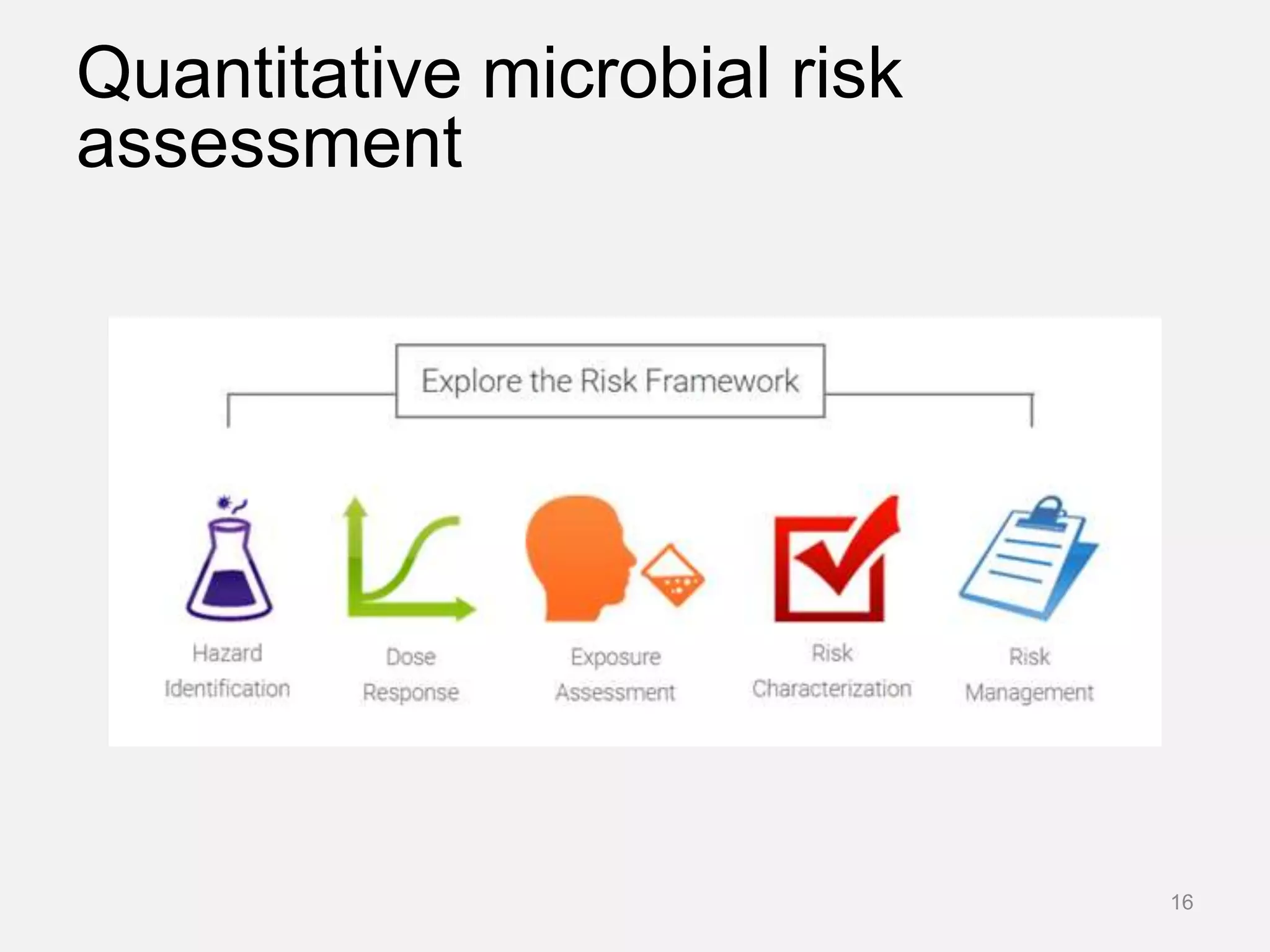
Quantitative microbial risk
assessment
16
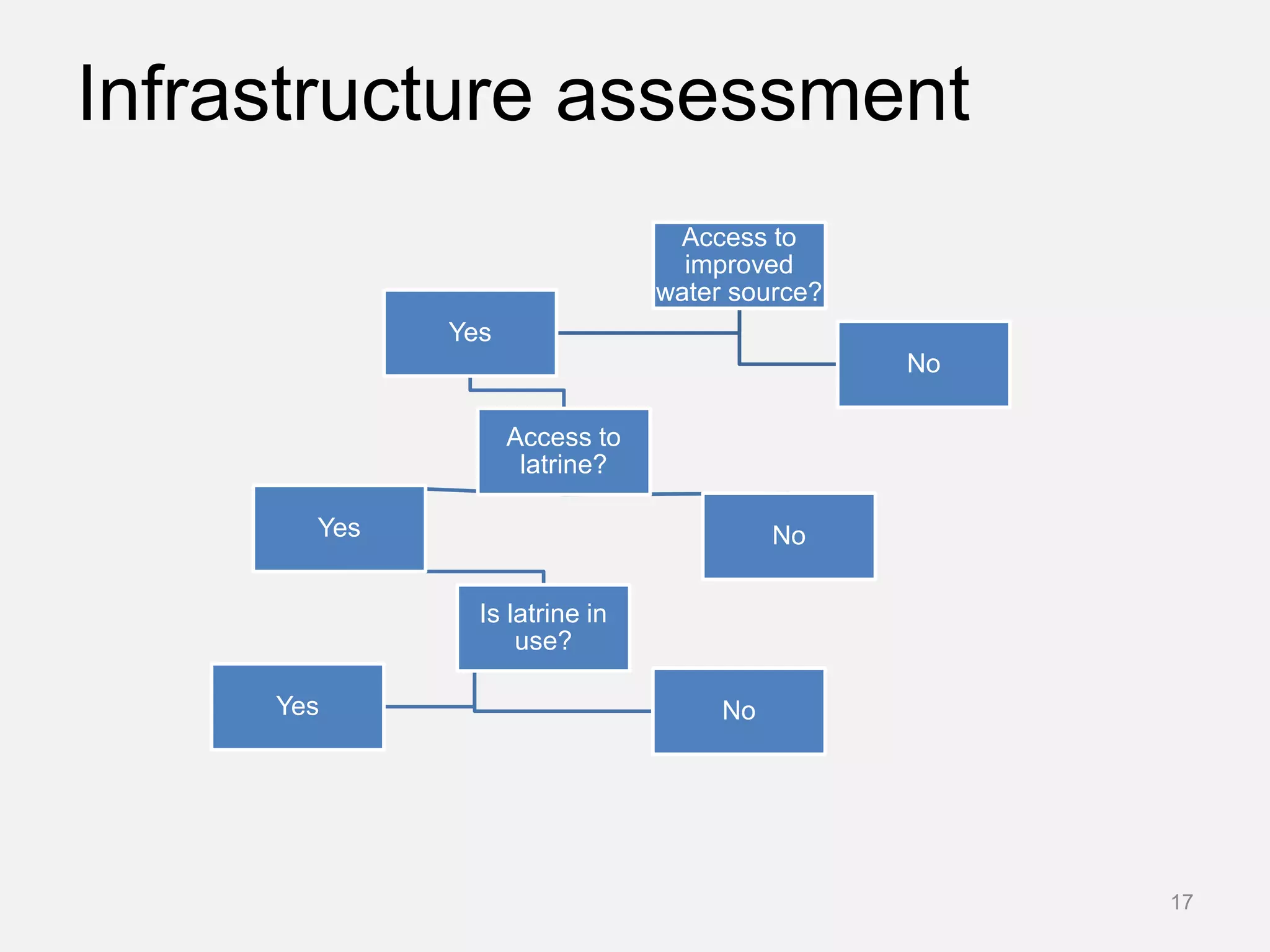
Infrastructure assessment
Access to
improved
water source?
Yes
Access to
latrine?
Yes
Is latrine in
use?
NoYes
No
No
17
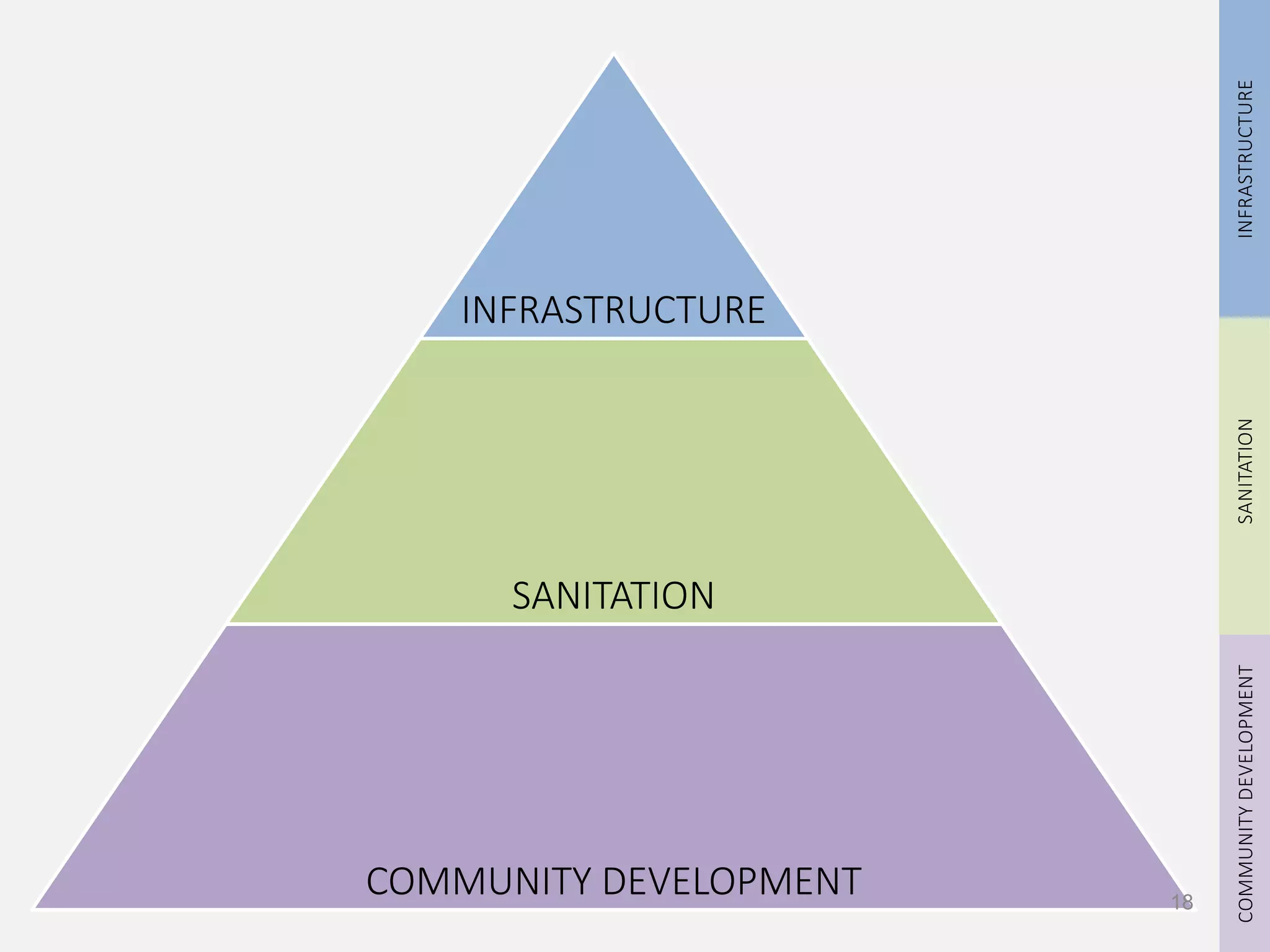
INFRASTRUCTURESANITATION
INFRASTRUCTURE
SANITATION
COMMUNITY DEVELOPMENT
COMMUNITYDEVELOPMENT
18
INFRASTRUCTURESANITATIONCOMMUNITYDEVELOPMENT
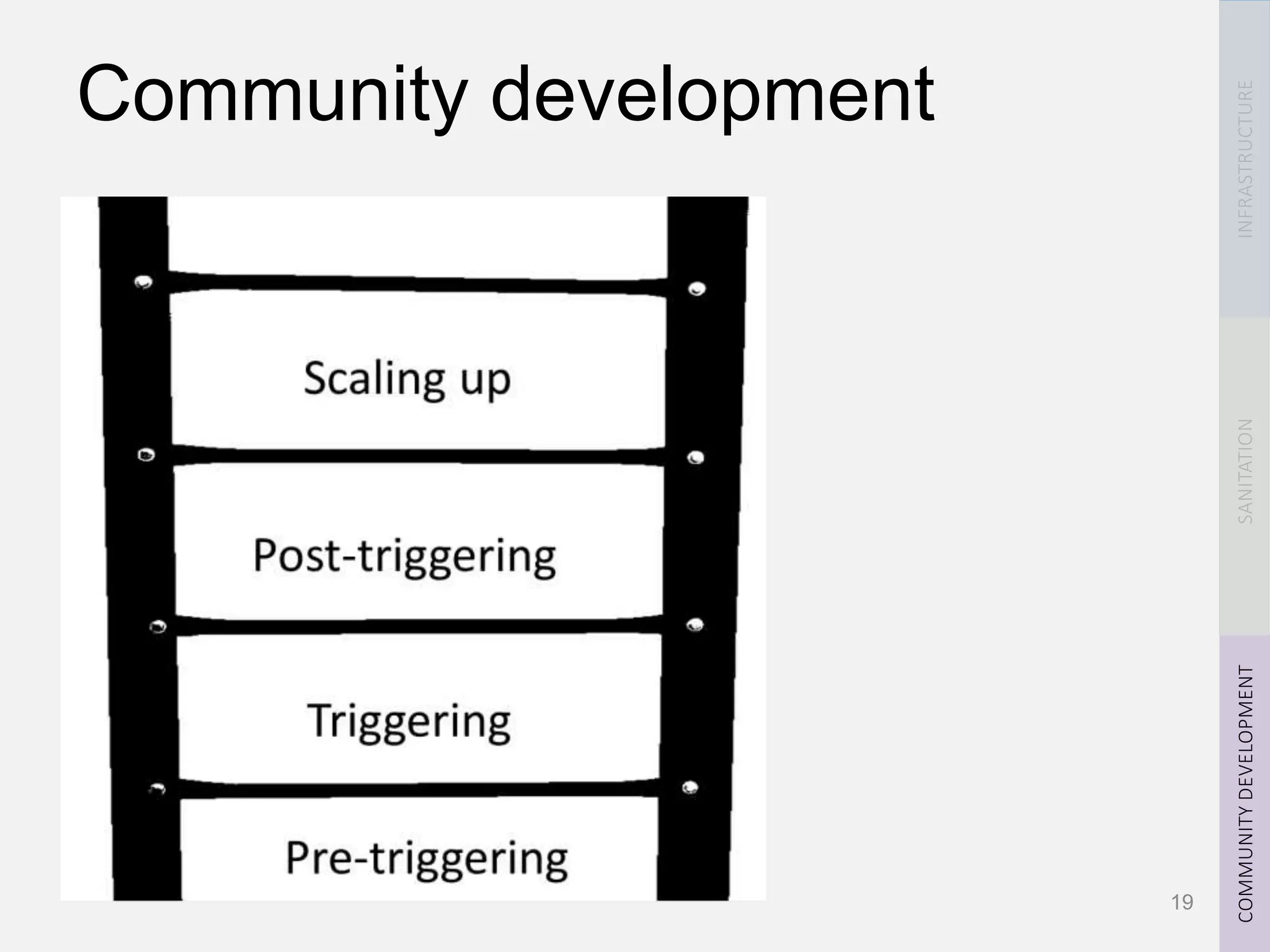
Community development
19
INFRASTRUCTURESANITATIONCOMMUNITYDEVELOPMENT
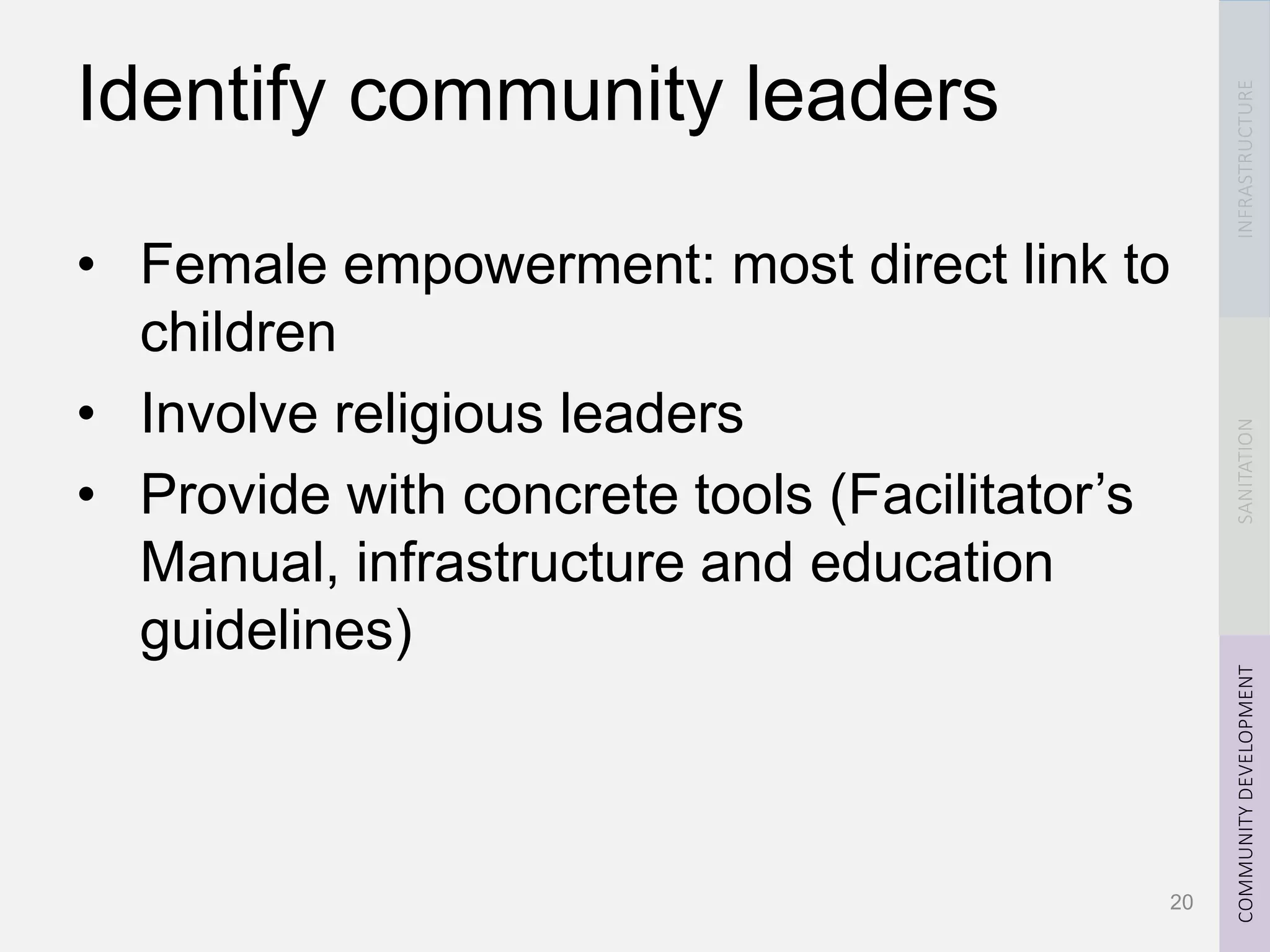
Identify community leaders
• Female empowerment: most direct link to
children
• Involve religious leaders
• Provide with concrete tools (Facilitator’s
Manual, infrastructure and education
guidelines)
20
INFRASTRUCTURESANITATIONCOMMUNITYDEVELOPMENT
Public health committees
• Host programs for women on basic
hygiene science and practices
• Monitor project implementations
• Seek input of community with
interventions
21
INFRASTRUCTURESANITATIONCOMMUNITYDEVELOPMENT
Primary schools
• Introduction of basic hygiene lessons
• Interactive demonstrations
• Partnerships with pre-existing work:
• Hope for Hapric
• UNICEF, TSC
• Tippy Tap
• Sulabh School Sanitation Club
• Swacch Express
• Feedback Foundation
22
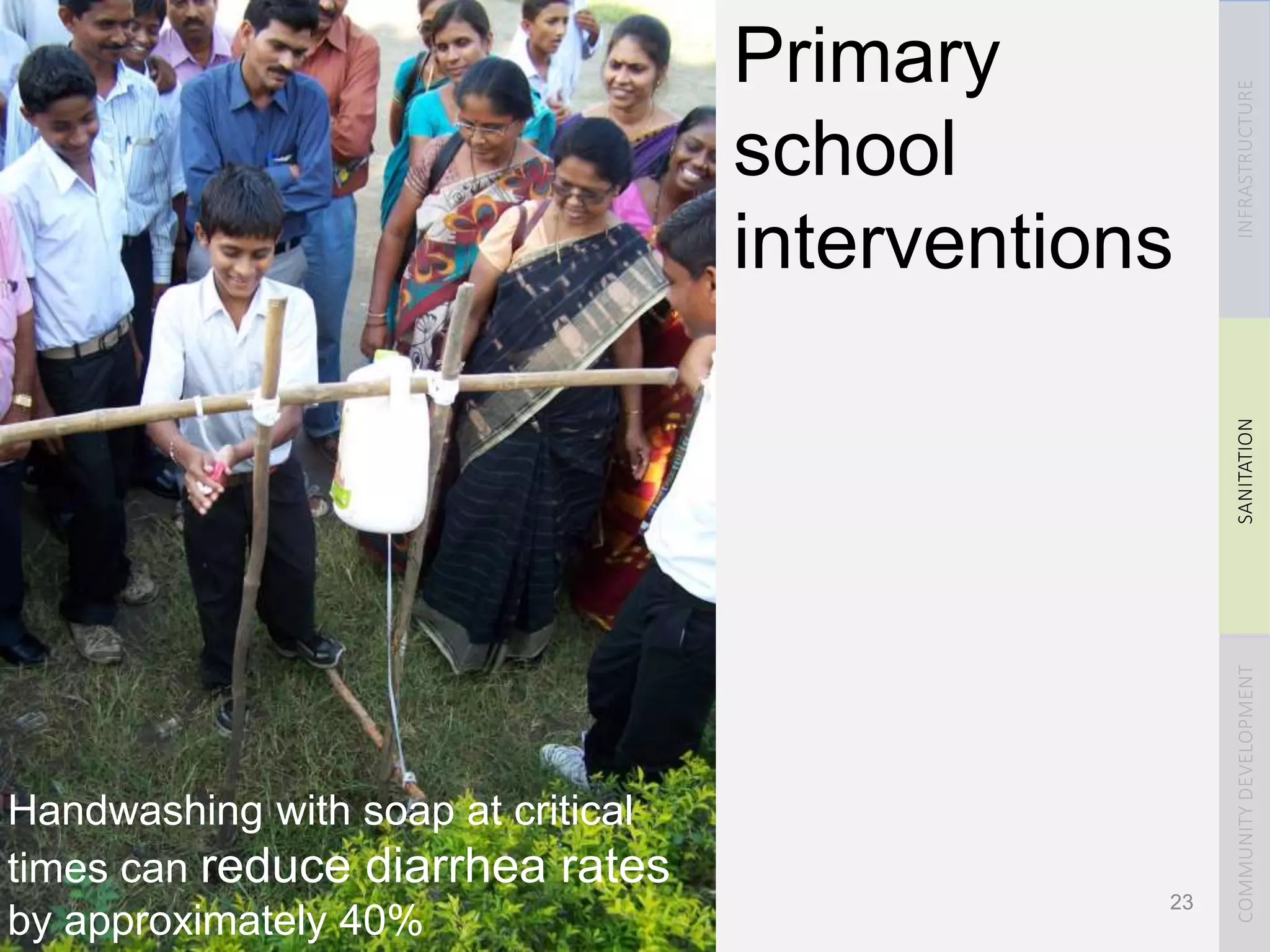
Primary
school
interventions
Handwashing with soap at critical
times can reduce diarrhea rates
by approximately 40%
INFRASTRUCTURESANITATIONCOMMUNITYDEVELOPMENT
23
INFRASTRUCTURESANITATIONCOMMUNITYDEVELOPMENT
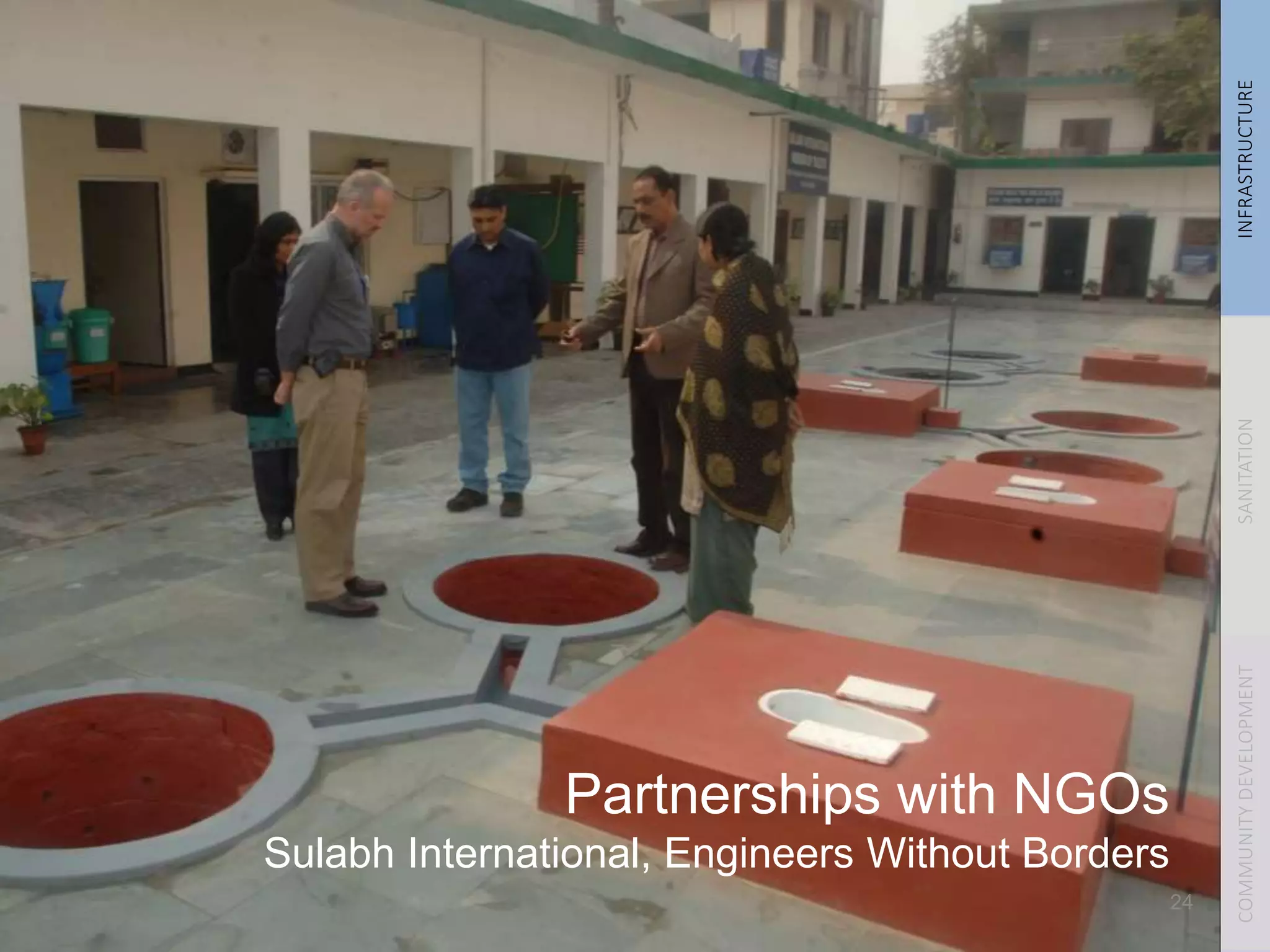
Partnerships with NGOs
Sulabh International, Engineers Without Borders
24
INFRASTRUCTURESANITATIONCOMMUNITYDEVELOPMENT
Bank filtration, managed aquifer recharge
Pumps, wells, spring boxes, gravity systems
Rainwater harvesting, micro dams
25
Monitoring and evaluation
• Adapted from Patil et al., 2014; see
appendix
• Measured Outcomes (questionnaires,
waste disposal classification, testing of
drinking water, child anthropometry and
specimen testing)
• Frequency: 2 times per year
• Award: Monetary incentives for villages
26
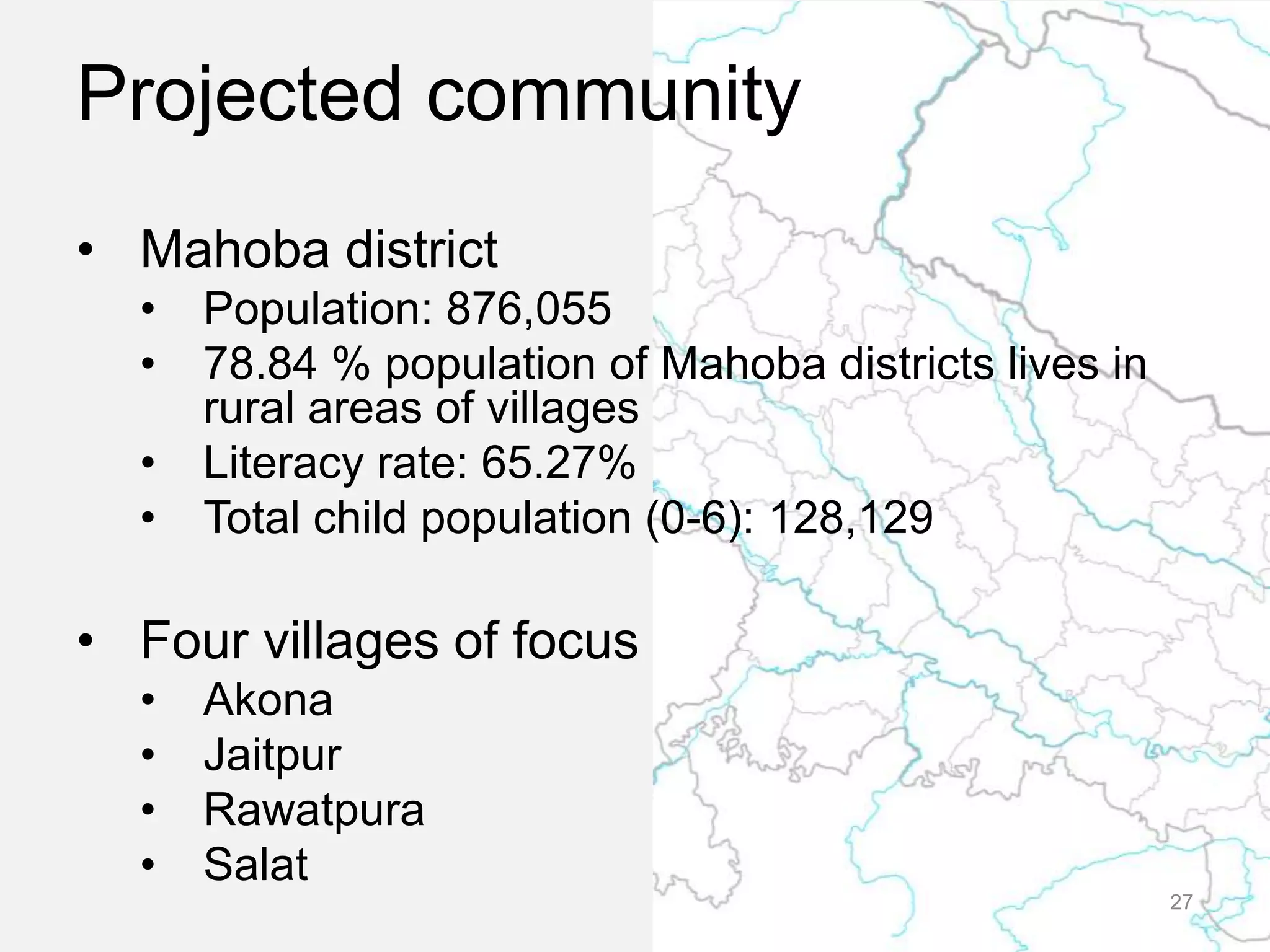
Projected community
• Mahoba district
• Population: 876,055
• 78.84 % population of Mahoba districts lives in
rural areas of villages
• Literacy rate: 65.27%
• Total child population (0-6): 128,129
• Four villages of focus
• Akona
• Jaitpur
• Rawatpura
• Salat
27
Hypothetical assessment
• Highest risk exposure pathway: ingestion
of excreta (fecal to hand to mouth)
• Latrines built by government but not in
use
• Access to food and water
28
INFRASTRUCTURESANITATION
INFRASTRUCTURE
SANITATION
COMMUNITY DEVELOPMENT
COMMUNITYDEVELOPMENT
29
INFRASTRUCTURESANITATIONCOMMUNITYDEVELOPMENT
Not a major concern according to assessment
Latrines in disuse
30
Primary
school
interventions
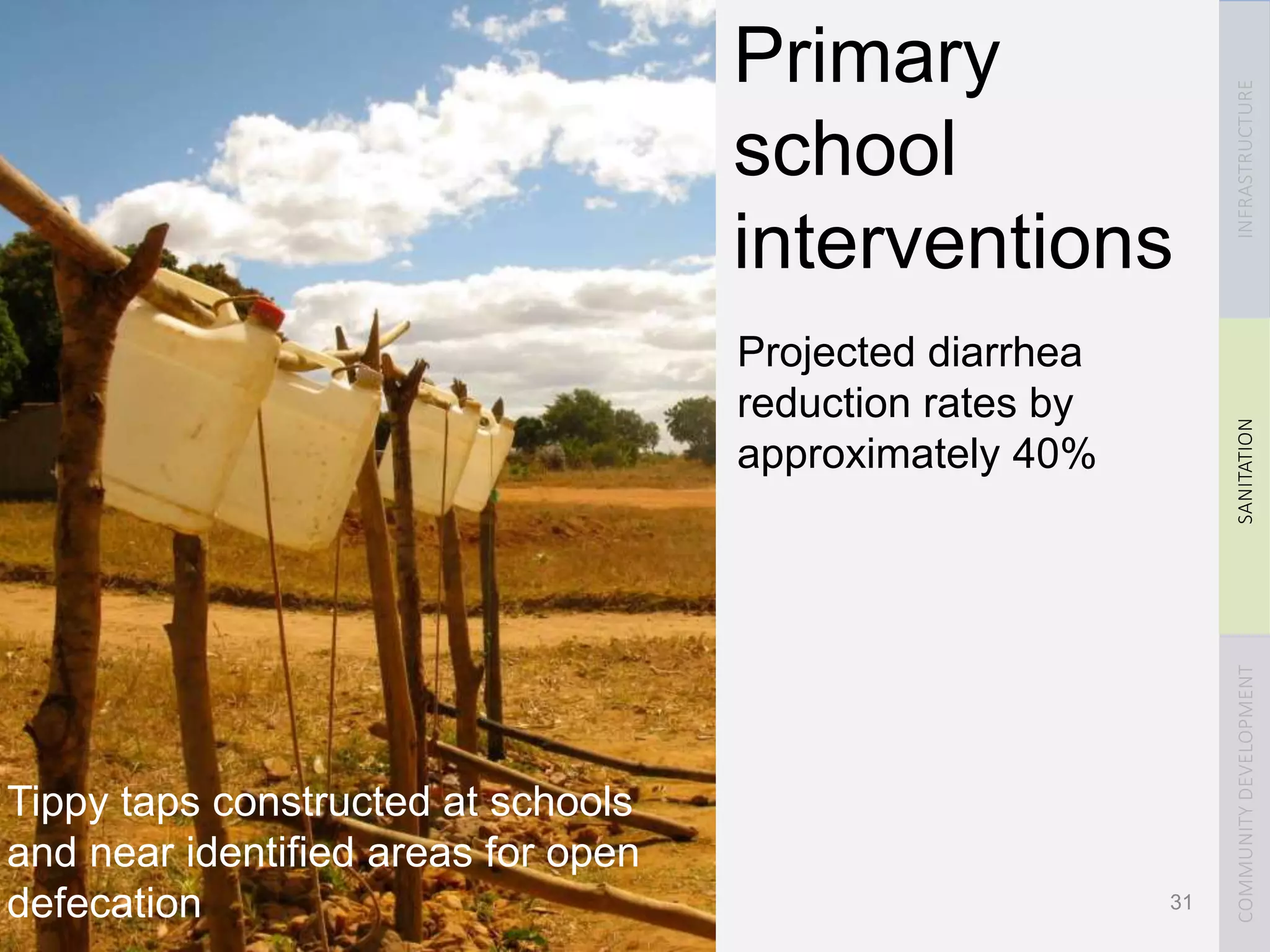
Projected diarrhea
reduction rates by
approximately 40%
INFRASTRUCTURESANITATIONCOMMUNITYDEVELOPMENT
Tippy taps constructed at schools
and near identified areas for open
defecation 31
INFRASTRUCTURESANITATIONCOMMUNITYDEVELOPMENT
Community development
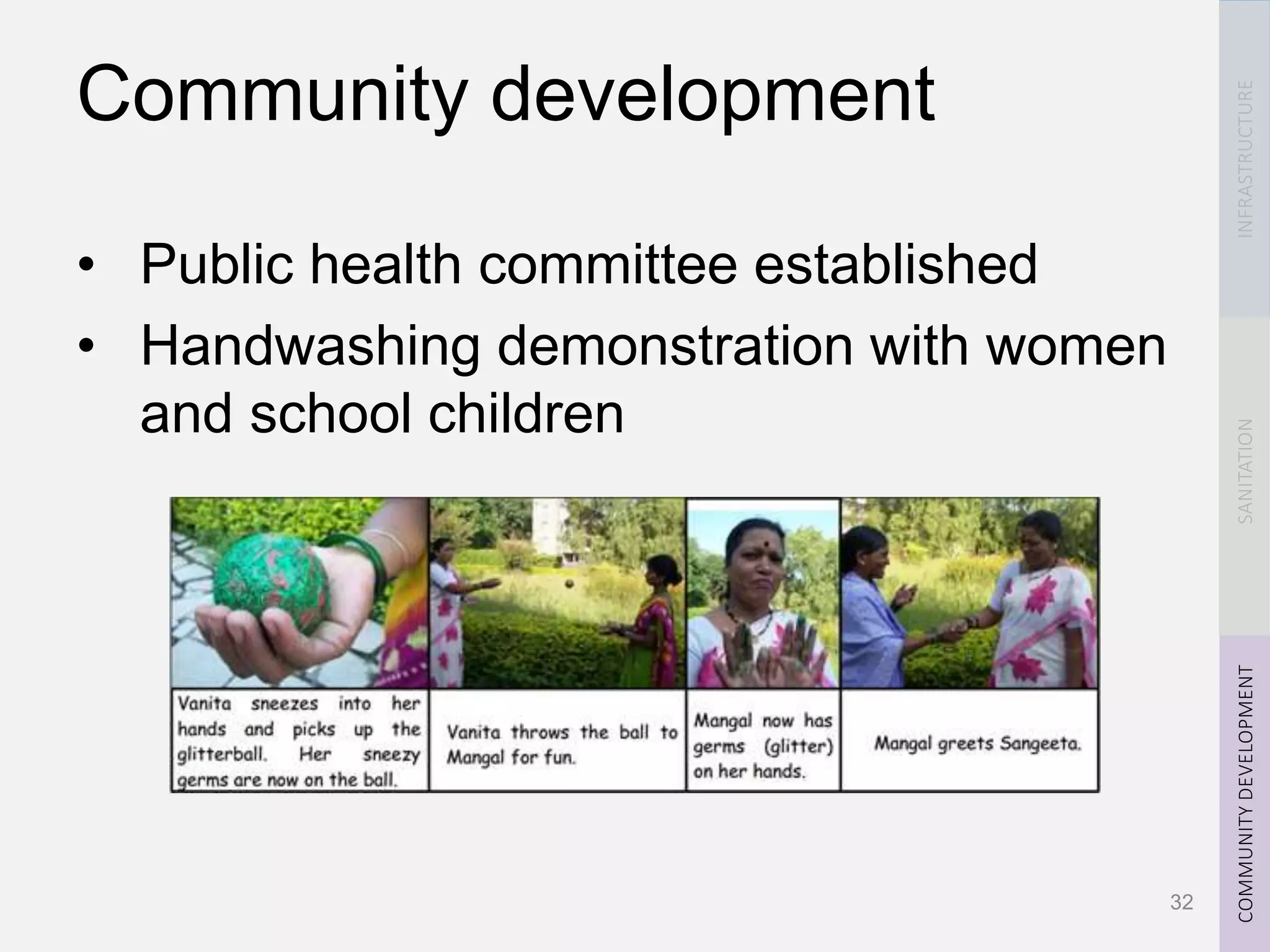
• Public health committee established
• Handwashing demonstration with women
and school children
32
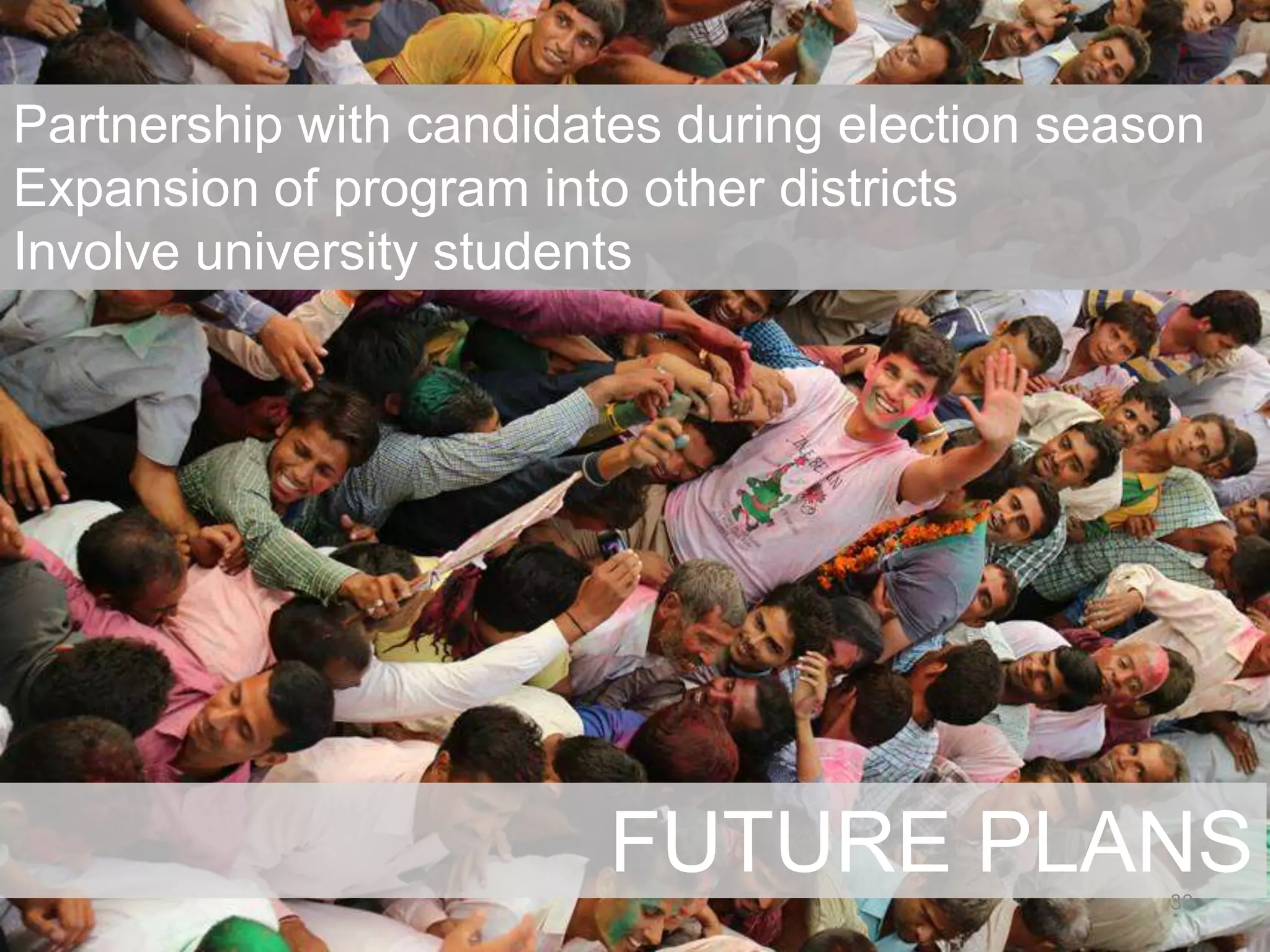
Partnership with candidates during election season
Expansion of program into other districts
Involve university students
FUTURE PLANS33
SUSTAINABILITY
Cultural awareness
Avoidance of proprietary breakdowns
Community members fuel the movement
34
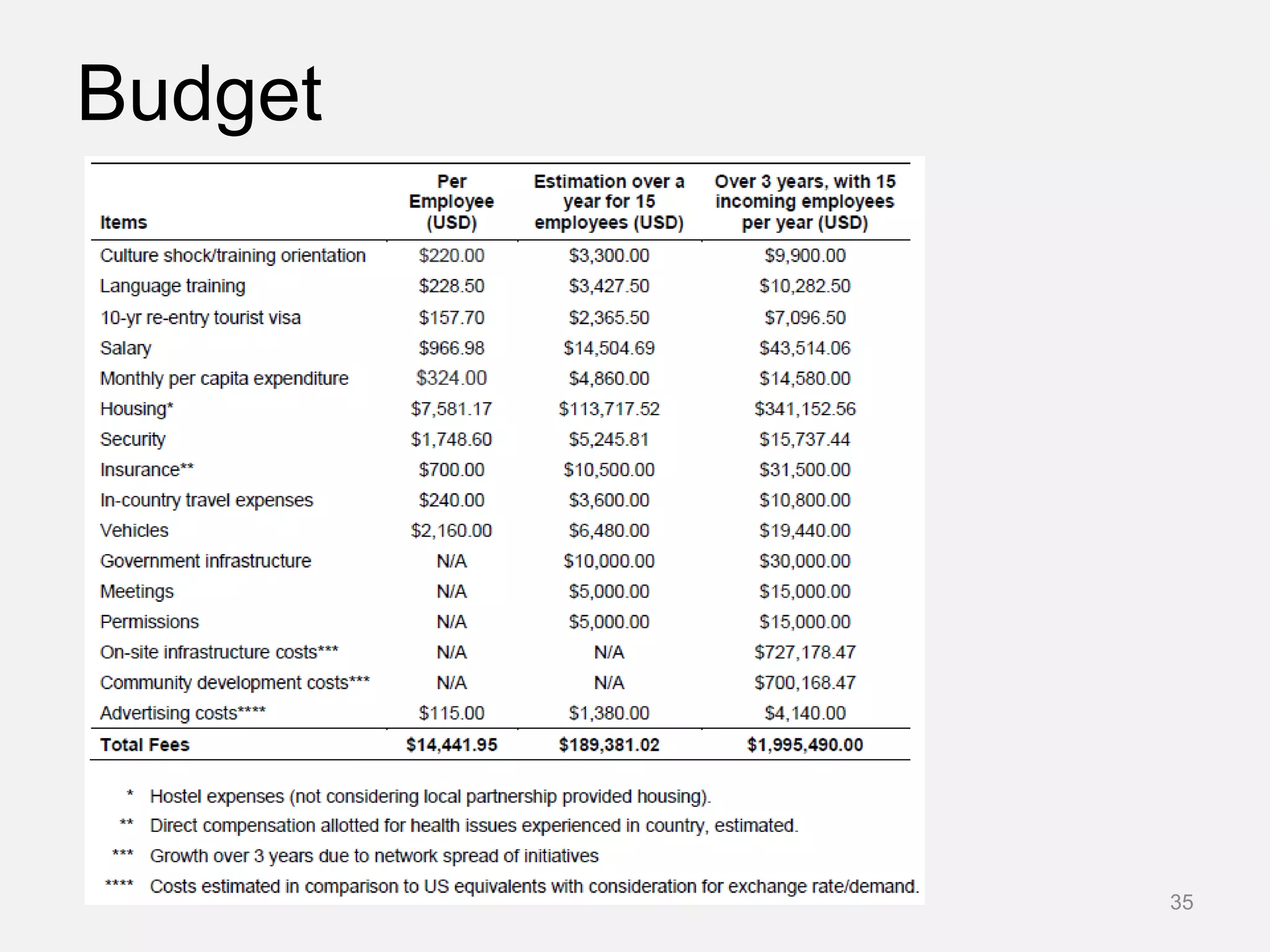
Budget
35
References
Badham J, Sweet L. (2010). Stunting: an Overview. Sight and Life. Retrieved on February 3, 2015 from:
http://www.sightandlife.org/fileadmin/data/Publications/Stunting/Stunting_An_O verview.pdf
Banda, K., Sarkar, R., Gopal, S., Govindarajan, J., Harijan, B., Jeyakumar, M., … Balraj, V. (2007). Water handling, sanitation and defecation practices in rural southern India: A
knowledge, attitudes and practices study. Transactions of the Royal Society of Tropical Medicine and Hygiene, 101(11), 1124-1130.
Coffey, D., Gupta, A., Hathi, P., Khurana, N., Srivastav, N., & Vyas, S. (2014, September 20). Revealed preference for Open Defecation: Evidence from a new survey in rural North
India. Economic & Political Weekly, 43-55.
Curtis, V., & Cairncross, S. (2003). Effect of washing hands with soap on diarrhea risk in the community: a systematic review. Lancet Infectious Diseases 3, 275–81.
Greater Access to Cell Phones Than Toilets in India: UN – United Nations University. (2010, April 14). Retrieved February 7, 2015, from http://unu.edu/media-
relations/releases/greater-access-to-cell-phones-than-toilets-in-india.html
Harris, G. (2014). Poor Sanitation in India May Afflict Well-Fed Children with Malnutrition. The New York Times. February 5, 2015 from:
http://www.nytimes.com/2014/07/15/world/asia/poor-sanitation-in-india-may- afflict-well-fed-children-with-malnutrition.html
Mahoba District : Census 2011 data. (n.d.). Retrieved February 6, 2015, from http://www.census2011.co.in/census/district/540-mahoba.html
Mehrotra K. 2014. India’s Toilet Race Failing as Villages don’t Use Them. Bloomberg. Retrieved November 13, 2014 from: http://www.bloomberg.com/news/2014-08-03/india-s-toilet-
race-failing-as- villages-don-t-use-them.html
Quantitative Microbial Risk Assessment (QMRA) Wiki. (n.d.). Retrieved February 6, 2015, from
http://qmrawiki.canr.msu.edu/index.php/Quantitative_Microbial_Risk_Assessment_(QMRA)_Wiki
Singh, P., Chavan, P., & Mathur, D. (2013, August 10). Policy Brief for Parliamentarians, Open Defecation: This is also your business! Retrieved February 7, 2015, from
http://www.clraindia.org/include/ODpolicybriefFinal.pdf
The Sphere Project (2010). Minimum standards in water supply, sanitation, and hygiene promotion. The Sphere Handbook, 51-102. Retrieved from: http://my.ewb-
usa.org/theme/library/myewb-usa/project-resources/technical/SphereHandbook-Chapter2.pdf
Sulabh International Social Service Organisation. (n.d.). Retrieved February 5, 2015, from http://www.sulabhinternational.org/
Tippy Tap. (n.d.). Retrieved February 4, 2015, from http://www.tippytap.org
WaterAid (2011). Technology Notes. Retrieved from: http://my.ewb-usa.org/theme/library/myewb-usa/project-resources/technical/water_aid_technology_notes.pdf
WHO/UNICEF Joint Monitoring Programme (JMP) for Water Supply and Sanitation. Progress on Drinking Water and Sanitation: 2014 Update. Retrieved February 6, 2015 from:
http://www.wssinfo.org/fileadmin/user_upload/resources/JMP_report_2014_webE ng.pdf 36
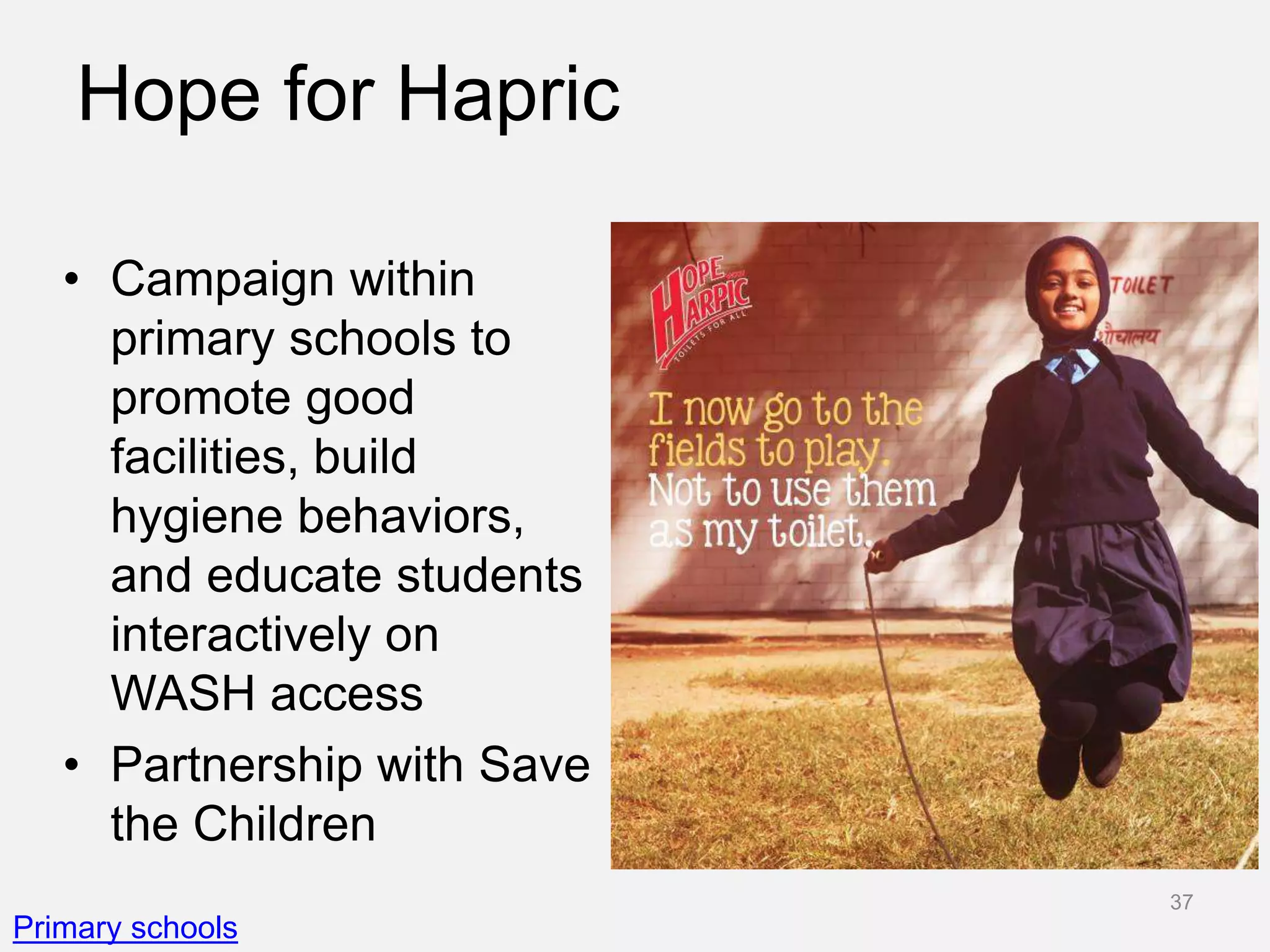
Hope for Hapric
• Campaign within
primary schools to
promote good
facilities, build
hygiene behaviors,
and educate students
interactively on
WASH access
• Partnership with Save
the Children
Primary schools
37
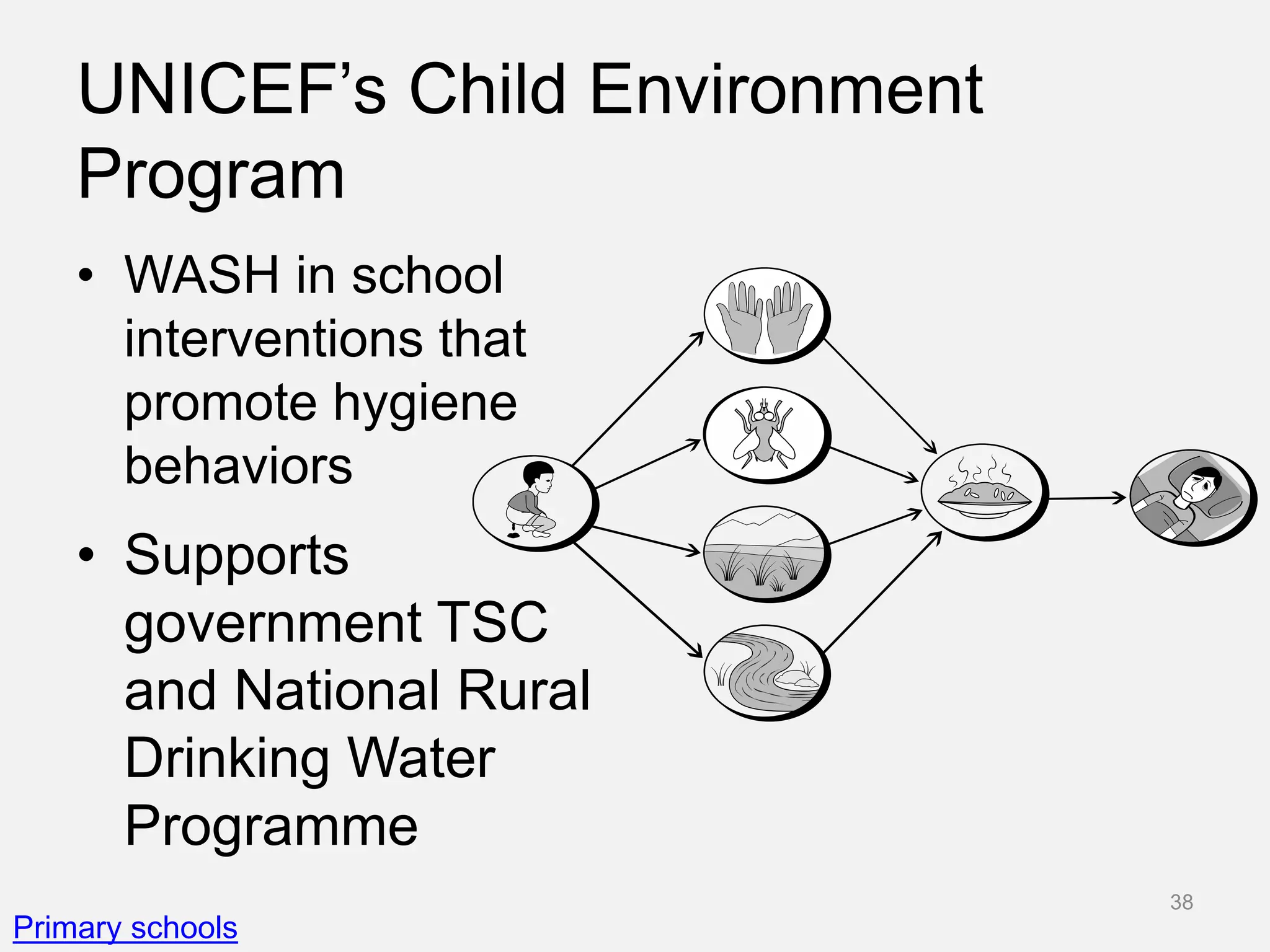
UNICEF’s Child Environment
Program
• WASH in school
interventions that
promote hygiene
behaviors
• Supports
government TSC
and National Rural
Drinking Water
Programme
Primary schools
38
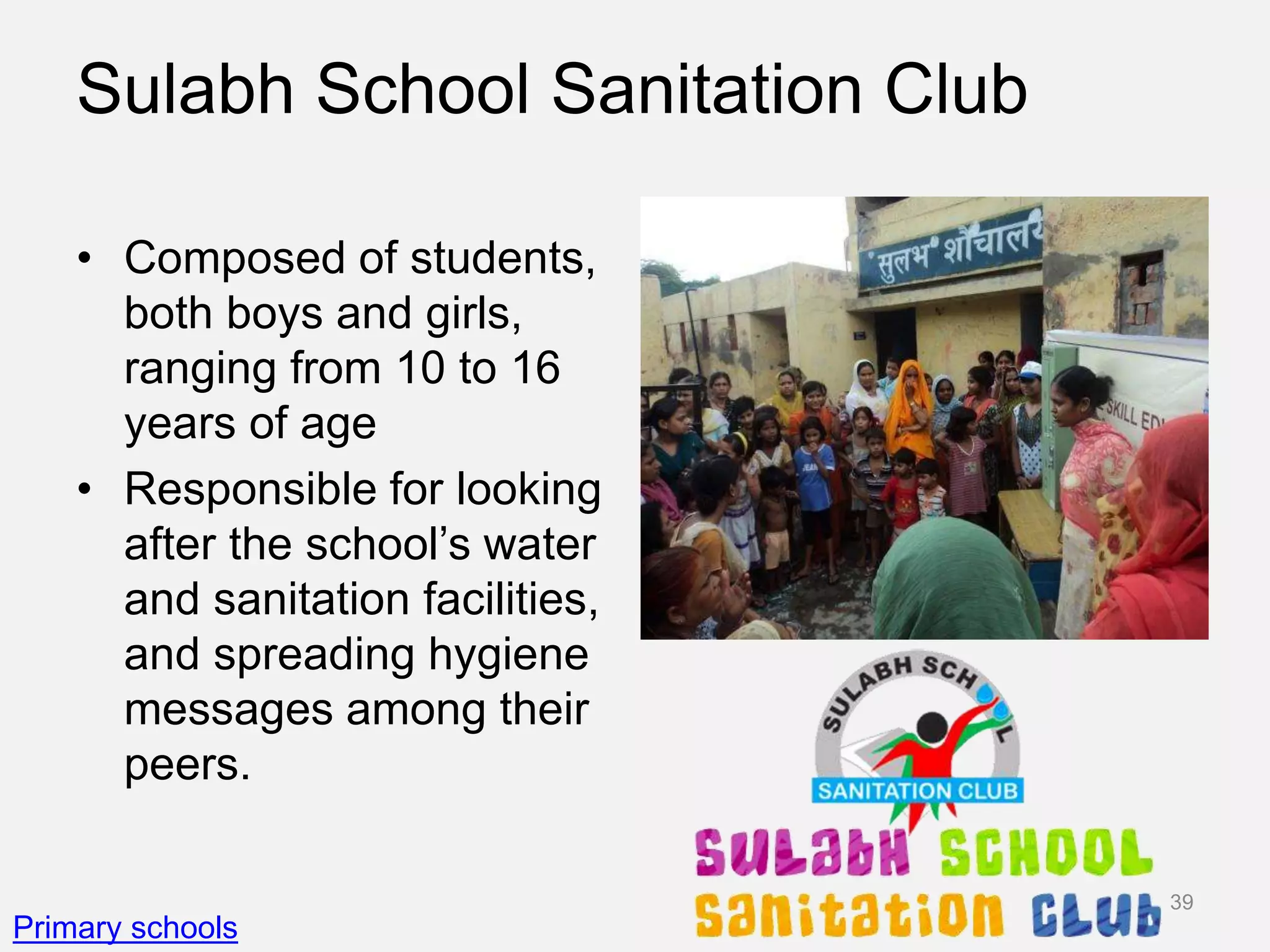
Sulabh School Sanitation Club
• Composed of students,
both boys and girls,
ranging from 10 to 16
years of age
• Responsible for looking
after the school’s water
and sanitation facilities,
and spreading hygiene
messages among their
peers.
Primary schools
39
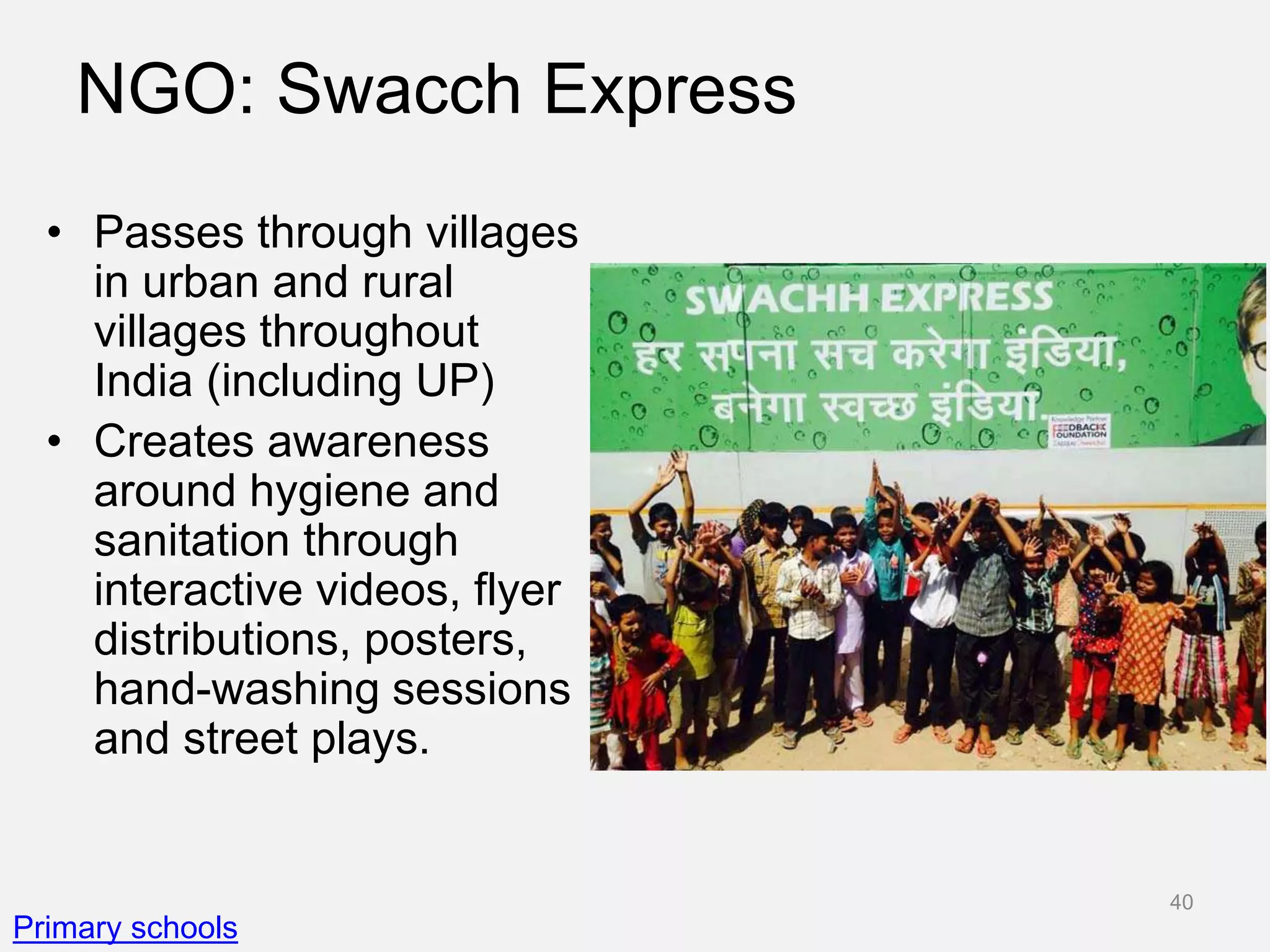
NGO: Swacch Express
• Passes through villages
in urban and rural
villages throughout
India (including UP)
• Creates awareness
around hygiene and
sanitation through
interactive videos, flyer
distributions, posters,
hand-washing sessions
and street plays.
Primary schools
40
Feedback Foundation (Partnership)
• Community engagement entity that could
partner with us to train university students and
community leaders/members to do work in
schools and communities
• Led a capacity building effort that “Trained the
Trainers” of the community-led Total
Sanitation Approach in rural areas
Primary schools
41

2015 team 8

  • 1.
    Resolving The AsianEnigma Sapha Sara Johnson | Katherine Hymel Sara Liaghati-Mobarhan | Jessica Sidhu 1
  • 2.
    Even with adequate caloricand nutritional intake, lack of sanitation inhibits growth.2
  • 3.
    Stunting • Low length-or height-for-age • Consequence of multiple factors often linked to poverty • Can lead to developmental problems and is often impossible to correct, but can be prevented GROWING UP EDUCATION VICIOUS CYCLEPROFESSIONAL LIFE 3
  • 4.
    “India’s stunting problem represents the largestloss of human potential in any country in history, and it affects 20 times more people in India alone than H.I.V./AIDS does around the world.” Ramanan Laxminarayan Vice president for research and policy at the Public Health Foundation of India 4
  • 5.
    Uttar Pradesh RELIGIONS |Hindi,Urdu,Bhojpuri, Awadhi LANGUAGES | Hindi, Urdu POPULATION | 211,797,459 REGIONAL | 75 districts Literacy rate: 70%, below national average of 74% Key industries: IT, Agro Processing, Tourism, Mineral-based industries and Textiles UTTAR PRADESH (UP) 5
  • 6.
    78% of peoplein UP practice open defecation (OD) Poor sanitation spreads infections Rapid escalation with population growth OPEN DEFECATION IN UP 6
  • 7.
    Far from hisdwelling let him remove urine (and ordure), far (let him remove) the water used for washing his feet, and far the remnants of food and the water from his bath. PURITY AND POLLUTION 7
  • 8.
    CURRENT STRATEGIES Total SanitationCampaign(TSC)/Clean India Campaign Change social norms and reduce OD Nirmal Gram Puraskar monetary award for “open defecation free” cities Generational resistance Constructed latrines in disuse 8
  • 9.
    IMPLEMENTATION BARRIERS Only 26%surveyed gave link between diarrhea and infectious agents Scientific misconceptions OD associated with strength, rising early 9
  • 10.
    Objective Combat child stuntingin rural regions of northern India through assessment of each village’s resources, mobilizing the community through religious figures to educate women and children on minimizing exposure to growth-stunting microbia 10
  • 11.
    Intervention overview • Strongcommunity assessment using “triggering” phases to determine current sanitation infrastructure and practices • Determination of exposure pathways • Community mobilization with educational programs/appropriate technologies to minimize exposure to those pathways 11
  • 12.
  • 13.
    Defecation area transect walk Community mapping Specific questionsabout defecation behaviors Community assessment 13
  • 14.
    Exposure assessment • Exposedgroups potentially at riskWho? • Directly and indirectly exposedHow many? • Point of exposure in sanitation systemWhere? • Routes (direct, water/food sources, mosquito breeding)Which? • Frequency of exposure (daily, weekly)How? • Likely dose of exposure and typeWhat? 14
  • 15.
  • 16.
  • 17.
    Infrastructure assessment Access to improved watersource? Yes Access to latrine? Yes Is latrine in use? NoYes No No 17
  • 18.
  • 19.
  • 20.
    INFRASTRUCTURESANITATIONCOMMUNITYDEVELOPMENT Identify community leaders •Female empowerment: most direct link to children • Involve religious leaders • Provide with concrete tools (Facilitator’s Manual, infrastructure and education guidelines) 20
  • 21.
    INFRASTRUCTURESANITATIONCOMMUNITYDEVELOPMENT Public health committees •Host programs for women on basic hygiene science and practices • Monitor project implementations • Seek input of community with interventions 21
  • 22.
    INFRASTRUCTURESANITATIONCOMMUNITYDEVELOPMENT Primary schools • Introductionof basic hygiene lessons • Interactive demonstrations • Partnerships with pre-existing work: • Hope for Hapric • UNICEF, TSC • Tippy Tap • Sulabh School Sanitation Club • Swacch Express • Feedback Foundation 22
  • 23.
    Primary school interventions Handwashing with soapat critical times can reduce diarrhea rates by approximately 40% INFRASTRUCTURESANITATIONCOMMUNITYDEVELOPMENT 23
  • 24.
  • 25.
    INFRASTRUCTURESANITATIONCOMMUNITYDEVELOPMENT Bank filtration, managedaquifer recharge Pumps, wells, spring boxes, gravity systems Rainwater harvesting, micro dams 25
  • 26.
    Monitoring and evaluation •Adapted from Patil et al., 2014; see appendix • Measured Outcomes (questionnaires, waste disposal classification, testing of drinking water, child anthropometry and specimen testing) • Frequency: 2 times per year • Award: Monetary incentives for villages 26
  • 27.
    Projected community • Mahobadistrict • Population: 876,055 • 78.84 % population of Mahoba districts lives in rural areas of villages • Literacy rate: 65.27% • Total child population (0-6): 128,129 • Four villages of focus • Akona • Jaitpur • Rawatpura • Salat 27
  • 28.
    Hypothetical assessment • Highestrisk exposure pathway: ingestion of excreta (fecal to hand to mouth) • Latrines built by government but not in use • Access to food and water 28
  • 29.
  • 30.
    INFRASTRUCTURESANITATIONCOMMUNITYDEVELOPMENT Not a majorconcern according to assessment Latrines in disuse 30
  • 31.
    Primary school interventions Projected diarrhea reduction ratesby approximately 40% INFRASTRUCTURESANITATIONCOMMUNITYDEVELOPMENT Tippy taps constructed at schools and near identified areas for open defecation 31
  • 32.
    INFRASTRUCTURESANITATIONCOMMUNITYDEVELOPMENT Community development • Publichealth committee established • Handwashing demonstration with women and school children 32
  • 33.
    Partnership with candidatesduring election season Expansion of program into other districts Involve university students FUTURE PLANS33
  • 34.
    SUSTAINABILITY Cultural awareness Avoidance ofproprietary breakdowns Community members fuel the movement 34
  • 35.
  • 36.
    References Badham J, SweetL. (2010). Stunting: an Overview. Sight and Life. Retrieved on February 3, 2015 from: http://www.sightandlife.org/fileadmin/data/Publications/Stunting/Stunting_An_O verview.pdf Banda, K., Sarkar, R., Gopal, S., Govindarajan, J., Harijan, B., Jeyakumar, M., … Balraj, V. (2007). Water handling, sanitation and defecation practices in rural southern India: A knowledge, attitudes and practices study. Transactions of the Royal Society of Tropical Medicine and Hygiene, 101(11), 1124-1130. Coffey, D., Gupta, A., Hathi, P., Khurana, N., Srivastav, N., & Vyas, S. (2014, September 20). Revealed preference for Open Defecation: Evidence from a new survey in rural North India. Economic & Political Weekly, 43-55. Curtis, V., & Cairncross, S. (2003). Effect of washing hands with soap on diarrhea risk in the community: a systematic review. Lancet Infectious Diseases 3, 275–81. Greater Access to Cell Phones Than Toilets in India: UN – United Nations University. (2010, April 14). Retrieved February 7, 2015, from http://unu.edu/media- relations/releases/greater-access-to-cell-phones-than-toilets-in-india.html Harris, G. (2014). Poor Sanitation in India May Afflict Well-Fed Children with Malnutrition. The New York Times. February 5, 2015 from: http://www.nytimes.com/2014/07/15/world/asia/poor-sanitation-in-india-may- afflict-well-fed-children-with-malnutrition.html Mahoba District : Census 2011 data. (n.d.). Retrieved February 6, 2015, from http://www.census2011.co.in/census/district/540-mahoba.html Mehrotra K. 2014. India’s Toilet Race Failing as Villages don’t Use Them. Bloomberg. Retrieved November 13, 2014 from: http://www.bloomberg.com/news/2014-08-03/india-s-toilet- race-failing-as- villages-don-t-use-them.html Quantitative Microbial Risk Assessment (QMRA) Wiki. (n.d.). Retrieved February 6, 2015, from http://qmrawiki.canr.msu.edu/index.php/Quantitative_Microbial_Risk_Assessment_(QMRA)_Wiki Singh, P., Chavan, P., & Mathur, D. (2013, August 10). Policy Brief for Parliamentarians, Open Defecation: This is also your business! Retrieved February 7, 2015, from http://www.clraindia.org/include/ODpolicybriefFinal.pdf The Sphere Project (2010). Minimum standards in water supply, sanitation, and hygiene promotion. The Sphere Handbook, 51-102. Retrieved from: http://my.ewb- usa.org/theme/library/myewb-usa/project-resources/technical/SphereHandbook-Chapter2.pdf Sulabh International Social Service Organisation. (n.d.). Retrieved February 5, 2015, from http://www.sulabhinternational.org/ Tippy Tap. (n.d.). Retrieved February 4, 2015, from http://www.tippytap.org WaterAid (2011). Technology Notes. Retrieved from: http://my.ewb-usa.org/theme/library/myewb-usa/project-resources/technical/water_aid_technology_notes.pdf WHO/UNICEF Joint Monitoring Programme (JMP) for Water Supply and Sanitation. Progress on Drinking Water and Sanitation: 2014 Update. Retrieved February 6, 2015 from: http://www.wssinfo.org/fileadmin/user_upload/resources/JMP_report_2014_webE ng.pdf 36
  • 37.
    Hope for Hapric •Campaign within primary schools to promote good facilities, build hygiene behaviors, and educate students interactively on WASH access • Partnership with Save the Children Primary schools 37
  • 38.
    UNICEF’s Child Environment Program •WASH in school interventions that promote hygiene behaviors • Supports government TSC and National Rural Drinking Water Programme Primary schools 38
  • 39.
    Sulabh School SanitationClub • Composed of students, both boys and girls, ranging from 10 to 16 years of age • Responsible for looking after the school’s water and sanitation facilities, and spreading hygiene messages among their peers. Primary schools 39
  • 40.
    NGO: Swacch Express •Passes through villages in urban and rural villages throughout India (including UP) • Creates awareness around hygiene and sanitation through interactive videos, flyer distributions, posters, hand-washing sessions and street plays. Primary schools 40
  • 41.
    Feedback Foundation (Partnership) •Community engagement entity that could partner with us to train university students and community leaders/members to do work in schools and communities • Led a capacity building effort that “Trained the Trainers” of the community-led Total Sanitation Approach in rural areas Primary schools 41

Editor's Notes

  • #6 http://www.iptu.co.uk/CONTENT/india_map_uttar_state_overview.asp http://www.indiaonlinepages.com/population/uttar-pradesh-population.html
  • #7 http://www.iptu.co.uk/CONTENT/india_map_uttar_state_overview.asp http://www.indiaonlinepages.com/population/uttar-pradesh-population.html
  • #8 http://www.iptu.co.uk/CONTENT/india_map_uttar_state_overview.asp http://www.indiaonlinepages.com/population/uttar-pradesh-population.html
  • #38 Image:  https://www.facebook.com/banegaswachhindia/photos/pb.707035792708456.-2207520000.1423186598./774407699304598/?type=3&theater At school level we will promote a combination of good facilities, correct behavioral practices and education for long lasting solutions on WASH access. Partnership with Save the Children http://www.harpic.co.in/hope-with-harpic/harpic-and-the-wash-intervention/
  • #39 http://www.unicef.org/india/wes.html http://www.unicef.org/publications/files/CFS_WASH_E_web.pdf WASH (water sanitation and hygiene) TSC (Total sanitation Campaign)
  • #40 http://sulabhschoolsanitationclub.org/ThingsWeDo.php
  • #41 Part of government campaign: Swachh Bharat Abhiyan (Hindi: स्वच्छ भारत अभियान, English: Clean India Mission