Addressing the Concerns related
to Deforestation and Construction
in Madre de Dios, Peru
Team 7
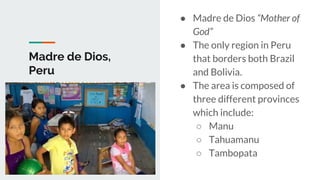
Madre de Dios,
Peru
● Madre de Dios “Mother of
God”
● The only region in Peru
that borders both Brazil
and Bolivia.
● The area is composed of
three different provinces
which include:
○ Manu
○ Tahuamanu
○ Tambopata
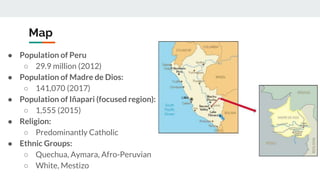
Map
● Population of Peru
○ 29.9 million (2012)
● Population of Madre de Dios:
○ 141,070 (2017)
● Population of Iñapari (focused region):
○ 1,555 (2015)
● Religion:
○ Predominantly Catholic
● Ethnic Groups:
○ Quechua, Aymara, Afro-Peruvian
○ White, Mestizo
Background Information
● Our team has been hired by the Environment Council to create
an implementation plan to address the issues of deforestation
and construction in the Madre de Dios Region.
● We have been allotted five years to implement our plan, as well
as 2,000,000 USD.
● We have been granted 500,000 USD for additional funding
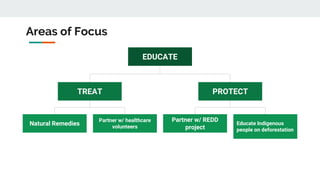
Areas of Focus
EDUCATE
TREAT PROTECT
Educate Indigenous
people on deforestation
Partner w/ REDD
project
Partner w/ healthcare
volunteers
Natural Remedies
Target Populations
● Women
● Children
● Our team has identified
women and children as
the target population.
○ Most susceptible
population to health
risk.
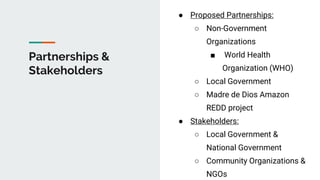
Partnerships &
Stakeholders
● Proposed Partnerships:
○ Non-Government
Organizations
■ World Health
Organization (WHO)
○ Local Government
○ Madre de Dios Amazon
REDD project
● Stakeholders:
○ Local Government &
National Government
○ Community Organizations &
NGOs
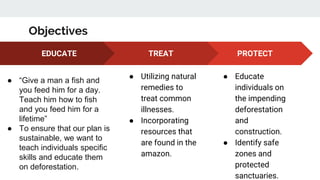
Objectives
PROTECT
● Educate
individuals on
the impending
deforestation
and
construction.
● Identify safe
zones and
protected
sanctuaries.
EDUCATE
● “Give a man a fish and
you feed him for a day.
Teach him how to fish
and you feed him for a
lifetime”
● To ensure that our plan is
sustainable, we want to
teach individuals specific
skills and educate them
on deforestation.
TREAT
● Utilizing natural
remedies to
treat common
illnesses.
● Incorporating
resources that
are found in the
amazon.
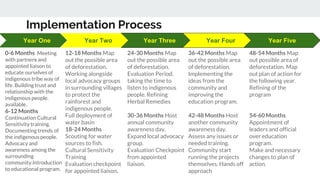
Implementation Process
Year One Year Two Year Three Year Four Year Five
12-18 Months Map
out the possible area
of deforestation.
Working alongside
local advocacy groups
in surrounding villages
to protect the
rainforest and
indigenous people.
Full deployment of
water basin
18-24 Months
Scouting for water
sources to fish.
Cultural Sensitivity
Training
Evaluation checkpoint
for appointed liaison.
24-30 Months Map
out the possible area
of deforestation.
Evaluation Period,
taking the time to
listen to indigenous
people. Refining
Herbal Remedies
30-36 Months Host
annual community
awareness day.
Expand local advocacy
group.
Evaluation Checkpoint
from appointed
liaison.
36-42 Months Map
out the possible area
of deforestation.
Implementing the
ideas from the
community and
improving the
education program.
42-48 Months Host
another community
awareness day.
Assess any issues or
needed training.
Community start
running the projects
themselves. Hands off
approach
48-54 Months Map
out possible area of
deforestation. Map
out plan of action for
the following year.
Refining of the
program
54-60 Months
Appointment of
leaders and official
over education
program.
Make and necessary
changes to plan of
action.
0-6 Months Meeting
with partners and
appointed liaison to
educate ourselves of
indigenous tribe way of
life. Building trust and
relationship with the
indigenous people.
available.
6-12 Months
Continuation Cultural
Sensitivity training.
Documenting trends of
the indigenous people.
Advocacy and
awareness among the
surrounding
community.Introduction
to educational program.
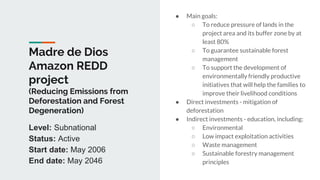
Madre de Dios
Amazon REDD
project
(Reducing Emissions from
Deforestation and Forest
Degeneration)
● Main goals:
○ To reduce pressure of lands in the
project area and its buffer zone by at
least 80%
○ To guarantee sustainable forest
management
○ To support the development of
environmentally friendly productive
initiatives that will help the families to
improve their livelihood conditions
● Direct investments - mitigation of
deforestation
● Indirect investments - education, including:
○ Environmental
○ Low impact exploitation activities
○ Waste management
○ Sustainable forestry management
principles
Level: Subnational
Status: Active
Start date: May 2006
End date: May 2046
Educate
● Partner with the REDD project to help expand upon existing education
programs
● Speak with village leaders about planned contents of education to
ensure cultural competency
● Planned education:
○ What is contamination?
■ Water sources
○ What are natural remedies?
■ Plants
○ What are alternate ways to use the land to survive?
Educate
● Contamination education:
○ What contamination is
○ Why the current location of the river will not be a viable resource
■ Partnership with the local government to obtain tributary
access to the river west of Iñapari
■ River flows to the north/northeast
○ How to collect water that is not contaminated
Educate
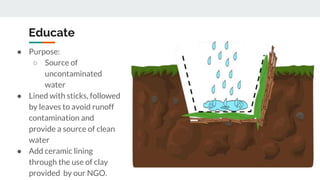
● Purpose:
○ Source of
uncontaminated
water
● Lined with sticks, followed
by leaves to avoid runoff
contamination and
provide a source of clean
water
● Add ceramic lining
through the use of clay
provided by our NGO.
Educate
● Natural Remedy Education:
○ What specific plants and fruits can do for health
■ Relieve symptoms of malaria, diarrhea, respiratory issues
● Cacao, Pomegranate, Avocado, Cinchona Bark
■ Protein and sustainable food sources in lieu of the lack of
direct access to fish
Educate
● Treatment Education:
○ Malaria
■ What symptoms can identify with disease and what way
natural remedies can assist with them
○ Diarrhea
■ What consistency stool should be
○ Respiratory Issues
■ How to protect airways from emissions produced from
construction
Treatment
Natural Remedies:
● Pomegranates: serve as an antioxidant and also has antiseptic powers
○ Is effective against diarrhea.
● Avocadoes: helps raise the body’s defenses and fights diseases.
○ Also helps treat diarrhea.
● Utilize the shell of a pomegranate and boil it in water along with the
seed of an avocado. The liquid that is produced should be drunk by the
individual suffering from diarrhea every time they are thirsty.
Treatment
Natural Remedies (cont.)
● Cinchona Tree Bark: serves as a source for quinine
○ Is effective against Malaria
○ Utilize the bark of Cinchona Tree by mashing into fine powder then boiling
allowing extraction of quinine. The liquid produced should be drunk by the
individual suffering from Malaria symptoms.
Treatment
Natural Remedies (cont.)
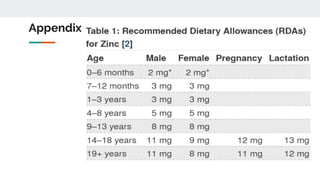
● Zinc is important for cellular growth, cellular differentiation and
metabolism.
● When a child suffers from a zinc deficiency, that limits their growth and
decreases their resistance to infections.
● Zinc can used as a treatment for acute respiratory illnesses.
● “Zinc Rich Foods”
○ Dark Chocolate (Cacao), Pomegranate, Avocado
Protect
● Protecting indigenous individuals human rights is an
important part of our mission.
● Our plan is to partner with Madre de Dios Amazon REDD
project in efforts to protect the individuals affected by
deforestation and construction in this region.
Evaluation
● Officials from the REDD project will be utilized to monitor the
communities within the Madre De Dios area
○ The REDD project will be in this region until 2048; therefore, they
will be essential in ensuring that the communities areas are not
being disturbed by deforestation.
● Appointed community liaisons and community officials that will
oversee the education and treatment programs
○ Track incidence rates
○ Continue educating on natural remedies and resources
● Officials from NGO will make routine evaluation trips the first year
after departure, and every two years following that.
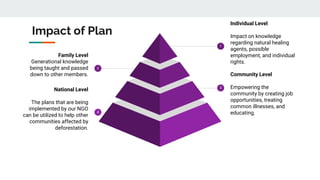
Impact of Plan
Community Level
Empowering the
community by creating job
opportunities, treating
common illnesses, and
educating.
3
National Level
The plans that are being
implemented by our NGO
can be utilized to help other
communities affected by
deforestation.
4
Individual Level
Impact on knowledge
regarding natural healing
agents, possible
employment, and individual
rights.
1
Family Level
Generational knowledge
being taught and passed
down to other members.
2
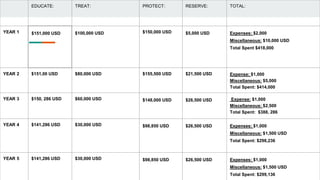
EDUCATE: TREAT: PROTECT: RESERVE: TOTAL:
YEAR 1 $151,000 USD $100,000 USD $150,000 USD $5,000 USD Expenses: $2,000
Miscellaneous: $10,000 USD
Total Spent $418,000
YEAR 2 $151,00 USD $80,000 USD $155,500 USD $21,500 USD Expense: $1,000
Miscellaneous: $5,000
Total Spent: $414,000
YEAR 3 $150, 286 USD $60,000 USD $148,000 USD $26,500 USD Expense: $1,000
Miscellaneous: $2,500
Total Spent: $388, 286
YEAR 4 $141,286 USD $30,000 USD $98,850 USD $26,500 USD Expenses: $1,000
Miscellaneous: $1,500 USD
Total Spent: $298,236
YEAR 5 $141,286 USD $30,000 USD $98,850 USD $26,500 USD Expenses: $1,000
Miscellaneous: $1,500 USD
Total Spent: $299,136
References
● https://www.healthbeckon.com/zinc-rich-foods/
● https://www.who.int/elena/titles/zinc_pneumonia_children/en/
● https://www.perunature.com/about-tambopata/madre-de-dios/
● https://theredddesk.org/countries/initiatives/madre-de-dios-amazon-redd-project
● https://www.cdc.gov/safewater/ceramic-filtration.html
● http://www.reddprojectsdatabase.org/view/project.php?id=205
● http://cuzcoeats.com/ancestral-medicine-against-diarrhea/
● https://www.iied.org/redd-protecting-climate-forests-livelihoods
● http://cuzcoeats.com/ancestral-medicine-against-diarrhea/
● https://www.chemistryviews.org/details/ezine/4701281/From_Pharmacy_to_the_Pub__A_Bark_
Conquers_the_World_Part_1.html
Appendix

2019 Statewide Case Competition (3rd place Team)

  • 1.
    Addressing the Concernsrelated to Deforestation and Construction in Madre de Dios, Peru Team 7
  • 2.
    Madre de Dios, Peru ●Madre de Dios “Mother of God” ● The only region in Peru that borders both Brazil and Bolivia. ● The area is composed of three different provinces which include: ○ Manu ○ Tahuamanu ○ Tambopata
  • 3.
    Map ● Population ofPeru ○ 29.9 million (2012) ● Population of Madre de Dios: ○ 141,070 (2017) ● Population of Iñapari (focused region): ○ 1,555 (2015) ● Religion: ○ Predominantly Catholic ● Ethnic Groups: ○ Quechua, Aymara, Afro-Peruvian ○ White, Mestizo
  • 4.
    Background Information ● Ourteam has been hired by the Environment Council to create an implementation plan to address the issues of deforestation and construction in the Madre de Dios Region. ● We have been allotted five years to implement our plan, as well as 2,000,000 USD. ● We have been granted 500,000 USD for additional funding
  • 5.
    Areas of Focus EDUCATE TREATPROTECT Educate Indigenous people on deforestation Partner w/ REDD project Partner w/ healthcare volunteers Natural Remedies
  • 6.
    Target Populations ● Women ●Children ● Our team has identified women and children as the target population. ○ Most susceptible population to health risk.
  • 7.
    Partnerships & Stakeholders ● ProposedPartnerships: ○ Non-Government Organizations ■ World Health Organization (WHO) ○ Local Government ○ Madre de Dios Amazon REDD project ● Stakeholders: ○ Local Government & National Government ○ Community Organizations & NGOs
  • 8.
    Objectives PROTECT ● Educate individuals on theimpending deforestation and construction. ● Identify safe zones and protected sanctuaries. EDUCATE ● “Give a man a fish and you feed him for a day. Teach him how to fish and you feed him for a lifetime” ● To ensure that our plan is sustainable, we want to teach individuals specific skills and educate them on deforestation. TREAT ● Utilizing natural remedies to treat common illnesses. ● Incorporating resources that are found in the amazon.
  • 9.
    Implementation Process Year OneYear Two Year Three Year Four Year Five 12-18 Months Map out the possible area of deforestation. Working alongside local advocacy groups in surrounding villages to protect the rainforest and indigenous people. Full deployment of water basin 18-24 Months Scouting for water sources to fish. Cultural Sensitivity Training Evaluation checkpoint for appointed liaison. 24-30 Months Map out the possible area of deforestation. Evaluation Period, taking the time to listen to indigenous people. Refining Herbal Remedies 30-36 Months Host annual community awareness day. Expand local advocacy group. Evaluation Checkpoint from appointed liaison. 36-42 Months Map out the possible area of deforestation. Implementing the ideas from the community and improving the education program. 42-48 Months Host another community awareness day. Assess any issues or needed training. Community start running the projects themselves. Hands off approach 48-54 Months Map out possible area of deforestation. Map out plan of action for the following year. Refining of the program 54-60 Months Appointment of leaders and official over education program. Make and necessary changes to plan of action. 0-6 Months Meeting with partners and appointed liaison to educate ourselves of indigenous tribe way of life. Building trust and relationship with the indigenous people. available. 6-12 Months Continuation Cultural Sensitivity training. Documenting trends of the indigenous people. Advocacy and awareness among the surrounding community.Introduction to educational program.
  • 10.
    Madre de Dios AmazonREDD project (Reducing Emissions from Deforestation and Forest Degeneration) ● Main goals: ○ To reduce pressure of lands in the project area and its buffer zone by at least 80% ○ To guarantee sustainable forest management ○ To support the development of environmentally friendly productive initiatives that will help the families to improve their livelihood conditions ● Direct investments - mitigation of deforestation ● Indirect investments - education, including: ○ Environmental ○ Low impact exploitation activities ○ Waste management ○ Sustainable forestry management principles Level: Subnational Status: Active Start date: May 2006 End date: May 2046
  • 11.
    Educate ● Partner withthe REDD project to help expand upon existing education programs ● Speak with village leaders about planned contents of education to ensure cultural competency ● Planned education: ○ What is contamination? ■ Water sources ○ What are natural remedies? ■ Plants ○ What are alternate ways to use the land to survive?
  • 12.
    Educate ● Contamination education: ○What contamination is ○ Why the current location of the river will not be a viable resource ■ Partnership with the local government to obtain tributary access to the river west of Iñapari ■ River flows to the north/northeast ○ How to collect water that is not contaminated
  • 13.
    Educate ● Purpose: ○ Sourceof uncontaminated water ● Lined with sticks, followed by leaves to avoid runoff contamination and provide a source of clean water ● Add ceramic lining through the use of clay provided by our NGO.
  • 14.
    Educate ● Natural RemedyEducation: ○ What specific plants and fruits can do for health ■ Relieve symptoms of malaria, diarrhea, respiratory issues ● Cacao, Pomegranate, Avocado, Cinchona Bark ■ Protein and sustainable food sources in lieu of the lack of direct access to fish
  • 15.
    Educate ● Treatment Education: ○Malaria ■ What symptoms can identify with disease and what way natural remedies can assist with them ○ Diarrhea ■ What consistency stool should be ○ Respiratory Issues ■ How to protect airways from emissions produced from construction
  • 16.
    Treatment Natural Remedies: ● Pomegranates:serve as an antioxidant and also has antiseptic powers ○ Is effective against diarrhea. ● Avocadoes: helps raise the body’s defenses and fights diseases. ○ Also helps treat diarrhea. ● Utilize the shell of a pomegranate and boil it in water along with the seed of an avocado. The liquid that is produced should be drunk by the individual suffering from diarrhea every time they are thirsty.
  • 17.
    Treatment Natural Remedies (cont.) ●Cinchona Tree Bark: serves as a source for quinine ○ Is effective against Malaria ○ Utilize the bark of Cinchona Tree by mashing into fine powder then boiling allowing extraction of quinine. The liquid produced should be drunk by the individual suffering from Malaria symptoms.
  • 18.
    Treatment Natural Remedies (cont.) ●Zinc is important for cellular growth, cellular differentiation and metabolism. ● When a child suffers from a zinc deficiency, that limits their growth and decreases their resistance to infections. ● Zinc can used as a treatment for acute respiratory illnesses. ● “Zinc Rich Foods” ○ Dark Chocolate (Cacao), Pomegranate, Avocado
  • 19.
    Protect ● Protecting indigenousindividuals human rights is an important part of our mission. ● Our plan is to partner with Madre de Dios Amazon REDD project in efforts to protect the individuals affected by deforestation and construction in this region.
  • 20.
    Evaluation ● Officials fromthe REDD project will be utilized to monitor the communities within the Madre De Dios area ○ The REDD project will be in this region until 2048; therefore, they will be essential in ensuring that the communities areas are not being disturbed by deforestation. ● Appointed community liaisons and community officials that will oversee the education and treatment programs ○ Track incidence rates ○ Continue educating on natural remedies and resources ● Officials from NGO will make routine evaluation trips the first year after departure, and every two years following that.
  • 21.
    Impact of Plan CommunityLevel Empowering the community by creating job opportunities, treating common illnesses, and educating. 3 National Level The plans that are being implemented by our NGO can be utilized to help other communities affected by deforestation. 4 Individual Level Impact on knowledge regarding natural healing agents, possible employment, and individual rights. 1 Family Level Generational knowledge being taught and passed down to other members. 2
  • 22.
    EDUCATE: TREAT: PROTECT:RESERVE: TOTAL: YEAR 1 $151,000 USD $100,000 USD $150,000 USD $5,000 USD Expenses: $2,000 Miscellaneous: $10,000 USD Total Spent $418,000 YEAR 2 $151,00 USD $80,000 USD $155,500 USD $21,500 USD Expense: $1,000 Miscellaneous: $5,000 Total Spent: $414,000 YEAR 3 $150, 286 USD $60,000 USD $148,000 USD $26,500 USD Expense: $1,000 Miscellaneous: $2,500 Total Spent: $388, 286 YEAR 4 $141,286 USD $30,000 USD $98,850 USD $26,500 USD Expenses: $1,000 Miscellaneous: $1,500 USD Total Spent: $298,236 YEAR 5 $141,286 USD $30,000 USD $98,850 USD $26,500 USD Expenses: $1,000 Miscellaneous: $1,500 USD Total Spent: $299,136
  • 23.
    References ● https://www.healthbeckon.com/zinc-rich-foods/ ● https://www.who.int/elena/titles/zinc_pneumonia_children/en/ ●https://www.perunature.com/about-tambopata/madre-de-dios/ ● https://theredddesk.org/countries/initiatives/madre-de-dios-amazon-redd-project ● https://www.cdc.gov/safewater/ceramic-filtration.html ● http://www.reddprojectsdatabase.org/view/project.php?id=205 ● http://cuzcoeats.com/ancestral-medicine-against-diarrhea/ ● https://www.iied.org/redd-protecting-climate-forests-livelihoods ● http://cuzcoeats.com/ancestral-medicine-against-diarrhea/ ● https://www.chemistryviews.org/details/ezine/4701281/From_Pharmacy_to_the_Pub__A_Bark_ Conquers_the_World_Part_1.html
  • 24.

Editor's Notes

  • #9 EDUCATION: Give a man a fish and you feed him for a day. Teach him how to fish and you feed him for a lifetime. We do not want the individuals of Madre de Dios to be given all the resources they need during our five year implementation, and be left with zero knowledge once we leave the area.