1
Team Global Generation
Arshnoor Grewal, Maria Jiminez, Grant Schell, Olivia Watts, Lynne Zhou
40,000 People at Risk of Toxic Exposure
3
2
E-Waste Within Ghana
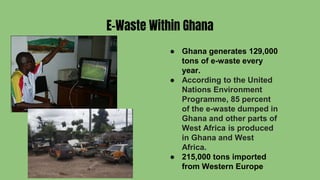
● Ghana generates 129,000
tons of e-waste every
year.
● According to the United
Nations Environment
Programme, 85 percent
of the e-waste dumped in
Ghana and other parts of
West Africa is produced
in Ghana and West
Africa.
● 215,000 tons imported
from Western Europe
4
Goal
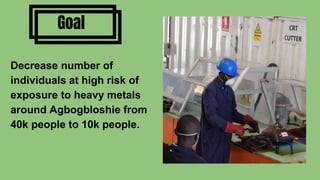
Decrease number of
individuals at high risk of
exposure to heavy metals
around Agbogbloshie from
40k people to 10k people.
Target Population
WWor
Individuals
Relationships
Community
Society
5
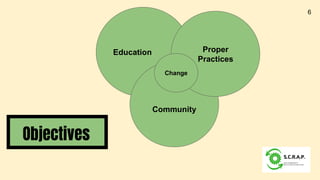
Objectives
Education
Community
Proper
Practices
6
Change
Partnerships
7
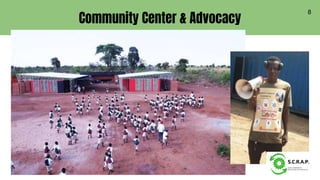
Community Center & Advocacy
8
9
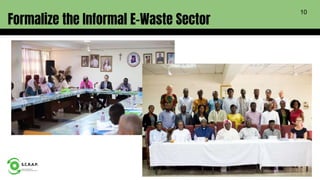
Formalize the Informal E-Waste Sector
10
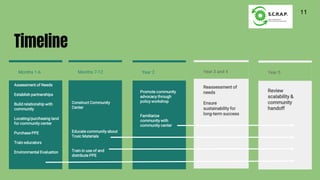
Timeline
Review
scalability &
community
handoff
Year 5
Reassessment of
needs
Ensure
sustainability for
long-term success
Year 3 and 4
Construct Community
Center
Educate community about
Toxic Materials
Train in use of and
distribute PPE
Months 7-12
Assessment of Needs
Establish partnerships
Build relationship with
community
Locating/purchasing land
for community center
Purchase PPE
Train educators
Environmental Evaluation
Months 1-6
Promote community
advocacy through
policy workshop
Familiarize
community with
community center
Year 2
11
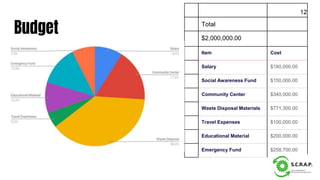
Budget Total
$2,000,000.00
Item Cost
Salary $180,000.00
Social Awareness Fund $150,000.00
Community Center $340,000.00
Waste Disposal Materials $771,300.00
Travel Expenses $100,000.00
Educational Material $200,000.00
Emergency Fund $258,700.00
12
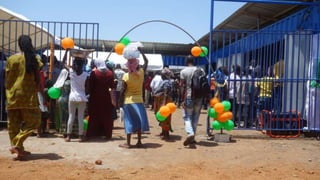
End on a high note
References
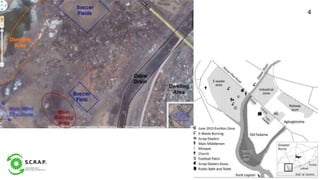
● Agbogbloshie scrap yard – detail map, Source: Amoyaw-Osei et al., 2011
● Wittsiepe, Jürgen, et al. “Pilot Study on the Internal Exposure to Heavy Metals of Informal-Level Electronic Waste Workers in
Agbogbloshie, Accra, Ghana.” Environmental Science and Pollution Research, vol. 24, no. 3, 2016, pp. 3097–3107.,
doi:10.1007/s11356-016-8002-5.
● Caravanos, Jack, Edith Clark, Richard Fuller, & Calah Lambertson. (2011). “Assessing Worker and Environmental Chemical
Exposure Risks at an e-Waste Recycling and Disposal Site in Accra, Ghana. Journal of Health and Pollution”, 16-25.
● Fall 2019 Global Health Case Competition . Sparkman Center for Global Health , 2019.
● “Ghana (Agbogbloshie) - E-Waste Recycling.” Pure Earth, https://www.pureearth.org/project/agbobloshie-e-waste/.
● Huo, X., Peng, L., Xu, X., Zheng, L., Qiu, B., Qi, Z., . . . Piao, Z. (2007). Elevated blood lead levels of children in Guiyu, an
electronic waste recycling town in China. . Environmental Health Perspectives, 15, 1113–1117.
● Wang, Zhaohua, et al. "Take responsibility for electronic-waste disposal: international cooperation is needed to stop
developed nations simply offloading defunct electronics on developing countries." Nature, vol. 536, no. 7614, 2016, p. 23+.
Gale Academic Onefile, https://link.gale.com/apps/doc/A460061096/AONE?u=birm97026&sid=AONE&xid=79335be4.
Accessed 2 Nov. 2019.
● https://www.smithsonianmag.com/science-nature/burning-truth-behind-e-waste-dump-africa-180957597/
12
13

Team 6 - 1st Place (Fall 2019)

  • 1.
    1 Team Global Generation ArshnoorGrewal, Maria Jiminez, Grant Schell, Olivia Watts, Lynne Zhou
  • 3.
    40,000 People atRisk of Toxic Exposure 3
  • 4.
  • 5.
    E-Waste Within Ghana ●Ghana generates 129,000 tons of e-waste every year. ● According to the United Nations Environment Programme, 85 percent of the e-waste dumped in Ghana and other parts of West Africa is produced in Ghana and West Africa. ● 215,000 tons imported from Western Europe
  • 6.
  • 7.
    Goal Decrease number of individualsat high risk of exposure to heavy metals around Agbogbloshie from 40k people to 10k people.
  • 8.
  • 9.
  • 10.
  • 11.
  • 12.
  • 13.
    Formalize the InformalE-Waste Sector 10
  • 14.
    Timeline Review scalability & community handoff Year 5 Reassessmentof needs Ensure sustainability for long-term success Year 3 and 4 Construct Community Center Educate community about Toxic Materials Train in use of and distribute PPE Months 7-12 Assessment of Needs Establish partnerships Build relationship with community Locating/purchasing land for community center Purchase PPE Train educators Environmental Evaluation Months 1-6 Promote community advocacy through policy workshop Familiarize community with community center Year 2 11
  • 15.
    Budget Total $2,000,000.00 Item Cost Salary$180,000.00 Social Awareness Fund $150,000.00 Community Center $340,000.00 Waste Disposal Materials $771,300.00 Travel Expenses $100,000.00 Educational Material $200,000.00 Emergency Fund $258,700.00 12
  • 16.
    End on ahigh note
  • 17.
    References ● Agbogbloshie scrapyard – detail map, Source: Amoyaw-Osei et al., 2011 ● Wittsiepe, Jürgen, et al. “Pilot Study on the Internal Exposure to Heavy Metals of Informal-Level Electronic Waste Workers in Agbogbloshie, Accra, Ghana.” Environmental Science and Pollution Research, vol. 24, no. 3, 2016, pp. 3097–3107., doi:10.1007/s11356-016-8002-5. ● Caravanos, Jack, Edith Clark, Richard Fuller, & Calah Lambertson. (2011). “Assessing Worker and Environmental Chemical Exposure Risks at an e-Waste Recycling and Disposal Site in Accra, Ghana. Journal of Health and Pollution”, 16-25. ● Fall 2019 Global Health Case Competition . Sparkman Center for Global Health , 2019. ● “Ghana (Agbogbloshie) - E-Waste Recycling.” Pure Earth, https://www.pureearth.org/project/agbobloshie-e-waste/. ● Huo, X., Peng, L., Xu, X., Zheng, L., Qiu, B., Qi, Z., . . . Piao, Z. (2007). Elevated blood lead levels of children in Guiyu, an electronic waste recycling town in China. . Environmental Health Perspectives, 15, 1113–1117. ● Wang, Zhaohua, et al. "Take responsibility for electronic-waste disposal: international cooperation is needed to stop developed nations simply offloading defunct electronics on developing countries." Nature, vol. 536, no. 7614, 2016, p. 23+. Gale Academic Onefile, https://link.gale.com/apps/doc/A460061096/AONE?u=birm97026&sid=AONE&xid=79335be4. Accessed 2 Nov. 2019. ● https://www.smithsonianmag.com/science-nature/burning-truth-behind-e-waste-dump-africa-180957597/ 12
  • 18.

Editor's Notes

  • #2 Create logo Title card
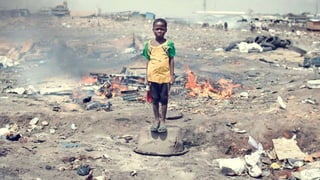
  • #3 Doreen had texted to say her 8 year old son Afram had been badly burned while playing with friends. The boy had gotten too close to a smoldering fire leftover from e-waste recyclers who were burning the insulation off cables to retrieve the metal inside. Doreen’s house was next to the Agbogbloshie waste site where kids often played among the broken refrigerators, car tires, and electronics. Some kids would skip school to help the recyclers, and make a little money to take home.
  • #4 https://www.ncbi.nlm.nih.gov/pubmed/27858271
  • #7 Within the scrap processing site southeast of the main waste dump (Figure 1) are a mosque and an informal football patch where workers—both adults and children—play amid scraps of e-waste. Other places of worship include a church southwest of the plastic processing site and another mosque northwest of the same site. A church-owned basketball court located nearly 140 m southwest of the plastic processing site offers another space for workers of all ages to play during their leisure time. https://www.mdpi.com/1660-4601/14/2/135/pdf
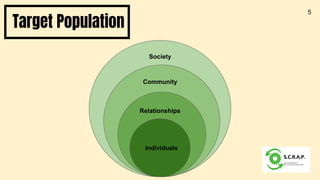
  • #9 Individuals at high risk of toxic e-waste exposure; workers and surrounding community.
  • #10 Then breakdown strategies
  • #12 e-waste site is integrated within the social geography of the community. Within the scrap processing site southeast of the main waste dump (Figure 1) are a mosque and an informal football patch where workers—both adults and children—play amid scraps of e-waste. Other places of worship include a church southwest of the plastic processing site and another mosque northwest of the same site.
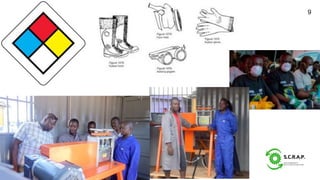
  • #13 Familiarize community with hazards at Agbogbloshie Icons/labels and pictograms Provide examples of signs and symptoms to be aware of through partnerships with local universities and healthcare professionals Familiarize community with how to self-advocate
  • #14 Act 917: Hazardous and Electronic Waste Control and Management
  • #15 Educate people who the policy impacts on the laws and what their power is as community members- Host a policy workshop/summit and speak to them about implementing Act 917 themselves Familiarize community with hazards at Agbogbloshie Icons/labels and pictograms Provide examples of signs and symptoms to be aware of through partnerships with local universities and healthcare professionals
  • #17 HOPE