Open Innovation: 
A Research Agenda 
Joel West 
World Open Innovation Conference 
December 4, 2014
2006 agenda 
• Multiple levels of analysis 
– Individual: least studied 
– Organizational: most studied 
• Not-for-profit unstudied 
– Value network and ecosytems 
– Industry/sector 
– National institutions 
• Incentives (to create, to participate) 
Source: West, Vanhaverbeke, Chesbrough (2006)
2014 agenda 
Four papers offer 2014 research agenda: 
•West & Bogers, J. Prod. Innovation Mgmt. 
•West, Salter, Vanhaverbeke & Chesbrough, 
Research Policy 
•Chesbrough & Bogers, Ch. 1 of New Frontiers in 
Open Innovation 
•Vanhaverbeke, Chesbrough & West, Ch 15 of 
NFOI 
See: blog.openinnovation.net, 27 Oct 2014
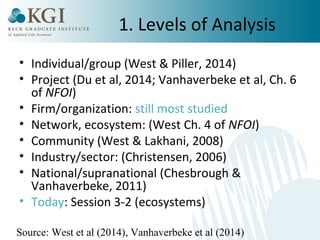
1. Levels of Analysis 
• Individual/group (West & Piller, 2014) 
• Project (Du et al, 2014; Vanhaverbeke et al, Ch. 6 
of NFOI) 
• Firm/organization: still most studied 
• Network, ecosystem: (West Ch. 4 of NFOI) 
• Community (West & Lakhani, 2008) 
• Industry/sector: (Christensen, 2006) 
• National/supranational (Chesbrough & 
Vanhaverbeke, 2011) 
• Today: Session 3-2 (ecosystems) 
Source: West et al (2014), Vanhaverbeke et al (2014)
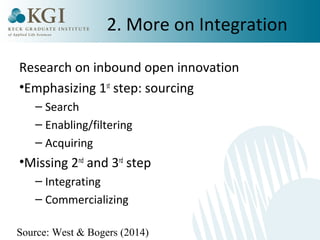
2. More on Integration 
Research on inbound open innovation 
•Emphasizing 1st step: sourcing 
– Search 
– Enabling/filtering 
– Acquiring 
•Missing 2nd and 3rd step 
– Integrating 
– Commercializing 
Source: West & Bogers (2014)
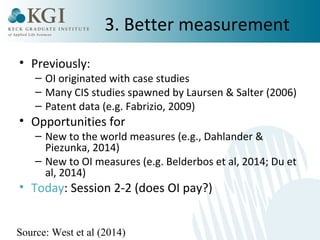
3. Better measurement 
• Previously: 
– OI originated with case studies 
– Many CIS studies spawned by Laursen & Salter (2006) 
– Patent data (e.g. Fabrizio, 2009) 
• Opportunities for 
– New to the world measures (e.g., Dahlander & 
Piezunka, 2014) 
– New to OI measures (e.g. Belderbos et al, 2014; Du et 
al, 2014) 
• Today: Session 2-2 (does OI pay?) 
Source: West et al (2014)
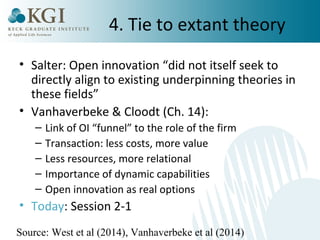
4. Tie to extant theory 
• Salter: Open innovation “did not itself seek to 
directly align to existing underpinning theories in 
these fields” 
• Vanhaverbeke & Cloodt (Ch. 14): 
– Link of OI “funnel” to the role of the firm 
– Transaction: less costs, more value 
– Less resources, more relational 
– Importance of dynamic capabilities 
– Open innovation as real options 
• Today: Session 2-1 
Source: West et al (2014), Vanhaverbeke et al (2014)
5. Nonpecuniary motivations 
• Identified early (Chesbrough, SMR 2003; West 
et al, 2006) 
• More general model of nonpecuniary: 
inbound and outbound nonpecuniary flows 
(Dahlander & Gann, 2010) 
• NGO, GO apply OI in a different way 
(Chesbrough and Di Minin, Ch. 9 of NFOI) 
• Today: Di Minin (3-1) 
Source: West et al (2014)
6. Role of Appropriability 
• OI inspired by Teece (1986) framework 
• Key reality for pecuniary modes (West, 2006; 
Dahlander & Gann, 2010) 
– What is the role of informal appropriability? 
(Laursen & Salter, 2014) 
• Blending of OI and non-proprietary “open” 
– Openness as a profitable OI strategy (Henkel et al, 
2014) 
• Today: Session 3-1 (IP); Wadhwa (1-1) 
Source: West et al (2014)
What’s Next 
• Semi-open wine (and beer) 
– Drink tickets 
– Cash bar 
• 6pm next door (in lunch room) 
• 12 poster sessions 
• Comment on a poster, get a ticket

Open Innovation: A Research Agenda

  • 1.
    Open Innovation: AResearch Agenda Joel West World Open Innovation Conference December 4, 2014
  • 2.
    2006 agenda •Multiple levels of analysis – Individual: least studied – Organizational: most studied • Not-for-profit unstudied – Value network and ecosytems – Industry/sector – National institutions • Incentives (to create, to participate) Source: West, Vanhaverbeke, Chesbrough (2006)
  • 3.
    2014 agenda Fourpapers offer 2014 research agenda: •West & Bogers, J. Prod. Innovation Mgmt. •West, Salter, Vanhaverbeke & Chesbrough, Research Policy •Chesbrough & Bogers, Ch. 1 of New Frontiers in Open Innovation •Vanhaverbeke, Chesbrough & West, Ch 15 of NFOI See: blog.openinnovation.net, 27 Oct 2014
  • 4.
    1. Levels ofAnalysis • Individual/group (West & Piller, 2014) • Project (Du et al, 2014; Vanhaverbeke et al, Ch. 6 of NFOI) • Firm/organization: still most studied • Network, ecosystem: (West Ch. 4 of NFOI) • Community (West & Lakhani, 2008) • Industry/sector: (Christensen, 2006) • National/supranational (Chesbrough & Vanhaverbeke, 2011) • Today: Session 3-2 (ecosystems) Source: West et al (2014), Vanhaverbeke et al (2014)
  • 5.
    2. More onIntegration Research on inbound open innovation •Emphasizing 1st step: sourcing – Search – Enabling/filtering – Acquiring •Missing 2nd and 3rd step – Integrating – Commercializing Source: West & Bogers (2014)
  • 6.
    3. Better measurement • Previously: – OI originated with case studies – Many CIS studies spawned by Laursen & Salter (2006) – Patent data (e.g. Fabrizio, 2009) • Opportunities for – New to the world measures (e.g., Dahlander & Piezunka, 2014) – New to OI measures (e.g. Belderbos et al, 2014; Du et al, 2014) • Today: Session 2-2 (does OI pay?) Source: West et al (2014)
  • 7.
    4. Tie toextant theory • Salter: Open innovation “did not itself seek to directly align to existing underpinning theories in these fields” • Vanhaverbeke & Cloodt (Ch. 14): – Link of OI “funnel” to the role of the firm – Transaction: less costs, more value – Less resources, more relational – Importance of dynamic capabilities – Open innovation as real options • Today: Session 2-1 Source: West et al (2014), Vanhaverbeke et al (2014)
  • 8.
    5. Nonpecuniary motivations • Identified early (Chesbrough, SMR 2003; West et al, 2006) • More general model of nonpecuniary: inbound and outbound nonpecuniary flows (Dahlander & Gann, 2010) • NGO, GO apply OI in a different way (Chesbrough and Di Minin, Ch. 9 of NFOI) • Today: Di Minin (3-1) Source: West et al (2014)
  • 9.
    6. Role ofAppropriability • OI inspired by Teece (1986) framework • Key reality for pecuniary modes (West, 2006; Dahlander & Gann, 2010) – What is the role of informal appropriability? (Laursen & Salter, 2014) • Blending of OI and non-proprietary “open” – Openness as a profitable OI strategy (Henkel et al, 2014) • Today: Session 3-1 (IP); Wadhwa (1-1) Source: West et al (2014)
  • 10.
    What’s Next •Semi-open wine (and beer) – Drink tickets – Cash bar • 6pm next door (in lunch room) • 12 poster sessions • Comment on a poster, get a ticket