
Distributed Perspectives on Innovation: Open Innovation,  User Innovation and Beyond Joel West blog.OpenInnovation.net San José State University New Forms of Collaborative Production and Innovation Georg-August-Universit ä t G öttingen May 5, 2010
Today’s Story Traditional and distributed innovation Similarities and differences Emerging areas of research and practice Conclusions
What is “Innovation”?
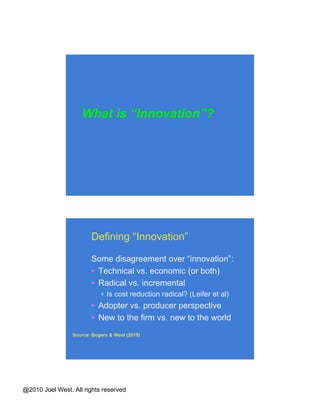
Defining “Innovation” Some disagreement over “innovation”:  Technical vs. economic (or both) Radical vs. incremental Is cost reduction radical? (Leifer et al) Adopter vs. producer perspective New to the firm vs. new to the world Source: Bogers & West (2010)
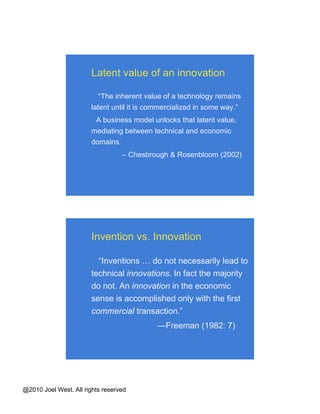
Latent value of an innovation “ The inherent value of a technology remains latent until it is commercialized in some way.” A business model unlocks that latent value, mediating between technical and economic domains. –  Chesbrough & Rosenbloom (2002)
Invention vs. Innovation “Inventions … do not necessarily lead to technical  innovations . In fact the majority do not. An  innovation  in the economic sense is accomplished only with the first  commercial  transaction.” —Freeman (1982: 7)
Non-commercial Application “Innovation is composed of two parts: (1) the generation of an idea or invention, and (2) the conversion of that invention into a business or other useful application.” — Roberts (1988: 12)
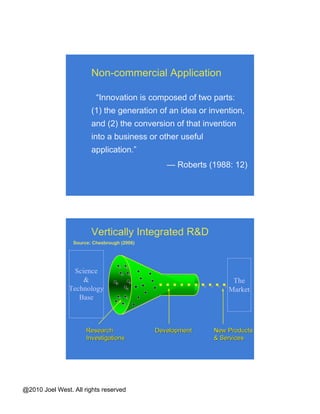
Vertically Integrated R&D Research Investigations Development New Products & Services The Market Science & Technology Base Source: Chesbrough (2006)
Research of Alfred D Chandler (1918-2007) Studied large US firms 1840-1940 Firms vertically integrate to supply own inputs and control their outputs R&D is an essential part of integration Technology industries require large R&D labs Markets don’t exists to buy/sell innovation Integration widely adopted in practice Pattern of large 20th C US and MNC firms Vertical Integration
Distributed *  Perspectives on Innovation *  i.e. O/U/CI
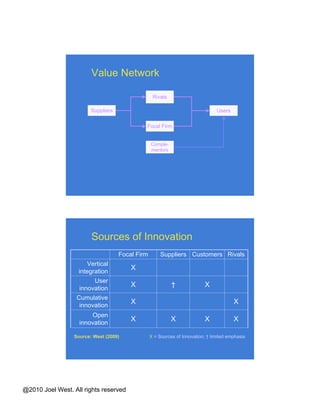
Value Network Suppliers Focal Firm Comple- mentors Users Rivals
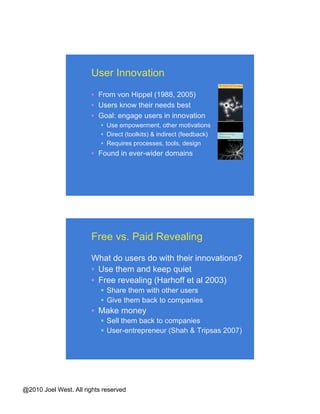
Sources of Innovation X  = Sources of Innovation; † limited emphasis   Source: West (2009) Focal Firm Suppliers Customers Rivals Vertical integration X User innovation X † X Cumulative innovation X X Open innovation X X X X
User Innovation From von Hippel (1988, 2005) Users know their needs best Goal: engage users in innovation Use empowerment, other motivations Direct (toolkits) & indirect (feedback) Requires processes, tools, design Found in ever-wider domains
Free vs. Paid Revealing What do users do with their innovations? Use them and keep quiet Free revealing (Harhoff et al 2003) Share them with other users Give them back to companies Make money Sell them back to companies User-entrepreneur (Shah & Tripsas 2007)
Cumulative Innovation Promoted by Scotchmer (1991, 2004) Focus: developing radical innovations Initial innovation is rarely complete Subsequent shared technological progress Competitors build on each other Need rights to each others’ work Some IP regimes hinder C.I. Jungle vs. commune view of rivalry
Three Cumulative Patterns Core technology, many derivatives E.g., Cohen-Boyer patent Derivative of many building blocks E.g., GSM/W-CDMA MP3 cameraphone Incremental quality improvements E.g., higher resolution inkjet print heads Source: Scotchmer (2004)
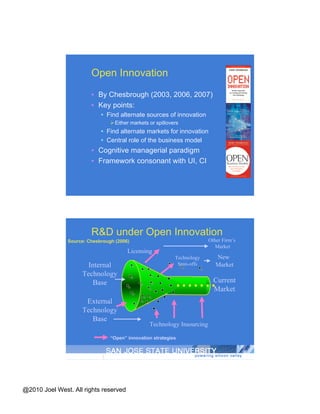
Open Innovation By Chesbrough (2003, 2006, 2007) Key points: Find alternate sources of innovation Either markets or spillovers Find alternate markets for innovation Central role of the business model Cognitive managerial paradigm Framework consonant with UI, CI
R&D under Open Innovation Source: Chesbrough (2006) Current Market Internal Technology Base Technology Insourcing New  Market Technology Spin-offs External Technology Base Other Firm’s  Market Licensing “ Open” innovation strategies
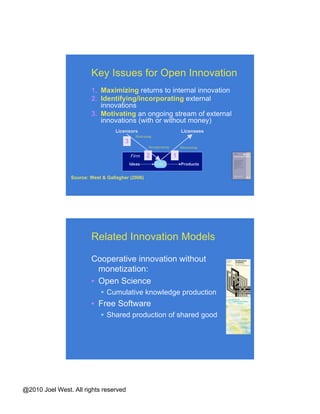
Key Issues for Open Innovation Maximizing   returns to internal innovation Identifying/incorporating  external innovations Motivating   an ongoing stream of external innovations (with or without money) R&D Firm Ideas Products Licensees Licensors Motivating Incorporating Maximizing 2 3 1 Source: West & Gallagher (2006)
Related Innovation Models Cooperative innovation without monetization: Open Science Cumulative knowledge production  Free Software Shared production of shared good
Creative Industries Copyright industries involve creativity, not technical innovation Some models consider creativity Open source software Creative commons Parallels to O/U/CI Dispersal, cumulative nature are similar Value creation, capture are different
Similarities Across O/U/CI
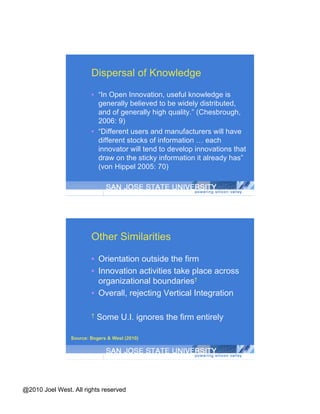
Dispersal of Knowledge “ In Open Innovation, useful knowledge is generally believed to be widely distributed, and of generally high quality.” (Chesbrough, 2006: 9) “ Different users and manufacturers will have different stocks of information … each innovator will tend to develop innovations that draw on the sticky information it already has” (von Hippel 2005: 70)
Other Similarities Orientation outside the firm Innovation activities take place across organizational boundaries † Overall, rejecting Vertical Integration †  Some U.I. ignores the firm entirely Source: Bogers & West (2010)
Contrasting Modes of Commercialization
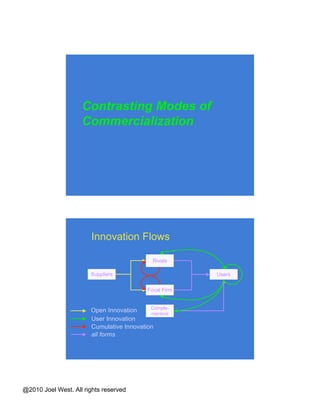
Innovation Flows Suppliers Focal Firm Comple- mentors Users Rivals Open Innovation User Innovation Cumulative Innovation all forms
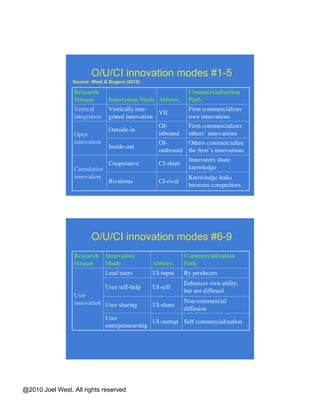
O/U/CI innovation modes #1-5 Source: West & Bogers (2010) Knowledge leaks between competitors CI-rival Rivalrous Innovators share knowledge CI-share Cooperative Cumulative innovation Others commercialize the firm’s innovations OI-outbound Inside-out Firm commercializes others’ innovations OI-inbound Outside-in Open innovation Firm commercializes own innovations VII Vertically inte-grated innovation Vertical integration Commercialization Path Abbrev. Innovation Mode Research Stream
O/U/CI innovation modes #6-9 Self commercialization UI-startup User entrepreneurship Non-commercial diffusion UI-share User sharing Enhances own utility, but not diffused UI-self User self-help By producers UI-input Lead users User innovation Commercialization Path Abbrev. Innovation Mode Research Stream
Antecedents for Selecting Modes Supply conditions Scale economies Cost of production and distribution Demand conditions Heterogeneity of demand Institutional conditions Strength of IP regime Markets for innovation
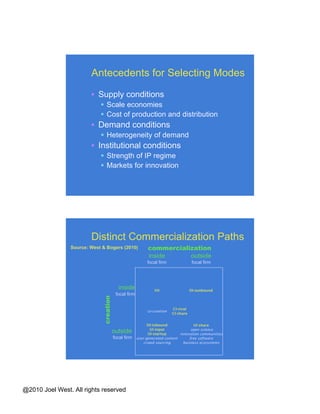
Distinct Commercialization Paths Source: West & Bogers (2010) inside focal firm outside focal firm inside focal firm outside focal firm creation commercialization VII OI-outbound OI-inbound UI-input UI-startup user-generated content crowd sourcing UI-share   open science innovation communities free software business ecosystems CI-rival CI-share co-creation
Communities
Importance of Communities Best known from open source software Implicit in CI research E.g. Meyer (2006) on 19th century airplane Increasingly important in UI E.g. Franke & Shah (2003), von Hippel (2005), Jeppesen & Frederiksen (2006) Finally being recognized in OI
Communities in OI Two pre-requisites: Voluntary association of independent actors Enabling innovation commercialization Open questions Who are the members? Individuals (cf. UI communities) or firms (cf. ecosystem, networks …) What are the boundaries? Upstream vs. downstream communities Interactions within vs. with communities Source: West & Lakhani (2008)
Communities as Third Mode Open innovation has three modes Outside-in:  using external innovations Inside-out:  commercializing internal innovations Coupled:  communities, ecosystems, alliances, consortia etc. Source: Enkel, Gassmann, Chesbrough (2009)
Communities in OI (3) Study of three innovation communities: Participants from multiple organizations Anchored to specific innovation Shared goals, objectives, identity Leverage distributed competencies Tied to Witte’s  Organisation f ü r Innovationsentscheidungen – Das Promotorenmodell Source: Fichter (2009)
Are  Fir ms Only “Open Enough”? Firms, OI communities share interests Firms chronically unwilling to give up control E.g. OSS communities: Apple, Google, Nokia, … Is it possible for firms to be open? Optimistic view: firms gain more by openness Pessimistic view: Firms are only as open as they need to be (West, 2003; West & O’Mahony, 2008)
Academic Controversies
Why So Many Germans*? They’re everywhere in UI/OI research: OUI (n ée UI) workshop  2003, 2004, … R&D Management  Sept 2009 (8-1) Heute Is it Eric’s dad? His co-authors? If so, why the interest in “open” innovation? * Plus of course German-speaking Swiss and Austrians
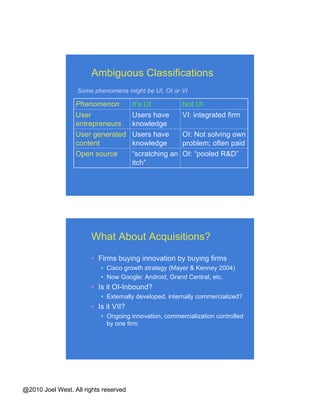
Ambiguous Classifications Some phenomena might be UI, OI or VI Phenomenon It’s UI Not UI User entrepreneurs Users have knowledge VI: integrated firm User generated content Users have knowledge OI: Not solving own problem; often paid Open source “ scratching an itch” OI: “pooled R&D”
What About Acquisitions? Firms buying innovation by buying firms Cisco growth strategy (Mayer & Kenney 2004) Now Google: Android, Grand Central, etc. Is it OI-Inbound? Externally developed, internally commercialized? Is it VII? Ongoing innovation, commercialization controlled by one firm
Why does classification matter? Different assumptions about Sources of innovation Motivations for innovating and diffusing Different managerial advice  Different policy prescriptions  E.g. IP policy, economic growth Can they all be right? Or is this the blind men and the elephant?
Emerging Patterns of Practice
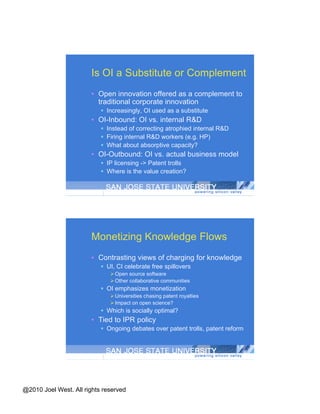
Learning from Observation ” The field of innovation studies arguably operates in Pasteur ’s  Quadrant, in that the processes and practices of industry actors often extend beyond the bounds predicted by academic theory.” –  Chesbrough (2006)
Is ICT Vertical Integration Dead? Silicon Valley: distributed innovation Ecosystems Component-based business models User innovation via beta sites, toolkits 1990s, even IBM became distributed Grove (1996) pronounced VI dead Today: increasing integration Apple, Google, HP, Microsoft, Nokia
Is OI a Substitute or Complement Open innovation offered as a complement to traditional corporate innovation Increasingly, OI used as a substitute OI-Inbound: OI vs. internal R&D Instead of correcting atrophied internal R&D Firing internal R&D workers (e.g. HP) What about absorptive capacity? OI-Outbound: OI vs. actual business model IP licensing -> Patent trolls Where is the value creation?
Monetizing Knowledge Flows Contrasting views of charging for knowledge UI, CI celebrate free spillovers Open source software Other collaborative communities OI emphasizes monetization Universities chasing patent royalties Impact on open science? Which is socially optimal? Tied to IPR policy Ongoing debates over patent trolls, patent reform
Conclusions
Summary Rapidly growing research on distributed innovation Distinct but overlapping O/U/CI domains Need for  Increasing conceptual clarity Understanding of emergent phenomena
Future Research Competing hypothesis O/U/CI study Which one predicts better? Joint maximization problem … for all stakeholders in value network Scope of knowledge and innovation Knowledge vs. innovation boundaries? Is there a value to knowledge for innovations other than those that we sell? (cf. Brusoni et al 2001)
Danke sehr! Joel West blog.OpenInnovation.net

Distributed Perspectives on Innovation

  • 1.
    Distributed Perspectives onInnovation: Open Innovation, User Innovation and Beyond Joel West blog.OpenInnovation.net San José State University New Forms of Collaborative Production and Innovation Georg-August-Universit ä t G öttingen May 5, 2010
  • 2.
    Today’s Story Traditionaland distributed innovation Similarities and differences Emerging areas of research and practice Conclusions
  • 3.
  • 4.
    Defining “Innovation” Somedisagreement over “innovation”: Technical vs. economic (or both) Radical vs. incremental Is cost reduction radical? (Leifer et al) Adopter vs. producer perspective New to the firm vs. new to the world Source: Bogers & West (2010)
  • 5.
    Latent value ofan innovation “ The inherent value of a technology remains latent until it is commercialized in some way.” A business model unlocks that latent value, mediating between technical and economic domains. – Chesbrough & Rosenbloom (2002)
  • 6.
    Invention vs. Innovation“Inventions … do not necessarily lead to technical innovations . In fact the majority do not. An innovation in the economic sense is accomplished only with the first commercial transaction.” —Freeman (1982: 7)
  • 7.
    Non-commercial Application “Innovationis composed of two parts: (1) the generation of an idea or invention, and (2) the conversion of that invention into a business or other useful application.” — Roberts (1988: 12)
  • 8.
    Vertically Integrated R&DResearch Investigations Development New Products & Services The Market Science & Technology Base Source: Chesbrough (2006)
  • 9.
    Research of AlfredD Chandler (1918-2007) Studied large US firms 1840-1940 Firms vertically integrate to supply own inputs and control their outputs R&D is an essential part of integration Technology industries require large R&D labs Markets don’t exists to buy/sell innovation Integration widely adopted in practice Pattern of large 20th C US and MNC firms Vertical Integration
  • 10.
    Distributed * Perspectives on Innovation * i.e. O/U/CI
  • 11.
    Value Network SuppliersFocal Firm Comple- mentors Users Rivals
  • 12.
    Sources of InnovationX = Sources of Innovation; † limited emphasis Source: West (2009) Focal Firm Suppliers Customers Rivals Vertical integration X User innovation X † X Cumulative innovation X X Open innovation X X X X
  • 13.
    User Innovation Fromvon Hippel (1988, 2005) Users know their needs best Goal: engage users in innovation Use empowerment, other motivations Direct (toolkits) & indirect (feedback) Requires processes, tools, design Found in ever-wider domains
  • 14.
    Free vs. PaidRevealing What do users do with their innovations? Use them and keep quiet Free revealing (Harhoff et al 2003) Share them with other users Give them back to companies Make money Sell them back to companies User-entrepreneur (Shah & Tripsas 2007)
  • 15.
    Cumulative Innovation Promotedby Scotchmer (1991, 2004) Focus: developing radical innovations Initial innovation is rarely complete Subsequent shared technological progress Competitors build on each other Need rights to each others’ work Some IP regimes hinder C.I. Jungle vs. commune view of rivalry
  • 16.
    Three Cumulative PatternsCore technology, many derivatives E.g., Cohen-Boyer patent Derivative of many building blocks E.g., GSM/W-CDMA MP3 cameraphone Incremental quality improvements E.g., higher resolution inkjet print heads Source: Scotchmer (2004)
  • 17.
    Open Innovation ByChesbrough (2003, 2006, 2007) Key points: Find alternate sources of innovation Either markets or spillovers Find alternate markets for innovation Central role of the business model Cognitive managerial paradigm Framework consonant with UI, CI
  • 18.
    R&D under OpenInnovation Source: Chesbrough (2006) Current Market Internal Technology Base Technology Insourcing New Market Technology Spin-offs External Technology Base Other Firm’s Market Licensing “ Open” innovation strategies
  • 19.
    Key Issues forOpen Innovation Maximizing returns to internal innovation Identifying/incorporating external innovations Motivating an ongoing stream of external innovations (with or without money) R&D Firm Ideas Products Licensees Licensors Motivating Incorporating Maximizing 2 3 1 Source: West & Gallagher (2006)
  • 20.
    Related Innovation ModelsCooperative innovation without monetization: Open Science Cumulative knowledge production Free Software Shared production of shared good
  • 21.
    Creative Industries Copyrightindustries involve creativity, not technical innovation Some models consider creativity Open source software Creative commons Parallels to O/U/CI Dispersal, cumulative nature are similar Value creation, capture are different
  • 22.
  • 23.
    Dispersal of Knowledge“ In Open Innovation, useful knowledge is generally believed to be widely distributed, and of generally high quality.” (Chesbrough, 2006: 9) “ Different users and manufacturers will have different stocks of information … each innovator will tend to develop innovations that draw on the sticky information it already has” (von Hippel 2005: 70)
  • 24.
    Other Similarities Orientationoutside the firm Innovation activities take place across organizational boundaries † Overall, rejecting Vertical Integration † Some U.I. ignores the firm entirely Source: Bogers & West (2010)
  • 25.
    Contrasting Modes ofCommercialization
  • 26.
    Innovation Flows SuppliersFocal Firm Comple- mentors Users Rivals Open Innovation User Innovation Cumulative Innovation all forms
  • 27.
    O/U/CI innovation modes#1-5 Source: West & Bogers (2010) Knowledge leaks between competitors CI-rival Rivalrous Innovators share knowledge CI-share Cooperative Cumulative innovation Others commercialize the firm’s innovations OI-outbound Inside-out Firm commercializes others’ innovations OI-inbound Outside-in Open innovation Firm commercializes own innovations VII Vertically inte-grated innovation Vertical integration Commercialization Path Abbrev. Innovation Mode Research Stream
  • 28.
    O/U/CI innovation modes#6-9 Self commercialization UI-startup User entrepreneurship Non-commercial diffusion UI-share User sharing Enhances own utility, but not diffused UI-self User self-help By producers UI-input Lead users User innovation Commercialization Path Abbrev. Innovation Mode Research Stream
  • 29.
    Antecedents for SelectingModes Supply conditions Scale economies Cost of production and distribution Demand conditions Heterogeneity of demand Institutional conditions Strength of IP regime Markets for innovation
  • 30.
    Distinct Commercialization PathsSource: West & Bogers (2010) inside focal firm outside focal firm inside focal firm outside focal firm creation commercialization VII OI-outbound OI-inbound UI-input UI-startup user-generated content crowd sourcing UI-share open science innovation communities free software business ecosystems CI-rival CI-share co-creation
  • 31.
  • 32.
    Importance of CommunitiesBest known from open source software Implicit in CI research E.g. Meyer (2006) on 19th century airplane Increasingly important in UI E.g. Franke & Shah (2003), von Hippel (2005), Jeppesen & Frederiksen (2006) Finally being recognized in OI
  • 33.
    Communities in OITwo pre-requisites: Voluntary association of independent actors Enabling innovation commercialization Open questions Who are the members? Individuals (cf. UI communities) or firms (cf. ecosystem, networks …) What are the boundaries? Upstream vs. downstream communities Interactions within vs. with communities Source: West & Lakhani (2008)
  • 34.
    Communities as ThirdMode Open innovation has three modes Outside-in: using external innovations Inside-out: commercializing internal innovations Coupled: communities, ecosystems, alliances, consortia etc. Source: Enkel, Gassmann, Chesbrough (2009)
  • 35.
    Communities in OI(3) Study of three innovation communities: Participants from multiple organizations Anchored to specific innovation Shared goals, objectives, identity Leverage distributed competencies Tied to Witte’s Organisation f ü r Innovationsentscheidungen – Das Promotorenmodell Source: Fichter (2009)
  • 36.
    Are Firms Only “Open Enough”? Firms, OI communities share interests Firms chronically unwilling to give up control E.g. OSS communities: Apple, Google, Nokia, … Is it possible for firms to be open? Optimistic view: firms gain more by openness Pessimistic view: Firms are only as open as they need to be (West, 2003; West & O’Mahony, 2008)
  • 37.
  • 38.
    Why So ManyGermans*? They’re everywhere in UI/OI research: OUI (n ée UI) workshop 2003, 2004, … R&D Management Sept 2009 (8-1) Heute Is it Eric’s dad? His co-authors? If so, why the interest in “open” innovation? * Plus of course German-speaking Swiss and Austrians
  • 39.
    Ambiguous Classifications Somephenomena might be UI, OI or VI Phenomenon It’s UI Not UI User entrepreneurs Users have knowledge VI: integrated firm User generated content Users have knowledge OI: Not solving own problem; often paid Open source “ scratching an itch” OI: “pooled R&D”
  • 40.
    What About Acquisitions?Firms buying innovation by buying firms Cisco growth strategy (Mayer & Kenney 2004) Now Google: Android, Grand Central, etc. Is it OI-Inbound? Externally developed, internally commercialized? Is it VII? Ongoing innovation, commercialization controlled by one firm
  • 41.
    Why does classificationmatter? Different assumptions about Sources of innovation Motivations for innovating and diffusing Different managerial advice Different policy prescriptions E.g. IP policy, economic growth Can they all be right? Or is this the blind men and the elephant?
  • 42.
  • 43.
    Learning from Observation” The field of innovation studies arguably operates in Pasteur ’s Quadrant, in that the processes and practices of industry actors often extend beyond the bounds predicted by academic theory.” – Chesbrough (2006)
  • 44.
    Is ICT VerticalIntegration Dead? Silicon Valley: distributed innovation Ecosystems Component-based business models User innovation via beta sites, toolkits 1990s, even IBM became distributed Grove (1996) pronounced VI dead Today: increasing integration Apple, Google, HP, Microsoft, Nokia
  • 45.
    Is OI aSubstitute or Complement Open innovation offered as a complement to traditional corporate innovation Increasingly, OI used as a substitute OI-Inbound: OI vs. internal R&D Instead of correcting atrophied internal R&D Firing internal R&D workers (e.g. HP) What about absorptive capacity? OI-Outbound: OI vs. actual business model IP licensing -> Patent trolls Where is the value creation?
  • 46.
    Monetizing Knowledge FlowsContrasting views of charging for knowledge UI, CI celebrate free spillovers Open source software Other collaborative communities OI emphasizes monetization Universities chasing patent royalties Impact on open science? Which is socially optimal? Tied to IPR policy Ongoing debates over patent trolls, patent reform
  • 47.
  • 48.
    Summary Rapidly growingresearch on distributed innovation Distinct but overlapping O/U/CI domains Need for Increasing conceptual clarity Understanding of emergent phenomena
  • 49.
    Future Research Competinghypothesis O/U/CI study Which one predicts better? Joint maximization problem … for all stakeholders in value network Scope of knowledge and innovation Knowledge vs. innovation boundaries? Is there a value to knowledge for innovations other than those that we sell? (cf. Brusoni et al 2001)
  • 50.
    Danke sehr! JoelWest blog.OpenInnovation.net

Editor's Notes

  • #4 Franke’s term
  • #9 Also, the other counterpoint is the vertically integrated model, where in order to do anything, you have to do everything.
  • #11 Franke’s term
  • #12 This is the sources of innovation diagram shown as a value network/ecosystem diagram
  • #26 Franke’s term
  • #27 This is the sources of innovation diagram shown as a value network/ecosystem diagram
  • #31 Overlapping commercialization modes, notably OI-inbound and UI-input New commercialization modes not previously studied For specific phenomena, an opportunity to differentiate overlapping but distinct innovation modes