
1
Joel West
Professor, Keck Graduate Institute
Associate Editor, Research Policy
29 June 2016
How Standards
Research Can Inform
Open Innovation
EURAS 2016
2
Overview
• Standards and standardization were open
innovation before there was an “open
innovation”
• Also true for co-opetition
• Thus EURAS research is relevant to a broader
audience
• Publication opportunity:
• Beyond focusing on just standards outcomes
• Instead addressing broader questions
• to be cited by both standards and other
researchers
3
Prior Research
4
Standards Research
• Standardization activities, processes
• SSOs, SDOs, alliances, consortia
• Technical compatibility standards
• As artifacts, actors or institutions
• Proprietary, open or shades of gray
• Technical and organizational modularity
• Platforms, ecosystems and third party
complements
• Shared implementations via open source
software (OSS)
5
Co-opetition
A firm “is your complementor if
customers value your product
more when they have the other
[firm’s] product than when they
have your product alone.”
- Brandenburger and Nalebuff
(1996)
6
Open Innovation
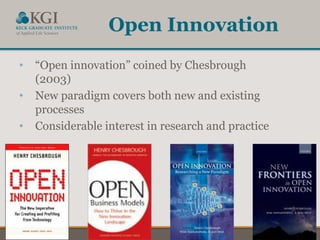
• “Open innovation” coined by Chesbrough
(2003)
• New paradigm covers both new and existing
processes
• Considerable interest in research and practice
7
Open Innovation (1)
“Open innovation is the use of purposive inflows
and outflows of knowledge to accelerate
internal innovation, and expand the markets for
external use of innovation, respectively.”
— Chesbrough (2006)
8
Open Innovation (2)
Not all firms can profit from all innovations
Contingent upon creating a business model
• Value creation
• Sustainable value capture
• Embedded in a value network of suppliers,
complementors and customers
Chesbrough (2003, 2006a, 2006b); Chesbrough & Rosenbloom (2002);
Vanhaverbeke & Chesbrough (2014)
9
Open Innovation (3)
Three modes of open innovation:
1. Inbound: accessing external innovations to
improve a firm’s innovations
2. Outbound: using external markets to
commercialize those innovations
3. Coupled: combining inbound & outbound
flows to innovate inside (or outside) the firm
Gassmann & Enkel (2004), Enkel et al (2009), Piller & West (2014)
10
Open Innovation (4)
Our interest is the network form
• Coupled or inbound
• Peer-to-peer (Powell 1990) or hub-and-spoke
These include
• Communities
• Consortia
• Ecosystems
• Platforms
West (2014)
11
Relates to Standards
• Simcoe (2006): open standards have optimal tradeoff
between public value creation and private value capture
• Vanhaverbeke & Cloodt (2006): managing networks for
value creation and capture
• West (2006): interdependent networks of
complementors and suppliers in systems products
• Dittrich & Duysters (2007): leveraging OI networks to
define and implement standards
• West & Lakhani (2008): communities and open
innovation
• West & Wood (2013): neglecting complementor value
capture leads to collapse of platform ecosystem
12
Research Opportunities
13
Importance of Framing
For reviewers and editors, framing is essential
• What is your paper about?
• What literature does it build upon?
• What do you promise to deliver?
You have a choice of framing
• Same study can be framed different ways
• Framing must align to actual data, findings and
contribution
• Some ways will have more impact than others
14
Narrow Framing
This paper “shows how victory in a standards
competition can be negated by the introduction of a
new architectural layer that spans two or more
previously incompatible architectures.Ӡ
• Study of IBM’s PC strategy in Japan
• Relevant to platforms and standards architectures
• Beyond that: ????
† West & Dedrick (2000)
15
Broad Framing
“This article … describes the use of innovation
networks as a means to adapt swiftly to changing
market conditions and strategic change.Ӡ
• Study of Nokia’s value creation networks
• Relevant to alliances, network management,
mobile telephony, ecosystems, innovation
exploration/exploitation
† Dittrich & Duysters (2007)
16
Approach
Requires joining another literature
How could this inform a broader audience?
• What research has studied similar phenomena?
• What is the same and different?
• What terms/concepts are different?
• Who are the key authors?
Don’t include too many literatures in one study
17
Standardization
Possible themes
• Tension of public/private gain
• Bilateral/multilateral alliances
• Creating/joining enduring or ad hoc institutions
• Governance, voice, permeability, openness
• Knowledge flows
• Effects/limits of intellectual property
18
Compatibility Standards
Possible themes
• Modularity
• Technical
• Organizational: “Mirroring” hypothesis
• Refactoring/coordination
• Tacit/explicit knowledge
• Creating/evolving product architectures
• Interdependence of public/private architectures
19
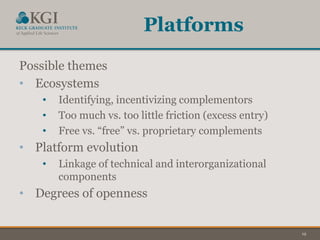
Platforms
Possible themes
• Ecosystems
• Identifying, incentivizing complementors
• Too much vs. too little friction (excess entry)
• Free vs. “free” vs. proprietary complements
• Platform evolution
• Linkage of technical and interorganizational
components
• Degrees of openness
20
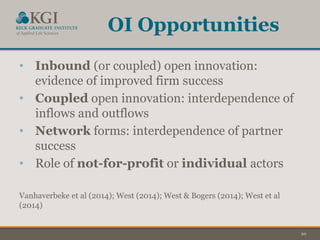
OI Opportunities
• Inbound (or coupled) open innovation:
evidence of improved firm success
• Coupled open innovation: interdependence of
inflows and outflows
• Network forms: interdependence of partner
success
• Role of not-for-profit or individual actors
Vanhaverbeke et al (2014); West (2014); West & Bogers (2014); West et al
(2014)
21
Conclusions
22
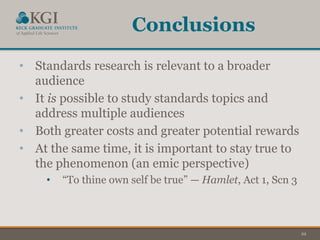
Conclusions
• Standards research is relevant to a broader
audience
• It is possible to study standards topics and
address multiple audiences
• Both greater costs and greater potential rewards
• At the same time, it is important to stay true to
the phenomenon (an emic perspective)
• “To thine own self be true” — Hamlet, Act 1, Scn 3
23
Thank You!
KGI@joelwest.org
www.JoelWest.org/Research

How Standards Research Can Inform Open Innovation

  • 1.
    1 Joel West Professor, KeckGraduate Institute Associate Editor, Research Policy 29 June 2016 How Standards Research Can Inform Open Innovation EURAS 2016
  • 2.
    2 Overview • Standards andstandardization were open innovation before there was an “open innovation” • Also true for co-opetition • Thus EURAS research is relevant to a broader audience • Publication opportunity: • Beyond focusing on just standards outcomes • Instead addressing broader questions • to be cited by both standards and other researchers
  • 3.
  • 4.
    4 Standards Research • Standardizationactivities, processes • SSOs, SDOs, alliances, consortia • Technical compatibility standards • As artifacts, actors or institutions • Proprietary, open or shades of gray • Technical and organizational modularity • Platforms, ecosystems and third party complements • Shared implementations via open source software (OSS)
  • 5.
    5 Co-opetition A firm “isyour complementor if customers value your product more when they have the other [firm’s] product than when they have your product alone.” - Brandenburger and Nalebuff (1996)
  • 6.
    6 Open Innovation • “Openinnovation” coined by Chesbrough (2003) • New paradigm covers both new and existing processes • Considerable interest in research and practice
  • 7.
    7 Open Innovation (1) “Openinnovation is the use of purposive inflows and outflows of knowledge to accelerate internal innovation, and expand the markets for external use of innovation, respectively.” — Chesbrough (2006)
  • 8.
    8 Open Innovation (2) Notall firms can profit from all innovations Contingent upon creating a business model • Value creation • Sustainable value capture • Embedded in a value network of suppliers, complementors and customers Chesbrough (2003, 2006a, 2006b); Chesbrough & Rosenbloom (2002); Vanhaverbeke & Chesbrough (2014)
  • 9.
    9 Open Innovation (3) Threemodes of open innovation: 1. Inbound: accessing external innovations to improve a firm’s innovations 2. Outbound: using external markets to commercialize those innovations 3. Coupled: combining inbound & outbound flows to innovate inside (or outside) the firm Gassmann & Enkel (2004), Enkel et al (2009), Piller & West (2014)
  • 10.
    10 Open Innovation (4) Ourinterest is the network form • Coupled or inbound • Peer-to-peer (Powell 1990) or hub-and-spoke These include • Communities • Consortia • Ecosystems • Platforms West (2014)
  • 11.
    11 Relates to Standards •Simcoe (2006): open standards have optimal tradeoff between public value creation and private value capture • Vanhaverbeke & Cloodt (2006): managing networks for value creation and capture • West (2006): interdependent networks of complementors and suppliers in systems products • Dittrich & Duysters (2007): leveraging OI networks to define and implement standards • West & Lakhani (2008): communities and open innovation • West & Wood (2013): neglecting complementor value capture leads to collapse of platform ecosystem
  • 12.
  • 13.
    13 Importance of Framing Forreviewers and editors, framing is essential • What is your paper about? • What literature does it build upon? • What do you promise to deliver? You have a choice of framing • Same study can be framed different ways • Framing must align to actual data, findings and contribution • Some ways will have more impact than others
  • 14.
    14 Narrow Framing This paper“shows how victory in a standards competition can be negated by the introduction of a new architectural layer that spans two or more previously incompatible architectures.”† • Study of IBM’s PC strategy in Japan • Relevant to platforms and standards architectures • Beyond that: ???? † West & Dedrick (2000)
  • 15.
    15 Broad Framing “This article… describes the use of innovation networks as a means to adapt swiftly to changing market conditions and strategic change.”† • Study of Nokia’s value creation networks • Relevant to alliances, network management, mobile telephony, ecosystems, innovation exploration/exploitation † Dittrich & Duysters (2007)
  • 16.
    16 Approach Requires joining anotherliterature How could this inform a broader audience? • What research has studied similar phenomena? • What is the same and different? • What terms/concepts are different? • Who are the key authors? Don’t include too many literatures in one study
  • 17.
    17 Standardization Possible themes • Tensionof public/private gain • Bilateral/multilateral alliances • Creating/joining enduring or ad hoc institutions • Governance, voice, permeability, openness • Knowledge flows • Effects/limits of intellectual property
  • 18.
    18 Compatibility Standards Possible themes •Modularity • Technical • Organizational: “Mirroring” hypothesis • Refactoring/coordination • Tacit/explicit knowledge • Creating/evolving product architectures • Interdependence of public/private architectures
  • 19.
    19 Platforms Possible themes • Ecosystems •Identifying, incentivizing complementors • Too much vs. too little friction (excess entry) • Free vs. “free” vs. proprietary complements • Platform evolution • Linkage of technical and interorganizational components • Degrees of openness
  • 20.
    20 OI Opportunities • Inbound(or coupled) open innovation: evidence of improved firm success • Coupled open innovation: interdependence of inflows and outflows • Network forms: interdependence of partner success • Role of not-for-profit or individual actors Vanhaverbeke et al (2014); West (2014); West & Bogers (2014); West et al (2014)
  • 21.
  • 22.
    22 Conclusions • Standards researchis relevant to a broader audience • It is possible to study standards topics and address multiple audiences • Both greater costs and greater potential rewards • At the same time, it is important to stay true to the phenomenon (an emic perspective) • “To thine own self be true” — Hamlet, Act 1, Scn 3
  • 23.