

8/4/14
1
1
Innovation Ecosystems:
Benefits, Challenges, and
Structures
Discussion
August 5, 2014
Joel West
Professor, Innovation & Entrepreneurship
School of Applied Life Sciences
2
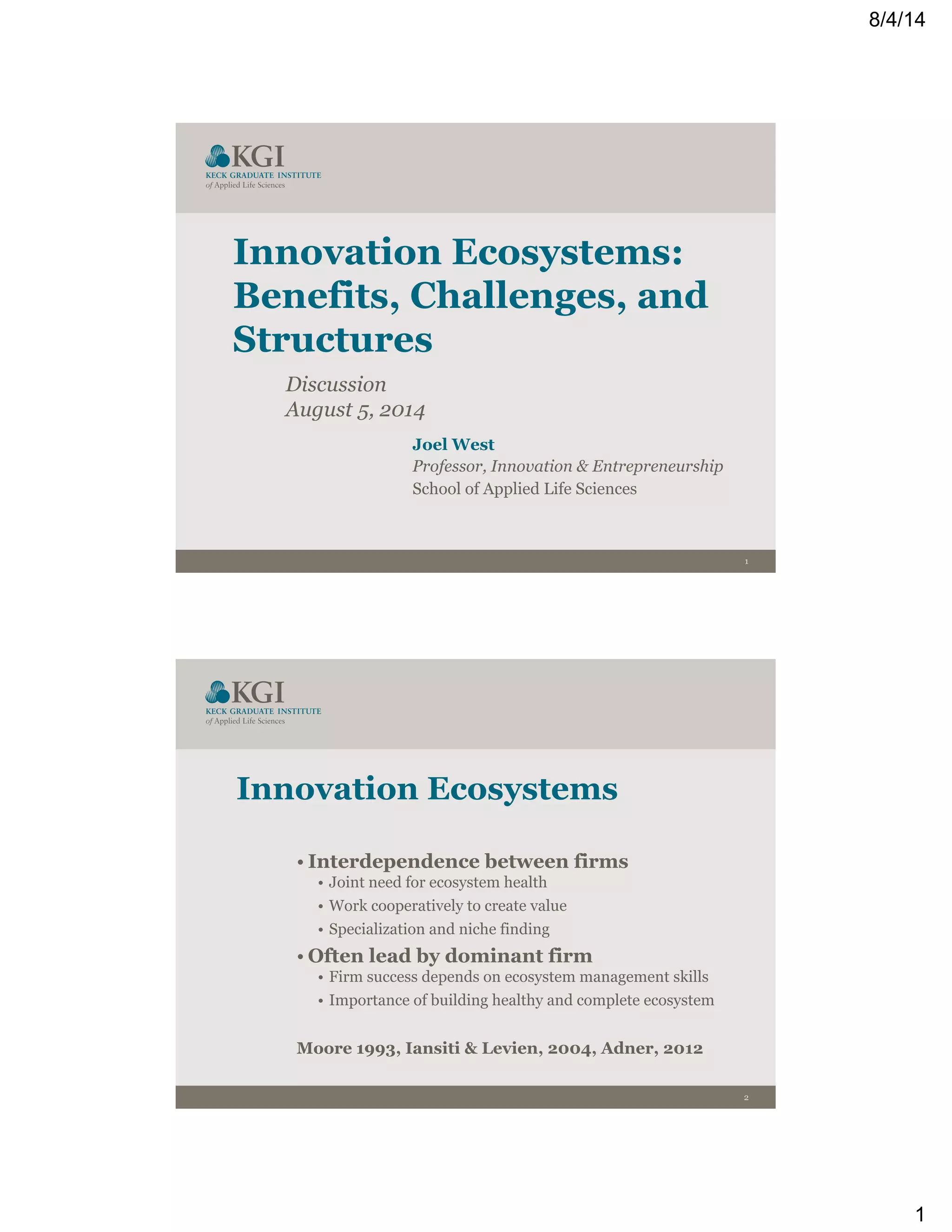
Innovation Ecosystems
• Interdependence between firms
•  Joint need for ecosystem health
•  Work cooperatively to create value
•  Specialization and niche finding
• Often lead by dominant firm
•  Firm success depends on ecosystem management skills
•  Importance of building healthy and complete ecosystem
Moore 1993, Iansiti & Levien, 2004, Adner, 2012
8/4/14
2
3
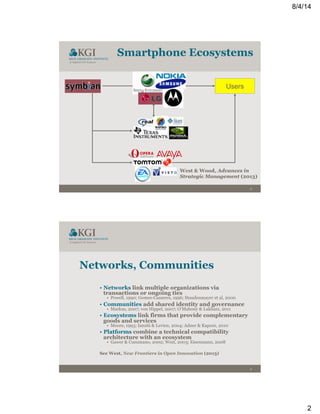
Users
Smartphone Ecosystems
West & Wood, Advances in
Strategic Management (2013)
4
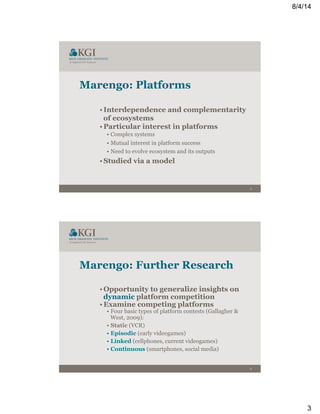
Networks, Communities
•  Networks link multiple organizations via
transactions or ongoing ties
•  Powell, 1990; Gomes-Casseres, 1996; Staudenmayer et al, 2000
•  Communities add shared identity and governance
•  Markus, 2007; von Hippel, 2007; O’Mahony & Lakhani, 2011
•  Ecosystems link firms that provide complementary
goods and services
•  Moore, 1993; Iansiti & Levien, 2004; Adner & Kapoor, 2010
•  Platforms combine a technical compatibility
architecture with an ecosystem
•  Gawer & Cusumano, 2002; West, 2003; Eisenmann, 2008
See West, New Frontiers in Open Innovation (2013)
8/4/14
3
5
Marengo: Platforms
• Interdependence and complementarity
of ecosystems
• Particular interest in platforms
• Complex systems
• Mutual interest in platform success
• Need to evolve ecosystem and its outputs
• Studied via a model
6
Marengo: Further Research
• Opportunity to generalize insights on
dynamic platform competition
• Examine competing platforms
• Four basic types of platform contests (Gallagher &
West, 2009):
• Static (VCR)
• Episodic (early videogames)
• Linked (cellphones, current videogames)
• Continuous (smartphones, social media)
8/4/14
4
7
Miles: Communities
• We know collaboration is important
• What are the barriers between firms?
• What are the barriers within firms?
• Is it driven by firm (or societal) norms?
• How can we change things?
• Direct links to cumulative innovation
• Allen, 1983; Nuvolari, 2004; Scotchmer, 2004; Murray
& O’Mahony, 2007; also von Hippel, 2005
8
Miles: Further Research
• Many firms compete w/o cooperating
• Rarer are examples of firm cooperation
• Inventors of the airplane (Meyer, 2013)
• Standardization communities (Axelrod et al, 1995;
Leiponen, 2008; Simcoe, 2012)
• Open source software (West, 2003; Stam, 2009;
Spaeth et al, 2010)
• Are differences attitudinal or strategic?
• An open empirical questions
8/4/14
5
9
Snow: Communities
• Multi-firm innovation ecosystems
• How can firms best collaborate?
• What are the rules?
• What benefits can be realized?
See Fjelstad et al (2012), Moore (1993)
10
Snow: Further Research
• We have examples of the architecture of
interfirm collaboration
•  West & O’Mahony, 2008; Fjeldstad et al, 2012
• But need a more general solution
•  What are the fundamental axioms?
•  Moderators?
•  Contracts and property rights?
• Other research designs (experiments,
simulations, ethnographic, etc.)
•  Cf. O’Mahony & Ferraro, 2007; Terwiesch & Xu 2008
8/4/14
6
11
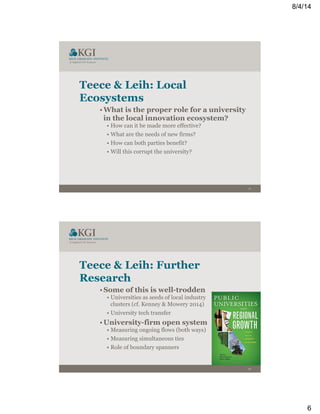
Teece & Leih: Local
Ecosystems
• What is the proper role for a university
in the local innovation ecosystem?
• How can it be made more effective?
• What are the needs of new firms?
• How can both parties benefit?
• Will this corrupt the university?
12
Teece & Leih: Further
Research
• Some of this is well-trodden
• Universities as seeds of local industry
clusters (cf. Kenney & Mowery 2014)
• University tech transfer
• University-firm open system
• Measuring ongoing flows (both ways)
• Measuring simultaneous ties
• Role of boundary spanners
8/4/14
7
13
Final Thoughts
• Ecosystems are increasingly recognized
as important to firm success
• Important to theory and practice
• An opportunity for future research
• Considerable research on ICT and other digital goods
• How do these ideas extend beyond ICT?
• E.g. Kim et al 2014 study of Chez Panisse
• Clearly delineate overlap with other constructs

Discussant: Innovation Ecosystems (AOM 2014)

  • 1.
    8/4/14 1 1 Innovation Ecosystems: Benefits, Challenges,and Structures Discussion August 5, 2014 Joel West Professor, Innovation & Entrepreneurship School of Applied Life Sciences 2 Innovation Ecosystems • Interdependence between firms •  Joint need for ecosystem health •  Work cooperatively to create value •  Specialization and niche finding • Often lead by dominant firm •  Firm success depends on ecosystem management skills •  Importance of building healthy and complete ecosystem Moore 1993, Iansiti & Levien, 2004, Adner, 2012
  • 2.
    8/4/14 2 3 Users Smartphone Ecosystems West &Wood, Advances in Strategic Management (2013) 4 Networks, Communities •  Networks link multiple organizations via transactions or ongoing ties •  Powell, 1990; Gomes-Casseres, 1996; Staudenmayer et al, 2000 •  Communities add shared identity and governance •  Markus, 2007; von Hippel, 2007; O’Mahony & Lakhani, 2011 •  Ecosystems link firms that provide complementary goods and services •  Moore, 1993; Iansiti & Levien, 2004; Adner & Kapoor, 2010 •  Platforms combine a technical compatibility architecture with an ecosystem •  Gawer & Cusumano, 2002; West, 2003; Eisenmann, 2008 See West, New Frontiers in Open Innovation (2013)
  • 3.
    8/4/14 3 5 Marengo: Platforms • Interdependence andcomplementarity of ecosystems • Particular interest in platforms • Complex systems • Mutual interest in platform success • Need to evolve ecosystem and its outputs • Studied via a model 6 Marengo: Further Research • Opportunity to generalize insights on dynamic platform competition • Examine competing platforms • Four basic types of platform contests (Gallagher & West, 2009): • Static (VCR) • Episodic (early videogames) • Linked (cellphones, current videogames) • Continuous (smartphones, social media)
  • 4.
    8/4/14 4 7 Miles: Communities • We knowcollaboration is important • What are the barriers between firms? • What are the barriers within firms? • Is it driven by firm (or societal) norms? • How can we change things? • Direct links to cumulative innovation • Allen, 1983; Nuvolari, 2004; Scotchmer, 2004; Murray & O’Mahony, 2007; also von Hippel, 2005 8 Miles: Further Research • Many firms compete w/o cooperating • Rarer are examples of firm cooperation • Inventors of the airplane (Meyer, 2013) • Standardization communities (Axelrod et al, 1995; Leiponen, 2008; Simcoe, 2012) • Open source software (West, 2003; Stam, 2009; Spaeth et al, 2010) • Are differences attitudinal or strategic? • An open empirical questions
  • 5.
    8/4/14 5 9 Snow: Communities • Multi-firm innovationecosystems • How can firms best collaborate? • What are the rules? • What benefits can be realized? See Fjelstad et al (2012), Moore (1993) 10 Snow: Further Research • We have examples of the architecture of interfirm collaboration •  West & O’Mahony, 2008; Fjeldstad et al, 2012 • But need a more general solution •  What are the fundamental axioms? •  Moderators? •  Contracts and property rights? • Other research designs (experiments, simulations, ethnographic, etc.) •  Cf. O’Mahony & Ferraro, 2007; Terwiesch & Xu 2008
  • 6.
    8/4/14 6 11 Teece & Leih:Local Ecosystems • What is the proper role for a university in the local innovation ecosystem? • How can it be made more effective? • What are the needs of new firms? • How can both parties benefit? • Will this corrupt the university? 12 Teece & Leih: Further Research • Some of this is well-trodden • Universities as seeds of local industry clusters (cf. Kenney & Mowery 2014) • University tech transfer • University-firm open system • Measuring ongoing flows (both ways) • Measuring simultaneous ties • Role of boundary spanners
  • 7.
    8/4/14 7 13 Final Thoughts • Ecosystems areincreasingly recognized as important to firm success • Important to theory and practice • An opportunity for future research • Considerable research on ICT and other digital goods • How do these ideas extend beyond ICT? • E.g. Kim et al 2014 study of Chez Panisse • Clearly delineate overlap with other constructs