

Researching Open Innovation
AOM 2015 PDW
August 5, 2015
1:00 - 3:00 p.m.
Organized by
Marcel Bogers
University of Copenhagen
Agnieszka Radziwon
University of Southern Denmark
Jonathan Sims
Babson College
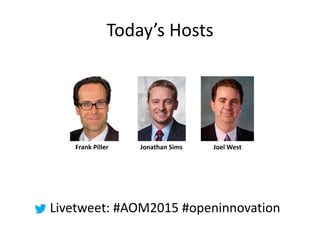
Today’s Hosts
Livetweet: #AOM2015 #openinnovation
Joel WestFrank Piller Jonathan Sims
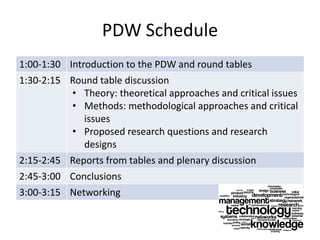
PDW Schedule
1:00-1:30 Introduction to the PDW and round tables
1:30-2:15 Round table discussion
• Theory: theoretical approaches and critical issues
• Methods: methodological approaches and critical
issues
• Proposed research questions and research
designs
2:15-2:45 Reports from tables and plenary discussion
2:45-3:00 Conclusions
3:00-3:15 Networking
What is “Open Innovation”?
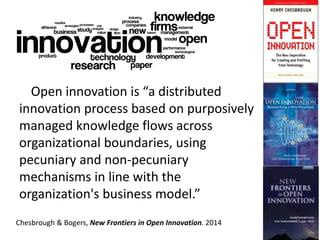
Open innovation is “a distributed
innovation process based on purposively
managed knowledge flows across
organizational boundaries, using
pecuniary and non-pecuniary
mechanisms in line with the
organization's business model.”
Chesbrough & Bogers, New Frontiers in Open Innovation. 2014
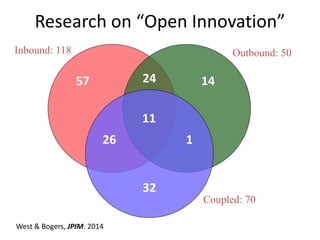
Research on “Open Innovation”
Inbound: 118 Outbound: 50
Coupled: 70
57 14
11
24
26 1
32
West & Bogers, JPIM. 2014
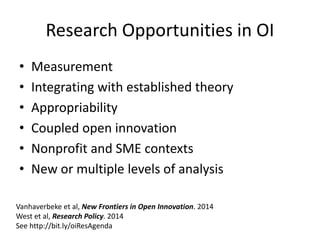
Research Opportunities in OI
• Measurement
• Integrating with established theory
• Appropriability
• Coupled open innovation
• Nonprofit and SME contexts
• New or multiple levels of analysis
Vanhaverbeke et al, New Frontiers in Open Innovation. 2014
West et al, Research Policy. 2014
See http://bit.ly/oiResAgenda
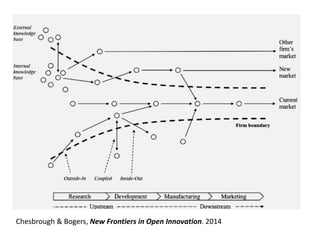
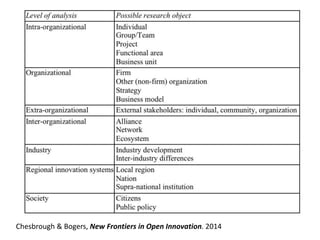
Researching Open Innovation at
Different Levels of Analysis
Chesbrough & Bogers, New Frontiers in Open Innovation. 2014
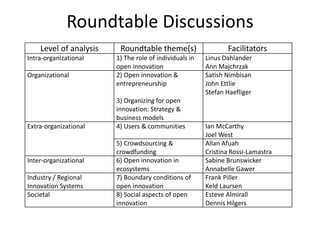
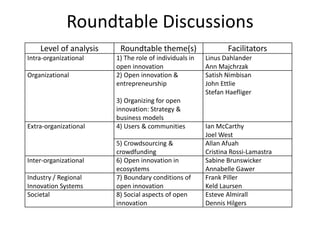
Roundtable Discussions
Level of analysis Roundtable theme(s) Facilitators
Intra-organizational 1) The role of individuals in
open innovation
Linus Dahlander
Ann Majchrzak
Organizational 2) Open innovation &
entrepreneurship
3) Organizing for open
innovation: Strategy &
business models
Satish Nimbisan
John Ettlie
Stefan Haefliger
Extra-organizational 4) Users & communities Ian McCarthy
Joel West
5) Crowdsourcing &
crowdfunding
Allan Afuah
Cristina Rossi-Lamastra
Inter-organizational 6) Open innovation in
ecosystems
Sabine Brunswicker
Annabelle Gawer
Industry / Regional
Innovation Systems
7) Boundary conditions of
open innovation
Frank Piller
Keld Laursen
Societal 8) Social aspects of open
innovation
Esteve Almirall
Dennis Hilgers
Invitations by Table Hosts
Level of analysis Roundtable theme(s) Facilitators
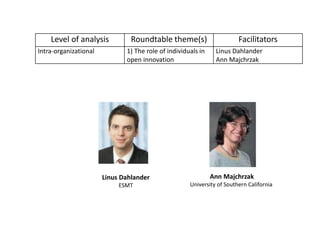
Intra-organizational 1) The role of individuals in
open innovation
Linus Dahlander
Ann Majchrzak
Ann Majchrzak
University of Southern California
Linus Dahlander
ESMT
Level of analysis Roundtable theme(s) Facilitators
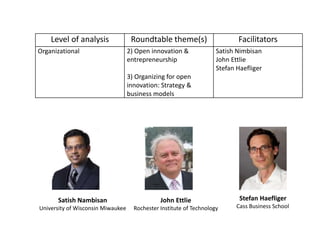
Organizational 2) Open innovation &
entrepreneurship
3) Organizing for open
innovation: Strategy &
business models
Satish Nimbisan
John Ettlie
Stefan Haefliger
Satish Nambisan
University of Wisconsin Miwaukee
John Ettlie
Rochester Institute of Technology
Stefan Haefliger
Cass Business School
Level of analysis Roundtable theme(s) Facilitators
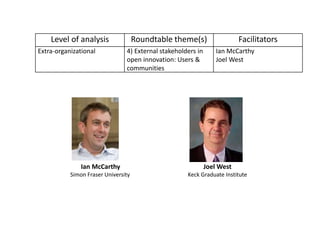
Extra-organizational 4) External stakeholders in
open innovation: Users &
communities
Ian McCarthy
Joel West
Ian McCarthy
Simon Fraser University
Joel West
Keck Graduate Institute
Level of analysis Roundtable theme(s) Facilitators
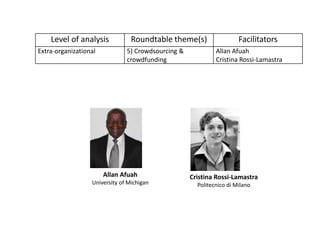
Extra-organizational 5) Crowdsourcing &
crowdfunding
Allan Afuah
Cristina Rossi-Lamastra
Allan Afuah
University of Michigan
Cristina Rossi-Lamastra
Politecnico di Milano
Level of analysis Roundtable theme(s) Facilitators
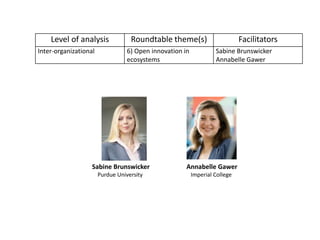
Inter-organizational 6) Open innovation in
ecosystems
Sabine Brunswicker
Annabelle Gawer
Sabine Brunswicker
Purdue University
Annabelle Gawer
Imperial College
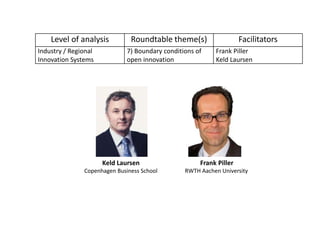
Level of analysis Roundtable theme(s) Facilitators
Industry / Regional
Innovation Systems
7) Boundary conditions of
open innovation
Frank Piller
Keld Laursen
Frank Piller
RWTH Aachen University
Keld Laursen
Copenhagen Business School
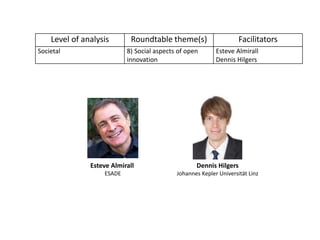
Level of analysis Roundtable theme(s) Facilitators
Societal 8) Social aspects of open
innovation
Esteve Almirall
Dennis Hilgers
Esteve Almirall
ESADE
Dennis Hilgers
Johannes Kepler Universität Linz
Roundtable Discussions
Level of analysis Roundtable theme(s) Facilitators
Intra-organizational 1) The role of individuals in
open innovation
Linus Dahlander
Ann Majchrzak
Organizational 2) Open innovation &
entrepreneurship
3) Organizing for open
innovation: Strategy &
business models
Satish Nimbisan
John Ettlie
Stefan Haefliger
Extra-organizational 4) Users & communities Ian McCarthy
Joel West
5) Crowdsourcing &
crowdfunding
Allan Afuah
Cristina Rossi-Lamastra
Inter-organizational 6) Open innovation in
ecosystems
Sabine Brunswicker
Annabelle Gawer
Industry / Regional
Innovation Systems
7) Boundary conditions of
open innovation
Frank Piller
Keld Laursen
Societal 8) Social aspects of open
innovation
Esteve Almirall
Dennis Hilgers
PDW Schedule
1:00-1:30 Introduction to the PDW and round tables
1:30-2:15 Round table discussion
• Theory: theoretical approaches and critical issues
• Methods: methodological approaches and critical
issues
• Proposed research questions and research
designs
2:15-2:45 Reports from tables and plenary discussion
2:45-3:00 Conclusions
3:00-3:15 Networking
Plenary Discussion
Conclusions
Networking

Researching Open Innovation 2015

  • 1.
    Researching Open Innovation AOM2015 PDW August 5, 2015 1:00 - 3:00 p.m. Organized by Marcel Bogers University of Copenhagen Agnieszka Radziwon University of Southern Denmark Jonathan Sims Babson College
  • 2.
    Today’s Hosts Livetweet: #AOM2015#openinnovation Joel WestFrank Piller Jonathan Sims
  • 3.
    PDW Schedule 1:00-1:30 Introductionto the PDW and round tables 1:30-2:15 Round table discussion • Theory: theoretical approaches and critical issues • Methods: methodological approaches and critical issues • Proposed research questions and research designs 2:15-2:45 Reports from tables and plenary discussion 2:45-3:00 Conclusions 3:00-3:15 Networking
  • 4.
    What is “OpenInnovation”?
  • 5.
    Open innovation is“a distributed innovation process based on purposively managed knowledge flows across organizational boundaries, using pecuniary and non-pecuniary mechanisms in line with the organization's business model.” Chesbrough & Bogers, New Frontiers in Open Innovation. 2014
  • 6.
    Chesbrough & Bogers,New Frontiers in Open Innovation. 2014
  • 7.
    Research on “OpenInnovation” Inbound: 118 Outbound: 50 Coupled: 70 57 14 11 24 26 1 32 West & Bogers, JPIM. 2014
  • 8.
    Research Opportunities inOI • Measurement • Integrating with established theory • Appropriability • Coupled open innovation • Nonprofit and SME contexts • New or multiple levels of analysis Vanhaverbeke et al, New Frontiers in Open Innovation. 2014 West et al, Research Policy. 2014 See http://bit.ly/oiResAgenda
  • 9.
    Researching Open Innovationat Different Levels of Analysis
  • 10.
    Chesbrough & Bogers,New Frontiers in Open Innovation. 2014
  • 11.
    Roundtable Discussions Level ofanalysis Roundtable theme(s) Facilitators Intra-organizational 1) The role of individuals in open innovation Linus Dahlander Ann Majchrzak Organizational 2) Open innovation & entrepreneurship 3) Organizing for open innovation: Strategy & business models Satish Nimbisan John Ettlie Stefan Haefliger Extra-organizational 4) Users & communities Ian McCarthy Joel West 5) Crowdsourcing & crowdfunding Allan Afuah Cristina Rossi-Lamastra Inter-organizational 6) Open innovation in ecosystems Sabine Brunswicker Annabelle Gawer Industry / Regional Innovation Systems 7) Boundary conditions of open innovation Frank Piller Keld Laursen Societal 8) Social aspects of open innovation Esteve Almirall Dennis Hilgers
  • 12.
  • 13.
    Level of analysisRoundtable theme(s) Facilitators Intra-organizational 1) The role of individuals in open innovation Linus Dahlander Ann Majchrzak Ann Majchrzak University of Southern California Linus Dahlander ESMT
  • 14.
    Level of analysisRoundtable theme(s) Facilitators Organizational 2) Open innovation & entrepreneurship 3) Organizing for open innovation: Strategy & business models Satish Nimbisan John Ettlie Stefan Haefliger Satish Nambisan University of Wisconsin Miwaukee John Ettlie Rochester Institute of Technology Stefan Haefliger Cass Business School
  • 15.
    Level of analysisRoundtable theme(s) Facilitators Extra-organizational 4) External stakeholders in open innovation: Users & communities Ian McCarthy Joel West Ian McCarthy Simon Fraser University Joel West Keck Graduate Institute
  • 16.
    Level of analysisRoundtable theme(s) Facilitators Extra-organizational 5) Crowdsourcing & crowdfunding Allan Afuah Cristina Rossi-Lamastra Allan Afuah University of Michigan Cristina Rossi-Lamastra Politecnico di Milano
  • 17.
    Level of analysisRoundtable theme(s) Facilitators Inter-organizational 6) Open innovation in ecosystems Sabine Brunswicker Annabelle Gawer Sabine Brunswicker Purdue University Annabelle Gawer Imperial College
  • 18.
    Level of analysisRoundtable theme(s) Facilitators Industry / Regional Innovation Systems 7) Boundary conditions of open innovation Frank Piller Keld Laursen Frank Piller RWTH Aachen University Keld Laursen Copenhagen Business School
  • 19.
    Level of analysisRoundtable theme(s) Facilitators Societal 8) Social aspects of open innovation Esteve Almirall Dennis Hilgers Esteve Almirall ESADE Dennis Hilgers Johannes Kepler Universität Linz
  • 20.
  • 21.
    Roundtable Discussions Level ofanalysis Roundtable theme(s) Facilitators Intra-organizational 1) The role of individuals in open innovation Linus Dahlander Ann Majchrzak Organizational 2) Open innovation & entrepreneurship 3) Organizing for open innovation: Strategy & business models Satish Nimbisan John Ettlie Stefan Haefliger Extra-organizational 4) Users & communities Ian McCarthy Joel West 5) Crowdsourcing & crowdfunding Allan Afuah Cristina Rossi-Lamastra Inter-organizational 6) Open innovation in ecosystems Sabine Brunswicker Annabelle Gawer Industry / Regional Innovation Systems 7) Boundary conditions of open innovation Frank Piller Keld Laursen Societal 8) Social aspects of open innovation Esteve Almirall Dennis Hilgers
  • 22.
    PDW Schedule 1:00-1:30 Introductionto the PDW and round tables 1:30-2:15 Round table discussion • Theory: theoretical approaches and critical issues • Methods: methodological approaches and critical issues • Proposed research questions and research designs 2:15-2:45 Reports from tables and plenary discussion 2:45-3:00 Conclusions 3:00-3:15 Networking
  • 23.
  • 24.
  • 25.