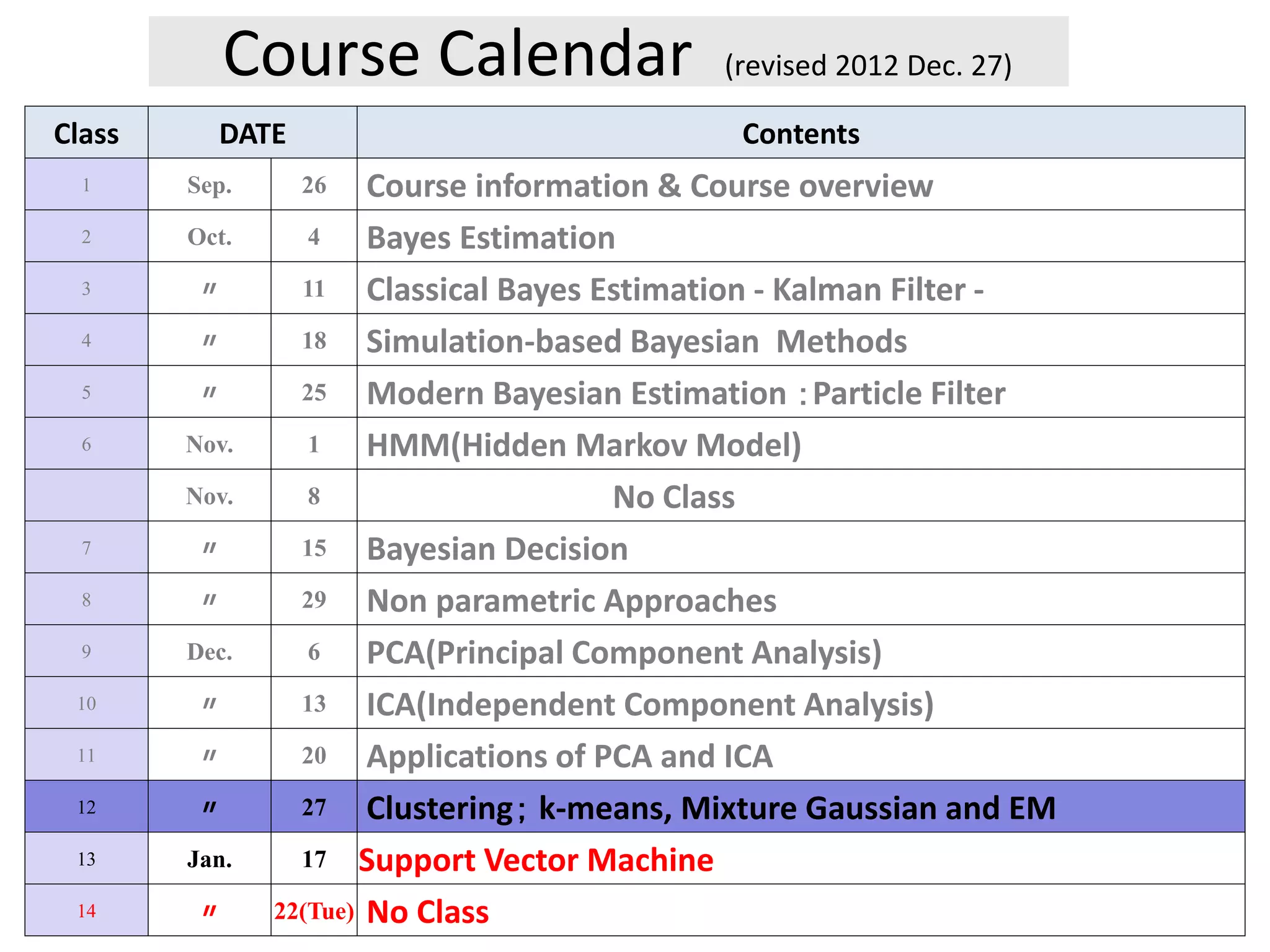
Course Calendar (revised 2012 Dec. 27)
Class DATE Contents
1 Sep. 26 Course information & Course overview
2 Oct. 4 Bayes Estimation
3 〃 11 Classical Bayes Estimation - Kalman Filter -
4 〃 18 Simulation-based Bayesian Methods
5 〃 25 Modern Bayesian Estimation :Particle Filter
6 Nov. 1 HMM(Hidden Markov Model)
Nov. 8 No Class
7 〃 15 Bayesian Decision
8 〃 29 Non parametric Approaches
9 Dec. 6 PCA(Principal Component Analysis)
10 〃 13 ICA(Independent Component Analysis)
11 〃 20 Applications of PCA and ICA
12 〃 27 Clustering; k-means, Mixture Gaussian and EM
13 Jan. 17 Support Vector Machine
14 〃 22(Tue) No Class
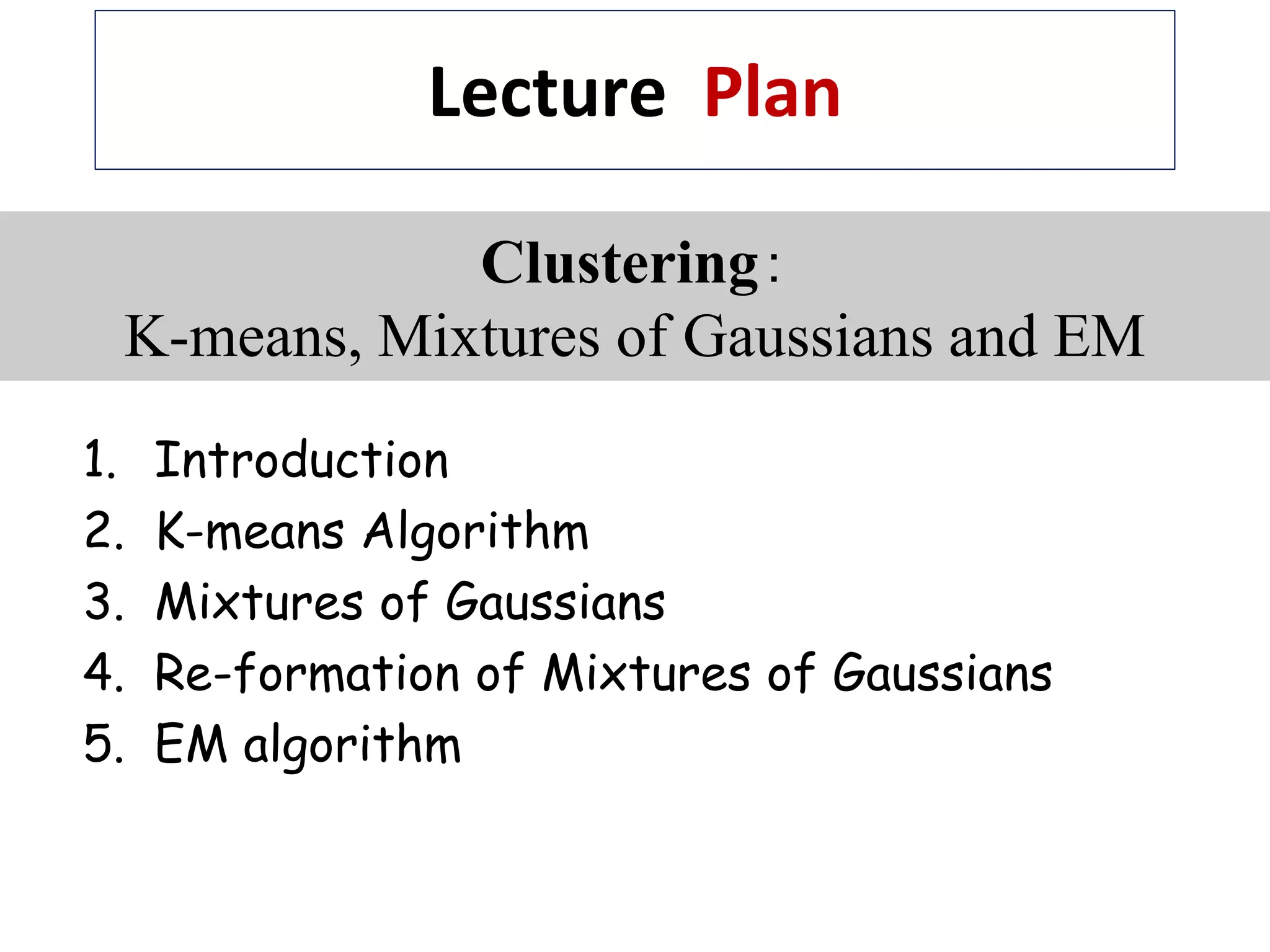
Lecture Plan
Clustering:
K-means, Mixtures of Gaussians and EM
1. Introduction
2. K-means Algorithm
3. Mixtures of Gaussians
4. Re-formation of Mixtures of Gaussians
5. EM algorithm
3
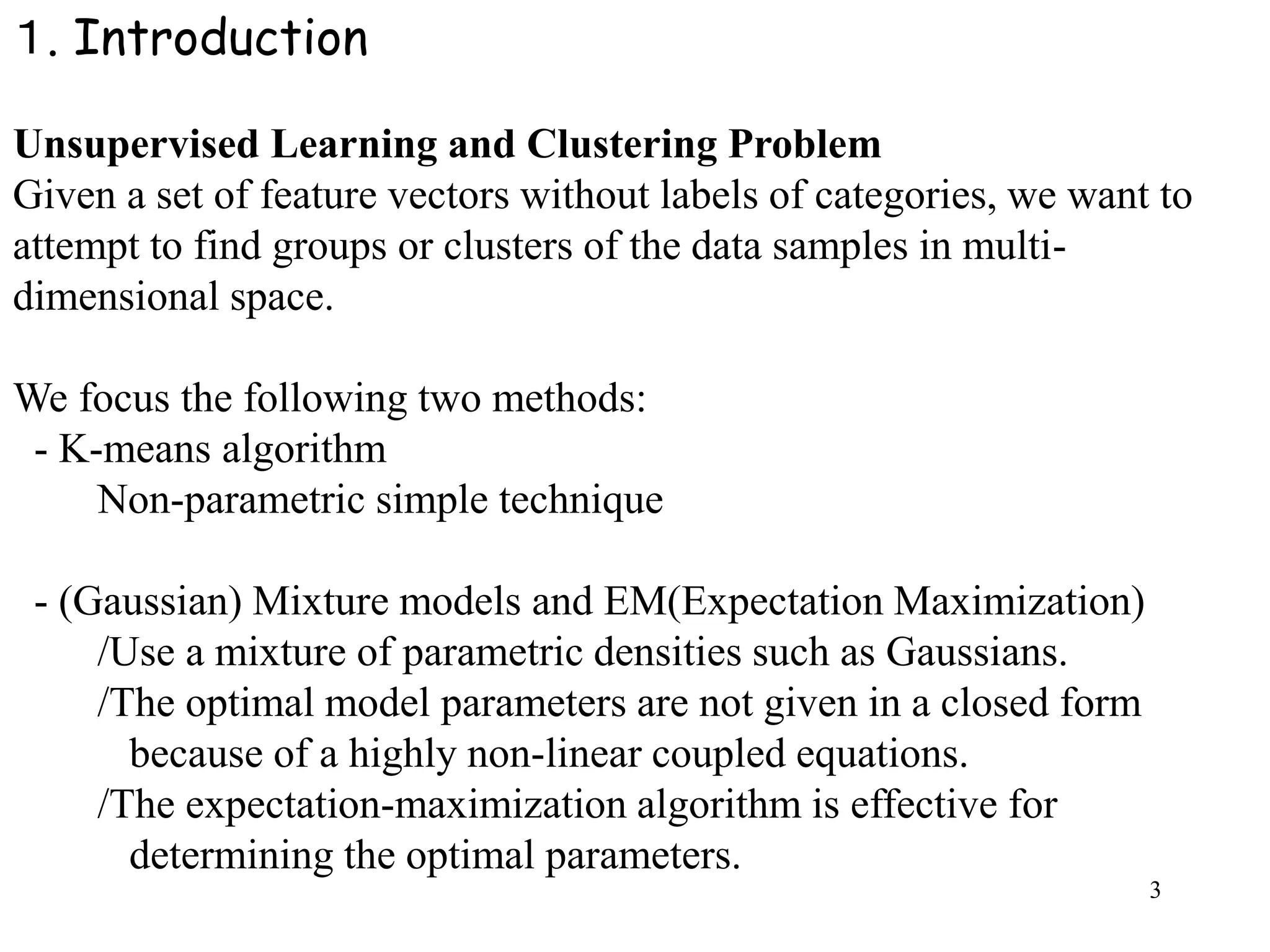
1. Introduction
Unsupervised Learning and Clustering Problem
Given a set of feature vectors without labels of categories, we want to
attempt to find groups or clusters of the data samples in multi-
dimensional space.
We focus the following two methods:
- K-means algorithm
Non-parametric simple technique
- (Gaussian) Mixture models and EM(Expectation Maximization)
/Use a mixture of parametric densities such as Gaussians.
/The optimal model parameters are not given in a closed form
because of a highly non-linear coupled equations.
/The expectation-maximization algorithm is effective for
determining the optimal parameters.
4
1 2
:D-dimensional random vector
N dataset of : X:={ , , , }
: A group of data points whose inter-distances are small
compared with the distances to the points outside of the cluster
N
Cluster
Prototy
x
x x x x
 
 
of cluster: 1
: Find a set of vectors , such that the sum of the squared
disstances of each point to its cvlosest vector is minimized.
k
k
k
k K
K



pe
Aim
2. K-means Algorithm
The K-means algorithm is a non-statistical approach of clustering of
data points in multi-dimensional feature space.
Problem: Partition the dataset into some number K of clusters
(K is known)
Fig. 1
1 [Bishop book[1] and its web site]
5
Fig. 1
1 [Bishop book[1] and its web site]
6
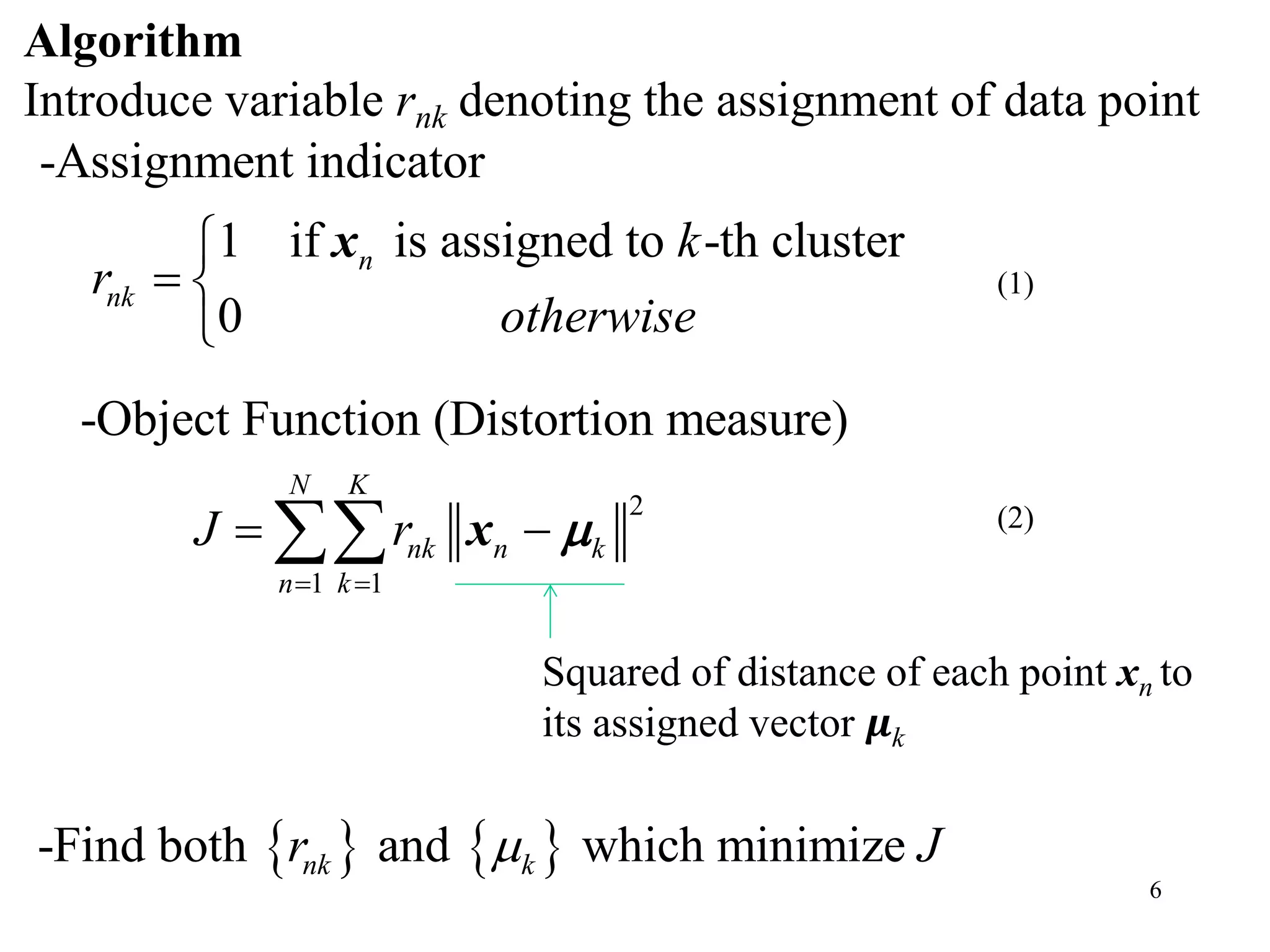
-Assignment indicator
1 if is assigned to -th cluster
0
n
nk
k
r
otherwise

 

x
Algorithm
Introduce variable rnk denoting the assignment of data point
2
1 1
-Object Function (Distortion measure)
N K
nk n k
n k
J r
 
  x 
Squared of distance of each point xn to
its assigned vector 𝝁k
   -Find both and which minimizenk kr J
(1)
(2)
7
(0)
( )
- : for the
- : Minize J with respect to for fixed
- : Minimize J with respect to for fixed
k k
i
nk
k nk
r
r
 
 


Two - stage Optimization
initial value
First stage
Second stage
 
:
Determination of for given 1~ at
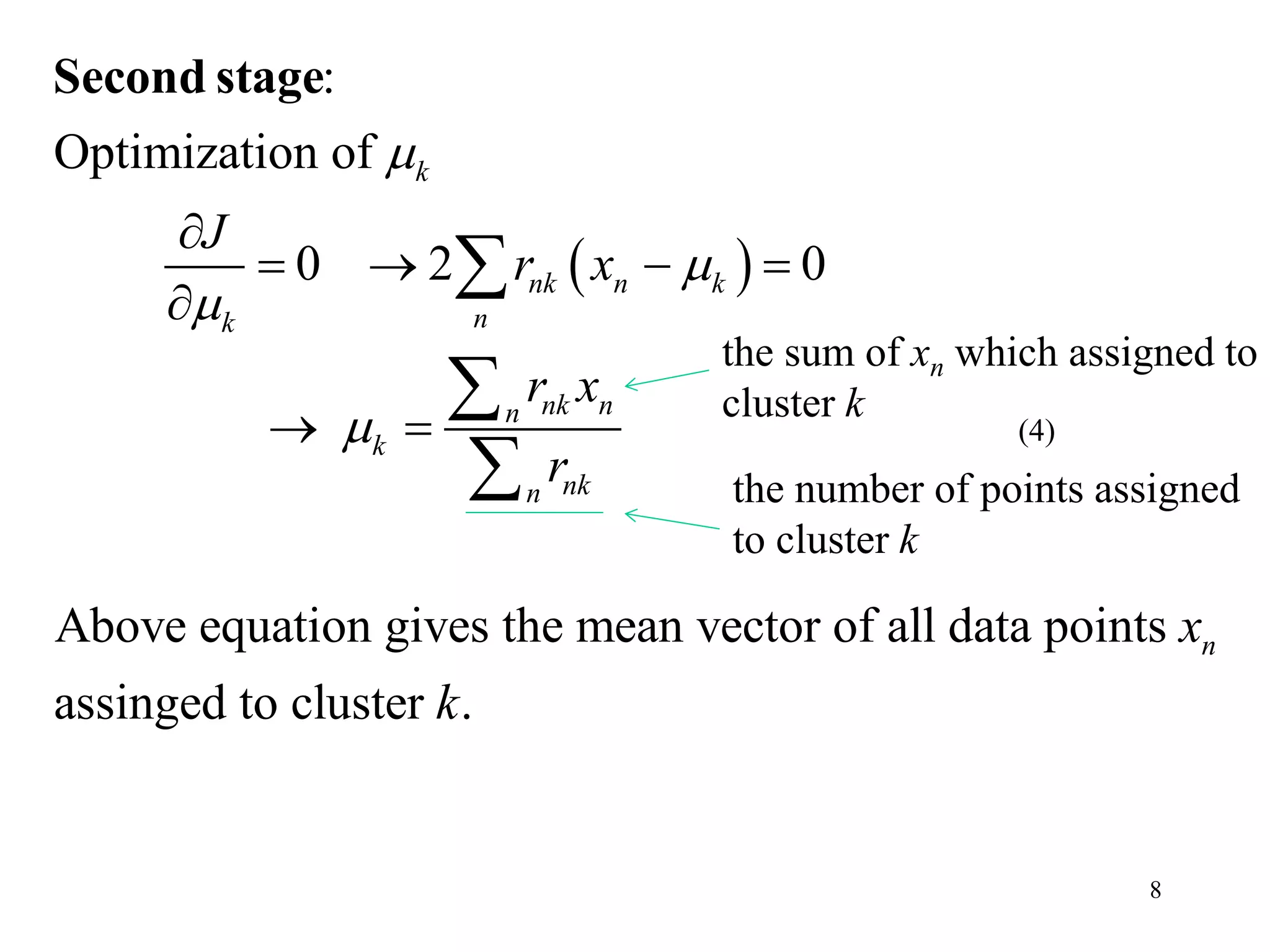
at argmin1
0
That is, we assign the to the closest cluster center.
nk k n
n j
j
nk
n
r k K x
k x
r
otherwise
x



  
 

First stage
(3)
8
 
:
Optimization of
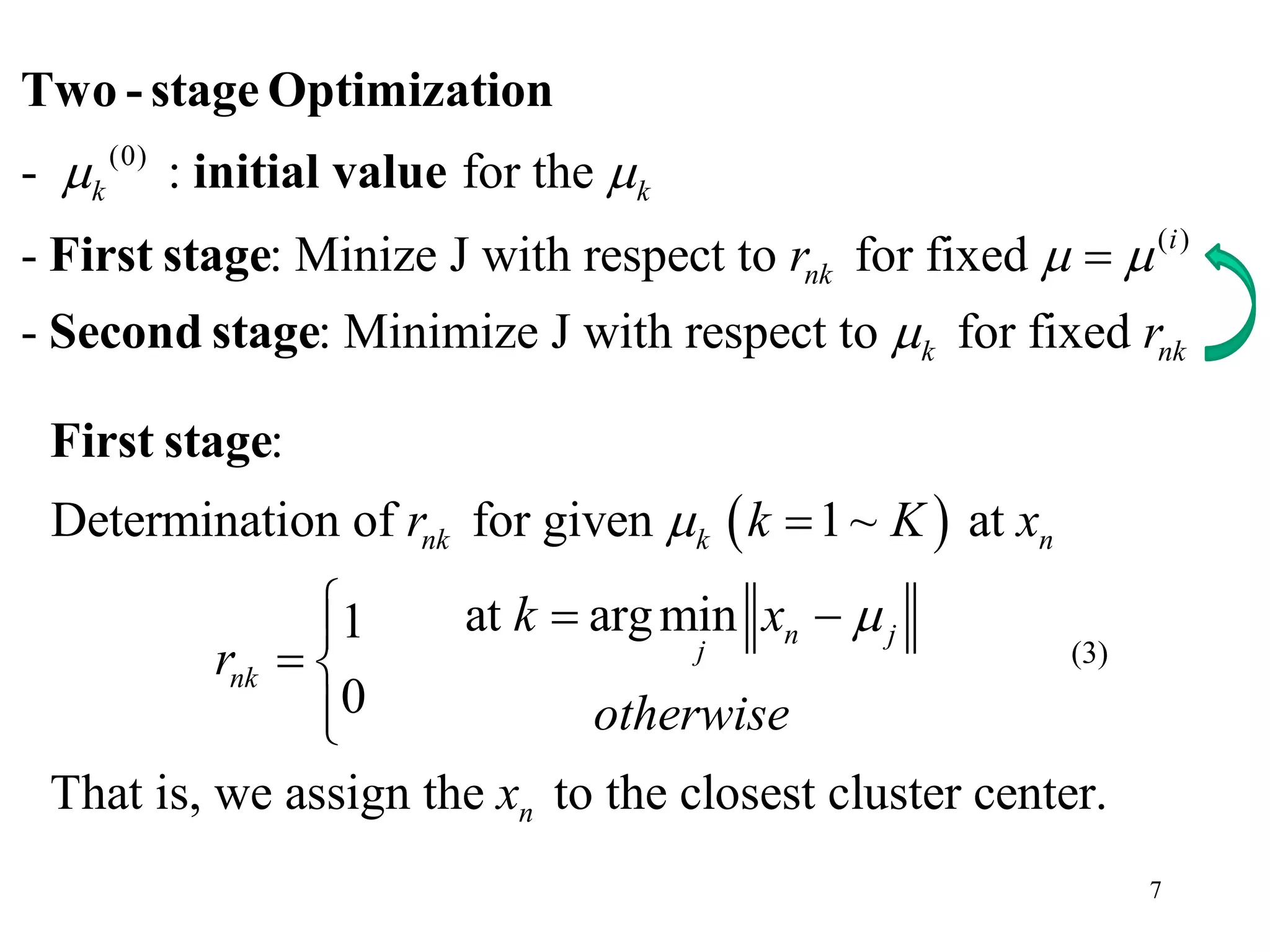
0 2 0
Above equation gives the mean vector of all data points
assinged to cluster .
k
nk n k
nk
nk nn
k
nkn
n
J
r x
r x
r
x
k





   

 



Second stage
the number of points assigned
to cluster k
the sum of xn which assigned to
cluster k
(4)
9
Example 1 [Bishop book[1] and its web site]
Fig.2
(0)
1
(0)
2
Fig. 3 [1]
Application of k-means algorithm for color-based image
segmentation [Bishop book[1] and its web site]
K-means clustering applied to the color vectors of pixels in RGB
color-space
11
   
1
[Mixture of Gaussians]
Conside a superposition of Gaussians (Normal distributions)
,
K
k k k
k
K
p x x 

 
3. Mixtures of Gaussians
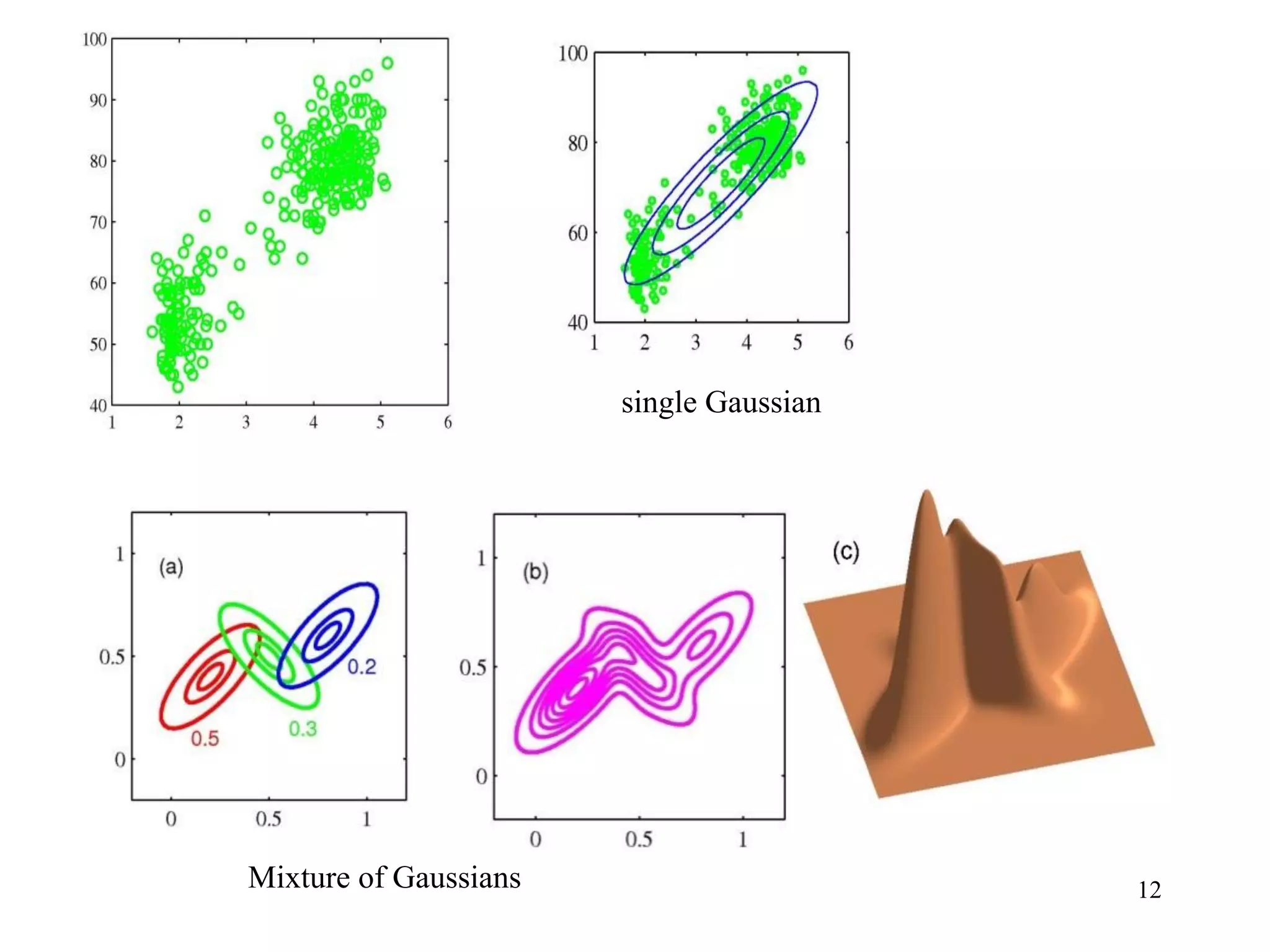
- Limitations of single Gaussian pdf model
Examples [Bishop[1]]
Single Gaussian model does not capture the multi-modes feature.
Fig 4
Mixture distribution approach: uses the linear combination of basic
distributions such as Gaussians
mixing coefficients mixture component
(5)
single Gaussian Mixture of Gaussians
12
single Gaussian
Mixture of Gaussians
13
 
 
 
   
1
1 1
0 0 1
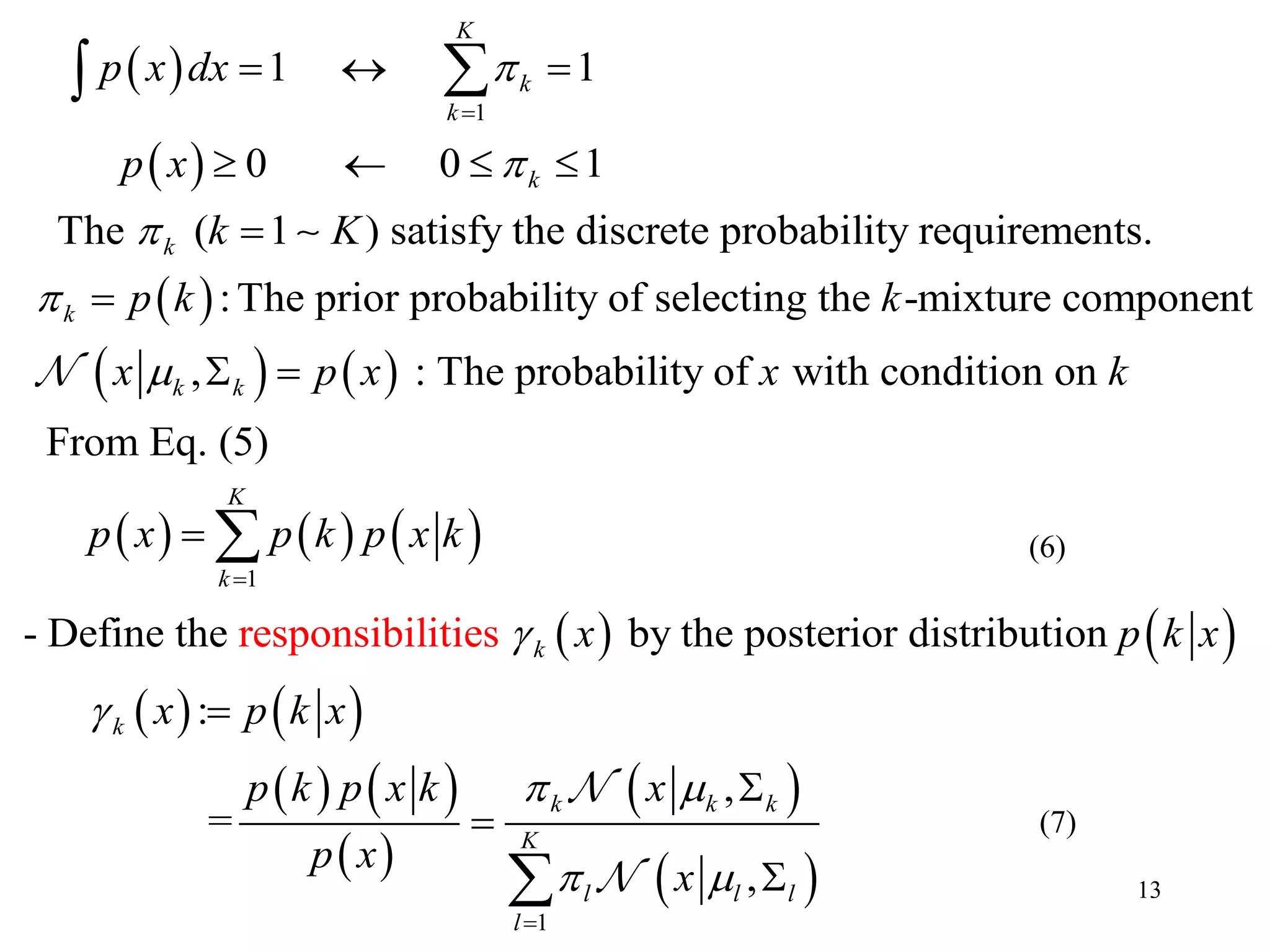
The ( 1 ) satisfy the discrete probability requirements.
:The prior probability of selecting the -mixture component
,
K
k
k
k
k
k
k k
p x dx
p x
k K
p k k
x p x






  
   


 

     
   
   
   
 
 
 
1
responsibilit
: The probability of
i
with condition on
From Eq. (5)
- Define the by the posterior distributioe n
:
,
=
s
,
K
k
k
k
k k k
l l l
x k
p x p k p x k
x p k x
x p k x
p k p x k x
p x
x


 
 







1
K
l

(7)
(6)
14
 
 
 
 
1 2
1 2
1 2
1 2
(*)
(* see lect
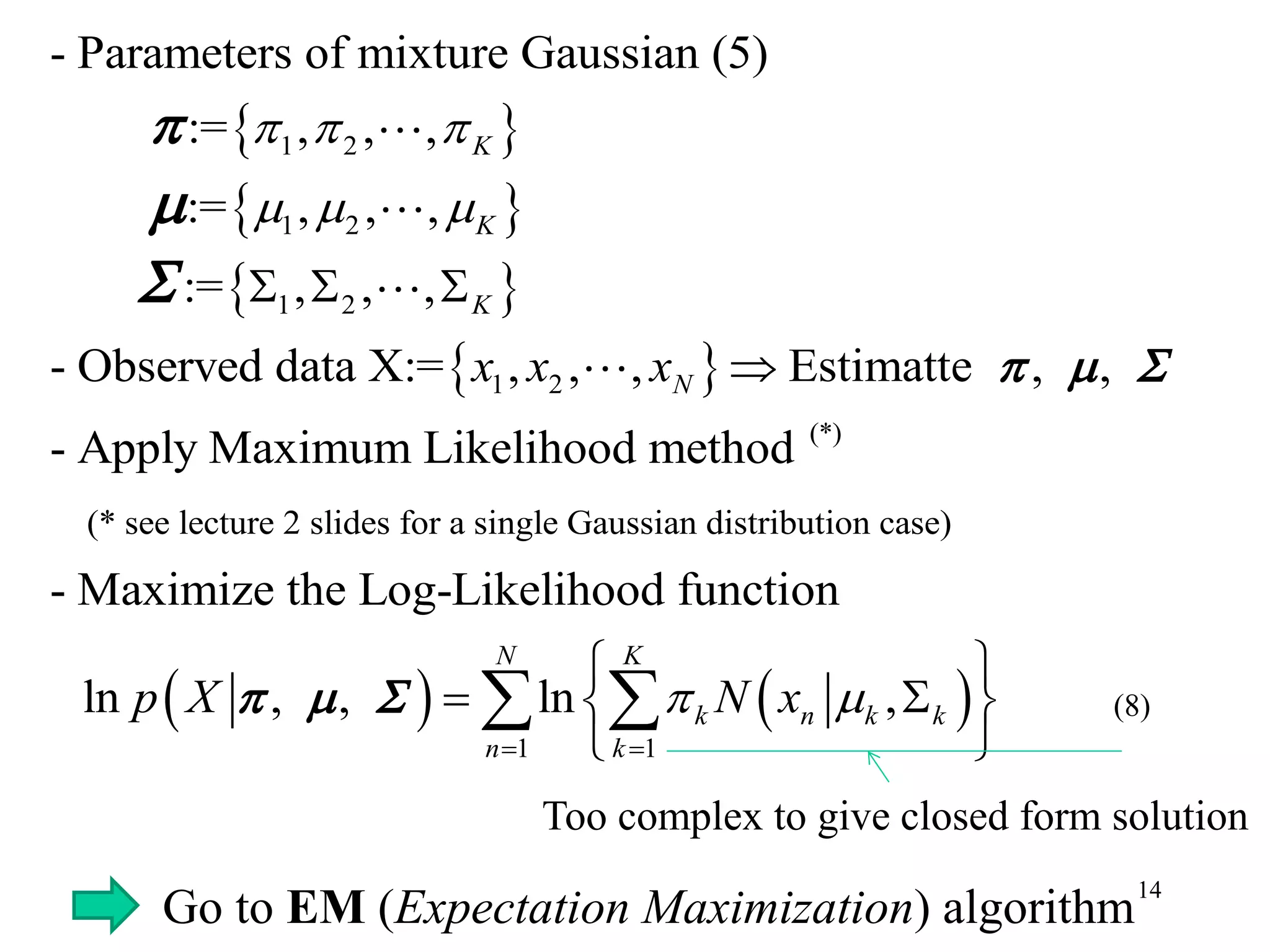
- Parameters of mixture Gaussian (5)
:= , , ,
:= , , ,
:= , , ,
- Observed data X:= , , , Estimatte , ,
- Apply Maximum Likelihood method
K
K
K
Nx x x
  
  
  
   



   
1 1
ure 2 slides for a single Gaussian distribution case)
- Maximize the Log-Likelihood function
ln , , ln ,
N K
k n k k
n k
p X N x 
 
 
  
 
   
Too complex to give closed form solution
Go to EM (Expectation Maximization) algorithm
(8)
15
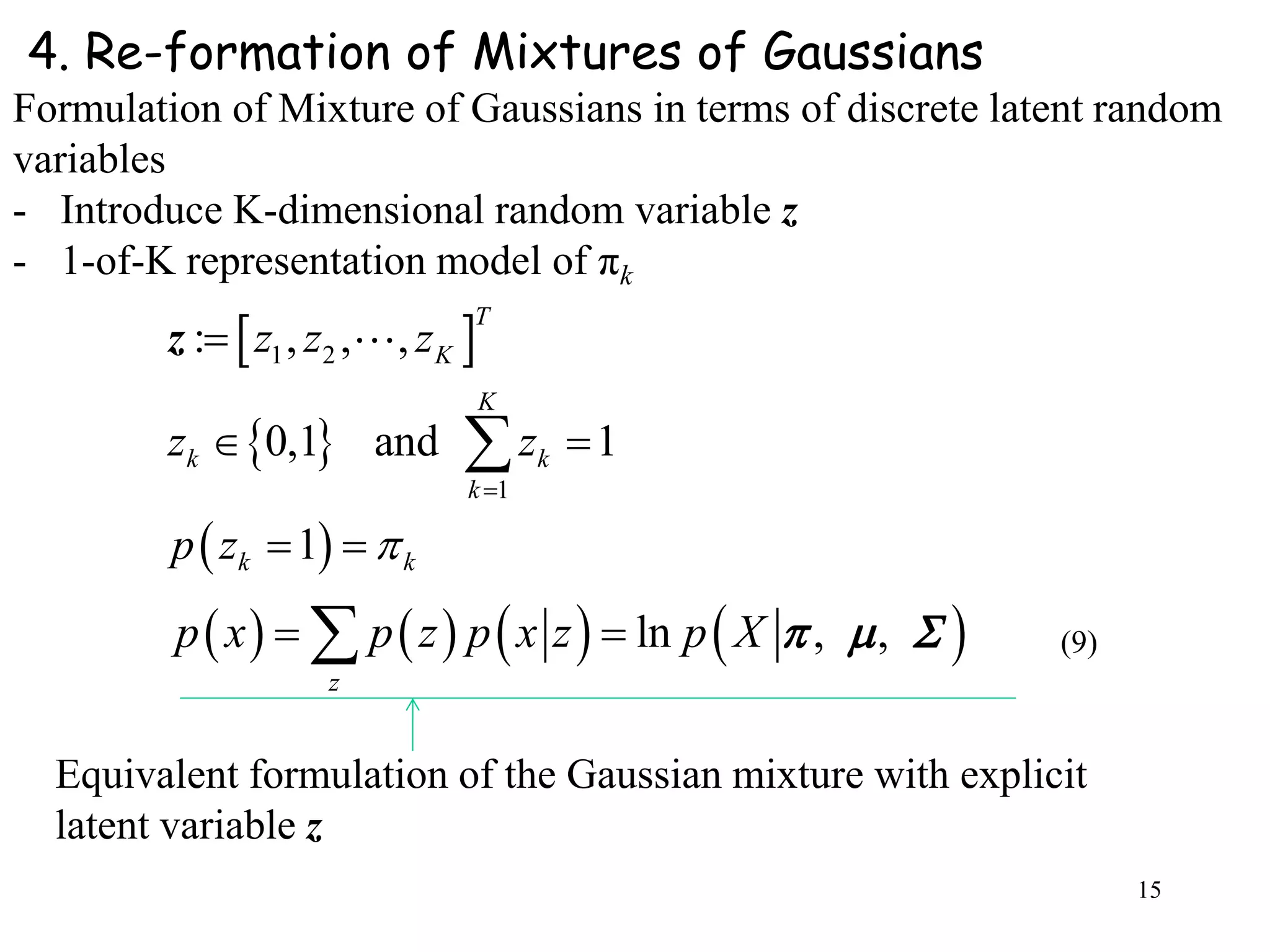
4. Re-formation of Mixtures of Gaussians
Formulation of Mixture of Gaussians in terms of discrete latent random
variables
- Introduce K-dimensional random variable z
- 1-of-K representation model of πk
 
 
 
1 2
1
: , , ,
0,1 and 1
1
T
K
K
k k
k
k k
z z z
z z
p z 


 
 

z
       ln , ,
z
p x p z p x z p X    
Equivalent formulation of the Gaussian mixture with explicit
latent variable z
(9)
16
   
   
   
 
 1 1
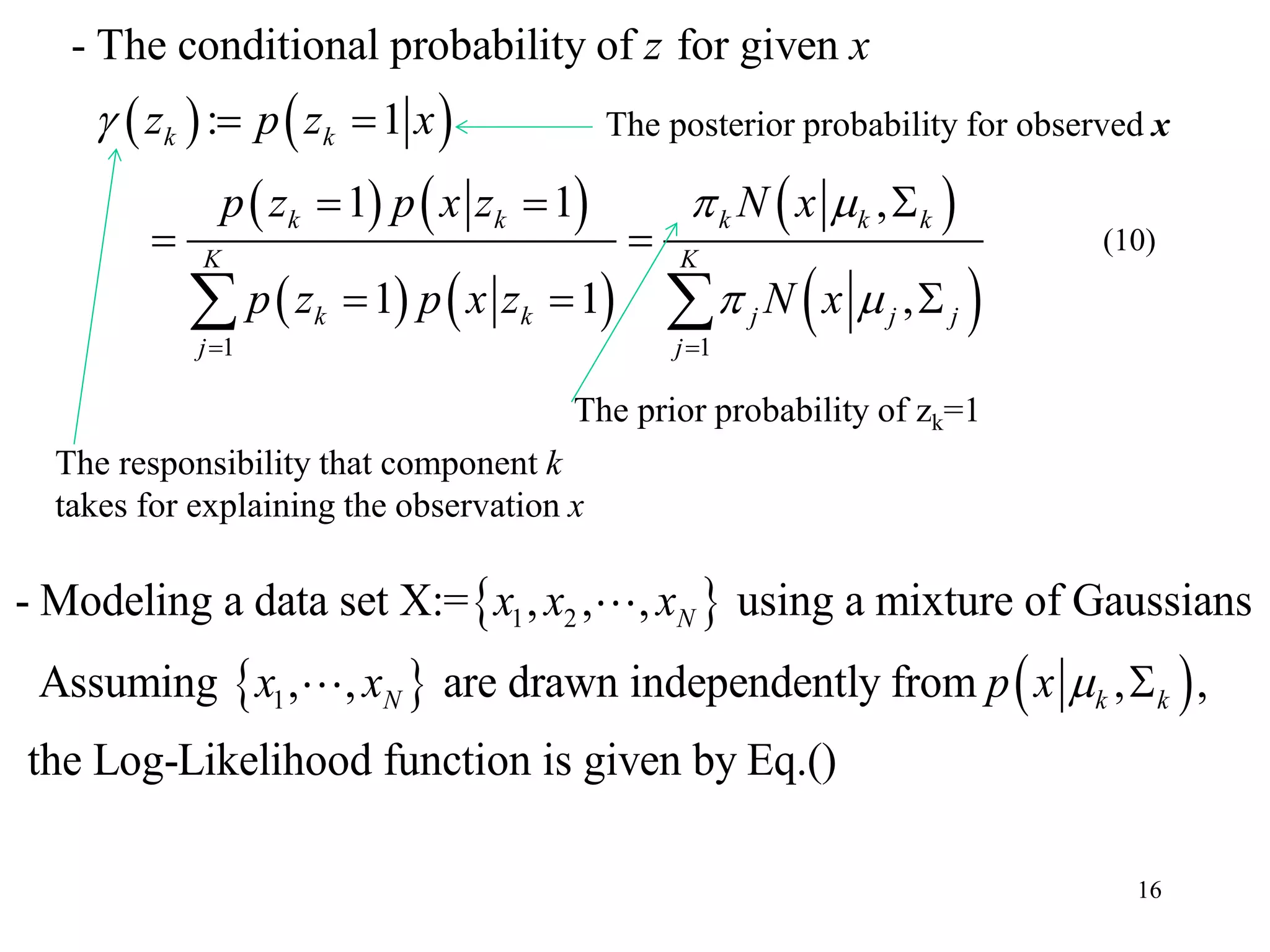
- The conditional probability of for given
: 1
1 1 ,
1 1 ,
k k
k k k k k
K K
k k j j j
j j
z x
z p z x
p z p x z N x
p z p x z N x

 
 
 
 
  
 
   
The responsibility that component k
takes for explaining the observation x
The posterior probability for observed x
The prior probability of zk=1
 
   
1 2
1
- Modeling a data set X:= , , , using a mixture of Gaussians
Assuming , , are drawn independently from , ,
the Log-Likelihood function is given by Eq.()
N
N k k
x x x
x x p x  
(10)
17
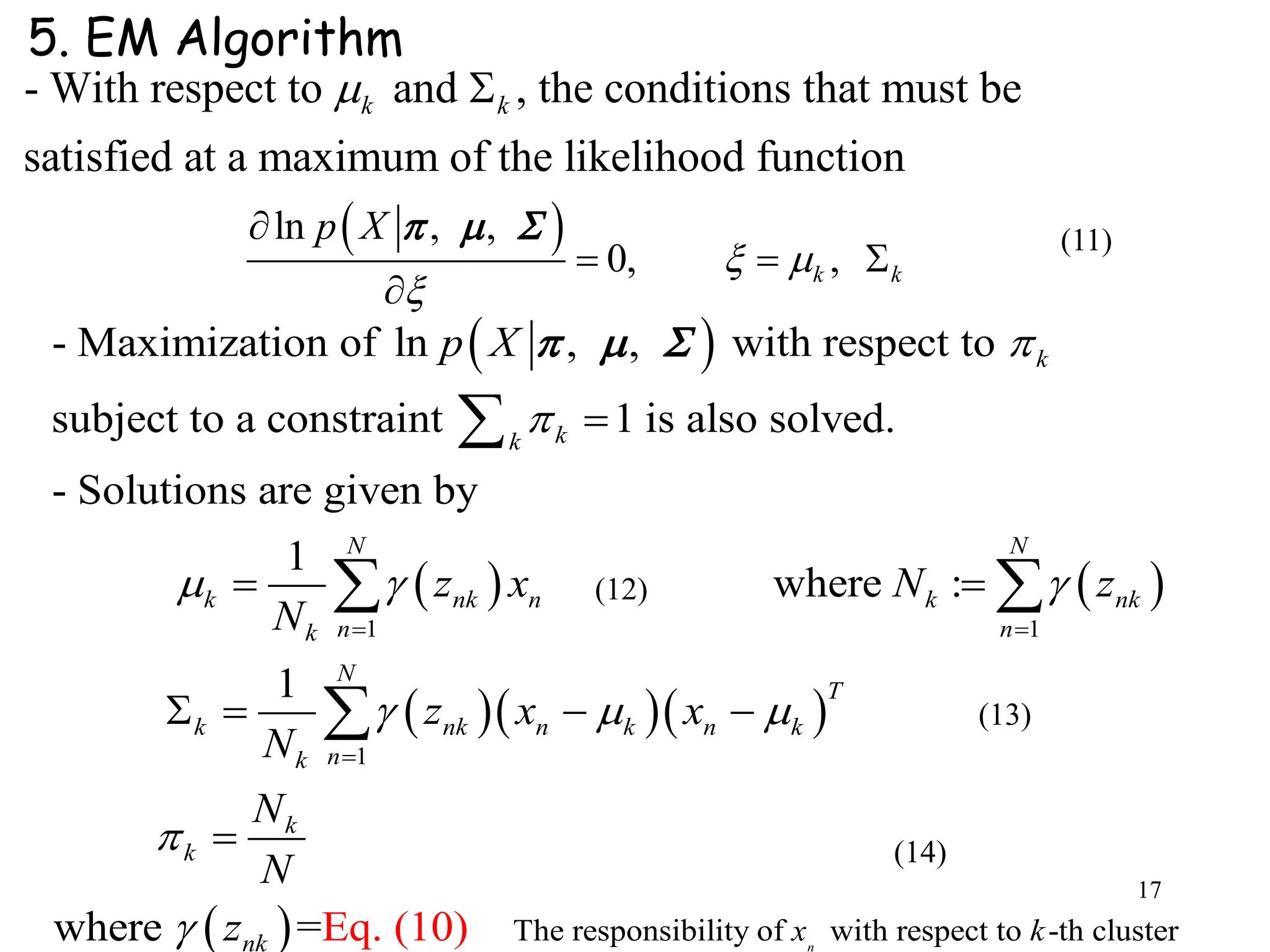
- With respect to and , the conditions that must be
satisfied at a maximum of the likelihood function
k k 
 
   
1 1
- Maximization of ln , , with respect to
subject to a constraint 1 is also solved.
- Solutions are given by
1
where :
k
kk
N N
k nk n k nk
n nk
k
p X
z x N z
N


  
 

 


 
  
   
 
1
The responsibility of with respect to -th cluster
1
where =Eq. (10) n
N
T
nk n k n k
nk
k
k
nk x k
z x x
N
N
N
z
  



  


5. EM Algorithm
 ln , ,
0, ,k k
p X
 


  

   (11)
(14)
(13)
(12)
18
 
Three equations ()-() do not give solutions directly because
, contain unknowns , , and in complex ways.
[EM algorithm for Gaussian Mixture Mode]
Simple iterative scheme which altaernate the
nk kz N   
 
E (Expectation)
and M (Maximization) steps.
: Evaluate the posterior probabilities (responsibilities)
using the current parameters
: Re-estimate parameters , , a
nkz
 
E step
M step
 
 
nd using the
evaluated
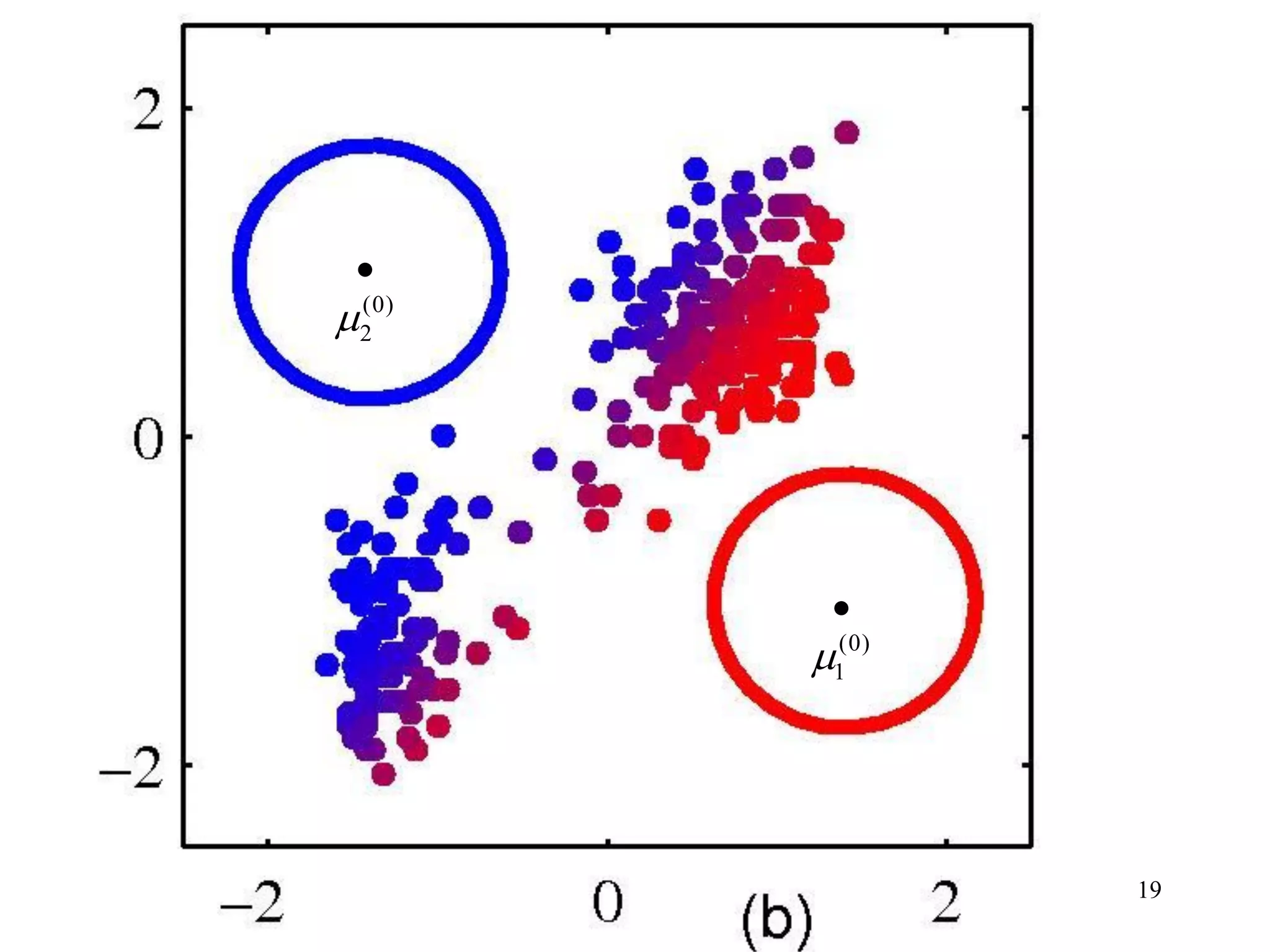
Color illustration of in two-category case
nk
nk
z
z



19
(0)
2
(0)
1
20
Example 2 EM algorithm [Bishop book[1] and its web site]
(0)
1
(0)
2
21
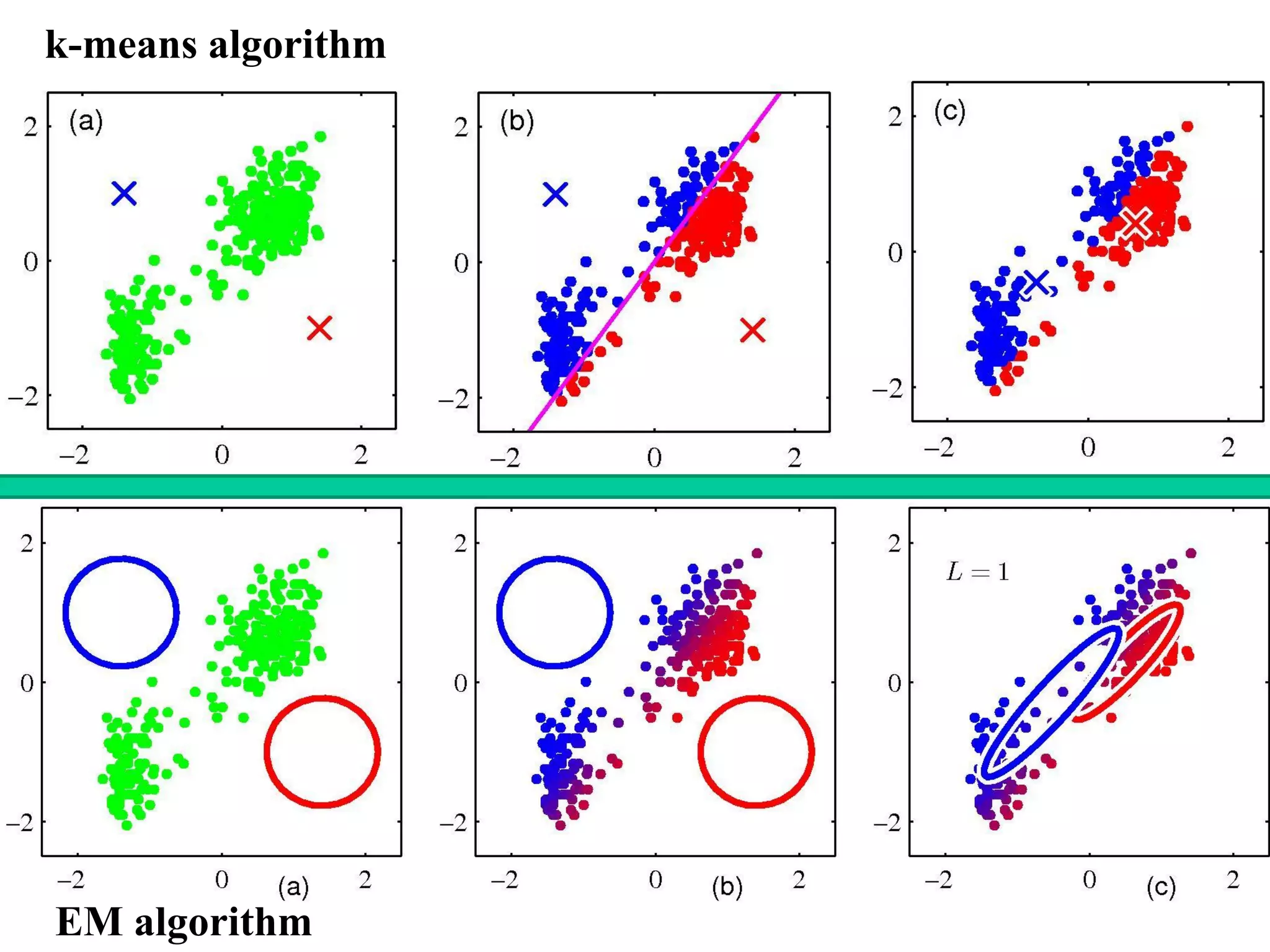
k-means algorithm
EM algorithm
22
References:
[1] C. M. Bishop, “Pattern Recognition and Machine Learning”,
Springer, 2006
[2] R.O. Duda, P.E. Hart, and D. G. Stork, “Pattern Classification”,
John Wiley & Sons, 2nd edition, 2004
23
   
 
 
 
     
2
1 1
21
1
2
2 2
2
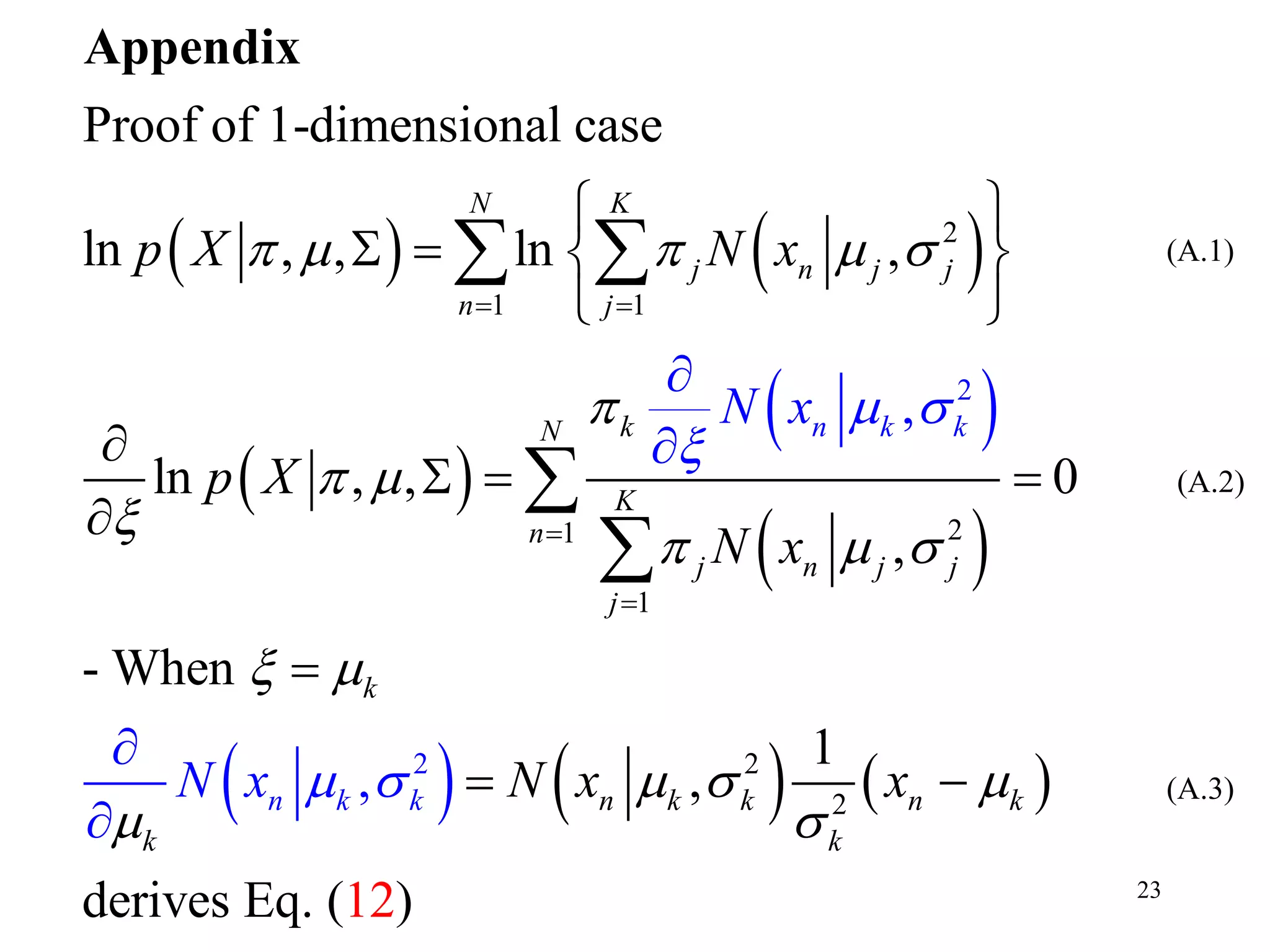
Proof of 1-dimensional case
ln , , ln ,
ln , , 0
,
- When
1
,
derives Eq.
,
,
1( 2)
n k k
n k k
N K
j n j j
n j
kN
K
n
j n j j
j
k
n k k n k
k k
N x
N x
p X N x
p X
N x
N x x
 


    

 

  
 
  



 


 
   
 





  


 
 


Appendix
(A.1)
(A.2)
(A.3)
24
 
  
22
1
2
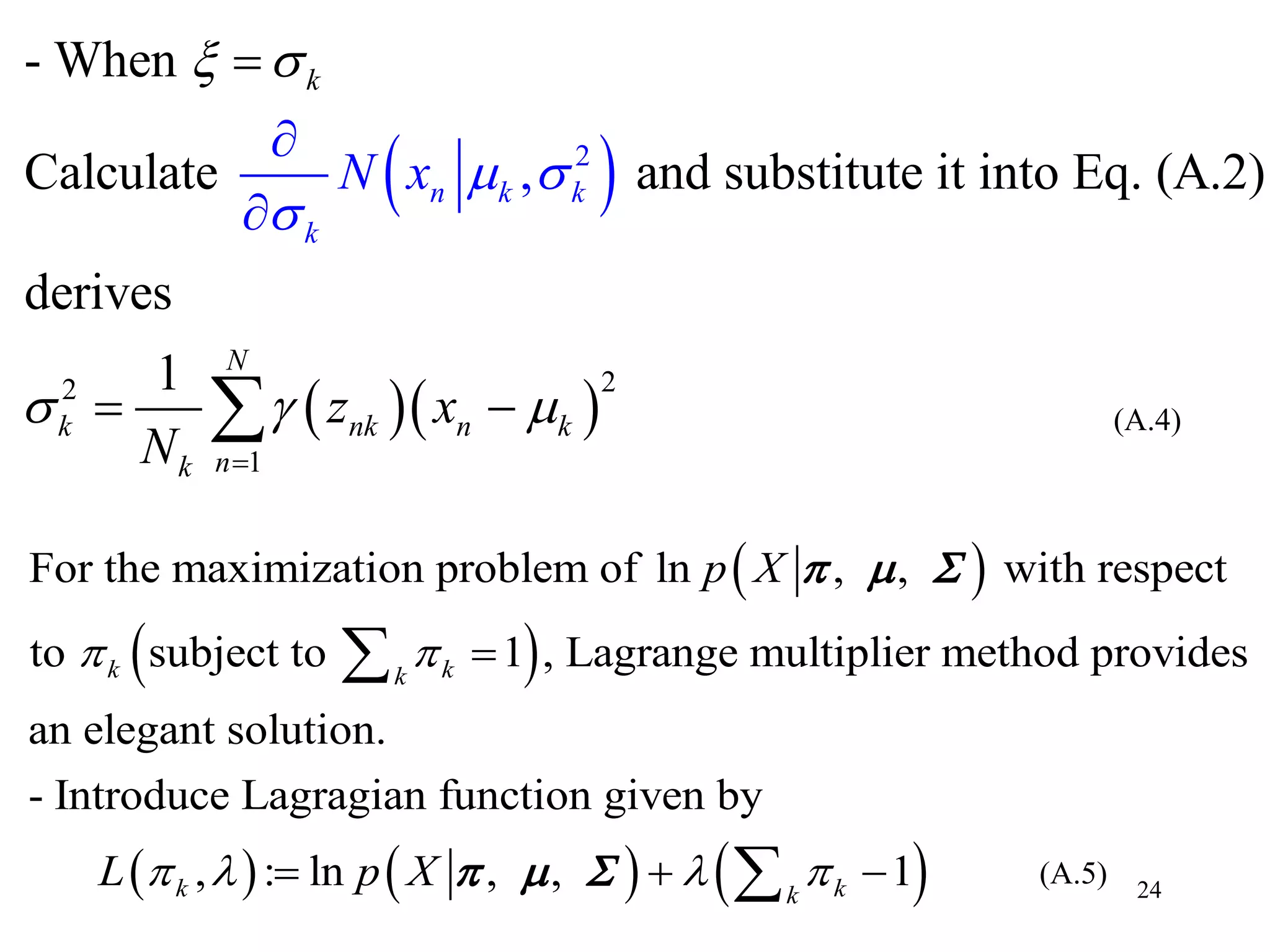
- When
Calculate and substitute it into Eq. (A.2)
derives
1
,
k
N
k nk n k
n
k
k
n
k
k
z x
N x
N
 

 
  


 



 
 
 
For the maximization problem of ln , , with respect
to subject to 1 , Lagrange multiplier method provides
an elegant solution.
- Introduce Lagragian function given by
, : ln ,
k kk
k
p X
L p X
 
 



  
    , 1kk
  
(A.4)
(A.5)
25
   
   
 
 
 
2
21
1
2
21
1
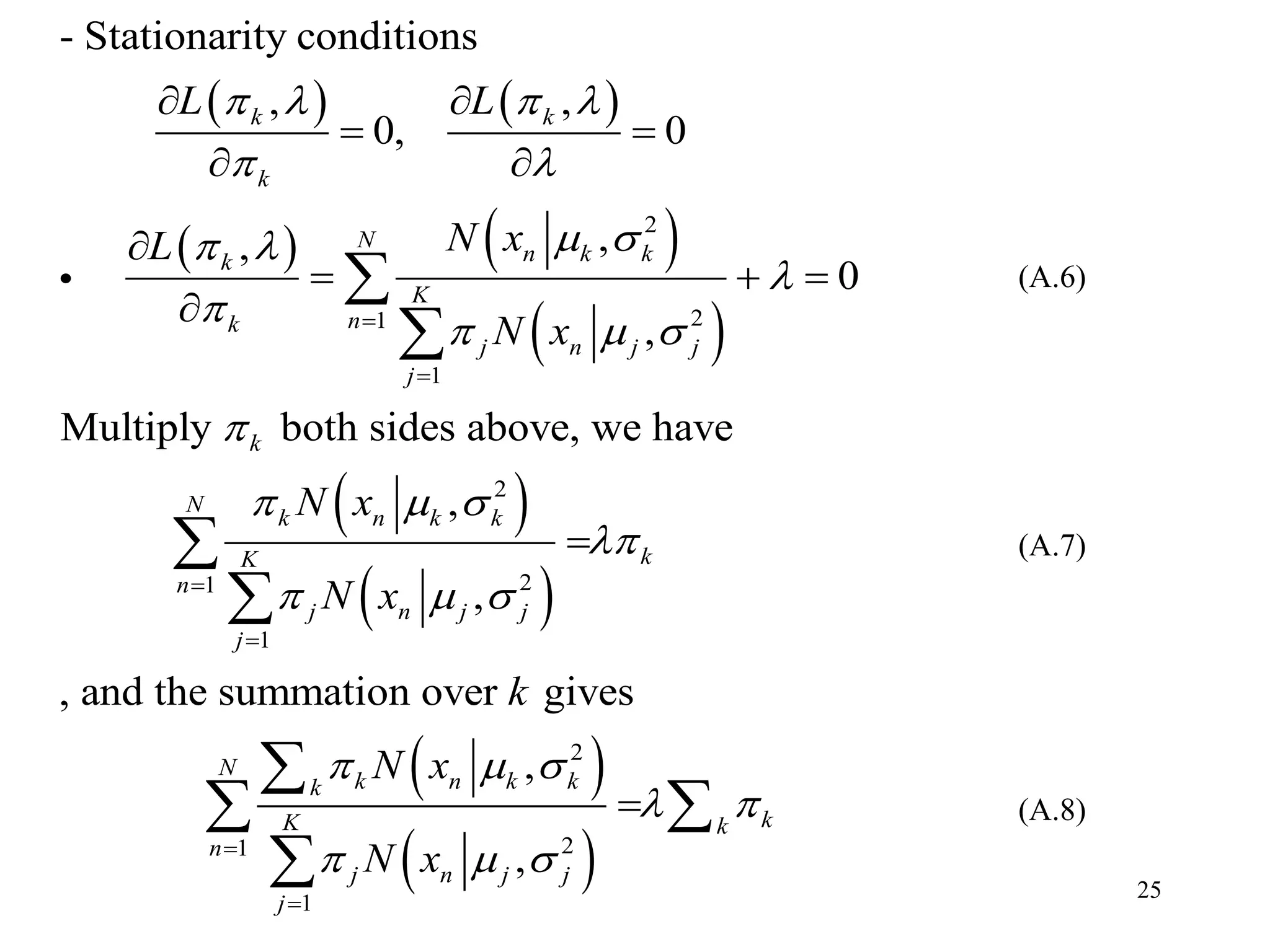
- Stationarity conditions
, ,
0, 0
,,
0
,
Multiply both sides above, we have
,
,
, and the s
k k
k
N
n k kk
K
nk
j n j j
j
k
N
k n k k
kK
n
j n j j
j
L L
N xL
N x
N x
N x
   
 
  


  

  

  




 
 
 

  






 
 
2
21
1
ummation over gives
,
,
N
k n k kk
kK k
n
j n j j
j
k
N x
N x
  
 
  



 

(A.6)
(A.7)
(A.8)
26
 
 
2
21
1
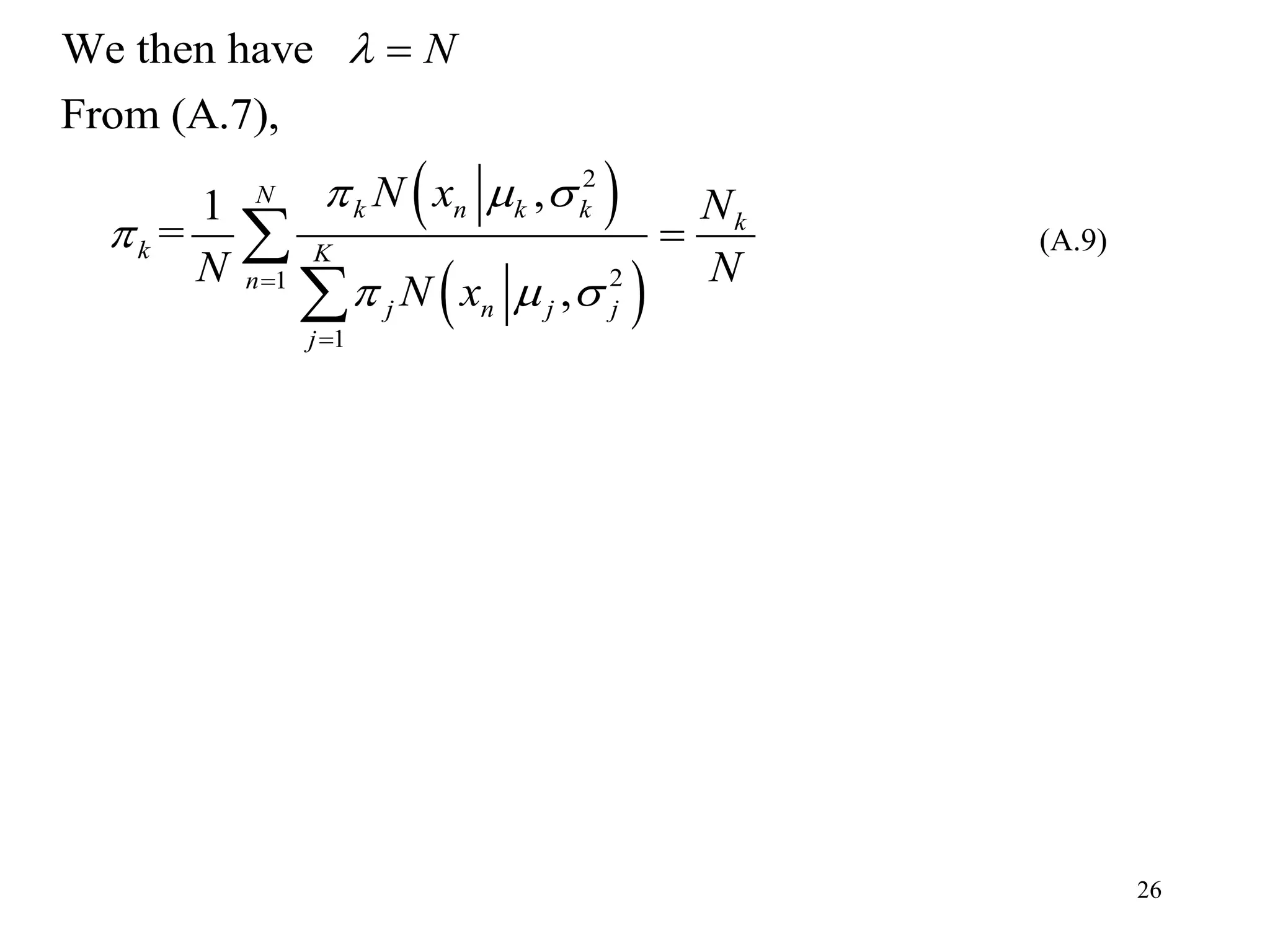
We then have
From (A.7),
,1
=
,
N
k n k k k
k K
n
j n j j
j
N
N x N
N N
N x

  

  




(A.9)

2012 mdsp pr12 k means mixture of gaussian

  • 1.
    Course Calendar (revised2012 Dec. 27) Class DATE Contents 1 Sep. 26 Course information & Course overview 2 Oct. 4 Bayes Estimation 3 〃 11 Classical Bayes Estimation - Kalman Filter - 4 〃 18 Simulation-based Bayesian Methods 5 〃 25 Modern Bayesian Estimation :Particle Filter 6 Nov. 1 HMM(Hidden Markov Model) Nov. 8 No Class 7 〃 15 Bayesian Decision 8 〃 29 Non parametric Approaches 9 Dec. 6 PCA(Principal Component Analysis) 10 〃 13 ICA(Independent Component Analysis) 11 〃 20 Applications of PCA and ICA 12 〃 27 Clustering; k-means, Mixture Gaussian and EM 13 Jan. 17 Support Vector Machine 14 〃 22(Tue) No Class
  • 2.
    Lecture Plan Clustering: K-means, Mixturesof Gaussians and EM 1. Introduction 2. K-means Algorithm 3. Mixtures of Gaussians 4. Re-formation of Mixtures of Gaussians 5. EM algorithm
  • 3.
    3 1. Introduction Unsupervised Learningand Clustering Problem Given a set of feature vectors without labels of categories, we want to attempt to find groups or clusters of the data samples in multi- dimensional space. We focus the following two methods: - K-means algorithm Non-parametric simple technique - (Gaussian) Mixture models and EM(Expectation Maximization) /Use a mixture of parametric densities such as Gaussians. /The optimal model parameters are not given in a closed form because of a highly non-linear coupled equations. /The expectation-maximization algorithm is effective for determining the optimal parameters.
  • 4.
    4 1 2 :D-dimensional randomvector N dataset of : X:={ , , , } : A group of data points whose inter-distances are small compared with the distances to the points outside of the cluster N Cluster Prototy x x x x x     of cluster: 1 : Find a set of vectors , such that the sum of the squared disstances of each point to its cvlosest vector is minimized. k k k k K K    pe Aim 2. K-means Algorithm The K-means algorithm is a non-statistical approach of clustering of data points in multi-dimensional feature space. Problem: Partition the dataset into some number K of clusters (K is known) Fig. 1 1 [Bishop book[1] and its web site]
  • 5.
    5 Fig. 1 1 [Bishopbook[1] and its web site]
  • 6.
    6 -Assignment indicator 1 ifis assigned to -th cluster 0 n nk k r otherwise     x Algorithm Introduce variable rnk denoting the assignment of data point 2 1 1 -Object Function (Distortion measure) N K nk n k n k J r     x  Squared of distance of each point xn to its assigned vector 𝝁k    -Find both and which minimizenk kr J (1) (2)
  • 7.
    7 (0) ( ) - :for the - : Minize J with respect to for fixed - : Minimize J with respect to for fixed k k i nk k nk r r       Two - stage Optimization initial value First stage Second stage   : Determination of for given 1~ at at argmin1 0 That is, we assign the to the closest cluster center. nk k n n j j nk n r k K x k x r otherwise x          First stage (3)
  • 8.
    8   : Optimization of 02 0 Above equation gives the mean vector of all data points assinged to cluster . k nk n k nk nk nn k nkn n J r x r x r x k                Second stage the number of points assigned to cluster k the sum of xn which assigned to cluster k (4)
  • 9.
    9 Example 1 [Bishopbook[1] and its web site] Fig.2 (0) 1 (0) 2
  • 10.
    Fig. 3 [1] Applicationof k-means algorithm for color-based image segmentation [Bishop book[1] and its web site] K-means clustering applied to the color vectors of pixels in RGB color-space
  • 11.
    11    1 [Mixture of Gaussians] Conside a superposition of Gaussians (Normal distributions) , K k k k k K p x x     3. Mixtures of Gaussians - Limitations of single Gaussian pdf model Examples [Bishop[1]] Single Gaussian model does not capture the multi-modes feature. Fig 4 Mixture distribution approach: uses the linear combination of basic distributions such as Gaussians mixing coefficients mixture component (5) single Gaussian Mixture of Gaussians
  • 12.
  • 13.
    13          1 1 1 0 0 1 The ( 1 ) satisfy the discrete probability requirements. :The prior probability of selecting the -mixture component , K k k k k k k k p x dx p x k K p k k x p x                                           1 responsibilit : The probability of i with condition on From Eq. (5) - Define the by the posterior distributioe n : , = s , K k k k k k k l l l x k p x p k p x k x p k x x p k x p k p x k x p x x              1 K l  (7) (6)
  • 14.
    14        1 2 1 2 1 2 1 2 (*) (* see lect - Parameters of mixture Gaussian (5) := , , , := , , , := , , , - Observed data X:= , , , Estimatte , , - Apply Maximum Likelihood method K K K Nx x x                     1 1 ure 2 slides for a single Gaussian distribution case) - Maximize the Log-Likelihood function ln , , ln , N K k n k k n k p X N x               Too complex to give closed form solution Go to EM (Expectation Maximization) algorithm (8)
  • 15.
    15 4. Re-formation ofMixtures of Gaussians Formulation of Mixture of Gaussians in terms of discrete latent random variables - Introduce K-dimensional random variable z - 1-of-K representation model of πk       1 2 1 : , , , 0,1 and 1 1 T K K k k k k k z z z z z p z         z        ln , , z p x p z p x z p X     Equivalent formulation of the Gaussian mixture with explicit latent variable z (9)
  • 16.
    16               1 1 - The conditional probability of for given : 1 1 1 , 1 1 , k k k k k k k K K k k j j j j j z x z p z x p z p x z N x p z p x z N x                   The responsibility that component k takes for explaining the observation x The posterior probability for observed x The prior probability of zk=1       1 2 1 - Modeling a data set X:= , , , using a mixture of Gaussians Assuming , , are drawn independently from , , the Log-Likelihood function is given by Eq.() N N k k x x x x x p x   (10)
  • 17.
    17 - With respectto and , the conditions that must be satisfied at a maximum of the likelihood function k k        1 1 - Maximization of ln , , with respect to subject to a constraint 1 is also solved. - Solutions are given by 1 where : k kk N N k nk n k nk n nk k p X z x N z N                        1 The responsibility of with respect to -th cluster 1 where =Eq. (10) n N T nk n k n k nk k k nk x k z x x N N N z            5. EM Algorithm  ln , , 0, ,k k p X            (11) (14) (13) (12)
  • 18.
    18   Three equations()-() do not give solutions directly because , contain unknowns , , and in complex ways. [EM algorithm for Gaussian Mixture Mode] Simple iterative scheme which altaernate the nk kz N      E (Expectation) and M (Maximization) steps. : Evaluate the posterior probabilities (responsibilities) using the current parameters : Re-estimate parameters , , a nkz   E step M step     nd using the evaluated Color illustration of in two-category case nk nk z z   
  • 19.
  • 20.
    20 Example 2 EMalgorithm [Bishop book[1] and its web site] (0) 1 (0) 2
  • 21.
  • 22.
    22 References: [1] C. M.Bishop, “Pattern Recognition and Machine Learning”, Springer, 2006 [2] R.O. Duda, P.E. Hart, and D. G. Stork, “Pattern Classification”, John Wiley & Sons, 2nd edition, 2004
  • 23.
    23                2 1 1 21 1 2 2 2 2 Proof of 1-dimensional case ln , , ln , ln , , 0 , - When 1 , derives Eq. , , 1( 2) n k k n k k N K j n j j n j kN K n j n j j j k n k k n k k k N x N x p X N x p X N x N x x                                                     Appendix (A.1) (A.2) (A.3)
  • 24.
    24     22 1 2 - When Calculate and substitute it into Eq. (A.2) derives 1 , k N k nk n k n k k n k k z x N x N                      For the maximization problem of ln , , with respect to subject to 1 , Lagrange multiplier method provides an elegant solution. - Introduce Lagragian function given by , : ln , k kk k p X L p X               , 1kk    (A.4) (A.5)
  • 25.
    25              2 21 1 2 21 1 - Stationarity conditions , , 0, 0 ,, 0 , Multiply both sides above, we have , , , and the s k k k N n k kk K nk j n j j j k N k n k k kK n j n j j j L L N xL N x N x N x                                               2 21 1 ummation over gives , , N k n k kk kK k n j n j j j k N x N x               (A.6) (A.7) (A.8)
  • 26.
    26     2 21 1 Wethen have From (A.7), ,1 = , N k n k k k k K n j n j j j N N x N N N N x             (A.9)