BE-IT <IT-05104>
Digital Signal Processing
Sample Question an Answer
Chapter – 3
1. Determine the Z-transform and sketch the ROC of the signals
(a) x (n) =(1/2)n
u(n)
(b) x (n) =3u(-n-1) (10-Marks)
2. State and prove ANY THREE properties of the Z-transform.
(20-Marks)
3. Determine the Z-transform and sketch the ROC of the signal
x(n)=[3(2)n
-4(3)n
]u(n).
(10-Marks)
4. Determine the system function and the unit sample response of the system describe by
the difference equation.
y(n)=1/2 y(n-1)+2x(n) (10-Marks)
5. Determine the inverse Z-transform of
X(Z)= 21
5.05.11
1
−−
+− ZZ
When
(a) ROC: |Z|>1
(b) ROC:| Z|<0.5
(c) ROC: 0.5<|Z|<1 (20-Marks)
6. Determine the causal signal x(n) having the Z-transform.
X(Z)= 211
)1)(1(
1
−−
−− ZZ
(20-Marks)
7. The well-known Fibonacci sequence of integer numbers is obtained by computing each
term as the sum of the two previous ones. The first few terms of the sequence are
1,1,2,3,4,5,8.
Determine a closed-form expression for the nth term of the Fibonacci sequence.
(20-Marks)
8. Determine the step response of the system
y(n)= ∞y(n-1) + x(n) -1<∞<1
when the initial condition is y(-1)=1 (20-Marks)
9. Determine the unit step response of the system describe by the difference equation
y(n)=0.9y(n-1)-0.81y(n-2)+x(n)
under the following initial condition:
y(-1)=y(-2)=1 (20-Marks)
10. Determine the transient and steady-state response of the system characterized by the
Difference equation
y(n)=0.5y(n-1)+x(n)
when the input signal is x(n)=10 cos(π n/4)u(n).
The system initially at rest (i.e, it is relaxed) (20-Marks)
11. Determine the inverse Z-transform of
H(Z)= 21
1
5.15.31
43
−−
−
+−
−
ZZ
Z
Specify the ROC of H(Z) and determine h(n) for the following conditions:
(a) The system is stable.
(b) The system is causal.
(c) The system is purely anticausal. (20-Marks)
12. Compute the convolution of the following signals by means of Z-transform
x1(n)=




<
≥
−
0)2/1(
0)3/1(
n
n
n
n
x2(n)=(1/2)n
u(n) (20-Marks)
13. Use the one side Z-transform to determine the zero input response, yzi (n), n 0≥ in the
following case.
y(n)-1.5y(n-1)+0.5y(n-2)=0,y(-1)=1,y(-2)=0 (10-Marks)
14. Compute the zero state response for the following pair of system and input signal.
h(n)=(2/5)n
u(n),x(n)=u(n)-u(n-7) (10-Marks)
15. Determine the response of the system described by the difference equation
Y(n)=5/6 y(n-1)- 1/6 y(n-2) + x(n)
to the input signal x(n)= δ (n)-1/3δ (n-1).
Take the initial condition y(-1)=1 and y(-2)=0 (20-Marks)
16. Determine the unit step response of the causal system described by the difference
equation
y(n)=y(n-1) + x(n) (10-Marks)
17. By using schur-cohn stability test ,determine if the system having the function
H(Z)= 21
2/14/71
1
−−
−− ZZ
is stable. (10Marks)
18. We want to design a causal discrete time LTI system with the property that if the input
is
x(n)=(1/2)n
u(n)-1/4(1/2)n+1
u(n-1)
then the output is y(n)=(1/3)n
u(n).
(a) Determine the system function H(Z) and the impulse response of a system that
satisfies the forgoing conditions.
(b) Find the difference equation that characterizes this system.
(c) Determine a realization of the system that requires a minimum number possible
amount of money.
(d) Determine if the system is stable. (20-Marks)
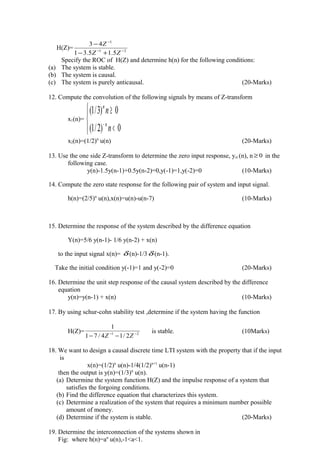
19. Determine the interconnection of the systems shown in
Fig: where h(n)=an
u(n),-1<a<1.
(a) Determine the impulse response of the overall system and determine if it is causal and
stable.
(b) Determine a realization of the system using the minimum numbers of adders, multipliers
and delay elements. (20-Marks)
20. Consider the system
H(Z)= 21
21
25
2
5
3
1
2/1
−−
−−
+−
+
ZZ
ZZ
(a) Determine impulse response.
(b) The zero state step response. (20-Marks)
21. Consider the system
H(Z)= 21
21
25
2
5
3
1
2/1
−−
−−
+−
+
ZZ
ZZ
Determine the step response if y(-1)=1 and y(-2)=2 (20-Marks)
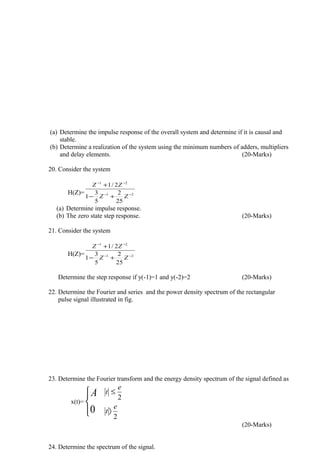
22. Determine the Fourier and series and the power density spectrum of the rectangular
pulse signal illustrated in fig.
23. Determine the Fourier transform and the energy density spectrum of the signal defined as
x(t)=



0
A
2
2
e
t
e
t
〉
≤
(20-Marks)
24. Determine the spectrum of the signal.
x(n)=cos w0n
when (a) w0=
π2 (a) w0= 3
π
(20-Marks)
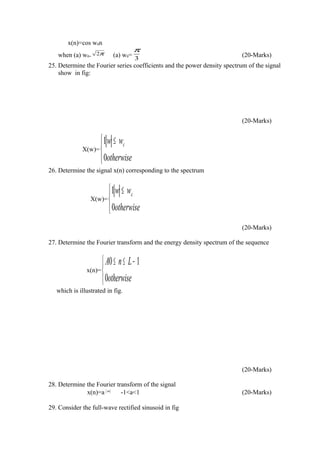
25. Determine the Fourier series coefficients and the power density spectrum of the signal
show in fig:
(20-Marks)
X(w)=


 ≤
otherwise
ww c
0
1
26. Determine the signal x(n) corresponding to the spectrum
X(w)=


 ≤
otherwise
ww c
0
1
(20-Marks)
27. Determine the Fourier transform and the energy density spectrum of the sequence
x(n)=


 −≤≤
otherwise
LnA
0
10
which is illustrated in fig.
(20-Marks)
28. Determine the Fourier transform of the signal
x(n)=a n
-1<a<1 (20-Marks)
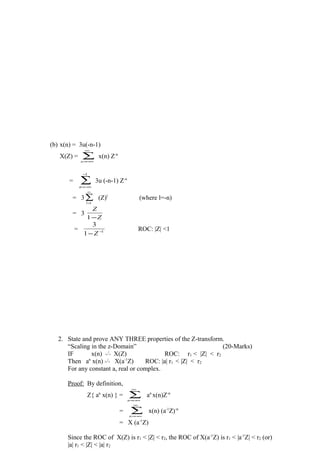
29. Consider the full-wave rectified sinusoid in fig
(a) Determine its spectrum Xa(F).
(b) Compute the power of the signal.
(c) plot the power spectrum density.
(d) Check the validity of parseval’s relation for this signals. (20-Marks)
30. Compute the Fourier transform of the following signals.
(a) x(n)=u(n)-u(n-6)
(b) x(n)=2n
u(n-6)
(c) x(n)=cos(
n3
π
)[u(n)-u(n-6)] (20-Marks)
BE. IT <IT. 05104>
Digital Signal Processing
Sample Questions and Answers
CHAPTER -3
1. Determine the Z-transform and sketch the ROC of the signal. (10 marks )
(a) x(n)= (1/2)n
u(n)
(b) x(n)= 3u(-n-1)
Solution:
(a) x(n) = (1/2)n
u(n)
X(Z) = ∑
∞
−∞=n
x(n) Z-n
= ∑
∞
=0n
(1/2)n
Z-n
= ∑
∞
=0n
(1/2 Z-1
)n
= 1
2
1
1
1
−
− z
ROC: |
1
2
1 −
Z |< 1
ROC: |Z | > ½
(b) x(n) = 3u(-n-1)
X(Z) = ∑
∞
−∞=n
x(n) Z-n
= ∑
−
−∞=
1
n
3u (-n-1) Z-n
= 3∑
∞
=1l
(Z)l
(where l=-n)
= 3
Z
Z
−1
= 1
1
3
−
−Z
ROC: |Z| <1
2. State and prove ANY THREE properties of the Z-transform.
“Scaling in the z-Domain” (20-Marks)
IF x(n)  →← Z
X(Z) ROC: r1 < |Z| < r2
Then an
x(n)  →← Z
X(a-1
Z) ROC: |a| r1 < |Z| < r2
For any constant a, real or complex.
Proof: By definition,
Z{ an
x(n) } = ∑
∞
−∞=n
an
x(n)Z-n
= ∑
∞
−∞=n
x(n) (a-1
Z)-n
= X (a-1
Z)
Since the ROC of X(Z) is r1 < |Z| < r2, the ROC of X(a-1
Z) is r1 < |a-1
Z| < r2 (or)
|a| r1 < |Z| < |a| r2
“Time Reversal”
IF x(n)  →← Z
X(Z) ROC: r1 < |Z| < r2
Then x(-n)  →← Z
X(Z-1
)ROC:
2
1
r
< |Z| <
1
1
r
Proof: By definition,
Z {x(-n) } = ∑
∞
−∞=n
x(-n) Z-n
= ∑
∞
−∞=l
x(l) (Z-1
)-l
= X(Z-1
)
where l=-n
The ROC of X(Z-1
) is
r1 < |Z-1
| < r2 or equivalently
2
1
r
< |Z| <
1
1
r
“Differentiation in the Z-Domain”
IF x(n)  →← Z
X(Z)
Then nx(n)  →← Z
-Z
dZ
ZdX )(
Proof: By differentiating both sides of Z transform equation
dZ
ZdX )(
= ∑
∞
−∞=n
x(n) (-n) Zn-1
= -Z-1
∑
∞
−∞=n
{n x(n)} Z-n
= -Z-1
Z {n x(n)}
dZ
ZZdX )(−
= Z {n x(n) }
Both transforms have the same ROC:
3. Determine the Z-transform and sketch the ROC of the signal x(n)=[3(2)n
– 4(3)n
]
u(n).
(10 marks)
Solution:
x(n)=[3(2)n
– 4(3)n
] u(n).
X(Z) = Z {x(n)}
= Z [ 3(2)n
– 4(3)n
] u(n)]
= Z { 3(2)n
u(n) } – Z { 4(3)n
u(n) }
= 1
21
1:3
−
− Z
- 1
31
1:4
−
− Z
ROC: |Z| > 2 ; ROC: |Z| > 3
X(Z) = 1
21
3
−
− Z
- 1
31
4
−
− Z
; ROC: |Z| > 3
Fig: ROC of X(Z)
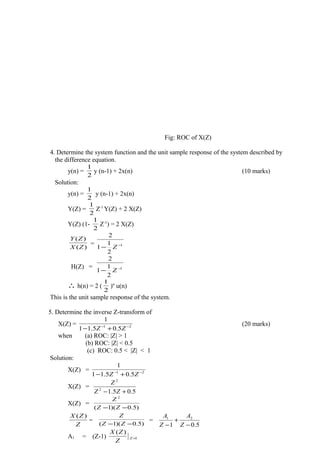
4. Determine the system function and the unit sample response of the system described by
the difference equation.
y(n) =
2
1
y (n-1) + 2x(n) (10 marks)
Solution:
y(n) =
2
1
y (n-1) + 2x(n)
Y(Z) =
2
1
Z-1
Y(Z) + 2 X(Z)
Y(Z) (1-
2
1
Z-1
) = 2 X(Z)
)(
)(
ZX
ZY
= 1
2
1
1
2
−
− Z
H(Z) = 1
2
1
1
2
−
− Z
∴ h(n) = 2 (
2
1
)n
u(n)
This is the unit sample response of the system.
5. Determine the inverse Z-transform of
X(Z) = 21
5.05.11
1
−−
+− ZZ
(20 marks)
when (a) ROC: |Z| > 1
(b) ROC: |Z| < 0.5
(c) ROC: 0.5 < |Z| < 1
Solution:
X(Z) = 21
5.05.11
1
−−
+− ZZ
X(Z) =
5.05.12
2
+− ZZ
Z
X(Z) =
)5.0)(1(
2
−− ZZ
Z
Z
ZX )(
=
)5.0)(1( −− ZZ
Z
=
5.01
21
−
+
− Z
A
Z
A
A1 = (Z-1) 1
)(
=Z
Z
ZX
A1 =
15.0 =− ZZ
Z
=
5.01
1
−
A1 = 2
A2 = (Z-0.5) 5.0
)(
=Z
Z
ZX
A2 = 5.0
1
=
−
Z
Z
Z
=
15.0
5.0
−
∴A2 = -1
Z
ZX )(
=
5.0
1
1
2
−
−
− ZZ
X(Z) =
5.01
27
−
−
− Z
Z
Z
∴X(Z) = 11
5.01
1
1
2
−−
−
−
− ZZ
(a) When the ROC is |Z| > 1 , the signal x(n) is causal arc terms are causal terms.
∴ x(n) = 2(1)n
u(n) –(0.5)n
u(n)
= (2-0.5n
) u(n)
(b) When the ROC is |Z| < 0.5 , the signal x(n) is anticausal.
Thus both terms result in anticausal components.
∴x(n) = [-2 + (0.5)n
] u(-n-1)
(c) When the ROC is 0.5 < |Z| < 1 , the signal x(n) is two sided.Thus one of term is a causal
part and the other is anticausal part. Thus,
∴x(n) = -2 (1)n
u(-n-1) –(0.5)n
u(n).
6. Determine the causal signal x(n) having the Z-transform
X(Z) = 211
)1)(1(
1
−−
−− ZZ
(20 marks)
Solution:
X(Z) = 211
)1)(1(
1
−−
−+ ZZ
X(Z) = 2
3
)1)(1( −+ ZZ
Z
X(Z) has simple pole at p1 = -1 and a double pole at p2 = p3 = 1.Thus partial fraction
exp
Z
ZX )(
= 2
2
)1)(1( −+ ZZ
Z
= 2
321
)1(11 −
+
−
+
+ Z
A
Z
A
Z
A
A1 = (Z+1)
1
)(
−=ZZ
ZX
A1 = 12
2
)1(
−=
−
Z
Z
Z
A1 = 2
2
)11(
)1(
−−
−
A1 =
4
1
A3 = 1
2
1
=
+
Z
Z
Z
A3 =
11
12
+
A3 =
2
1
A2 = 





−
Z
ZX
Z
dZ
d )(
)1( 2
Z=1
A2 = 1
2
1
=
+
Z
Z
Z
dZ
d
A2 = 2
2
)1(
)1(27)1(
+
−+
Z
ZZ
1=Z
A2 =
4
3
4
14
)11(
12)11(
2
=
−
=
+
−+
2
)1(
2
1
1
4
3
1
4
1
)(
−
+
−
+
+
=
ZZZZ
ZX
X(Z) =
2
)1(
2
1
1
4
3
1
4
1
−
+
−
+
+ Z
Z
Z
Z
Z
Z
=
2)1(2
1
)1(
1
4
3
)1(
1
4
1
1
1
11 −
−
−−
−
+
−
+
+ Z
Z
ZZ
x(n) = )(
2
1
)(
4
3
)()1(
4
1
nununun
++−
x(n) = )(
24
3
)1(
4
1
nu
nn






++−
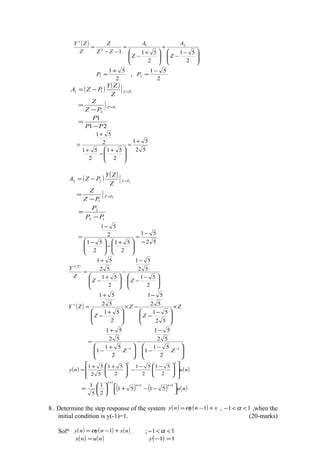
7. The well-known Fibonancci sequence of integer numbers is obtained by computing each
term as the sum of the two previous one. The first few terms of the sequence are
1,1,2,3,5,8,13,21,34,….Determine a closed –form expression for the nth term of the
Fibonancci sequence. (20 marks)
Solution:
y(n) = y(n-1) + y(n-2) ( )A→
initial condition
n=0 ( )11)2()1()0( →=−+−=⇒ yyy
)2(1)1()0()1( →=−+= yyy
0)1( =−∴y
( ) 12 =−y
( ){ } ( ) ( ) 0;
1
>





−+=− ∑=
+−+
KZnyZYZKnyZ
K
n
nK
eqn:
(A) ( ) ( ) ( ){ }[ ] ( ) ( ) ( ){ }[ ]2211
211 ZyZyZYZZyZYZZY −+−++−+= +−+−+
( ) ( )[ ] ( ) ( ) ( )[ ]211 121
−+−++−+= −+−+−
yZyZYZyZYZ
( ) ( ) 121
++= +−+−
ZYZZYZ
( )[ ] 11 21
=−− −−+
ZZZY
21
1
1
−−
−−
=
ZZ
12
2
−−
=
ZZ
Z
( )







 −
−
+







 +
−
=
−−
=
+
2
51
2
511
21
2
Z
A
Z
A
ZZ
Z
Z
ZY
2
51
1
+
=P ,
2
51
2
−
=P
( ) ( )
111 PZ
Z
ZY
PZA =−=
1
2
PZ
PZ
Z
=
−
=
21
1
PP
P
−
=
52
51
2
51
2
51
2
51
+
=







 +
−
+
+
=
( ) ( )
222 PZ
Z
ZY
PZA =−=
2
1
PZ
PZ
Z
=
−
=
12
2
PP
P
−
=
52
51
2
51
2
51
2
51
−
−
=







 +
−






 −
−
=
( )







 −
−
−
−







 +
−
+
=
+
2
51
52
51
2
51
52
51
ZZ
Z
Y Z
( ) Z
Z
Z
Z
ZY ×







 −
−
−
−×







 +
−
+
=+
52
51
52
51
2
51
52
51







 −
−
−
−







 +
−
+
=
−− 11
2
51
1
52
51
2
51
1
52
51
ZZ
( ) ( )nuny
nn















 −−
−






 ++
=
2
51
2
51
2
51
52
51
( ) ( ) ( )nu
nn
n



 −−+





=
++
+
11
1
5151
2
1
5
1
8 . Determine the step response of the system ( ) ( ) xnyny +−= 1α , 11 <<− α ,when the
initial condition is y(-1)=1. (20-marks)
Soln: ( ) ( ) ( )nxnyny +−= 1α ; 11 <<− α
( ) ( )nunx = ( ) 11 =−y
( ) ( ) ( ) 





−+↔− ∑=
+−
+ K
n
nK
Z
ZnxZZKnx
1
α ; 0>K
( ) ( ) ( ){ }[ ] ( )ZXZyZYZZY ++−+
+−+= 11
α
( ) ( ) ( )[ ] ( )ZXyZYZZY ++−+
+−+= 11
α
( ) ( )nunx =
( ) 1
1
1
−
+
−
=
Z
ZX
( ) ( ) ( )ZXZYZZY ++−+
++= αα 1
( ) ( ) 1
1
1
1
−
+−+
−
+=−
Z
ZYZZY αα
( )
( )( )111
11
1
1 −−−
+
−−
+
−
=
ZZZ
ZY
αα
α
( )
( )( ) ( ) ( )1
2
1
1
11
1111
1
−−−−
+
−
+
−
=
−−
=
Z
A
Z
A
ZZ
ZY
αα
( ) ( )
α
α 1
1
1 11 =
−
−−= Z
ZYZA
α
α
α
α
α
−
−
=
−
=
−
=
−
= −
11
1
11
1
1
1
1
Z
( ) ( ) 1
1
2 11 =
−
−−= Z
ZYZA
αα −
=
−
= −
1
1
1
1
1
Z
( ) ( )
( )( ) ( )( )111
11
1
111 −−−
+
−−
+
−−
−
+
−
=
ZZZ
ZY
ααα
α
α
α
( ) ( )[ ]ZYZny +
= 1
( ) ( )
( )
( )
( )
( )nununu nn
α
α
α
α
αα
−
+
−
−=
1
1
1
( ) ( )nunu
n
n
αα
α
α
−
+
−
−=
+
+
1
1
1
1
1
( ) ( )nunu
n
n
α
α
α
−
−
+=
+
+
1
1 1
1
( ) ( ) ( )nu
nn






−
−+−
=
++
α
ααα
1
11
11
( ) ( )nunn 11
1
1
1 ++
−+
−
= αα
α
( ) ( )nun 2
1
1
1 +
−
−
= α
α
9 . Determine the unit step response of the system described b difference equation.
( ) ( ) ( ) ( )nxnynyny +−−−= 281.019.0
under the following initial conditions:
( ) ( ) 121 =−=− yy (20 marks)
Solution:
( ) ( ) ( ) ( )nxnynyny +−−−= 281.019.0
( ) ( ) 121 =−=− yy
210
81.09.01)(,
)(
)(
)( −−
+−== ZZZA
ZA
ZN
ZyZi
∑∑ ==
−
−−=
k
n
n
N
k
k
k ZnyZaZN
11
0 )()(
= { }[ ]))2()1(()1( 212
2
11
1 ZyZyZaZyZa −+−+−− −−
= [ ]2
1
21 aZaZa ++− −
= [ ])81.0()81.0(9.0 1
++−− −
Z
= 1
81.009.0 −
− Z
∑
∑∑
=
−
==
−
+
+
−
== N
k
k
k
k
n
n
N
k
k
k
Zi
Za
ZnyZa
ZA
ZN
Zy
1
110
1
)(
)(
)(
)(
21
1
0
81.09.01
81.009.0
)(
)(
)( −−
−
+−
−
==
ZZ
Z
ZA
ZN
ZyZi
)9.01)(9.01(
81.009.0
1212
1
−
−
−
−
−−
−
=
ZeZe
Z
jj
ππ
)9.01()9.01( 1212 −
−
−
−
+
−
=
Ze
B
Ze
A
jj
ππ
)9.01)(9.01(
)9.01()9.01(
1212
1212
−
−
−
−−
−
−−
−+−
=
ZeZe
ZeBZeA
jj
jj
ππ
ππ
3
1
12
1
9.0
1
)9.01(
81.009.0
ππ
j
Z
j
eZe
Z
A =
−
−
=
−
−
−
−
3
2
3
9.0
1
9.01
9.0/81.009.0
π
π
π
j
j
j
e
e
e
A
−
−
−
=
866.05.1
779.036.0
j
j
+
+−
=
B = A”
)9.01(
4936.0026.0
9.01
4936.0026.0
)(
1213 −
−
−
−
−
+
−
+
=
Ze
j
Ze
j
Zy
jj
Zi ππ
)()87
3
cos()9.0(988.0)( .
nunny n
Zi +=
π
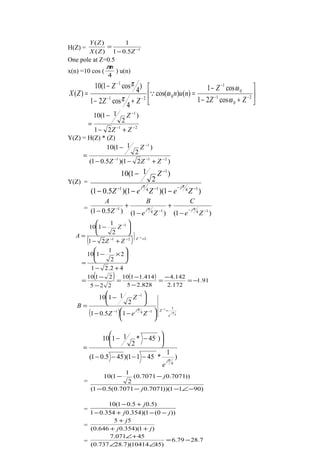
10. Determine the transient and steady state response of the system characterized by the
difference equation.
y(n)=0.5 y(n-1) + x(n) when the input signal x(n) = 10 cos (
4
nπ
) u(n)
The system is initially at rest (i.e it is relaxed). (20 marks)
Solution:
y(n) = 0.5 y(n-1) + x(n)
Y(Z) = 0.5 y(Z)Z-1
+ X(Z)
Y(Z) (1-0.5Z-1
) = X(Z)
H(Z) = 1
5.01
1
)(
)(
−
−
=
ZZX
ZY
One pole at Z=0.5
x(n) =10 cos (
4
nπ
) u(n)






+−
−
=
+−
−
= −−
−
−−
−
2
0
1
0
1
021
1
cos21
cos1
)()cos(
4
cos21
)
4
cos1(10
)(
ZZ
Z
nun
ZZ
Z
ZX
ω
ω
ω
π
π

21
1
21
)
2
11(10
−−
−
+−
−
=
ZZ
Z
Y(Z) = H(Z) * (Z)
)21)(5.01(
)
2
11(10
211
1
−−−
−
+−−
−
=
ZZZ
Z
Y(Z) =
)1)(1)(5.01(
)
2
11(10
14141
1
−−−−
−
−−−
−
ZeZeZ
Z
jj ππ
=
)1()1()5.01( 1414
1
−−−
−
−
+
−
+
− Ze
C
Ze
B
Z
A
jj ππ
( ) 221
1
1
21
2
1
110
=−−
−
−
+−






−
= Z
ZZ
Z
A
42.21
2
2
1
110
+−






×−
=
( ) ( ) 91.1
172.2
142.4
828.25
414.1110
225
2110
−=
−
=
−
−
=
−
−
=
( ) 4
1 1
141
1
15.01
2
1110
π
π
j
e
Zj
ZeZ
Z
B
=−−
−
−




 −−





 −
=
)
1
*4511)(455.01(
)45*
2
1110
4
.
.
πj
e
−−−−





 −−
=
=
)9011))(7071.07071.0(5.01(
))7071.07071.0(
2
1
1(10
−∠−−−
−−
j
j
=
))0(1)(354.0354.01
)5.05.01(10
jj
j
−−+−
+−
=
)1)(354.0646.0(
55
jj
j
++
+
= 7.2879.6
)4510414)(7.28737.0(
45071.7
−=
∠∠
+∠
C = B = 6.79 7.28∠
Y(Z) =
1414
1
1
7.2879.6
1
7.2879.6
5.01
9.1
−−−
−
−
∠
+
−
−∠
+
−
−
ZeZeZ jj ππ
y(n) = -1.9(0.5)n
u(n) +2*6.79(1)n
cos (
n
4
π
- 28.7) u(n)
The natural or transient rep: is
ynr (n) = -1.9(0.5)n
u(n)
The forced or steady state rep: is
yfr(n) = 13.58 cos (
n
4
π
- 28.7) u(n)
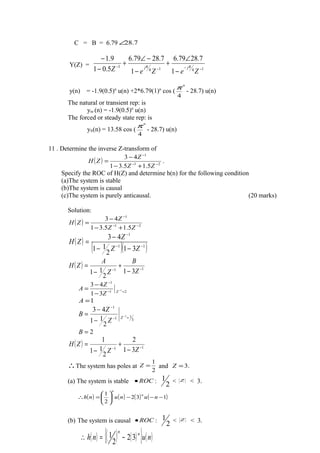
11 . Determine the inverse Z-transform of
( ) 21
1
5.15.31
43
−−
−
+−
−
=
ZZ
Z
ZH .
Specify the ROC of H(Z) and determine h(n) for the following condition
(a)The system is stable
(b)The system is causal
(c)The system is purely anticausal. (20 marks)
Solution:
( ) 21
1
5.15.31
43
−−
−
+−
−
=
ZZ
Z
ZH
( )
( )( )11
1
31
2
11
43
−−
−
−−
−
=
ZZ
Z
ZH
( ) 11
31
2
11
−−
−
+
−
=
Z
B
Z
A
ZH
21
1
1
31
43
=−
−
−
−
−
= Z
Z
Z
A
1=A
3
11
1
1
2
11
43
=−
−
−
−
−
= Z
Z
Z
B
2=B
( ) 11
31
2
2
11
1
−−
−
+
−
=
ZZ
ZH
∴The system has poles at
2
1
=Z and .3=Z
(a) The system is stable ROC• :
2
1 < Z < 3.
( ) ( ) ( ) ( )132
2
1
−−−





=∴ nununh
n
n
(b) The system is causal ROC• :
2
1 < Z < 3.
( ) ( ) ( ){ } ( )nunh
nn
32
2
1 −=∴
(c) The system is anticausal ROC• :
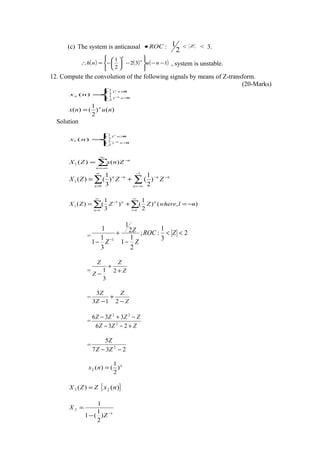
2
1 < Z < 3.
( ) ( ) ( )132
2
1
−−








−





−=∴ nunh
n
n
, system is unstable.
12. Compute the convolution of the following signals by means of Z-transform.
(20-Marks)



=
≥
<−
0)
3
1
(
0)
2
1
(
)(
n
n
n
n
n
nx
)()
2
1
()( nunx n
=
Solution



=
≥
<−
0)
3
1
(
0)
2
1
(
1 )(
n
n
n
n
nx
∑
∞
−∞=
−
=
n
n
ZnxZX )()(1
∑ ∑
∞
=
−
−∞=
−−−
+=
0
1
1 )
2
1
()
3
1
()(
n n
nnnn
ZZZX
∑ ∑
∞
=
∞
=
−
−=+=
1 1
1
1 ),()
2
1
()
3
1
()(
n l
nn
nlwhereZZZX
= 2
3
1
:;
2
1
1
2
1
3
1
1
1
1
<<
−
+
− −
ZROC
Z
Z
Z
= Z
Z
Z
Z
+
+
−
2
3
1
=
Z
Z
Z
Z
−
+
− 213
3
=
ZZZ
ZZZZ
+−−
−+−
236
336
2
22
=
237
5
2
−− ZZ
Z
n
nx )
2
1
()(2 =
ZZX =)(2 { })(2 nx
1
2
)
2
1
(1
1
−
−
=
Z
X
2
1
:;
2
1
>
−
= ZROC
Z
Z
{ } )()()()( 2121 zXZXnxnxZ ⋅=∗
2
1237
5
)( 2
−
×
−
= −
Z
Z
ZZ
Z
ZX
)
2
1
)(2)(
3
1
(
5
)(
2
−−−
=
ZZZ
Z
ZX
)
2
1
)(2)(
3
1
(
5)(
−−−
=
ZZZ
Z
Z
ZX
)
2
1
(
)2(
)
3
1
(
)(
−
+
−
+
−
=
Z
C
Z
B
Z
A
Z
ZX
3
1
)
2
1
)(2(
5
=−−
=
ZZZ
Z
A
6=A
2
1
)
2
1
)(
3
1
(
5
=−−
=
ZZZ
Z
B
4=B
2
1
)2)(
3
1
(
5
=−−
=
ZZZ
Z
C
10−=C
3
1
)10(
2
4
3
1
6)(
−
−
+
−
+
−
=
Z
Z
Z
Z
ZX
22
1
:,
3
1
1
)10(
21
4
3
1
1
6
)(
1
1
1 <<
−
−
+
−
+
−
=
−
−
− Z
ROC
Z
Z
Z
ZX
)()
2
1
(10)1()2(4)()
3
1
()( nunununx nnn
−−−+=∴
13. Use the one-side Z-transform to determine the zero input response ,y 0),(2 ≥nny in the
following case.
0)2(5.0)1(5.1 =−+−− nynyyn ; y(-1)=1,y(-2)=0 (10-Marks)






+→←− ∑=
+−+
n
k
n
kZ
ZnxZXZknx )()()(
1
|
[ ] [ ]
[ ] 00.05.15.05.11)(
)2()1()(5.0)1()(5.1)(
121
221
=+−+−=
−+−++−+−
−−−+
+−+−+
ZZZZy
ZyyZyZZyZyZzy
21
1
5.05.11
)5.05.1(
)( −−
−
+
+−
−
=
ZZ
Z
Zy
)1)(5.01(
5.05.1
)( 11
1
−−
−
−−
−
=
ZZ
Z
Zyzi (where no input signal)
11
15.01 −−
−
+
−
=
Z
B
Z
A
2
1
−=A
2=B
11
1
2
5.01
2
1
)( −−
−
+
−
−
=
ZZ
Zyzi
)()1(2)5.0(
2
1
)( nuny nn
zi 





+−∴
)()
2
1
(2 1
nun






−= +
14. Compute the zero state response for the following pair of system and input signal.
(10-Marks)
)7()()(),()
5
2
()( −−== nununxnunh n
)7()()(),()
5
2
()( −−== nununxnunh n
)()()( ZZHZyzs ×=
{ })()( nhZZH =
=






)()
5
2
( nuZ n
= 1
5
2
1
1
−
− Z
{ })7()()( −−= nunuZZX
= 1
7
1
11
1
−
−
−
−
−
− Z
Z
Z
= 1
7
1
1
−
−
−
−
Z
Z
)()()( ZZHZYzs ×=
= 1
7
1
1
1
5
21
1
Z
Z
Z −
−
⋅
−
−
−
= [ ]654321
1
1
5
21
1 −−−−−−
−
++++++
−
ZZZZZZ
Z
let 1
5
21
1
)( −
−
=′
Z
ZYzs
61
)(...)()()( −−
′+′+′=∴ ZZYZZYZYZYzs zszszs
)()
5
2
()( nunY n
zs =′
)6(...)1()()( −′++−′+′=∴ nynynyny zszszszs
)6()
5
2
(...)1()
5
2
()()
5
2
( 61
−++−+= −−
nununu nnn
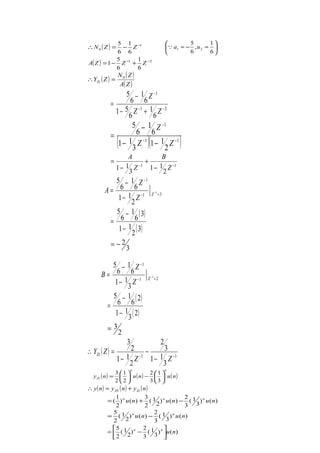
15 . Determine the response of the system described by the difference equation .
( ) ( ) ( ) ( )nxnynyny +−−−= 2
6
1
1
6
5
to the input signal
( ) ( ) ( )1
3
1
−−= nnnx δδ .
Take the initial condition: ( ) 11 =−y and ( ) 02 =−y . (20-marks)
Solution:
( ) 11 =−y , ( ) 02 =−y
( ) ( ) ( ) ( )nxnynyny +−−−= 2
6
1
1
6
5
( ) ( ) ( ) ( )ZXZZYZZYZY +−= −− 21
6
1
6
5
( ) ( )ZXZZZY =





+−= −− 21
6
1
6
5
1
( ) ( ) 1==∴ ZYZH
( ) 21
6
1
6
5
1 −−
+−= ZZZX
( ) ( ) ( )1
3
1
−−= nnnx δδ
( ) ( ) ( )





−−= 1
3
1
nnZZX δδ
1
3
1
1 −
−= Z
( ) ( ) ( )ZXZHZYZS =






−












+−
= −
−−
1
21 3
1
1
6
1
6
5
1
1
Z
ZZ
21
1
6
1
6
5
1
3
1
1
−−
−
+−
−
=
ZZ
Z






−





−
−
=
−−
−
11
1
2
1
1
3
1
1
3
1
1
ZZ
Z
1
2
1
1
1
−
−
=
Z
( ) ( )nuny
n
ZS 





=∴
2
1
( ) ( ) n
N
K
K
n
K
K ZnyZaZN ∑ ∑= =
−
−−=
0 1
0
( )∑∑ ==
−
−−=
K
n
n
K
K
K ZnyZa
1
2
0
( ) ( ) ( ){ }[ ]22
2
1
1 211 ZyZyZaZyZa −+−+−−= −−
1
21
−
−−= Zaa
( ) 1
0
6
1
6
5 −
−=∴ ZZN 





=−=
6
1
,
6
5
21 ua
( ) 21
6
1
6
5
1 −−
+−= ZZZA
( )
( )
( )ZA
ZN
ZYZi
0
=∴
21
1
6
1
6
51
6
1
6
5
−−
−
+−
−
=
ZZ
Z
( )( )11
1
2
11
3
11
6
1
6
5
−−
−
−−
−
=
ZZ
Z
11
2
11
3
11 −−
−
+
−
=
Z
B
Z
A
31
1
1
2
11
6
1
6
5
=−
−
−
−
−
= Z
Z
Z
A
( )
( )3
2
11
3
6
1
6
5
−
−
=
3
2−=
21
1
1
3
11
6
1
6
5
=−
−
−
−
−
= Z
Z
Z
B
( )
( )2
3
11
2
6
1
6
5
−
−
=
2
3=
( ) 11
3
11
3
2
2
11
2
3
−−
−
−
−
=∴
ZZ
ZYZi
( ) ( ) ( )nununy
nn
Zi 





−





=
3
1
3
2
2
1
2
3
( ) ( ) ( )nynyny ZiZS +=∴
)()
3
1(
3
2
)()
2
1(
2
3
)()
2
1
( nununu nnn
−+=
)()
3
1(
3
2
)()
2
1(
2
5
nunu nn
−=
)()
3
1(
3
2
)
2
1(
2
5
nunn






−=
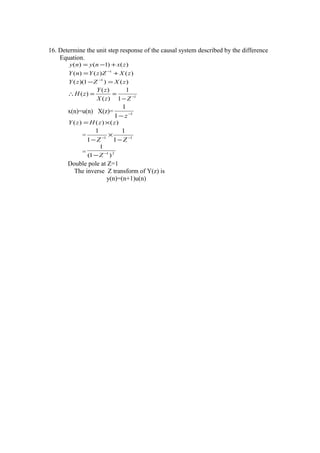
16. Determine the unit step response of the causal system described by the difference
Equation.
)()1()( zxnyny +−=
)()()( 1
zXZzYnY += −
)()1)(( 1
zXZzY =− −
1
1
1
)(
)(
)( −
−
==∴
ZzX
zY
zH
x(n)=u(n) X(z)= 1
1
1
−
− z
)()()( zzHzY ×=
= 11
1
1
1
1
−−
−
×
− ZZ
= 21
)1(
1
−
−Z
Double pole at Z=1
The inverse Z transform of Y(z) is
y(n)=(n+1)u(n)

It 05104 digsig_1

  • 1.
    BE-IT <IT-05104> Digital SignalProcessing Sample Question an Answer Chapter – 3 1. Determine the Z-transform and sketch the ROC of the signals (a) x (n) =(1/2)n u(n) (b) x (n) =3u(-n-1) (10-Marks) 2. State and prove ANY THREE properties of the Z-transform. (20-Marks) 3. Determine the Z-transform and sketch the ROC of the signal x(n)=[3(2)n -4(3)n ]u(n). (10-Marks) 4. Determine the system function and the unit sample response of the system describe by the difference equation. y(n)=1/2 y(n-1)+2x(n) (10-Marks) 5. Determine the inverse Z-transform of X(Z)= 21 5.05.11 1 −− +− ZZ When (a) ROC: |Z|>1 (b) ROC:| Z|<0.5 (c) ROC: 0.5<|Z|<1 (20-Marks) 6. Determine the causal signal x(n) having the Z-transform. X(Z)= 211 )1)(1( 1 −− −− ZZ (20-Marks) 7. The well-known Fibonacci sequence of integer numbers is obtained by computing each term as the sum of the two previous ones. The first few terms of the sequence are 1,1,2,3,4,5,8. Determine a closed-form expression for the nth term of the Fibonacci sequence. (20-Marks) 8. Determine the step response of the system y(n)= ∞y(n-1) + x(n) -1<∞<1 when the initial condition is y(-1)=1 (20-Marks) 9. Determine the unit step response of the system describe by the difference equation y(n)=0.9y(n-1)-0.81y(n-2)+x(n) under the following initial condition: y(-1)=y(-2)=1 (20-Marks) 10. Determine the transient and steady-state response of the system characterized by the Difference equation y(n)=0.5y(n-1)+x(n) when the input signal is x(n)=10 cos(π n/4)u(n). The system initially at rest (i.e, it is relaxed) (20-Marks) 11. Determine the inverse Z-transform of
  • 2.
    H(Z)= 21 1 5.15.31 43 −− − +− − ZZ Z Specify theROC of H(Z) and determine h(n) for the following conditions: (a) The system is stable. (b) The system is causal. (c) The system is purely anticausal. (20-Marks) 12. Compute the convolution of the following signals by means of Z-transform x1(n)=     < ≥ − 0)2/1( 0)3/1( n n n n x2(n)=(1/2)n u(n) (20-Marks) 13. Use the one side Z-transform to determine the zero input response, yzi (n), n 0≥ in the following case. y(n)-1.5y(n-1)+0.5y(n-2)=0,y(-1)=1,y(-2)=0 (10-Marks) 14. Compute the zero state response for the following pair of system and input signal. h(n)=(2/5)n u(n),x(n)=u(n)-u(n-7) (10-Marks) 15. Determine the response of the system described by the difference equation Y(n)=5/6 y(n-1)- 1/6 y(n-2) + x(n) to the input signal x(n)= δ (n)-1/3δ (n-1). Take the initial condition y(-1)=1 and y(-2)=0 (20-Marks) 16. Determine the unit step response of the causal system described by the difference equation y(n)=y(n-1) + x(n) (10-Marks) 17. By using schur-cohn stability test ,determine if the system having the function H(Z)= 21 2/14/71 1 −− −− ZZ is stable. (10Marks) 18. We want to design a causal discrete time LTI system with the property that if the input is x(n)=(1/2)n u(n)-1/4(1/2)n+1 u(n-1) then the output is y(n)=(1/3)n u(n). (a) Determine the system function H(Z) and the impulse response of a system that satisfies the forgoing conditions. (b) Find the difference equation that characterizes this system. (c) Determine a realization of the system that requires a minimum number possible amount of money. (d) Determine if the system is stable. (20-Marks) 19. Determine the interconnection of the systems shown in Fig: where h(n)=an u(n),-1<a<1.
  • 3.
    (a) Determine theimpulse response of the overall system and determine if it is causal and stable. (b) Determine a realization of the system using the minimum numbers of adders, multipliers and delay elements. (20-Marks) 20. Consider the system H(Z)= 21 21 25 2 5 3 1 2/1 −− −− +− + ZZ ZZ (a) Determine impulse response. (b) The zero state step response. (20-Marks) 21. Consider the system H(Z)= 21 21 25 2 5 3 1 2/1 −− −− +− + ZZ ZZ Determine the step response if y(-1)=1 and y(-2)=2 (20-Marks) 22. Determine the Fourier and series and the power density spectrum of the rectangular pulse signal illustrated in fig. 23. Determine the Fourier transform and the energy density spectrum of the signal defined as x(t)=    0 A 2 2 e t e t 〉 ≤ (20-Marks) 24. Determine the spectrum of the signal.
  • 4.
    x(n)=cos w0n when (a)w0= π2 (a) w0= 3 π (20-Marks) 25. Determine the Fourier series coefficients and the power density spectrum of the signal show in fig: (20-Marks) X(w)=    ≤ otherwise ww c 0 1 26. Determine the signal x(n) corresponding to the spectrum X(w)=    ≤ otherwise ww c 0 1 (20-Marks) 27. Determine the Fourier transform and the energy density spectrum of the sequence x(n)=    −≤≤ otherwise LnA 0 10 which is illustrated in fig. (20-Marks) 28. Determine the Fourier transform of the signal x(n)=a n -1<a<1 (20-Marks) 29. Consider the full-wave rectified sinusoid in fig
  • 5.
    (a) Determine itsspectrum Xa(F). (b) Compute the power of the signal. (c) plot the power spectrum density. (d) Check the validity of parseval’s relation for this signals. (20-Marks) 30. Compute the Fourier transform of the following signals. (a) x(n)=u(n)-u(n-6) (b) x(n)=2n u(n-6) (c) x(n)=cos( n3 π )[u(n)-u(n-6)] (20-Marks) BE. IT <IT. 05104> Digital Signal Processing Sample Questions and Answers CHAPTER -3 1. Determine the Z-transform and sketch the ROC of the signal. (10 marks ) (a) x(n)= (1/2)n u(n) (b) x(n)= 3u(-n-1) Solution: (a) x(n) = (1/2)n u(n) X(Z) = ∑ ∞ −∞=n x(n) Z-n = ∑ ∞ =0n (1/2)n Z-n = ∑ ∞ =0n (1/2 Z-1 )n = 1 2 1 1 1 − − z ROC: | 1 2 1 − Z |< 1 ROC: |Z | > ½
  • 6.
    (b) x(n) =3u(-n-1) X(Z) = ∑ ∞ −∞=n x(n) Z-n = ∑ − −∞= 1 n 3u (-n-1) Z-n = 3∑ ∞ =1l (Z)l (where l=-n) = 3 Z Z −1 = 1 1 3 − −Z ROC: |Z| <1 2. State and prove ANY THREE properties of the Z-transform. “Scaling in the z-Domain” (20-Marks) IF x(n)  →← Z X(Z) ROC: r1 < |Z| < r2 Then an x(n)  →← Z X(a-1 Z) ROC: |a| r1 < |Z| < r2 For any constant a, real or complex. Proof: By definition, Z{ an x(n) } = ∑ ∞ −∞=n an x(n)Z-n = ∑ ∞ −∞=n x(n) (a-1 Z)-n = X (a-1 Z) Since the ROC of X(Z) is r1 < |Z| < r2, the ROC of X(a-1 Z) is r1 < |a-1 Z| < r2 (or) |a| r1 < |Z| < |a| r2
  • 7.
    “Time Reversal” IF x(n) →← Z X(Z) ROC: r1 < |Z| < r2 Then x(-n)  →← Z X(Z-1 )ROC: 2 1 r < |Z| < 1 1 r Proof: By definition, Z {x(-n) } = ∑ ∞ −∞=n x(-n) Z-n = ∑ ∞ −∞=l x(l) (Z-1 )-l = X(Z-1 ) where l=-n The ROC of X(Z-1 ) is r1 < |Z-1 | < r2 or equivalently 2 1 r < |Z| < 1 1 r “Differentiation in the Z-Domain” IF x(n)  →← Z X(Z) Then nx(n)  →← Z -Z dZ ZdX )( Proof: By differentiating both sides of Z transform equation dZ ZdX )( = ∑ ∞ −∞=n x(n) (-n) Zn-1 = -Z-1 ∑ ∞ −∞=n {n x(n)} Z-n = -Z-1 Z {n x(n)} dZ ZZdX )(− = Z {n x(n) } Both transforms have the same ROC: 3. Determine the Z-transform and sketch the ROC of the signal x(n)=[3(2)n – 4(3)n ] u(n). (10 marks) Solution: x(n)=[3(2)n – 4(3)n ] u(n). X(Z) = Z {x(n)} = Z [ 3(2)n – 4(3)n ] u(n)] = Z { 3(2)n u(n) } – Z { 4(3)n u(n) } = 1 21 1:3 − − Z - 1 31 1:4 − − Z ROC: |Z| > 2 ; ROC: |Z| > 3 X(Z) = 1 21 3 − − Z - 1 31 4 − − Z ; ROC: |Z| > 3
  • 8.
    Fig: ROC ofX(Z) 4. Determine the system function and the unit sample response of the system described by the difference equation. y(n) = 2 1 y (n-1) + 2x(n) (10 marks) Solution: y(n) = 2 1 y (n-1) + 2x(n) Y(Z) = 2 1 Z-1 Y(Z) + 2 X(Z) Y(Z) (1- 2 1 Z-1 ) = 2 X(Z) )( )( ZX ZY = 1 2 1 1 2 − − Z H(Z) = 1 2 1 1 2 − − Z ∴ h(n) = 2 ( 2 1 )n u(n) This is the unit sample response of the system. 5. Determine the inverse Z-transform of X(Z) = 21 5.05.11 1 −− +− ZZ (20 marks) when (a) ROC: |Z| > 1 (b) ROC: |Z| < 0.5 (c) ROC: 0.5 < |Z| < 1 Solution: X(Z) = 21 5.05.11 1 −− +− ZZ X(Z) = 5.05.12 2 +− ZZ Z X(Z) = )5.0)(1( 2 −− ZZ Z Z ZX )( = )5.0)(1( −− ZZ Z = 5.01 21 − + − Z A Z A A1 = (Z-1) 1 )( =Z Z ZX
  • 9.
    A1 = 15.0 =−ZZ Z = 5.01 1 − A1 = 2 A2 = (Z-0.5) 5.0 )( =Z Z ZX A2 = 5.0 1 = − Z Z Z = 15.0 5.0 − ∴A2 = -1 Z ZX )( = 5.0 1 1 2 − − − ZZ X(Z) = 5.01 27 − − − Z Z Z ∴X(Z) = 11 5.01 1 1 2 −− − − − ZZ (a) When the ROC is |Z| > 1 , the signal x(n) is causal arc terms are causal terms. ∴ x(n) = 2(1)n u(n) –(0.5)n u(n) = (2-0.5n ) u(n) (b) When the ROC is |Z| < 0.5 , the signal x(n) is anticausal. Thus both terms result in anticausal components. ∴x(n) = [-2 + (0.5)n ] u(-n-1) (c) When the ROC is 0.5 < |Z| < 1 , the signal x(n) is two sided.Thus one of term is a causal part and the other is anticausal part. Thus, ∴x(n) = -2 (1)n u(-n-1) –(0.5)n u(n). 6. Determine the causal signal x(n) having the Z-transform X(Z) = 211 )1)(1( 1 −− −− ZZ (20 marks) Solution: X(Z) = 211 )1)(1( 1 −− −+ ZZ X(Z) = 2 3 )1)(1( −+ ZZ Z X(Z) has simple pole at p1 = -1 and a double pole at p2 = p3 = 1.Thus partial fraction exp Z ZX )( = 2 2 )1)(1( −+ ZZ Z = 2 321 )1(11 − + − + + Z A Z A Z A A1 = (Z+1) 1 )( −=ZZ ZX A1 = 12 2 )1( −= − Z Z Z A1 = 2 2 )11( )1( −− − A1 = 4 1 A3 = 1 2 1 = + Z Z Z
  • 10.
    A3 = 11 12 + A3 = 2 1 A2=       − Z ZX Z dZ d )( )1( 2 Z=1 A2 = 1 2 1 = + Z Z Z dZ d A2 = 2 2 )1( )1(27)1( + −+ Z ZZ 1=Z A2 = 4 3 4 14 )11( 12)11( 2 = − = + −+ 2 )1( 2 1 1 4 3 1 4 1 )( − + − + + = ZZZZ ZX X(Z) = 2 )1( 2 1 1 4 3 1 4 1 − + − + + Z Z Z Z Z Z = 2)1(2 1 )1( 1 4 3 )1( 1 4 1 1 1 11 − − −− − + − + + Z Z ZZ x(n) = )( 2 1 )( 4 3 )()1( 4 1 nununun ++− x(n) = )( 24 3 )1( 4 1 nu nn       ++− 7. The well-known Fibonancci sequence of integer numbers is obtained by computing each term as the sum of the two previous one. The first few terms of the sequence are 1,1,2,3,5,8,13,21,34,….Determine a closed –form expression for the nth term of the Fibonancci sequence. (20 marks) Solution: y(n) = y(n-1) + y(n-2) ( )A→ initial condition n=0 ( )11)2()1()0( →=−+−=⇒ yyy )2(1)1()0()1( →=−+= yyy 0)1( =−∴y ( ) 12 =−y ( ){ } ( ) ( ) 0; 1 >      −+=− ∑= +−+ KZnyZYZKnyZ K n nK eqn: (A) ( ) ( ) ( ){ }[ ] ( ) ( ) ( ){ }[ ]2211 211 ZyZyZYZZyZYZZY −+−++−+= +−+−+ ( ) ( )[ ] ( ) ( ) ( )[ ]211 121 −+−++−+= −+−+− yZyZYZyZYZ ( ) ( ) 121 ++= +−+− ZYZZYZ ( )[ ] 11 21 =−− −−+ ZZZY 21 1 1 −− −− = ZZ 12 2 −− = ZZ Z
  • 11.
    ( )         − − +        + − = −− = + 2 51 2 511 21 2 Z A Z A ZZ Z Z ZY 2 51 1 + =P , 2 51 2 − =P ( ) ( ) 111 PZ Z ZY PZA =−= 1 2 PZ PZ Z = − = 21 1 PP P − = 52 51 2 51 2 51 2 51 + =         + − + + = ( ) ( ) 222 PZ Z ZY PZA =−= 2 1 PZ PZ Z = − = 12 2 PP P − = 52 51 2 51 2 51 2 51 − − =         + −        − − = ( )         − − − −         + − + = + 2 51 52 51 2 51 52 51 ZZ Z Y Z ( ) Z Z Z Z ZY ×         − − − −×         + − + =+ 52 51 52 51 2 51 52 51         − − − −         + − + = −− 11 2 51 1 52 51 2 51 1 52 51 ZZ ( ) ( )nuny nn                 −− −        ++ = 2 51 2 51 2 51 52 51 ( ) ( ) ( )nu nn n     −−+      = ++ + 11 1 5151 2 1 5 1 8 . Determine the step response of the system ( ) ( ) xnyny +−= 1α , 11 <<− α ,when the initial condition is y(-1)=1. (20-marks) Soln: ( ) ( ) ( )nxnyny +−= 1α ; 11 <<− α ( ) ( )nunx = ( ) 11 =−y
  • 12.
    ( ) () ( )       −+↔− ∑= +− + K n nK Z ZnxZZKnx 1 α ; 0>K ( ) ( ) ( ){ }[ ] ( )ZXZyZYZZY ++−+ +−+= 11 α ( ) ( ) ( )[ ] ( )ZXyZYZZY ++−+ +−+= 11 α ( ) ( )nunx = ( ) 1 1 1 − + − = Z ZX ( ) ( ) ( )ZXZYZZY ++−+ ++= αα 1 ( ) ( ) 1 1 1 1 − +−+ − +=− Z ZYZZY αα ( ) ( )( )111 11 1 1 −−− + −− + − = ZZZ ZY αα α ( ) ( )( ) ( ) ( )1 2 1 1 11 1111 1 −−−− + − + − = −− = Z A Z A ZZ ZY αα ( ) ( ) α α 1 1 1 11 = − −−= Z ZYZA α α α α α − − = − = − = − = − 11 1 11 1 1 1 1 Z ( ) ( ) 1 1 2 11 = − −−= Z ZYZA αα − = − = − 1 1 1 1 1 Z ( ) ( ) ( )( ) ( )( )111 11 1 111 −−− + −− + −− − + − = ZZZ ZY ααα α α α ( ) ( )[ ]ZYZny + = 1 ( ) ( ) ( ) ( ) ( ) ( )nununu nn α α α α αα − + − −= 1 1 1 ( ) ( )nunu n n αα α α − + − −= + + 1 1 1 1 1 ( ) ( )nunu n n α α α − − += + + 1 1 1 1 ( ) ( ) ( )nu nn       − −+− = ++ α ααα 1 11 11 ( ) ( )nunn 11 1 1 1 ++ −+ − = αα α ( ) ( )nun 2 1 1 1 + − − = α α 9 . Determine the unit step response of the system described b difference equation. ( ) ( ) ( ) ( )nxnynyny +−−−= 281.019.0 under the following initial conditions: ( ) ( ) 121 =−=− yy (20 marks) Solution: ( ) ( ) ( ) ( )nxnynyny +−−−= 281.019.0 ( ) ( ) 121 =−=− yy 210 81.09.01)(, )( )( )( −− +−== ZZZA ZA ZN ZyZi ∑∑ == − −−= k n n N k k k ZnyZaZN 11 0 )()(
  • 13.
    = { }[]))2()1(()1( 212 2 11 1 ZyZyZaZyZa −+−+−− −− = [ ]2 1 21 aZaZa ++− − = [ ])81.0()81.0(9.0 1 ++−− − Z = 1 81.009.0 − − Z ∑ ∑∑ = − == − + + − == N k k k k n n N k k k Zi Za ZnyZa ZA ZN Zy 1 110 1 )( )( )( )( 21 1 0 81.09.01 81.009.0 )( )( )( −− − +− − == ZZ Z ZA ZN ZyZi )9.01)(9.01( 81.009.0 1212 1 − − − − −− − = ZeZe Z jj ππ )9.01()9.01( 1212 − − − − + − = Ze B Ze A jj ππ )9.01)(9.01( )9.01()9.01( 1212 1212 − − − −− − −− −+− = ZeZe ZeBZeA jj jj ππ ππ 3 1 12 1 9.0 1 )9.01( 81.009.0 ππ j Z j eZe Z A = − − = − − − − 3 2 3 9.0 1 9.01 9.0/81.009.0 π π π j j j e e e A − − − = 866.05.1 779.036.0 j j + +− = B = A” )9.01( 4936.0026.0 9.01 4936.0026.0 )( 1213 − − − − − + − + = Ze j Ze j Zy jj Zi ππ )()87 3 cos()9.0(988.0)( . nunny n Zi += π 10. Determine the transient and steady state response of the system characterized by the difference equation. y(n)=0.5 y(n-1) + x(n) when the input signal x(n) = 10 cos ( 4 nπ ) u(n) The system is initially at rest (i.e it is relaxed). (20 marks) Solution: y(n) = 0.5 y(n-1) + x(n) Y(Z) = 0.5 y(Z)Z-1 + X(Z) Y(Z) (1-0.5Z-1 ) = X(Z)
  • 14.
    H(Z) = 1 5.01 1 )( )( − − = ZZX ZY Onepole at Z=0.5 x(n) =10 cos ( 4 nπ ) u(n)       +− − = +− − = −− − −− − 2 0 1 0 1 021 1 cos21 cos1 )()cos( 4 cos21 ) 4 cos1(10 )( ZZ Z nun ZZ Z ZX ω ω ω π π  21 1 21 ) 2 11(10 −− − +− − = ZZ Z Y(Z) = H(Z) * (Z) )21)(5.01( ) 2 11(10 211 1 −−− − +−− − = ZZZ Z Y(Z) = )1)(1)(5.01( ) 2 11(10 14141 1 −−−− − −−− − ZeZeZ Z jj ππ = )1()1()5.01( 1414 1 −−− − − + − + − Ze C Ze B Z A jj ππ ( ) 221 1 1 21 2 1 110 =−− − − +−       − = Z ZZ Z A 42.21 2 2 1 110 +−       ×− = ( ) ( ) 91.1 172.2 142.4 828.25 414.1110 225 2110 −= − = − − = − − = ( ) 4 1 1 141 1 15.01 2 1110 π π j e Zj ZeZ Z B =−− − −      −−       − = ) 1 *4511)(455.01( )45* 2 1110 4 . . πj e −−−−       −− = = )9011))(7071.07071.0(5.01( ))7071.07071.0( 2 1 1(10 −∠−−− −− j j = ))0(1)(354.0354.01 )5.05.01(10 jj j −−+− +− = )1)(354.0646.0( 55 jj j ++ + = 7.2879.6 )4510414)(7.28737.0( 45071.7 −= ∠∠ +∠
  • 15.
    C = B= 6.79 7.28∠ Y(Z) = 1414 1 1 7.2879.6 1 7.2879.6 5.01 9.1 −−− − − ∠ + − −∠ + − − ZeZeZ jj ππ y(n) = -1.9(0.5)n u(n) +2*6.79(1)n cos ( n 4 π - 28.7) u(n) The natural or transient rep: is ynr (n) = -1.9(0.5)n u(n) The forced or steady state rep: is yfr(n) = 13.58 cos ( n 4 π - 28.7) u(n) 11 . Determine the inverse Z-transform of ( ) 21 1 5.15.31 43 −− − +− − = ZZ Z ZH . Specify the ROC of H(Z) and determine h(n) for the following condition (a)The system is stable (b)The system is causal (c)The system is purely anticausal. (20 marks) Solution: ( ) 21 1 5.15.31 43 −− − +− − = ZZ Z ZH ( ) ( )( )11 1 31 2 11 43 −− − −− − = ZZ Z ZH ( ) 11 31 2 11 −− − + − = Z B Z A ZH 21 1 1 31 43 =− − − − − = Z Z Z A 1=A 3 11 1 1 2 11 43 =− − − − − = Z Z Z B 2=B ( ) 11 31 2 2 11 1 −− − + − = ZZ ZH ∴The system has poles at 2 1 =Z and .3=Z (a) The system is stable ROC• : 2 1 < Z < 3. ( ) ( ) ( ) ( )132 2 1 −−−      =∴ nununh n n (b) The system is causal ROC• : 2 1 < Z < 3. ( ) ( ) ( ){ } ( )nunh nn 32 2 1 −=∴
  • 16.
    (c) The systemis anticausal ROC• : 2 1 < Z < 3. ( ) ( ) ( )132 2 1 −−         −      −=∴ nunh n n , system is unstable. 12. Compute the convolution of the following signals by means of Z-transform. (20-Marks)    = ≥ <− 0) 3 1 ( 0) 2 1 ( )( n n n n n nx )() 2 1 ()( nunx n = Solution    = ≥ <− 0) 3 1 ( 0) 2 1 ( 1 )( n n n n nx ∑ ∞ −∞= − = n n ZnxZX )()(1 ∑ ∑ ∞ = − −∞= −−− += 0 1 1 ) 2 1 () 3 1 ()( n n nnnn ZZZX ∑ ∑ ∞ = ∞ = − −=+= 1 1 1 1 ),() 2 1 () 3 1 ()( n l nn nlwhereZZZX = 2 3 1 :; 2 1 1 2 1 3 1 1 1 1 << − + − − ZROC Z Z Z = Z Z Z Z + + − 2 3 1 = Z Z Z Z − + − 213 3 = ZZZ ZZZZ +−− −+− 236 336 2 22 = 237 5 2 −− ZZ Z n nx ) 2 1 ()(2 = ZZX =)(2 { })(2 nx 1 2 ) 2 1 (1 1 − − = Z X
  • 17.
    2 1 :; 2 1 > − = ZROC Z Z { })()()()( 2121 zXZXnxnxZ ⋅=∗ 2 1237 5 )( 2 − × − = − Z Z ZZ Z ZX ) 2 1 )(2)( 3 1 ( 5 )( 2 −−− = ZZZ Z ZX ) 2 1 )(2)( 3 1 ( 5)( −−− = ZZZ Z Z ZX ) 2 1 ( )2( ) 3 1 ( )( − + − + − = Z C Z B Z A Z ZX 3 1 ) 2 1 )(2( 5 =−− = ZZZ Z A 6=A 2 1 ) 2 1 )( 3 1 ( 5 =−− = ZZZ Z B 4=B 2 1 )2)( 3 1 ( 5 =−− = ZZZ Z C 10−=C 3 1 )10( 2 4 3 1 6)( − − + − + − = Z Z Z Z ZX 22 1 :, 3 1 1 )10( 21 4 3 1 1 6 )( 1 1 1 << − − + − + − = − − − Z ROC Z Z Z ZX )() 2 1 (10)1()2(4)() 3 1 ()( nunununx nnn −−−+=∴ 13. Use the one-side Z-transform to determine the zero input response ,y 0),(2 ≥nny in the following case. 0)2(5.0)1(5.1 =−+−− nynyyn ; y(-1)=1,y(-2)=0 (10-Marks)       +→←− ∑= +−+ n k n kZ ZnxZXZknx )()()( 1 | [ ] [ ] [ ] 00.05.15.05.11)( )2()1()(5.0)1()(5.1)( 121 221 =+−+−= −+−++−+− −−−+ +−+−+ ZZZZy ZyyZyZZyZyZzy
  • 18.
    21 1 5.05.11 )5.05.1( )( −− − + +− − = ZZ Z Zy )1)(5.01( 5.05.1 )( 11 1 −− − −− − = ZZ Z Zyzi(where no input signal) 11 15.01 −− − + − = Z B Z A 2 1 −=A 2=B 11 1 2 5.01 2 1 )( −− − + − − = ZZ Zyzi )()1(2)5.0( 2 1 )( nuny nn zi       +−∴ )() 2 1 (2 1 nun       −= + 14. Compute the zero state response for the following pair of system and input signal. (10-Marks) )7()()(),() 5 2 ()( −−== nununxnunh n )7()()(),() 5 2 ()( −−== nununxnunh n )()()( ZZHZyzs ×= { })()( nhZZH = =       )() 5 2 ( nuZ n = 1 5 2 1 1 − − Z { })7()()( −−= nunuZZX = 1 7 1 11 1 − − − − − − Z Z Z = 1 7 1 1 − − − − Z Z )()()( ZZHZYzs ×= = 1 7 1 1 1 5 21 1 Z Z Z − − ⋅ − − − = [ ]654321 1 1 5 21 1 −−−−−− − ++++++ − ZZZZZZ Z let 1 5 21 1 )( − − =′ Z ZYzs 61 )(...)()()( −− ′+′+′=∴ ZZYZZYZYZYzs zszszs )() 5 2 ()( nunY n zs =′ )6(...)1()()( −′++−′+′=∴ nynynyny zszszszs
  • 19.
    )6() 5 2 (...)1() 5 2 ()() 5 2 ( 61 −++−+= −− nunununnn 15 . Determine the response of the system described by the difference equation . ( ) ( ) ( ) ( )nxnynyny +−−−= 2 6 1 1 6 5 to the input signal ( ) ( ) ( )1 3 1 −−= nnnx δδ . Take the initial condition: ( ) 11 =−y and ( ) 02 =−y . (20-marks) Solution: ( ) 11 =−y , ( ) 02 =−y ( ) ( ) ( ) ( )nxnynyny +−−−= 2 6 1 1 6 5 ( ) ( ) ( ) ( )ZXZZYZZYZY +−= −− 21 6 1 6 5 ( ) ( )ZXZZZY =      +−= −− 21 6 1 6 5 1 ( ) ( ) 1==∴ ZYZH ( ) 21 6 1 6 5 1 −− +−= ZZZX ( ) ( ) ( )1 3 1 −−= nnnx δδ ( ) ( ) ( )      −−= 1 3 1 nnZZX δδ 1 3 1 1 − −= Z ( ) ( ) ( )ZXZHZYZS =       −             +− = − −− 1 21 3 1 1 6 1 6 5 1 1 Z ZZ 21 1 6 1 6 5 1 3 1 1 −− − +− − = ZZ Z       −      − − = −− − 11 1 2 1 1 3 1 1 3 1 1 ZZ Z 1 2 1 1 1 − − = Z ( ) ( )nuny n ZS       =∴ 2 1 ( ) ( ) n N K K n K K ZnyZaZN ∑ ∑= = − −−= 0 1 0 ( )∑∑ == − −−= K n n K K K ZnyZa 1 2 0 ( ) ( ) ( ){ }[ ]22 2 1 1 211 ZyZyZaZyZa −+−+−−= −− 1 21 − −−= Zaa
  • 20.
    ( ) 1 0 6 1 6 5− −=∴ ZZN       =−= 6 1 , 6 5 21 ua ( ) 21 6 1 6 5 1 −− +−= ZZZA ( ) ( ) ( )ZA ZN ZYZi 0 =∴ 21 1 6 1 6 51 6 1 6 5 −− − +− − = ZZ Z ( )( )11 1 2 11 3 11 6 1 6 5 −− − −− − = ZZ Z 11 2 11 3 11 −− − + − = Z B Z A 31 1 1 2 11 6 1 6 5 =− − − − − = Z Z Z A ( ) ( )3 2 11 3 6 1 6 5 − − = 3 2−= 21 1 1 3 11 6 1 6 5 =− − − − − = Z Z Z B ( ) ( )2 3 11 2 6 1 6 5 − − = 2 3= ( ) 11 3 11 3 2 2 11 2 3 −− − − − =∴ ZZ ZYZi ( ) ( ) ( )nununy nn Zi       −      = 3 1 3 2 2 1 2 3 ( ) ( ) ( )nynyny ZiZS +=∴ )() 3 1( 3 2 )() 2 1( 2 3 )() 2 1 ( nununu nnn −+= )() 3 1( 3 2 )() 2 1( 2 5 nunu nn −= )() 3 1( 3 2 ) 2 1( 2 5 nunn       −=
  • 21.
    16. Determine theunit step response of the causal system described by the difference Equation. )()1()( zxnyny +−= )()()( 1 zXZzYnY += − )()1)(( 1 zXZzY =− − 1 1 1 )( )( )( − − ==∴ ZzX zY zH x(n)=u(n) X(z)= 1 1 1 − − z )()()( zzHzY ×= = 11 1 1 1 1 −− − × − ZZ = 21 )1( 1 − −Z Double pole at Z=1 The inverse Z transform of Y(z) is y(n)=(n+1)u(n)