Machine Learning with MapReduce
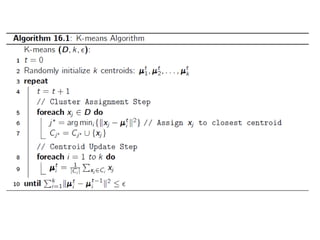
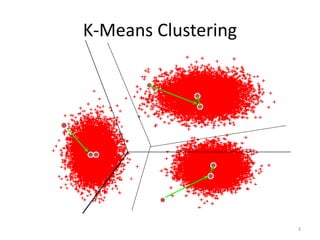
K-Means Clustering
3
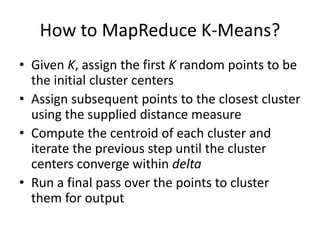
How to MapReduce K-Means?
• Given K, assign the first K random points to be
the initial cluster centers
• Assign subsequent points to the closest cluster
using the supplied distance measure
• Compute the centroid of each cluster and
iterate the previous step until the cluster
centers converge within delta
• Run a final pass over the points to cluster
them for output
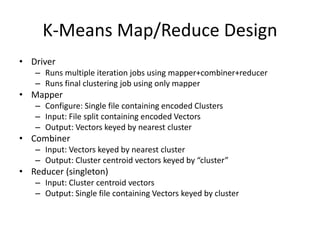
K-Means Map/Reduce Design
• Driver
– Runs multiple iteration jobs using mapper+combiner+reducer
– Runs final clustering job using only mapper
• Mapper
– Configure: Single file containing encoded Clusters
– Input: File split containing encoded Vectors
– Output: Vectors keyed by nearest cluster
• Combiner
– Input: Vectors keyed by nearest cluster
– Output: Cluster centroid vectors keyed by “cluster”
• Reducer (singleton)
– Input: Cluster centroid vectors
– Output: Single file containing Vectors keyed by cluster
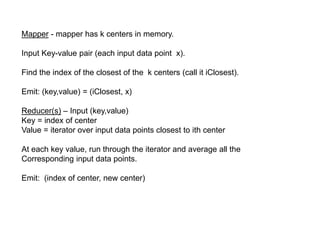
Mapper - mapper has k centers in memory.
Input Key-value pair (each input data point x).
Find the index of the closest of the k centers (call it iClosest).
Emit: (key,value) = (iClosest, x)
Reducer(s) – Input (key,value)
Key = index of center
Value = iterator over input data points closest to ith center
At each key value, run through the iterator and average all the
Corresponding input data points.
Emit: (index of center, new center)
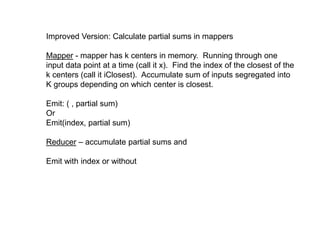
Improved Version: Calculate partial sums in mappers
Mapper - mapper has k centers in memory. Running through one
input data point at a time (call it x). Find the index of the closest of the
k centers (call it iClosest). Accumulate sum of inputs segregated into
K groups depending on which center is closest.
Emit: ( , partial sum)
Or
Emit(index, partial sum)
Reducer – accumulate partial sums and
Emit with index or without
EM-Algorithm
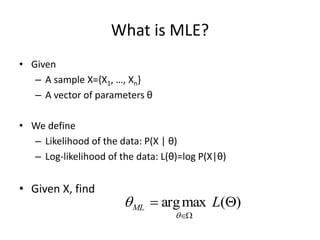
What is MLE?
• Given
– A sample X={X1, …, Xn}
– A vector of parameters θ
• We define
– Likelihood of the data: P(X | θ)
– Log-likelihood of the data: L(θ)=log P(X|θ)
• Given X, find
)
(
max
arg 



L
ML


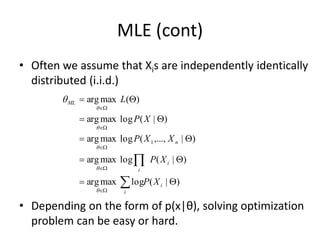
MLE (cont)
• Often we assume that Xis are independently identically
distributed (i.i.d.)
• Depending on the form of p(x|θ), solving optimization
problem can be easy or hard.
)
|
(
log
max
arg
)
|
(
log
max
arg
)
|
,...,
(
log
max
arg
)
|
(
log
max
arg
)
(
max
arg
1






















i
i
i
i
n
ML
X
P
X
P
X
X
P
X
P
L






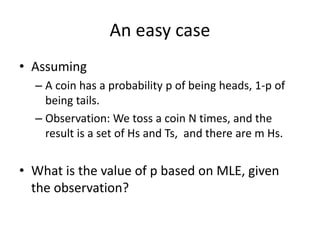
An easy case
• Assuming
– A coin has a probability p of being heads, 1-p of
being tails.
– Observation: We toss a coin N times, and the
result is a set of Hs and Ts, and there are m Hs.
• What is the value of p based on MLE, given
the observation?
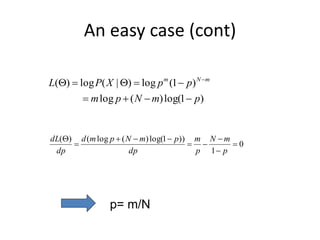
An easy case (cont)
)
1
log(
)
(
log
)
1
(
log
)
|
(
log
)
(
p
m
N
p
m
p
p
X
P
L m
N
m








 
0
1
))
1
log(
)
(
log
(
)
(










p
m
N
p
m
dp
p
m
N
p
m
d
dp
dL
p= m/N
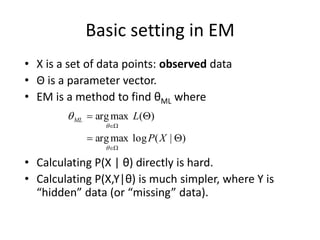
Basic setting in EM
• X is a set of data points: observed data
• Θ is a parameter vector.
• EM is a method to find θML where
• Calculating P(X | θ) directly is hard.
• Calculating P(X,Y|θ) is much simpler, where Y is
“hidden” data (or “missing” data).
)
|
(
log
max
arg
)
(
max
arg








X
P
L
ML



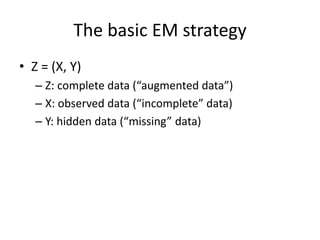
The basic EM strategy
• Z = (X, Y)
– Z: complete data (“augmented data”)
– X: observed data (“incomplete” data)
– Y: hidden data (“missing” data)
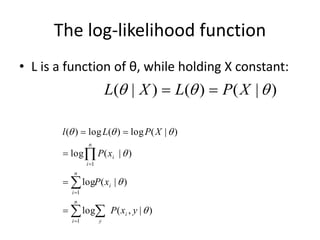
The log-likelihood function
• L is a function of θ, while holding X constant:
)
|
(
)
(
)
|
( 

 X
P
L
X
L 

)
|
,
(
log
)
|
(
log
)
|
(
log
)
|
(
log
)
(
log
)
(
1
1
1






y
x
P
x
P
x
P
X
P
L
l
i
y
n
i
i
n
i
n
i
i












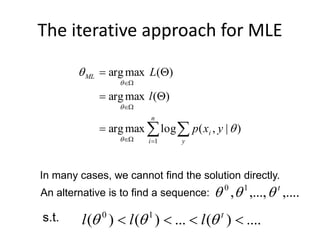
The iterative approach for MLE
)
|
,
(
log
max
arg
)
(
max
arg
)
(
max
arg
1





y
x
p
l
L
n
i y
i
ML
 












,....
,...,
, 1
0 t



In many cases, we cannot find the solution directly.
An alternative is to find a sequence:
....
)
(
...
)
(
)
( 1
0



 t
l
l
l 


s.t.
]
)
|
,
(
)
|
,
(
[log
]
)
|
,
(
)
|
,
(
[
log
)
|
,
(
)
|
,
(
)
,
|
(
log
)
|
,
(
)
|
,
(
)
|
'
,
(
)
|
,
(
log
)
|
,
(
)
|
,
(
)
|
'
,
(
)
|
,
(
log
)
|
'
,
(
)
|
,
(
log
)
|
,
(
)
|
,
(
log
)
|
,
(
log
)
|
,
(
log
)
|
(
log
)
|
(
log
)
(
)
(
1
)
,
|
(
1
)
,
|
(
1
'
1
'
1
'
1
1
1
1
t
i
i
n
i
x
y
P
t
i
i
n
i
x
y
P
t
i
i
t
n
i y
i
t
i
i
y
t
y
i
t
i
n
i
t
i
t
i
y
t
y
i
i
n
i
y
t
y
i
i
n
i
t
y
i
y
i
n
i
t
y
i
n
i
y
i
n
i
t
t
y
x
P
y
x
P
E
y
x
P
y
x
P
E
y
x
P
y
x
P
x
y
P
y
x
P
y
x
P
y
x
P
y
x
P
y
x
P
y
x
P
y
x
P
y
x
P
y
x
P
y
x
P
y
x
P
y
x
P
y
x
P
y
x
P
X
P
X
P
l
l
t
i
t
i





























 







































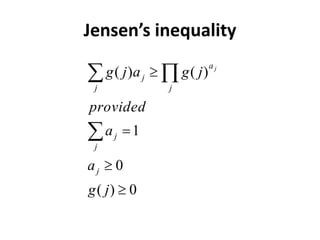
Jensen’s inequality
Jensen’s inequality
])
(
[
(
)]
(
(
[
, x
g
E
f
x
g
f
E
then
convex
is
f
if 


)])
(
[
log(
)]
(
[log( x
p
E
x
p
E 
])
(
[
(
)]
(
(
[
, x
g
E
f
x
g
f
E
then
concave
is
f
if 


log is a concave function
Maximizing the lower bound
)]
|
,
(
[log
max
arg
)
|
,
(
log
)
,
|
(
max
arg
)
|
,
(
)
|
,
(
log
)
,
|
(
max
arg
]
)
|
,
(
)
|
,
(
[log
max
arg
1
)
,
|
(
1
1
1
)
,
|
(
)
1
(















y
x
P
E
y
x
P
x
y
P
y
x
P
y
x
P
x
y
P
y
x
p
y
x
p
E
i
n
i
x
y
P
i
t
i
n
i y
t
i
i
t
i
n
i y
t
i
i
n
i
x
y
P
t
t
i
t
i













The Q function
The Q-function
• Define the Q-function (a function of θ):
– Y is a random vector.
– X=(x1, x2, …, xn) is a constant (vector).
– Θt is the current parameter estimate and is a constant (vector).
– Θ is the normal variable (vector) that we wish to adjust.
• The Q-function is the expected value of the complete data log-likelihood
P(X,Y|θ) with respect to Y given X and θt.
)
|
,
(
log
)
,
|
(
)]
|
,
(
[log
)
|
,
(
log
)
,
|
(
)]
|
,
(
[log
]
,
|
)
|
,
(
[log
)
,
(
1
1
)
,
|
(
)
,
|
(












y
x
P
x
y
P
y
x
P
E
Y
X
P
X
Y
P
Y
X
P
E
X
Y
X
P
E
Q
i
t
n
i y
i
n
i
i
x
y
P
Y
t
X
Y
P
t
t
t
i
t










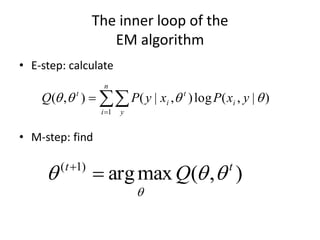
The inner loop of the
EM algorithm
• E-step: calculate
• M-step: find
)
,
(
max
arg
)
1
( t
t
Q 





)
|
,
(
log
)
,
|
(
)
,
(
1



 y
x
P
x
y
P
Q i
t
n
i y
i
t



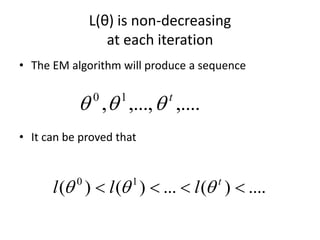
L(θ) is non-decreasing
at each iteration
• The EM algorithm will produce a sequence
• It can be proved that
,....
,...,
, 1
0 t



....
)
(
...
)
(
)
( 1
0



 t
l
l
l 


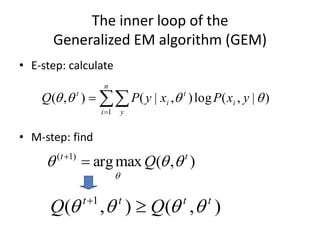
The inner loop of the
Generalized EM algorithm (GEM)
• E-step: calculate
• M-step: find
)
,
(
max
arg
)
1
( t
t
Q 





)
|
,
(
log
)
,
|
(
)
,
(
1



 y
x
P
x
y
P
Q i
t
n
i y
i
t



)
,
(
)
,
( 1 t
t
t
t
Q
Q 


 

Recap of the EM algorithm
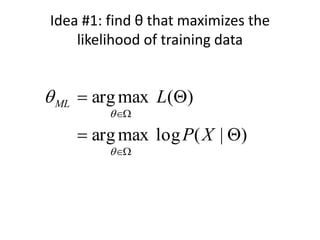
Idea #1: find θ that maximizes the
likelihood of training data
)
|
(
log
max
arg
)
(
max
arg








X
P
L
ML



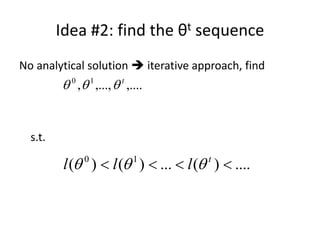
Idea #2: find the θt sequence
No analytical solution  iterative approach, find
s.t.
,....
,...,
, 1
0 t



....
)
(
...
)
(
)
( 1
0



 t
l
l
l 


Idea #3: find θt+1 that maximizes a tight
lower bound of )
(
)
( t
l
l 
 
a tight lower bound
]
)
|
,
(
)
|
,
(
[log
)
(
)
(
1
)
,
|
( t
i
i
n
i
x
y
P
t
y
x
P
y
x
P
E
l
l t
i



 




Idea #4: find θt+1 that maximizes
the Q function
)]
|
,
(
[log
max
arg
]
)
|
,
(
)
|
,
(
[log
max
arg
1
)
,
|
(
1
)
,
|
(
)
1
(








y
x
P
E
y
x
p
y
x
p
E
i
n
i
x
y
P
t
i
i
n
i
x
y
P
t
t
i
t
i







Lower bound of )
(
)
( t
l
l 
 
The Q function
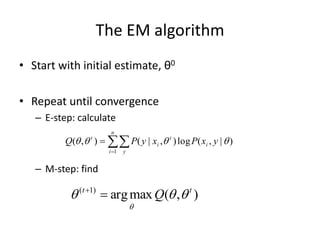
The EM algorithm
• Start with initial estimate, θ0
• Repeat until convergence
– E-step: calculate
– M-step: find
)
,
(
max
arg
)
1
( t
t
Q 





)
|
,
(
log
)
,
|
(
)
,
(
1



 y
x
P
x
y
P
Q i
t
n
i y
i
t



Important classes of EM problem
• Products of multinomial (PM) models
• Exponential families
• Gaussian mixture
• …
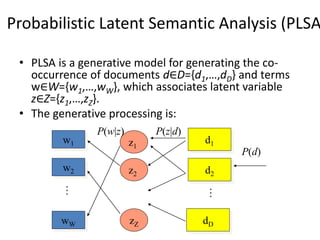
Probabilistic Latent Semantic Analysis (PLSA
• PLSA is a generative model for generating the co-
occurrence of documents d∈D={d1,…,dD} and terms
w∈W={w1,…,wW}, which associates latent variable
z∈Z={z1,…,zZ}.
• The generative processing is:
w1
w2
wW
…
d1
d2
dD
…
z1
z2
zZ
P(d)
P(z|d)
P(w|z)
Model
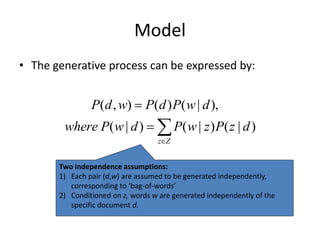
• The generative process can be expressed by:
( , ) ( ) ( | ),
( | ) ( | ) ( | )
z Z
P d w P d P w d
where P w d P w z P z d


  
Two independence assumptions:
1) Each pair (d,w) are assumed to be generated independently,
corresponding to ‘bag-of-words’
2) Conditioned on z, words w are generated independently of the
specific document d.
Model
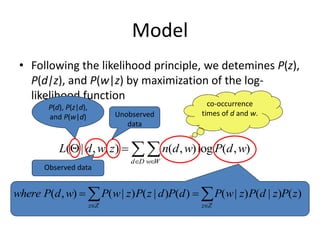
• Following the likelihood principle, we detemines P(z),
P(d|z), and P(w|z) by maximization of the log-
likelihood function
( | , , ) ( , )log ( , )
d D w W
L d w z n d w P d w
 
  
( , ) ( | ) ( | ) ( ) ( | ) ( | ) ( )
z Z z Z
where P d w P w z P z d P d P w z P d z P z
 
 
 
co-occurrence
times of d and w.
Observed data
Unobserved
data
P(d), P(z|d),
and P(w|d)
Maximum-likelihood
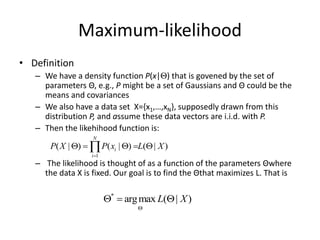
• Definition
– We have a density function P(x|Θ) that is govened by the set of
parameters Θ, e.g., P might be a set of Gaussians and Θ could be the
means and covariances
– We also have a data set X={x1,…,xN}, supposedly drawn from this
distribution P, and assume these data vectors are i.i.d. with P.
– Then the likehihood function is:
– The likelihood is thought of as a function of the parameters Θwhere
the data X is fixed. Our goal is to find the Θthat maximizes L. That is
1
( | ) ( | ) ( | )
N
i
i
P X P x L X

    

*
argmax ( | )
L X

  
Jensen’s inequality
0
)
(
0
1
)
(
)
(





 
j
g
a
a
provided
j
g
a
j
g
j
j
j
j j
a
j
j
 
  


D
d W
w Z
z
z
d
P
z
w
P
z
P
w
d
n
z
w
d
L )
|
(
)
|
(
)
(
log
)
,
(
max
)
,
,
|
(
max
Estimation-using EM
difficult!!!
Idea: start with a guess t, compute an easily computed lower-bound B(; t)
to the function log P(|U) and maximize the bound instead
By Jensen’s inequality:
)
,
|
(
]
)
,
|
(
)
|
(
)
|
(
)
(
[
)
,
|
(
)
,
|
(
)
|
(
)
|
(
)
(
d
w
z
P
Z
z j d
w
z
P
z
d
P
z
w
P
z
P
d
w
z
P
d
w
z
P
z
d
P
z
w
P
z
P
 


 


 
 





D
d W
w z
d
w
z
P
z
D
d W
w
t
d
w
z
P
d
w
z
P
z
d
P
z
w
P
z
P
w
d
n
d
w
z
P
z
d
P
z
w
P
z
P
w
d
n
B
)
,
|
(
)]
,
|
(
log
)
|
(
)
|
(
)
(
[log
)
,
(
max
]
)
,
|
(
)
|
(
)
|
(
)
(
[
log
)
,
(
max
)
,
(
max
)
,
|
(
(1)Solve P(w|z)
• We introduce Lagrange multiplier λwith the constraint that
∑wP(w|z)=1, and solve the following equation:
( , ) [log ( ) ( | ) ( | ) log ( | , )] ( | , ) ( ( | ) 1) 0
( | )
( , ) ( | , )
0,
( | )
( , ) ( | , )
( | ) ,
( | ) 1,
( , ) ( | , ),
( , )
( | )
d D w W z w
d D
d D
w
w W d D
n d w P z P w z P d z P z w d P z w d P w z
P w z
n d w P z d w
P w z
n d w P z d w
P w z
P w z
n d w P z d w
n d w P
P w z




 


 
  
   
 
  
  
  

  
 
   



 
( | , )
( , ) ( | , )
d D
w W d D
z d w
n d w P z d w

 

 
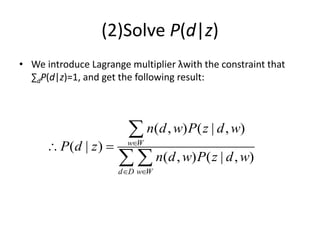
(2)Solve P(d|z)
• We introduce Lagrange multiplier λwith the constraint that
∑dP(d|z)=1, and get the following result:
( , ) ( | , )
( | )
( , ) ( | , )
w W
d D w W
n d w P z d w
P d z
n d w P z d w

 
 

 
(3)Solve P(z)
• We introduce Lagrange multiplier λwith the constraint that
∑zP(z)=1, and solve the following equation:
( , ) [log ( ) ( | ) ( | ) log ( | , )] ( | , ) ( ( ) 1) 0
( )
( , ) ( | , )
0,
( )
( , ) ( | , )
( ) ,
( ) 1,
( , ) ( | , ) ( , ),
d D w W z z
d D w W
d D w W
z
d D w W z d D w W
n d w P z P w z P d z P z w d P z w d P z
P z
n d w P z d w
P z
n d w P z d w
P z
P z
n d w P z d w n d w




 
 
 
   
  
   
 
  
  
  

    
   
 
 

   
( , ) ( | , )
( )
( , )
d D w W
w W d D
n d w P z d w
P z
n d w
 
 
 

 
 
(1)Solve P(z|d,w)
• We introduce Lagrange multiplier λwith the constraint that
∑zP(z|d,w)=1, and solve the following equation:
,
,
,
( , ) [log ( ) ( | ) ( | ) log ( | , )] ( | , ) ( ( | , ) 1) 0
( | , )
( , )[log ( ) ( | ) ( | ) log ( | , ) 1] 0,
log ( | , ) log ( ) ( | ) ( | ) 1 0,
( |
d w
d D w W z d D w W z
d w
d w
n d w P z P w z P d z P z d w P z d w P z d w
P z d w
n d w P z P w z P d z P z d w
P z d w P z P w z P d z
P z d



   
  
   
 
  
    
    

     
,
,
,
1
1
,
1
1 (1 log ( ) ( | ) ( | ))
, ) ( ) ( | ) ( | )
( | , ) 1,
( ) ( | ) ( | ) 1
1 log ( ) ( | ) ( | )
( ) ( | ) ( | )
( | )
( ) ( | ) ( | )
( ) ( | ) ( | )
( ) ( |
d w
d w
d w
z
z
z
d w
z
P z P w z P d z
w P z P w z P d z e
P z d w
P z P w z P d z e
P z P w z P d z
P z P w z P d z
P w z
e
P z P w z P d z
e
P z P w z P d z
P z P w z







 


 
  
 






) ( | )
z
P d z

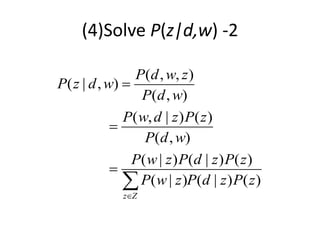
(4)Solve P(z|d,w) -2
( , , )
( | , )
( , )
( , | ) ( )
( , )
( | ) ( | ) ( )
( | ) ( | ) ( )
z Z
P d w z
P z d w
P d w
P w d z P z
P d w
P w z P d z P z
P w z P d z P z





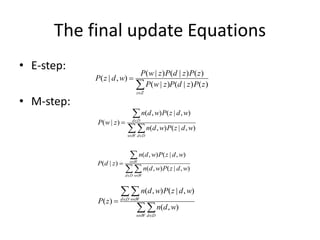
The final update Equations
• E-step:
• M-step:
( | ) ( | ) ( )
( | , )
( | ) ( | ) ( )
z Z
P w z P d z P z
P z d w
P w z P d z P z



( , ) ( | , )
( | )
( , ) ( | , )
d D
w W d D
n d w P z d w
P w z
n d w P z d w

 



( , ) ( | , )
( | )
( , ) ( | , )
w W
d D w W
n d w P z d w
P d z
n d w P z d w

 



( , ) ( | , )
( )
( , )
d D w W
w W d D
n d w P z d w
P z
n d w
 
 



Coding Design
• Variables:
• double[][] p_dz_n // p(d|z), |D|*|Z|
• double[][] p_wz_n // p(w|z), |W|*|Z|
• double[] p_z_n // p(z), |Z|
• Running Processing:
1. Read dataset from file
ArrayList<DocWordPair> doc; // all the docs
DocWordPair – (word_id, word_frequency_in_doc)
2. Parameter Initialization
Assign each elements of p_dz_n, p_wz_n and p_z_n with a random double value, satisfying
∑d p_dz_n=1, ∑d p_wz_n =1, and ∑d p_z_n =1
3. Estimation (Iterative processing)
1. Update p_dz_n, p_wz_n and p_z_n
2. Calculate Log-likelihood function to see where ( |Log-likelihood – old_Log-likelihood|
< threshold)
4. Output p_dz_n, p_wz_n and p_z_n
Coding Design
• Update p_dz_n
For each doc d{
For each word w included in d {
denominator = 0;
nominator = new double[Z];
For each topic z {
nominator[z] = p_dz_n[d][z]* p_wz_n[w][z]* p_z_n[z]
denominator +=nominator[z];
} // end for each topic z
For each topic z {
P_z_condition_d_w = nominator[j]/denominator;
nominator_p_dz_n[d][z] += tfwd*P_z_condition_d_w;
denominator_p_dz_n[z] += tfwd*P_z_condition_d_w;
} // end for each topic z
}// end for each word w included in d
}// end for each doc d
For each doc d {
For each topic z {
p_dz_n_new[d][z] = nominator_p_dz_n[d][z]/ denominator_p_dz_n[z];
} // end for each topic z
}// end for each doc d
Coding Design
• Update p_wz_n
For each doc d{
For each word w included in d {
denominator = 0;
nominator = new double[Z];
For each topic z {
nominator[z] = p_dz_n[d][z]* p_wz_n[w][z]* p_z_n[z]
denominator +=nominator[z];
} // end for each topic z
For each topic z {
P_z_condition_d_w = nominator[j]/denominator;
nominator_p_wz_n[w][z] += tfwd*P_z_condition_d_w;
denominator_p_wz_n[z] += tfwd*P_z_condition_d_w;
} // end for each topic z
}// end for each word w included in d
}// end for each doc d
For each w {
For each topic z {
p_wz_n_new[w][z] = nominator_p_wz_n[w][z]/ denominator_p_wz_n[z];
} // end for each topic z
}// end for each doc d
Coding Design
• Update p_z_n
For each doc d{
For each word w included in d {
denominator = 0;
nominator = new double[Z];
For each topic z {
nominator[z] = p_dz_n[d][z]* p_wz_n[w][z]* p_z_n[z]
denominator +=nominator[z];
} // end for each topic z
For each topic z {
P_z_condition_d_w = nominator[j]/denominator;
nominator_p_z_n[z] += tfwd*P_z_condition_d_w;
} // end for each topic z
denominator_p_z_n[z] += tfwd;
}// end for each word w included in d
}// end for each doc d
For each topic z{
p_dz_n_new[d][j] = nominator_p_z_n[z]/ denominator_p_z_n;
} // end for each topic z
Apache Mahout
Industrial Strength Machine Learning
GraphLab
Current Situation
• Large volumes of data are now available
• Platforms now exist to run computations over
large datasets (Hadoop, HBase)
• Sophisticated analytics are needed to turn data
into information people can use
• Active research community and proprietary
implementations of “machine learning”
algorithms
• The world needs scalable implementations of ML
under open license - ASF
History of Mahout
• Summer 2007
– Developers needed scalable ML
– Mailing list formed
• Community formed
– Apache contributors
– Academia & industry
– Lots of initial interest
• Project formed under Apache Lucene
– January 25, 2008
Current Code Base
• Matrix & Vector library
– Memory resident sparse & dense implementations
• Clustering
– Canopy
– K-Means
– Mean Shift
• Collaborative Filtering
– Taste
• Utilities
– Distance Measures
– Parameters
Others
• Naïve Bayes
• Perceptron
• PLSI/EM
• Genetic Programming
• Dirichlet Process Clustering
• Clustering Examples
• Hama (Incubator) for very large arrays

Machine Learning With MapReduce, K-Means, MLE

  • 1.
  • 3.
  • 4.
    How to MapReduceK-Means? • Given K, assign the first K random points to be the initial cluster centers • Assign subsequent points to the closest cluster using the supplied distance measure • Compute the centroid of each cluster and iterate the previous step until the cluster centers converge within delta • Run a final pass over the points to cluster them for output
  • 5.
    K-Means Map/Reduce Design •Driver – Runs multiple iteration jobs using mapper+combiner+reducer – Runs final clustering job using only mapper • Mapper – Configure: Single file containing encoded Clusters – Input: File split containing encoded Vectors – Output: Vectors keyed by nearest cluster • Combiner – Input: Vectors keyed by nearest cluster – Output: Cluster centroid vectors keyed by “cluster” • Reducer (singleton) – Input: Cluster centroid vectors – Output: Single file containing Vectors keyed by cluster
  • 6.
    Mapper - mapperhas k centers in memory. Input Key-value pair (each input data point x). Find the index of the closest of the k centers (call it iClosest). Emit: (key,value) = (iClosest, x) Reducer(s) – Input (key,value) Key = index of center Value = iterator over input data points closest to ith center At each key value, run through the iterator and average all the Corresponding input data points. Emit: (index of center, new center)
  • 7.
    Improved Version: Calculatepartial sums in mappers Mapper - mapper has k centers in memory. Running through one input data point at a time (call it x). Find the index of the closest of the k centers (call it iClosest). Accumulate sum of inputs segregated into K groups depending on which center is closest. Emit: ( , partial sum) Or Emit(index, partial sum) Reducer – accumulate partial sums and Emit with index or without
  • 8.
  • 9.
    What is MLE? •Given – A sample X={X1, …, Xn} – A vector of parameters θ • We define – Likelihood of the data: P(X | θ) – Log-likelihood of the data: L(θ)=log P(X|θ) • Given X, find ) ( max arg     L ML  
  • 10.
    MLE (cont) • Oftenwe assume that Xis are independently identically distributed (i.i.d.) • Depending on the form of p(x|θ), solving optimization problem can be easy or hard. ) | ( log max arg ) | ( log max arg ) | ,..., ( log max arg ) | ( log max arg ) ( max arg 1                       i i i i n ML X P X P X X P X P L      
  • 11.
    An easy case •Assuming – A coin has a probability p of being heads, 1-p of being tails. – Observation: We toss a coin N times, and the result is a set of Hs and Ts, and there are m Hs. • What is the value of p based on MLE, given the observation?
  • 12.
    An easy case(cont) ) 1 log( ) ( log ) 1 ( log ) | ( log ) ( p m N p m p p X P L m N m           0 1 )) 1 log( ) ( log ( ) (           p m N p m dp p m N p m d dp dL p= m/N
  • 13.
    Basic setting inEM • X is a set of data points: observed data • Θ is a parameter vector. • EM is a method to find θML where • Calculating P(X | θ) directly is hard. • Calculating P(X,Y|θ) is much simpler, where Y is “hidden” data (or “missing” data). ) | ( log max arg ) ( max arg         X P L ML   
  • 14.
    The basic EMstrategy • Z = (X, Y) – Z: complete data (“augmented data”) – X: observed data (“incomplete” data) – Y: hidden data (“missing” data)
  • 15.
    The log-likelihood function •L is a function of θ, while holding X constant: ) | ( ) ( ) | (    X P L X L   ) | , ( log ) | ( log ) | ( log ) | ( log ) ( log ) ( 1 1 1       y x P x P x P X P L l i y n i i n i n i i            
  • 16.
    The iterative approachfor MLE ) | , ( log max arg ) ( max arg ) ( max arg 1      y x p l L n i y i ML               ,.... ,..., , 1 0 t    In many cases, we cannot find the solution directly. An alternative is to find a sequence: .... ) ( ... ) ( ) ( 1 0     t l l l    s.t.
  • 17.
    ] ) | , ( ) | , ( [log ] ) | , ( ) | , ( [ log ) | , ( ) | , ( ) , | ( log ) | , ( ) | , ( ) | ' , ( ) | , ( log ) | , ( ) | , ( ) | ' , ( ) | , ( log ) | ' , ( ) | , ( log ) | , ( ) | , ( log ) | , ( log ) | , ( log ) | ( log ) | ( log ) ( ) ( 1 ) , | ( 1 ) , | ( 1 ' 1 ' 1 ' 1 1 1 1 t i i n i x y P t i i n i x y P t i i t n i y i t i i y t y i t i n i t i t i y t y i i n i y t y i i n i t y i y i n i t y i n i y i n i t t y x P y x P E y x P y x P E y x P y x P x y P y x P y x P y x P y x P y x P y x P y x P y x P y x P y x P y x P y x P y x P y x P X P X P l l t i t i                                                                       Jensen’sinequality
  • 18.
    Jensen’s inequality ]) ( [ ( )] ( ( [ , x g E f x g f E then convex is f if   )]) ( [ log( )] ( [log( x p E x p E  ]) ( [ ( )] ( ( [ , x g E f x g f E then concave is f if    log is a concave function
  • 19.
    Maximizing the lowerbound )] | , ( [log max arg ) | , ( log ) , | ( max arg ) | , ( ) | , ( log ) , | ( max arg ] ) | , ( ) | , ( [log max arg 1 ) , | ( 1 1 1 ) , | ( ) 1 (                y x P E y x P x y P y x P y x P x y P y x p y x p E i n i x y P i t i n i y t i i t i n i y t i i n i x y P t t i t i              The Q function
  • 20.
    The Q-function • Definethe Q-function (a function of θ): – Y is a random vector. – X=(x1, x2, …, xn) is a constant (vector). – Θt is the current parameter estimate and is a constant (vector). – Θ is the normal variable (vector) that we wish to adjust. • The Q-function is the expected value of the complete data log-likelihood P(X,Y|θ) with respect to Y given X and θt. ) | , ( log ) , | ( )] | , ( [log ) | , ( log ) , | ( )] | , ( [log ] , | ) | , ( [log ) , ( 1 1 ) , | ( ) , | (             y x P x y P y x P E Y X P X Y P Y X P E X Y X P E Q i t n i y i n i i x y P Y t X Y P t t t i t          
  • 21.
    The inner loopof the EM algorithm • E-step: calculate • M-step: find ) , ( max arg ) 1 ( t t Q       ) | , ( log ) , | ( ) , ( 1     y x P x y P Q i t n i y i t   
  • 22.
    L(θ) is non-decreasing ateach iteration • The EM algorithm will produce a sequence • It can be proved that ,.... ,..., , 1 0 t    .... ) ( ... ) ( ) ( 1 0     t l l l   
  • 23.
    The inner loopof the Generalized EM algorithm (GEM) • E-step: calculate • M-step: find ) , ( max arg ) 1 ( t t Q       ) | , ( log ) , | ( ) , ( 1     y x P x y P Q i t n i y i t    ) , ( ) , ( 1 t t t t Q Q      
  • 24.
    Recap of theEM algorithm
  • 25.
    Idea #1: findθ that maximizes the likelihood of training data ) | ( log max arg ) ( max arg         X P L ML   
  • 26.
    Idea #2: findthe θt sequence No analytical solution  iterative approach, find s.t. ,.... ,..., , 1 0 t    .... ) ( ... ) ( ) ( 1 0     t l l l   
  • 27.
    Idea #3: findθt+1 that maximizes a tight lower bound of ) ( ) ( t l l    a tight lower bound ] ) | , ( ) | , ( [log ) ( ) ( 1 ) , | ( t i i n i x y P t y x P y x P E l l t i         
  • 28.
    Idea #4: findθt+1 that maximizes the Q function )] | , ( [log max arg ] ) | , ( ) | , ( [log max arg 1 ) , | ( 1 ) , | ( ) 1 (         y x P E y x p y x p E i n i x y P t i i n i x y P t t i t i        Lower bound of ) ( ) ( t l l    The Q function
  • 29.
    The EM algorithm •Start with initial estimate, θ0 • Repeat until convergence – E-step: calculate – M-step: find ) , ( max arg ) 1 ( t t Q       ) | , ( log ) , | ( ) , ( 1     y x P x y P Q i t n i y i t   
  • 30.
    Important classes ofEM problem • Products of multinomial (PM) models • Exponential families • Gaussian mixture • …
  • 31.
    Probabilistic Latent SemanticAnalysis (PLSA • PLSA is a generative model for generating the co- occurrence of documents d∈D={d1,…,dD} and terms w∈W={w1,…,wW}, which associates latent variable z∈Z={z1,…,zZ}. • The generative processing is: w1 w2 wW … d1 d2 dD … z1 z2 zZ P(d) P(z|d) P(w|z)
  • 32.
    Model • The generativeprocess can be expressed by: ( , ) ( ) ( | ), ( | ) ( | ) ( | ) z Z P d w P d P w d where P w d P w z P z d      Two independence assumptions: 1) Each pair (d,w) are assumed to be generated independently, corresponding to ‘bag-of-words’ 2) Conditioned on z, words w are generated independently of the specific document d.
  • 33.
    Model • Following thelikelihood principle, we detemines P(z), P(d|z), and P(w|z) by maximization of the log- likelihood function ( | , , ) ( , )log ( , ) d D w W L d w z n d w P d w      ( , ) ( | ) ( | ) ( ) ( | ) ( | ) ( ) z Z z Z where P d w P w z P z d P d P w z P d z P z       co-occurrence times of d and w. Observed data Unobserved data P(d), P(z|d), and P(w|d)
  • 34.
    Maximum-likelihood • Definition – Wehave a density function P(x|Θ) that is govened by the set of parameters Θ, e.g., P might be a set of Gaussians and Θ could be the means and covariances – We also have a data set X={x1,…,xN}, supposedly drawn from this distribution P, and assume these data vectors are i.i.d. with P. – Then the likehihood function is: – The likelihood is thought of as a function of the parameters Θwhere the data X is fixed. Our goal is to find the Θthat maximizes L. That is 1 ( | ) ( | ) ( | ) N i i P X P x L X        * argmax ( | ) L X    
  • 35.
  • 36.
          D d W w Z z z d P z w P z P w d n z w d L ) | ( ) | ( ) ( log ) , ( max ) , , | ( max Estimation-using EM difficult!!! Idea: start with a guess t, compute an easily computed lower-bound B(; t) to the function log P(|U) and maximize the bound instead By Jensen’s inequality: ) , | ( ] ) , | ( ) | ( ) | ( ) ( [ ) , | ( ) , | ( ) | ( ) | ( ) ( d w z P Z z j d w z P z d P z w P z P d w z P d w z P z d P z w P z P                  D d W w z d w z P z D d W w t d w z P d w z P z d P z w P z P w d n d w z P z d P z w P z P w d n B ) , | ( )] , | ( log ) | ( ) | ( ) ( [log ) , ( max ] ) , | ( ) | ( ) | ( ) ( [ log ) , ( max ) , ( max ) , | (
  • 37.
    (1)Solve P(w|z) • Weintroduce Lagrange multiplier λwith the constraint that ∑wP(w|z)=1, and solve the following equation: ( , ) [log ( ) ( | ) ( | ) log ( | , )] ( | , ) ( ( | ) 1) 0 ( | ) ( , ) ( | , ) 0, ( | ) ( , ) ( | , ) ( | ) , ( | ) 1, ( , ) ( | , ), ( , ) ( | ) d D w W z w d D d D w w W d D n d w P z P w z P d z P z w d P z w d P w z P w z n d w P z d w P w z n d w P z d w P w z P w z n d w P z d w n d w P P w z                                            ( | , ) ( , ) ( | , ) d D w W d D z d w n d w P z d w      
  • 38.
    (2)Solve P(d|z) • Weintroduce Lagrange multiplier λwith the constraint that ∑dP(d|z)=1, and get the following result: ( , ) ( | , ) ( | ) ( , ) ( | , ) w W d D w W n d w P z d w P d z n d w P z d w        
  • 39.
    (3)Solve P(z) • Weintroduce Lagrange multiplier λwith the constraint that ∑zP(z)=1, and solve the following equation: ( , ) [log ( ) ( | ) ( | ) log ( | , )] ( | , ) ( ( ) 1) 0 ( ) ( , ) ( | , ) 0, ( ) ( , ) ( | , ) ( ) , ( ) 1, ( , ) ( | , ) ( , ), d D w W z z d D w W d D w W z d D w W z d D w W n d w P z P w z P d z P z w d P z w d P z P z n d w P z d w P z n d w P z d w P z P z n d w P z d w n d w                                                    ( , ) ( | , ) ( ) ( , ) d D w W w W d D n d w P z d w P z n d w           
  • 40.
    (1)Solve P(z|d,w) • Weintroduce Lagrange multiplier λwith the constraint that ∑zP(z|d,w)=1, and solve the following equation: , , , ( , ) [log ( ) ( | ) ( | ) log ( | , )] ( | , ) ( ( | , ) 1) 0 ( | , ) ( , )[log ( ) ( | ) ( | ) log ( | , ) 1] 0, log ( | , ) log ( ) ( | ) ( | ) 1 0, ( | d w d D w W z d D w W z d w d w n d w P z P w z P d z P z d w P z d w P z d w P z d w n d w P z P w z P d z P z d w P z d w P z P w z P d z P z d                                     , , , 1 1 , 1 1 (1 log ( ) ( | ) ( | )) , ) ( ) ( | ) ( | ) ( | , ) 1, ( ) ( | ) ( | ) 1 1 log ( ) ( | ) ( | ) ( ) ( | ) ( | ) ( | ) ( ) ( | ) ( | ) ( ) ( | ) ( | ) ( ) ( | d w d w d w z z z d w z P z P w z P d z w P z P w z P d z e P z d w P z P w z P d z e P z P w z P d z P z P w z P d z P w z e P z P w z P d z e P z P w z P d z P z P w z                         ) ( | ) z P d z 
  • 41.
    (4)Solve P(z|d,w) -2 (, , ) ( | , ) ( , ) ( , | ) ( ) ( , ) ( | ) ( | ) ( ) ( | ) ( | ) ( ) z Z P d w z P z d w P d w P w d z P z P d w P w z P d z P z P w z P d z P z     
  • 42.
    The final updateEquations • E-step: • M-step: ( | ) ( | ) ( ) ( | , ) ( | ) ( | ) ( ) z Z P w z P d z P z P z d w P w z P d z P z    ( , ) ( | , ) ( | ) ( , ) ( | , ) d D w W d D n d w P z d w P w z n d w P z d w       ( , ) ( | , ) ( | ) ( , ) ( | , ) w W d D w W n d w P z d w P d z n d w P z d w       ( , ) ( | , ) ( ) ( , ) d D w W w W d D n d w P z d w P z n d w       
  • 43.
    Coding Design • Variables: •double[][] p_dz_n // p(d|z), |D|*|Z| • double[][] p_wz_n // p(w|z), |W|*|Z| • double[] p_z_n // p(z), |Z| • Running Processing: 1. Read dataset from file ArrayList<DocWordPair> doc; // all the docs DocWordPair – (word_id, word_frequency_in_doc) 2. Parameter Initialization Assign each elements of p_dz_n, p_wz_n and p_z_n with a random double value, satisfying ∑d p_dz_n=1, ∑d p_wz_n =1, and ∑d p_z_n =1 3. Estimation (Iterative processing) 1. Update p_dz_n, p_wz_n and p_z_n 2. Calculate Log-likelihood function to see where ( |Log-likelihood – old_Log-likelihood| < threshold) 4. Output p_dz_n, p_wz_n and p_z_n
  • 44.
    Coding Design • Updatep_dz_n For each doc d{ For each word w included in d { denominator = 0; nominator = new double[Z]; For each topic z { nominator[z] = p_dz_n[d][z]* p_wz_n[w][z]* p_z_n[z] denominator +=nominator[z]; } // end for each topic z For each topic z { P_z_condition_d_w = nominator[j]/denominator; nominator_p_dz_n[d][z] += tfwd*P_z_condition_d_w; denominator_p_dz_n[z] += tfwd*P_z_condition_d_w; } // end for each topic z }// end for each word w included in d }// end for each doc d For each doc d { For each topic z { p_dz_n_new[d][z] = nominator_p_dz_n[d][z]/ denominator_p_dz_n[z]; } // end for each topic z }// end for each doc d
  • 45.
    Coding Design • Updatep_wz_n For each doc d{ For each word w included in d { denominator = 0; nominator = new double[Z]; For each topic z { nominator[z] = p_dz_n[d][z]* p_wz_n[w][z]* p_z_n[z] denominator +=nominator[z]; } // end for each topic z For each topic z { P_z_condition_d_w = nominator[j]/denominator; nominator_p_wz_n[w][z] += tfwd*P_z_condition_d_w; denominator_p_wz_n[z] += tfwd*P_z_condition_d_w; } // end for each topic z }// end for each word w included in d }// end for each doc d For each w { For each topic z { p_wz_n_new[w][z] = nominator_p_wz_n[w][z]/ denominator_p_wz_n[z]; } // end for each topic z }// end for each doc d
  • 46.
    Coding Design • Updatep_z_n For each doc d{ For each word w included in d { denominator = 0; nominator = new double[Z]; For each topic z { nominator[z] = p_dz_n[d][z]* p_wz_n[w][z]* p_z_n[z] denominator +=nominator[z]; } // end for each topic z For each topic z { P_z_condition_d_w = nominator[j]/denominator; nominator_p_z_n[z] += tfwd*P_z_condition_d_w; } // end for each topic z denominator_p_z_n[z] += tfwd; }// end for each word w included in d }// end for each doc d For each topic z{ p_dz_n_new[d][j] = nominator_p_z_n[z]/ denominator_p_z_n; } // end for each topic z
  • 47.
    Apache Mahout Industrial StrengthMachine Learning GraphLab
  • 48.
    Current Situation • Largevolumes of data are now available • Platforms now exist to run computations over large datasets (Hadoop, HBase) • Sophisticated analytics are needed to turn data into information people can use • Active research community and proprietary implementations of “machine learning” algorithms • The world needs scalable implementations of ML under open license - ASF
  • 49.
    History of Mahout •Summer 2007 – Developers needed scalable ML – Mailing list formed • Community formed – Apache contributors – Academia & industry – Lots of initial interest • Project formed under Apache Lucene – January 25, 2008
  • 50.
    Current Code Base •Matrix & Vector library – Memory resident sparse & dense implementations • Clustering – Canopy – K-Means – Mean Shift • Collaborative Filtering – Taste • Utilities – Distance Measures – Parameters
  • 51.
    Others • Naïve Bayes •Perceptron • PLSI/EM • Genetic Programming • Dirichlet Process Clustering • Clustering Examples • Hama (Incubator) for very large arrays