THE NEW NEWS MEDIA-SCAPE   Lee Rainie – Director Pew Internet Project Public Broadcasters – Atlanta  February 17, 2009
New information ecosystem:  Then   and  Now Industrial Age Info was: Scarce Expensive Institutionally oriented Designed for consumption Information Age Info is: Abundant Cheap Personally oriented Designed for participation
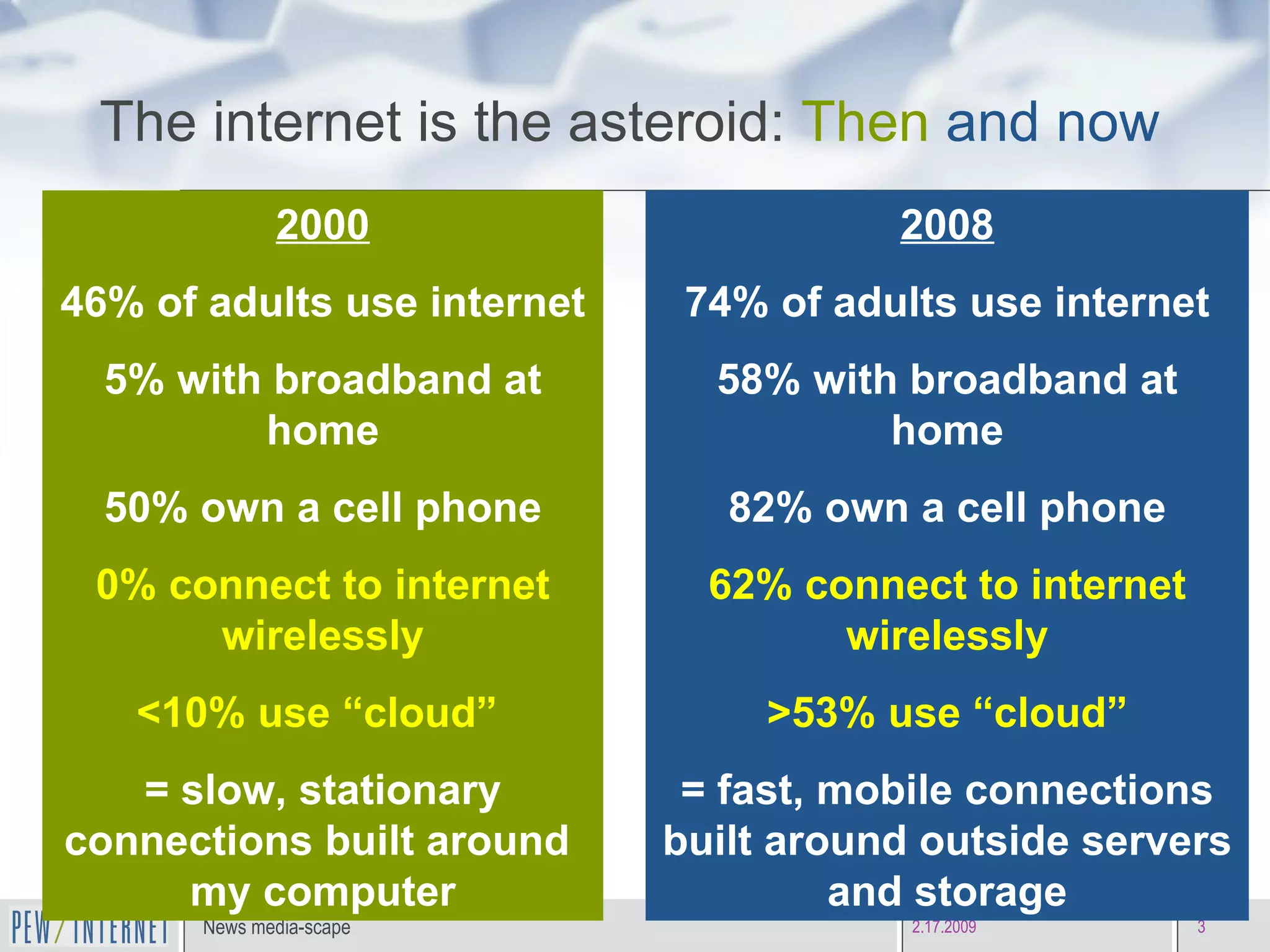
2000 46% of adults use internet 5% with broadband at home 50% own a cell phone 0% connect to internet wirelessly <10% use “cloud”  = slow, stationary connections built around  my computer The internet is the asteroid:  Then   and now 2008 74% of adults use internet 58% with broadband at home 82% own a cell phone 62% connect to internet wirelessly >53% use “cloud” = fast, mobile connections built around outside servers and storage
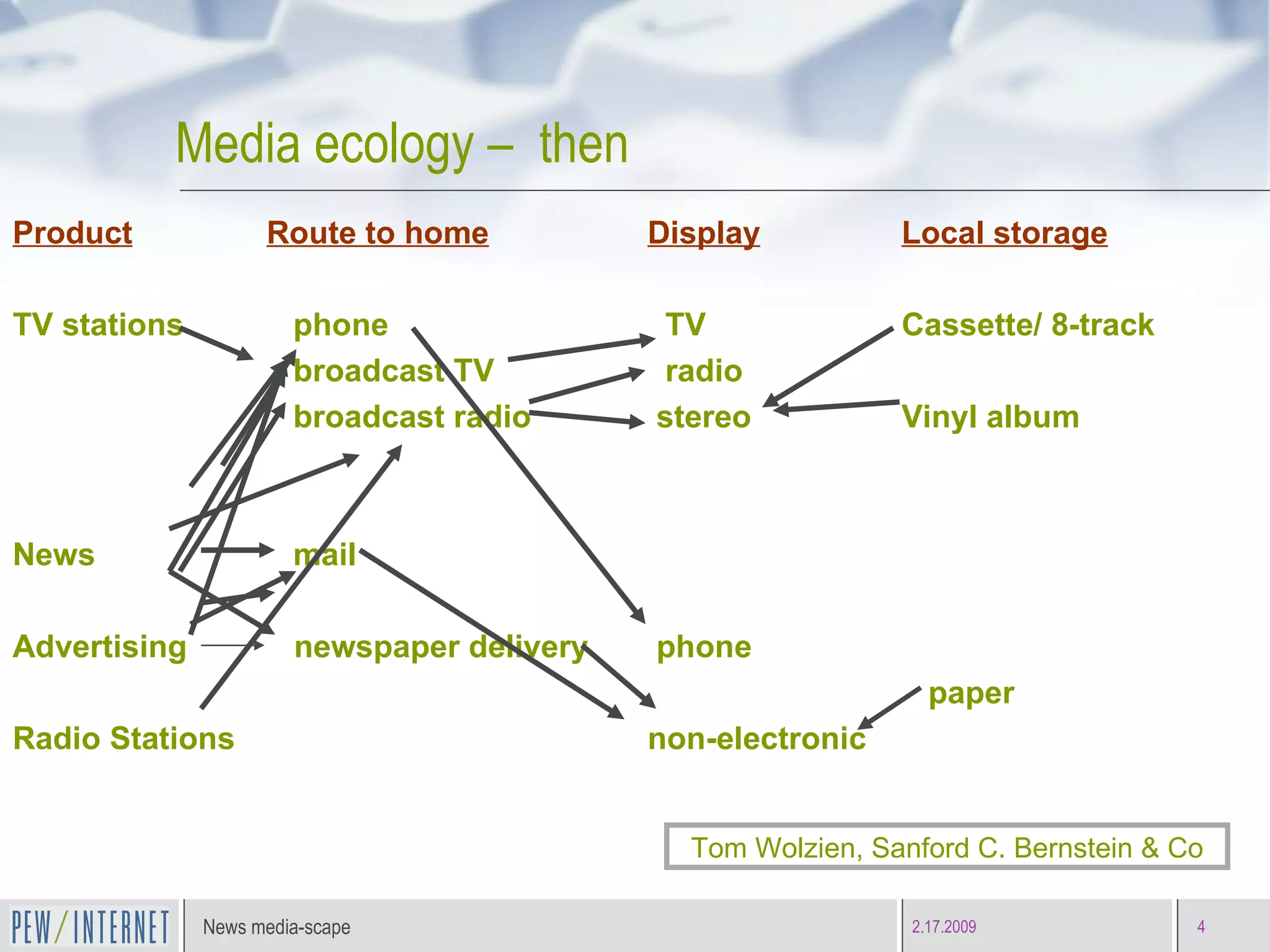
Media ecology –  then Product   Route to home   Display   Local storage TV stations   phone     TV Cassette/ 8-track   broadcast TV   radio   broadcast radio  stereo Vinyl album News   mail Advertising  newspaper delivery  phone   paper Radio Stations non-electronic Tom Wolzien, Sanford C. Bernstein & Co
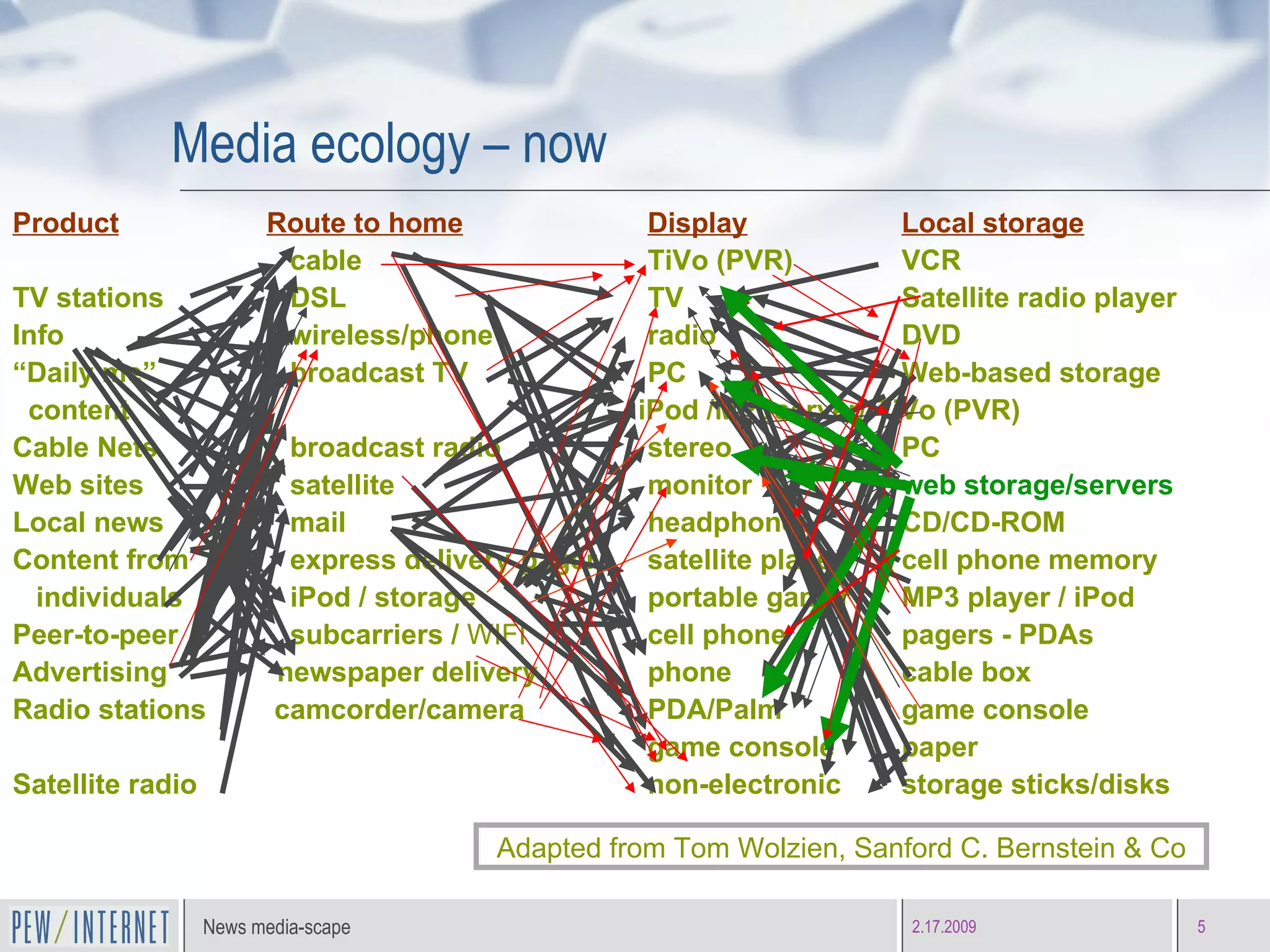
Media ecology – now Product   Route to home   Display   Local storage   cable TiVo (PVR) VCR TV stations   DSL TV Satellite radio player Info   wireless/phone radio DVD “ Daily me”    broadcast TV PC Web-based storage content       iPod /MP3 server/ TiVo (PVR) Cable Nets   broadcast radio stereo PC Web sites   satellite monitor web storage/servers Local news   mail headphones CD/CD-ROM Content from   express delivery pager satellite player cell phone memory individuals   iPod / storage portable gamer MP3 player / iPod Peer-to-peer   subcarriers /  WIFI cell phone pagers - PDAs Advertising  newspaper delivery phone cable box Radio stations  camcorder/camera PDA/Palm game console game console paper Satellite radio non-electronic storage sticks/disks Adapted from Tom Wolzien, Sanford C. Bernstein & Co
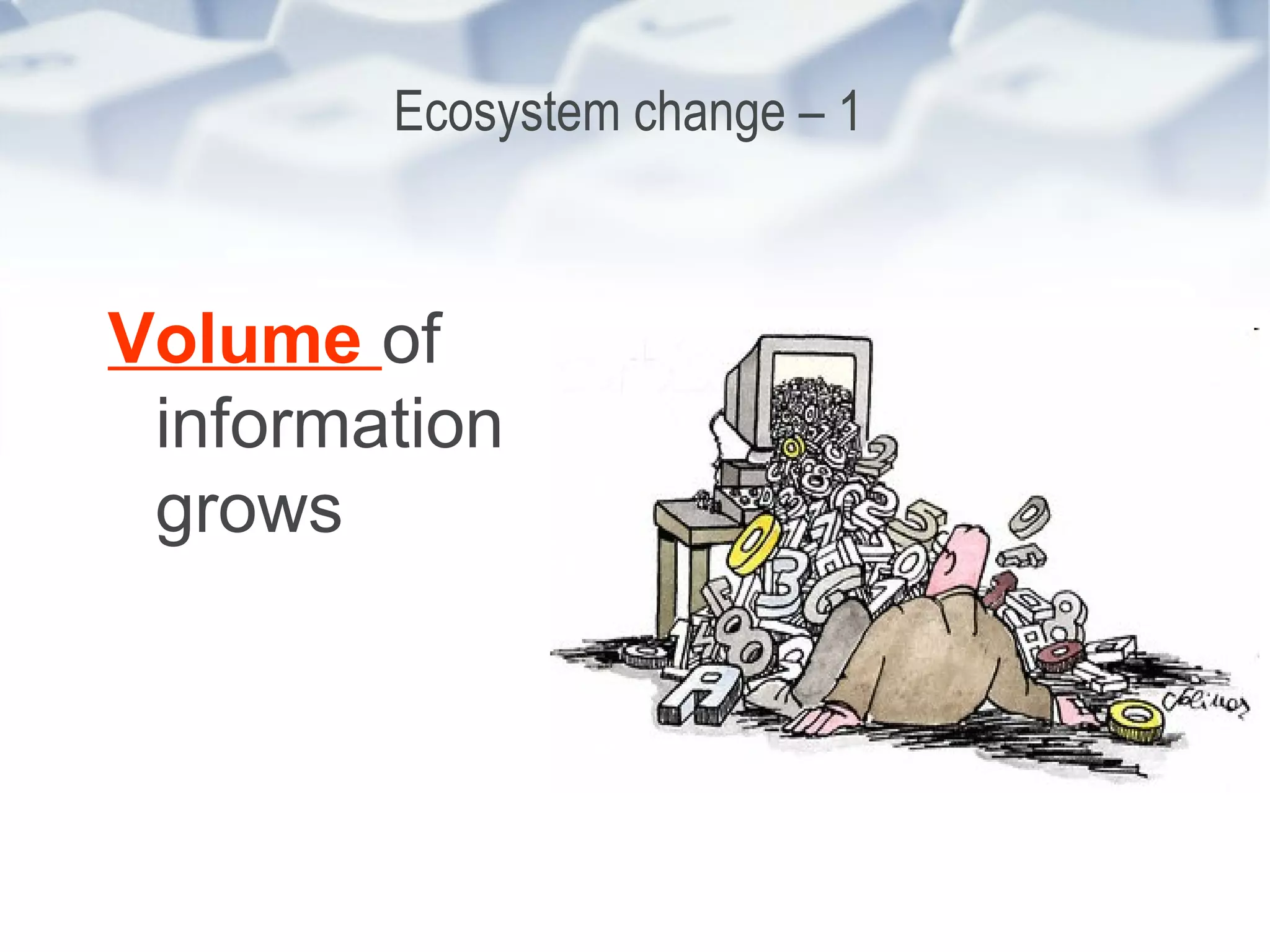
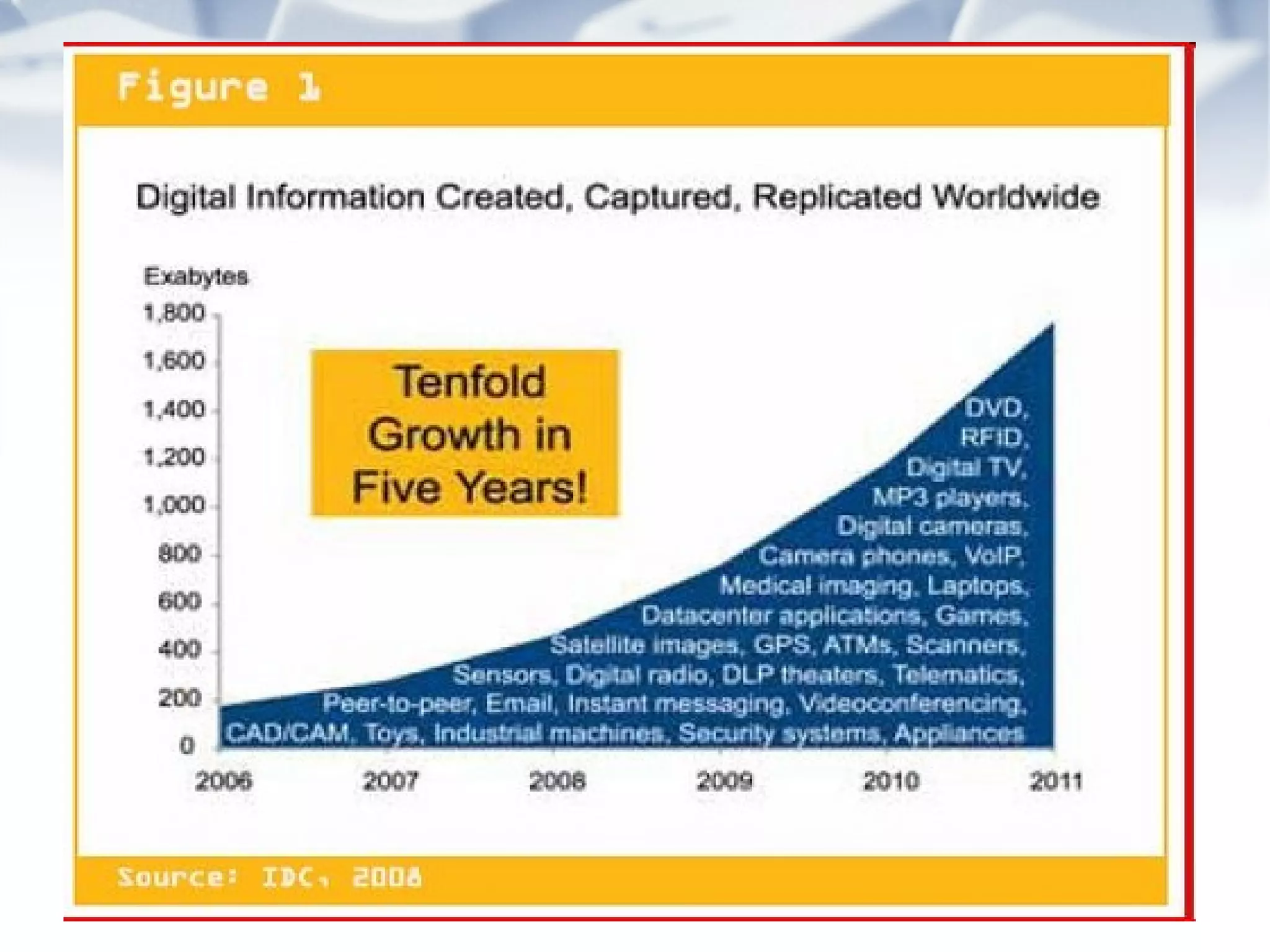
Ecosystem change – 1  Volume  of information grows
 
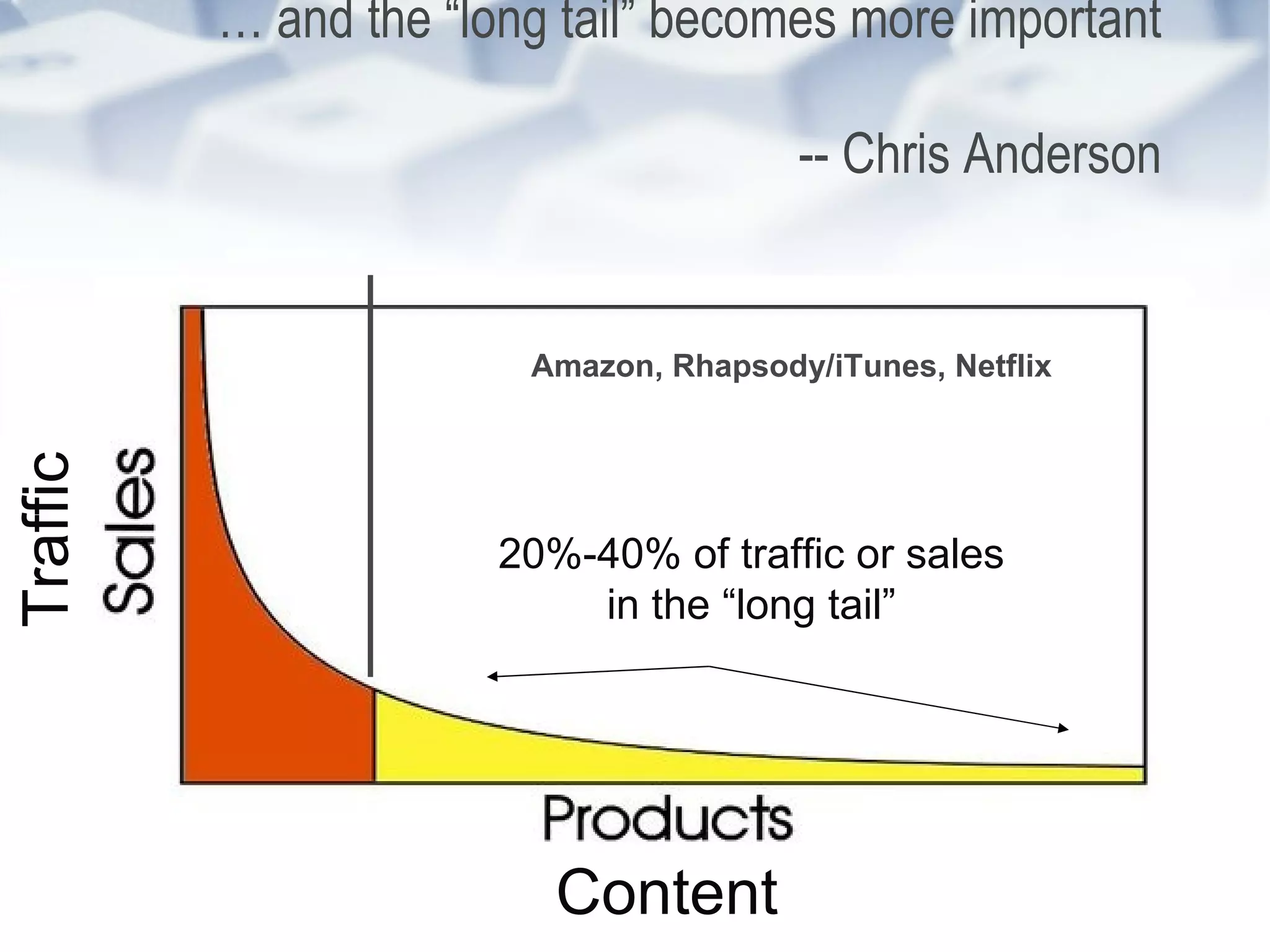
… and the “long tail” becomes more important  -- Chris Anderson Traffic Content 20%-40% of traffic or sales in the “long tail” Amazon, Rhapsody/iTunes, Netflix
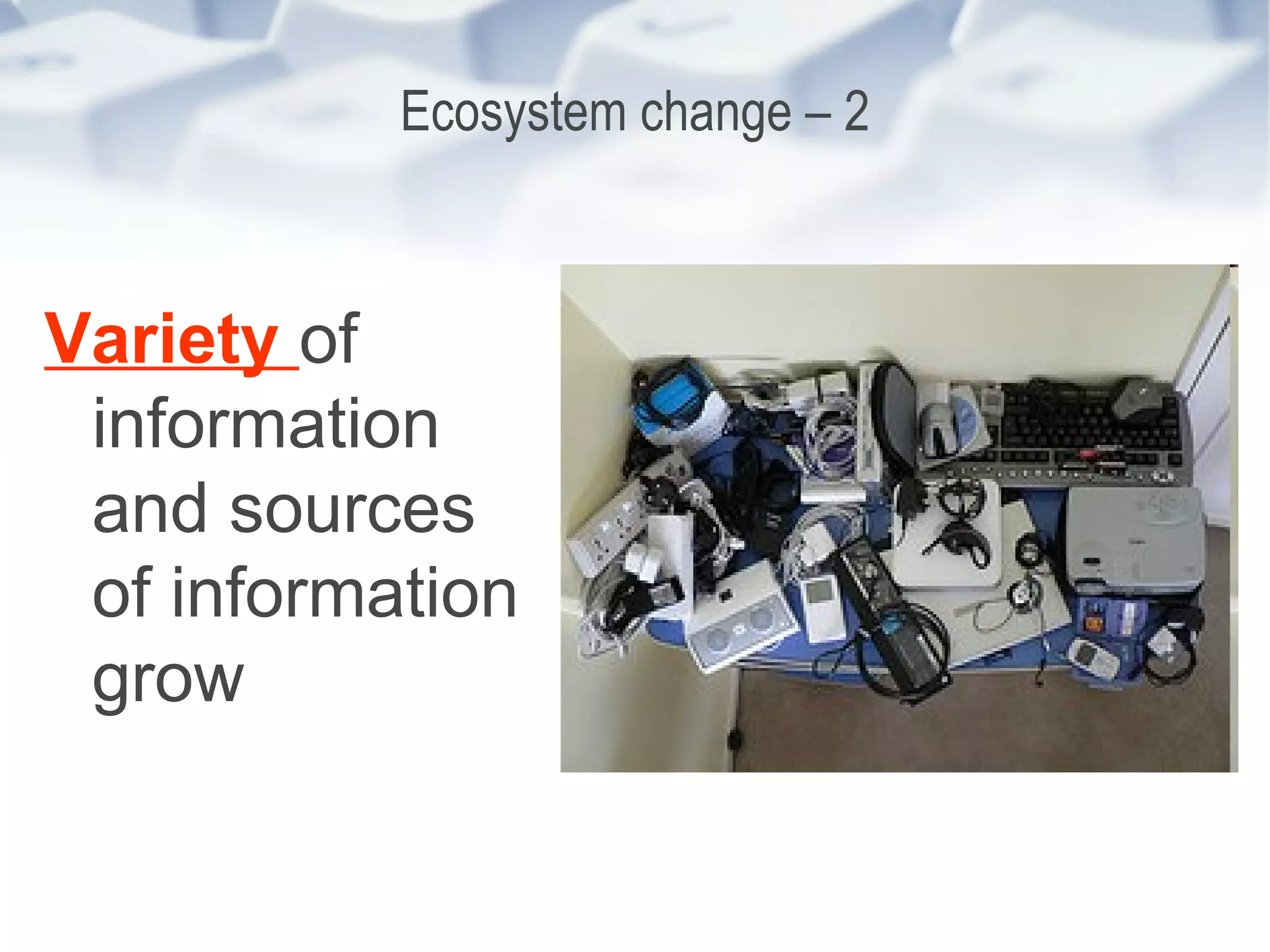
Ecosystem change – 2 Variety  of information and sources of information grow
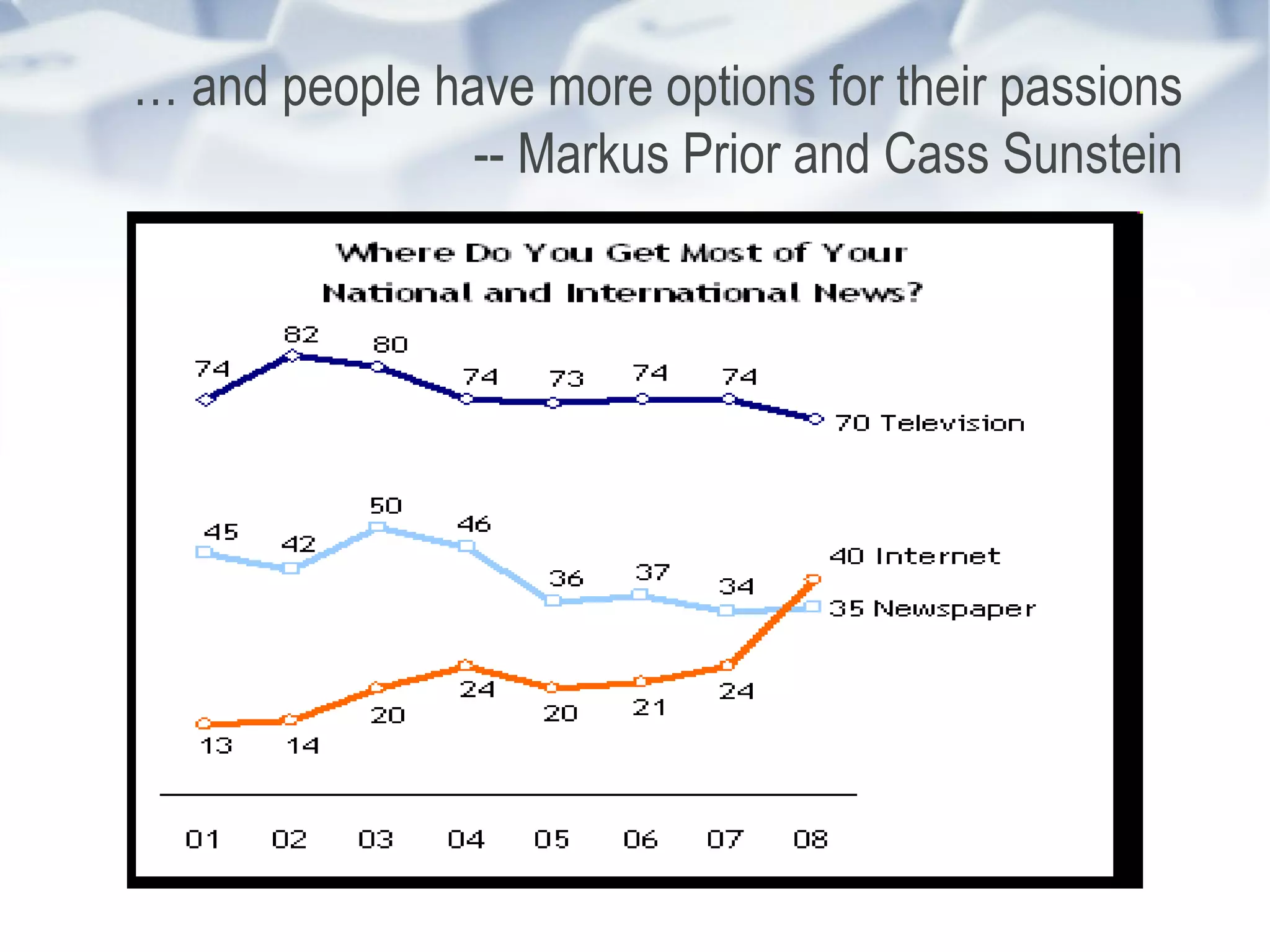
…  and people have more options for their passions -- Markus Prior and Cass Sunstein
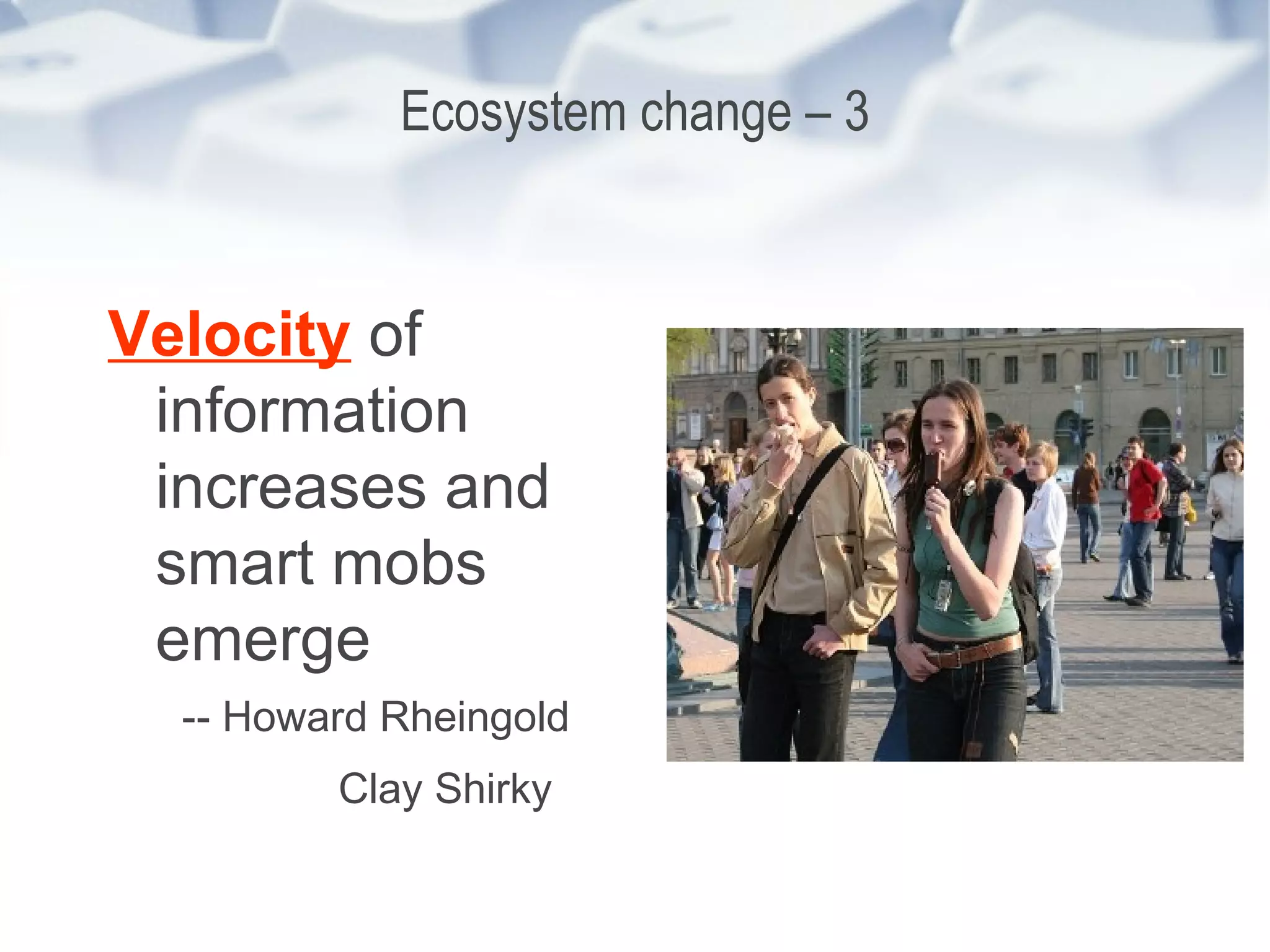
Ecosystem change – 3 Velocity  of information increases and smart mobs emerge -- Howard Rheingold Clay Shirky
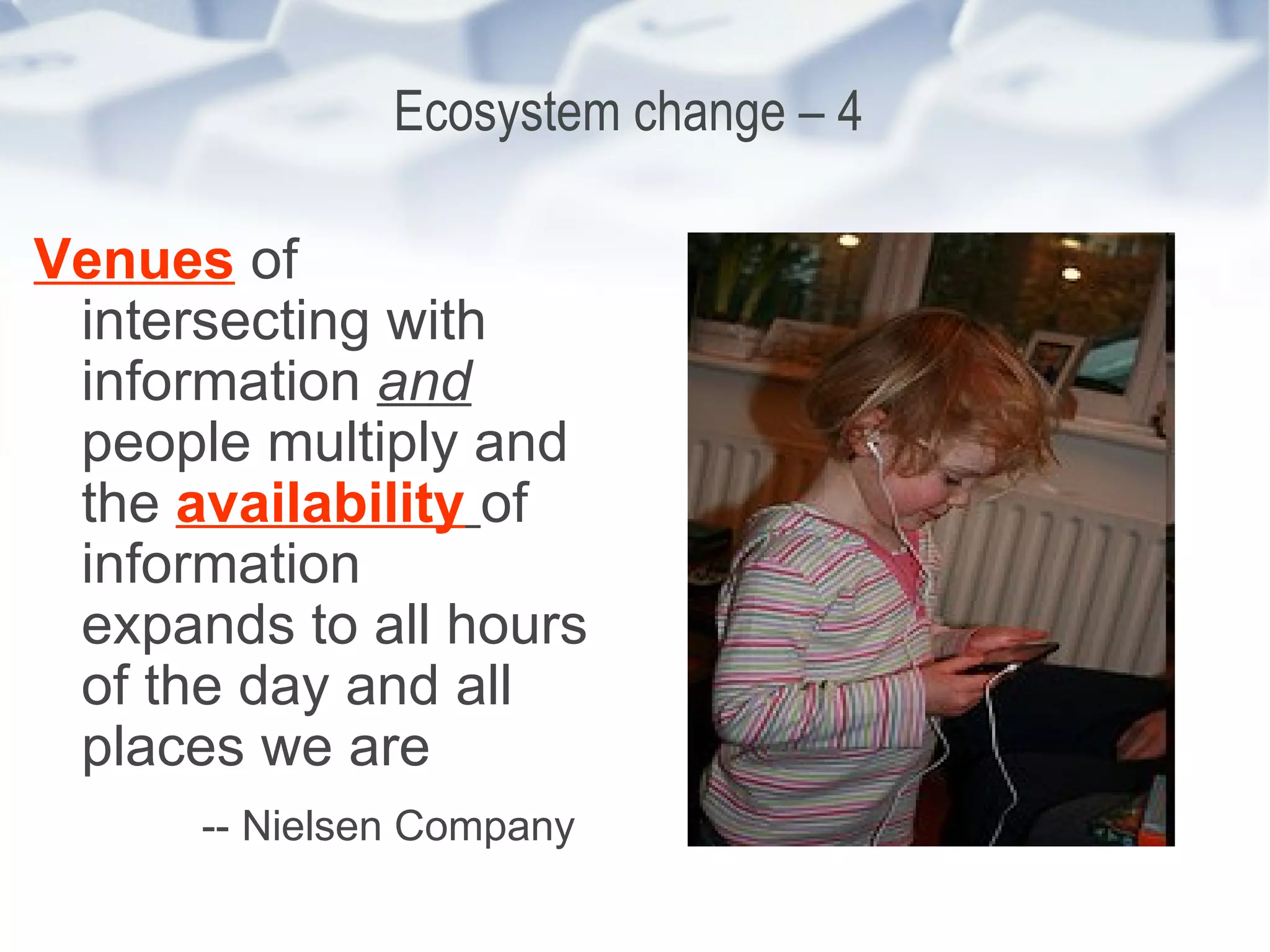
Ecosystem change – 4  Venues  of intersecting with information  and   people multiply and the  availability   of information expands to all hours of the day and all places we are -- Nielsen Company
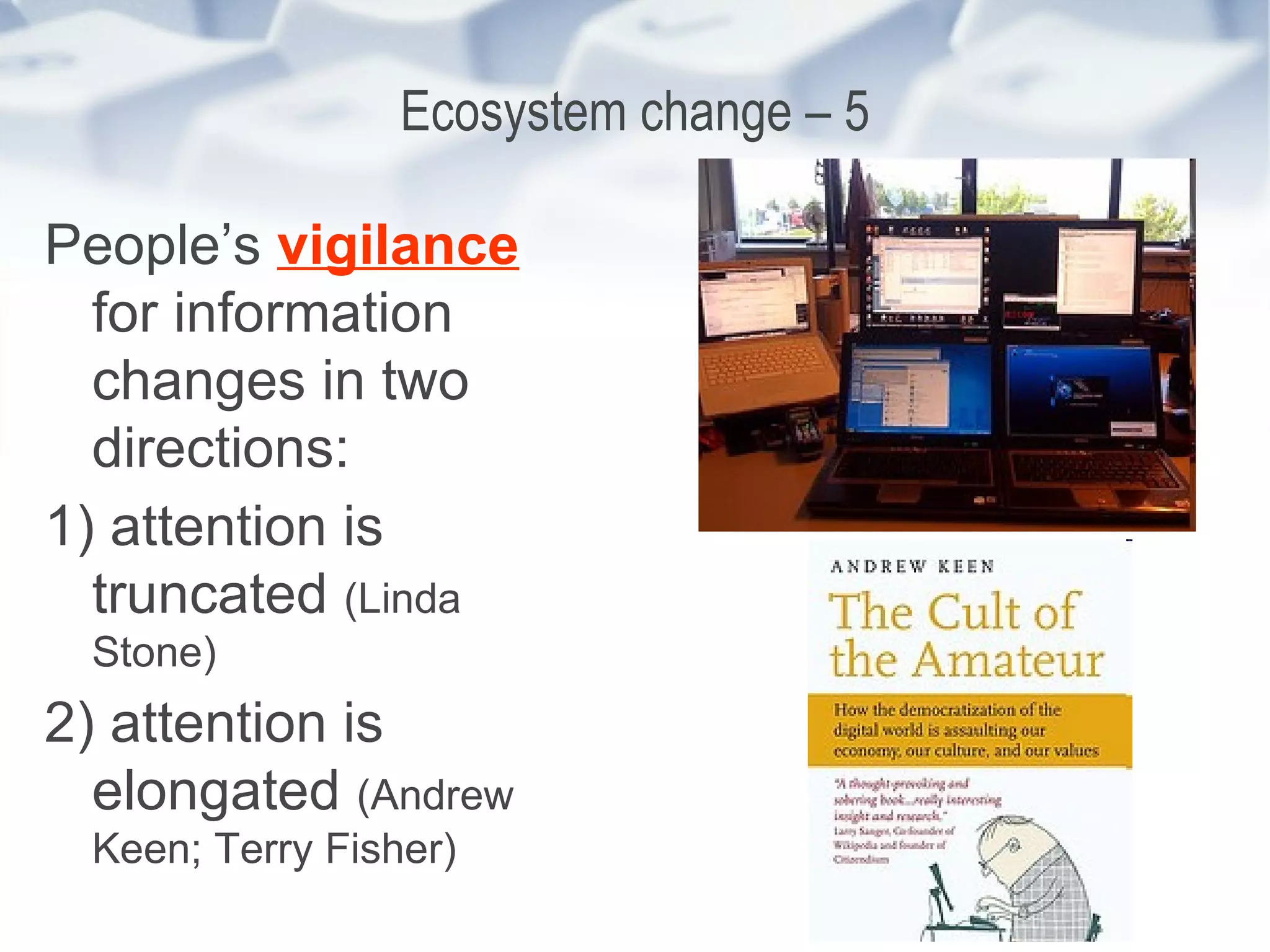
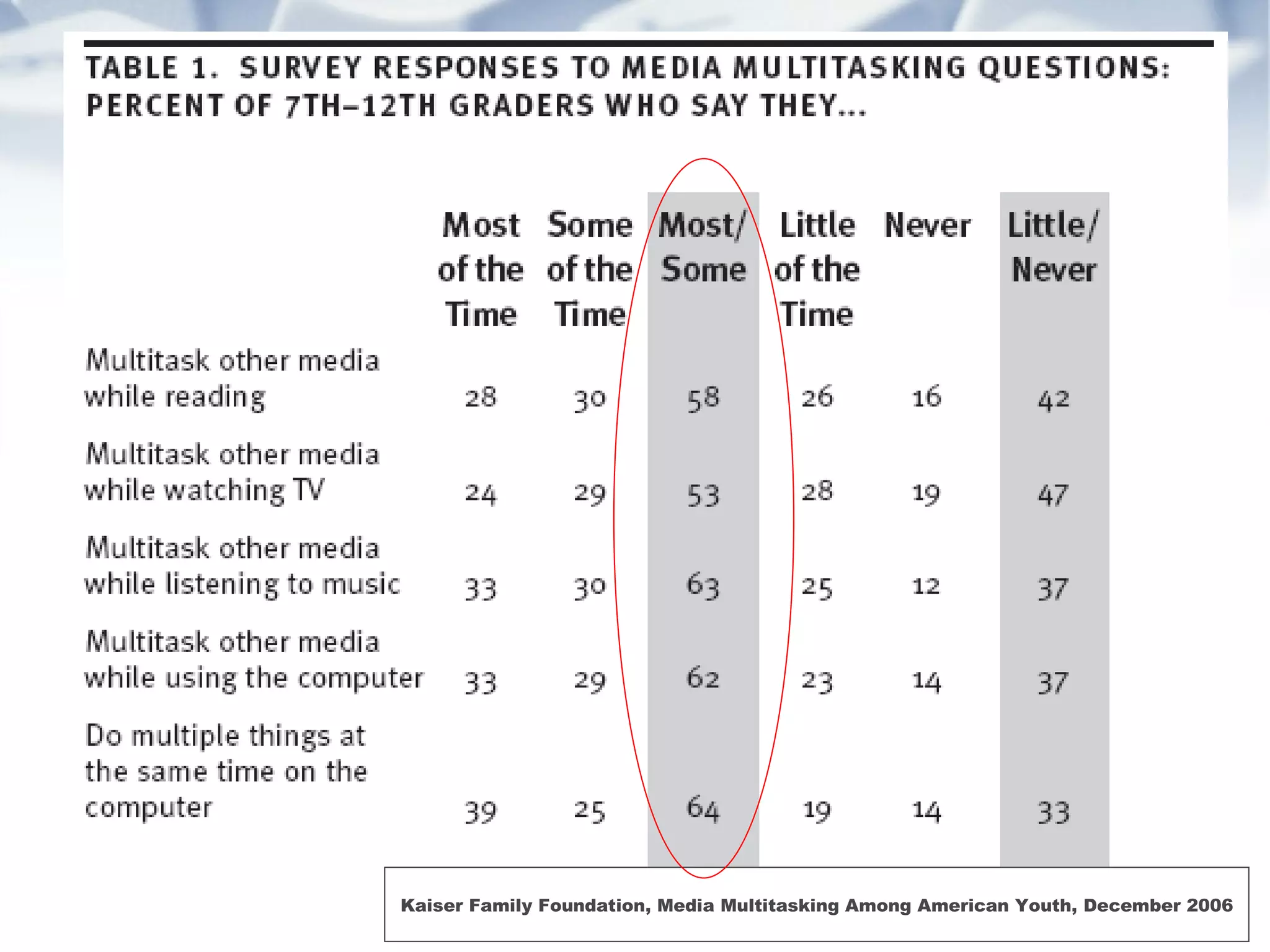
Ecosystem change – 5 People’s  vigilance  for information changes in two directions: 1) attention is truncated  (Linda Stone) 2) attention is elongated  (Andrew Keen; Terry Fisher)
Kaiser Family Foundation, Media Multitasking Among American Youth, December 2006
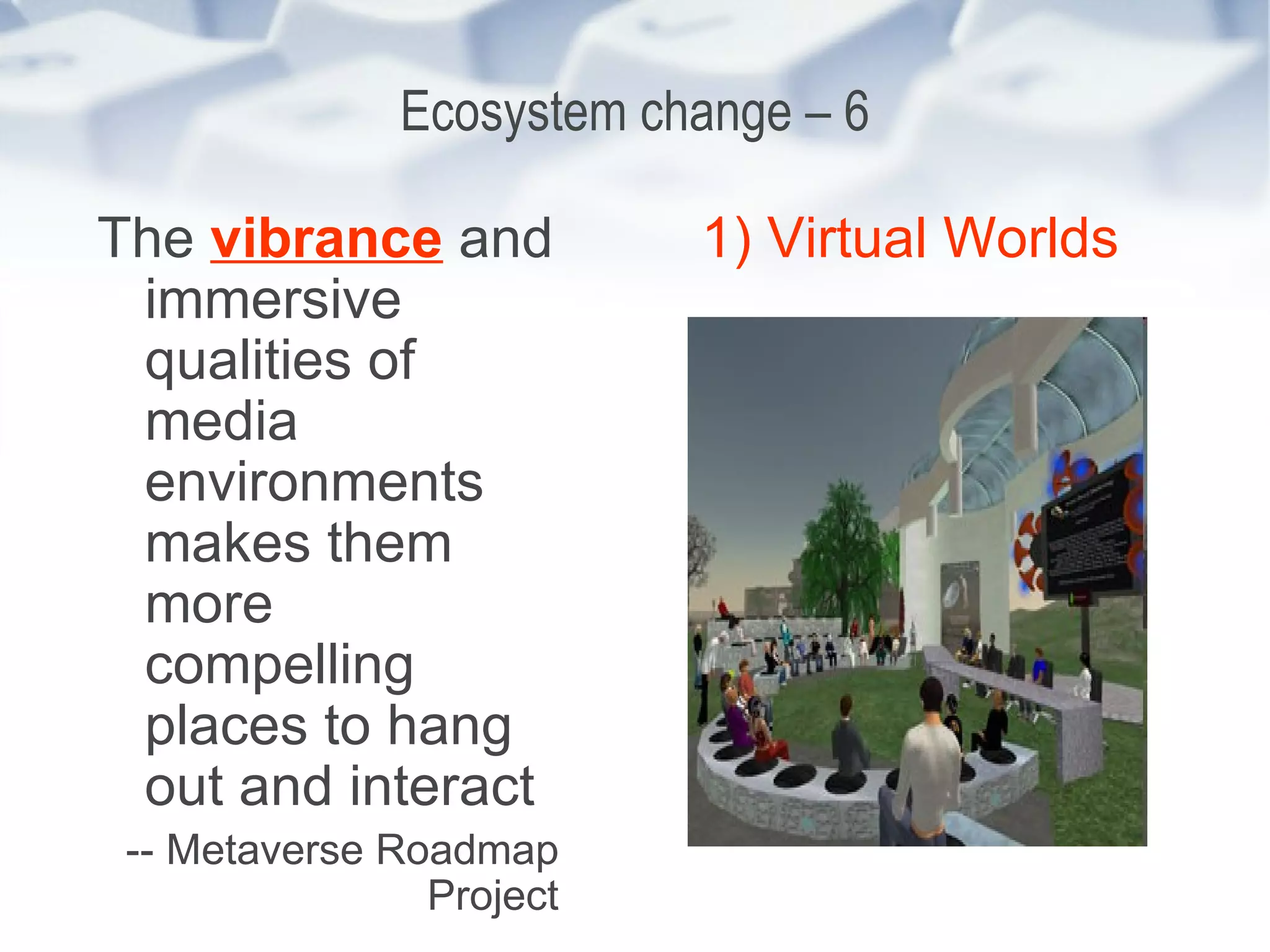
Ecosystem change – 6 The  vibrance  and immersive qualities of media environments makes them more compelling places to hang out and interact -- Metaverse Roadmap Project 1) Virtual Worlds
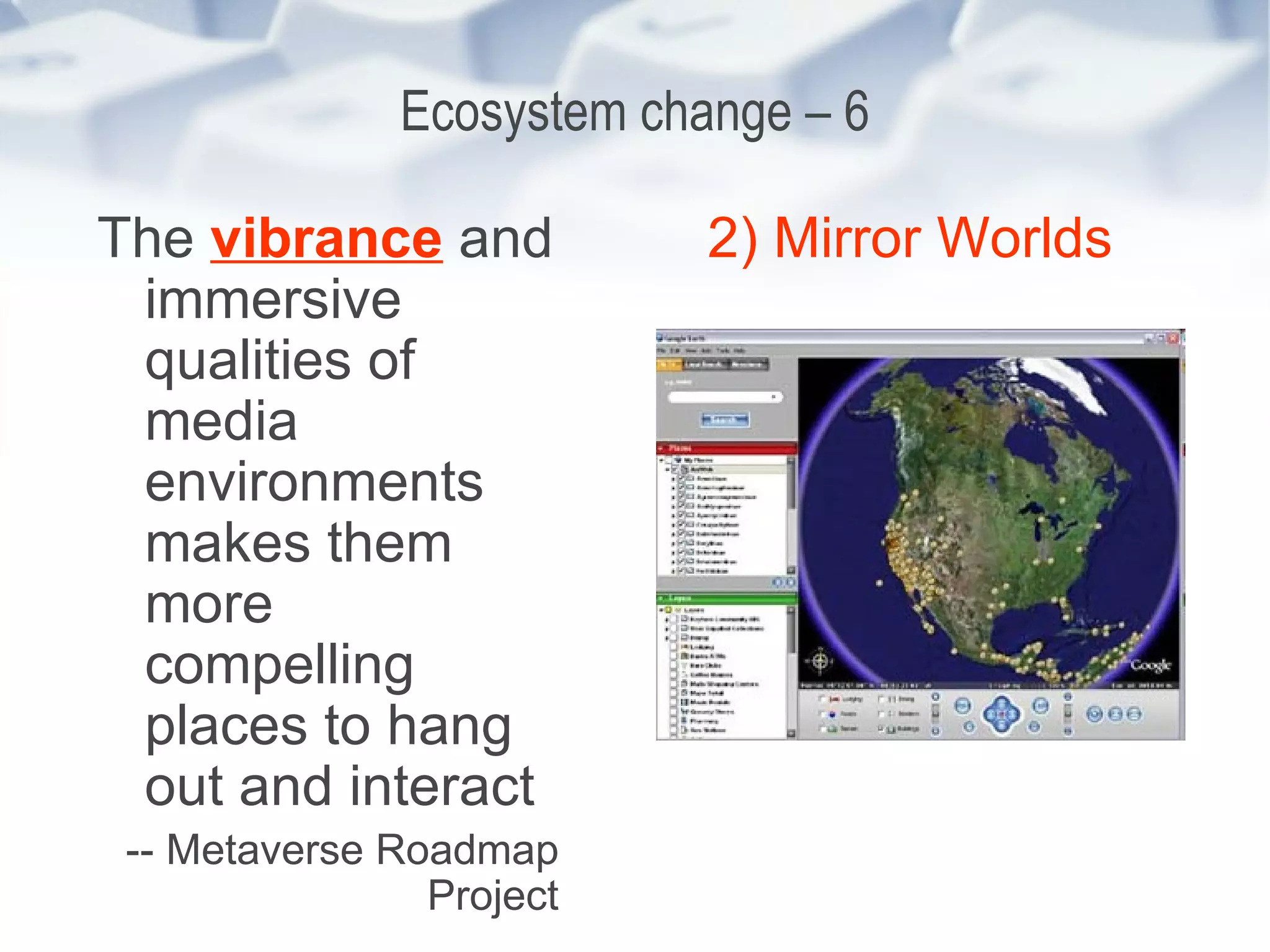
Ecosystem change – 6 The  vibrance  and immersive qualities of media environments makes them more compelling places to hang out and interact -- Metaverse Roadmap Project 2) Mirror Worlds
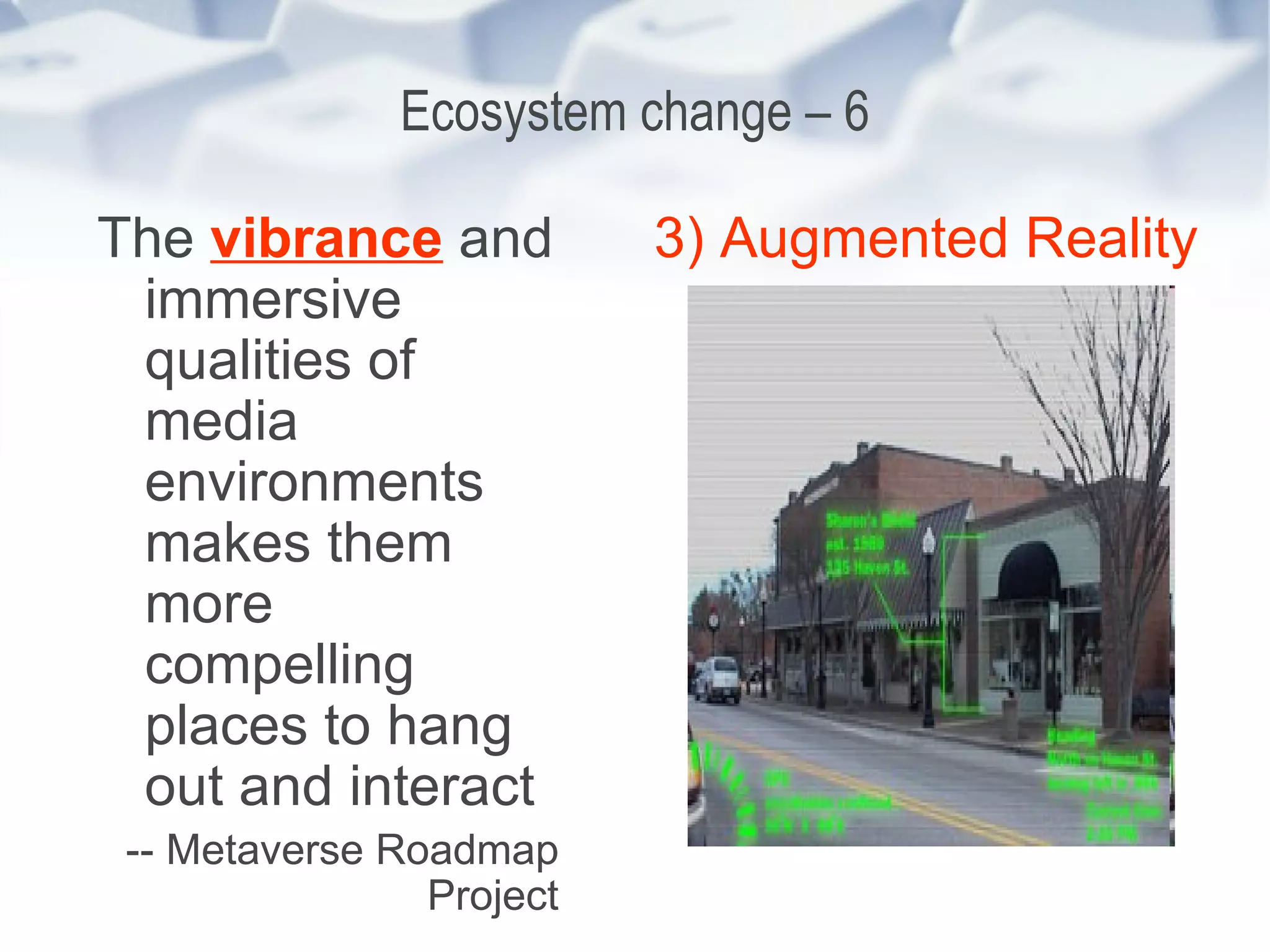
Ecosystem change – 6 The  vibrance  and immersive qualities of media environments makes them more compelling places to hang out and interact -- Metaverse Roadmap Project 3) Augmented Reality
Ecosystem change – 6 The  vibrance  and immersive qualities of media environments makes them more compelling places to hang out and interact -- Metaverse Roadmap Project 4) Life-logging -- Gordon Bell
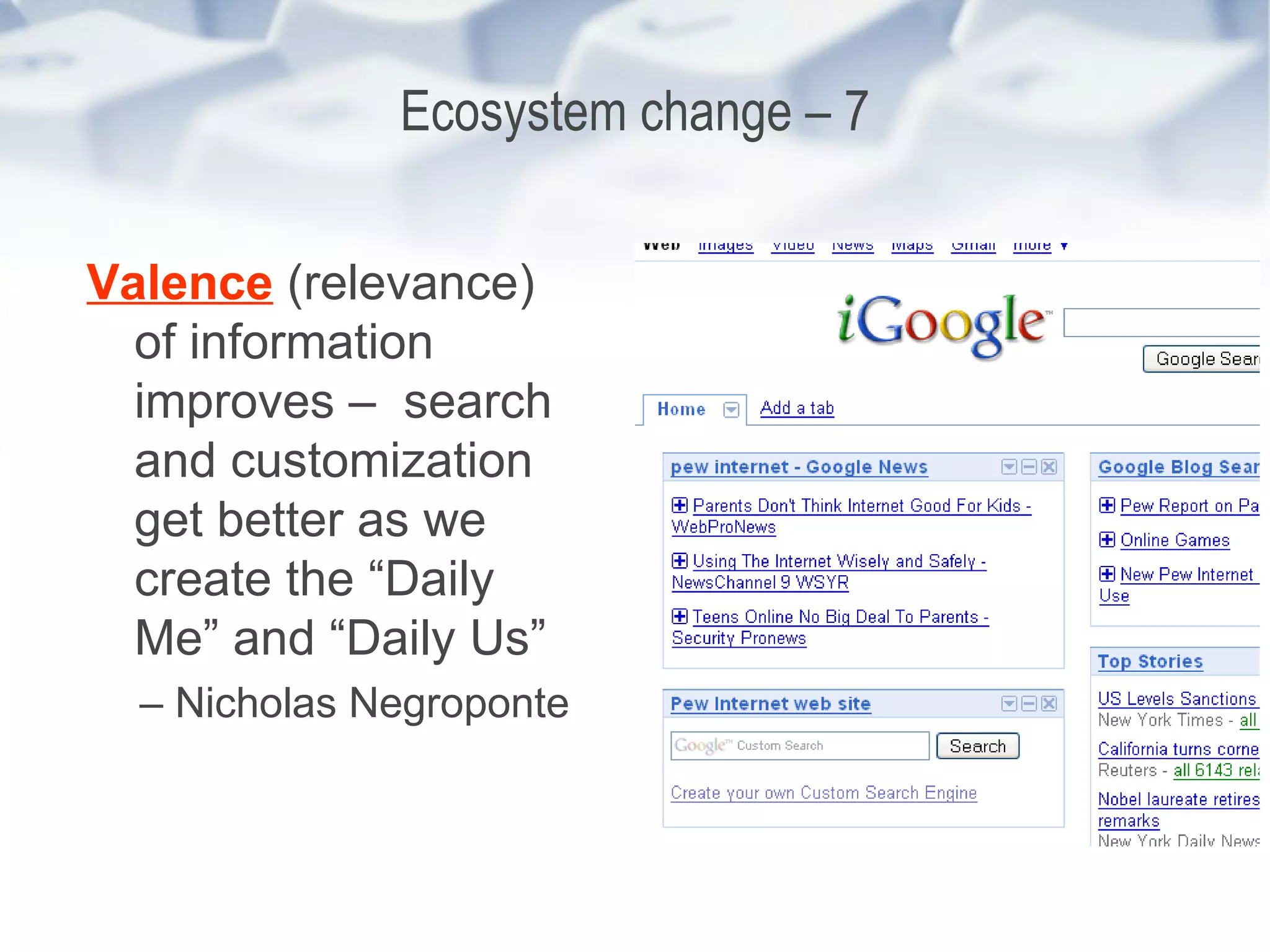
Ecosystem change – 7 Valence  (relevance) of information improves –  search and customization get better as we create the “Daily Me” and “Daily Us”  –  Nicholas Negroponte
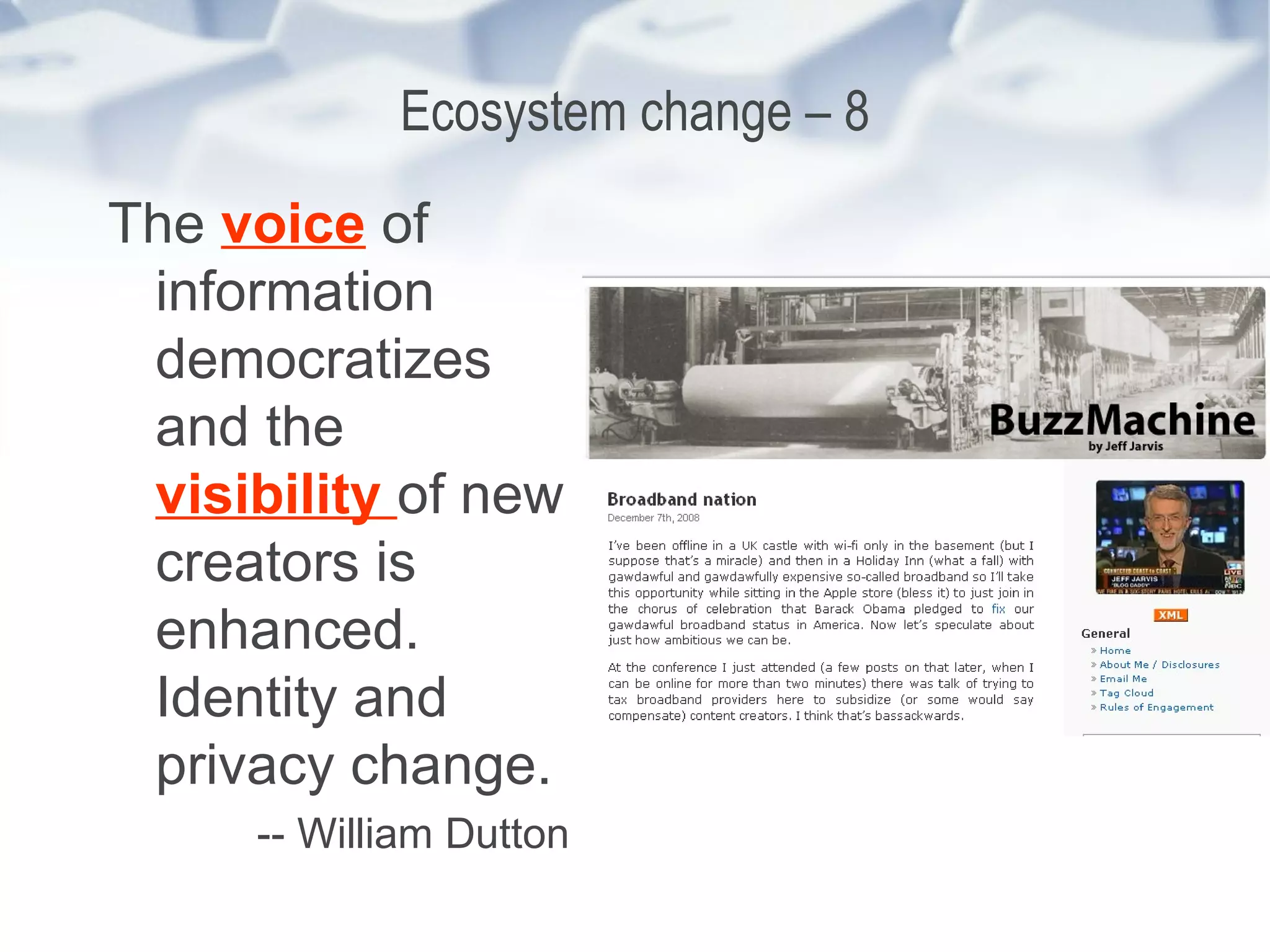
Ecosystem change – 8 The  voice  of information democratizes and the  visibility  of new creators is enhanced. Identity and privacy change. -- William Dutton
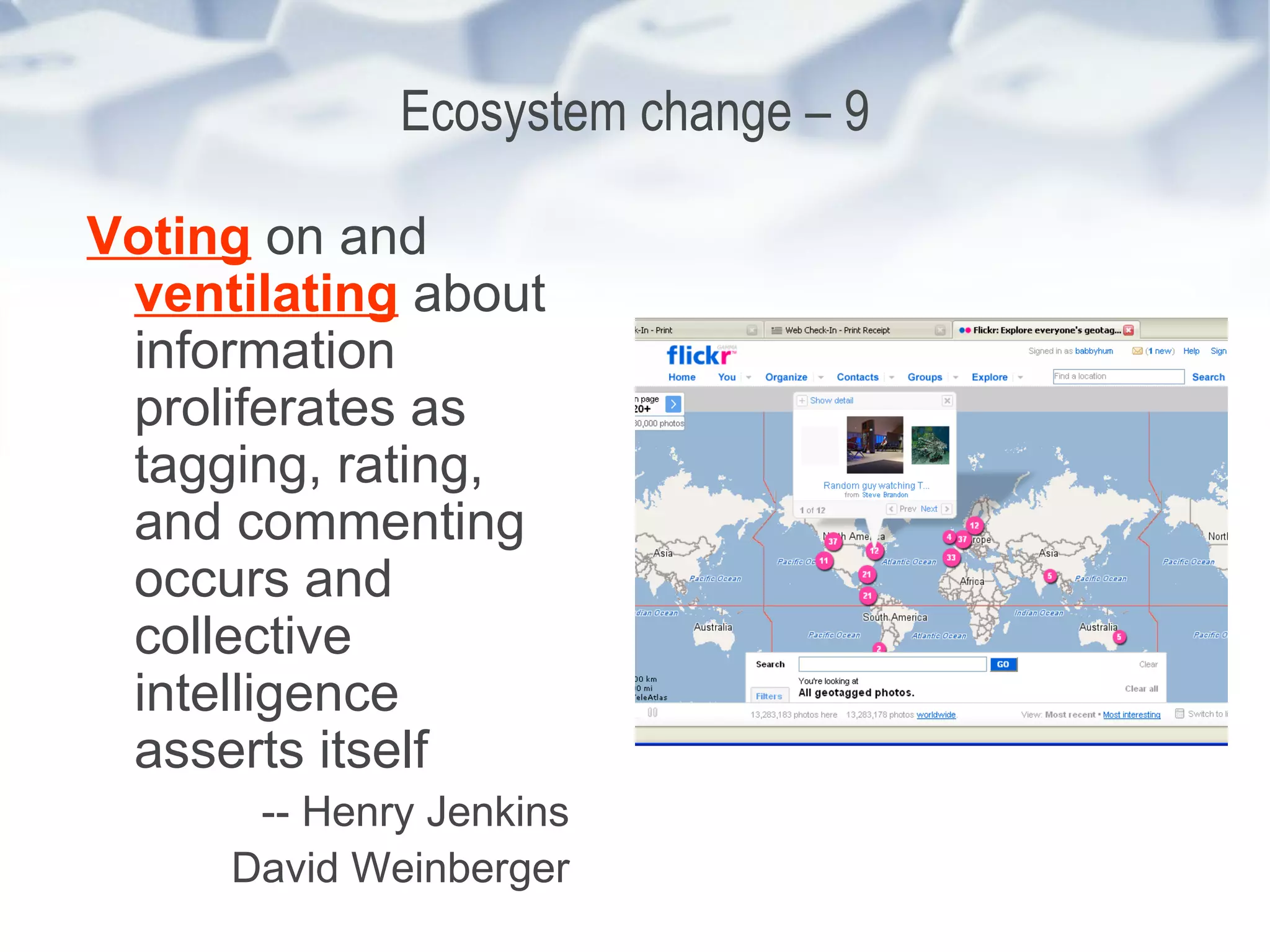
Ecosystem change – 9 Voting  on and  ventilating  about information proliferates as tagging, rating, and commenting occurs and collective intelligence   asserts itself -- Henry Jenkins David Weinberger
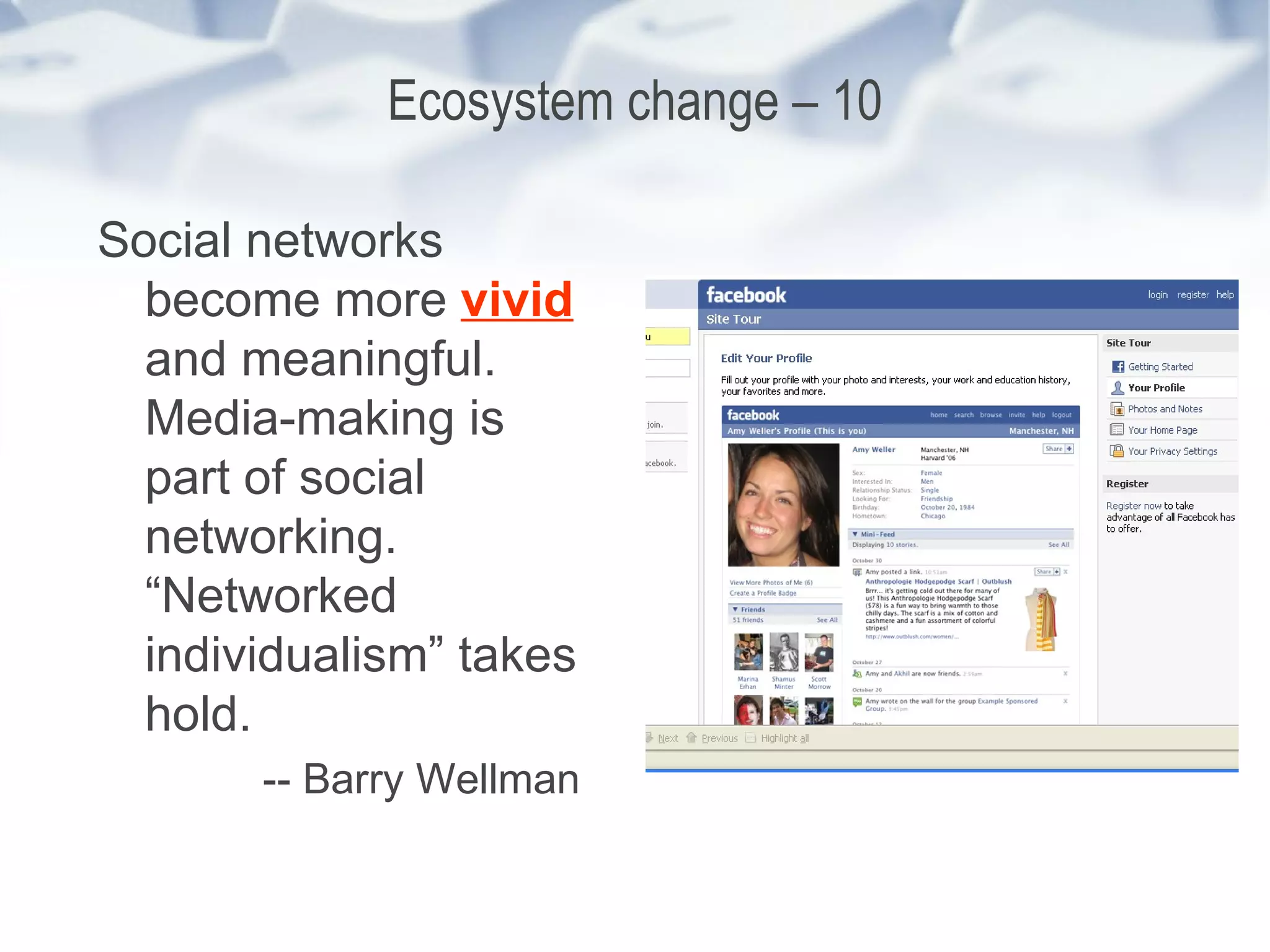
Ecosystem change – 10 Social networks become more  vivid  and meaningful. Media-making is part of social networking. “Networked individualism” takes hold. -- Barry Wellman
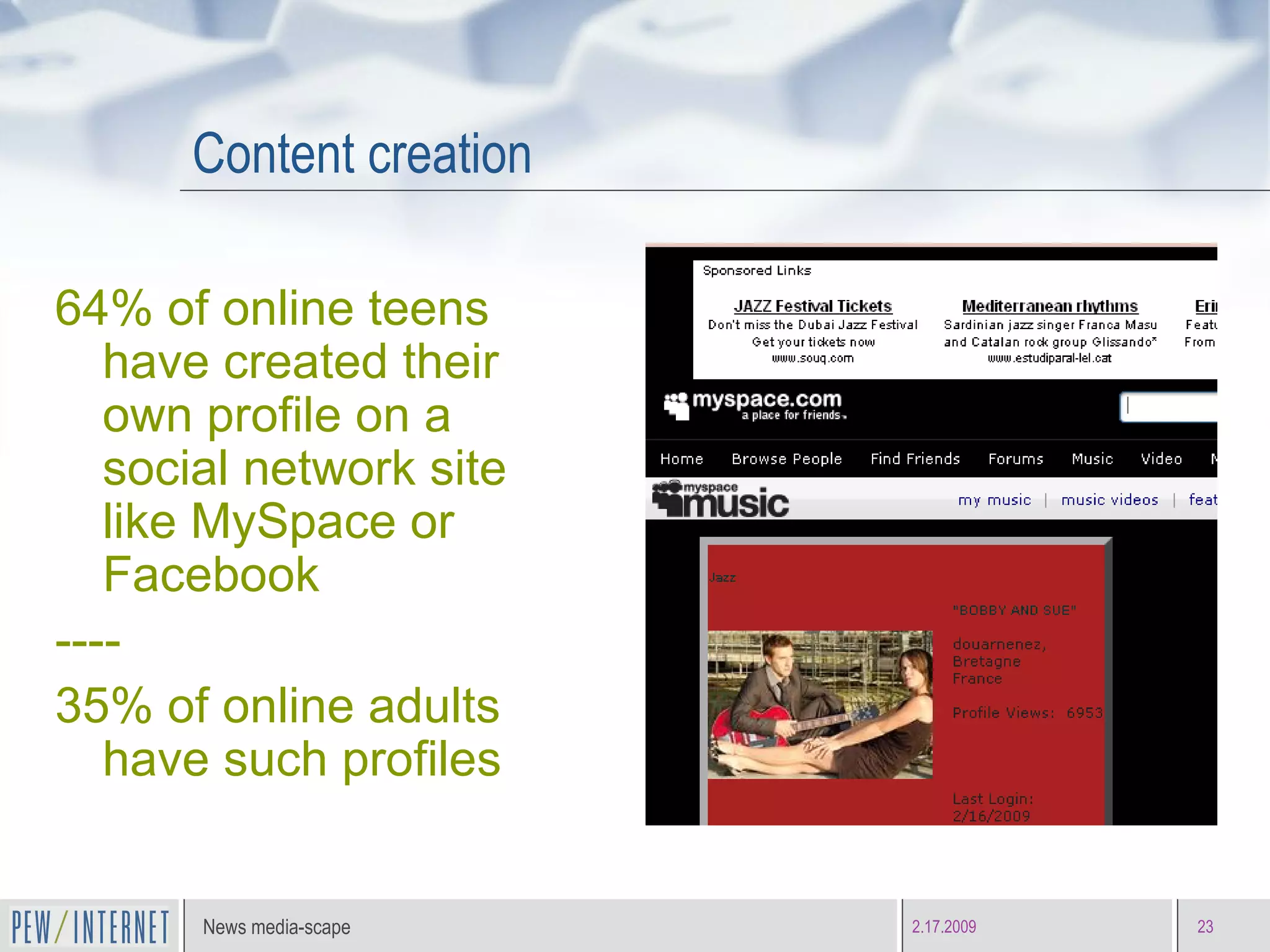
64% of online teens have created their own profile on a social network site like MySpace or Facebook ---- 35% of online adults have such profiles Content creation
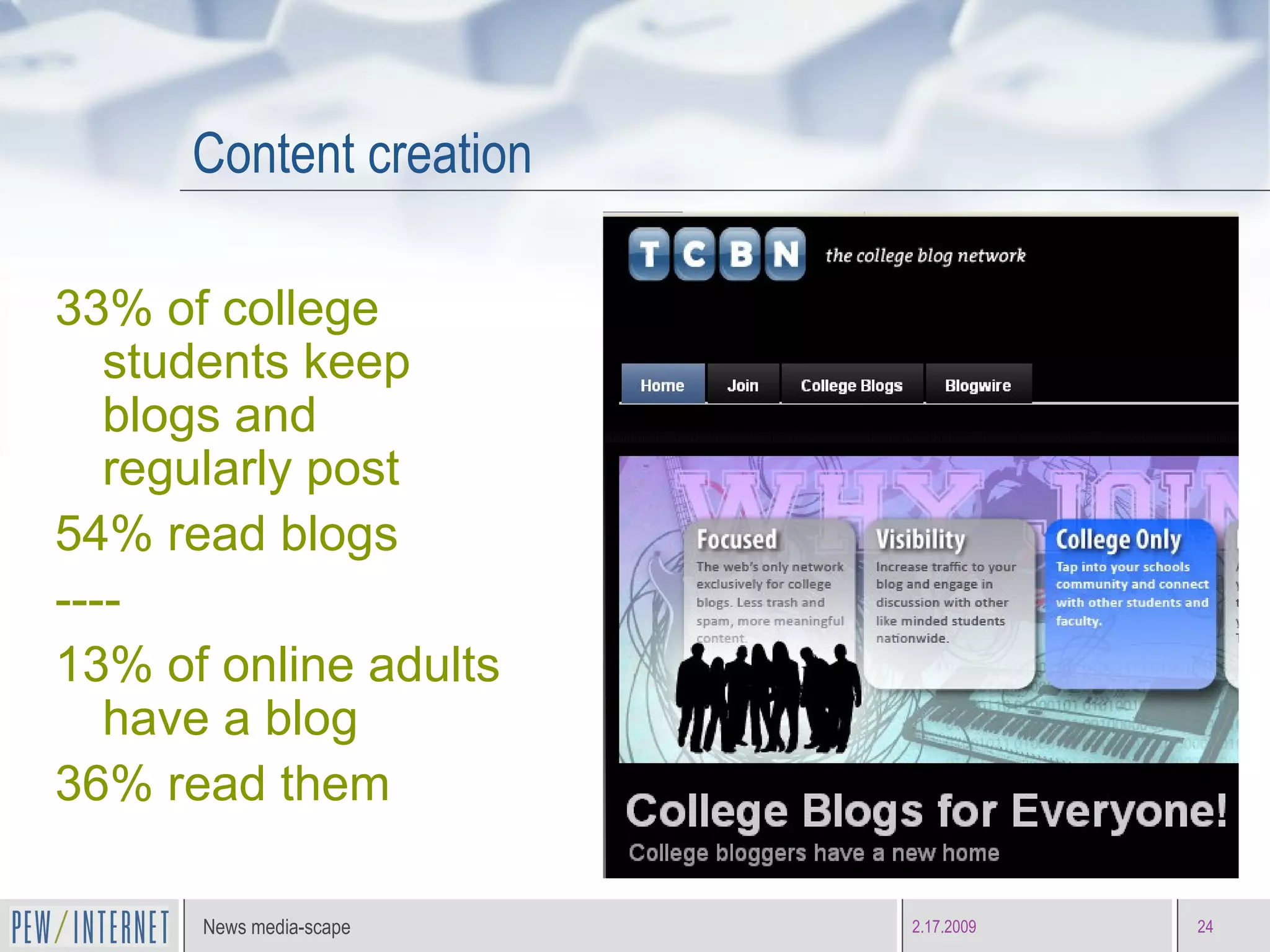
33% of college students keep blogs and regularly post 54% read blogs ---- 13% of online adults have a blog 36% read them Content creation
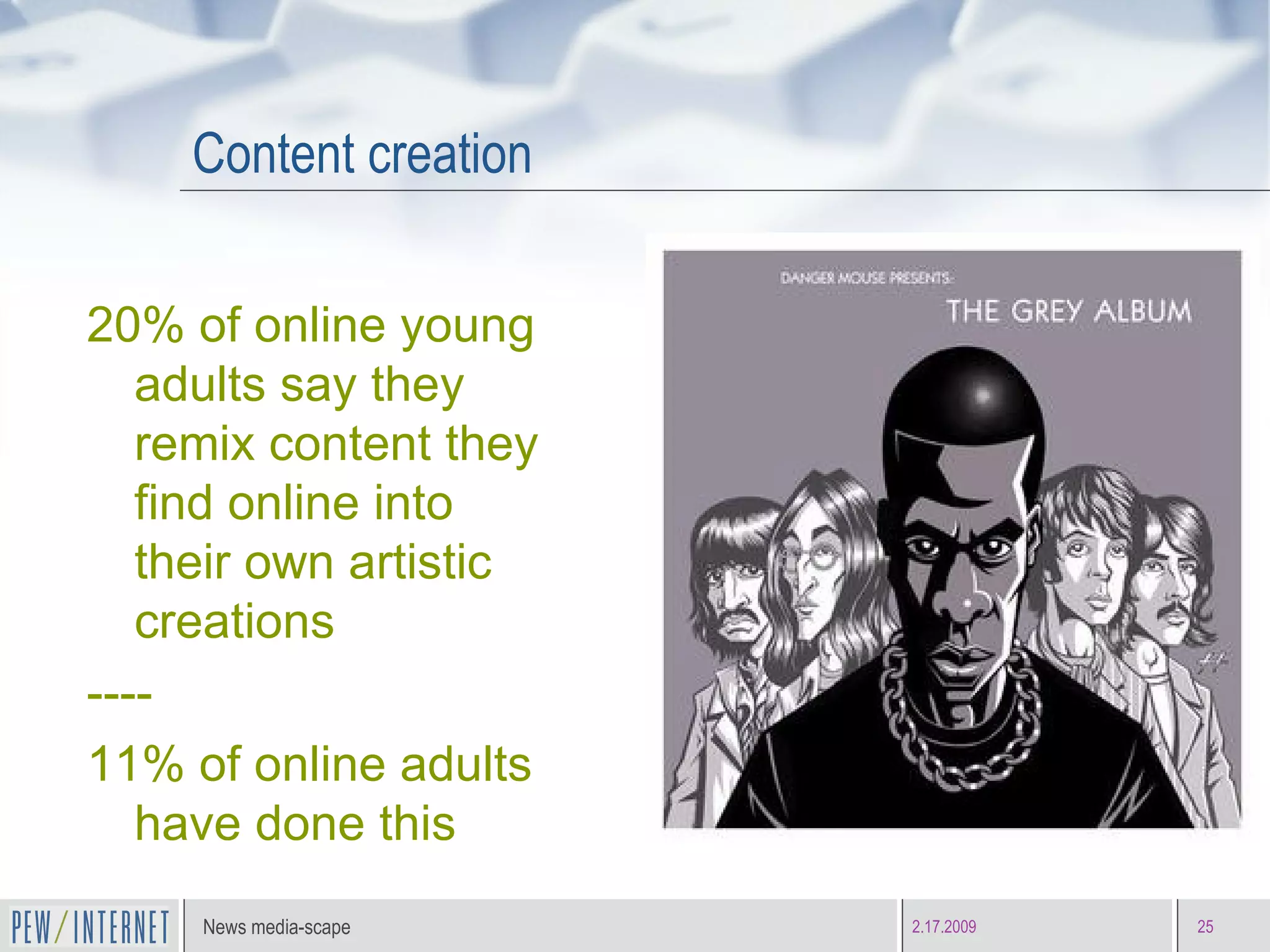
Content creation 20% of online young adults say they remix content they find online into their own artistic creations ---- 11% of online adults have done this
Behold  Homo Connectus Different species with a different sense of …   Expectation about access to information  Place and distance Presence with others Social networking possibilities Capacity to build community Possibilities of play Time use  Personal efficacy
A new pattern of communication and influence attention acquisition assessment action
How do you…. get his/her attention? leverage your traditional platform offer alerts, updates, feeds be available in relevant places find pathways through his/her social network
How do you…. help him/her acquire information? be findable in a “long tail” world pursue new distribution methods offer “link love” for selfish reasons participate in the conversation about your work
How do you…. help him/her assess information? honor the ethics of your kind of story telling be transparent, link-friendly, and archive everything aggregate the best related work when you make mistakes seek forgiveness
How do you…. assist him/her act on information? offer opportunities for feedback offer opportunities for remixing offer opportunities for community building be open to the wisdom of crowds
Thank you! Lee Rainie Director Pew Internet & American Life Project 1615 L Street NW Suite 700 Washington, DC 20036 [email_address] 202-419-4500

2009 Feb 17 Public Broadcasters

  • 1.
    THE NEW NEWSMEDIA-SCAPE Lee Rainie – Director Pew Internet Project Public Broadcasters – Atlanta February 17, 2009
  • 2.
    New information ecosystem: Then and Now Industrial Age Info was: Scarce Expensive Institutionally oriented Designed for consumption Information Age Info is: Abundant Cheap Personally oriented Designed for participation
  • 3.
    2000 46% ofadults use internet 5% with broadband at home 50% own a cell phone 0% connect to internet wirelessly <10% use “cloud” = slow, stationary connections built around my computer The internet is the asteroid: Then and now 2008 74% of adults use internet 58% with broadband at home 82% own a cell phone 62% connect to internet wirelessly >53% use “cloud” = fast, mobile connections built around outside servers and storage
  • 4.
    Media ecology – then Product Route to home Display Local storage TV stations phone TV Cassette/ 8-track broadcast TV radio broadcast radio stereo Vinyl album News mail Advertising newspaper delivery phone paper Radio Stations non-electronic Tom Wolzien, Sanford C. Bernstein & Co
  • 5.
    Media ecology –now Product Route to home Display Local storage cable TiVo (PVR) VCR TV stations DSL TV Satellite radio player Info wireless/phone radio DVD “ Daily me” broadcast TV PC Web-based storage content iPod /MP3 server/ TiVo (PVR) Cable Nets broadcast radio stereo PC Web sites satellite monitor web storage/servers Local news mail headphones CD/CD-ROM Content from express delivery pager satellite player cell phone memory individuals iPod / storage portable gamer MP3 player / iPod Peer-to-peer subcarriers / WIFI cell phone pagers - PDAs Advertising newspaper delivery phone cable box Radio stations camcorder/camera PDA/Palm game console game console paper Satellite radio non-electronic storage sticks/disks Adapted from Tom Wolzien, Sanford C. Bernstein & Co
  • 6.
    Ecosystem change –1 Volume of information grows
  • 7.
  • 8.
    … and the“long tail” becomes more important -- Chris Anderson Traffic Content 20%-40% of traffic or sales in the “long tail” Amazon, Rhapsody/iTunes, Netflix
  • 9.
    Ecosystem change –2 Variety of information and sources of information grow
  • 10.
    … andpeople have more options for their passions -- Markus Prior and Cass Sunstein
  • 11.
    Ecosystem change –3 Velocity of information increases and smart mobs emerge -- Howard Rheingold Clay Shirky
  • 12.
    Ecosystem change –4 Venues of intersecting with information and people multiply and the availability of information expands to all hours of the day and all places we are -- Nielsen Company
  • 13.
    Ecosystem change –5 People’s vigilance for information changes in two directions: 1) attention is truncated (Linda Stone) 2) attention is elongated (Andrew Keen; Terry Fisher)
  • 14.
    Kaiser Family Foundation,Media Multitasking Among American Youth, December 2006
  • 15.
    Ecosystem change –6 The vibrance and immersive qualities of media environments makes them more compelling places to hang out and interact -- Metaverse Roadmap Project 1) Virtual Worlds
  • 16.
    Ecosystem change –6 The vibrance and immersive qualities of media environments makes them more compelling places to hang out and interact -- Metaverse Roadmap Project 2) Mirror Worlds
  • 17.
    Ecosystem change –6 The vibrance and immersive qualities of media environments makes them more compelling places to hang out and interact -- Metaverse Roadmap Project 3) Augmented Reality
  • 18.
    Ecosystem change –6 The vibrance and immersive qualities of media environments makes them more compelling places to hang out and interact -- Metaverse Roadmap Project 4) Life-logging -- Gordon Bell
  • 19.
    Ecosystem change –7 Valence (relevance) of information improves – search and customization get better as we create the “Daily Me” and “Daily Us” – Nicholas Negroponte
  • 20.
    Ecosystem change –8 The voice of information democratizes and the visibility of new creators is enhanced. Identity and privacy change. -- William Dutton
  • 21.
    Ecosystem change –9 Voting on and ventilating about information proliferates as tagging, rating, and commenting occurs and collective intelligence asserts itself -- Henry Jenkins David Weinberger
  • 22.
    Ecosystem change –10 Social networks become more vivid and meaningful. Media-making is part of social networking. “Networked individualism” takes hold. -- Barry Wellman
  • 23.
    64% of onlineteens have created their own profile on a social network site like MySpace or Facebook ---- 35% of online adults have such profiles Content creation
  • 24.
    33% of collegestudents keep blogs and regularly post 54% read blogs ---- 13% of online adults have a blog 36% read them Content creation
  • 25.
    Content creation 20%of online young adults say they remix content they find online into their own artistic creations ---- 11% of online adults have done this
  • 26.
    Behold HomoConnectus Different species with a different sense of … Expectation about access to information Place and distance Presence with others Social networking possibilities Capacity to build community Possibilities of play Time use Personal efficacy
  • 27.
    A new patternof communication and influence attention acquisition assessment action
  • 28.
    How do you….get his/her attention? leverage your traditional platform offer alerts, updates, feeds be available in relevant places find pathways through his/her social network
  • 29.
    How do you….help him/her acquire information? be findable in a “long tail” world pursue new distribution methods offer “link love” for selfish reasons participate in the conversation about your work
  • 30.
    How do you….help him/her assess information? honor the ethics of your kind of story telling be transparent, link-friendly, and archive everything aggregate the best related work when you make mistakes seek forgiveness
  • 31.
    How do you….assist him/her act on information? offer opportunities for feedback offer opportunities for remixing offer opportunities for community building be open to the wisdom of crowds
  • 32.
    Thank you! LeeRainie Director Pew Internet & American Life Project 1615 L Street NW Suite 700 Washington, DC 20036 [email_address] 202-419-4500