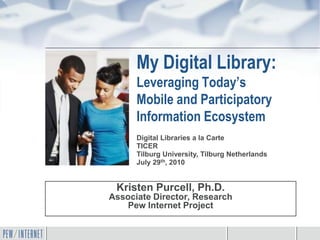
My Digital Library:Leveraging Today’s Mobile and Participatory Information EcosystemDigital Libraries a la CarteTICERTilburg University, Tilburg NetherlandsJuly 29th, 2010Kristen Purcell, Ph.D.Associate Director, ResearchPew Internet Project
Pew Internet ProjectPart of the Pew Research Center, a nonpartisan “fact tank” based in Washington, DC Provide high quality, objective data to thought leaders and policy makersFunded by the Pew Charitable TrustsAll US findings are based on nationally representative telephone surveys of… US adults age 18+, or US teens ages 12-17Drawn from dual-frame (RDD/cell) samples
Today’s DiscussionWhat’s Mobile Got to Do With It?Global cell phone use trendsUS cell phone and internet use trendsThe importance of social mediaHighlights of the New Information EcologyWhat are the hallmarks of the new information ecology?Online information consumerswho they arehow they behavewhat they likeLeveraging New TechnologiesTips for success in the new information ecology
What’s Mobile Got to Do With It?
Global Mobile Subscriptions
Mobile Penetration by Region
Worldwide Mobile Subscriptions, 2005-2009Number of mobile subscriptions per 100 inhabitants.  Source: International Telecommunications Union, 2010.
Mobile Subscriptions, Select CountriesSource: ITU World Telecommunication/ICT Indicators Database, 2009 figures.  Worldwide average is 68 subscriptions per 100 people.  Worldwide ratio of cell subscription to fixed line is almost 4:1.  Total worldwide cell phone subscriptions is 4,676,174,400, up from 1,763,978,500 in 2004.
Global IT Trends
Mobile Broadband Subscriptions, 2005-2009Number of mobile broadband subscriptions per 100 inhabitants.  Source: International Telecommunications Union, 2010.
Internet Users, 2005-2009Number of internet users per 100 inhabitants.  Source: International Telecommunications Union, 2010.
Internet Use, Western EuropeSource: ITU World Telecommunication/ICT Indicators Database, 2009 figures.  Western Europe average is 42 (24 if you include CIS).
Internet Access Via Cell, 16-74 Year-OldsSource:  Eurostat, 2009 figures.
Internet Access Via Laptop, 16-74 Year-OldsSource:  Eurostat, 2009 figures.
THE BIG 5 MOBILE YOUTH ECONOMIES255m$58b$31b281m97mCHINA$21bTHE MOBILEYOUTH® REPORT 2010$21b32USA$19b76mJAPANINDIASUBSCRIPTIONS (AGE <30)VALUE $BN PABRAZIL15SOURCE MOBILEYOUTH DATA 2010 AGES 5-29
MOBILE YOUTH: TEENS & STUDENTSMILLIONS OF SUBSCRIPTIONS 2010119.747.599.422.441.7121328.630.822.9EAST EUROPE139.8NE ASIA36.6WEST EUROPETHE MOBILEYOUTH® REPORT 201020NORTH AMERICACHINA HK60.163.752.9MENA32.138.2STUDENTS (19-24)TEENS (14-18)31.715LATIN AMERICASUB SAH AFRICASOUTH ASIAASIAN PACIFICSOURCE MOBILEYOUTH DATA 2010 BASED ON SUBSCRIPTIONS (ACCOUNTS) RATHER THAN SUBSCRIBERSTEENS 14-18 STUDENTS 19-2416
www.mobileYouthreport.comPublished by mobileYouthStatistics on youth mobile usageAvailable for download
US Teen Mobile Use
US Teen Mobile Use
US Teen Gadget Use
US Teen Internet Access
US Adult Cell Phone Use
US Adult Wireless Internet Use
What’s Mobile Got to Do With It?Overall, US wireless internet users are more engaged in online activitiesHalf of all African-American adults in the US (48%) have used their cell phone to access the internet, compared with 40% of Hispanic adults and 31% of white adultsOverall, African-American adults in the US are the most active mobile internet usersIn the US, African-American mobile internet use is growing at a faster rate than non-Hispanic whites and Hispanics
US Social Network Site Use
Percent of Online Adults Who Use Social MediaUS Adult Social Media Use
US Adult Social Media Use, by RacePercent of Online Adults Who Use Social Media
US Teens Aren’t That Into Twitter
US Adults 18-24 Are Into Twitter
US Teens are More Into Content Creation
Content Sharing is Growing Among Adults
Remixing is Flat
SNS Takes the Place of Blogging?
Blogging is Also Down For Young Adults
Summary of US Teen Online Activities73% of online teens use SNS (up 50%)14% blog (down 50%)8% use Twitter8% visit online virtual worlds38% share content online (steady)21% remix content (steady)62% get news about current events and politics48% buy things online31% get health, dieting, fitness info17% get info about sensitive health topics
Hallmarks of the New Information Ecology
Then and Now
The “New” Information EcologyBlurring line between “news” and “information”Information is “free”Information is “at my fingertips”Information is available when I want itInformation is available from multiple sources
The “New” Information EcologyVolume of information grows
The “New” Information EcologyThe variety of info sources increases and democratizes and the visibilityof new creators is enhanced in the age of social media.
The “New” Information EcologyPeople’s vigilance for information changes in two directions:1) attention is truncated (Linda Stone)2) attention is elongated (Andrew Keen; Terry Fisher)
The “New” Information EcologyVenues of intersecting with information andpeople multiply and the availabilityof information expands to all hours of the day and all places people are
The “New” Information EcologyThe vibrance and immersive qualities of media environments makes them more compelling places to hang out and interact
The “New” Information EcologyValence (relevance) of information improves –  search and customization get better as we create the “Daily Me” and “Daily Us” ~40% of online adults get RSS feeds ~35% customize web pages for info they want
The “New” Information EcologyVoting on and ventilating about information proliferates as tagging, rating, and commenting occurs and collective intelligenceasserts itself31% of online adults rated person, product, service
The “New” Information EcologyNine in ten American adults (92%) get news/info from multiple platforms on a typical dayFor six in ten American adults (59%), one of those platforms is the internet*Platforms include print newspapers, television, radio and the internet
The “New” Information EcologyWhere Americans get their news and information on a typical day
The “New” Information EcologyThe internet has not replaced/ displaced traditional media but…It is fundamentally changing the way people consume and interact with information
The Online News/Info Consumer71% of American adults ever get news or information onlineThe majority of online news and information consumers are under age 50
The Online News/Info Consumer71% of American adults ever get news or information onlineAlmost a third of online news and information consumers are under age 30
The Online News/Info Consumer71% of American adults ever get news or information onlineAlmost a third of online news and information consumers are under age 30*The median age of online news/info consumers is 40
Online News/Information Consumers in the US…	Are more educated than other online 	adults and other adults in general
  	Have higher incomes than other online 	adults and other adults in general
  	Are disproportionately white and 	Hispanic
  	Are much more likely than other online 	adults to have home broadband access 	and to have premium broadband serviceThe Online News/Info ConsumerMost Popular Online Sources for News and Information% of Online News/Info Consumers Who Use Each Site on a Typical Day
The Online News/Info ConsumerWhat Are the Most Popular Online News/Information Topics?% of Online Adults Who Get News/Information Online About Each Topic
The Online News/Info ConsumerMost Popular Features of Online News Sites% of Online News/Info Consumers Who Say Each Feature is Important
The Online News/Info ConsumerHow many websites, if any, do you routinely rely on for news and information?% of Online News/Info Consumers
The Online News/Info ConsumerOnline News/Info Consumers are…Efficient Grazers
Hunters and Gatherers(71% go online specifically 	to get news/information at least a few times a week)
Serendipitous News/Info Discoverers(80% come 	across news/information at least a few times a week 	while they are online doing other things)
News/Info Receivers(44% get news/information 	forwarded to them through email, automatic updates 	and alerts, or posts on social networking sites at least 	a few times a week)Online News and InformationOnline News and Information is…Portable
Participatory
PersonalizedOnline information is portable“On the Go” News/Info Consumers26% of adults access news/information on their cell phonesAmong this population, 73% use social networking sites and 29% use TwitterTypically a white male, age 34, employed full-timeOne in ten adults gets news alerts sent to his or her phoneThe mobile phone allows anytime/anywhere access to informationInfo is consumed on the individual’s terms, when they want, where they want
Online information is participatory“News Participators”37% of internet users have contributed to the creation of news, commented on it, or disseminated it via postings on social media sites like Facebook or TwitterHalf of all online African-Americans (46%) are news participators (disproportionately high SNS use)Overall, 71% of internet users get news and information through email or posts on social networking sitesRemember…42% of online news consumers say being able to easily share material with others is something they look for in a news site65% look for news sites with links to related material36% look for news sites with interactive material35% look for news sites where they can comment on stories.
Online information is participatory“News Participators” are standing in the information streamThanks to them, your story/information has an organic life beyond your presentation of it
Online information is personalized“The Daily Me” Takes Shape28% of internet users have customized their homepage to include news and information of particular interest to them 39% say being able to customize content is something they look for in an online news site
Leveraging New Technologies
1996 Benton Foundation report: “Buildings, books, and bytes”"If you plopped a library down. . .30 years from now. . .there would be cobwebs growing everywhere because people would look at it and wouldn't think of it as a legitimate institution because it would be so far behind. . ."-- Experienced library user.
How Technology Changes the Role of LibrariesMakes it possible for organizations like libraries to become “nodes” in people’s networks that can help them solve problems and make decisionsAllows for immediate, spontaneous creation of networks that can include librariesGives people a sense that there are more “friends” in their networks like librarians that they can access when they have needs
No longer think like this…
Now think like this…
How to become a node in people’s social networks
Tips on becoming a node in a social networkThink like a friend, not an institutionPlay to your strengths by being an expert, a filter, a recommender (linker), and a facilitator Be aware that your audience is bigger than the available evidence provides – lurkers and future arrivals are part of the mixRemember that your information can (will, should) have an organic life beyond your presentation of itLook for opportunities to build communities with your material
More tips on becoming a node in a social networkParticipate in the Web 2.0 worldEmbrace the move towards mobility, constant connectivity, perpetual contact This changes the realities of time and space and presenceAsk for feedbackAct on/respond to that feedbackProvide opportunities for interaction with and customization of materialFacilitate information sharing
The 4-Step Flow of InformationAttentionAcquisitionAssessmentAction
The Four A’s of Online Information FlowGet AttentionLeverage your services and knowledgeOffer alerts, updates, feedsHave a presence in relevant placesFind pathways to people through their social networkEnable AcquisitionOffer services and media in many placesPursue new distribution methods for your collectionsPoint people to good material through linksParticipate in conversations about your work with your patrons
The Four A’s of Online Information FlowHelp with Information AssessmentExploit your skills in knowing the highest quality materialAggregate the best related workFacilitate ActionOffer opportunities for feedbackOffer opportunities for remixing, customization, interactionOffer opportunities for community buildingOffer opportunities to learn how to use social media

My Digital Library: Leveraging Today’s Mobile and Participatory Information Ecosystem

  • 1.
    My Digital Library:LeveragingToday’s Mobile and Participatory Information EcosystemDigital Libraries a la CarteTICERTilburg University, Tilburg NetherlandsJuly 29th, 2010Kristen Purcell, Ph.D.Associate Director, ResearchPew Internet Project
  • 2.
    Pew Internet ProjectPartof the Pew Research Center, a nonpartisan “fact tank” based in Washington, DC Provide high quality, objective data to thought leaders and policy makersFunded by the Pew Charitable TrustsAll US findings are based on nationally representative telephone surveys of… US adults age 18+, or US teens ages 12-17Drawn from dual-frame (RDD/cell) samples
  • 3.
    Today’s DiscussionWhat’s MobileGot to Do With It?Global cell phone use trendsUS cell phone and internet use trendsThe importance of social mediaHighlights of the New Information EcologyWhat are the hallmarks of the new information ecology?Online information consumerswho they arehow they behavewhat they likeLeveraging New TechnologiesTips for success in the new information ecology
  • 4.
    What’s Mobile Gotto Do With It?
  • 5.
  • 6.
  • 7.
    Worldwide Mobile Subscriptions,2005-2009Number of mobile subscriptions per 100 inhabitants. Source: International Telecommunications Union, 2010.
  • 8.
    Mobile Subscriptions, SelectCountriesSource: ITU World Telecommunication/ICT Indicators Database, 2009 figures. Worldwide average is 68 subscriptions per 100 people. Worldwide ratio of cell subscription to fixed line is almost 4:1. Total worldwide cell phone subscriptions is 4,676,174,400, up from 1,763,978,500 in 2004.
  • 9.
  • 10.
    Mobile Broadband Subscriptions,2005-2009Number of mobile broadband subscriptions per 100 inhabitants. Source: International Telecommunications Union, 2010.
  • 11.
    Internet Users, 2005-2009Numberof internet users per 100 inhabitants. Source: International Telecommunications Union, 2010.
  • 12.
    Internet Use, WesternEuropeSource: ITU World Telecommunication/ICT Indicators Database, 2009 figures. Western Europe average is 42 (24 if you include CIS).
  • 13.
    Internet Access ViaCell, 16-74 Year-OldsSource: Eurostat, 2009 figures.
  • 14.
    Internet Access ViaLaptop, 16-74 Year-OldsSource: Eurostat, 2009 figures.
  • 15.
    THE BIG 5MOBILE YOUTH ECONOMIES255m$58b$31b281m97mCHINA$21bTHE MOBILEYOUTH® REPORT 2010$21b32USA$19b76mJAPANINDIASUBSCRIPTIONS (AGE <30)VALUE $BN PABRAZIL15SOURCE MOBILEYOUTH DATA 2010 AGES 5-29
  • 16.
    MOBILE YOUTH: TEENS& STUDENTSMILLIONS OF SUBSCRIPTIONS 2010119.747.599.422.441.7121328.630.822.9EAST EUROPE139.8NE ASIA36.6WEST EUROPETHE MOBILEYOUTH® REPORT 201020NORTH AMERICACHINA HK60.163.752.9MENA32.138.2STUDENTS (19-24)TEENS (14-18)31.715LATIN AMERICASUB SAH AFRICASOUTH ASIAASIAN PACIFICSOURCE MOBILEYOUTH DATA 2010 BASED ON SUBSCRIPTIONS (ACCOUNTS) RATHER THAN SUBSCRIBERSTEENS 14-18 STUDENTS 19-2416
  • 17.
    www.mobileYouthreport.comPublished by mobileYouthStatisticson youth mobile usageAvailable for download
  • 18.
  • 19.
  • 23.
  • 24.
  • 28.
    US Adult CellPhone Use
  • 30.
    US Adult WirelessInternet Use
  • 31.
    What’s Mobile Gotto Do With It?Overall, US wireless internet users are more engaged in online activitiesHalf of all African-American adults in the US (48%) have used their cell phone to access the internet, compared with 40% of Hispanic adults and 31% of white adultsOverall, African-American adults in the US are the most active mobile internet usersIn the US, African-American mobile internet use is growing at a faster rate than non-Hispanic whites and Hispanics
  • 32.
  • 33.
    Percent of OnlineAdults Who Use Social MediaUS Adult Social Media Use
  • 34.
    US Adult SocialMedia Use, by RacePercent of Online Adults Who Use Social Media
  • 35.
    US Teens Aren’tThat Into Twitter
  • 36.
    US Adults 18-24Are Into Twitter
  • 37.
    US Teens areMore Into Content Creation
  • 38.
    Content Sharing isGrowing Among Adults
  • 39.
  • 40.
    SNS Takes thePlace of Blogging?
  • 41.
    Blogging is AlsoDown For Young Adults
  • 42.
    Summary of USTeen Online Activities73% of online teens use SNS (up 50%)14% blog (down 50%)8% use Twitter8% visit online virtual worlds38% share content online (steady)21% remix content (steady)62% get news about current events and politics48% buy things online31% get health, dieting, fitness info17% get info about sensitive health topics
  • 43.
    Hallmarks of theNew Information Ecology
  • 44.
  • 45.
    The “New” InformationEcologyBlurring line between “news” and “information”Information is “free”Information is “at my fingertips”Information is available when I want itInformation is available from multiple sources
  • 46.
    The “New” InformationEcologyVolume of information grows
  • 47.
    The “New” InformationEcologyThe variety of info sources increases and democratizes and the visibilityof new creators is enhanced in the age of social media.
  • 48.
    The “New” InformationEcologyPeople’s vigilance for information changes in two directions:1) attention is truncated (Linda Stone)2) attention is elongated (Andrew Keen; Terry Fisher)
  • 49.
    The “New” InformationEcologyVenues of intersecting with information andpeople multiply and the availabilityof information expands to all hours of the day and all places people are
  • 50.
    The “New” InformationEcologyThe vibrance and immersive qualities of media environments makes them more compelling places to hang out and interact
  • 51.
    The “New” InformationEcologyValence (relevance) of information improves – search and customization get better as we create the “Daily Me” and “Daily Us” ~40% of online adults get RSS feeds ~35% customize web pages for info they want
  • 52.
    The “New” InformationEcologyVoting on and ventilating about information proliferates as tagging, rating, and commenting occurs and collective intelligenceasserts itself31% of online adults rated person, product, service
  • 53.
    The “New” InformationEcologyNine in ten American adults (92%) get news/info from multiple platforms on a typical dayFor six in ten American adults (59%), one of those platforms is the internet*Platforms include print newspapers, television, radio and the internet
  • 54.
    The “New” InformationEcologyWhere Americans get their news and information on a typical day
  • 55.
    The “New” InformationEcologyThe internet has not replaced/ displaced traditional media but…It is fundamentally changing the way people consume and interact with information
  • 56.
    The Online News/InfoConsumer71% of American adults ever get news or information onlineThe majority of online news and information consumers are under age 50
  • 57.
    The Online News/InfoConsumer71% of American adults ever get news or information onlineAlmost a third of online news and information consumers are under age 30
  • 58.
    The Online News/InfoConsumer71% of American adults ever get news or information onlineAlmost a third of online news and information consumers are under age 30*The median age of online news/info consumers is 40
  • 59.
    Online News/Information Consumersin the US… Are more educated than other online adults and other adults in general
  • 60.
    Havehigher incomes than other online adults and other adults in general
  • 61.
    Aredisproportionately white and Hispanic
  • 62.
    Aremuch more likely than other online adults to have home broadband access and to have premium broadband serviceThe Online News/Info ConsumerMost Popular Online Sources for News and Information% of Online News/Info Consumers Who Use Each Site on a Typical Day
  • 63.
    The Online News/InfoConsumerWhat Are the Most Popular Online News/Information Topics?% of Online Adults Who Get News/Information Online About Each Topic
  • 64.
    The Online News/InfoConsumerMost Popular Features of Online News Sites% of Online News/Info Consumers Who Say Each Feature is Important
  • 65.
    The Online News/InfoConsumerHow many websites, if any, do you routinely rely on for news and information?% of Online News/Info Consumers
  • 66.
    The Online News/InfoConsumerOnline News/Info Consumers are…Efficient Grazers
  • 67.
    Hunters and Gatherers(71%go online specifically to get news/information at least a few times a week)
  • 68.
    Serendipitous News/Info Discoverers(80%come across news/information at least a few times a week while they are online doing other things)
  • 69.
    News/Info Receivers(44% getnews/information forwarded to them through email, automatic updates and alerts, or posts on social networking sites at least a few times a week)Online News and InformationOnline News and Information is…Portable
  • 70.
  • 71.
    PersonalizedOnline information isportable“On the Go” News/Info Consumers26% of adults access news/information on their cell phonesAmong this population, 73% use social networking sites and 29% use TwitterTypically a white male, age 34, employed full-timeOne in ten adults gets news alerts sent to his or her phoneThe mobile phone allows anytime/anywhere access to informationInfo is consumed on the individual’s terms, when they want, where they want
  • 72.
    Online information isparticipatory“News Participators”37% of internet users have contributed to the creation of news, commented on it, or disseminated it via postings on social media sites like Facebook or TwitterHalf of all online African-Americans (46%) are news participators (disproportionately high SNS use)Overall, 71% of internet users get news and information through email or posts on social networking sitesRemember…42% of online news consumers say being able to easily share material with others is something they look for in a news site65% look for news sites with links to related material36% look for news sites with interactive material35% look for news sites where they can comment on stories.
  • 73.
    Online information isparticipatory“News Participators” are standing in the information streamThanks to them, your story/information has an organic life beyond your presentation of it
  • 74.
    Online information ispersonalized“The Daily Me” Takes Shape28% of internet users have customized their homepage to include news and information of particular interest to them 39% say being able to customize content is something they look for in an online news site
  • 75.
  • 76.
    1996 Benton Foundationreport: “Buildings, books, and bytes”"If you plopped a library down. . .30 years from now. . .there would be cobwebs growing everywhere because people would look at it and wouldn't think of it as a legitimate institution because it would be so far behind. . ."-- Experienced library user.
  • 77.
    How Technology Changesthe Role of LibrariesMakes it possible for organizations like libraries to become “nodes” in people’s networks that can help them solve problems and make decisionsAllows for immediate, spontaneous creation of networks that can include librariesGives people a sense that there are more “friends” in their networks like librarians that they can access when they have needs
  • 78.
    No longer thinklike this…
  • 79.
  • 80.
    How to becomea node in people’s social networks
  • 81.
    Tips on becominga node in a social networkThink like a friend, not an institutionPlay to your strengths by being an expert, a filter, a recommender (linker), and a facilitator Be aware that your audience is bigger than the available evidence provides – lurkers and future arrivals are part of the mixRemember that your information can (will, should) have an organic life beyond your presentation of itLook for opportunities to build communities with your material
  • 82.
    More tips onbecoming a node in a social networkParticipate in the Web 2.0 worldEmbrace the move towards mobility, constant connectivity, perpetual contact This changes the realities of time and space and presenceAsk for feedbackAct on/respond to that feedbackProvide opportunities for interaction with and customization of materialFacilitate information sharing
  • 83.
    The 4-Step Flowof InformationAttentionAcquisitionAssessmentAction
  • 84.
    The Four A’sof Online Information FlowGet AttentionLeverage your services and knowledgeOffer alerts, updates, feedsHave a presence in relevant placesFind pathways to people through their social networkEnable AcquisitionOffer services and media in many placesPursue new distribution methods for your collectionsPoint people to good material through linksParticipate in conversations about your work with your patrons
  • 85.
    The Four A’sof Online Information FlowHelp with Information AssessmentExploit your skills in knowing the highest quality materialAggregate the best related workFacilitate ActionOffer opportunities for feedbackOffer opportunities for remixing, customization, interactionOffer opportunities for community buildingOffer opportunities to learn how to use social media