Chapter 4 
Digital Communities 
By: Alma Hasanovic, Alyssa Fields, Raven Whitehead
Online Communities 
• Online Communities are a group of people who 
come together for a specific purpose, who are 
guided by community policies, and who are 
supported by Internet access that enables virtual 
communication 
• Examples include MyLife, LiveJournal, Tagged, 
LinkedIn, and Buzzfeed.
Networks: The Underlying Structure of 
Communities 
• All of social media is networked 
• Social Network is a set of socially relevant nodes 
connected by one or more relations. 
• Members of a network can be organizations, 
articles,countries, departments, or any other definable unit. 
• Nodes are members of a network. Nodes in a network 
experience interactions and these behaviors based ties 
such as talking with each other attending an event together 
or working together.
• Flows occur between nodes. Flows are exchanges of resources, information, or 
influences among members of the network. 
• Example: On Facebook you share news, updates about your life, opinions on 
favorite books and movies, photos, videos, and notes. 
• Flows are not simply two-way or three-way, they ,may be sent toward an entire 
community, a list or a group within a network, or several individuals independently. 
• While the online community exists within a web space, the flows of communication 
may extend to other domains such as emails, text messages, virtual worlds, and 
even face to face meet ups where members of an online network arrange to meet 
in a physical location.
Networks: The Underlying Structure of Communities 
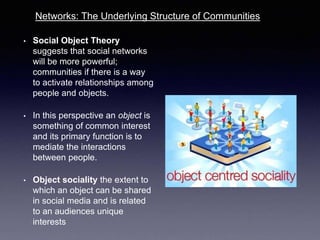
• Social Object Theory 
suggests that social networks 
will be more powerful; 
communities if there is a way 
to activate relationships among 
people and objects. 
• In this perspective an object is 
something of common interest 
and its primary function is to 
mediate the interactions 
between people. 
• Object sociality the extent to 
which an object can be shared 
in social media and is related 
to an audiences unique 
interests
Characteristics of Online 
Communities 
• Conversations- Communities thrive on communication among members. 
Though social media provides an online space for what are essentially 
digital conversations, these conversations are not based on talking or writing 
but on a hybrid of the two. 
• Presence-refers to the effect that people experience when they interact with 
a computer-mediated or computer-generated environment. 
• Democracy- Is a descriptive term that refers to rule by the people. Leaders 
emerge due to the reputation they earn among the general membership. 
• Control over what appears on the platform shifts from a small elite to the 
larger mass. Media democratization means that the members of social 
communities, not traditional media publishers such as magazines or 
newspaper companies, control the creation, delivery, and popularity.
Characteristics of Online Communities 
• Standards of Behavior-Virtual communities need norms, 
or rules that govern behavior, in order to operate. 
• Example:If you buy an item on eBay you agree that you 
have entered into a legal contract to pay for it. 
• 1) Open access sites enable anyone to participate without 
registration or identification. This can be valuable for 
participation on sensitive topics as well as for ease of use. 
• 2) Social contract is the agreement that exists between the 
host or governing body and the members. You engage in a 
social contract when you indicate agreement to a “terms of 
use” clause for a site.
• Level of participation-For an online community 
to thrive, a significant proportion of its members 
must participate. Otherwise the site will fail to 
offer fresh material and ultimately traffic will slow.
How Ideas Travel in a 
Community 
• Whether online or offline, a community has a culture that includes 
shared knowledge, myths, norms, and language. 
• We see evidence of community culture in the memes that evolve 
within community. A meme is a snippet of cultural information that 
speeds person to person until eventually it enters the general 
consciousness. These snippets may include songs phrases, 
ideas, slang words, fashion trends, or shared behaviors. 
• Memes spread among consumers in a geometric progression, just 
as a virus starts off small and steadily infects increasing numbers 
of people until it becomes an epidemic. Because of the viral 
nature of memes, they typically spread rapidly.
Memes
Opinion Leaders and Source of Powers 
• Opinion Leader - a 
person who is frequently 
able to influence others 
attitudes or behavior. 
• They carry more weight 
than the other 
members. 
• They Possess Source of 
power.
The Two-Step Flow Model 
• The two step model helps to explain how 
opinion leaders develop and influence 
others. 
• This model propose that small group of 
influences are responsible for 
disseminating information to opinion 
leaders who then share the information 
with larger respective networks. 
• This might cause influences to ripple.
The Role of Social Capital And 
the Ties to the Communities 
● Social capital refers to the valuable resource people 
individually or in groups have within the context of a 
community. 
● The capital may be actual or virtual and can include 
reputational capital, bonding social capital and maintained 
social capital. People’s network always include strong and 
weak ties. both have values. Even weak ties can create social 
capital for network members.
Creating Sources of Power 
• Everyone who participates in social media can contribute 
content, including their opinions and experience, everyone has 
the potential to spread a message to a potentially large group 
of people. Though connectors are best able to spread 
message, influence impressions can be delivered by anyone
Youtube Video 
• https://www.youtube.com/watch?v=-5PZ_Bh-M6o
Case Study 
• http://techcrunch.com/2012/10/18/facebook-reaffirms- 
its-commitment-to-stop-cyber-bulling-with- 
new-activist-page-partnership-with-the-ad-council/ 
• https://www.facebook.com/notes/facebook/watch-your- 
words-steps-to-preventing-cyberbullying/ 
166700102130

Social media chapter 4

  • 1.
    Chapter 4 DigitalCommunities By: Alma Hasanovic, Alyssa Fields, Raven Whitehead
  • 2.
    Online Communities •Online Communities are a group of people who come together for a specific purpose, who are guided by community policies, and who are supported by Internet access that enables virtual communication • Examples include MyLife, LiveJournal, Tagged, LinkedIn, and Buzzfeed.
  • 3.
    Networks: The UnderlyingStructure of Communities • All of social media is networked • Social Network is a set of socially relevant nodes connected by one or more relations. • Members of a network can be organizations, articles,countries, departments, or any other definable unit. • Nodes are members of a network. Nodes in a network experience interactions and these behaviors based ties such as talking with each other attending an event together or working together.
  • 4.
    • Flows occurbetween nodes. Flows are exchanges of resources, information, or influences among members of the network. • Example: On Facebook you share news, updates about your life, opinions on favorite books and movies, photos, videos, and notes. • Flows are not simply two-way or three-way, they ,may be sent toward an entire community, a list or a group within a network, or several individuals independently. • While the online community exists within a web space, the flows of communication may extend to other domains such as emails, text messages, virtual worlds, and even face to face meet ups where members of an online network arrange to meet in a physical location.
  • 5.
    Networks: The UnderlyingStructure of Communities • Social Object Theory suggests that social networks will be more powerful; communities if there is a way to activate relationships among people and objects. • In this perspective an object is something of common interest and its primary function is to mediate the interactions between people. • Object sociality the extent to which an object can be shared in social media and is related to an audiences unique interests
  • 6.
    Characteristics of Online Communities • Conversations- Communities thrive on communication among members. Though social media provides an online space for what are essentially digital conversations, these conversations are not based on talking or writing but on a hybrid of the two. • Presence-refers to the effect that people experience when they interact with a computer-mediated or computer-generated environment. • Democracy- Is a descriptive term that refers to rule by the people. Leaders emerge due to the reputation they earn among the general membership. • Control over what appears on the platform shifts from a small elite to the larger mass. Media democratization means that the members of social communities, not traditional media publishers such as magazines or newspaper companies, control the creation, delivery, and popularity.
  • 7.
    Characteristics of OnlineCommunities • Standards of Behavior-Virtual communities need norms, or rules that govern behavior, in order to operate. • Example:If you buy an item on eBay you agree that you have entered into a legal contract to pay for it. • 1) Open access sites enable anyone to participate without registration or identification. This can be valuable for participation on sensitive topics as well as for ease of use. • 2) Social contract is the agreement that exists between the host or governing body and the members. You engage in a social contract when you indicate agreement to a “terms of use” clause for a site.
  • 8.
    • Level ofparticipation-For an online community to thrive, a significant proportion of its members must participate. Otherwise the site will fail to offer fresh material and ultimately traffic will slow.
  • 9.
    How Ideas Travelin a Community • Whether online or offline, a community has a culture that includes shared knowledge, myths, norms, and language. • We see evidence of community culture in the memes that evolve within community. A meme is a snippet of cultural information that speeds person to person until eventually it enters the general consciousness. These snippets may include songs phrases, ideas, slang words, fashion trends, or shared behaviors. • Memes spread among consumers in a geometric progression, just as a virus starts off small and steadily infects increasing numbers of people until it becomes an epidemic. Because of the viral nature of memes, they typically spread rapidly.
  • 10.
  • 11.
    Opinion Leaders andSource of Powers • Opinion Leader - a person who is frequently able to influence others attitudes or behavior. • They carry more weight than the other members. • They Possess Source of power.
  • 12.
    The Two-Step FlowModel • The two step model helps to explain how opinion leaders develop and influence others. • This model propose that small group of influences are responsible for disseminating information to opinion leaders who then share the information with larger respective networks. • This might cause influences to ripple.
  • 14.
    The Role ofSocial Capital And the Ties to the Communities ● Social capital refers to the valuable resource people individually or in groups have within the context of a community. ● The capital may be actual or virtual and can include reputational capital, bonding social capital and maintained social capital. People’s network always include strong and weak ties. both have values. Even weak ties can create social capital for network members.
  • 15.
    Creating Sources ofPower • Everyone who participates in social media can contribute content, including their opinions and experience, everyone has the potential to spread a message to a potentially large group of people. Though connectors are best able to spread message, influence impressions can be delivered by anyone
  • 16.
    Youtube Video •https://www.youtube.com/watch?v=-5PZ_Bh-M6o
  • 17.
    Case Study •http://techcrunch.com/2012/10/18/facebook-reaffirms- its-commitment-to-stop-cyber-bulling-with- new-activist-page-partnership-with-the-ad-council/ • https://www.facebook.com/notes/facebook/watch-your- words-steps-to-preventing-cyberbullying/ 166700102130