
ECONOMIC IMPORTANCE OF
BRYOPHYTES
INTRODUCTION TO
BRYOPHYTES
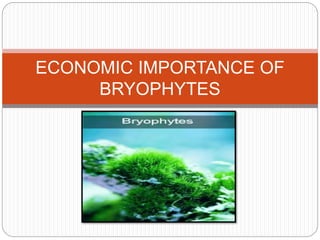
 Bryophyte is a traditional name
used to refer to
all embryophytes (land plants)
that are non-vascular plants
such as mosses, liverworts etc.
 The defining feature of
bryophytes is that they do not
have true vascular tissue.
Although some do have
specialized tissues for the
transport of water, they are not
considered to be true vascular
tissue since they do not contain
lignin.
 There are about 25,000 different
species of bryophytes in the
world today.
 Even though these plants are
small in size, they are one of the
largest groups of land plants
and can be found almost
everywhere in the world.
OCCURANCES OF
BRYOPHYTES
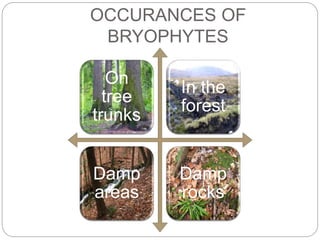
On
tree
trunks
In the
forest
Damp
areas
Damp
rocks
TYPES OF BRYOPHYTES
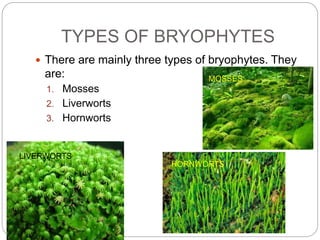
 There are mainly three types of bryophytes. They
are:
1. Mosses
2. Liverworts
3. Hornworts
MOSSES
LIVERWORTS
HORNWORTS
ECONOMIC IMPORTANCE OF
BRYOPHYTES
BRYOPHYTES AS A FUEL
 Liverworts and mosses have long been tried and
used as a fuel in developed countries like
Finland, Sweden, Ireland, West Germany, Poland
and Soviet Union.
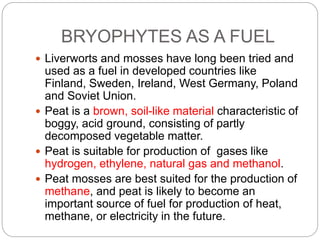
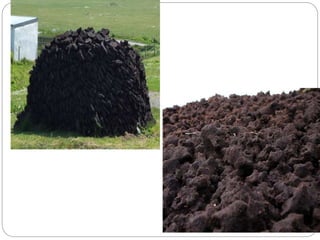
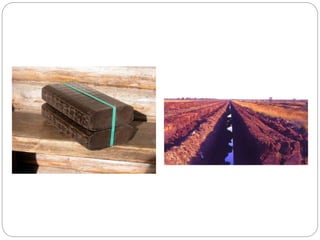
 Peat is a brown, soil-like material characteristic of
boggy, acid ground, consisting of partly
decomposed vegetable matter.
 Peat is suitable for production of gases like
hydrogen, ethylene, natural gas and methanol.
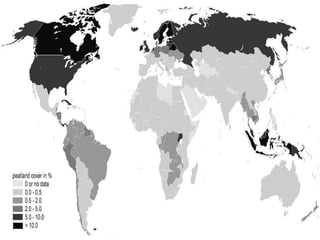
 Peat mosses are best suited for the production of
methane, and peat is likely to become an
important source of fuel for production of heat,
methane, or electricity in the future.
HORTICULTURE USES
 There is a long tradition of use of bryophytes in
horticulture as soil additives, because of their
high water holding capacity.
 Peat is an important soil conditioner and is
commonly used for agricultural and horticultural
purposes around the world.
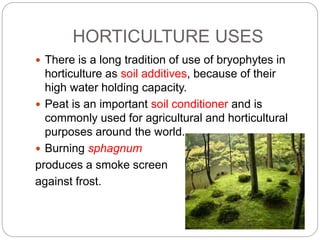
 Burning sphagnum
produces a smoke screen
against frost.
 V. R. Timmer contended that mosses accumulate
potassium, magnesium and calcium during
rainfall, but they do not compete for phosphorous
in soil. These trapped nutrients maybe released
slowly from the mosses to soil. When the mosses
become dry its cell membrane undergoes some
damage, so when the moss is rehydrated, it
becomes leaky. while it repairs the damage it can
release its more soluble contents (eg.
Potassium)into the soil, allowing other plant roots
to absorb it, during the first stages of rainfall.
AS A PRESERVATIVE AGENT
 Bryophytes have excellent power to absorb
moisture and can act as a good preservative
agent.
 They also have a natural acidity that inhibits
the growth of fungi and bacteria, therefore
they are also used in shipping live shellfish
and other organisms.
 Wet sphagnum is used to ship live plants.
MOSS INDUSTRY
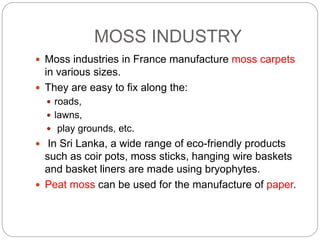
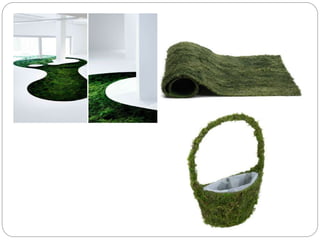
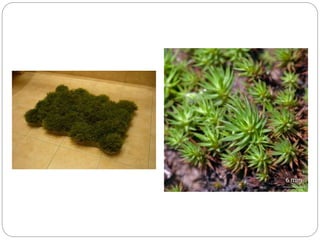
 Moss industries in France manufacture moss carpets
in various sizes.
 They are easy to fix along the:
 roads,
 lawns,
 play grounds, etc.
 In Sri Lanka, a wide range of eco-friendly products
such as coir pots, moss sticks, hanging wire baskets
and basket liners are made using bryophytes.
 Peat moss can be used for the manufacture of paper.
BRYOPHYTES IN HOUSE
CONSTRUCTION
• These tiny plants are used in the construction
of houses and their furnishings.
• At Kapkot in the Himalayas, villagers use
moss mats with shrubs, grasses, and bamboo
to make a pharki, a kind of door placed at the
openings of their temporary huts. Sphagnum
peat, peatcrete and peatwood are the new
material use for making houses ,they are low
cost and easy to transport.
 Some bryophytes are also used as furniture
stuffing.
HOUSEHOLD USES
 Polytrichum juniperinum is a tall moss that holds
soil in place, and its strong enough to make
brooms, baskets and doormats.
 Some mosses are used as insect repellants when
storing food.
 Local mosses and liverworts are dried, made into a
coarse powder that is sprinkled over grains and other
goods to be stored in containers.
FIBRE INDUSTRIES
•Mosses are mixed with wool to make cheap
clothes.
•They are used in decoration of net bags and
other objects.
•Women also wear their steam like structure in
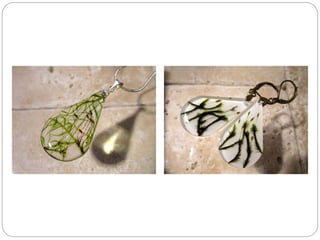
their hair and as decorations in bracelets .
•Used in hiking boots to absorb odour and
moisture.
•Used in lining of diapers to improve absorbing
power.
MEDICINAL USES
 chilblains, scabies, acne and other forms of skin
diseases can be treated using bryophytes.
 Help to cure ringworms.
 Ash of moss is mixed with honey and fat to treat cuts
burns and wounds.
 Used for curing allaying from insect bites.
 Medicines made of bryophytes can treat tonsillitis,
cystis, bronchitis and tympanitis.
 Some mosses are antiseptic and can be used in
wounds. This antiseptic effect was discovered during
world war II.
 Marchantia polymorpha can be used for the treatment
of pulmonary tuberculosis.
USE IN BIOTECHNOLOGY
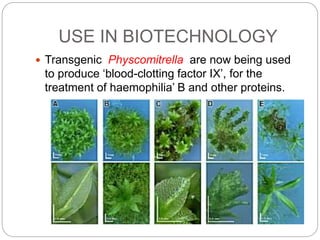
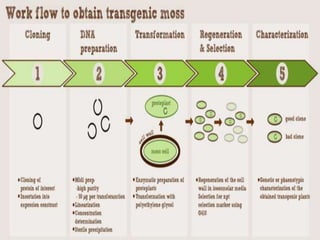
 Transgenic Physcomitrella are now being used
to produce ‘blood-clotting factor IX’, for the
treatment of haemophilia’ B and other proteins.
ROLE IN ECOLOGICAL
SUCCESSION
 Liverworts, mosses and lichens serves as
pioneers in lithosere.
 They colonize bare rocks and similar habitats
where other plants cannot get initially established.
 They initiate soil formation and gradually make
these habitats ideal for colonization by other
plants.
ROLE IN BOG SUCCESSION
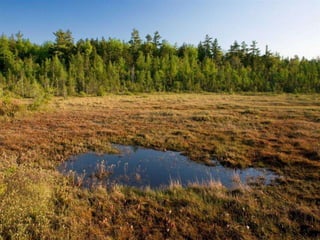
 Mosses play an important role in bog succession from
open water to climax forests.
 Plants like sphagnum establish themselves in open
water bodies and cover their whole surface area.
 Due to the constant deposition of all plant debris, the
bottom of the water body rises gradually.
 Sphagnum and other hydrophytes form a dense cover
and convert the open water body into a quaking bog.
 Finally large trees colonize the area transforming the
swamp into a forest.
ROLE IN SOIL FORMATION AND
GROWTH OF VEGETATION
 Mosses play a significant role in soil formation.
 They grow in the cracks and crevices of rocks
and cause weathering of rocks with the help of
the acid they release.
 This leads to soil formation.
 The death and decay of these plants also help in
soil formation and also favour the growth of
vegetation.
ROLE IN SOIL CONSERVATION
 Some bryophytes like mosses check the sheet
erosion of soil and thereby play an important role
in soil conservation.
 They grow luxuriantly and form thick mat or
carpet which can tightly hold the soil preventing
soil erosion.
 They can also retain the impact of rainfall and
hold most of the water.
ROLE AS POLLUTION INDICATORS
 Some live or sundried mosses, especially
sphagnum, can absorb metals.
 The accumulation of heavy metals in mosses
enables them to be used as indicators of
atmospheric and aquatic pollution and also in
mineralogical surveys.
Economic importance of Bryophytes