Recombinant DNARecombinant DNA
TechnologyTechnology
Recombinant DNA TechnologyRecombinant DNA Technology
Recombinant DNA technology proceduresRecombinant DNA technology procedures
by which DNA from different species canby which DNA from different species can
be isolated, cut andbe isolated, cut and spliced togetherspliced together ----
newnew "recombinant ""recombinant " molecules are thenmolecules are then
multiplied (cloning) in quantity inmultiplied (cloning) in quantity in
populations of rapidly dividing cells (e.g.populations of rapidly dividing cells (e.g.
bacteria, yeast).bacteria, yeast).
Recombinant DNA TechnologyRecombinant DNA Technology
The termThe term gene cloning, recombinant DNAgene cloning, recombinant DNA
technology and genetic engineering maytechnology and genetic engineering may
seems similar, however they are differentseems similar, however they are different
techniques in Biotechnology andtechniques in Biotechnology and they arethey are
interrelatedinterrelated
Clone: a collection of molecules or cells,Clone: a collection of molecules or cells,
allall identicalidentical to an original molecule or cellto an original molecule or cell
Recombinant DNA TechnologyRecombinant DNA Technology
Three goalsThree goals
- Eliminate undesirableEliminate undesirable phenotypic traitsphenotypic traits
(observable characteristics)(observable characteristics)
- Combine beneficial traits of two or moreCombine beneficial traits of two or more
organismsorganisms
- Create organisms that synthesizeCreate organisms that synthesize
products humans needproducts humans need
Recombinant DNA TechnologyRecombinant DNA Technology
HumanHuman gene therapygene therapy, genetically-, genetically-
engineeredengineered cropcrop plants andplants and
transgenictransgenic mice have become possible mice have become possible
because of the powerful techniquesbecause of the powerful techniques
developed to manipulate nucleic acids anddeveloped to manipulate nucleic acids and
proteins.proteins.
Recombinant DNA TechnologyRecombinant DNA Technology
In the early 1970s it became possible toIn the early 1970s it became possible to
isolate a specific piece of DNA out of theisolate a specific piece of DNA out of the
millions of base pairs in a typical genome.millions of base pairs in a typical genome.
Recombinant DNA TechnologyRecombinant DNA Technology
Currently it is relatively easy to cut out aCurrently it is relatively easy to cut out a
specific piece of DNA, produce a largespecific piece of DNA, produce a large
number of copies , determine itsnumber of copies , determine its
nucleotide sequence, slightly alter it andnucleotide sequence, slightly alter it and
then as a final step transfer it back into cellthen as a final step transfer it back into cell
in.in.
Recombinant DNA TechnologyRecombinant DNA Technology
Recombinant DNA technology is based on aRecombinant DNA technology is based on a
number of important things:number of important things:
 Bacteria contain extrachromosomalBacteria contain extrachromosomal
molecules of DNA calledmolecules of DNA called plasmidsplasmids
which are circular.which are circular.
Recombinant DNA TechnologyRecombinant DNA Technology
 Bacteria also produce enzymes calledBacteria also produce enzymes called
restriction endonucleasesrestriction endonucleases that cutthat cut
DNA molecules at specific places intoDNA molecules at specific places into
many smaller fragments calledmany smaller fragments called
restriction fragmentsrestriction fragments ..
Recombinant DNA TechnologyRecombinant DNA Technology
Restriction Enzymes and plasmidRestriction Enzymes and plasmid
There are many different kinds ofThere are many different kinds of
restriction endonucleasesrestriction endonucleases
Each nuclei cuts DNA at a specific siteEach nuclei cuts DNA at a specific site
defined by a sequence of bases in thedefined by a sequence of bases in the
DNA called aDNA called a recognition siterecognition site
Recombinant DNA TechnologyRecombinant DNA Technology
Restriction Enzymes and plasmidRestriction Enzymes and plasmid
A restriction enzyme cuts only double-A restriction enzyme cuts only double-
helical segments that contain a particularhelical segments that contain a particular
sequence, and it makes its incisions onlysequence, and it makes its incisions only
within that sequence--known as awithin that sequence--known as a
"recognition sequence"."recognition sequence".
Recombinant DNA TechnologyRecombinant DNA Technology
Restriction Enzymes and plasmidRestriction Enzymes and plasmid
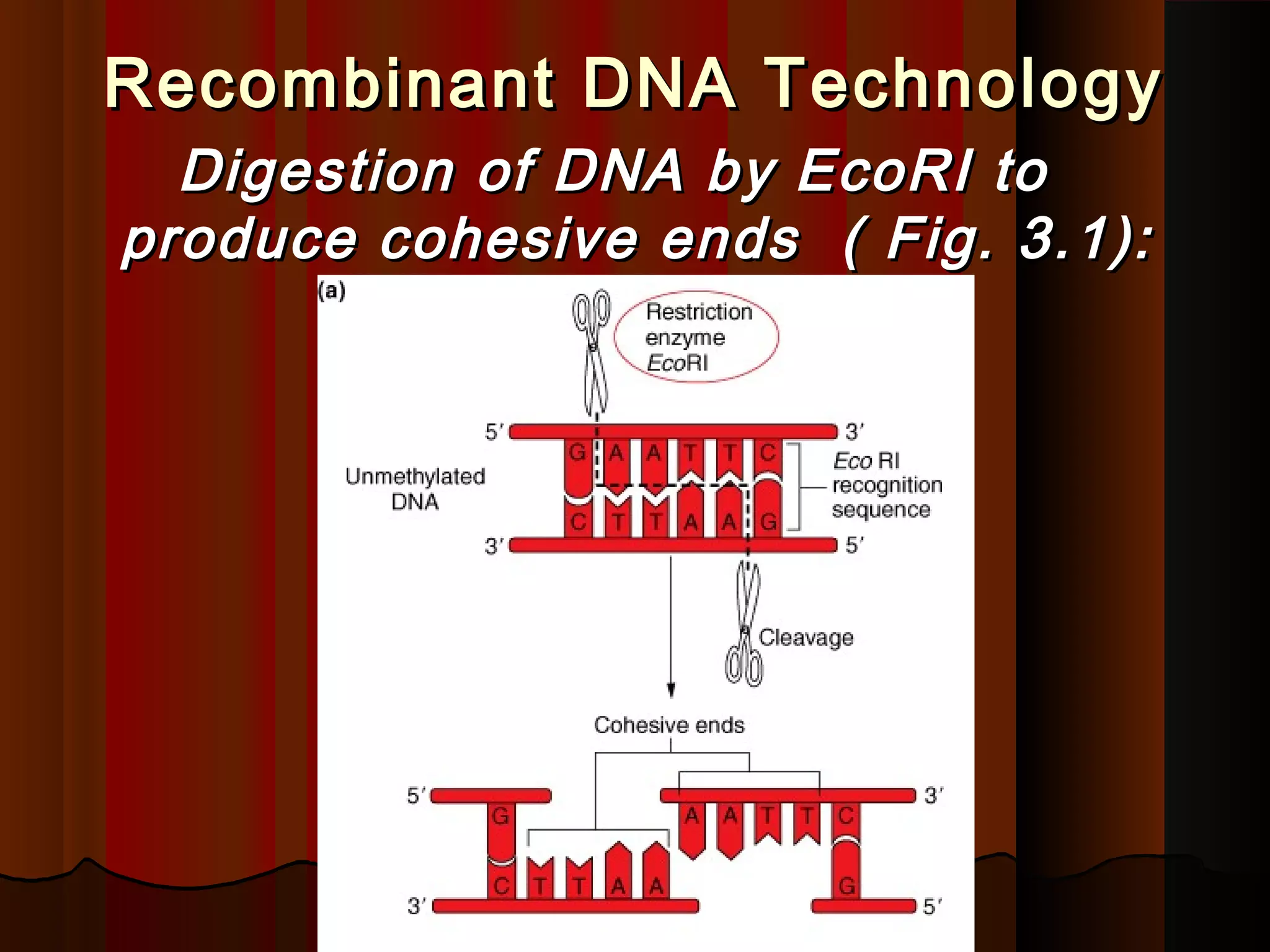
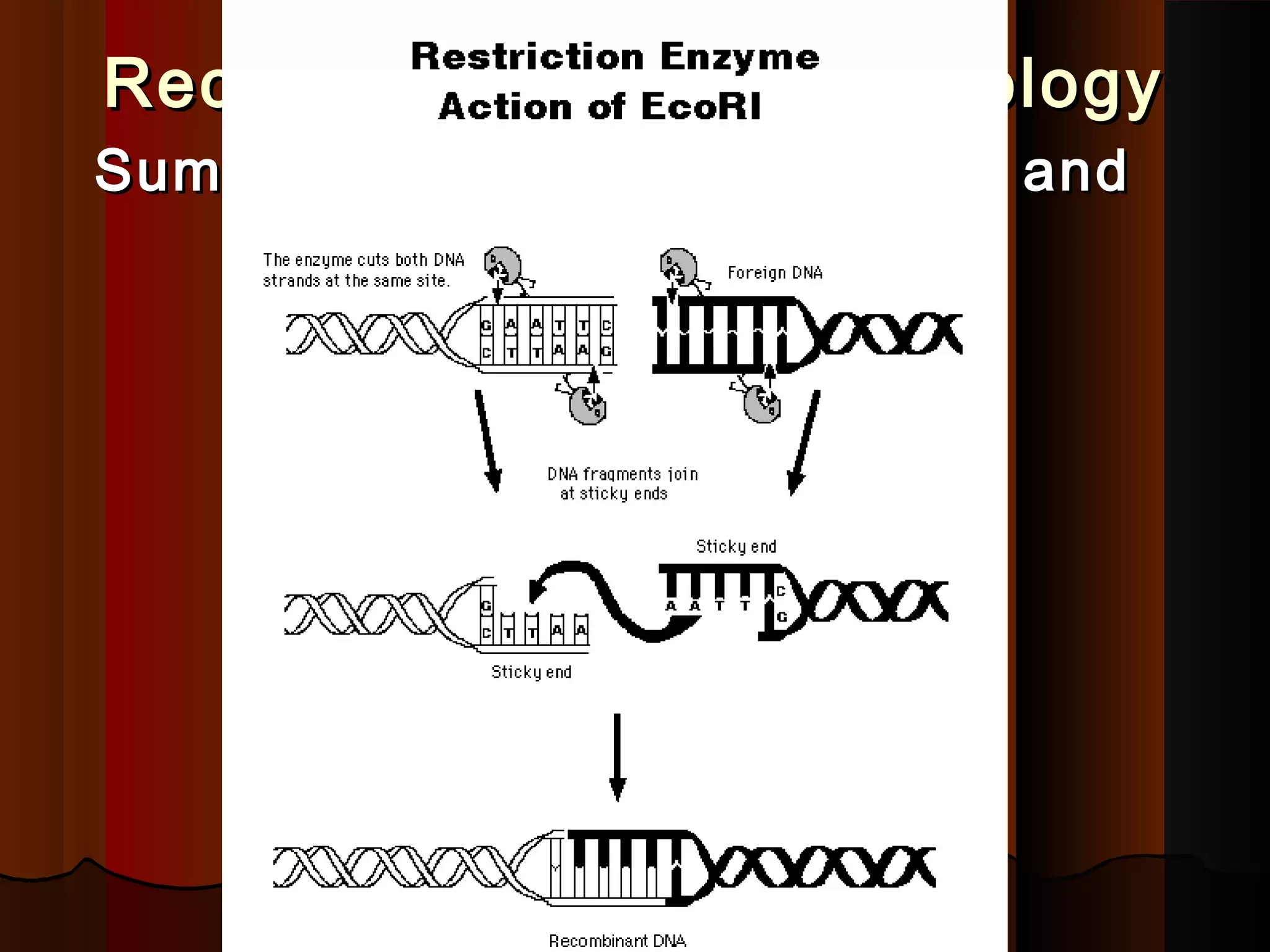
Sticky endSticky end andand blunt endblunt end are the twoare the two
possible configurations resulting from thepossible configurations resulting from the
breaking of double-stranded DNAbreaking of double-stranded DNA
Recombinant DNA TechnologyRecombinant DNA Technology
Restriction Enzymes and plasmidRestriction Enzymes and plasmid
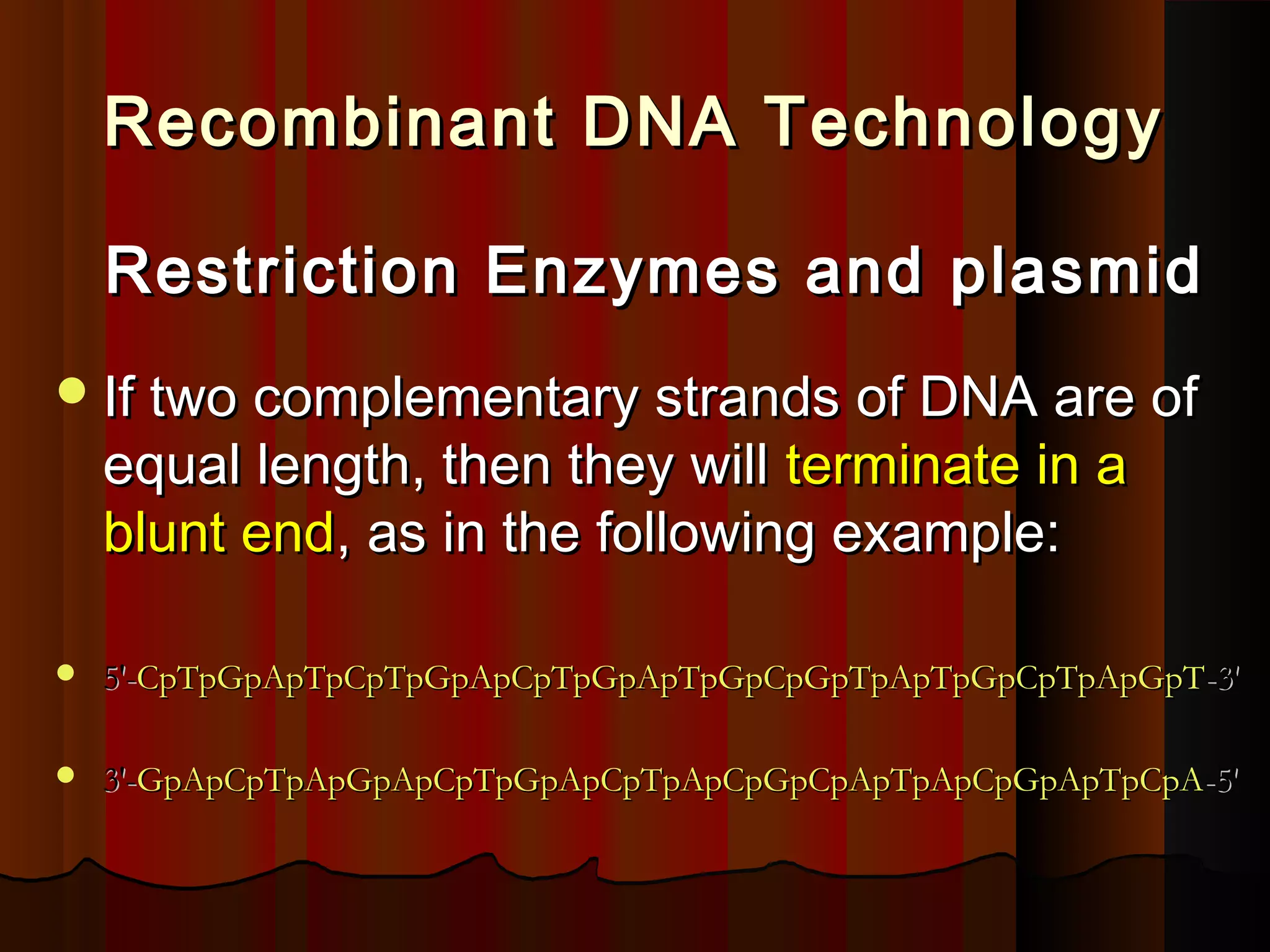
If two complementary strands of DNA are ofIf two complementary strands of DNA are of
equal length, then they willequal length, then they will terminate in aterminate in a
blunt endblunt end, as in the following example:, as in the following example:
 5'-5'-CpTpGpApTpCpTpGpApCpTpGpApTpGpCpGpTpApTpGpCpTpApGpTCpTpGpApTpCpTpGpApCpTpGpApTpGpCpGpTpApTpGpCpTpApGpT-3'-3'
 3'-3'-GpApCpTpApGpApCpTpGpApCpTpApCpGpCpApTpApCpGpApTpCpAGpApCpTpApGpApCpTpGpApCpTpApCpGpCpApTpApCpGpApTpCpA-5'-5'
Recombinant DNA TechnologyRecombinant DNA Technology
Restriction Enzymes and plasmidRestriction Enzymes and plasmid
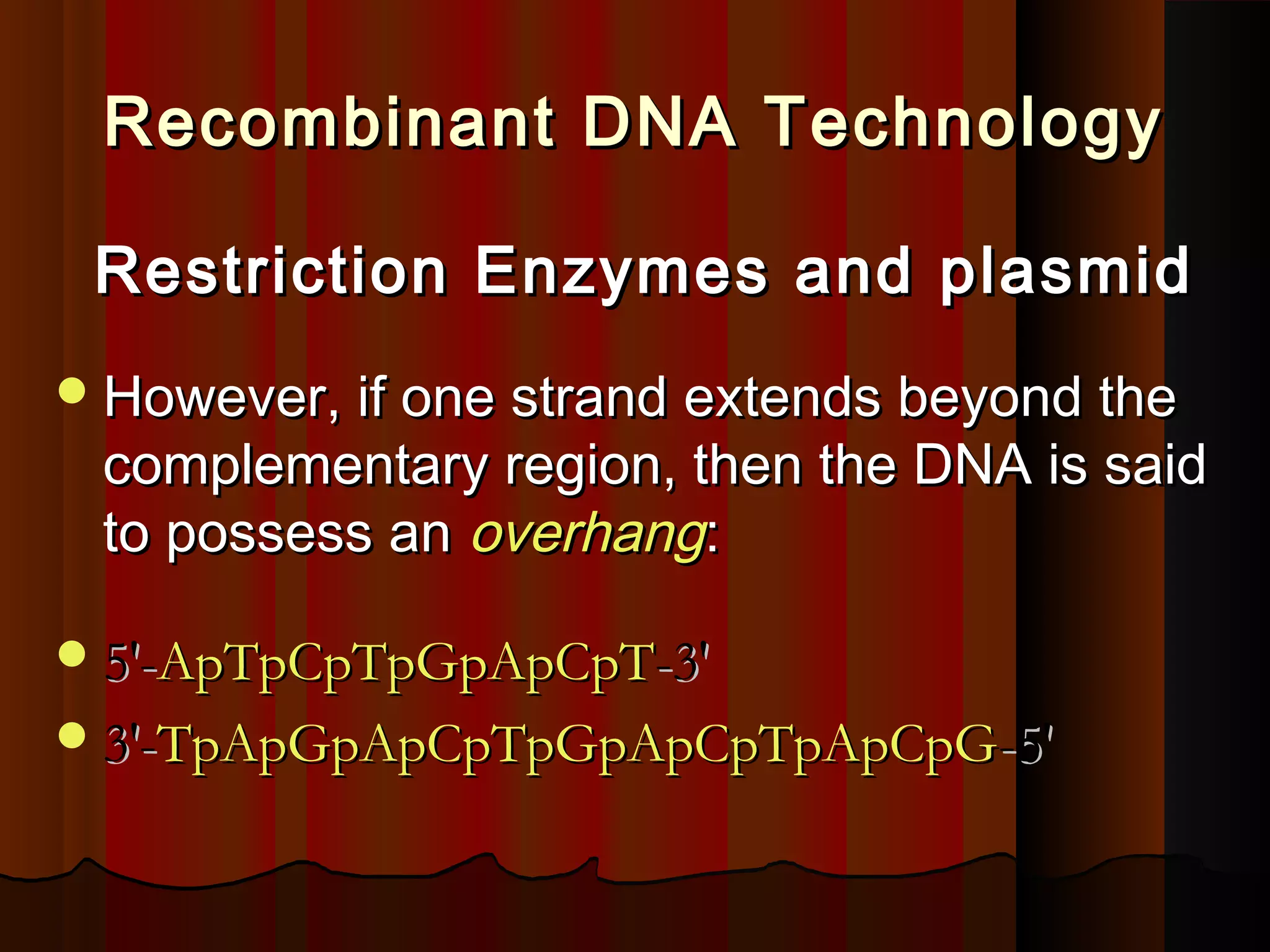
However, if one strand extends beyond theHowever, if one strand extends beyond the
complementary region, then the DNA is saidcomplementary region, then the DNA is said
to possess anto possess an overhangoverhang::
5'-5'-ApTpCpTpGpApCpTApTpCpTpGpApCpT-3'-3'
3'-3'-TpApGpApCpTpGpApCpTpApCpGTpApGpApCpTpGpApCpTpApCpG-5'-5'
Recombinant DNA TechnologyRecombinant DNA Technology
Restriction Enzymes and plasmidRestriction Enzymes and plasmid
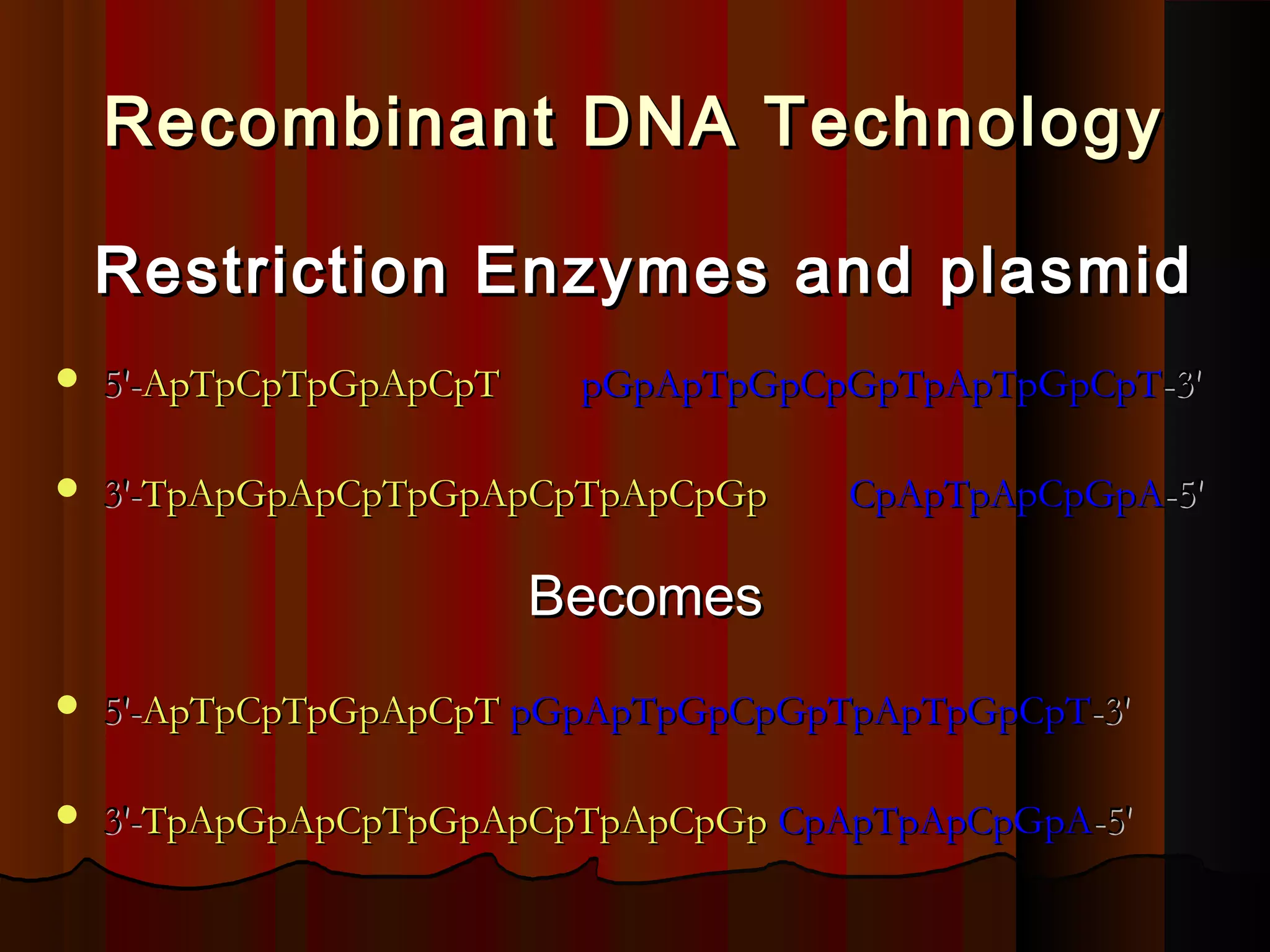
If another DNA fragment exists with aIf another DNA fragment exists with a
complementary overhang, then these twocomplementary overhang, then these two
overhangs will tend to associate with eachoverhangs will tend to associate with each
other and each strand is said to possess aother and each strand is said to possess a
sticky endsticky end::
Recombinant DNA TechnologyRecombinant DNA Technology
Restriction Enzymes and plasmidRestriction Enzymes and plasmid
 5'-5'-ApTpCpTpGpApCpTApTpCpTpGpApCpT pGpApTpGpCpGpTpApTpGpCpTpGpApTpGpCpGpTpApTpGpCpT-3'-3'
 3'-3'-TpApGpApCpTpGpApCpTpApCpGpTpApGpApCpTpGpApCpTpApCpGp CpApTpApCpGpACpApTpApCpGpA-5'-5'
BecomesBecomes
 5'-5'-ApTpCpTpGpApCpTApTpCpTpGpApCpT pGpApTpGpCpGpTpApTpGpCpTpGpApTpGpCpGpTpApTpGpCpT-3'-3'
 3'-3'-TpApGpApCpTpGpApCpTpApCpGpTpApGpApCpTpGpApCpTpApCpGp CpApTpApCpGpACpApTpApCpGpA-5'-5'
Recombinant DNA TechnologyRecombinant DNA Technology
Restriction Enzymes and plasmidRestriction Enzymes and plasmid
Restriction Enzymes are primarily found inRestriction Enzymes are primarily found in
bacteria and are given abbreviationsbacteria and are given abbreviations
based on genus and species of thebased on genus and species of the
bacteria.bacteria.
One of the first restriction enzymes to beOne of the first restriction enzymes to be
isolated was from EcoRIisolated was from EcoRI
EcoRI is so named because it wasEcoRI is so named because it was
isolated fromisolated from EscherichiaEscherichia coli strain calledcoli strain called
RY13.RY13.
Recombinant DNA TechnologyRecombinant DNA Technology
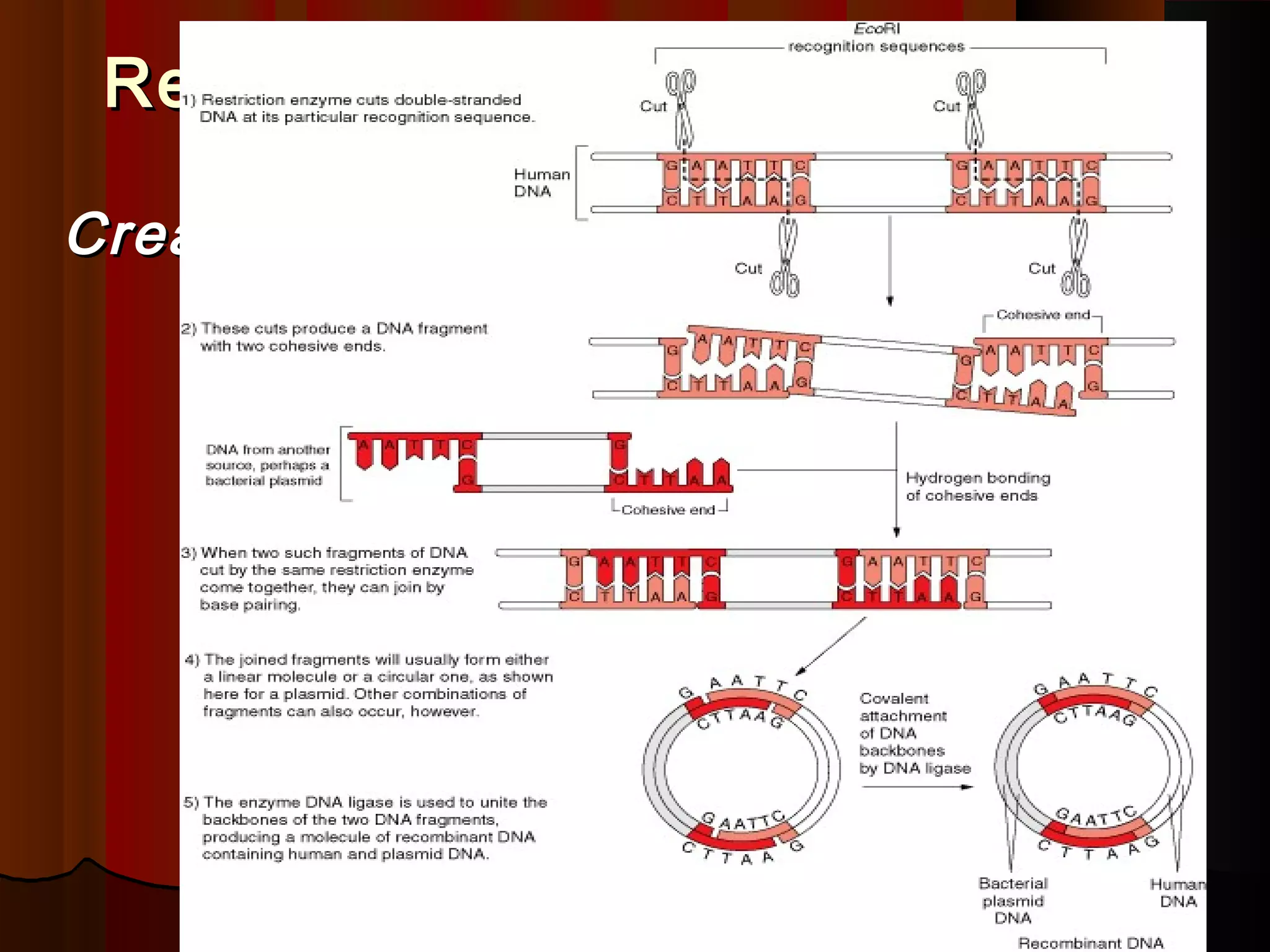
Digestion of DNA by EcoRI toDigestion of DNA by EcoRI to
produce cohesive ends ( Fig. 3.1):produce cohesive ends ( Fig. 3.1):
Recombinant DNA TechnologyRecombinant DNA Technology
Creating recombinant DNA :Creating recombinant DNA :
The first Recombinant DNA moleculesThe first Recombinant DNA molecules
were made by Paul Berg at Stanfordwere made by Paul Berg at Stanford
University in 1972.University in 1972.
In 1973 Herbert Boyer and Stanley CohenIn 1973 Herbert Boyer and Stanley Cohen
created the first recombinant DNAcreated the first recombinant DNA
organisms.organisms.
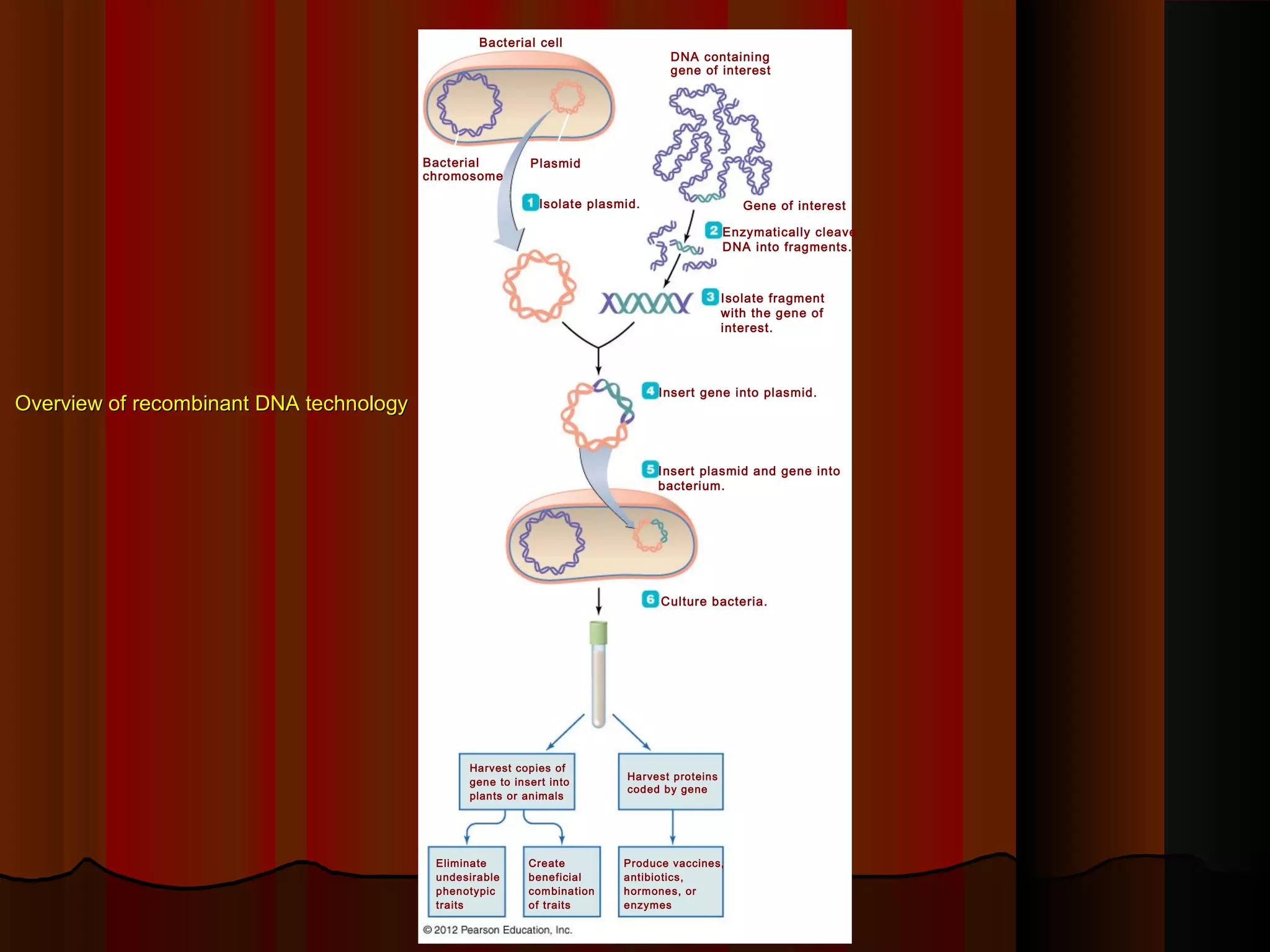
Overview of recombinant DNA technologyOverview of recombinant DNA technology
Bacterial cell
Bacterial
chromosome
Plasmid
Gene of interest
DNA containing
gene of interest
Isolate plasmid.
Enzymatically cleave
DNA into fragments.
Isolate fragment
with the gene of
interest.
Insert gene into plasmid.
Insert plasmid and gene into
bacterium.
Culture bacteria.
Harvest copies of
gene to insert into
plants or animals
Harvest proteins
coded by gene
Eliminate
undesirable
phenotypic
traits
Produce vaccines,
antibiotics,
hormones, or
enzymes
Create
beneficial
combination
of traits
Ligase
E. Coli
E. Coli
Recombinant DNA TechnologyRecombinant DNA Technology
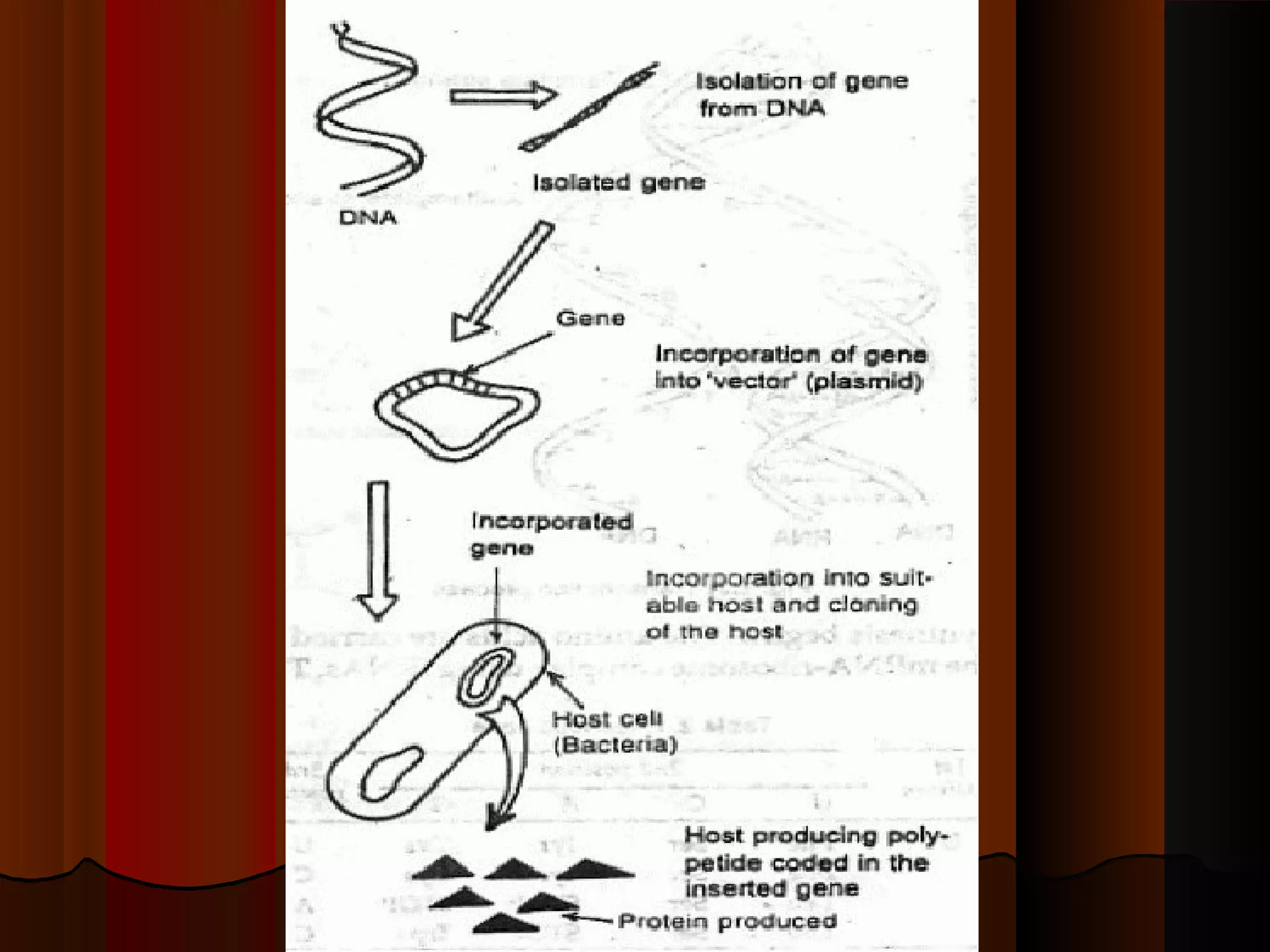
Creating Recombinant DNA (Fig 3.2):Creating Recombinant DNA (Fig 3.2):
Recombinant DNA TechnologyRecombinant DNA Technology
Reading materials :Summary ofReading materials :Summary of
Recombinant DNA technologyRecombinant DNA technology
process:process:
Recombinant DNA technology requiresRecombinant DNA technology requires
DNA extraction, purification, andDNA extraction, purification, and
fragmentation.fragmentation.
Fragmentation of DNA is done by specificFragmentation of DNA is done by specific
'restriction' enzymes and is followed by'restriction' enzymes and is followed by
sorting and isolation of fragmentssorting and isolation of fragments
containing a particular gene.containing a particular gene.
Recombinant DNA TechnologyRecombinant DNA Technology
Summary of Recombinant DNASummary of Recombinant DNA
technology process:technology process:
This portion of the DNA is then coupled toThis portion of the DNA is then coupled to
a carrier molecule.a carrier molecule.
The hybrid DNA is introduced into aThe hybrid DNA is introduced into a
chosen cell for reproduction andchosen cell for reproduction and
synthesis.synthesis.
Recombinant DNA TechnologyRecombinant DNA Technology
Transformation and AntibioticTransformation and Antibiotic
SelectionSelection
Transformation is the genetic alteration ofTransformation is the genetic alteration of
a cell resulting from the introduction,a cell resulting from the introduction,
uptake and expression of foreign DNA.uptake and expression of foreign DNA.
Recombinant DNA TechnologyRecombinant DNA Technology
Transformation and AntibioticTransformation and Antibiotic
SelectionSelection
There are more aggressive techniques forThere are more aggressive techniques for
inserting foreign DNA into eukaryotic cells.inserting foreign DNA into eukaryotic cells.
For example, throughFor example, through electroporationelectroporation ..
ElectroporationElectroporation involves applying ainvolves applying a
brief (milliseconds) pulse high voltagebrief (milliseconds) pulse high voltage
electricity to create tiny holes in theelectricity to create tiny holes in the
bacterial cell wall that allows DNA to enter.bacterial cell wall that allows DNA to enter.
Recombinant DNA TechnologyRecombinant DNA Technology
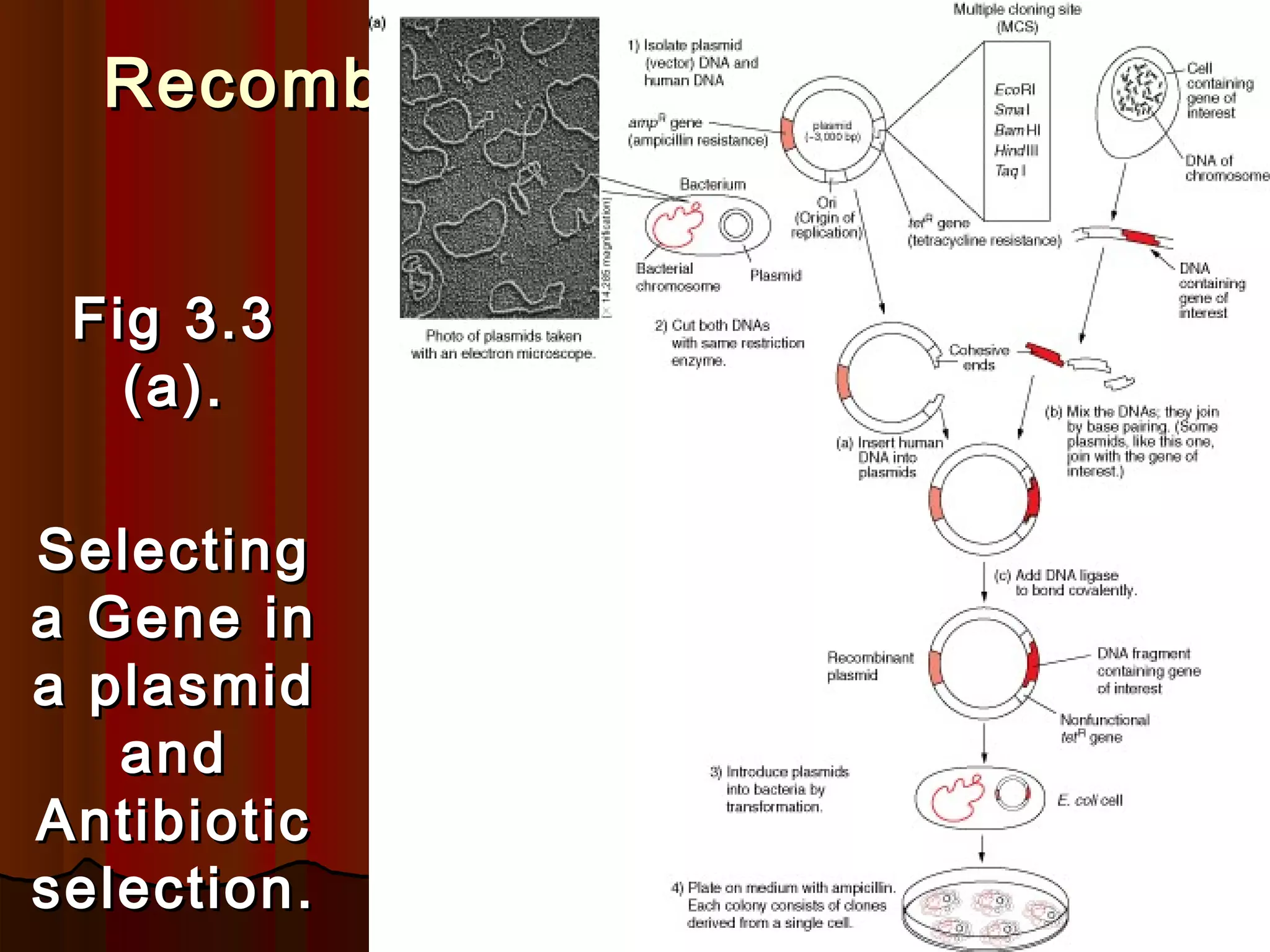
Plasmids and Antibiotic resistancePlasmids and Antibiotic resistance
PlasmidsPlasmids were discovered in the latewere discovered in the late
sixties, and it was quickly realized thatsixties, and it was quickly realized that
they could be used to amplify a gene ofthey could be used to amplify a gene of
interest.interest.
A plasmid containing resistance to anA plasmid containing resistance to an
antibiotic (usually ampicillin) orantibiotic (usually ampicillin) or
Tetracycline, is used as a vector.Tetracycline, is used as a vector.
Recombinant DNA TechnologyRecombinant DNA Technology
The gene of interest (resistant toThe gene of interest (resistant to
Ampicillin) is inserted into the vectorAmpicillin) is inserted into the vector
plasmid and this newly constructedplasmid and this newly constructed
plasmid is then put into E. coli that isplasmid is then put into E. coli that is
sensitive to ampicillin.( Text bk:Pg 58)sensitive to ampicillin.( Text bk:Pg 58)
The bacteria are then spread over a plateThe bacteria are then spread over a plate
that contains ampicillin.that contains ampicillin.
Recombinant DNA TechnologyRecombinant DNA Technology
Plasmids and Antibiotic resistancePlasmids and Antibiotic resistance
The ampicillin provides a selectiveThe ampicillin provides a selective
pressure because only bacteria that havepressure because only bacteria that have
acquired the plasmid can grow on theacquired the plasmid can grow on the
plate.plate.
Those bacteria which do not acquire theThose bacteria which do not acquire the
plasmid with the inserted gene of interestplasmid with the inserted gene of interest
will die.will die.
Recombinant DNA TechnologyRecombinant DNA Technology
Plasmids and Antibiotic resistancePlasmids and Antibiotic resistance
As long as the bacteria grow in ampicillin,As long as the bacteria grow in ampicillin,
it will need the plasmid to survive and itit will need the plasmid to survive and it
will continually replicate it, along with thewill continually replicate it, along with the
gene of interest that has been inserted togene of interest that has been inserted to
the plasmid .the plasmid .
Recombinant DNA TechnologyRecombinant DNA Technology
Fig 3.3Fig 3.3
(a).(a).
SelectingSelecting
a Gene ina Gene in
a plasmida plasmid
andand
AntibioticAntibiotic
selection.selection.
Recombinant DNA TechnologyRecombinant DNA Technology
Assignment: For above procedure,Assignment: For above procedure,
Read Transformation of BacterialRead Transformation of Bacterial
cells and Antibiotic selection pgcells and Antibiotic selection pg
61.61.
Recombinant DNA TechnologyRecombinant DNA Technology
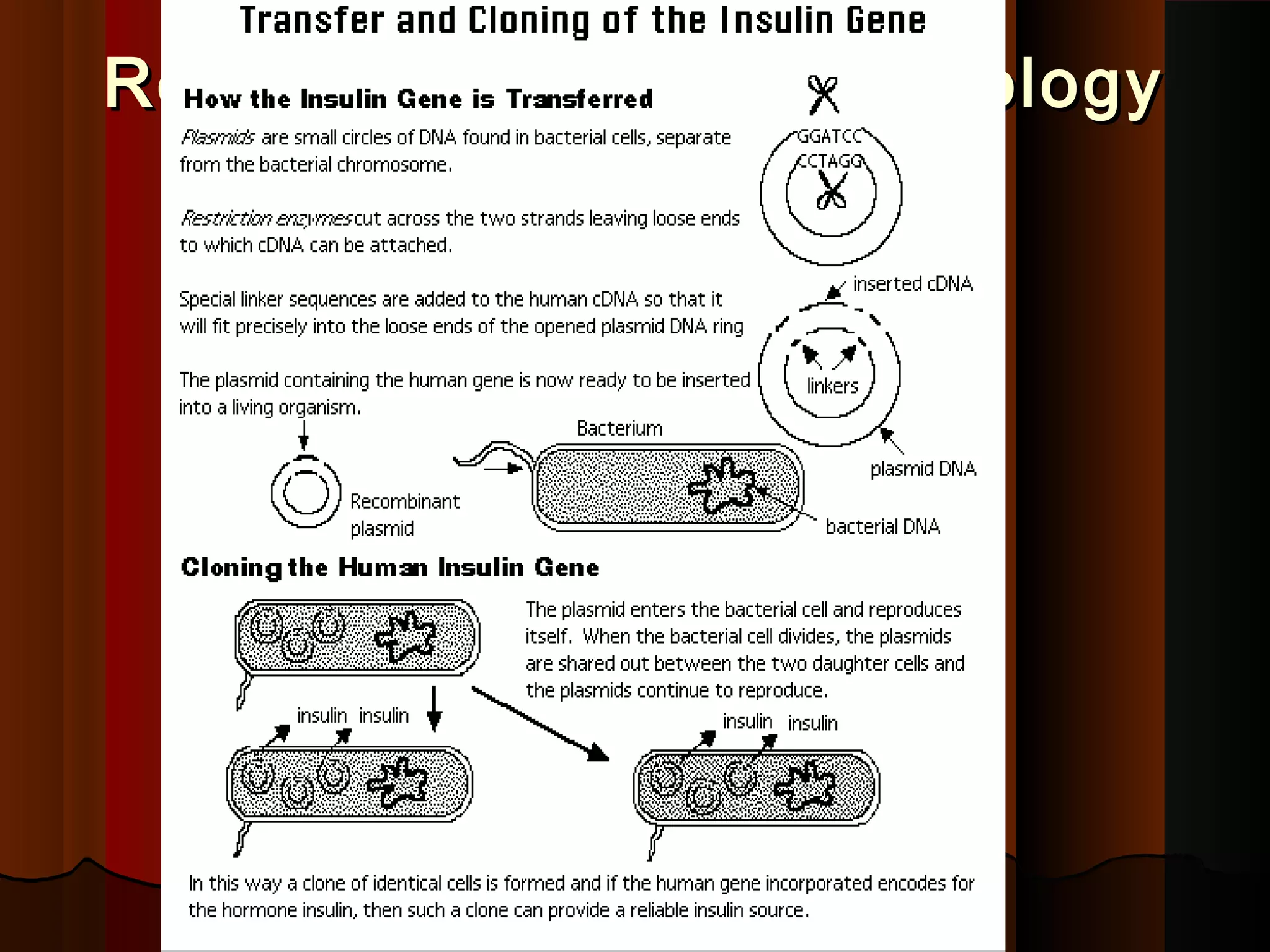
Human Gene cloningHuman Gene cloning
Once inside a bacterium, the plasmidOnce inside a bacterium, the plasmid
containing the human cDNA can multiplycontaining the human cDNA can multiply
to yield several dozen replicas.to yield several dozen replicas.
Recombinant DNA TechnologyRecombinant DNA Technology
Reading materials:Reading materials:
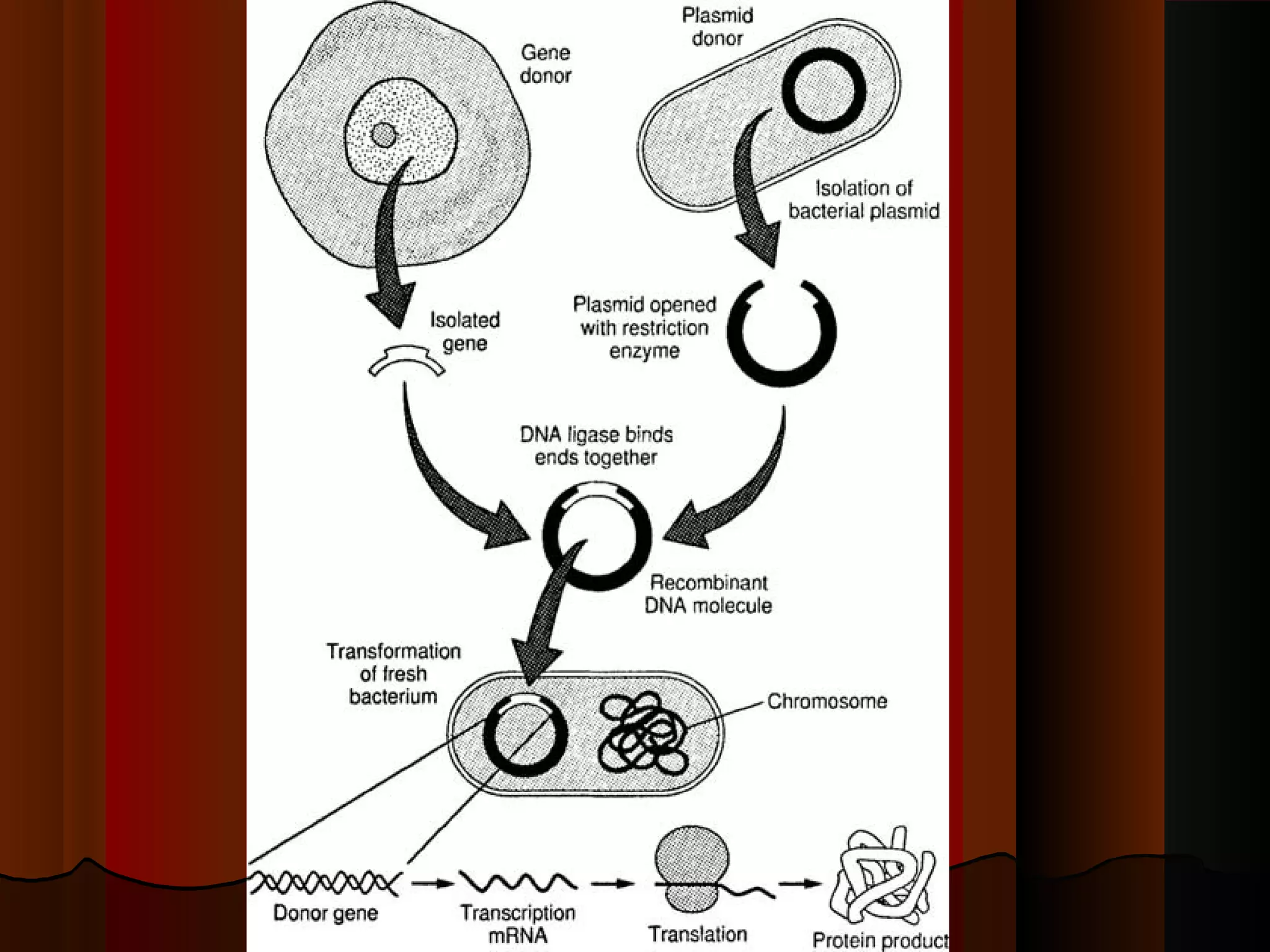
Summary of Recombinant DNA andSummary of Recombinant DNA and
Cloning (Fig. below):Cloning (Fig. below):
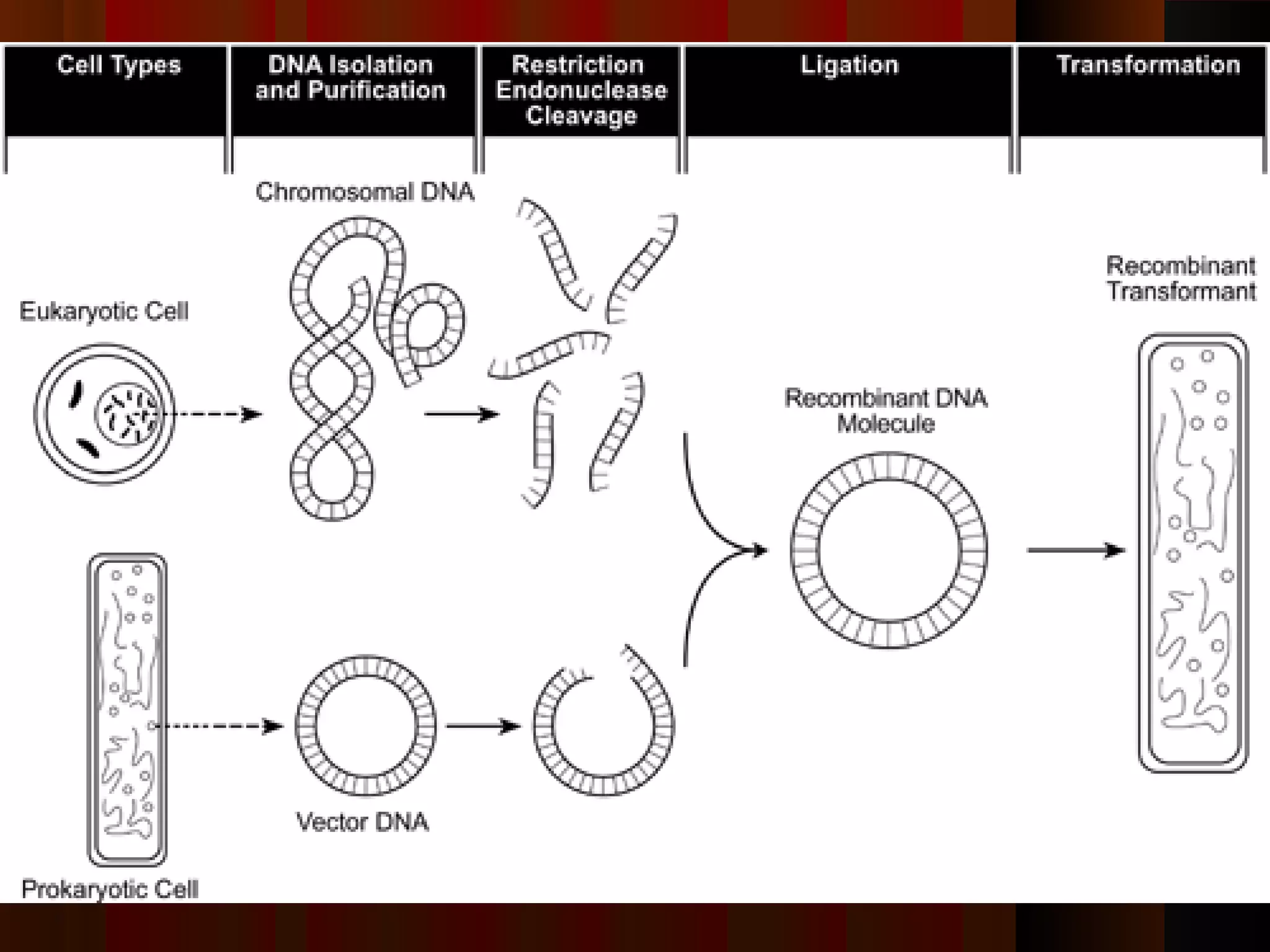
Isolation of two kinds of DNAIsolation of two kinds of DNA
Treatment of plasmid and foreign DNATreatment of plasmid and foreign DNA
with the same restriction enzymewith the same restriction enzyme
Mixture of foreign DNA with plasmidsMixture of foreign DNA with plasmids
Recombinant DNA TechnologyRecombinant DNA Technology
Addition of DNA ligaseAddition of DNA ligase
Introduction of recombinant plasmid intoIntroduction of recombinant plasmid into
bacterial cellsbacterial cells
Production of multiple gene copies byProduction of multiple gene copies by
gene cloninggene cloning
Recombinant DNA TechnologyRecombinant DNA Technology
Summary of Recombinant DNA andSummary of Recombinant DNA and
Cloning (Fig.):Cloning (Fig.):
Recombinant DNA TechnologyRecombinant DNA Technology
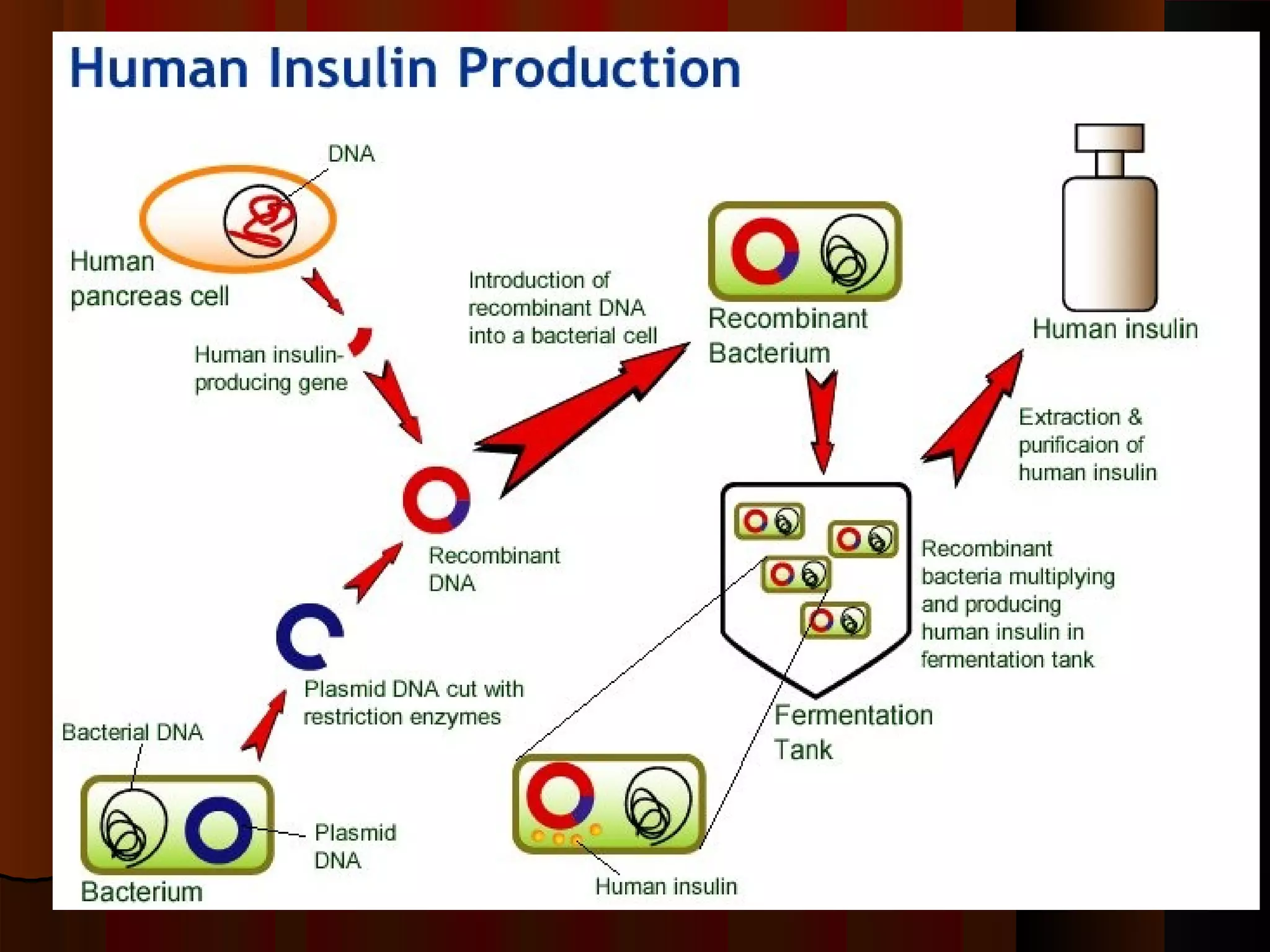
This segment is "glued" into place usingThis segment is "glued" into place using
an enzyme called DNA ligase.an enzyme called DNA ligase.
The result is an edited, or recombinant,The result is an edited, or recombinant,
DNA molecule.DNA molecule.
Recombinant DNA TechnologyRecombinant DNA Technology
When this recombinant plasmid DNA isWhen this recombinant plasmid DNA is
inserted intoinserted into E. coliE. coli, the cell will be able to, the cell will be able to
process the instructions to assemble theprocess the instructions to assemble the
amino acids for insulin production.amino acids for insulin production.
Recombinant DNA TechnologyRecombinant DNA Technology
More importantly, the new instructions areMore importantly, the new instructions are
passed along to the next generation ofpassed along to the next generation of E.E.
colicoli cells in the process known as genecells in the process known as gene
cloning.cloning.
Assignment: Human gene cloning pg 63Assignment: Human gene cloning pg 63
Recombinant DNA TechnologyRecombinant DNA Technology
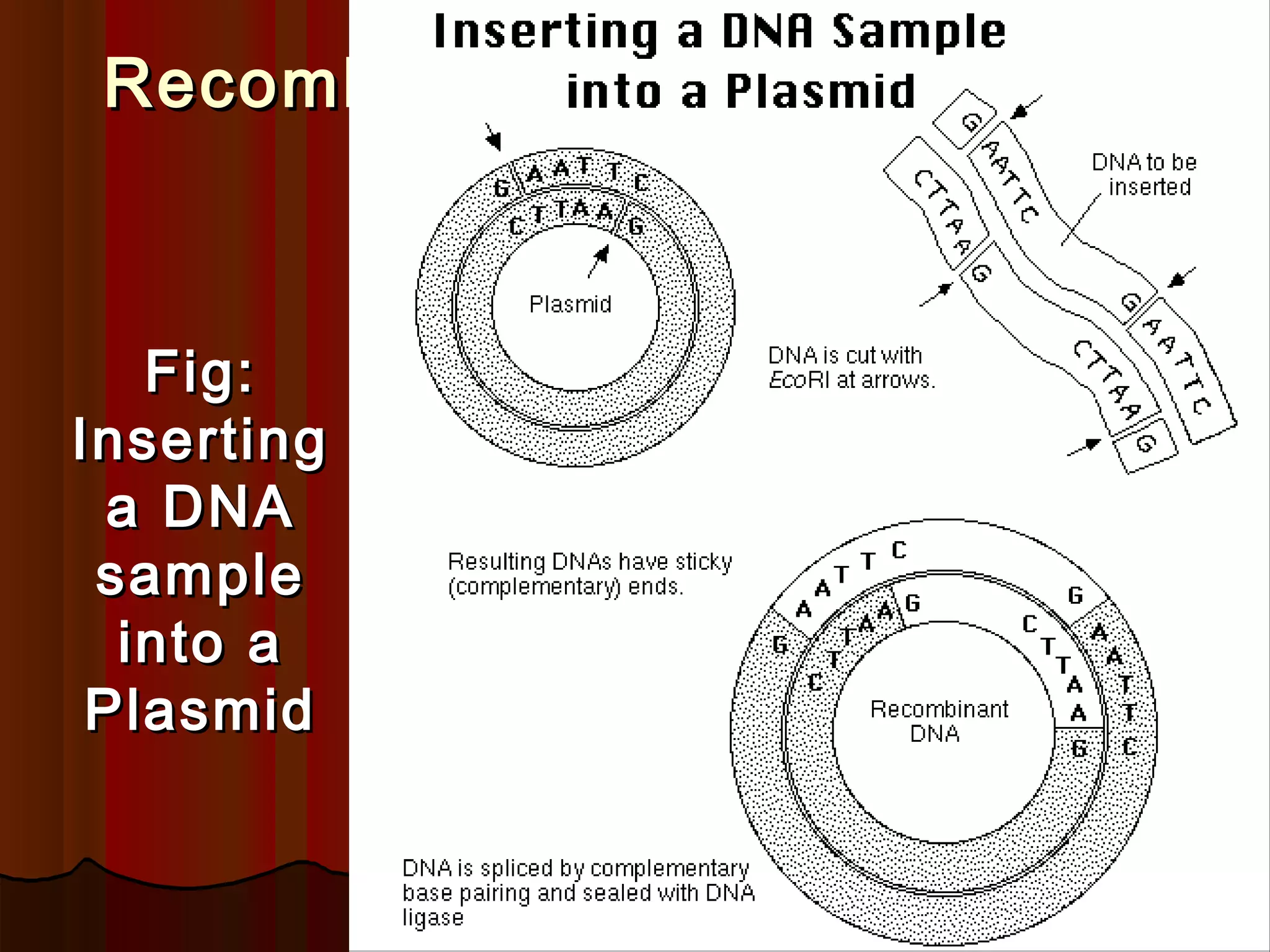
Fig:Fig:
InsertingInserting
a DNAa DNA
samplesample
into ainto a
PlasmidPlasmid
Recombinant DNA TechnologyRecombinant DNA Technology
ReferencesReferences
 http://en.wikipedia.org/wiki/Restriction_enzymehttp://en.wikipedia.org/wiki/Restriction_enzyme
 http://web.mit.edu/esgbio/www/rdna/cloning.htmlhttp://web.mit.edu/esgbio/www/rdna/cloning.html
 http://faculty.plattsburgh.edu/donald.slish/Transformation.htmlhttp://faculty.plattsburgh.edu/donald.slish/Transformation.html

2 recombinant dna technology

  • 1.
  • 2.
    Recombinant DNA TechnologyRecombinantDNA Technology Recombinant DNA technology proceduresRecombinant DNA technology procedures by which DNA from different species canby which DNA from different species can be isolated, cut andbe isolated, cut and spliced togetherspliced together ---- newnew "recombinant ""recombinant " molecules are thenmolecules are then multiplied (cloning) in quantity inmultiplied (cloning) in quantity in populations of rapidly dividing cells (e.g.populations of rapidly dividing cells (e.g. bacteria, yeast).bacteria, yeast).
  • 3.
    Recombinant DNA TechnologyRecombinantDNA Technology The termThe term gene cloning, recombinant DNAgene cloning, recombinant DNA technology and genetic engineering maytechnology and genetic engineering may seems similar, however they are differentseems similar, however they are different techniques in Biotechnology andtechniques in Biotechnology and they arethey are interrelatedinterrelated Clone: a collection of molecules or cells,Clone: a collection of molecules or cells, allall identicalidentical to an original molecule or cellto an original molecule or cell
  • 4.
    Recombinant DNA TechnologyRecombinantDNA Technology Three goalsThree goals - Eliminate undesirableEliminate undesirable phenotypic traitsphenotypic traits (observable characteristics)(observable characteristics) - Combine beneficial traits of two or moreCombine beneficial traits of two or more organismsorganisms - Create organisms that synthesizeCreate organisms that synthesize products humans needproducts humans need
  • 5.
    Recombinant DNA TechnologyRecombinantDNA Technology HumanHuman gene therapygene therapy, genetically-, genetically- engineeredengineered cropcrop plants andplants and transgenictransgenic mice have become possible mice have become possible because of the powerful techniquesbecause of the powerful techniques developed to manipulate nucleic acids anddeveloped to manipulate nucleic acids and proteins.proteins.
  • 6.
    Recombinant DNA TechnologyRecombinantDNA Technology In the early 1970s it became possible toIn the early 1970s it became possible to isolate a specific piece of DNA out of theisolate a specific piece of DNA out of the millions of base pairs in a typical genome.millions of base pairs in a typical genome.
  • 7.
    Recombinant DNA TechnologyRecombinantDNA Technology Currently it is relatively easy to cut out aCurrently it is relatively easy to cut out a specific piece of DNA, produce a largespecific piece of DNA, produce a large number of copies , determine itsnumber of copies , determine its nucleotide sequence, slightly alter it andnucleotide sequence, slightly alter it and then as a final step transfer it back into cellthen as a final step transfer it back into cell in.in.
  • 8.
    Recombinant DNA TechnologyRecombinantDNA Technology Recombinant DNA technology is based on aRecombinant DNA technology is based on a number of important things:number of important things:  Bacteria contain extrachromosomalBacteria contain extrachromosomal molecules of DNA calledmolecules of DNA called plasmidsplasmids which are circular.which are circular.
  • 9.
    Recombinant DNA TechnologyRecombinantDNA Technology  Bacteria also produce enzymes calledBacteria also produce enzymes called restriction endonucleasesrestriction endonucleases that cutthat cut DNA molecules at specific places intoDNA molecules at specific places into many smaller fragments calledmany smaller fragments called restriction fragmentsrestriction fragments ..
  • 10.
    Recombinant DNA TechnologyRecombinantDNA Technology Restriction Enzymes and plasmidRestriction Enzymes and plasmid There are many different kinds ofThere are many different kinds of restriction endonucleasesrestriction endonucleases Each nuclei cuts DNA at a specific siteEach nuclei cuts DNA at a specific site defined by a sequence of bases in thedefined by a sequence of bases in the DNA called aDNA called a recognition siterecognition site
  • 11.
    Recombinant DNA TechnologyRecombinantDNA Technology Restriction Enzymes and plasmidRestriction Enzymes and plasmid A restriction enzyme cuts only double-A restriction enzyme cuts only double- helical segments that contain a particularhelical segments that contain a particular sequence, and it makes its incisions onlysequence, and it makes its incisions only within that sequence--known as awithin that sequence--known as a "recognition sequence"."recognition sequence".
  • 12.
    Recombinant DNA TechnologyRecombinantDNA Technology Restriction Enzymes and plasmidRestriction Enzymes and plasmid Sticky endSticky end andand blunt endblunt end are the twoare the two possible configurations resulting from thepossible configurations resulting from the breaking of double-stranded DNAbreaking of double-stranded DNA
  • 13.
    Recombinant DNA TechnologyRecombinantDNA Technology Restriction Enzymes and plasmidRestriction Enzymes and plasmid If two complementary strands of DNA are ofIf two complementary strands of DNA are of equal length, then they willequal length, then they will terminate in aterminate in a blunt endblunt end, as in the following example:, as in the following example:  5'-5'-CpTpGpApTpCpTpGpApCpTpGpApTpGpCpGpTpApTpGpCpTpApGpTCpTpGpApTpCpTpGpApCpTpGpApTpGpCpGpTpApTpGpCpTpApGpT-3'-3'  3'-3'-GpApCpTpApGpApCpTpGpApCpTpApCpGpCpApTpApCpGpApTpCpAGpApCpTpApGpApCpTpGpApCpTpApCpGpCpApTpApCpGpApTpCpA-5'-5'
  • 14.
    Recombinant DNA TechnologyRecombinantDNA Technology Restriction Enzymes and plasmidRestriction Enzymes and plasmid However, if one strand extends beyond theHowever, if one strand extends beyond the complementary region, then the DNA is saidcomplementary region, then the DNA is said to possess anto possess an overhangoverhang:: 5'-5'-ApTpCpTpGpApCpTApTpCpTpGpApCpT-3'-3' 3'-3'-TpApGpApCpTpGpApCpTpApCpGTpApGpApCpTpGpApCpTpApCpG-5'-5'
  • 15.
    Recombinant DNA TechnologyRecombinantDNA Technology Restriction Enzymes and plasmidRestriction Enzymes and plasmid If another DNA fragment exists with aIf another DNA fragment exists with a complementary overhang, then these twocomplementary overhang, then these two overhangs will tend to associate with eachoverhangs will tend to associate with each other and each strand is said to possess aother and each strand is said to possess a sticky endsticky end::
  • 16.
    Recombinant DNA TechnologyRecombinantDNA Technology Restriction Enzymes and plasmidRestriction Enzymes and plasmid  5'-5'-ApTpCpTpGpApCpTApTpCpTpGpApCpT pGpApTpGpCpGpTpApTpGpCpTpGpApTpGpCpGpTpApTpGpCpT-3'-3'  3'-3'-TpApGpApCpTpGpApCpTpApCpGpTpApGpApCpTpGpApCpTpApCpGp CpApTpApCpGpACpApTpApCpGpA-5'-5' BecomesBecomes  5'-5'-ApTpCpTpGpApCpTApTpCpTpGpApCpT pGpApTpGpCpGpTpApTpGpCpTpGpApTpGpCpGpTpApTpGpCpT-3'-3'  3'-3'-TpApGpApCpTpGpApCpTpApCpGpTpApGpApCpTpGpApCpTpApCpGp CpApTpApCpGpACpApTpApCpGpA-5'-5'
  • 17.
    Recombinant DNA TechnologyRecombinantDNA Technology Restriction Enzymes and plasmidRestriction Enzymes and plasmid Restriction Enzymes are primarily found inRestriction Enzymes are primarily found in bacteria and are given abbreviationsbacteria and are given abbreviations based on genus and species of thebased on genus and species of the bacteria.bacteria. One of the first restriction enzymes to beOne of the first restriction enzymes to be isolated was from EcoRIisolated was from EcoRI EcoRI is so named because it wasEcoRI is so named because it was isolated fromisolated from EscherichiaEscherichia coli strain calledcoli strain called RY13.RY13.
  • 18.
    Recombinant DNA TechnologyRecombinantDNA Technology Digestion of DNA by EcoRI toDigestion of DNA by EcoRI to produce cohesive ends ( Fig. 3.1):produce cohesive ends ( Fig. 3.1):
  • 19.
    Recombinant DNA TechnologyRecombinantDNA Technology Creating recombinant DNA :Creating recombinant DNA : The first Recombinant DNA moleculesThe first Recombinant DNA molecules were made by Paul Berg at Stanfordwere made by Paul Berg at Stanford University in 1972.University in 1972. In 1973 Herbert Boyer and Stanley CohenIn 1973 Herbert Boyer and Stanley Cohen created the first recombinant DNAcreated the first recombinant DNA organisms.organisms.
  • 23.
    Overview of recombinantDNA technologyOverview of recombinant DNA technology Bacterial cell Bacterial chromosome Plasmid Gene of interest DNA containing gene of interest Isolate plasmid. Enzymatically cleave DNA into fragments. Isolate fragment with the gene of interest. Insert gene into plasmid. Insert plasmid and gene into bacterium. Culture bacteria. Harvest copies of gene to insert into plants or animals Harvest proteins coded by gene Eliminate undesirable phenotypic traits Produce vaccines, antibiotics, hormones, or enzymes Create beneficial combination of traits
  • 24.
  • 25.
    Recombinant DNA TechnologyRecombinantDNA Technology Creating Recombinant DNA (Fig 3.2):Creating Recombinant DNA (Fig 3.2):
  • 26.
    Recombinant DNA TechnologyRecombinantDNA Technology Reading materials :Summary ofReading materials :Summary of Recombinant DNA technologyRecombinant DNA technology process:process: Recombinant DNA technology requiresRecombinant DNA technology requires DNA extraction, purification, andDNA extraction, purification, and fragmentation.fragmentation. Fragmentation of DNA is done by specificFragmentation of DNA is done by specific 'restriction' enzymes and is followed by'restriction' enzymes and is followed by sorting and isolation of fragmentssorting and isolation of fragments containing a particular gene.containing a particular gene.
  • 27.
    Recombinant DNA TechnologyRecombinantDNA Technology Summary of Recombinant DNASummary of Recombinant DNA technology process:technology process: This portion of the DNA is then coupled toThis portion of the DNA is then coupled to a carrier molecule.a carrier molecule. The hybrid DNA is introduced into aThe hybrid DNA is introduced into a chosen cell for reproduction andchosen cell for reproduction and synthesis.synthesis.
  • 28.
    Recombinant DNA TechnologyRecombinantDNA Technology Transformation and AntibioticTransformation and Antibiotic SelectionSelection Transformation is the genetic alteration ofTransformation is the genetic alteration of a cell resulting from the introduction,a cell resulting from the introduction, uptake and expression of foreign DNA.uptake and expression of foreign DNA.
  • 29.
    Recombinant DNA TechnologyRecombinantDNA Technology Transformation and AntibioticTransformation and Antibiotic SelectionSelection There are more aggressive techniques forThere are more aggressive techniques for inserting foreign DNA into eukaryotic cells.inserting foreign DNA into eukaryotic cells. For example, throughFor example, through electroporationelectroporation .. ElectroporationElectroporation involves applying ainvolves applying a brief (milliseconds) pulse high voltagebrief (milliseconds) pulse high voltage electricity to create tiny holes in theelectricity to create tiny holes in the bacterial cell wall that allows DNA to enter.bacterial cell wall that allows DNA to enter.
  • 30.
    Recombinant DNA TechnologyRecombinantDNA Technology Plasmids and Antibiotic resistancePlasmids and Antibiotic resistance PlasmidsPlasmids were discovered in the latewere discovered in the late sixties, and it was quickly realized thatsixties, and it was quickly realized that they could be used to amplify a gene ofthey could be used to amplify a gene of interest.interest. A plasmid containing resistance to anA plasmid containing resistance to an antibiotic (usually ampicillin) orantibiotic (usually ampicillin) or Tetracycline, is used as a vector.Tetracycline, is used as a vector.
  • 31.
    Recombinant DNA TechnologyRecombinantDNA Technology The gene of interest (resistant toThe gene of interest (resistant to Ampicillin) is inserted into the vectorAmpicillin) is inserted into the vector plasmid and this newly constructedplasmid and this newly constructed plasmid is then put into E. coli that isplasmid is then put into E. coli that is sensitive to ampicillin.( Text bk:Pg 58)sensitive to ampicillin.( Text bk:Pg 58) The bacteria are then spread over a plateThe bacteria are then spread over a plate that contains ampicillin.that contains ampicillin.
  • 32.
    Recombinant DNA TechnologyRecombinantDNA Technology Plasmids and Antibiotic resistancePlasmids and Antibiotic resistance The ampicillin provides a selectiveThe ampicillin provides a selective pressure because only bacteria that havepressure because only bacteria that have acquired the plasmid can grow on theacquired the plasmid can grow on the plate.plate. Those bacteria which do not acquire theThose bacteria which do not acquire the plasmid with the inserted gene of interestplasmid with the inserted gene of interest will die.will die.
  • 33.
    Recombinant DNA TechnologyRecombinantDNA Technology Plasmids and Antibiotic resistancePlasmids and Antibiotic resistance As long as the bacteria grow in ampicillin,As long as the bacteria grow in ampicillin, it will need the plasmid to survive and itit will need the plasmid to survive and it will continually replicate it, along with thewill continually replicate it, along with the gene of interest that has been inserted togene of interest that has been inserted to the plasmid .the plasmid .
  • 34.
    Recombinant DNA TechnologyRecombinantDNA Technology Fig 3.3Fig 3.3 (a).(a). SelectingSelecting a Gene ina Gene in a plasmida plasmid andand AntibioticAntibiotic selection.selection.
  • 35.
    Recombinant DNA TechnologyRecombinantDNA Technology Assignment: For above procedure,Assignment: For above procedure, Read Transformation of BacterialRead Transformation of Bacterial cells and Antibiotic selection pgcells and Antibiotic selection pg 61.61.
  • 36.
    Recombinant DNA TechnologyRecombinantDNA Technology Human Gene cloningHuman Gene cloning Once inside a bacterium, the plasmidOnce inside a bacterium, the plasmid containing the human cDNA can multiplycontaining the human cDNA can multiply to yield several dozen replicas.to yield several dozen replicas.
  • 37.
  • 38.
    Recombinant DNA TechnologyRecombinantDNA Technology Reading materials:Reading materials: Summary of Recombinant DNA andSummary of Recombinant DNA and Cloning (Fig. below):Cloning (Fig. below): Isolation of two kinds of DNAIsolation of two kinds of DNA Treatment of plasmid and foreign DNATreatment of plasmid and foreign DNA with the same restriction enzymewith the same restriction enzyme Mixture of foreign DNA with plasmidsMixture of foreign DNA with plasmids
  • 39.
    Recombinant DNA TechnologyRecombinantDNA Technology Addition of DNA ligaseAddition of DNA ligase Introduction of recombinant plasmid intoIntroduction of recombinant plasmid into bacterial cellsbacterial cells Production of multiple gene copies byProduction of multiple gene copies by gene cloninggene cloning
  • 40.
    Recombinant DNA TechnologyRecombinantDNA Technology Summary of Recombinant DNA andSummary of Recombinant DNA and Cloning (Fig.):Cloning (Fig.):
  • 41.
    Recombinant DNA TechnologyRecombinantDNA Technology This segment is "glued" into place usingThis segment is "glued" into place using an enzyme called DNA ligase.an enzyme called DNA ligase. The result is an edited, or recombinant,The result is an edited, or recombinant, DNA molecule.DNA molecule.
  • 42.
    Recombinant DNA TechnologyRecombinantDNA Technology When this recombinant plasmid DNA isWhen this recombinant plasmid DNA is inserted intoinserted into E. coliE. coli, the cell will be able to, the cell will be able to process the instructions to assemble theprocess the instructions to assemble the amino acids for insulin production.amino acids for insulin production.
  • 43.
    Recombinant DNA TechnologyRecombinantDNA Technology More importantly, the new instructions areMore importantly, the new instructions are passed along to the next generation ofpassed along to the next generation of E.E. colicoli cells in the process known as genecells in the process known as gene cloning.cloning. Assignment: Human gene cloning pg 63Assignment: Human gene cloning pg 63
  • 44.
    Recombinant DNA TechnologyRecombinantDNA Technology Fig:Fig: InsertingInserting a DNAa DNA samplesample into ainto a PlasmidPlasmid
  • 45.
    Recombinant DNA TechnologyRecombinantDNA Technology ReferencesReferences  http://en.wikipedia.org/wiki/Restriction_enzymehttp://en.wikipedia.org/wiki/Restriction_enzyme  http://web.mit.edu/esgbio/www/rdna/cloning.htmlhttp://web.mit.edu/esgbio/www/rdna/cloning.html  http://faculty.plattsburgh.edu/donald.slish/Transformation.htmlhttp://faculty.plattsburgh.edu/donald.slish/Transformation.html