Nimish Shirish Khandekar
Roll no. 45, Div-1
T.Y. B. Pharm,
ADCBP, Ashta
RECOMBINANT DNA (rDNA)
TECHNOLOGY
Recombinant DNA Technology
2
Introduction
Recombinant DNA Technology
3
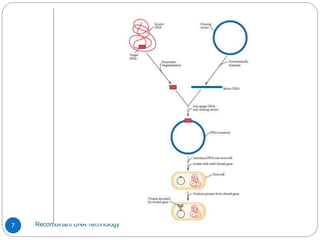
ď‚— Also known as cloning or molecular cloning.
ď‚— Recombinant DNA is a technology in
which molecules of DNA from two
different species that are inserted into a host
organism to produce new genetic combinations
that are of value to science, medicine, agriculture,
and industry.
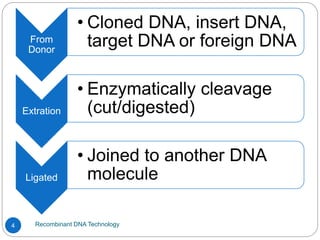
ď‚— In short, the process of rDNA is:
Recombinant DNA Technology
4
From
Donor
• Cloned DNA, insert DNA,
target DNA or foreign DNA
Extration
• Enzymatically cleavage
(cut/digested)
Ligated
• Joined to another DNA
molecule
Recombinant DNA Technology
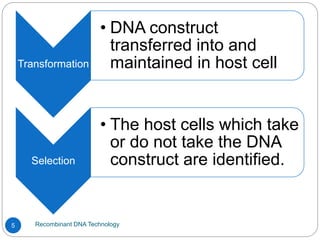
5
Transformation
• DNA construct
transferred into and
maintained in host cell
Selection
• The host cells which take
or do not take the DNA
construct are identified.
Recombinant DNA Technology
6
Recombinant DNA Technology
7
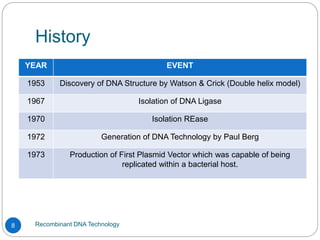
History
Recombinant DNA Technology
8
YEAR EVENT
1953 Discovery of DNA Structure by Watson & Crick (Double helix model)
1967 Isolation of DNA Ligase
1970 Isolation REase
1972 Generation of DNA Technology by Paul Berg
1973 Production of First Plasmid Vector which was capable of being
replicated within a bacterial host.
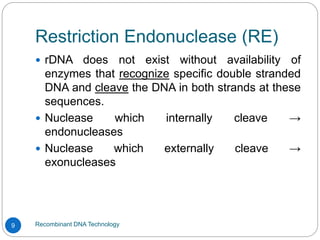
Restriction Endonuclease (RE)
Recombinant DNA Technology
9
ď‚— rDNA does not exist without availability of
enzymes that recognize specific double stranded
DNA and cleave the DNA in both strands at these
sequences.
 Nuclease which internally cleave →
endonucleases
 Nuclease which externally cleave →
exonucleases
Recombinant DNA Technology
10
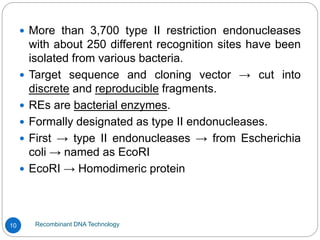
ď‚— More than 3,700 type II restriction endonucleases
with about 250 different recognition sites have been
isolated from various bacteria.
 Target sequence and cloning vector → cut into
discrete and reproducible fragments.
ď‚— REs are bacterial enzymes.
ď‚— Formally designated as type II endonucleases.
 First → type II endonucleases → from Escherichia
coli → named as EcoRI
 EcoRI → Homodimeric protein
Recombinant DNA Technology
11
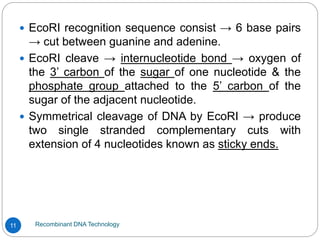
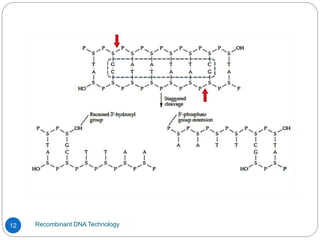
 EcoRI recognition sequence consist → 6 base pairs
→ cut between guanine and adenine.
 EcoRI cleave → internucleotide bond → oxygen of
the 3’ carbon of the sugar of one nucleotide & the
phosphate group attached to the 5’ carbon of the
sugar of the adjacent nucleotide.
 Symmetrical cleavage of DNA by EcoRI → produce
two single stranded complementary cuts with
extension of 4 nucleotides known as sticky ends.
Recombinant DNA Technology
12
Plasmid Cloning Vectors
Recombinant DNA Technology
13
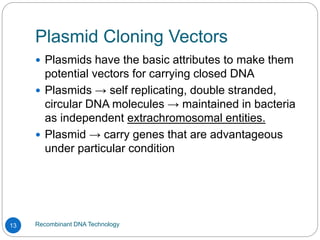
ď‚— Plasmids have the basic attributes to make them
potential vectors for carrying closed DNA
 Plasmids → self replicating, double stranded,
circular DNA molecules → maintained in bacteria
as independent extrachromosomal entities.
 Plasmid → carry genes that are advantageous
under particular condition
Recombinant DNA Technology
14
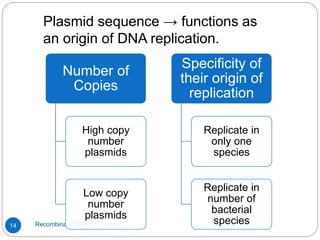
Number of
Copies
High copy
number
plasmids
Low copy
number
plasmids
Specificity of
their origin of
replication
Replicate in
only one
species
Replicate in
number of
bacterial
species
Plasmid sequence → functions as
an origin of DNA replication.
Plasmid Cloning Vector pBR322
Recombinant DNA Technology
15
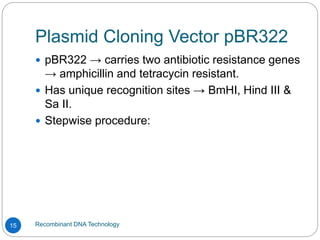
 pBR322 → carries two antibiotic resistance genes
→ amphicillin and tetracycin resistant.
 Has unique recognition sites → BmHI, Hind III &
Sa II.
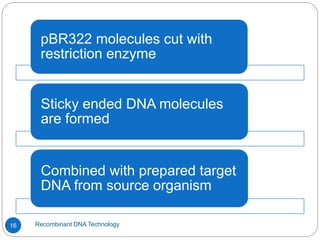
ď‚— Stepwise procedure:
Recombinant DNA Technology
16
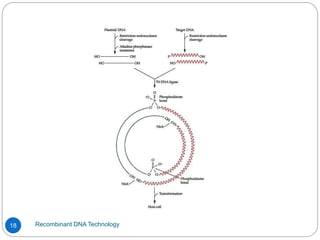
pBR322 molecules cut with
restriction enzyme
Sticky ended DNA molecules
are formed
Combined with prepared target
DNA from source organism
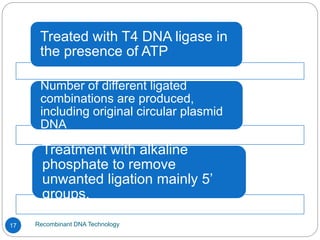
Recombinant DNA Technology
17
Treated with T4 DNA ligase in
the presence of ATP
Number of different ligated
combinations are produced,
including original circular plasmid
DNA
Treatment with alkaline
phosphate to remove
unwanted ligation mainly 5’
groups.
Recombinant DNA Technology
18
Transformation & Selection
Recombinant DNA Technology
19
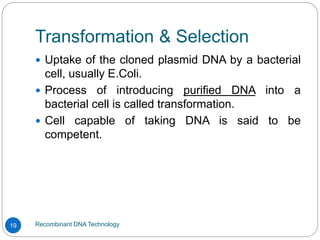
ď‚— Uptake of the cloned plasmid DNA by a bacterial
cell, usually E.Coli.
ď‚— Process of introducing purified DNA into a
bacterial cell is called transformation.
ď‚— Cell capable of taking DNA is said to be
competent.
Recombinant DNA Technology
20
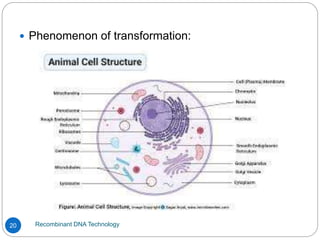
ď‚— Phenomenon of transformation:
Recombinant DNA Technology
21
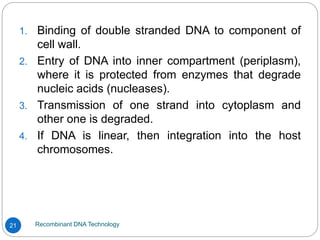
1. Binding of double stranded DNA to component of
cell wall.
2. Entry of DNA into inner compartment (periplasm),
where it is protected from enzymes that degrade
nucleic acids (nucleases).
3. Transmission of one strand into cytoplasm and
other one is degraded.
4. If DNA is linear, then integration into the host
chromosomes.
Recombinant DNA Technology
22
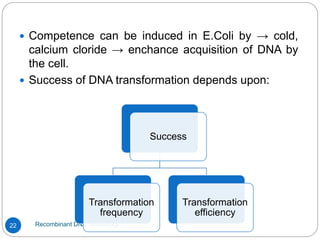
 Competence can be induced in E.Coli by → cold,
calcium cloride → enchance acquisition of DNA by
the cell.
ď‚— Success of DNA transformation depends upon:
Success
Transformation
frequency
Transformation
efficiency
Recombinant DNA Technology
23
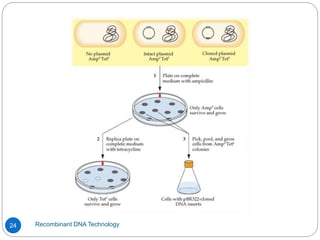
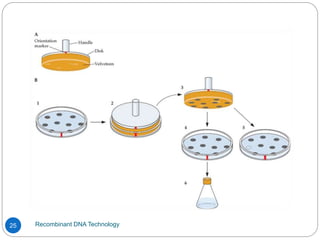
 After transformation → it is necessary to identify as
easily possible, those cells that contain plasmids
with cloned DNA.
E.g: pBR322 → ampicillin & tetracyclin medium
Recombinant DNA Technology
24
Recombinant DNA Technology
25
Overview
Recombinant DNA Technology
26
Recombinant DNA Technology
27

Recombinant DNA Technology (Key-Notes)

  • 1.
    Nimish Shirish Khandekar Rollno. 45, Div-1 T.Y. B. Pharm, ADCBP, Ashta RECOMBINANT DNA (rDNA) TECHNOLOGY
  • 2.
  • 3.
    Introduction Recombinant DNA Technology 3 ď‚—Also known as cloning or molecular cloning. ď‚— Recombinant DNA is a technology in which molecules of DNA from two different species that are inserted into a host organism to produce new genetic combinations that are of value to science, medicine, agriculture, and industry. ď‚— In short, the process of rDNA is:
  • 4.
    Recombinant DNA Technology 4 From Donor •Cloned DNA, insert DNA, target DNA or foreign DNA Extration • Enzymatically cleavage (cut/digested) Ligated • Joined to another DNA molecule
  • 5.
    Recombinant DNA Technology 5 Transformation •DNA construct transferred into and maintained in host cell Selection • The host cells which take or do not take the DNA construct are identified.
  • 6.
  • 7.
  • 8.
    History Recombinant DNA Technology 8 YEAREVENT 1953 Discovery of DNA Structure by Watson & Crick (Double helix model) 1967 Isolation of DNA Ligase 1970 Isolation REase 1972 Generation of DNA Technology by Paul Berg 1973 Production of First Plasmid Vector which was capable of being replicated within a bacterial host.
  • 9.
    Restriction Endonuclease (RE) RecombinantDNA Technology 9  rDNA does not exist without availability of enzymes that recognize specific double stranded DNA and cleave the DNA in both strands at these sequences.  Nuclease which internally cleave → endonucleases  Nuclease which externally cleave → exonucleases
  • 10.
    Recombinant DNA Technology 10 More than 3,700 type II restriction endonucleases with about 250 different recognition sites have been isolated from various bacteria.  Target sequence and cloning vector → cut into discrete and reproducible fragments.  REs are bacterial enzymes.  Formally designated as type II endonucleases.  First → type II endonucleases → from Escherichia coli → named as EcoRI  EcoRI → Homodimeric protein
  • 11.
    Recombinant DNA Technology 11 EcoRI recognition sequence consist → 6 base pairs → cut between guanine and adenine.  EcoRI cleave → internucleotide bond → oxygen of the 3’ carbon of the sugar of one nucleotide & the phosphate group attached to the 5’ carbon of the sugar of the adjacent nucleotide.  Symmetrical cleavage of DNA by EcoRI → produce two single stranded complementary cuts with extension of 4 nucleotides known as sticky ends.
  • 12.
  • 13.
    Plasmid Cloning Vectors RecombinantDNA Technology 13  Plasmids have the basic attributes to make them potential vectors for carrying closed DNA  Plasmids → self replicating, double stranded, circular DNA molecules → maintained in bacteria as independent extrachromosomal entities.  Plasmid → carry genes that are advantageous under particular condition
  • 14.
    Recombinant DNA Technology 14 Numberof Copies High copy number plasmids Low copy number plasmids Specificity of their origin of replication Replicate in only one species Replicate in number of bacterial species Plasmid sequence → functions as an origin of DNA replication.
  • 15.
    Plasmid Cloning VectorpBR322 Recombinant DNA Technology 15  pBR322 → carries two antibiotic resistance genes → amphicillin and tetracycin resistant.  Has unique recognition sites → BmHI, Hind III & Sa II.  Stepwise procedure:
  • 16.
    Recombinant DNA Technology 16 pBR322molecules cut with restriction enzyme Sticky ended DNA molecules are formed Combined with prepared target DNA from source organism
  • 17.
    Recombinant DNA Technology 17 Treatedwith T4 DNA ligase in the presence of ATP Number of different ligated combinations are produced, including original circular plasmid DNA Treatment with alkaline phosphate to remove unwanted ligation mainly 5’ groups.
  • 18.
  • 19.
    Transformation & Selection RecombinantDNA Technology 19 ď‚— Uptake of the cloned plasmid DNA by a bacterial cell, usually E.Coli. ď‚— Process of introducing purified DNA into a bacterial cell is called transformation. ď‚— Cell capable of taking DNA is said to be competent.
  • 20.
    Recombinant DNA Technology 20 ď‚—Phenomenon of transformation:
  • 21.
    Recombinant DNA Technology 21 1.Binding of double stranded DNA to component of cell wall. 2. Entry of DNA into inner compartment (periplasm), where it is protected from enzymes that degrade nucleic acids (nucleases). 3. Transmission of one strand into cytoplasm and other one is degraded. 4. If DNA is linear, then integration into the host chromosomes.
  • 22.
    Recombinant DNA Technology 22 Competence can be induced in E.Coli by → cold, calcium cloride → enchance acquisition of DNA by the cell.  Success of DNA transformation depends upon: Success Transformation frequency Transformation efficiency
  • 23.
    Recombinant DNA Technology 23 After transformation → it is necessary to identify as easily possible, those cells that contain plasmids with cloned DNA. E.g: pBR322 → ampicillin & tetracyclin medium
  • 24.
  • 25.
  • 26.
  • 27.