Wheat Improvement for the Changing
Climate:
Adaptation to Heat Stress Environments
Izzat S. A. Tahir
ARC/ICARDA
International Workshop on: “Applied Mathematics and Omics Technologies for
Discovering Biodiversity and Genetic Resources for Climate Change Mitigation and
Adaptation to Sustain Agriculture in Drylands”
Rabat - Morocco, 24-27 June 2014
Outlines
• Climate change and its effects on wheat
production
• Breeding strategy and methodology
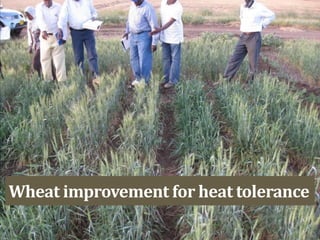
• Wheat improvement for heat tolerance
• Broadening the wheat genetic diversity
• Crop management
• Integrated approaches
• Precision Phenotyping Platforms
• Conclusions
Abstract
Breeding high-yielding wheat varieties adapted to diverse environments is regarded as
one of the most important means needed to meet the ever increasing global demand
for wheat especially in the light of the ensuing climate change. Genetic improvement of
wheat yield could be through a better exploitation of genetic diversity, understanding
and mining physiological traits associated with climate change and then utilization
these traits via their introduction into new varieties by conventional breeding and/or
genetic manipulation. Multiple synthetic derivatives (MSD) developed by Tottori
University utilizing diverse sources of Aegilops tauschii are being evaluated for heat
stress tolerance in Sudan. Multi-location evaluation and selection is essential for
identifying high-yielding better adapted wheat varieties. In this respect, close
collaboration, coordination and communication are needed among the national
(NARS), regional and international wheat research centers and scientific community.
One of the good examples for such collaboration between NARS and international
center is wheat improvement under heat stress condition coordinated by
CIMMYT/ICARDA. In this regard, wheat germplasm targeted to heat stress areas is
evaluated and selected under temperature gradients ranging from favorable to very
high temperatures. Some stress adaptive traits have been identified and could be used
for further improvement and mining the genetic resources for heat stress tolerance.
Promising lines identified have been shared among west and east African low lands
experiencing high temperature during the growing season. This is further supported
by the plan to set up Precision Wheat Phenotyping Platforms (PWPPs) anticipated to
improve the breadth and quality of data collected and shared among wheat scientists.
Climate changeand its effects on wheat
production
• Increased frequency of:
• Heat stress,
• Droughts
• Flooding
• Reduced crop yields.
• Food insecurity due to extreme climate events
• Countries with less wealth and natural resource
adapt less efficiently to climate change
IPCC, 2007
Climate change and its effects on wheat production, cont.
• Global warming:
• Could be beneficial for wheat in some regions,
• Could reduce productivity in zones where optimal
temperatures already exist.
• How to adapt and mitigate the climate change effects:
• Germplasm development
• Crop management
• Mitigation
(Climate change: Can wheat beat the heat? (Ortiz et
al. 2008).
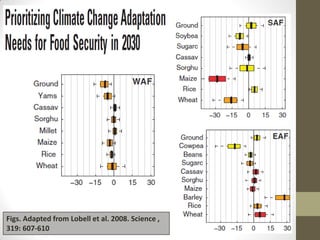
Figs. Adapted from Lobell et al. 2008. Science ,
319: 607-610
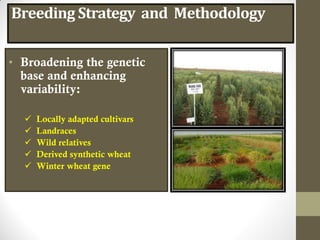
Breeding Strategy and Methodology
• Broadening the genetic
base and enhancing
variability:
 Locally adapted cultivars
 Landraces
 Wild relatives
 Derived synthetic wheat
 Winter wheat gene
BreedingStrategy and Methodology,cont.
• Strategic trait-based
crossing to address
different objectives:
 Yield potential
 Biotic stresses
 Abiotic stresses
(e.g. Heat stress)
 Grain quality
Bringing drought and heat adaptive traits together in one genotype could increase
wheat yields particularly in low yielding environments.
Lopes et al. 2012. Field Crops Res. 128:129–136
BreedingStrategy and Methodology,cont.
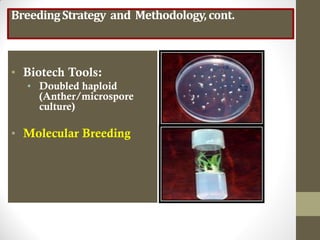
• Biotech Tools:
• Doubled haploid
(Anther/microspore
culture)
• Molecular Breeding
Multi-environment testing and
evaluation
• Yield potential
• Breeding for Abiotic Stress Tolerance:
• Cold
• Drought
• Heat stress
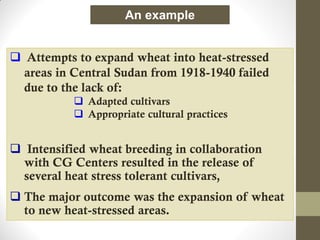
 Attempts to expand wheat into heat-stressed
areas in Central Sudan from 1918-1940 failed
due to the lack of:
 Adapted cultivars
 Appropriate cultural practices
 Intensified wheat breeding in collaboration
with CG Centers resulted in the release of
several heat stress tolerant cultivars,
 The major outcome was the expansion of wheat
to new heat-stressed areas.
An example
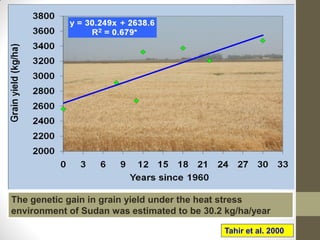
The genetic gain in grain yield under the heat stress
environment of Sudan was estimated to be 30.2 kg/ha/year
Tahir et al. 2000
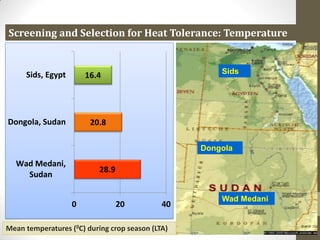
Wheat improvement for heat tolerance
Wad Medani
Dongola
Sids
Screening and Selection for Heat Tolerance: Temperature
gradient
Mean temperatures (0C) during crop season (LTA)
28.9
20.8
16.4
0 20 40
Wad Medani,
Sudan
Dongola, Sudan
Sids, Egypt
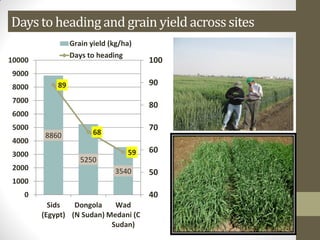
Daysto heading and grain yield acrosssites
8860
5250
3540
89
68
59
40
50
60
70
80
90
100
0
1000
2000
3000
4000
5000
6000
7000
8000
9000
10000
Sids
(Egypt)
Dongola
(N Sudan)
Wad
Medani (C
Sudan)
Grain yield (kg/ha)
Days to heading
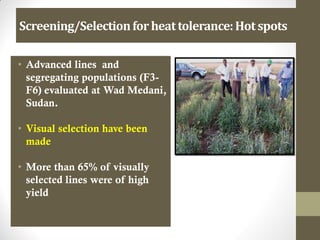
Screening/Selectionforheattolerance:Hotspots
• Advanced lines and
segregating populations (F3-
F6) evaluated at Wad Medani,
Sudan.
• Visual selection have been
made
• More than 65% of visually
selected lines were of high
yield
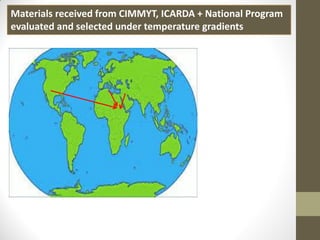
Materials received from CIMMYT, ICARDA + National Program
evaluated and selected under temperature gradients
/
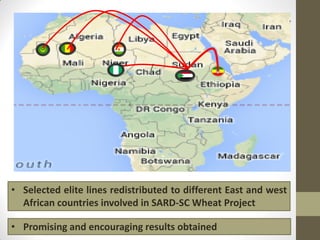
• Selected elite lines redistributed to different East and west
African countries involved in SARD-SC Wheat Project
• Promising and encouraging results obtained
 Partners countries expressed their
satisfaction with the material received and
evaluated
 A number of entries have been frequently
selected by partners form the nurseries
received
 Some lines selected across several
environments
Preliminary Results (2013/2014 Season):
 REYNA-28
 REYNA-29
 JNRB.5/PIFED
 KINGBRD#1//INQALAB91*2/TUKURU
 HUBARA-3*2/SHUHA-4
 HUBARA-16/2*SOMAMA-3
 KAUZ'S'/FLORKWA-1//GOUMRIA-3
 SERI.1B*2/3/KAUZ*2/BOW//KAUZ/4/ANGI-2
 ATTILA 50Y//ATTILA/BCN/3/STAR*MUSK-3
 SERI.1B*2/3/KAUZ*2/BOW//KAUZ/4/KAUZ/FLORKWA-1
Most frequently selected lines/families:
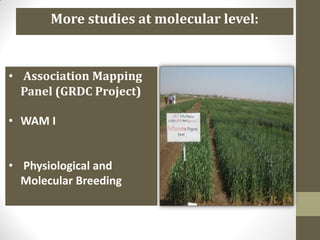
More studies at molecular level:
• Association Mapping
Panel (GRDC Project)
• WAM I
• Physiological and
Molecular Breeding
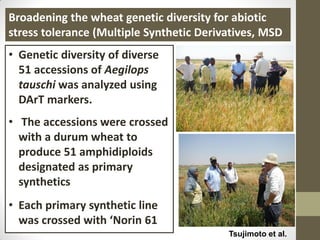
Broadening the wheat genetic diversity for abiotic
stress tolerance (Multiple Synthetic Derivatives, MSD
Tsujimoto et al.
• Genetic diversity of diverse
51 accessions of Aegilops
tauschi was analyzed using
DArT markers.
• The accessions were crossed
with a durum wheat to
produce 51 amphidiploids
designated as primary
synthetics
• Each primary synthetic line
was crossed with ‘Norin 61
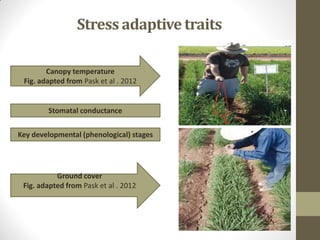
Stress adaptive traits
Canopy temperature
Fig. adapted from Pask et al . 2012
Ground cover
Fig. adapted from Pask et al . 2012
Stomatal conductance
Key developmental (phenological) stages
NUT
H2O
CHO
CHO
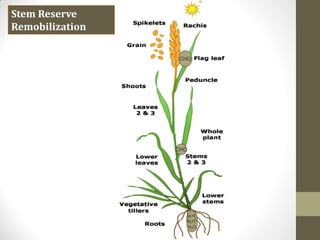
Stem Reserve
Remobilization
NUT
H2O
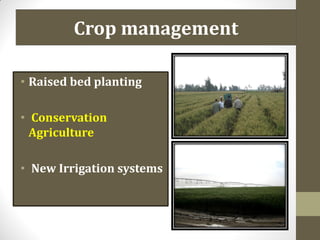
Crop management
• Raised bed planting
• Conservation
Agriculture
• New Irrigation systems
More approaches
• Mathematics, Omics and Modeling
• Network s
• Facilities
• Platforms for integrated solution
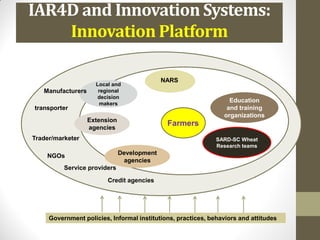
Credit agencies
Trader/marketer
transporter
NGOs
Farmers
Government policies, Informal institutions, practices, behaviors and attitudes
NARS
Extension
agencies
Education
and training
organizations
Development
agencies
SARD-SC Wheat
Research teams
Local and
regional
decision
makers
Service providers
Manufacturers
IAR4D and Innovation Systems:
Innovation Platform
Precision Phenotyping Platforms
• Precision Wheat Phenotyping Platforms
(PWPPs) anticipated to:
• Improve the breadth and quality of data
collected
• Data and knowledge shared among wheat
scientists.
• Wad Medani, Sudan is proposed as PWPP
for heat stress
Conclusions
• Better exploitation of genetic diversity,
understanding and mining physiological climate
change-adaptive traits and their utilization .
• Multi-location testing is important for spatial
adaptation and identification of temporally stable,
stress tolerant germplasm
• Evaluation at hot spots has resulted in the
development of several promising lines tolerance
to abiotic stresses
• Broadening the wheat genetic diversity
• Networking and international collaboration
• Platforms for Integrated solution

THEME – 3 Wheat Improvement for the Changing Climate: Adaptation to Heat Stress Environments

  • 1.
    Wheat Improvement forthe Changing Climate: Adaptation to Heat Stress Environments Izzat S. A. Tahir ARC/ICARDA International Workshop on: “Applied Mathematics and Omics Technologies for Discovering Biodiversity and Genetic Resources for Climate Change Mitigation and Adaptation to Sustain Agriculture in Drylands” Rabat - Morocco, 24-27 June 2014
  • 2.
    Outlines • Climate changeand its effects on wheat production • Breeding strategy and methodology • Wheat improvement for heat tolerance • Broadening the wheat genetic diversity • Crop management • Integrated approaches • Precision Phenotyping Platforms • Conclusions
  • 3.
    Abstract Breeding high-yielding wheatvarieties adapted to diverse environments is regarded as one of the most important means needed to meet the ever increasing global demand for wheat especially in the light of the ensuing climate change. Genetic improvement of wheat yield could be through a better exploitation of genetic diversity, understanding and mining physiological traits associated with climate change and then utilization these traits via their introduction into new varieties by conventional breeding and/or genetic manipulation. Multiple synthetic derivatives (MSD) developed by Tottori University utilizing diverse sources of Aegilops tauschii are being evaluated for heat stress tolerance in Sudan. Multi-location evaluation and selection is essential for identifying high-yielding better adapted wheat varieties. In this respect, close collaboration, coordination and communication are needed among the national (NARS), regional and international wheat research centers and scientific community. One of the good examples for such collaboration between NARS and international center is wheat improvement under heat stress condition coordinated by CIMMYT/ICARDA. In this regard, wheat germplasm targeted to heat stress areas is evaluated and selected under temperature gradients ranging from favorable to very high temperatures. Some stress adaptive traits have been identified and could be used for further improvement and mining the genetic resources for heat stress tolerance. Promising lines identified have been shared among west and east African low lands experiencing high temperature during the growing season. This is further supported by the plan to set up Precision Wheat Phenotyping Platforms (PWPPs) anticipated to improve the breadth and quality of data collected and shared among wheat scientists.
  • 4.
    Climate changeand itseffects on wheat production • Increased frequency of: • Heat stress, • Droughts • Flooding • Reduced crop yields. • Food insecurity due to extreme climate events • Countries with less wealth and natural resource adapt less efficiently to climate change IPCC, 2007
  • 5.
    Climate change andits effects on wheat production, cont. • Global warming: • Could be beneficial for wheat in some regions, • Could reduce productivity in zones where optimal temperatures already exist. • How to adapt and mitigate the climate change effects: • Germplasm development • Crop management • Mitigation (Climate change: Can wheat beat the heat? (Ortiz et al. 2008).
  • 6.
    Figs. Adapted fromLobell et al. 2008. Science , 319: 607-610
  • 7.
    Breeding Strategy andMethodology • Broadening the genetic base and enhancing variability:  Locally adapted cultivars  Landraces  Wild relatives  Derived synthetic wheat  Winter wheat gene
  • 8.
    BreedingStrategy and Methodology,cont. •Strategic trait-based crossing to address different objectives:  Yield potential  Biotic stresses  Abiotic stresses (e.g. Heat stress)  Grain quality Bringing drought and heat adaptive traits together in one genotype could increase wheat yields particularly in low yielding environments. Lopes et al. 2012. Field Crops Res. 128:129–136
  • 9.
    BreedingStrategy and Methodology,cont. •Biotech Tools: • Doubled haploid (Anther/microspore culture) • Molecular Breeding
  • 10.
    Multi-environment testing and evaluation •Yield potential • Breeding for Abiotic Stress Tolerance: • Cold • Drought • Heat stress
  • 11.
     Attempts toexpand wheat into heat-stressed areas in Central Sudan from 1918-1940 failed due to the lack of:  Adapted cultivars  Appropriate cultural practices  Intensified wheat breeding in collaboration with CG Centers resulted in the release of several heat stress tolerant cultivars,  The major outcome was the expansion of wheat to new heat-stressed areas. An example
  • 12.
    The genetic gainin grain yield under the heat stress environment of Sudan was estimated to be 30.2 kg/ha/year Tahir et al. 2000
  • 13.
    Wheat improvement forheat tolerance
  • 14.
    Wad Medani Dongola Sids Screening andSelection for Heat Tolerance: Temperature gradient Mean temperatures (0C) during crop season (LTA) 28.9 20.8 16.4 0 20 40 Wad Medani, Sudan Dongola, Sudan Sids, Egypt
  • 15.
    Daysto heading andgrain yield acrosssites 8860 5250 3540 89 68 59 40 50 60 70 80 90 100 0 1000 2000 3000 4000 5000 6000 7000 8000 9000 10000 Sids (Egypt) Dongola (N Sudan) Wad Medani (C Sudan) Grain yield (kg/ha) Days to heading
  • 16.
    Screening/Selectionforheattolerance:Hotspots • Advanced linesand segregating populations (F3- F6) evaluated at Wad Medani, Sudan. • Visual selection have been made • More than 65% of visually selected lines were of high yield
  • 17.
    Materials received fromCIMMYT, ICARDA + National Program evaluated and selected under temperature gradients
  • 18.
    / • Selected elitelines redistributed to different East and west African countries involved in SARD-SC Wheat Project • Promising and encouraging results obtained
  • 19.
     Partners countriesexpressed their satisfaction with the material received and evaluated  A number of entries have been frequently selected by partners form the nurseries received  Some lines selected across several environments Preliminary Results (2013/2014 Season):
  • 20.
     REYNA-28  REYNA-29 JNRB.5/PIFED  KINGBRD#1//INQALAB91*2/TUKURU  HUBARA-3*2/SHUHA-4  HUBARA-16/2*SOMAMA-3  KAUZ'S'/FLORKWA-1//GOUMRIA-3  SERI.1B*2/3/KAUZ*2/BOW//KAUZ/4/ANGI-2  ATTILA 50Y//ATTILA/BCN/3/STAR*MUSK-3  SERI.1B*2/3/KAUZ*2/BOW//KAUZ/4/KAUZ/FLORKWA-1 Most frequently selected lines/families:
  • 21.
    More studies atmolecular level: • Association Mapping Panel (GRDC Project) • WAM I • Physiological and Molecular Breeding
  • 22.
    Broadening the wheatgenetic diversity for abiotic stress tolerance (Multiple Synthetic Derivatives, MSD Tsujimoto et al. • Genetic diversity of diverse 51 accessions of Aegilops tauschi was analyzed using DArT markers. • The accessions were crossed with a durum wheat to produce 51 amphidiploids designated as primary synthetics • Each primary synthetic line was crossed with ‘Norin 61
  • 23.
    Stress adaptive traits Canopytemperature Fig. adapted from Pask et al . 2012 Ground cover Fig. adapted from Pask et al . 2012 Stomatal conductance Key developmental (phenological) stages
  • 24.
  • 25.
    Crop management • Raisedbed planting • Conservation Agriculture • New Irrigation systems
  • 26.
    More approaches • Mathematics,Omics and Modeling • Network s • Facilities • Platforms for integrated solution
  • 27.
    Credit agencies Trader/marketer transporter NGOs Farmers Government policies,Informal institutions, practices, behaviors and attitudes NARS Extension agencies Education and training organizations Development agencies SARD-SC Wheat Research teams Local and regional decision makers Service providers Manufacturers IAR4D and Innovation Systems: Innovation Platform
  • 28.
    Precision Phenotyping Platforms •Precision Wheat Phenotyping Platforms (PWPPs) anticipated to: • Improve the breadth and quality of data collected • Data and knowledge shared among wheat scientists. • Wad Medani, Sudan is proposed as PWPP for heat stress
  • 29.
    Conclusions • Better exploitationof genetic diversity, understanding and mining physiological climate change-adaptive traits and their utilization . • Multi-location testing is important for spatial adaptation and identification of temporally stable, stress tolerant germplasm • Evaluation at hot spots has resulted in the development of several promising lines tolerance to abiotic stresses • Broadening the wheat genetic diversity • Networking and international collaboration • Platforms for Integrated solution