Complications of Whipple Operation By Ri  林帛賢
Reference 1.Prevention and treatment of complications in pancreatic cancer surgery. Review. Digestive Surgery 1999;16:327-336 2.Complications after resection of biliopancreatic cancer. Annals of Oncology 10 suppl. 4:S257-260 3.Management of complication after pancreaticoduodenaectomy in a high volume center:Results on 150 consecutive patients.  Digestive Surgery 2001;18:453-458 4. Management of complications following pancreaticoduodenectomy. Surg Clin North Am 75:913-924,  5. Trends in indications and outcomes in the Whipple procedure over a 40-year period.Am Surg. 1999 Sep;65(9):889-93.  6. Pancreatic Resection: Effects on Glucose Metabolism. World J Surg. 2001 Apr;25(4):452-60. Epub 2001 Apr 11 Sabiston Textbook of Surgery, 16th ed   Oxford Textbook of Surgery 2000. 2th ed http://www.rcsed.ac.uk/journal/vol47_3/4730003.html
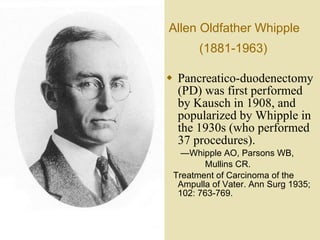
Allen Oldfather Whipple  (1881-1963)   Pancreatico-duodenectomy (PD) was first performed by Kausch in 1908, and popularized by Whipple in the 1930s (who performed 37 procedures).  — Whipple AO, Parsons WB,  Mullins CR.  Treatment of Carcinoma of the Ampulla of Vater. Ann Surg 1935; 102: 763-769.
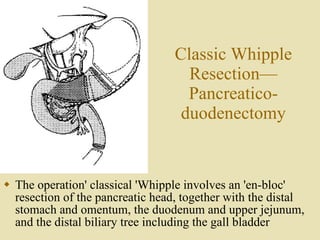
The operation' classical 'Whipple involves an 'en-bloc' resection of the pancreatic head, together with the distal stomach and omentum, the duodenum and upper jejunum, and the distal biliary tree including the gall bladder Classic Whipple Resection— Pancreatico-duodenectomy
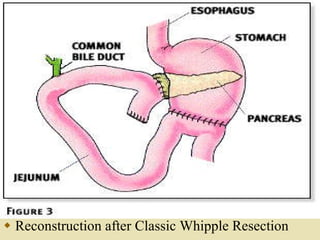
Reconstruction after Classic Whipple Resection
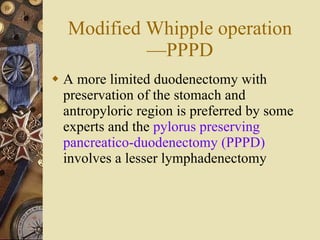
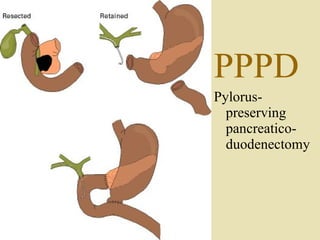
Modified Whipple operation —PPPD A more limited duodenectomy with preservation of the stomach and antropyloric region is preferred by some experts and the  pylorus preserving pancreatico-duodenectomy (PPPD)  involves a lesser lymphadenectomy
PPPD Pylorus-preserving  pancreatico- duodenectomy                                                                           
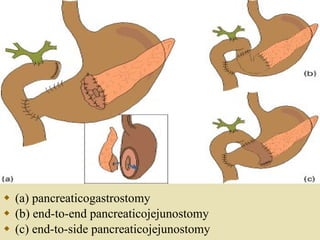
(a) pancreaticogastrostomy (b) end-to-end pancreaticojejunostomy (c) end-to-side pancreaticojejunostomy                                                                         
Classic Whipple V.S. PPPD PPPD—protects against gastric dumping, marginal ulceration, and bile reflux gastritis. Significant reduction of the operation time, the intraoperative blood loss and the consequent need for blood substitution.  But sufficiently radical to treat pancreatic cancer? Similar or even better postoperative morbidity and mortality result was debated.
Principle Indications for PD Ductal adenocarcinoma of the pancreatic head Cholangiocarcinoma of the distal biliary tree  Periampullary adenocarcinoma and ampullary carcinoid  Primary duodenal adenocarcinoma, duodenal GIST and duodenal lymphoma  Chronic pancreatitis with associated mass lesion of uncertain aetiology
Results following Pancreaticoduodenectomy Due to improved surgical skill and peri-operative care Mortality rate 20%-40% in earlier days  During the past decades, dramatically decreased and currently is between 0-4% in experience centers with experience.  Complication rate is still 30%-40%
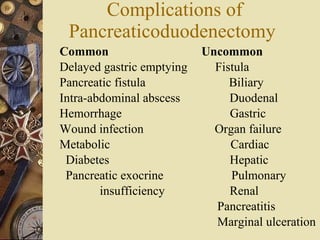
Complications of Pancreaticoduodenectomy  Common  Uncommon Delayed gastric emptying  Fistula Pancreatic fistula    Biliary Intra-abdominal abscess    Duodenal Hemorrhage    Gastric Wound infection  Organ failure Metabolic    Cardiac     Diabetes    Hepatic     Pancreatic exocrine  Pulmonary insufficiency  Renal    Pancreatitis Marginal ulceration
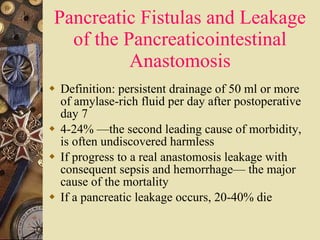
Pancreatic Fistulas and Leakage of the Pancreaticointestinal Anastomosis Definition: persistent drainage of 50 ml or more of amylase-rich fluid per day after postoperative day 7 4-24% —the second leading cause of morbidity, is often undiscovered harmless  If progress to a real anastomosis leakage with consequent sepsis and hemorrhage— the major cause of the mortality  If a pancreatic leakage occurs, 20-40% die
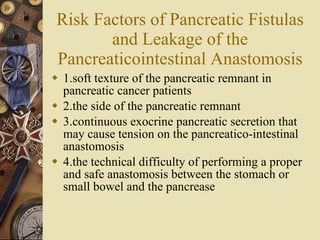
Risk Factors of Pancreatic Fistulas and Leakage of the Pancreaticointestinal Anastomosis 1.soft texture of the pancreatic remnant in pancreatic cancer patients 2.the side of the pancreatic remnant 3.continuous exocrine pancreatic secretion that may cause tension on the pancreatico-intestinal anastomosis 4.the technical difficulty of performing a proper and safe anastomosis between the stomach or small bowel and the pancrease
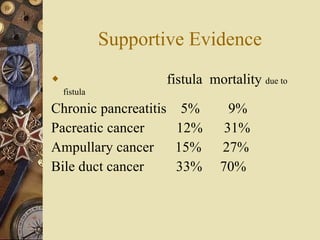
Supportive Evidence fistula  mortality  due to fistula  Chronic pancreatitis  5%  9%  Pacreatic cancer  12%  31% Ampullary cancer  15%  27% Bile duct cancer  33%  70%
Supportive Evidence Fibrotic pancreatic remnant , as commonly found in chronic pancreatitis, facilitates the anastomosis Normal pre-operative exocrine function test result—low degree of pancreatic fibrosis and consequently a higher incidence of postoperative pancreatic fistula and leakage
Best surgical prevention of postoperative complication  Safe surgical technique 1. End-to-side pancreaticojejunostomy  2. End-to-end pancreaticojejunostomy  3. Pancreaticogastrostomy
4.Pancreatic ductal occlusion or drainage Pancreatic duct closure by ligation, stapling, or suturing 1. Inevitable fistula rate—50-100% 2. Exocrine insufficiency— steatorrhea and diarrhea =>unfavorable
5. others External stenting of the duct with separated Roux loops  Sealing of the pancreaticojejunostomy with fibrin glue => Minor Effective
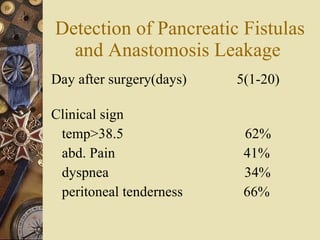
Detection of Pancreatic Fistulas and Anastomosis Leakage   Day after surgery(days)  5(1-20)  Clinical sign temp>38.5  62% abd. Pain  41% dyspnea  34% peritoneal tenderness  66%
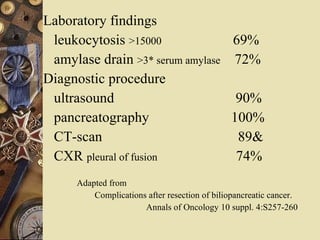
Laboratory findings  leukocytosis  >15000   69% amylase drain  >3* serum amylase   72% Diagnostic procedure ultrasound  90%  pancreatography  100% CT-scan  89& CXR  pleural of fusion   74% Adapted from  Complications after resection of biliopancreatic cancer.  Annals of Oncology 10 suppl. 4:S257-260
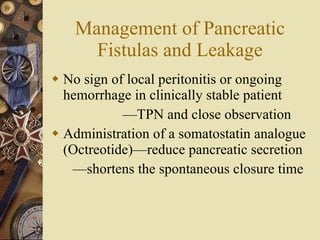
Management of Pancreatic Fistulas and Leakage No sign of local peritonitis or ongoing hemorrhage in clinically stable patient — TPN and close observation Administration of a somatostatin analogue (Octreotide)—reduce pancreatic secretion — shortens the spontaneous closure time
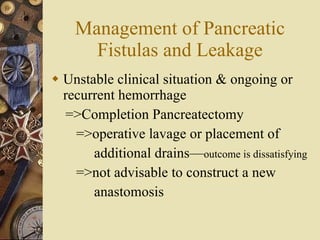
Management of Pancreatic Fistulas and Leakage Unstable clinical situation & ongoing or recurrent hemorrhage =>Completion Pancreatectomy =>operative lavage or placement of  additional drains— outcome is dissatisfying   =>not advisable to construct a new  anastomosis
Intraabdominal Abscess Incidence—10% Pancreatic Fistulas and Leakage  Intraabdominal Abscess  Sepsis D/D—postoperative intraabdominal fluid  collection  resolve spontaneously  by drainage fluid character
Management of Intraabdominal Abscess Controlling the underlying causes — fistula & anastomosis leakage  Completion Pancreatectomy  if neccessary Ultrasonographic or CT guide percutaneous catheter drainage  Operative lavage or placement of additional drains
Hemorrhage Incidence—5-16% Mortality rate—15-58% Classification (a) Bleeding within 24 hr (b) Bleeding occurs in the 2th and 3th weeks  (1) Intraabdominal bleeding(mostly from the  retroperitoneal operation field) (2)  Gastrointestinal bleeding(intraluminal)
Bleeding within 24 hr Mostly caused by—  Insufficient Intraoperative Hemostasis Detection—(1)output of the drain (2)Hb level (3)vital sign of the patient
Bleeding within 24 hr Bloody output of NG tube or melena  suture line bleeding  gastroscopy  no stablization after blood & FFP   reoperation
Bleeding in the later course Anastomostic suture line bleeding or marginal ulcer  often masking “Sentinel Bleed”  (the erosive bleeding from the  retroperitoneal vessels)  leakage of the pancreatic anastomosis  carefully D/D by gastroscopy
D/D Stress Ulcer Rarely seen after pancreaticoduodenectomy Prevention by administration of H+ pump inhibitor, H2-antagonist  Detected and resolved by interventional endoscopy
Prevention of Hemorrhage Perform a proper operation with a careful hemostasis Pre-operation bile drainage into the duodenum by ERCP or PTCD in jaundice patients(because coagulation disturbance usually seen in jaundice patients)
Delayed Gastric Emptying (1) Persistent secretion via the gastric tube of  more than 500 ml/day over more than 5  days after surgery (2) Recurrent vomitting  (3) Swelling of the gastrojejunostomy/ duodenojejunostomy (4) Dilation of the stomach in the contrast medium  passage
Delay Gastric Emptying Incidence 25-70% Resolves spontaneously within 2-4 week  Risk factor a. Presence of intraabdominal complication b. Radicality of the resection (Lymph node dissection)  D/D obstruction at the duodenojejunostomy or gastrojejunostomy
Mechanism of  Delay Gastric Emptying (1)Gastric atony caused by disruption of the gastroduodenal neural network after extended retroperitoneal lymphadenectomy (2)Decreased Motilin level(produced from the enterochromaffin cells of  duodenum and proximal jejunum) reduce the gastric motility (3)Ischemic injury to the antropyloric muscle mechanism (4)Gastric arrythmias secondary to intra-abdominal complication such as anastomostic leakage or abscess
Management of  Delay Gastric Emptying Incorpotrating prolonged nasogastric or gastrostomy tube decompression combined with TPN or Enteral nutrition Administration of  (1) motilin agonist—erythromycin (2) prokinetic agents—metoclopramide  and/or cisapride
Pancreatogenic Diabetes Pancreaticoduodenectomy remove 30-40% of the pancreatic parenchymal mass Majority of patients—no important clinically important effect on glucose homeostasis  Minority—hyperglycemia and glucosuria — dietary adjustment, OHA or  parenteral insulin
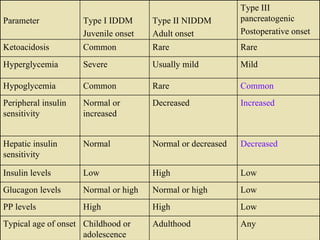
Any Adulthood Childhood or adolescence Typical age of onset Low High High PP levels Low Normal or high Normal or high Glucagon levels Low High Low Insulin levels Decreased Normal or decreased Normal Hepatic insulin  sensitivity Increased Decreased Normal or increased Peripheral insulin sensitivity Common Rare Common Hypoglycemia Mild Usually mild Severe Hyperglycemia Rare Rare Common Ketoacidosis Type III pancreatogenic Postoperative onset Type II NIDDM Adult onset Type I IDDM Juvenile onset Parameter
Pancreatic exocrine Insufficiency Fecal fat measurement or N-benzoyl-L-tyrosil-P-aminobenzoic acid test Presumably related to obstruction of the pancreatic duct Management—exogenous pancreatic enzyme supplementation(Creon, Pancrease, Viokase) in the early post-op period and weaning in patients who survival more than 1 year and have no malabsorption
Wound Infection Incidence:5-20% Management: (1)Antibiotics: Prophylasis and post-op (2)suture or staple removal, drainage,  and packing
Thanks for your attention !

Whipple complication

  • 1.
    Complications of WhippleOperation By Ri 林帛賢
  • 2.
    Reference 1.Prevention andtreatment of complications in pancreatic cancer surgery. Review. Digestive Surgery 1999;16:327-336 2.Complications after resection of biliopancreatic cancer. Annals of Oncology 10 suppl. 4:S257-260 3.Management of complication after pancreaticoduodenaectomy in a high volume center:Results on 150 consecutive patients. Digestive Surgery 2001;18:453-458 4. Management of complications following pancreaticoduodenectomy. Surg Clin North Am 75:913-924, 5. Trends in indications and outcomes in the Whipple procedure over a 40-year period.Am Surg. 1999 Sep;65(9):889-93. 6. Pancreatic Resection: Effects on Glucose Metabolism. World J Surg. 2001 Apr;25(4):452-60. Epub 2001 Apr 11 Sabiston Textbook of Surgery, 16th ed Oxford Textbook of Surgery 2000. 2th ed http://www.rcsed.ac.uk/journal/vol47_3/4730003.html
  • 3.
    Allen Oldfather Whipple (1881-1963) Pancreatico-duodenectomy (PD) was first performed by Kausch in 1908, and popularized by Whipple in the 1930s (who performed 37 procedures). — Whipple AO, Parsons WB, Mullins CR. Treatment of Carcinoma of the Ampulla of Vater. Ann Surg 1935; 102: 763-769.
  • 4.
    The operation' classical'Whipple involves an 'en-bloc' resection of the pancreatic head, together with the distal stomach and omentum, the duodenum and upper jejunum, and the distal biliary tree including the gall bladder Classic Whipple Resection— Pancreatico-duodenectomy
  • 5.
  • 6.
    Modified Whipple operation—PPPD A more limited duodenectomy with preservation of the stomach and antropyloric region is preferred by some experts and the pylorus preserving pancreatico-duodenectomy (PPPD) involves a lesser lymphadenectomy
  • 7.
    PPPD Pylorus-preserving pancreatico- duodenectomy                                                                          
  • 8.
    (a) pancreaticogastrostomy (b)end-to-end pancreaticojejunostomy (c) end-to-side pancreaticojejunostomy                                                                         
  • 9.
    Classic Whipple V.S.PPPD PPPD—protects against gastric dumping, marginal ulceration, and bile reflux gastritis. Significant reduction of the operation time, the intraoperative blood loss and the consequent need for blood substitution. But sufficiently radical to treat pancreatic cancer? Similar or even better postoperative morbidity and mortality result was debated.
  • 10.
    Principle Indications forPD Ductal adenocarcinoma of the pancreatic head Cholangiocarcinoma of the distal biliary tree Periampullary adenocarcinoma and ampullary carcinoid Primary duodenal adenocarcinoma, duodenal GIST and duodenal lymphoma Chronic pancreatitis with associated mass lesion of uncertain aetiology
  • 11.
    Results following PancreaticoduodenectomyDue to improved surgical skill and peri-operative care Mortality rate 20%-40% in earlier days During the past decades, dramatically decreased and currently is between 0-4% in experience centers with experience. Complication rate is still 30%-40%
  • 12.
    Complications of Pancreaticoduodenectomy Common Uncommon Delayed gastric emptying Fistula Pancreatic fistula   Biliary Intra-abdominal abscess   Duodenal Hemorrhage   Gastric Wound infection Organ failure Metabolic   Cardiac     Diabetes   Hepatic    Pancreatic exocrine Pulmonary insufficiency Renal   Pancreatitis Marginal ulceration
  • 13.
    Pancreatic Fistulas andLeakage of the Pancreaticointestinal Anastomosis Definition: persistent drainage of 50 ml or more of amylase-rich fluid per day after postoperative day 7 4-24% —the second leading cause of morbidity, is often undiscovered harmless If progress to a real anastomosis leakage with consequent sepsis and hemorrhage— the major cause of the mortality If a pancreatic leakage occurs, 20-40% die
  • 14.
    Risk Factors ofPancreatic Fistulas and Leakage of the Pancreaticointestinal Anastomosis 1.soft texture of the pancreatic remnant in pancreatic cancer patients 2.the side of the pancreatic remnant 3.continuous exocrine pancreatic secretion that may cause tension on the pancreatico-intestinal anastomosis 4.the technical difficulty of performing a proper and safe anastomosis between the stomach or small bowel and the pancrease
  • 15.
    Supportive Evidence fistula mortality due to fistula Chronic pancreatitis 5% 9% Pacreatic cancer 12% 31% Ampullary cancer 15% 27% Bile duct cancer 33% 70%
  • 16.
    Supportive Evidence Fibroticpancreatic remnant , as commonly found in chronic pancreatitis, facilitates the anastomosis Normal pre-operative exocrine function test result—low degree of pancreatic fibrosis and consequently a higher incidence of postoperative pancreatic fistula and leakage
  • 17.
    Best surgical preventionof postoperative complication Safe surgical technique 1. End-to-side pancreaticojejunostomy 2. End-to-end pancreaticojejunostomy 3. Pancreaticogastrostomy
  • 18.
    4.Pancreatic ductal occlusionor drainage Pancreatic duct closure by ligation, stapling, or suturing 1. Inevitable fistula rate—50-100% 2. Exocrine insufficiency— steatorrhea and diarrhea =>unfavorable
  • 19.
    5. others Externalstenting of the duct with separated Roux loops Sealing of the pancreaticojejunostomy with fibrin glue => Minor Effective
  • 20.
    Detection of PancreaticFistulas and Anastomosis Leakage Day after surgery(days) 5(1-20) Clinical sign temp>38.5 62% abd. Pain 41% dyspnea 34% peritoneal tenderness 66%
  • 21.
    Laboratory findings leukocytosis >15000 69% amylase drain >3* serum amylase 72% Diagnostic procedure ultrasound 90% pancreatography 100% CT-scan 89& CXR pleural of fusion 74% Adapted from Complications after resection of biliopancreatic cancer. Annals of Oncology 10 suppl. 4:S257-260
  • 22.
    Management of PancreaticFistulas and Leakage No sign of local peritonitis or ongoing hemorrhage in clinically stable patient — TPN and close observation Administration of a somatostatin analogue (Octreotide)—reduce pancreatic secretion — shortens the spontaneous closure time
  • 23.
    Management of PancreaticFistulas and Leakage Unstable clinical situation & ongoing or recurrent hemorrhage =>Completion Pancreatectomy =>operative lavage or placement of additional drains— outcome is dissatisfying =>not advisable to construct a new anastomosis
  • 24.
    Intraabdominal Abscess Incidence—10%Pancreatic Fistulas and Leakage  Intraabdominal Abscess  Sepsis D/D—postoperative intraabdominal fluid collection  resolve spontaneously  by drainage fluid character
  • 25.
    Management of IntraabdominalAbscess Controlling the underlying causes — fistula & anastomosis leakage  Completion Pancreatectomy if neccessary Ultrasonographic or CT guide percutaneous catheter drainage Operative lavage or placement of additional drains
  • 26.
    Hemorrhage Incidence—5-16% Mortalityrate—15-58% Classification (a) Bleeding within 24 hr (b) Bleeding occurs in the 2th and 3th weeks (1) Intraabdominal bleeding(mostly from the retroperitoneal operation field) (2) Gastrointestinal bleeding(intraluminal)
  • 27.
    Bleeding within 24hr Mostly caused by— Insufficient Intraoperative Hemostasis Detection—(1)output of the drain (2)Hb level (3)vital sign of the patient
  • 28.
    Bleeding within 24hr Bloody output of NG tube or melena  suture line bleeding  gastroscopy  no stablization after blood & FFP  reoperation
  • 29.
    Bleeding in thelater course Anastomostic suture line bleeding or marginal ulcer  often masking “Sentinel Bleed” (the erosive bleeding from the retroperitoneal vessels)  leakage of the pancreatic anastomosis  carefully D/D by gastroscopy
  • 30.
    D/D Stress UlcerRarely seen after pancreaticoduodenectomy Prevention by administration of H+ pump inhibitor, H2-antagonist Detected and resolved by interventional endoscopy
  • 31.
    Prevention of HemorrhagePerform a proper operation with a careful hemostasis Pre-operation bile drainage into the duodenum by ERCP or PTCD in jaundice patients(because coagulation disturbance usually seen in jaundice patients)
  • 32.
    Delayed Gastric Emptying(1) Persistent secretion via the gastric tube of more than 500 ml/day over more than 5 days after surgery (2) Recurrent vomitting (3) Swelling of the gastrojejunostomy/ duodenojejunostomy (4) Dilation of the stomach in the contrast medium passage
  • 33.
    Delay Gastric EmptyingIncidence 25-70% Resolves spontaneously within 2-4 week Risk factor a. Presence of intraabdominal complication b. Radicality of the resection (Lymph node dissection) D/D obstruction at the duodenojejunostomy or gastrojejunostomy
  • 34.
    Mechanism of Delay Gastric Emptying (1)Gastric atony caused by disruption of the gastroduodenal neural network after extended retroperitoneal lymphadenectomy (2)Decreased Motilin level(produced from the enterochromaffin cells of duodenum and proximal jejunum) reduce the gastric motility (3)Ischemic injury to the antropyloric muscle mechanism (4)Gastric arrythmias secondary to intra-abdominal complication such as anastomostic leakage or abscess
  • 35.
    Management of Delay Gastric Emptying Incorpotrating prolonged nasogastric or gastrostomy tube decompression combined with TPN or Enteral nutrition Administration of (1) motilin agonist—erythromycin (2) prokinetic agents—metoclopramide and/or cisapride
  • 36.
    Pancreatogenic Diabetes Pancreaticoduodenectomyremove 30-40% of the pancreatic parenchymal mass Majority of patients—no important clinically important effect on glucose homeostasis Minority—hyperglycemia and glucosuria — dietary adjustment, OHA or parenteral insulin
  • 37.
    Any Adulthood Childhoodor adolescence Typical age of onset Low High High PP levels Low Normal or high Normal or high Glucagon levels Low High Low Insulin levels Decreased Normal or decreased Normal Hepatic insulin sensitivity Increased Decreased Normal or increased Peripheral insulin sensitivity Common Rare Common Hypoglycemia Mild Usually mild Severe Hyperglycemia Rare Rare Common Ketoacidosis Type III pancreatogenic Postoperative onset Type II NIDDM Adult onset Type I IDDM Juvenile onset Parameter
  • 38.
    Pancreatic exocrine InsufficiencyFecal fat measurement or N-benzoyl-L-tyrosil-P-aminobenzoic acid test Presumably related to obstruction of the pancreatic duct Management—exogenous pancreatic enzyme supplementation(Creon, Pancrease, Viokase) in the early post-op period and weaning in patients who survival more than 1 year and have no malabsorption
  • 39.
    Wound Infection Incidence:5-20%Management: (1)Antibiotics: Prophylasis and post-op (2)suture or staple removal, drainage, and packing
  • 40.
    Thanks for yourattention !