
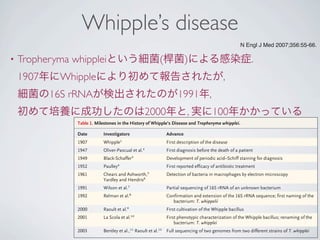
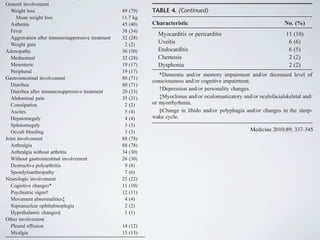
![• 142名のWDのうち,
113例のcWD患者の解析
TABLE 4. Epidemiologic and Clinical Data for 113 Patients
With Definite Classic WD
Characteristic No. (%)
Male 83 (73)
Mean age, yr [range] 56.64 [33Y80]
Diagnosis delay after first symptoms, yr [range] 6.4 [0Y30]
First diagnosis 65 (57)
Rheumatoid disease 56 (50)
Unexplained polyarthritis 32 (28)
Destructive polyarthritis 9 (8)
Spondyloarthropathy 7 (6)
Psoriatic arthritis 2 (2)
Giant cell arteritis 6 (6)
Sarcoidosis 7 (7)
Fibromyalgia 2 (2)
Lymphoma suspicion 6 (6)
Arthralgia resolving with previous antibiotics 4 (4)
Previous immunosuppressive treatment 56 (50)
Corticosteroids 50 (43)
Tumor necrosis factor antagonists 16 (14)
Other immunosuppressive therapy 16 (14)
Analysis of Biopsies From Patients With
No. of
Samples
Tested by
PAS
PAS
Positive
No. of
Samples
Tested by
IHC
IHC
Positive
c
113 113 84 83
12 11 11 11
2 2 2 2
1 1 1 1
3 2 3 2
1 1 1 1
1 1 1 1
1 1 1 1
14 0 9 0
Medicine & Volume 89, Number 5, September 2010
Medicine 2010;89: 337-345](https://image.slidesharecdn.com/whipple-130907054112-/85/Whipple-6-320.jpg)
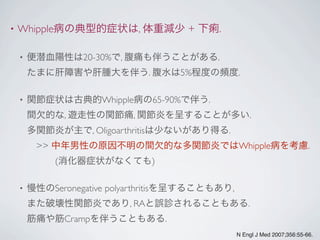
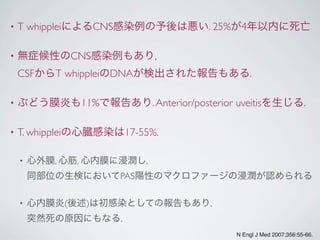
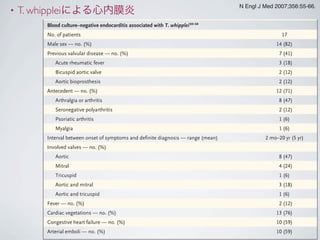
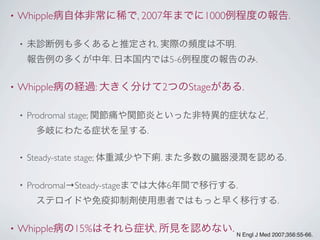
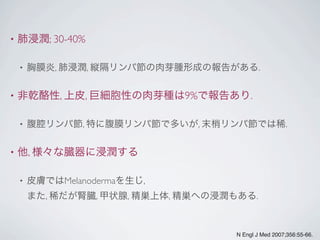
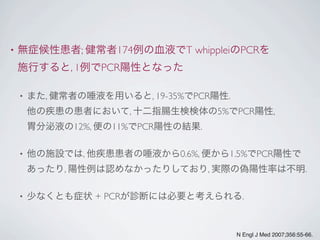
![• 16例の心内膜炎症例の解析
previously estimated.24
Of the patients in the current study with
such infections, the majority presented with the well-known
classic WD (80%).72
Less frequently (11%), endocarditis was
reported; other localizations of T whipplei were occasionally
observed. Most of our patients with classic WD were middle-
6,10,29,32,47,72
improvement is possible and should not exclude the diagnos
classic WD. Moreover, the inefficacy of such treatment aga
polyarthritis that is sometimes observed should lead to suspi
of T whipplei infection.
In future cases in which, after initiation of immuno
pressive therapy, patients with inflammatory rheumatoid dis
develop severe general involvement or the therapy is ineffec
against polyarthritis, we strongly suggest screening for cla
WD. PCR screening of saliva and stool specimens should
performed first, followed by a new, recently developed stra
that allows a noninvasive procedure.19
When results of both t
are positive, diagnosis of WD is highly suspected (93% of
cases in the current study).22
Small-bowel biopsy should
performed to confirm the diagnosis. When the results of the P
screening are negative, classic WD is unlikely.22
After initiation of immunosuppressive therapy, some pati
quickly developed other cardinal signs of classic WD includ
diarrhea and weight loss.32,42,69
Among other symptoms of
gestive involvement,10,24,47,72
abdominal pain is frequent. L
frequently, ascites, hepatomegaly, or splenomegaly have b
described.10,29,47,72
Mesenteric lymph nodes (17%) represent
of the major lymphadenopathic sites of involvement.
Differential diagnosis such as lymphoma or sarcoid
should be suspected in the presence of well-described pseu
tumoral involvement with mediastinal, mesenteric, and,
frequently, peripheral lymph nodes.10,24,47,72
Although lymph
should be easily differentiated by histologic analysis of lym
node biopsy, differential diagnosis with sarcoidosis may be d
cult because noncaseating epithelioid and giant-cell granulo
have been described10,52,68
in approximately 10% of patien
with classic WD. Indeed, granuloma is a frequent differen
diagnosis of classic WD that should not be excluded eve
PAS-staining is negative. One of our patients had fatal co
quences after corticosteroid therapy initiated for sarcoido
TABLE 5. Epidemiologic and Clinical Characteristics of 16
Patients With Endocarditis Associated With T whipplei
Characteristic No. of Patients (%)
Male 16 (100)
Mean age, yr [range] 60.2 [42Y71]
Immunosuppressive treatment 5 (31)
Corticosteroids 5 (31)
Tumor necrosis factor antagonists 2 (12)
Other immunosuppressive therapy 2 (12)
Arthralgia 11 (69)
Valvular disease history 5 (31)
Diarrhea 1 (6)
Type of valve involvement
Aortic valve 9 (56)
Mitral and aortic valve 4 (25)
Mitral valve 2 (12)
Aortic and tricuspid valve 1 (6)
Cardiac vegetation 13 (81)
Congestive heart failure 8 (50)
Acute ischemic stroke 6 (37)
Fever 4 (25)
Peripheral arterial embolism 3 (19)
Medicine 2010;89: 337-345](https://image.slidesharecdn.com/whipple-130907054112-/85/Whipple-13-320.jpg)
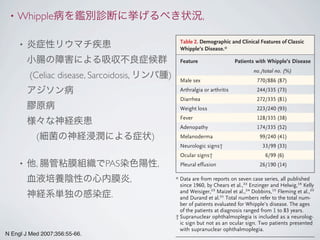
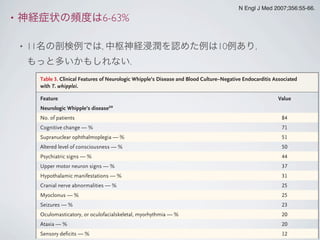
![• 大型の脂肪滴が組織に認められることもある.
(上記は腸粘膜)
Figure 16: Accumulation of large lipid droplets (asterisk) in the
lamina propria of intestinal villi. Semi-thin resin section, scale =
0.1 mm. Courtesy of Ladislav Kubeˇs, MD, PhD. Reproduced with
permission from Bureˇs and Rejchrt [42].
Whipple’s disease is a rare disease. We have re
only five cases at our tertiary gastroenterology centre
a 20-year period (no new case during the last 8
Patients were presented mostly with weight loss, diar
microcytic anaemia, and arthralgias. We decided
penicillin G or amoxicillin-clavulanic acid + i.v. gent
for two weeks, followed by p.o. doxycycline (100 mg p
plus p.o. salazopyrine (3 g per day) for 1 year. Full rem
was achieved in all our patients. We do not recom
streptomycin because of the significant risk of seriou
effects of this treatment. We consider salazopyrine a s
alternative to trimethoprim-sulfamethoxazole. The su
bility of bacteria to trimethoprim-sulfamethoxazole
to sulfamethoxazole alone [61]. None of our patient
presented with neurologic symptoms.
12. Conclusions
Whipple’s disease is chronic infectious systemic d
caused by the bacterium Tropheryma whipplei. Nond
ing arthritis is frequently an initial complaint. Gastro
nal and general symptoms include marked diarrhoea
serious malabsorption), abdominal pain, prominent
loss, and low-grade fever. Possible neurologic sym
(up to 20%) might be associated with worse pro
Diagnosis is based on the clinical picture and small int
histology revealing foamy macrophages containing pe
acid-Schiff- (PAS-) positive material. Long-term (up
year) antibiotic therapy provides a favourable outcome
vast majority of cases.
Gastroenterol Res Pract. 2013;2013:478349](https://image.slidesharecdn.com/whipple-130907054112-/85/Whipple-23-320.jpg)
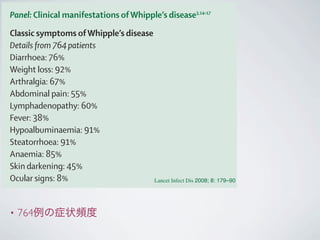
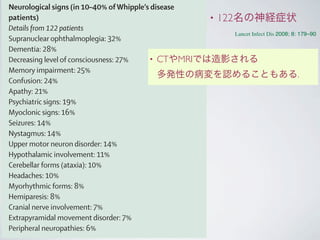
![Figure 17: Groups of microbes (arrow) and characteristic lysosomes
(asterisk) present in an intestinal histiocyte in Whipple’s disease.
Electron micrograph, scale = 2 𝜇m. Courtesy of Professor Josef
ˇSpaˇcek, MD, DSc. Reproduced with permission from Bureˇs and
Rejchrt [42]. Gastroenterol Res Pract. 2013;2013:478349](https://image.slidesharecdn.com/whipple-130907054112-/85/Whipple-26-320.jpg)
![TABLE 4. Epidemiologic and Clinical Data for 113 Patients
With Definite Classic WD
Characteristic No. (%)
Male 83 (73)
Mean age, yr [range] 56.64 [33Y80]
Diagnosis delay after first symptoms, yr [range] 6.4 [0Y30]
First diagnosis 65 (57)
Rheumatoid disease 56 (50)
Unexplained polyarthritis 32 (28)
Destructive polyarthritis 9 (8)
Spondyloarthropathy 7 (6)
Psoriatic arthritis 2 (2)
Giant cell arteritis 6 (6)
Sarcoidosis 7 (7)
Fibromyalgia 2 (2)
Lymphoma suspicion 6 (6)
Arthralgia resolving with previous antibiotics 4 (4)
Previous immunosuppressive treatment 56 (50)
Corticosteroids 50 (43)
Tumor necrosis factor antagonists 16 (14)
Other immunosuppressive therapy 16 (14)
General involvement
Weight loss 89 (79)
Mean weight loss 11.7 kg
Asthenia 45 (40)
Fever 38 (34)
Aggravation after immunosuppressive treatment 32 (28)
Weight gain 2 (2)
Adenopathy 56 (50)
Mediastinal 32 (28)
Mesenteric 19 (17)
Peripheral 19 (17)
Gastrointestinal involvement 80 (71)
Diarrhea 80 (71)
Diarrhea after immunosuppressive treatment 20 (33)
Abdominal pain 35 (31)
Constipation 2 (2)
Ascites 5 (4)
Hepatomegaly 4 (4)
Splenomegaly 3 (3)
Occult bleeding 3 (3)
Joint involvement 88 (78)
TABLE 3. Histologic Analysis of Biopsies From Patients With
T whipplei Infections
Patients, Biopsy Type
No. of
Samples
Tested by
PAS
PAS
Positive
No. of
Samples
Tested by
IHC
IHC
Positive
113 Patients with classic
Whipple disease
Duodenal biopsy 113 113 84 83
Adenopathy biopsy 12 11 11 11
Heart valve biopsy 2 2 2 2
Aqueous humor
biopsy
1 1 1 1
Muscle biopsy 3 2 3 2
Synovial biopsy 1 1 1 1
Pleural biopsy 1 1 1 1
Pericardial biopsy 1 1 1 1
16 Patients with
definite infective
endocarditis due to
T whipplei
Duodenal biopsy 14 0 9 0
Valve biopsy 11 11 11 11
2 Patients with definite
uveitis due to
T whipplei
Duodenal biopsy 2 0 2 0
2 Patients with definite
adenopathy due to
T whipplei
Duodenal biopsy 2 0 2 0
Adenopathy 2 2 2 2
2 Patients with definite
pulmonary infection
due to T whipplei
Duodenal biopsy 2 0 2 0
Lung biopsy 1 1 1 1
Adenopathy 1 0 1 0
2 Patients with isolated
joint involvement
due to T whipplei
Duodenal biopsy 2 0 2 0
Abbreviation: IHC = immunohistochemistry with a polyclonal rabbit
anti-T whipplei antibody.
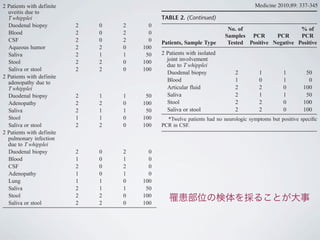
罹患部位の検体のPAS染色の感度は
ほぼ100%
*ただし, CNS感染におけるCSFの感度は
低いと考えられる.
Medicine 2010;89: 337-345](https://image.slidesharecdn.com/whipple-130907054112-/85/Whipple-31-320.jpg)

- Whipple's disease is a rare infection caused by the bacterium Tropheryma whipplei. It was first reported in 1907 but the bacterium was not identified until 1991 and not cultured until 2000. - Classic symptoms include weight loss, diarrhea, arthralgia or arthritis. Neurological involvement occurs in 10-40% of cases and can include cognitive changes, supranuclear ophthalmoplegia, and altered consciousness. - T. whipplei can also cause heart infections in 17-55% of cases, with infiltration of the pericardium, myocardium, and endocardium. Endocarditis from T. whipplei is a potential cause of sudden


