Avionics Architecture
Digital Avionics :CP
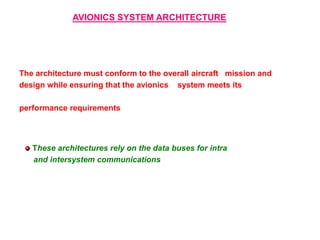
AVIONICS SYSTEM ARCHITECTURE
These architectures rely on the data buses for intra
and intersystem communications
The architecture must conform to the overall aircraft mission and
design while ensuring that the avionics system meets its
performance requirements
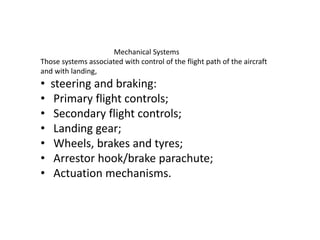
Mechanical Systems
Those systems associated with control of the flight path of the aircraft
and with landing,
• steering and braking:
• Primary flight controls;
• Secondary flight controls;
• Landing gear;
• Wheels, brakes and tyres;
• Arrestor hook/brake parachute;
• Actuation mechanisms.
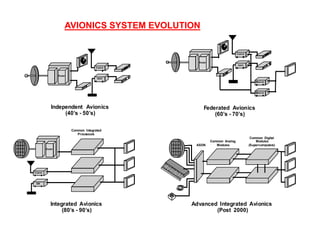
Advanced Integrated Avionics
(Post 2000)
Common Analog
Modules
ASDN
Common Digital
Modules
(Supercomputers)
Radar
Comm
EW
Common Integrated
Processors
Integrated Avionics
(80’s - 90’s)
Mission
Radar
Comm
NAV
Mission
Federated Avionics
(60’s - 70’s)
Radar
Comm
NAV
Independent Avionics
(40’s - 50’s)
AVIONICS SYSTEM EVOLUTION
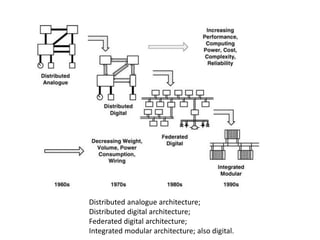
Distributed analogue architecture;
Distributed digital architecture;
Federated digital architecture;
Integrated modular architecture; also digital.
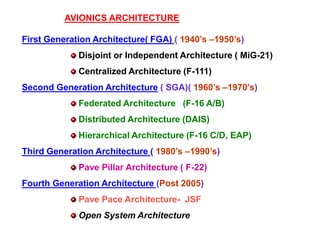
AVIONICS ARCHITECTURE
First Generation Architecture( FGA) ( 1940’s –1950’s)
Disjoint or Independent Architecture ( MiG-21)
Centralized Architecture (F-111)
Second Generation Architecture ( SGA)( 1960’s –1970’s)
Federated Architecture (F-16 A/B)
Distributed Architecture (DAIS)
Hierarchical Architecture (F-16 C/D, EAP)
Third Generation Architecture ( 1980’s –1990’s)
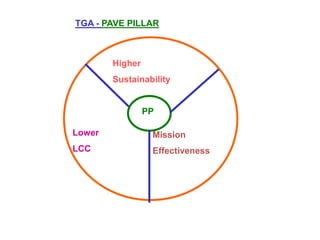
Pave Pillar Architecture ( F-22)
Fourth Generation Architecture (Post 2005)
Pave Pace Architecture- JSF
Open System Architecture
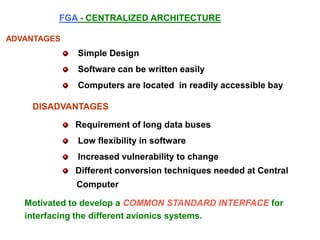
ADVANTAGES
Simple Design
Software can be written easily
Computers are located in readily accessible bay
DISADVANTAGES
Requirement of long data buses
Low flexibility in software
Increased vulnerability to change
Different conversion techniques needed at Central
Computer
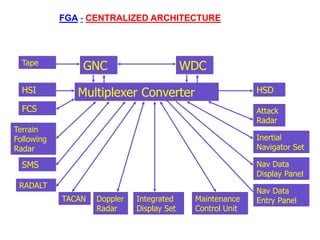
FGA - CENTRALIZED ARCHITECTURE
Motivated to develop a COMMON STANDARD INTERFACE for
interfacing the different avionics systems.
GNC WDC
Multiplexer Converter
HSI
FCS
Terrain
Following
Radar
SMS
RADALT
TACAN Doppler
Radar
Integrated
Display Set
Maintenance
Control Unit
HSD
Attack
Radar
Inertial
Navigator Set
Nav Data
Display Panel
Nav Data
Entry Panel
Tape
FGA - CENTRALIZED ARCHITECTURE
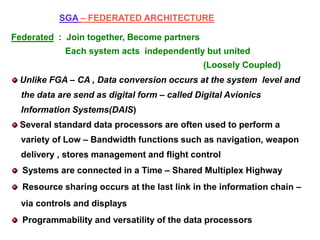
SGA – FEDERATED ARCHITECTURE
Federated : Join together, Become partners
Each system acts independently but united
(Loosely Coupled)
Unlike FGA – CA , Data conversion occurs at the system level and
the data are send as digital form – called Digital Avionics
Information Systems(DAIS)
Several standard data processors are often used to perform a
variety of Low – Bandwidth functions such as navigation, weapon
delivery , stores management and flight control
Systems are connected in a Time – Shared Multiplex Highway
Resource sharing occurs at the last link in the information chain –
via controls and displays
Programmability and versatility of the data processors
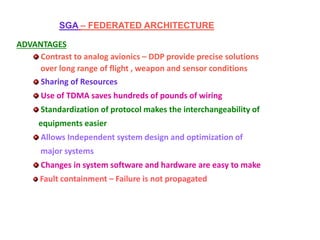
ADVANTAGES
Contrast to analog avionics – DDP provide precise solutions
over long range of flight , weapon and sensor conditions
Sharing of Resources
Use of TDMA saves hundreds of pounds of wiring
Standardization of protocol makes the interchangeability of
equipments easier
Allows Independent system design and optimization of
major systems
Changes in system software and hardware are easy to make
Fault containment – Failure is not propagated
SGA – FEDERATED ARCHITECTURE
Processor1
Bus Control
Interface
Processor2
Bus Control
Interface
Processor M
Bus Control
Interface
……
Data bus A
Remote
Terminal 1
Sensor
Equipment
Remote
Terminal 2
Sensor
Equipment
Remote
Terminal N
Control &
Display
Equipment
Data bus B
……
SGA - HARDWARE ARCHITECTURE
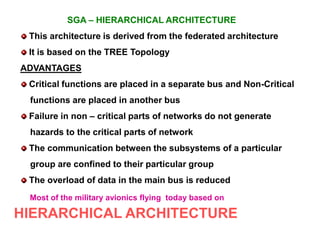
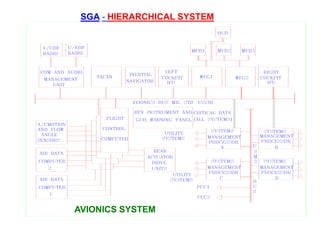
SGA – HIERARCHICAL ARCHITECTURE
This architecture is derived from the federated architecture
It is based on the TREE Topology
ADVANTAGES
Critical functions are placed in a separate bus and Non-Critical
functions are placed in another bus
Failure in non – critical parts of networks do not generate
hazards to the critical parts of network
The communication between the subsystems of a particular
group are confined to their particular group
The overload of data in the main bus is reduced
Most of the military avionics flying today based on
HIERARCHICAL ARCHITECTURE
SGA - HIERARCHICAL SYSTEM
AVIONICS SYSTEM
TGA - PAVE PILLAR
PP
Higher
Sustainability
Mission
Effectiveness
Lower
LCC
KEY Points
Increased Digitization of Functions
Increased sharing and modularization of functions
Integration/ sharing concepts increased to the skin of the
aircraft
Functionality has increasingly obtained through software
Complex hardware architecture modules
Complex software modules
Increased network complexity and speed
Modern concept
Integrated Modular architecture
AVIONICS ARCHITECTURAL EVOLUTION
MODERN TECHNOLOGY
Integrated Modular Avionics
Fast Bus definition
FLY By Wire : use co oaxial cables
FLY BY LIGHT /Optics use optical media
ANY QUESTIONS ?

2. avionics architecture da cp

  • 1.
  • 2.
    AVIONICS SYSTEM ARCHITECTURE Thesearchitectures rely on the data buses for intra and intersystem communications The architecture must conform to the overall aircraft mission and design while ensuring that the avionics system meets its performance requirements
  • 4.
    Mechanical Systems Those systemsassociated with control of the flight path of the aircraft and with landing, • steering and braking: • Primary flight controls; • Secondary flight controls; • Landing gear; • Wheels, brakes and tyres; • Arrestor hook/brake parachute; • Actuation mechanisms.
  • 5.
    Advanced Integrated Avionics (Post2000) Common Analog Modules ASDN Common Digital Modules (Supercomputers) Radar Comm EW Common Integrated Processors Integrated Avionics (80’s - 90’s) Mission Radar Comm NAV Mission Federated Avionics (60’s - 70’s) Radar Comm NAV Independent Avionics (40’s - 50’s) AVIONICS SYSTEM EVOLUTION
  • 6.
    Distributed analogue architecture; Distributeddigital architecture; Federated digital architecture; Integrated modular architecture; also digital.
  • 7.
    AVIONICS ARCHITECTURE First GenerationArchitecture( FGA) ( 1940’s –1950’s) Disjoint or Independent Architecture ( MiG-21) Centralized Architecture (F-111) Second Generation Architecture ( SGA)( 1960’s –1970’s) Federated Architecture (F-16 A/B) Distributed Architecture (DAIS) Hierarchical Architecture (F-16 C/D, EAP) Third Generation Architecture ( 1980’s –1990’s) Pave Pillar Architecture ( F-22) Fourth Generation Architecture (Post 2005) Pave Pace Architecture- JSF Open System Architecture
  • 8.
    ADVANTAGES Simple Design Software canbe written easily Computers are located in readily accessible bay DISADVANTAGES Requirement of long data buses Low flexibility in software Increased vulnerability to change Different conversion techniques needed at Central Computer FGA - CENTRALIZED ARCHITECTURE Motivated to develop a COMMON STANDARD INTERFACE for interfacing the different avionics systems.
  • 9.
    GNC WDC Multiplexer Converter HSI FCS Terrain Following Radar SMS RADALT TACANDoppler Radar Integrated Display Set Maintenance Control Unit HSD Attack Radar Inertial Navigator Set Nav Data Display Panel Nav Data Entry Panel Tape FGA - CENTRALIZED ARCHITECTURE
  • 10.
    SGA – FEDERATEDARCHITECTURE Federated : Join together, Become partners Each system acts independently but united (Loosely Coupled) Unlike FGA – CA , Data conversion occurs at the system level and the data are send as digital form – called Digital Avionics Information Systems(DAIS) Several standard data processors are often used to perform a variety of Low – Bandwidth functions such as navigation, weapon delivery , stores management and flight control Systems are connected in a Time – Shared Multiplex Highway Resource sharing occurs at the last link in the information chain – via controls and displays Programmability and versatility of the data processors
  • 11.
    ADVANTAGES Contrast to analogavionics – DDP provide precise solutions over long range of flight , weapon and sensor conditions Sharing of Resources Use of TDMA saves hundreds of pounds of wiring Standardization of protocol makes the interchangeability of equipments easier Allows Independent system design and optimization of major systems Changes in system software and hardware are easy to make Fault containment – Failure is not propagated SGA – FEDERATED ARCHITECTURE
  • 12.
    Processor1 Bus Control Interface Processor2 Bus Control Interface ProcessorM Bus Control Interface …… Data bus A Remote Terminal 1 Sensor Equipment Remote Terminal 2 Sensor Equipment Remote Terminal N Control & Display Equipment Data bus B …… SGA - HARDWARE ARCHITECTURE
  • 13.
    SGA – HIERARCHICALARCHITECTURE This architecture is derived from the federated architecture It is based on the TREE Topology ADVANTAGES Critical functions are placed in a separate bus and Non-Critical functions are placed in another bus Failure in non – critical parts of networks do not generate hazards to the critical parts of network The communication between the subsystems of a particular group are confined to their particular group The overload of data in the main bus is reduced Most of the military avionics flying today based on HIERARCHICAL ARCHITECTURE
  • 14.
    SGA - HIERARCHICALSYSTEM AVIONICS SYSTEM
  • 15.
    TGA - PAVEPILLAR PP Higher Sustainability Mission Effectiveness Lower LCC
  • 16.
    KEY Points Increased Digitizationof Functions Increased sharing and modularization of functions Integration/ sharing concepts increased to the skin of the aircraft Functionality has increasingly obtained through software Complex hardware architecture modules Complex software modules Increased network complexity and speed Modern concept Integrated Modular architecture AVIONICS ARCHITECTURAL EVOLUTION
  • 17.
    MODERN TECHNOLOGY Integrated ModularAvionics Fast Bus definition FLY By Wire : use co oaxial cables FLY BY LIGHT /Optics use optical media
  • 18.