JSC Space Rocket Center Progress 
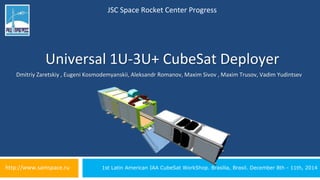
Universal 1U-3U+ CubeSat Deployer 
Dmitriy Zaretskiy , Eugeni Kosmodemyanskii, Aleksandr Romanov, Maxim Sivov , Maxim Trusov, Vadim Yudintsev 
1st Latin American IAA CubeSat WorkShop. BrasΓ­lia, Brasil. December 8th - 11th, 2014 
http://www.samspace.ru
Outline 
 Historical Background 
 Mechanical design 
 Separation dynamics 
 Installation 
1st Latin American IAA CubeSat WorkShop. BrasΓ­lia, Brasil. December 8th - 11th, 2014 
2
Historical Background 
About Space Rocket Center Progress
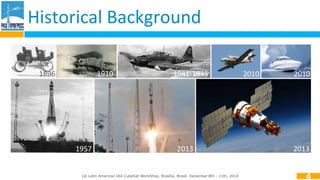
Historical Background 
1896 2010 
1957 
1910 1941-1945 2010 
2013 2013 
1st Latin American IAA CubeSat WorkShop. BrasΓ­lia, Brasil. December 8th - 11th, 2014 4
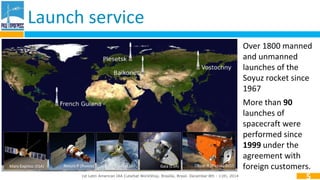
Launch service 
1st Latin American IAA CubeSat WorkShop. BrasΓ­lia, Brasil. December 8th - 11th, 2014 
5 
Mars-Express (ESA) Resurs-P (Russia) Pleyades (ESA) Gaia (ESA) 
Over 1800 manned 
and unmanned 
launches of the 
Soyuz rocket since 
1967 
More than 90 
launches of 
spacecraft were 
performed since 
1999 under the 
agreement with 
Obzor-R (Russia) 2015 foreign customers.
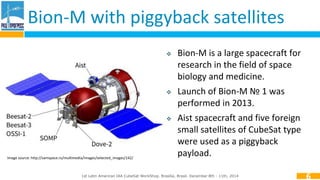
Bion-M with piggyback satellites 
 Bion-M is a large spacecraft for 
research in the field of space 
biology and medicine. 
 Launch of Bion-M β„– 1 was 
performed in 2013. 
 Aist spacecraft and five foreign 
small satellites of CubeSat type 
were used as a piggyback 
payload. 
1st Latin American IAA CubeSat WorkShop. BrasΓ­lia, Brasil. December 8th - 11th, 2014 
6 
Image source: http://samspace.ru/multimedia/images/selected_images/142/
CubeSat Deployer 
Mechanical design
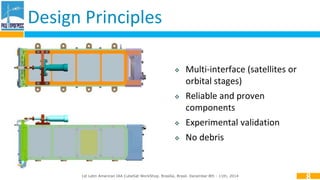
 Multi-interface (satellites or 
orbital stages) 
 Reliable and proven 
components 
 Experimental validation 
 No debris 
Design Principles 
1st Latin American IAA CubeSat WorkShop. BrasΓ­lia, Brasil. December 8th - 11th, 2014 
8
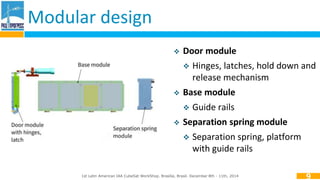
Modular design 
 Door module 
 Hinges, latches, hold down and 
release mechanism 
 Base module 
 Guide rails 
 Separation spring module 
 Separation spring, platform 
with guide rails 
1st Latin American IAA CubeSat WorkShop. BrasΓ­lia, Brasil. December 8th - 11th, 2014 
9
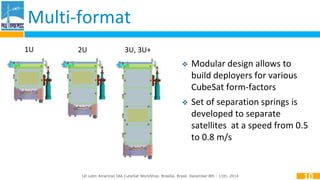
Multi-format 
1st Latin American IAA CubeSat WorkShop. BrasΓ­lia, Brasil. December 8th - 11th, 2014 
10 
1U 2U 3U, 3U+ 
 Modular design allows to 
build deployers for various 
CubeSat form-factors 
 Set of separation springs is 
developed to separate 
satellites at a speed from 0.5 
to 0.8 m/s
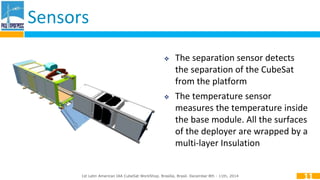
Sensors 
 The separation sensor detects 
the separation of the CubeSat 
from the platform 
 The temperature sensor 
measures the temperature inside 
the base module. All the surfaces 
of the deployer are wrapped by a 
multi-layer Insulation 
1st Latin American IAA CubeSat WorkShop. BrasΓ­lia, Brasil. December 8th - 11th, 2014 
11
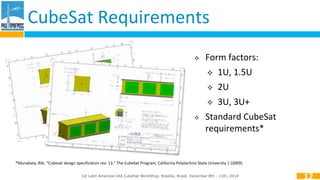
CubeSat Requirements 
 Form factors: 
 1U, 1.5U 
 2U 
 3U, 3U+ 
 Standard CubeSat 
requirements* 
1st Latin American IAA CubeSat WorkShop. BrasΓ­lia, Brasil. December 8th - 11th, 2014 
12 
*Munakata, Riki. "Cubesat design specification rev. 13." The CubeSat Program, California Polytechnic State University 1 (2009).
Separation dynamics
Separation dynamics 
 Separation speed 
0.5 … 0.8 m/s 
 Angular velocity 
1U CubeSats: < 15 Β°/s 
3U CubeSats: < 5 Β°/s 
1st Latin American IAA CubeSat WorkShop. BrasΓ­lia, Brasil. December 8th - 11th, 2014 
14
Angular velocity of 1U CubeSat 
for different COG offset and Ξ΄ =0.5 mm 
1st Latin American IAA CubeSat WorkShop. BrasΓ­lia, Brasil. December 8th - 11th, 2014 
15
Angular velocity of 3U CubeSat 
1st Latin American IAA CubeSat WorkShop. BrasΓ­lia, Brasil. December 8th - 11th, 2014 
16 
Angular velocity of 3U CubeSat 
for different COG offset and Ξ΄ =0.5 mm
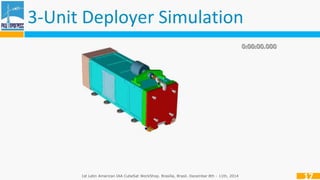
3-Unit Deployer Simulation 
1st Latin American IAA CubeSat WorkShop. BrasΓ­lia, Brasil. December 8th - 11th, 2014 
17
Installation
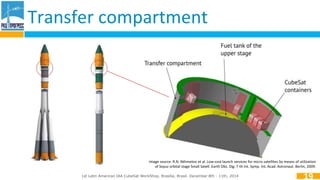
Transfer compartment 
Image source: R.N. Akhmetov et al. Low-cost launch services for micro satellites by means of utilization 
of Soyuz orbital stage Small Satell. Earth Obs. Dig. 7-th Int. Symp. Int. Acad. Astronaut. Berlin, 2009. 
1st Latin American IAA CubeSat WorkShop. BrasΓ­lia, Brasil. December 8th - 11th, 2014 
19
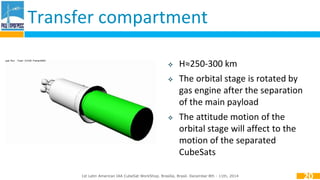
Transfer compartment 
 Hβ‰ˆ250-300 km 
 The orbital stage is rotated by 
gas engine after the separation 
of the main payload 
 The attitude motion of the 
orbital stage will affect to the 
motion of the separated 
CubeSats 
1st Latin American IAA CubeSat WorkShop. BrasΓ­lia, Brasil. December 8th - 11th, 2014 
20
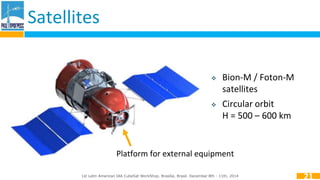
Satellites 
 Bion-M / Foton-M 
satellites 
 Circular orbit 
H = 500 – 600 km 
1st Latin American IAA CubeSat WorkShop. BrasΓ­lia, Brasil. December 8th - 11th, 2014 
21 
Platform for external equipment
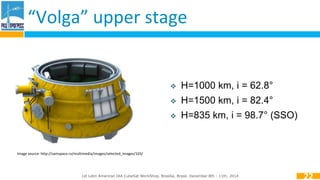
β€œVolga” upper stage 
 H=1000 km, i = 62.8° 
 H=1500 km, i = 82.4° 
 H=835 km, i = 98.7° (SSO) 
1st Latin American IAA CubeSat WorkShop. BrasΓ­lia, Brasil. December 8th - 11th, 2014 
22 
Image source: http://samspace.ru/multimedia/images/selected_images/103/
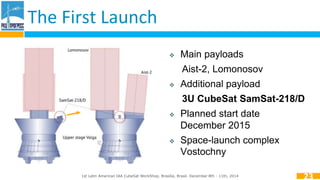
 Main payloads 
Aist-2, Lomonosov 
 Additional payload 
3U CubeSat SamSat-218/D 
 Planned start date 
December 2015 
 Space-launch complex 
Vostochny 
The First Launch 
1st Latin American IAA CubeSat WorkShop. BrasΓ­lia, Brasil. December 8th - 11th, 2014 
23
Key features of the Deployer 
οƒΌ Modular multiformat design: 1U, 1.5U, 2U, 3U, 3U+ 
οƒΌ Low angular velocities of separated satellites 
οƒΌ High reliability p>0,999 
οƒΌ Temperature sensor 
οƒΌ Separation sensor 
οƒΌ Passive thermal control system 
οƒΌ Adaptation to the SRC space vehicles 
1st Latin American IAA CubeSat WorkShop. BrasΓ­lia, Brasil. December 8th - 11th, 2014 
24
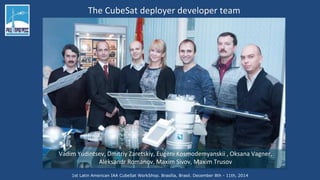
The CubeSat deployer developer team 
Vadim Yudintsev, Dmitriy Zaretskiy, Eugeni Kosmodemyanskii , Oksana Vagner, 
Aleksandr Romanov, Maxim Sivov, Maxim Trusov 
1st Latin American IAA CubeSat WorkShop. BrasΓ­lia, Brasil. December 8th - 11th, 2014
Contacts 
JSC SRC Β«ProgressΒ», 
18, Zemetsa str., Samara, Russia 
Phone: +7 (846) 955-13-61 
Fax: +7 (846) 992-65-18 
e-mail: ved878@samspace.ru 
1st Latin American IAA CubeSat WorkShop. BrasΓ­lia, Brasil. December 8th - 11th, 2014 
http://www.samspace.ru

1U-3U+ Cubesat Deployer by JSC SRC "Progress"

  • 1.
    JSC Space RocketCenter Progress Universal 1U-3U+ CubeSat Deployer Dmitriy Zaretskiy , Eugeni Kosmodemyanskii, Aleksandr Romanov, Maxim Sivov , Maxim Trusov, Vadim Yudintsev 1st Latin American IAA CubeSat WorkShop. BrasΓ­lia, Brasil. December 8th - 11th, 2014 http://www.samspace.ru
  • 2.
    Outline  HistoricalBackground  Mechanical design  Separation dynamics  Installation 1st Latin American IAA CubeSat WorkShop. Brasília, Brasil. December 8th - 11th, 2014 2
  • 3.
    Historical Background AboutSpace Rocket Center Progress
  • 4.
    Historical Background 18962010 1957 1910 1941-1945 2010 2013 2013 1st Latin American IAA CubeSat WorkShop. BrasΓ­lia, Brasil. December 8th - 11th, 2014 4
  • 5.
    Launch service 1stLatin American IAA CubeSat WorkShop. BrasΓ­lia, Brasil. December 8th - 11th, 2014 5 Mars-Express (ESA) Resurs-P (Russia) Pleyades (ESA) Gaia (ESA) Over 1800 manned and unmanned launches of the Soyuz rocket since 1967 More than 90 launches of spacecraft were performed since 1999 under the agreement with Obzor-R (Russia) 2015 foreign customers.
  • 6.
    Bion-M with piggybacksatellites  Bion-M is a large spacecraft for research in the field of space biology and medicine.  Launch of Bion-M β„– 1 was performed in 2013.  Aist spacecraft and five foreign small satellites of CubeSat type were used as a piggyback payload. 1st Latin American IAA CubeSat WorkShop. BrasΓ­lia, Brasil. December 8th - 11th, 2014 6 Image source: http://samspace.ru/multimedia/images/selected_images/142/
  • 7.
  • 8.
     Multi-interface (satellitesor orbital stages)  Reliable and proven components  Experimental validation  No debris Design Principles 1st Latin American IAA CubeSat WorkShop. Brasília, Brasil. December 8th - 11th, 2014 8
  • 9.
    Modular design Door module  Hinges, latches, hold down and release mechanism  Base module  Guide rails  Separation spring module  Separation spring, platform with guide rails 1st Latin American IAA CubeSat WorkShop. Brasília, Brasil. December 8th - 11th, 2014 9
  • 10.
    Multi-format 1st LatinAmerican IAA CubeSat WorkShop. Brasília, Brasil. December 8th - 11th, 2014 10 1U 2U 3U, 3U+  Modular design allows to build deployers for various CubeSat form-factors  Set of separation springs is developed to separate satellites at a speed from 0.5 to 0.8 m/s
  • 11.
    Sensors  Theseparation sensor detects the separation of the CubeSat from the platform  The temperature sensor measures the temperature inside the base module. All the surfaces of the deployer are wrapped by a multi-layer Insulation 1st Latin American IAA CubeSat WorkShop. Brasília, Brasil. December 8th - 11th, 2014 11
  • 12.
    CubeSat Requirements Form factors:  1U, 1.5U  2U  3U, 3U+  Standard CubeSat requirements* 1st Latin American IAA CubeSat WorkShop. Brasília, Brasil. December 8th - 11th, 2014 12 *Munakata, Riki. "Cubesat design specification rev. 13." The CubeSat Program, California Polytechnic State University 1 (2009).
  • 13.
  • 14.
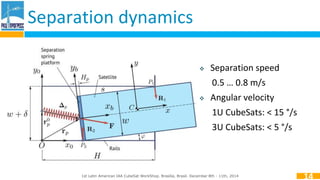
    Separation dynamics Separation speed 0.5 … 0.8 m/s  Angular velocity 1U CubeSats: < 15 Β°/s 3U CubeSats: < 5 Β°/s 1st Latin American IAA CubeSat WorkShop. BrasΓ­lia, Brasil. December 8th - 11th, 2014 14
  • 15.
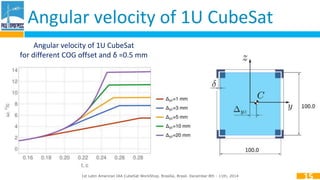
    Angular velocity of1U CubeSat Angular velocity of 1U CubeSat for different COG offset and Ξ΄ =0.5 mm 1st Latin American IAA CubeSat WorkShop. BrasΓ­lia, Brasil. December 8th - 11th, 2014 15
  • 16.
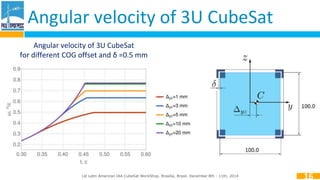
    Angular velocity of3U CubeSat 1st Latin American IAA CubeSat WorkShop. BrasΓ­lia, Brasil. December 8th - 11th, 2014 16 Angular velocity of 3U CubeSat for different COG offset and Ξ΄ =0.5 mm
  • 17.
    3-Unit Deployer Simulation 1st Latin American IAA CubeSat WorkShop. BrasΓ­lia, Brasil. December 8th - 11th, 2014 17
  • 18.
  • 19.
    Transfer compartment Imagesource: R.N. Akhmetov et al. Low-cost launch services for micro satellites by means of utilization of Soyuz orbital stage Small Satell. Earth Obs. Dig. 7-th Int. Symp. Int. Acad. Astronaut. Berlin, 2009. 1st Latin American IAA CubeSat WorkShop. BrasΓ­lia, Brasil. December 8th - 11th, 2014 19
  • 20.
    Transfer compartment Hβ‰ˆ250-300 km  The orbital stage is rotated by gas engine after the separation of the main payload  The attitude motion of the orbital stage will affect to the motion of the separated CubeSats 1st Latin American IAA CubeSat WorkShop. BrasΓ­lia, Brasil. December 8th - 11th, 2014 20
  • 21.
    Satellites  Bion-M/ Foton-M satellites  Circular orbit H = 500 – 600 km 1st Latin American IAA CubeSat WorkShop. BrasΓ­lia, Brasil. December 8th - 11th, 2014 21 Platform for external equipment
  • 22.
    β€œVolga” upper stage  H=1000 km, i = 62.8Β°  H=1500 km, i = 82.4Β°  H=835 km, i = 98.7Β° (SSO) 1st Latin American IAA CubeSat WorkShop. BrasΓ­lia, Brasil. December 8th - 11th, 2014 22 Image source: http://samspace.ru/multimedia/images/selected_images/103/
  • 23.
     Main payloads Aist-2, Lomonosov  Additional payload 3U CubeSat SamSat-218/D  Planned start date December 2015  Space-launch complex Vostochny The First Launch 1st Latin American IAA CubeSat WorkShop. Brasília, Brasil. December 8th - 11th, 2014 23
  • 24.
    Key features ofthe Deployer οƒΌ Modular multiformat design: 1U, 1.5U, 2U, 3U, 3U+ οƒΌ Low angular velocities of separated satellites οƒΌ High reliability p>0,999 οƒΌ Temperature sensor οƒΌ Separation sensor οƒΌ Passive thermal control system οƒΌ Adaptation to the SRC space vehicles 1st Latin American IAA CubeSat WorkShop. BrasΓ­lia, Brasil. December 8th - 11th, 2014 24
  • 25.
    The CubeSat deployerdeveloper team Vadim Yudintsev, Dmitriy Zaretskiy, Eugeni Kosmodemyanskii , Oksana Vagner, Aleksandr Romanov, Maxim Sivov, Maxim Trusov 1st Latin American IAA CubeSat WorkShop. BrasΓ­lia, Brasil. December 8th - 11th, 2014
  • 26.
    Contacts JSC SRCΒ«ProgressΒ», 18, Zemetsa str., Samara, Russia Phone: +7 (846) 955-13-61 Fax: +7 (846) 992-65-18 e-mail: ved878@samspace.ru 1st Latin American IAA CubeSat WorkShop. BrasΓ­lia, Brasil. December 8th - 11th, 2014 http://www.samspace.ru

Editor's Notes

  • #2Β Good morning, Ladies and Gentlemen! My name is Vadim Yudintsev. I represent Space Rocket Center β€œProgress”. In this presentation I’d like to focus on recent developments in our CubeSats Deployer Project.
  • #3Β My talk is divided into 4 parts and will last about 10 minutes. I'll start with a brief history of our company. Then I'll go on to the CubeSat deployer design. Next I'll talk a few words about the separation dynamics of CubeSats and finally I'll take a look at the installation of the deployer on launch vehicles. At the end of my presentation I will distribute some handouts and reply to questions that you may have.
  • #4Β Let me start by telling you a brief history of our company. Β 
  • #5Β Space Rocket Center β€œProgress” was established more than a century ago as a factory that produced bicycles. Ten years later it built cars and airplanes. Β  During World War II the factory was evacuated from Moscow to Samara and renamed to State Aviation Plant. More than 10,000 legendary ground attack aircrafts IL-2 were produced in those years. Β  The "Space" history of our company started in 1959. In this year our R-7 rocket was launched. This rocket is an ancestor of the well known Soyuz family rockets. Β 
  • #6Β Soyuz family rockets are used to launch satellites and manned spacecraft. The Soyuz rocket is the launch vehicle most frequently used in the world. More than 12 launches are performed every year. Soyuz family rockets are launched from 3 launch sites: Baikonur, Plesetsk, French Guiana. In 2015 an upgraded Soyuz-2 rocket will be launched from a new cosmodrome β€œVostochny”. We think that this launch capability can be used more effectively particularly for educational purposes.
  • #7Β In 2013 a small satellite Aist and five CubeSats were successfully separated from the Bion-M satellite. At this picture you can see the Bion-M satellite and the platform for external equipment that carries five CubeSats. For that launch the control logic of the satellite was specially adapted to ISIPOD and FlyMate CubeSat deployers. We enjoyed this experience and decided to develop our CubeSat deployer for effective cooperation with educational institutions and research groups.
  • #8Β Well, what I’m going to do now is to point out the main principles of the deployer’s design: -Β the deployer must interface with a variety of our launch vehicles with no changes to the CubeSat specifications; - only reliable, proven and possibly low cost components should be used; - all new mechanisms have to be validated through laboratory experiments; - the deployer does not have to produce any debris.
  • #9Β -Β the deployer must interface with a variety of our launch vehicles with no changes to the CubeSat specifications; - only reliable, proven and possibly low cost components should be used; - all new mechanisms have to be validated through laboratory experiments; - the deployer does not have to produce any debris. ΠžΡ‚Π²Π΅Ρ‚ Π½Π° Π²ΠΎΠ·ΠΌΠΎΠΆΠ½Ρ‹ΠΉ вопрос ΠΎΠ± устройствС открытия ΠΊΡ€Ρ‹ΡˆΠΊΠΈ. For the first launch in the door hold down and release mechanism reliable low shock pyrotechnic pin-puller will be used, that easily adapted to the interface of our space vehicles.
  • #10Β The deployer consists of three parts or modules: Β  - the base module includes guide rails; Β  -Β the door module includes rotation springs, hinges, a latch and a hold down and release mechanism; Β  - the separation spring module includes a separation spring and a platform base with guide rails. Β 
  • #11Β The modular design allows us to build a customized deployer. At this picture you can see three possible configurations of the CubeSat deployer for 1U, 2U and 3U cubesats.
  • #12Β The deployer includes two sensors. The temperature sensor measures temperature inside the base module. The separation sensor indicates the separation of the CubeSat from the platform. To minimize power loss to, or gain from, the environment a multi Layer Insulation is used to wrap all the deployer’s surfaces.
  • #13Β There are no special requirements for satellites that can be launched using the deployer. But satellites should meet the well known CubeSat Design Specification. Β 
  • #14Β Now, I’d like to describe the CubeSat separation process.
  • #15Β As you know small satellites often use passive stabilization system: gravity, aerodynamic, electromagnetic. The effectiveness of these systems depends on the initial conditions of the attitude motion of a satellite. Therefore, particular attention was given to the minimization of the angular velocity of separated satellites. We’ve developed several mathematical models of the separation process. Here is the scheme of one simple model. Β  Preliminary results that will be validated by laboratory experiments show that the angular velocity of a separated Π‘ubeSat will be less than 15 degrees per second.
  • #16Β This figure shows the angular velocity of the 1-U satellite for the various center of mass positions relative to the longitudinal axis of the satellite. For the all cases the angular velocity is less than 15 degrees per second. Β 
  • #17Β Our tentative estimate of the 3U CubeSat angular velocity is even lower than 5 degrees per second. But we expect that the experiments will confirm our optimistic and ambitious estimates that the 3U CubeSat angular velocity will be lower than 1 degree per second. To make this happen, we’ve decreased the minimum gap between the deployer and the satellite guide rails and increased the length of the platform. Moreover, we’ve decreased the stroke of the platform to two-thirds of the length of the deployer (ΠΎΡΡ‚Π°Π²ΠΈΡ‚ΡŒ для вопроса).
  • #18Β Here you can see the simulation of a 3-Unit CubeSat ejection. Β 
  • #19Β The next question is where the deployer can be installed.
  • #20Β The first option is the transfer compartment on the Soyuz family rockets. This picture shows a possible arrangement of the deployers in the transfer compartment. The CubeSats should be separated after the separation of the main payload to avoid the collision. Also non-separated equipment for short-term scientific research can be installed in the transfer compartment. The lifetime of the orbital stage is about several days.
  • #21Β Note that after the separation of the main payload the orbital stage is de-orbited using a thrust nozzle. Here you can see the relative motion of the main payload and the orbital stage. It's obvious that the separation from the rotating orbital stage will cause an increase in the angular velocity of the separated satellites. So satellites that do not need the low angular velocity can be installed in the transfer compartment.
  • #22Β The deployers can be installed as piggyback payload on large satellites. As I said before the Bion-M satellite can be equipped with a platform for small satellite deployers. Here you can see this platform that was used to deploy satellites in 2013.
  • #23Β CubeSats can be ejected from the upper stage Volga after or before the separation of the main payload. The Upper stage Volga can reach a variety of orbits up to 1500 km. The upper stage has high potential to deploy small satellites into orbit. Β 
  • #24Β 3 unit CubeSat SamSat will be separated from the orbital stage Volga using our deployer next year. This CubeSat is developed by students of Samara State Aerospace University. The main objective of this satellite is a demonstration of navigation and control technologies. Β  This CubeSat will be placed in orbit with two other satellites – a small satellite β€œAist-2”, which is designed by the young scientists and students of the Aerospace University in partnership with specialists of the Space Rocket Centre ”Progress” and the β€œLomonosov” satellite made by Moscow State University. Β  In December 2015 these satellites will go into space from the cosmodrome β€œVostochniy”. It will be the first launch from this spaceport. Β 
  • #25Β In conclusion I’d like to summarize the main points of my talk. The presented deployer has a modular multiformat design that allows to eject cubesats from 1U to 3U at low angular velocities. The deployer uses a passive thermal control system and includes two sensors to measure temperature and indicate the separation. The deployer is adapted to the space vehicles of the space rocket center.
  • #26Β Here is our great developer team. So we are interested in cooperation and we hope that our space vehicles will help make the space closer to all of us!
  • #27Β Thank you for your attention! If you have any questions, I’m happy to answer them.